
The loudest advice on the best mud tires for UTV work is to buy the tallest carcass and the deepest lug you can bolt on. That advice treats a side-by-side like a weekend bog toy. On an electric UTV used for hunting, farm lanes, ranch chores, and property work, the tire is an energy decision first. Extra diameter changes gearing. Extra width and lug depth add drag. Extra casing weight adds rotating mass the motor has to spin every time you leave a stop.
A tire that packs with clay will spin, and that spin spends battery without moving the machine. A tire that clears mud but howls on gravel will do the same thing steadily, mile after mile of hardpack. I would not start with the most aggressive pattern on the rack. I would start with the share of hours you spend in deep mud, then prove the choice on one loop of your own ground.
Table of Contents
- Quick-Pick Mud Tires by Terrain and Use
- Tread Patterns That Clear Deep Mud
- Sidewall Construction and Ply Ratings
- Fitment, Clearance and Load Checks Before You Buy
- How to Set Pressure and Mount Mud Tires
- Range, Route Testing and Final Buying Decision
Quick-Pick Mud Tires by Terrain and Use
The deepest lug is not automatically the right mud tire for an electric UTV that hunts, hauls feed, and runs ranch roads. Match the pattern to the hours, not to the worst hole you hit once a season.
| Use case | Tread profile | Depth band | Ply rating | Typical use |
|---|---|---|---|---|
| Deep mud and swamp | Open voids, directional or paddle lugs | Above 1 inch | 8 or 10 | Sustained bogs and deep ruts |
| Mixed mud and trail | Moderate mud pattern, staggered lugs | 0.75 to 1 inch | 8 | Hunting, farm lanes, property work |
| Heavy utility and cargo | Tougher casing, moderate tread | 0.75 to 1 inch | 10 | Towing, dump bed loads, rocky ground |
| Hardpack with occasional mud | Tighter pattern | Below 0.75 inch | 6 or 8 | Mostly roads and packed trails |
| Benchmark deep-lug example (Outlaw 2, 29.5-inch) | Scooped tread extending toward the rim | About 1 5/8 inch center | 8 or 10 | Benchmark for deep-mud builds |
The benchmark row is a real deep-mud reference, not a daily driver. High Lifter describes a later 29.5-inch Outlaw 2 with scooped tread, about 1 5/8 inches of center depth and up to 2 3/4 inches at the shoulder, with tread running toward the rim for rut bite. That shape belongs to sustained bog work. On gravel and packed soil it adds rolling resistance, noise, and wear you pay for in watt-hours.
Default pick: a mixed mud-and-trail pattern for most property owners. Staggered, moderate lugs still clear ordinary mud, and the machine stays predictable on gravel and packed lanes where you spend most of the day.
Find the row that matches how often you are in deep mud. The rest of this guide is the reasoning behind each cell: how the tread clears, how the casing survives, whether the tire fits, how you set pressure, and how you measure the range cost before you buy a full set.
Tread Patterns That Clear Deep Mud
Four features decide whether a tire keeps biting after the first spin or turns into a slick cylinder of packed clay.
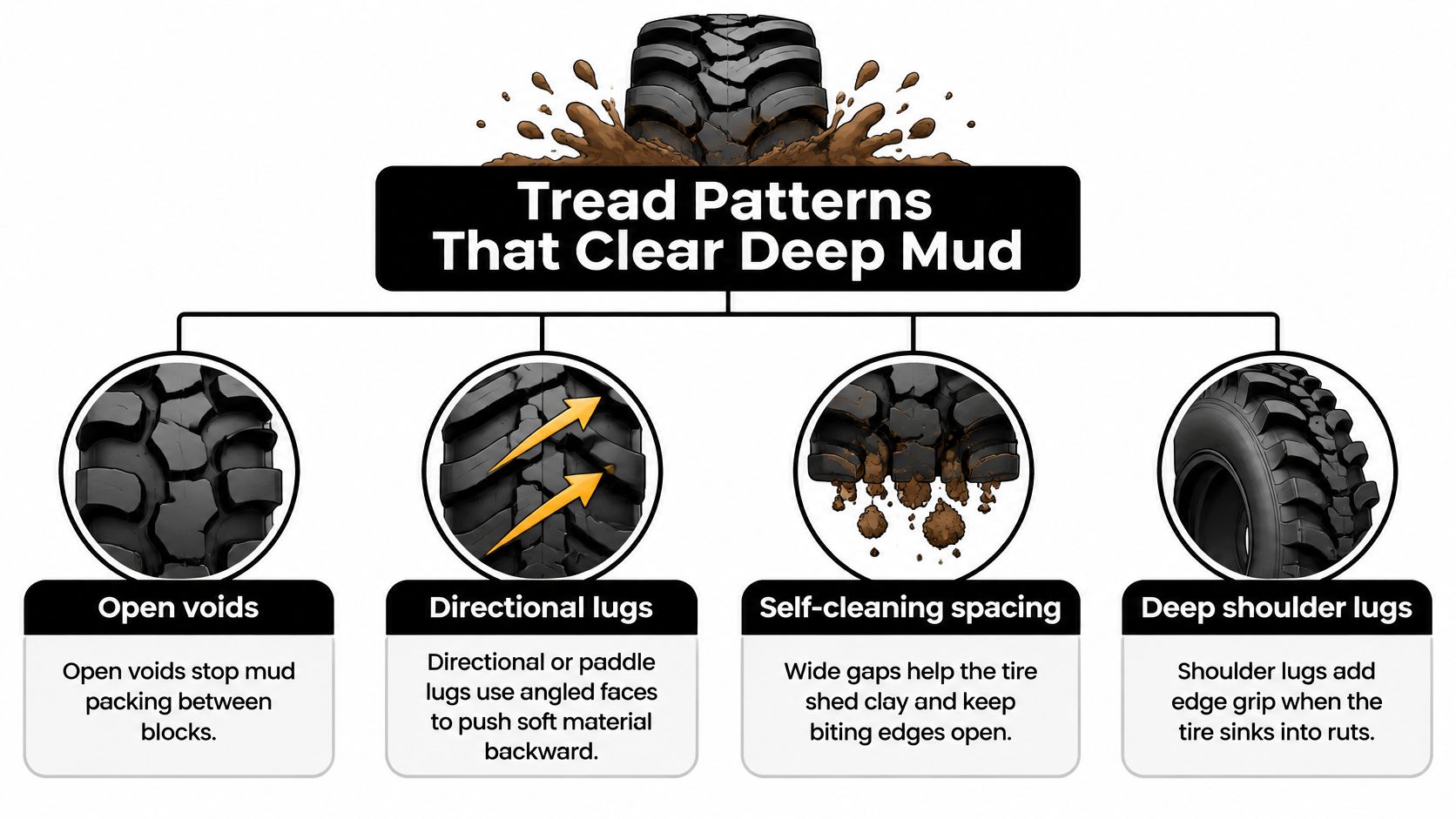
Catech USA puts the priorities for deep mud in a clear order: open voids, directional or paddle-style lugs, aggressive shoulder bite, and reinforced construction.
Open voids are the gaps between blocks. If those gaps are tight, clay packs solid and the next rotation has no edge left. You feel it as sudden wheelspin with almost no forward creep.
Directional or paddle lugs use an angled face. The face shoves soft material backward, and that shove is the forward thrust. A non-directional block can still grip a rut, but it does less paddling when the tire is half buried.
Shoulder bite is what holds the sidewall of a rut while you climb out. If the shoulder is rounded, the tire climbs, slips sideways, and drops back into the same track.
Reinforced construction keeps that shape under a sustained bog load instead of folding the carcass.
A narrower casing can cut down to firmer ground instead of floating on the slurry. Wide flotation helps on a soft pasture. In a deep, narrow bog it can keep the lugs up in the soup.
What the rider actually feels
Low-speed torque on an electric UTV will overwhelm a tire that cannot self-clean. The motor keeps pulling, the tire spins, and the battery spends energy heating mud instead of moving mass. Deep lugs can fix that in a hole and then punish you on the road home. They raise rolling resistance, steering effort, noise, and hard-surface wear.
Pressure is part of the same decision. For muddy ground, drop about 1 to 3 psi below your normal cold setting, and never go under the tire or vehicle minimum. That small change grows the patch without asking the bead to do something it was not built for.
Screening rule: published lug depth and tread layout tell you which tires are worth a test. They do not prove traction or life on your clay. Confirm with a controlled comparison, or with owner reports from ground that matches yours.
Use the depth bands in the quick-pick table as the screen. Above an inch of lug is bog equipment. The mixed band is the working tire. A competition-only paddle is the wrong default for hunting, farming, ranching, and property routes that still include gravel, pavement, and packed soil.
Sidewall Construction and Ply Ratings
Puncture risk should pick the casing before lug height picks the tread. An 8-ply or 10-ply radial is the defensible choice when you regularly meet roots, rocks, brush, and scrap. A lighter 6-ply cuts unsprung and rotating mass, and it gives you less casing left after the first deep cut.
Tire Verdict describes 8-ply and 10-ply construction as a balance of puncture resistance and ride comfort. Reviewed UTV tires in that guide span roughly 0.75 to 1.25 inches of tread depth by size, so ply and depth have to be chosen as a pair, not as separate shopping filters.
| Ply rating | Puncture resistance | Weight and ride | Best fit |
|---|---|---|---|
| 6-ply | Lower casing reserve | Lightest, least rotating mass | Light use, low puncture exposure |
| 8-ply | Balanced reserve | Moderate weight | Mixed farm, hunting and property |
| 10-ply | Highest reserve | Heaviest, firmer ride | Rocky, brush, construction, high puncture exposure |
Where each casing belongs
Brush lines, rocky creek beds, fence wire, and construction scraps favor the 10-ply. You are buying reserve so a single cut does not end the day. Mixed farm and hunting ground, with some rock and a lot of lane miles, suits an 8-ply radial hybrid. Light use on ground you already know is clean can live with a 6-ply, and the motor will notice the lower rotating mass.
On an electric UTV, less unsprung mass helps the suspension follow ruts and can trim energy demand a little. Going taller or wider does the opposite: more drivetrain load, less acceleration, a thinner hill-climbing margin, and less range. That is why a heavy 10-ply on a much larger diameter is a double penalty, not a free upgrade in toughness.
Lower pressure only works if the sidewall was built for it. A soft sidewall at a pressure the casing cannot support raises pinch risk. Compare the tire's maximum load at its stated pressure with your axle loads, check offset and clearance at full steering lock, and treat the maker's cold pressure as the baseline.
If you keep fixing flats, buy ply first and tread second. A deep lug on a thin casing still dies on the first sharp root.
For mixed surfaces, an 8-ply hybrid or a moderate mud tire is the practical buy. Save the high-void, inch-plus designs for sustained bogs and deep ruts, where self-cleaning matters more than how the tire behaves on the lane.
Fitment, Clearance and Load Checks Before You Buy
Run this list before you order. A great tread on the wrong wheel is still the wrong tire.
- Confirm outside diameter at full travel. The tire has to clear suspension parts and the frame when the suspension is compressed, not just when the machine is sitting still in the shop.
- Match front and rear width to the wheel, then check offset. A wider tire on a stock wheel changes the contact patch and can pull the sidewall into the arm at lock.
- Turn the wheel to full lock with the largest tire you plan to run. Rub here cuts sidewalls and loads steering parts every time you turn around in a gate.
- Compare rated load with real per-wheel load. Count the driver, passengers, tools, feed or game, and trailer tongue weight. An overloaded tire fails first on rock or in a deep rut, not on the driveway.
- Keep cold inflation inside the vehicle window. The tire's range and the vehicle's approved range both have to be true at the same time.
- Match the depth band to the ground you ride most. Bog depth on a hardpack route only buys drag.
Carcody's fitment guide is direct about priorities: open voids, lug depth, casing strength, and correct load capacity, not a generic ranking. It treats deep tread above 1 inch as the mud category and medium tread from 0.75 to 1 inch as the mixed-terrain category. One reviewed mud tire in that guide uses about 1.26-inch lugs and a wide-open pattern meant to eject mud from the patch. Those figures are a screen. Tire dimensions alone do not prove traction or service life.
The Campus E1 uses on-demand 2WD and 4WD plus a locking rear differential, so the tire has to match sizes the drivetrain and clearance were approved for. When you are unsure, stay inside those sizes. Our side-by-side tire size comparison is the place to line sizes up before you order, and genuine tires and related parts are sold on our site when you are ready to match a verified fit.
A tire that rubs at full lock damages the sidewall and the steering path. An overloaded tire is the one that fails when the ground gets rocky or deep. Treat the checklist as a screen, not a verdict, and still confirm lug layout against a real test on your ground.
How to Set Pressure and Mount Mud Tires
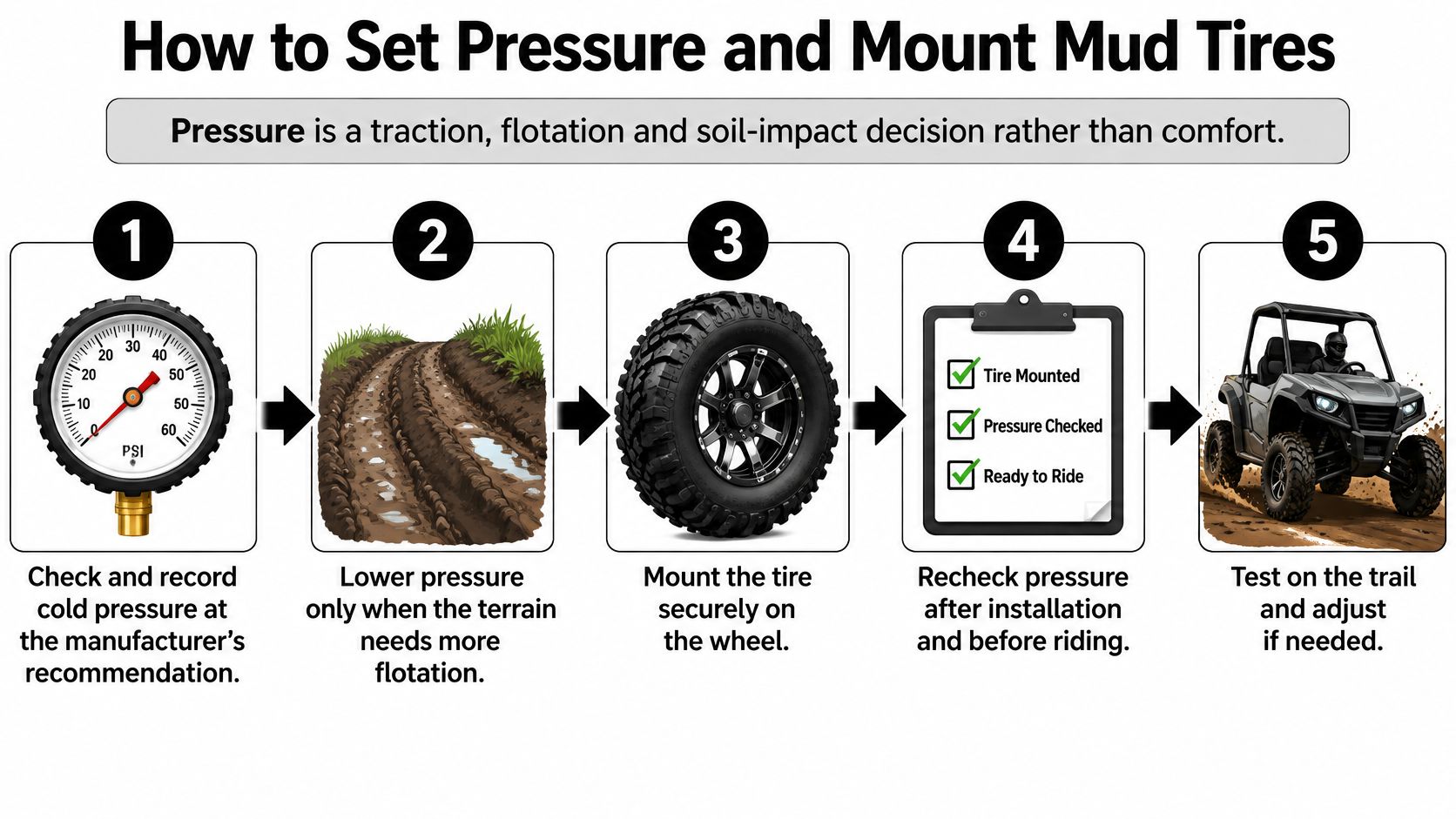
A mud tire can gain bite when aired down, but the right pressure depends on the load and the ground. For an electric UTV, that choice also affects energy use: more tire flex and rolling drag can reduce the distance you get from a charge.
Start at the vehicle and tire makers' cold-pressure guidance, then make small changes for the surface. Lower pressure can widen the contact patch and help the tire float on soft ground. Too much reduction can make steering vague and increase the risk of bead problems. A wider tire may float better, but can also make steering heavier or rub at full lock.
- Record cold pressure at the manufacturer's recommended baseline before making changes. Check before driving, since heat raises pressure.
- Identify the route surface: deep mud, wet pasture, or hardpack.
- For deep mud, adjust in small steps and stay at or above the tire and vehicle minimum.
- Mount directional tires with the arrow pointing in the direction of rotation.
- Tighten lug nuts to the wheel maker's specification, using a star pattern.
- Recheck pressure after the first run. Restore the recommended pressure before extended hardpack travel.
| Condition | Starting point | Pressure adjustment | Limit to respect |
|---|---|---|---|
| Deep mud and bog | Manufacturer cold pressure | Small reductions, checking traction and steering after each change | Stay at or above the tire and vehicle minimum |
| Wet pasture | Manufacturer cold pressure | Reduce only as needed for flotation | Stop if ruts deepen or turf tears |
| Hardpack access road | Manufacturer cold pressure | Return to the recommended pressure | Watch for heavy steering |
If the pasture starts rutting or the turf tears, add pressure or change your line. On hardpack, heavy steering is a cue to restore the recommended pressure. Keep a short route log of payload, tire temperature, rut depth, wheel slip, and energy use so you can compare pressure settings on the same ground.
Carry a tire gauge and water on UTV outings. The essential gear for overlanding trips can help with general trip packing, while this off-road essentials checklist covers useful equipment to bring along.
Range, Route Testing and Final Buying Decision
Tall mud tires are sold as clearance. The gearing math is less flattering. Motorcycle, ATV and UTV specs notes that a 2-inch diameter increase gives only about 1 inch of theoretical clearance, while it reduces mechanical advantage and raises the load required to turn the tire. You also add rotating mass, which dulls low-speed response. On a belt-driven gas machine that mass shows up as belt heat. On an electric side-by-side the same mass shows up as range, hill-climbing consistency, motor heat margin, and how cleanly the tire hooks at walking speed.
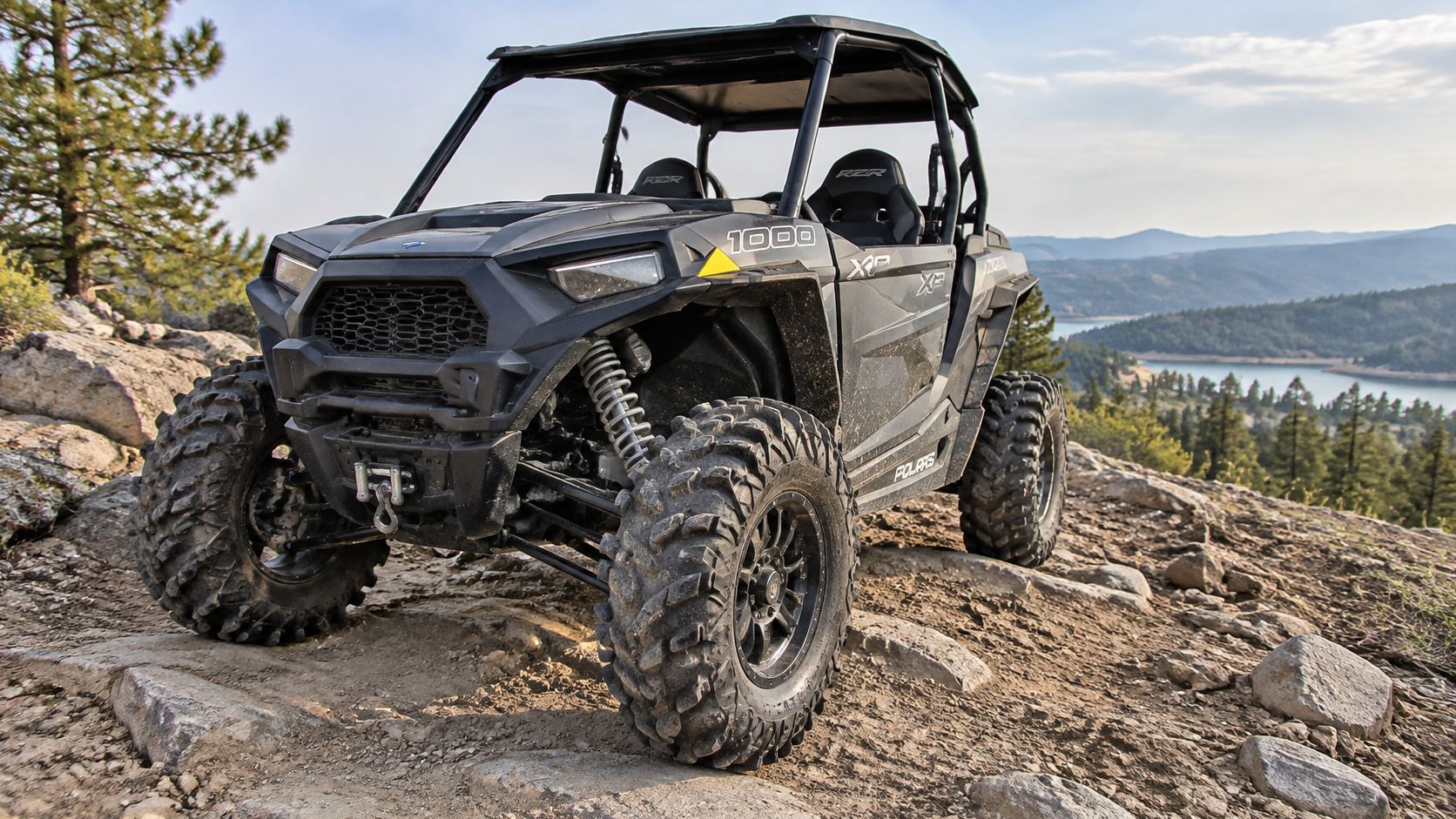
Compare options by weight, diameter, width, rolling resistance, and operating load. Tread aggression alone does not tell you what the pack will do.
| Change | Mechanical effect | Range impact | Test to run |
|---|---|---|---|
| Taller tire, about 2 inches more diameter | Lower effective gearing; about 1 inch of added clearance | Less hill-climb margin and acceleration | Same-route range test before and after |
| Wider tread | Higher drag and steering effort | More energy per mile as drag rises | Check steering at full lock first |
| Deeper aggressive lugs | Higher rolling resistance and noise | Energy use increases on hardpack | Compare energy use on hardpack loop |
| Heavier 10-ply casing | More rotating mass | Slower low-speed response and extra energy to spin the mass | Measure range with the same payload |
Run one loop, then change one thing
Pick a loop you already drive: a muddy gate, a pasture crossing, a hill, and a hardpack lane back to the shed. Hold payload, cold pressure from your log, and temperature band constant. Record range or energy used, and note where the tire spins. Change one variable. Repeat the loop. If you change height, width, and ply in the same swap, you will not know which one ate the miles.
The Campus E1's on-demand 2WD and 4WD and locking rear differential put torque where the tire can use it, which is exactly why a tire that will not clean becomes an energy leak. The same machine tows up to 2,500 lbs and hauls 550 lbs in the electric dump bed. Tongue weight and a full bed raise the load each tire must roll. A heavy, tall mud tire on top of that load costs more energy than the same tire on an empty hunting loop. If you want the operating side of that trade, our notes on how to improve efficiency sit next to this test, not instead of it.
After a bog loop, clay in the bead and on the brakes hides the next problem. A careful wash, the way SwiftJet's car power washing guide walks through for a car, keeps you from blasting a seal or driving the next test with a packed tread you think is "just how the tire is."
What I would buy, in order
A moderate-height, self-cleaning tire is the right default for mixed farm, hunting, and property use. Extreme-height mud tires are for riders who have already accepted lower efficiency and altered gearing.
- Hunting with real swamp access starts on the deep-mud row: open, directional, above an inch, 8- or 10-ply.
- Farm, ranch, and property work stays on the mixed row, 0.75 to 1 inch and 8-ply, and moves to 10-ply only after you count punctures, not before.
- Towing and dump-bed days start with per-wheel rated load. If the casing cannot carry the tongue and the bed, the tread never gets a vote.
Before you pay for four tires, confirm the depth band, the ply, the fitment checks, and a pressure log you will keep. Order one approved size, run the same route twice, and only then change the setup.
A same-route test on your ground beats any tread contest written for a different machine.
Campus EV builds the Campus E1 for hunting, farming, ranching, and property work, with on-demand four-wheel drive, a locking rear differential, and a dump bed sized for real loads. Tire choice is part of how far that pack goes between charges, so match the tread to your ground before you spend the battery on the wrong lug. See the electric side-by-side and the fitment details at Campus EV.