
The most popular advice for finding the cheapest side by side UTV is also the least useful. Sort by price, pick the lowest number that still looks like a real machine, and call the difference savings. That shortcut treats a work vehicle like a commodity, as if traction, payload, charging access, and five years of cash out were footnotes.
They're not. A side-by-side that can't climb your wet grade, finish your longest loop, or charge where it parks isn't cheap at any price. It's a second purchase waiting to happen, plus the truck trips, rental days, and abandoned chores in between.
Judge these machines differently. The winner is the lowest price per usable work mile on your ground, over five years, for your duty cycle. Sometimes that's the lowest sticker in the listings. Often it isn't, and the gap usually shows up in places the ad never priced.
Table of Contents
- Lowest 2026 Side-by-Side Prices and What They Leave Out
- Five-Year Cash That the Sticker Leaves Out
- Whether Claimed Range Finishes the Workday
- New, Used, and the Loan Between Them
- Jobs Where a Cheap UTV Holds Up
- Choose the Lowest Cost Tool for Your Ground
Lowest 2026 Side-by-Side Prices and What They Leave Out
The lowest advertised price may buy the least useful machine for your ground. Compare the listings first, then check what each price and performance claim really includes.
Lowest advertised electric side-by-sides in 2026 listings
| Model | Advertised price | Drive and seats | Claimed range | Disclosed battery or payload | Listing gaps |
|---|---|---|---|---|---|
| TrailMaster Taurus 50EV | $8,349 | 2WD, four seats | 48 miles | Not disclosed in listing | Battery kWh, payload, speed, charge time, test method |
| LLAMA Apex | $12,499 | Drive not stated in listing | 62 miles | 72 V 100 Ah, about 7.2 kWh, 34 mph, 2,200 lb payload | Charge power, charge time, battery warranty, thermal management |
| Affordable 2026 band | About $8,000 to $14,000 | 2WD and 4WD options, two to four seats | Model-specific claim | Often unpublished | Destination, checkout, insurance, charging gear |
The MotoBuys 2026 side-by-side comparison listing puts the TrailMaster Taurus 50EV at $8,349, with four seats, electric propulsion, 2WD, and a claimed 48-mile range. That range is approximately 23% lower than the 62-mile figure listed for the LLAMA Apex. Neither figure includes disclosed test conditions, so the difference is a listing comparison, not a prediction of how far either machine will travel on your route.
The LLAMA Apex product listing advertises a price of $12,499, a 72 V, 100 Ah lithium-ion battery, a claimed 62-mile range, a 34 mph top speed, a 2,200 lb payload, and 110 to 240 V AC charging input. Its battery capacity works out to roughly 7.2 kWh. Dividing that by the claimed range gives about 116 Wh per claimed mile, a rough calculation rather than a measured result. Terrain, load, temperature, and tire pressure affect actual range.
What the Cells Cannot Tell You
The listings do not provide a common basis for judging cost or work capacity. The Taurus listing omits battery capacity; both leave out charger amperage and charge time. Battery warranty, thermal management, destination charges, and checkout fees are also missing. A range claim without a test method is difficult to apply to a particular job.
Electric utility vehicles remain a small share of North American UTV sales. Listings are consequently thinner, and specifications less standardized, than buyers may find among more established options. That makes missing details a buying constraint: without comparable battery, charging, and fee information, a low sticker cannot establish the lower five-year cost.
Screening rule: Rank machines by price per usable work mile. A mile that cannot handle your mud, grade, or load does not count.
The $8,349 2WD machine may suit flat ground and light hauling. Its low price alone does not establish suitability for hills, mud, snow, or towing. Those jobs depend on whether the machine can complete the work, and whether its range and charging fit the duty cycle.
Five-Year Cash That the Sticker Leaves Out
A sticker tells you what leaves your account on day one. Ownership tells you what leaves over five years, and those two rankings swap more often than dealers admit.
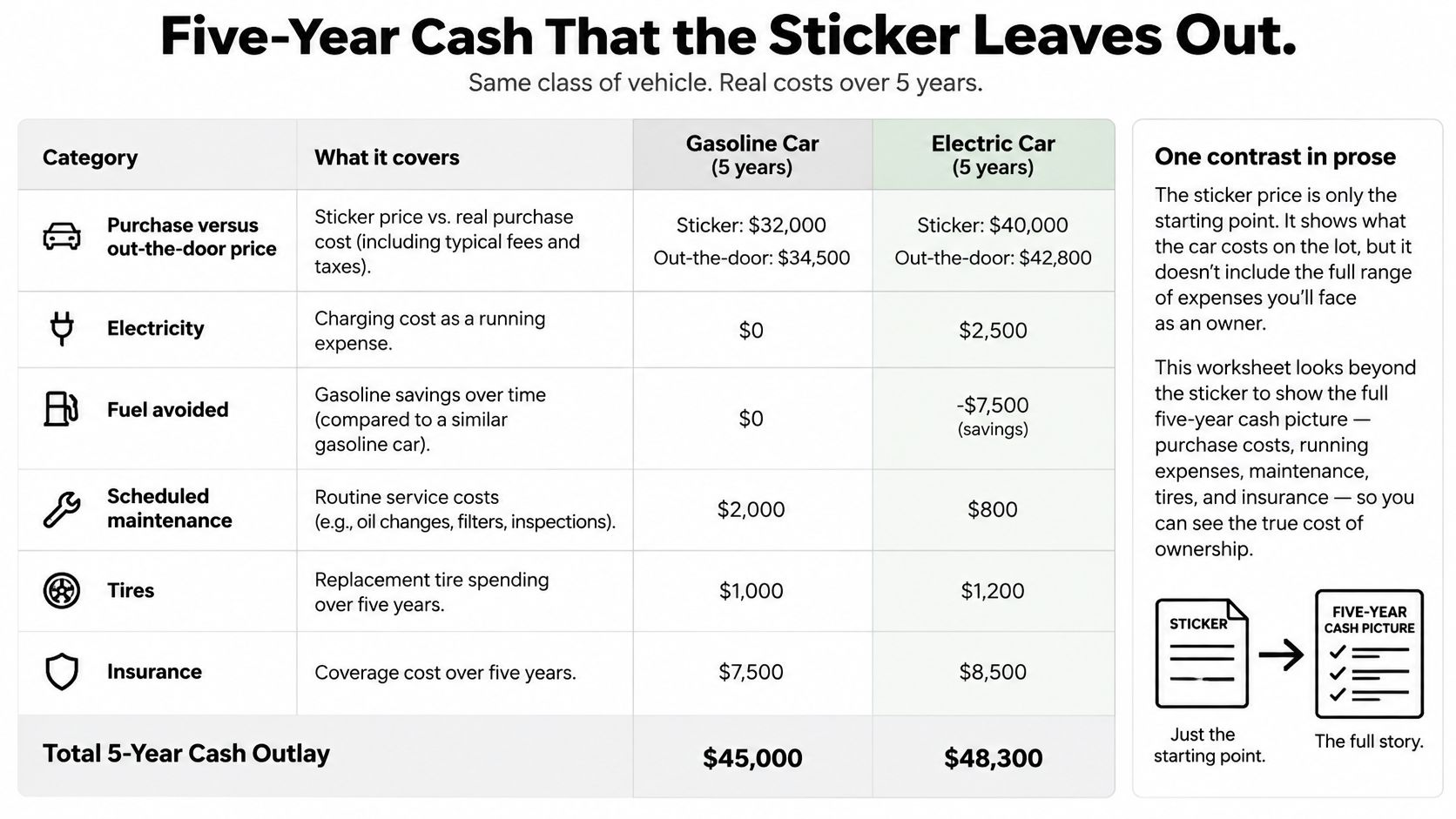
Five-year lowest-total-cost worksheet
| Cost line | What to enter | Planning range | When it flips the winner |
|---|---|---|---|
| Purchase and fees | Advertised price plus destination and checkout | About $8,000 to $14,000 before fees | Fees larger than the sticker gap |
| Charging installation | Outlet already present, or new circuit and panel work | $0 on an existing outlet, or about $1,900 to $12,100 | Electrical work exceeds the vehicle price gap |
| Energy and fuel avoided | Annual kWh or gallons times local price | Your own rate and hours | Daily short trips, not rare weekend use |
| Maintenance, tires, insurance, registration | Local quotes and tire count for the terrain | Quoted by state and surface | Soft ground or public-road use |
| Financing interest | APR, term, and cash down, totaled not monthly | Interest over the full term | A cheap loan on a higher price beats a high APR on a lower price |
| Accessories and battery reserve | Bed, light, winch, and a future pack quote | Budget separately from MSRP | A bare ad that needs a second purchase immediately |
Coverage summarized by Edge Performance Sports in its affordable side-by-side reviews puts affordable 2026 models at roughly $8,000 to $14,000, while noting listings often omit destination charges, financing, insurance, registration, accessories, and battery replacement exposure. The same source places a complete charging installation at anywhere from $1,900 to $12,100 depending on equipment, wiring, permits, and site conditions.
One Contrast That Changes the Ranking
Say you buy the $8,349 2WD unit, then discover the barn panel needs an upgrade before you can charge reliably. Add tires chewed up on ground the drivetrain wasn't built for, plus a borrowed or rented second vehicle for the hill work it can't do. Your five-year total now carries an electrical bill, a capability gap, and the original purchase.
Compare a pricier 4WD electric that plugs into an outlet already on the barn wall and replaces daily short gas trips. It has no installation line, no second-vehicle line, and a fuel-avoided line that grows every week. Even with a higher starting number, it can finish five years cheaper because the expensive surprises never happen.
The MA Hydraulics guide to lifetime costs makes the same structural point for equipment generally: purchase price is only one input in total cost of ownership. Apply it carefully here. Fill every worksheet row with a local quote or your own rate before you compare totals, and use our UTV maintenance cost breakdown to sanity-check the service lines you're entering.
Heavy daily use with an outlet already in place favors spending more up front. Very low annual hours, or an electrical upgrade larger than the price gap between machines, favor the cheaper purchase or keeping what you own.
Don't let anyone fill the energy row for you with a national average. Enter your kilowatt-hour rate, your weekly hours, and the gas trips you'd eliminate. If those trips are rare, the savings story collapses, and that's useful to know before you sign.
Whether Claimed Range Finishes the Workday
Range is the number buyers quote and the number workdays ignore. Your loop doesn't care what a brochure achieved on an undisclosed course.
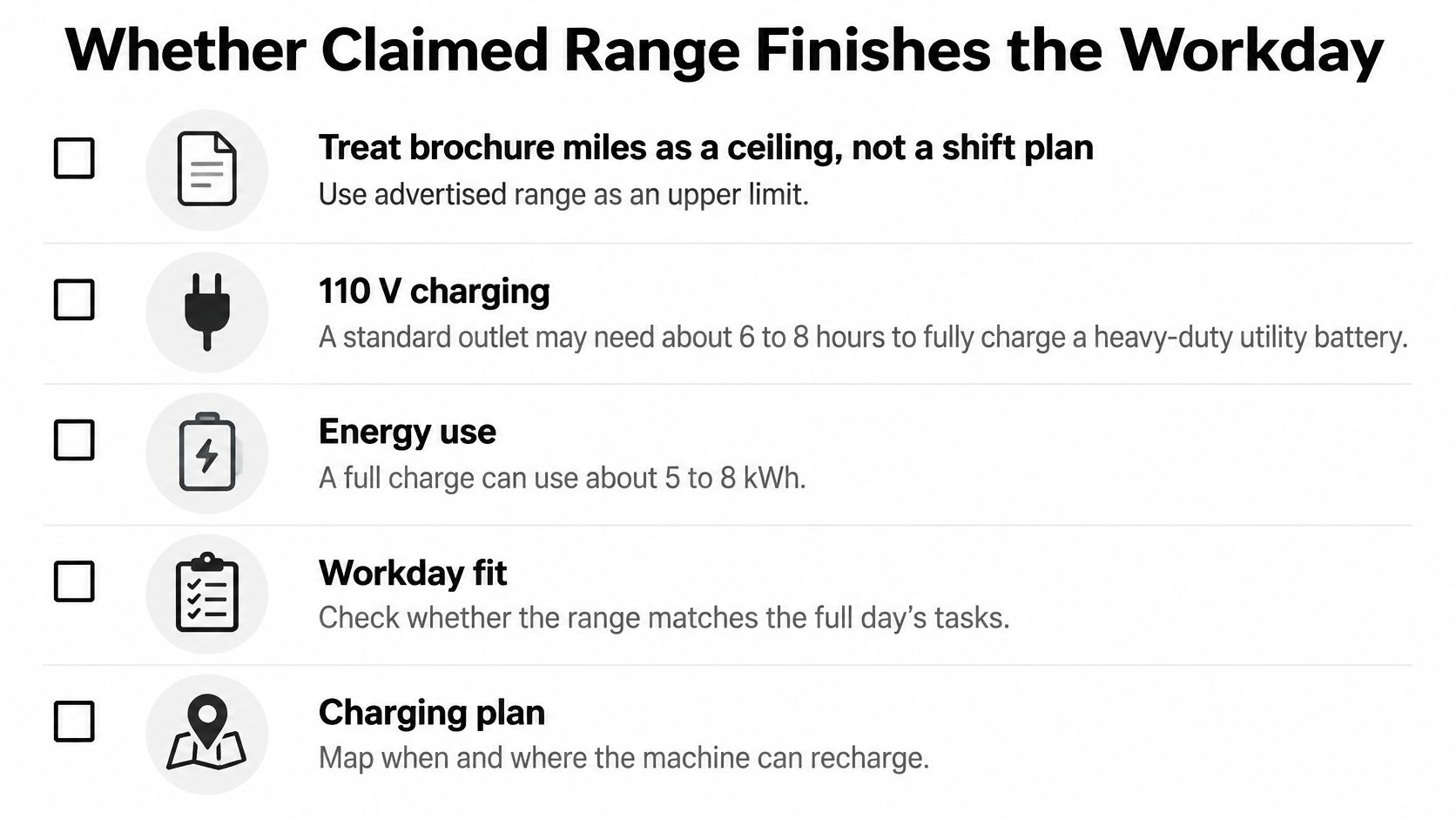
Guidance from the LLAMA home charging cost guide indicates a standard 110V outlet may require about 6 to 8 hours for a heavy-duty utility battery, while a full charge can use approximately 5 to 8 kWh and cost about $1.00 to $1.50 at $0.17/kWh. That's cheap energy, but only if the machine parks near power long enough to take it.
Plan in Three Bands, Not One Number
- Flat, light, mild day: Short loops, little payload, gentle speeds. This is the only band that can sit close to a claimed figure like 48 miles or 62 miles, and you should still hold return miles in reserve.
- Loaded, mixed day: Stop-start hauling, passengers, some grades, soft patches. Plan well under the claim, because repeated launches and weight drain a pack faster than steady cruising.
- Cold, hilly, towing day: Winching, dump-bed cycles, trailer work, low temperatures. Plan a short loop, a midday charge, or a second machine. Don't stretch this band to fit the brochure.
Apply the bands and the two headline claims change meaning. A 48-mile claim might cover a small property's mixed day with margin, while a 62-mile claim might still fail a long hunting property in cold weather with gear aboard. Neither listing states its test conditions, so neither number entitles you to plan a full shift at face value.
The Question That Actually Decides It
Ask whether one overnight charge covers your longest real day, with reserve. If yes, a basic outlet and a modest pack can be the cheapest setup you'll ever run. If no, you're shopping for a midday charging window, faster electrical service, a generator plan, or a spare vehicle, and each option belongs in the five-year worksheet.
Charging access beats theoretical range. A smaller pack that fills every night where the machine sleeps outperforms a bigger claim that depends on infrastructure you don't have.
Before you compare another sticker, walk the property with three measurements. Note the outlet location relative to parking, the charger amps the seller can document, and your longest daily loop in miles and hours. Those three facts sort cheap electrics faster than any advertised maximum.
New, Used, and the Loan Between Them
Ads collapse three separate prices into one. Pull them apart and the cheapest path depends on hours, history, and interest, not just age.
The video below walks through a side-by-side comparison in motion, which helps when you're judging size and layout rather than spec sheets.
A new budget electric buys a known battery, a warranty conversation in writing, and fewer engine and belt items to budget. It doesn't buy uniformity. Seats, 2WD versus 4WD, pack size, and whether a dump bed or winch is included still vary enough to change what the machine can do on Monday morning.
Used Machines Need Two Different Screens
A used gas side-by-side can undercut new stickers and make sense when annual hours are low. Price it fairly, with belts, fluids, filters, and fuel carried across the same five years you'd give an electric. Low hours shrink the electric advantage, so a documented gas machine can win without apology.
Used electrics deserve a harder screen, which is why browsing used electric UTV listings with a checklist in hand beats chasing the lowest ad. Ask for these before you travel:
- Battery history: Cycle count or health data, plus a written replacement-pack price.
- Charger included: Confirm it works, matches the pack, and comes with the sale.
- Frame and wiring: Look for corrosion, pinched harnesses, and amateur splices near the controller.
- Title and paperwork: Clean title, matching serial numbers, any remaining warranty in writing.
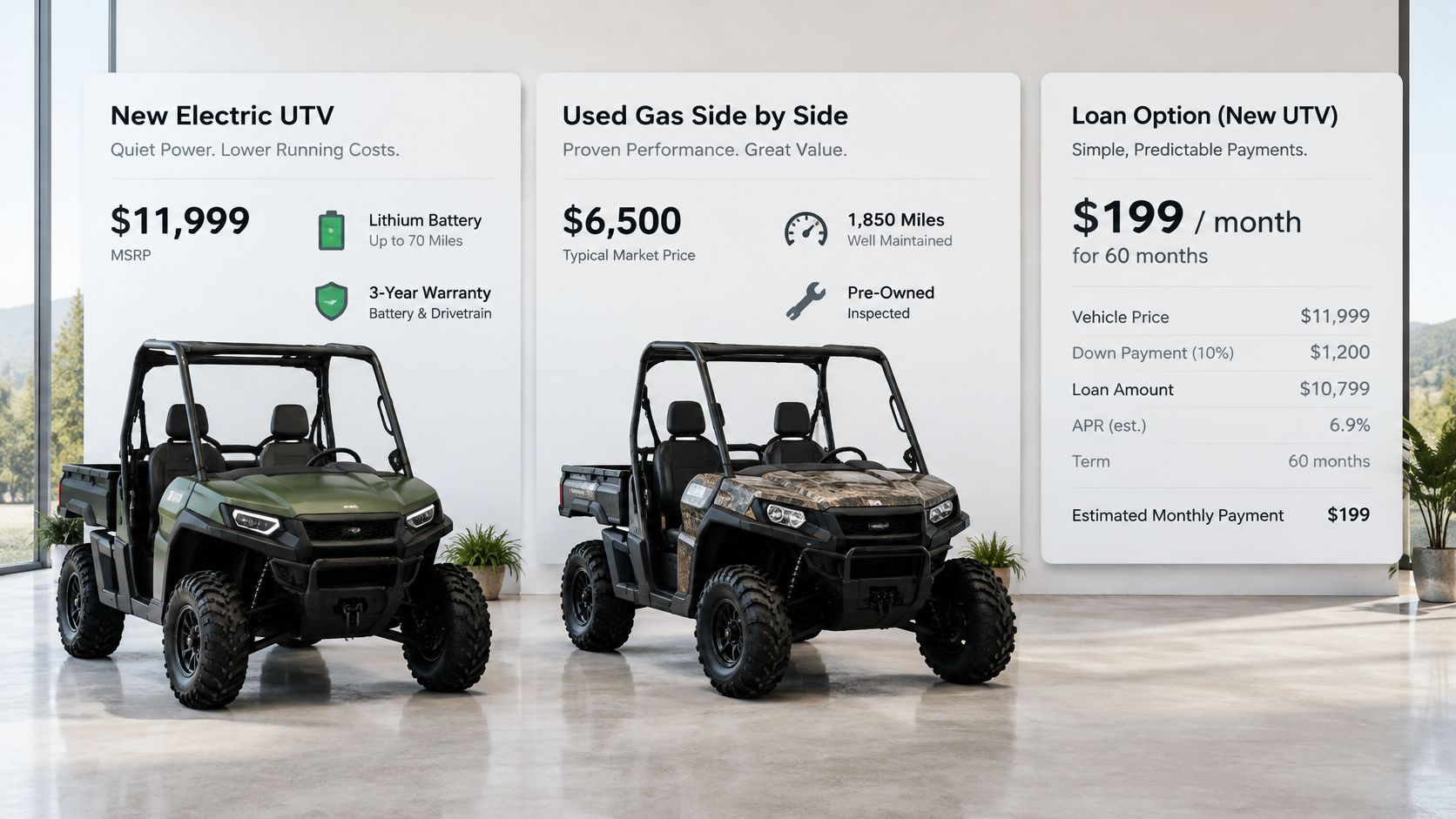
The image here shows the new-versus-used choice at a glance, fresh electric against a working gas machine with visible wear.
Price the Money Separately
Compare total interest over the full term and cash due at signing, never the monthly teaser. A high APR on an $8,349 unit can outspend a low promotional rate on a machine several thousand dollars higher. The reverse also happens when a promotion demands a short term your cash flow can't carry, so run both totals to the last payment.
Insurance and registration swing with your state and whether the vehicle stays off public roads. Get named quotes for the exact use, not a generic estimate. Then apply the closing rule, prefer used when hours are low and history is documented, prefer new when the machine will work most days from an outlet that's already in place.
Jobs Where a Cheap UTV Holds Up
The cheapest machine is a bargain only if it finishes the work without extra trips, recoveries, or upgrades. Match traction and daily use to the job before weighing the sticker price.
Which cheap setup fits the job
| Job | Traction that is enough | Why the cheapest sticker fits or fails |
|---|---|---|
| Flat property and light hauling | 2WD | Lowest price can also be the lowest cost |
| Warehouse or campus loops | 2WD and a short loop | A plug between shifts beats top speed |
| Mud, grades, sand, snow, hunting roads | 4WD | The 2WD discount is spent the first time it cannot climb out |
| Farm or ranch hauling and towing | 4WD plus checked ratings | A payload claim is not a safe tow rating |
| Daily multi-hour chores | Match the ground, then favor the outlet | Higher purchase wins only when hours and fuel avoided are real |
| Very few hours a year | Cheapest reliable unit, new or used | Electric savings shrink when the machine mostly sits |
Flat property maintenance, warehouse loops, and light hauling suit a cheap 2WD electric when the route is short and predictable. A plug near the parking spot can keep the machine ready between shifts. For farm chores, farm UTV buying guidance can help distinguish useful work features from trail equipment the job does not require.
Mud, steep grades, loose sand, snow, and hunting access roads call for more traction. A 2WD discount can disappear if the machine gets stuck and needs a recovery or another vehicle to finish the task.
Two Traps the Table Cannot Hold
A bare price rarely stays bare. The SEMA UTV accessorization survey reported an average accessory spend of $1,550, based on research covering sales between 2010 and 2012. Bed hardware, lighting, and tires suited to your surface belong in the job budget from the start. The same budget discipline applies to budget drill advice from Value Tools Co.
Payload is not a tow rating. Check the manufacturer's trailer rating and the vehicle's load limits before towing. A payload figure alone cannot establish whether a particular trailer is safe for the machine.
Circle the row that matches your ground. Rule out cheaper setups that cannot do the job, because an unusable machine has no practical cost advantage.
Daily multi-hour chores may justify a higher purchase price when charging access fits the routine and the machine replaces fuel-powered trips. For a vehicle used only occasionally, those savings have fewer chances to offset the purchase. Work hours and terrain determine which setup costs less over time.
Choose the Lowest Cost Tool for Your Ground
Three verdicts cover most buyers, and none of them start with a brand name.
If your ground is flat, your loop is short, and an outlet already sits where the machine parks, the cheapest defensible buy is a 2WD electric near the $8,349 floor. Don't pay sport-machine money for chore work, and don't buy capability your property never requests. Spend the savings on tires and lighting that match the actual surface.
If mud, grades, hunting tracks, or towing show up weekly, pay for 4WD and verified bed and tow ratings, even though the price sits higher in the $8,000 to $14,000 band. Traction you use every week isn't an upgrade, it's the job requirement. Skipping it doesn't save money, it defers the purchase and adds recoveries in between.
If a panel upgrade is heading toward the $1,900 to $12,100 range, or the machine will sit most of the year, don't buy an electric yet. Finish the five-year worksheet with real quotes first. Sometimes the correct answer is a documented used gas machine, and sometimes it's waiting until the electrical work makes sense for other reasons.
Pricing a Work-Configured 4WD Electric
For buyers whose chores land in that middle verdict, the Campus E1 is worth pricing as a work-configured option rather than a cheapest-sticker winner. It can tow up to 2,500 lbs and haul 550 lbs in its electric-powered dump bed, and we offer 0% APR for 36 months on it for qualified buyers. Those are inputs for your worksheet, not a substitute for it.
Request a quote with current out-the-door figures, because specs and terms need confirming at purchase time. You can find a dealer near you to book a test drive, and you should run that drive on your actual grade with your actual load. A parking lot loop tells you nothing about a wet clay bank or a loaded climb.
Then enter the out-the-door number, the financing total, and your charging setup into the worksheet beside every cheaper alternative. If the five-year total wins on your ground, sign with confidence. If it doesn't, the worksheet just saved you from buying the wrong kind of cheap, which is the whole point.
Put the worksheet to work on a real machine by pricing the Campus E1 against your ground, your loop, and your outlet, then booking a dealer test drive loaded the way you work. Visit Campus EV to request a quote, check current financing, and find a dealer near you.