
Side-by-sides aren't the niche alternative to four-wheelers anymore. According to Douglas Insights, they accounted for 73.1% of combined global ATV and UTV market value in 2025. That doesn't mean they're the right purchase for every property. A wider vehicle with an unused passenger seat and an empty bed can be a worse work tool than a compact ATV that reaches every fence corner.
The useful 4 wheeler vs side by side comparison starts with your work, not the accessory catalog. Match the platform to the people, load and route first. Then decide whether your annual operating hours and charging access justify electric power.
Table of Contents
- Who Should Buy a 4 Wheeler and Who Needs a Side-by-Side
- Side-by-Side and Four-Wheeler Differences at a Glance
- Rollover Risk, Restraints and Protection Compared
- Carrying, Towing and Trail Access on Each Platform
- What Electric Ownership Costs by Hours of Use
- Charging, Range and Maintenance for Electric UTVs
- Matching Jobs to the Right Vehicle and Verifying the Choice
Who Should Buy a 4 Wheeler and Who Needs a Side-by-Side
A side-by-side is the default for regularly carrying a passenger, substantial tools, game or a work trailer. A four-wheeler suits a solo operator whose narrow trails matter more than cargo space. Light tools and a small trailer don't automatically require a UTV, but repeated hauling makes its bed and passenger seat easier to justify.
For hunters working private land, access often settles the choice. An ATV can suit scouting trips through tight timber; a UTV makes more sense when the trip includes a hunting partner and bulky equipment. Farmers moving feed and fencing supplies, ranchers carrying repair tools, and construction or warehouse crews moving materials should start by evaluating a utility side-by-side.
Start with the job description
Before browsing a utility ATV for sale, separate necessary capability from equipment you'd merely enjoy owning:
- People and load: List who rides and everything that travels with them, including permanently mounted accessories.
- Access: Identify the gates, wooded turns and soft ground the vehicle must negotiate.
- Annual use: Estimate working hours, including seasonal peaks rather than just a typical week.
Electric versions of both platforms exist, so platform choice and drivetrain choice are separate decisions. Electric power doesn't turn an ATV rack into a cargo bed, and a gas engine doesn't make a wide UTV fit a narrow opening.
Buying rule: Choose the smallest platform that safely completes your recurring work, not the smallest one that can occasionally manage it.
Write down your three main tasks and rough annual operating hours before comparing models. Keep that list beside the specifications. It will help you distinguish useful capacity from features that add cost without improving your working day.
Side-by-Side and Four-Wheeler Differences at a Glance
ATV vs side-by-side by buying criterion
| Criteria | 4 Wheeler (ATV) | Side-by-Side (UTV) |
|---|---|---|
| Operator interface | Handlebars, with active body-weight shifting | Steering wheel and pedals |
| Occupants | Usually a single rider | Dedicated passenger seating; buy for the approved seating capacity |
| Occupant restraint | No seat belts | Seat belts, with rollover protection on most models |
| Cargo | Front or rear racks with individual load limits | Dedicated bed; powered dump bed on some models |
| Towing | Rated hitch for lighter utility trailers, not a cargo-rack attachment | Hitch receivers and model-specific rated towing capacity |
| Trail width and turning | Generally narrower, with less turning space required | Generally wider and needs more room to maneuver |
| Best fit | Solo travel, narrow trails and light utility work | Passenger transport, repeated hauling and utility towing |
The U.S. Forest Service UTV guide distinguishes straddle-seat, handlebar-controlled ATVs from steering-wheel-operated UTVs and specifies seat belts for every UTV occupant in its operating context. Those differences determine how the machine works, not just how it looks.
This comparison graphic makes the platform differences easy to identify.
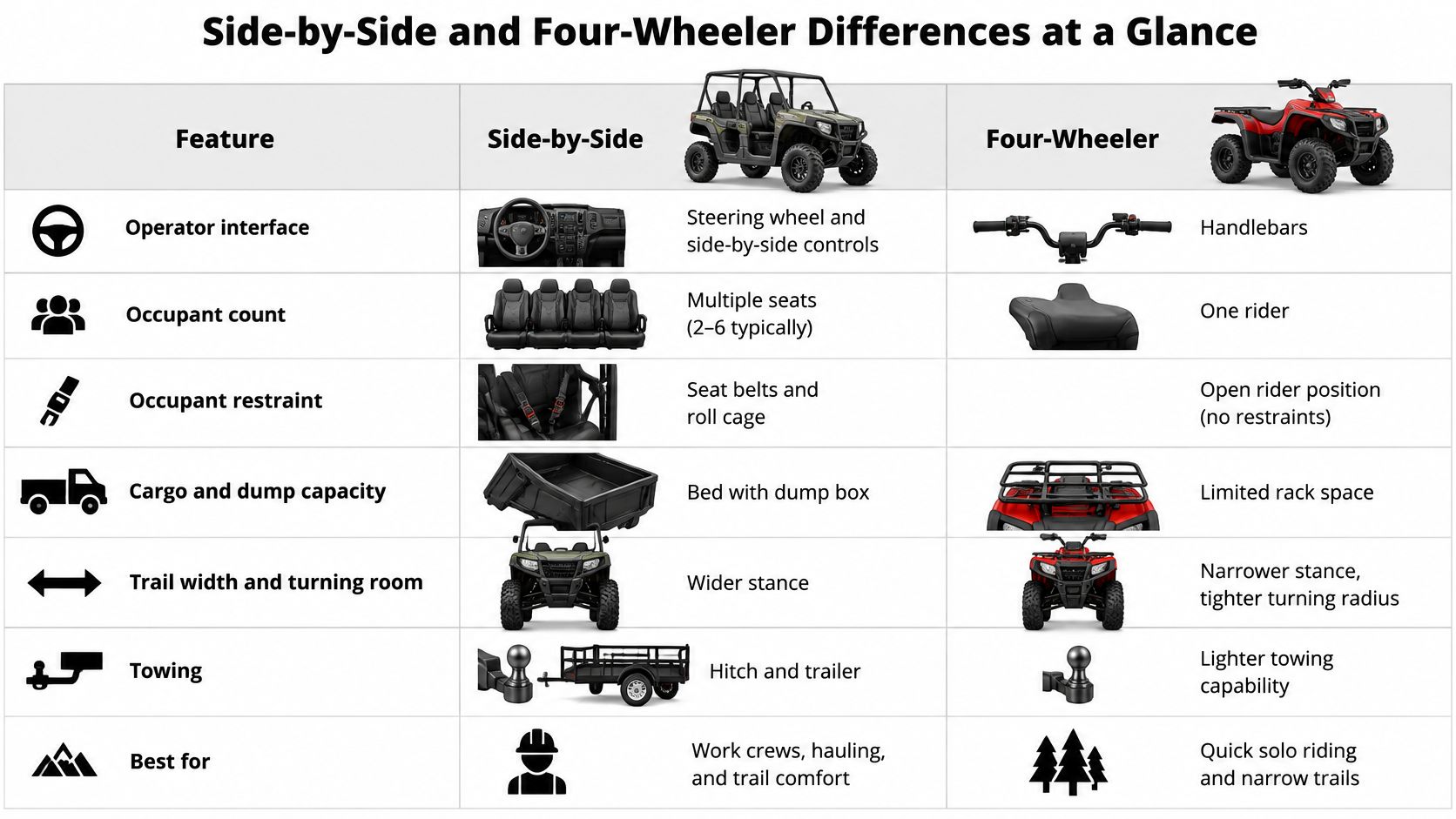
Read the rows as work requirements
Controls determine the operator's physical involvement. An ATV requires active riding technique; a UTV uses familiar automotive-style controls, but still requires off-road training.
Occupants and restraints are purchase gates, not optional preferences. Don't plan to carry a coworker on a cargo rack or improvise a seat in a bed.
Cargo and towing describe different capacities. A bed supports material on the vehicle; a hitch transfers trailer forces through an approved mounting point. Neither rating substitutes for the other.
Width and turning room determine whether useful capacity can reach the job. Measure the approach to a gate as well as the opening itself, because a vehicle may fit through straight but struggle when entering from an angle.
Use the video as another way to compare the operating layouts.
Highlight the rows you use during an ordinary workday. If passenger transport and bed space appear repeatedly, start with a UTV. If your work mostly involves solo access through confined terrain, start with an ATV and check whether its actual carrying limits are sufficient.
The table describes vehicle architecture, not fuel type. An electric side-by-side retains its seating, bed and restraint layout. Choosing electric comes afterward, once that layout fits the job.
Rollover Risk, Restraints and Protection Compared
A side-by-side is not automatically the safer machine. An ATV rider uses body position to help control the vehicle and remains exposed if it overturns. A side-by-side occupant stays seated within a protective structure, provided the belt is fastened and the occupant remains inside. Protection during a rollover and resistance to rolling over aren't the same thing.
The Consumer Product Safety Commission's ATV injury report estimated 107,900 ATV-related emergency-department-treated injuries in 2012, with approximately 26,500 involving children. Those historical figures describe the ATV category, not a controlled comparison proving that any particular UTV is safer.
Side-by-side rollovers can cause severe injury or death, including on flat, open ground. A roll cage doesn't make abrupt steering or excessive speed harmless. Annual hours change the exposure. A UTV that spends most of its life on level feed runs faces a different risk profile from one worked daily on sidehills. Charging access affects how often the machine is available, not how it behaves on a slope. Load and terrain do.
Why a vehicle tips
Rollover behavior involves more than vehicle width. Center-of-gravity height, tires, suspension and occupant interaction all affect rollover resistance, as described in the SAE study of side-by-side rollover initiations.
On a working property, the operator changes the situation by adding cargo, crossing ruts or turning downhill. A load piled high in the bed can make a familiar route handle differently. Driving an empty demonstration vehicle around a level yard won't reveal that change.
Inspect the protection package before discussing comfort accessories:
- Rollover structure: Verify the manufacturer's rollover-protection documentation. A roof or decorative enclosure isn't proof of structural protection.
- Restraints: Check belt operation, adjustment and fit with the clothing occupants wear.
- Occupant containment: Inspect doors or nets, latches and approved handholds. Keep arms and legs inside.
- Personal protection: Use a properly fitted helmet and eye protection, plus footwear that stays secure on the controls.
- Cargo placement: Secure dense items low and centered rather than stacking them above the bed sides.
A UTV with doors can add useful containment, but doors don't replace belts or a suitable rollover structure. An enclosed cab isn't permission to treat an off-road machine like a passenger car.
Set operating rules before the first trip
Use terrain-specific training and the manufacturer's slope instructions. Walk unfamiliar obstacles, choose the route before entering it, and slow down before a turn rather than braking abruptly during it.
A familiar route isn't a fixed condition. Rain, livestock traffic, a fresh rut or a different load can change the safe approach.
For slopes, establish a stop-and-reassess rule when traction, visibility or stability feels uncertain. Don't ask an operator to prove a machine's limits with a full load. A seat belt only provides its intended protection when it stays fastened.
Carrying, Towing and Trail Access on Each Platform
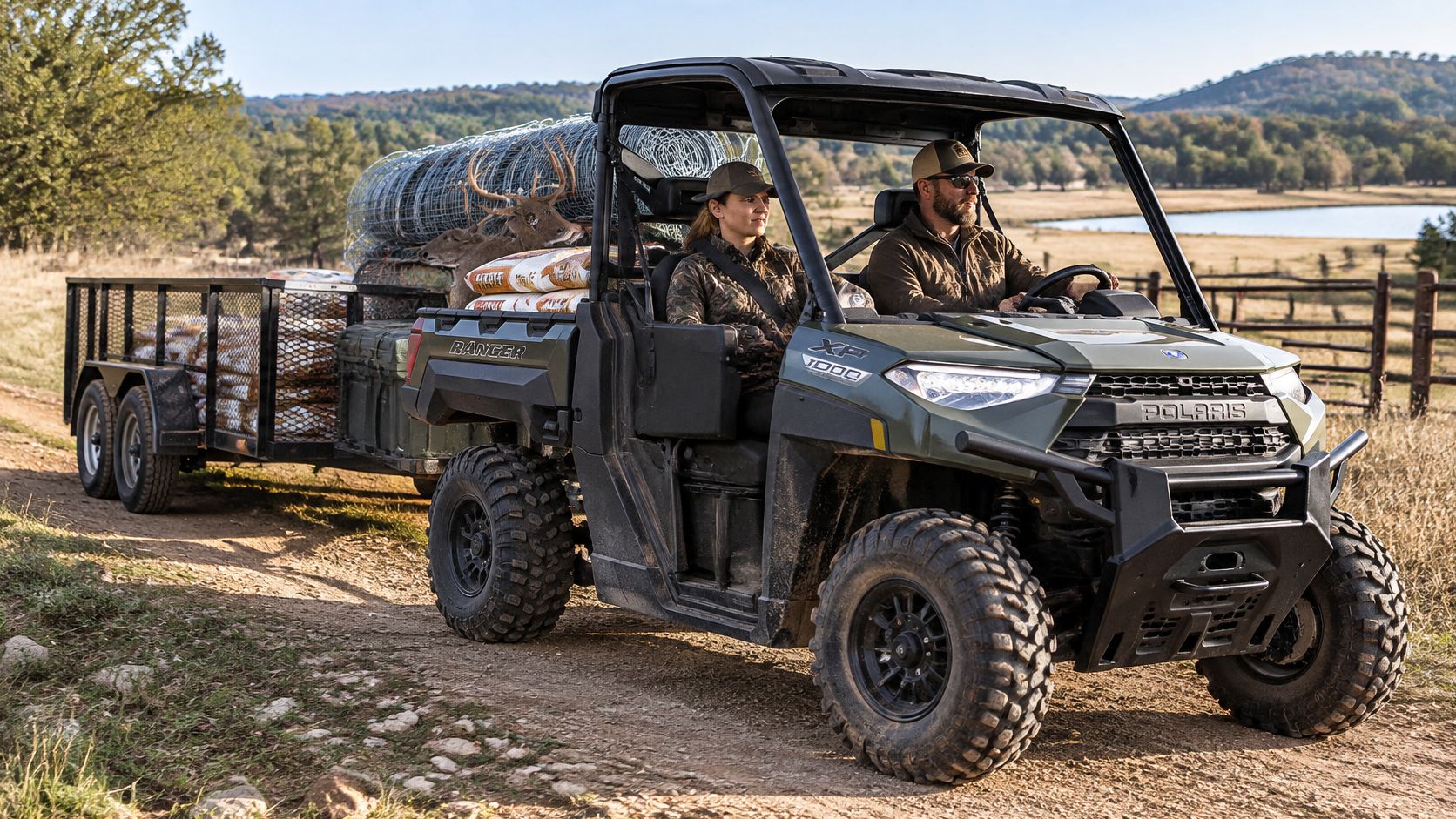
Say a fence repair trip includes feed bags, wire, posts, hand tools and a coworker. An ATV might move the operator and some equipment, but completing the task could require a trailer or repeated journeys. A utility side-by-side can consolidate that work, provided the combined load stays within its limits.
A trailer also changes the route, as this working setup illustrates.
Our Campus E1 tows up to 2,500 lbs and carries 550 lbs in its electric-powered dump bed. It has front and rear 2-inch hitch receivers and 11 inches of ground clearance. Those specifications describe different capabilities; they aren't interchangeable allowances.
Separate the limits before loading
Bed capacity tells you what the bed can carry. Total vehicle payload must also account for occupants, accessories and the trailer's downward force on the hitch. A towing rating doesn't establish the permitted tongue weight, and a receiver's size doesn't establish either rating.
Use a load sheet rather than a visual estimate:
- Weigh the cargo: Include toolboxes, recovery equipment, coolers and material packaging.
- Account for occupants: Use realistic working weights, including clothing and carried equipment.
- Check tongue weight: Measure the loaded trailer's hitch load and compare it with the vehicle and hitch limits.
- Read combined restrictions: Confirm whether maximum bed load and maximum towing are permitted together.
- Secure the load: Use rated straps and suitable anchor points; don't rely on bed sides to stop heavy tools.
A powered dump bed reduces manual unloading, but it doesn't increase the load rating. Park on suitable level ground before dumping and check that the material can discharge without catching on the tailgate or shifting the vehicle.
Access can outweigh carrying capacity
The ATV remains useful where trees, gates or sharp switchbacks exclude a larger machine. Don't compare only brochure width. Include mirrors, accessories, turning space and trailer off-tracking when measuring the route.
A loaded demonstration should assess controlled travel, braking and restart ability, not just whether the vehicle climbs. Use a representative route within the manufacturer's operating limits, with dealer supervision where appropriate. Never attempt a questionable slope just because it's the steepest one on the property.
Measure before buying: Record your heaviest routine load and narrowest unavoidable access point. A vehicle must satisfy both requirements to be useful.
What Electric Ownership Costs by Hours of Use
Lower running costs don't automatically mean lower ownership costs. An electric UTV can save fuel and powertrain service expenses while still costing more overall if the purchase premium is large or the vehicle spends most of the year parked.
An independent electric off-road vehicle comparison estimated that an electric utility UTV could cost about $8,000 to $8,500 more over five years than a gas model despite lower energy and maintenance expenses; its utilization discussion also suggests gas may remain cheaper below roughly 100 annual operating hours, with electric savings becoming more meaningful above about 250 hours.
Treat utilization bands as screening tools
Likely cheaper option by annual operating hours
| Annual operating hours | Likely cheaper option | What to add to the calculation |
|---|---|---|
| Low use | Gas often has the total-cost advantage | Purchase premium, seasonal storage and idle time |
| Moderate use | Choose the lower calculated total after charging and fuel costs | Battery replacement reserve, resale value and charging access |
| Frequent use | Electric running-cost savings have greater potential | Charger installation, loaded energy consumption and daily downtime |
These are screening categories, not guaranteed break-even points. A seasonal hunter and a property crew can accumulate similar hours while having very different charging opportunities. Remote use, towing and short turnaround windows can change the answer.
Don't compare a basic ATV against a heavily equipped electric UTV and call the difference an electric premium. Match passenger capacity, cargo capability, traction equipment and necessary accessories before comparing drivetrains.
Calculate cost per productive hour
Build the calculation over the period you realistically expect to own the vehicle:
- Start with delivered purchase cost. Include necessary accessories, transport equipment and charging installation.
- Add operating energy. Use your electricity tariff or local fuel price and consumption measured during representative work.
- Add service and repairs. Separate scheduled maintenance from tires, brakes and damage-related repairs.
- Allow for battery risk and downtime. Obtain replacement pricing and warranty terms rather than assuming either a free replacement or an inevitable failure.
- Subtract a conservative resale estimate. Divide the resulting total by projected productive operating hours.
A UTV maintenance cost comparison helps identify service categories, but your worksheet should also price lost working time. If charging forces a crew to stop before the job is finished, inexpensive electricity won't compensate for that disruption.
Conversely, an electric vehicle that returns to a powered shed after predictable daily rounds may recharge without interrupting anyone. That's a stronger financial fit than occasional trips to a remote hunting property where power is uncertain.
Frequent, predictable utility work near dependable power is the strongest starting case for electric. Buy it because the complete working pattern makes sense, not because a lower energy bill is appealing in isolation.
Charging, Range and Maintenance for Electric UTVs
A household outlet and a higher-power charging setup aren't interchangeable. Available charging power and the vehicle's onboard charger determine turnaround, so installing a different outlet won't necessarily make the vehicle accept energy faster.
Choose the parking and charging location before buying. Then confirm electrical supply, charger compatibility, weather exposure and the interval between shifts. Have a qualified electrician assess the circuit rather than planning around a long extension cord across the yard.
Match the charging setup to the workday
Charging setups and expected charge times
| Charging setup | Typical charge time | Best for |
|---|---|---|
| Standard household outlet | Confirm a full recharge interval with the supplied charger; allow an uninterrupted overnight window | Occasional use and overnight top-up |
| Higher-voltage charging | Shorter only when supported by the vehicle and charger; obtain the specified recharge time | Daily use and tighter turnaround |
| Generator or solar backup | Calculate from usable battery energy, sustained charger input and conversion losses | Off-grid properties with a properly sized backup system |
Don't transfer a charge-time claim from a different battery or charger. For solar, include storage and poor-weather availability. For a generator, check continuous output and charger compatibility, and operate it outdoors away from people and buildings.
Our Campus E1 uses a 72V 150Ah lithium battery and a 20 kW motor. For a purchase decision, request usable battery capacity and loaded-route performance rather than treating voltage, amp-hours or motor output as a range guarantee.
Maintain the machine, not just the battery
Electric drive removes certain engine-service jobs, but it doesn't remove the chassis, brakes or recovery equipment.
What drops out compared with a gas engine
- Engine lubrication service: No combustion-engine oil and engine-oil filter changes.
- Fuel-system care: No stale gasoline, fuel stabilization or carburetor maintenance.
- Engine ignition service: No spark-plug replacement for the traction motor.
What stays on the inspection schedule
- Tires and wheels: Check pressure, damage and wheel-fastener condition.
- Brakes and suspension: Inspect wear, fluid where applicable, bushings and mounting points.
- Drive components: Follow the actual drivetrain's lubrication and inspection requirements.
- Recovery equipment: Inspect the winch line, hook, fairlead and electrical connections.
Plan range around the complete route, including the return journey and an operating reserve. Towing, soft ground, hills and repeated acceleration change consumption. A short loaded loop on your property is more useful than an unloaded distance claim.
Follow the battery manufacturer's storage and temperature instructions. Avoid routinely finishing work at the battery's discharge limit, and obtain the battery warranty, charging restrictions and replacement cost in writing.
Matching Jobs to the Right Vehicle and Verifying the Choice
Hunters and farmers
Solo hunters on confined trails should lean toward an ATV. Camera checks and scouting often reward access more than bed space. The choice reverses when hauling a partner, a blind or recovered game becomes a recurring task rather than an occasional inconvenience.
A UTV-mounted winch helps with controlled recovery, but it doesn't turn every nearby tree into a suitable anchor. Our Campus E1 has a 3,000 lb winch capacity. Use suitable rigging, keep people outside the line's path, and distinguish winching capacity from lifting approval.
Farmers moving feed, fencing and repair equipment should start with a side-by-side. Consider the whole task: loading at the shed, reaching the work area, unloading and returning with damaged material. A bed that keeps supplies organized can be more useful than additional top speed.
The preference reverses where farm work consists mainly of solo inspections along restricted routes, with substantial material movement handled by another machine. Don't purchase bed capacity merely because the property is large.
Ranches and commercial yards
Ranchers carrying fence-repair equipment or another worker should lean toward a utility UTV. Electric drive can reduce powertrain noise around livestock, but quiet operation doesn't guarantee that animals will remain calm. Approach predictably and allow space for movement.
An ATV becomes more attractive when narrow fence-line access dominates and the operator carries little equipment. Where loads exceed the UTV's ratings, move up to an appropriate work vehicle rather than treating a compact utility machine as a tractor substitute.
Construction and warehouse crews benefit from dedicated seats and a material bed. Electric drive also avoids tailpipe emissions at the point of use, although that alone doesn't establish suitability for an indoor workplace. Check site vehicle rules, pedestrian separation, braking requirements and any hazardous-location restrictions.
The recommendation reverses if the actual task requires equipment outside the UTV's design, such as lifting palletized loads. A side-by-side transports suitable cargo; it isn't a forklift.
Verify the purchase with a working demonstration
For predictable utility work near charging, the E1 is an electric option worth testing against your task list. It offers selectable 2WD and 4WD and a locking rear differential. Confirm the permitted shifting procedure during familiarization rather than assuming every traction change is appropriate under load.
In our manufacturer testing, the E1 climbed a steep grade in 4WD with the differential locked without running out of power. In a separate recovery test, it pulled a zero-turn mower up a wet clay bank of about 20 degrees. These results describe those tests, not a universal slope rating or a promise for your soil and load.
Use this purchase sequence:
- Rank the work. Bring your task list, passenger needs and access measurements.
- Calculate utilization. Include seasonal demand and the longest working day.
- Demonstrate the load. Assess representative hauling, turning and braking within approved limits.
- Confirm charging. Identify the circuit, charger, parking location and available recharge window.
- Document ownership details. Request service requirements, warranty terms and replacement-component pricing.
Book a demonstration with an authorized dealer and bring the load weights, route photographs and charging details. Ask for a controlled demonstration that resembles your work, not merely a lap around the sales yard.
Campus EV offers electric utility side-by-sides for hunting, farming, ranching and property work, including the Campus E1 with selectable traction and an electric dump bed. Visit Campus EV to explore the E1 and arrange an authorized-dealer demonstration with your actual hauling, terrain and charging requirements in hand.