
What if the machine that feels best on a trail is the wrong machine for the work waiting at the end of it?
A sport 4×4 ATV earns its place when you want speed, body control, and traction on rough ground. It loses that place when the job needs a second seat, a heavy load, or hours of low speed hauling. Judge it by the task, not by horsepower alone.
Table of Contents
- Sport 4×4 ATVs, Utility ATVs and UTVs Compared
- What Defines a Sport 4×4 ATV
- How 4×4 Drivetrains Change Traction and Control
- Matching Sport 4×4 ATVs to Trail, Hunting and Farm Work
- Electric Options and Whether Range Fits Your Day
- Ownership Costs, Maintenance and Safety Habits
- Audience FAQs for Sport 4×4 ATV Buyers
- Buyer's Checklist and Test Ride
Sport 4×4 ATVs, Utility ATVs and UTVs Compared
| Vehicle | Control and seating | Occupant protection | Cargo and towing | Best fit |
|---|---|---|---|---|
| Sport 4×4 ATV | Straddle seat, handlebars, built for speed and trail feel | Rider exposed, relies on helmet, gear and speed choice | Small racks, light towing | Trail riding and hunting access |
| Utility 4×4 ATV | Straddle seat, handlebars, lower top speed | Rider exposed, relies on helmet, gear and speed choice | Front and rear racks, rated towing | Farm chores and fence checks |
| Gas UTV | Steering wheel, seated occupants | Seat belts and roll cage on most models | Dump beds, larger towing ratings | Ranch, construction and multi-passenger work |
| Electric UTV | Steering wheel, seated occupants, no engine noise | Seat belts and roll cage on most models | Dump beds, towing set by model rating | Hunting, property and yard hauling |
The seating row drives most other choices. On an ATV you straddle the machine, steer with handlebars, and shift your weight to help it turn and climb. There's no cab around you, so protection comes from your helmet, eye protection, gloves, boots, and how fast you choose to ride.
A UTV puts you in a seat behind a steering wheel, usually with seat belts and a roll cage. That layout suits passengers, tools in a bed, and repeated stops where you climb in and out. If you're weighing those layouts directly, this 4-wheeler versus side-by-side comparison helps you sort seating from cargo claims.
Cargo separates the classes just as clearly. Racks work for a chainsaw, a pack, or light fencing tools. A dump bed works for feed, firewood, posts, and game.
Ownership cost belongs in the same comparison, because Hayden Outdoors ATV cost guidance estimates routine annual upkeep at roughly 10 to 15% of purchase price under normal use.
Rule of thumb: Pick a sport ATV for trail speed and solo access. Pick a side-by-side when passengers, seated work, or heavier loads are part of the normal day.
What Defines a Sport 4×4 ATV
A sport 4×4 ATV combines a straddle seat and handlebars with four wheels and a chassis set up for active trail riding. The rider shifts weight through turns and over uneven ground, while the suspension and throttle response favor quick changes in pace and direction over carrying bulky loads.
The photo below shows the riding position: upright, exposed, and dependent on the rider's balance and control.
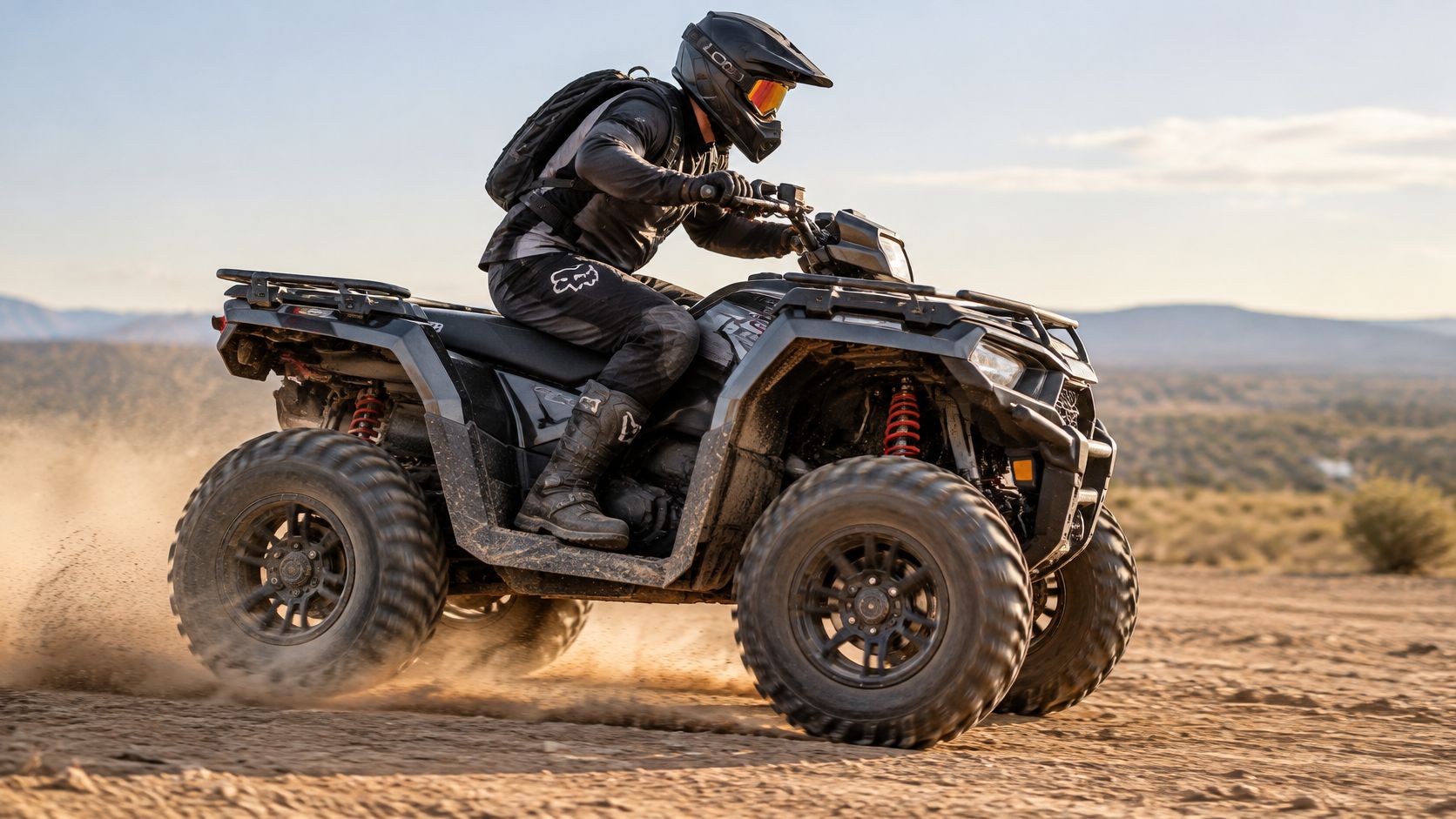
ATVs shifted from three wheels to four after U.S. Consumer Product Safety Commission reporting identified at least 161 ATV-related deaths between January 1982 and April 1985. Four-wheel platforms became the foundation for later sport models.
Sport Tuning Versus Utility Tuning
Sport models typically have lighter bodywork, smaller racks, firmer suspension, and gearing that favors acceleration. They suit trail riding, scouting, and hunting access when the rider carries only what fits securely on the machine. A straddle ATV can reach narrow routes, but it is a poor fit for repeated hauling, passenger transport, or long days moving bulky supplies.
Utility models put more emphasis on racks, towing equipment, and steady low-speed work. Choose by the job: a sport ATV prioritizes rider involvement and trail handling, while a utility ATV or UTV makes more sense when cargo and work tasks dominate. Four wheels do not make an ATV a substitute for a work vehicle, and they do not guarantee stability on a slope.
How 4×4 Drivetrains Change Traction and Control
In 2WD, the rear wheels push and the front wheels only steer. On hardpack that feels light and playful, but on mud, sand, wet grass, or loose rock the rear tires can spin, dig, and leave the front end as dead weight. In 4WD, four driven wheels share the work, so the front tires pull the machine up and over obstacles instead of waiting to be shoved into them.
This diagram shows that split in driven wheels before you get into switching modes.
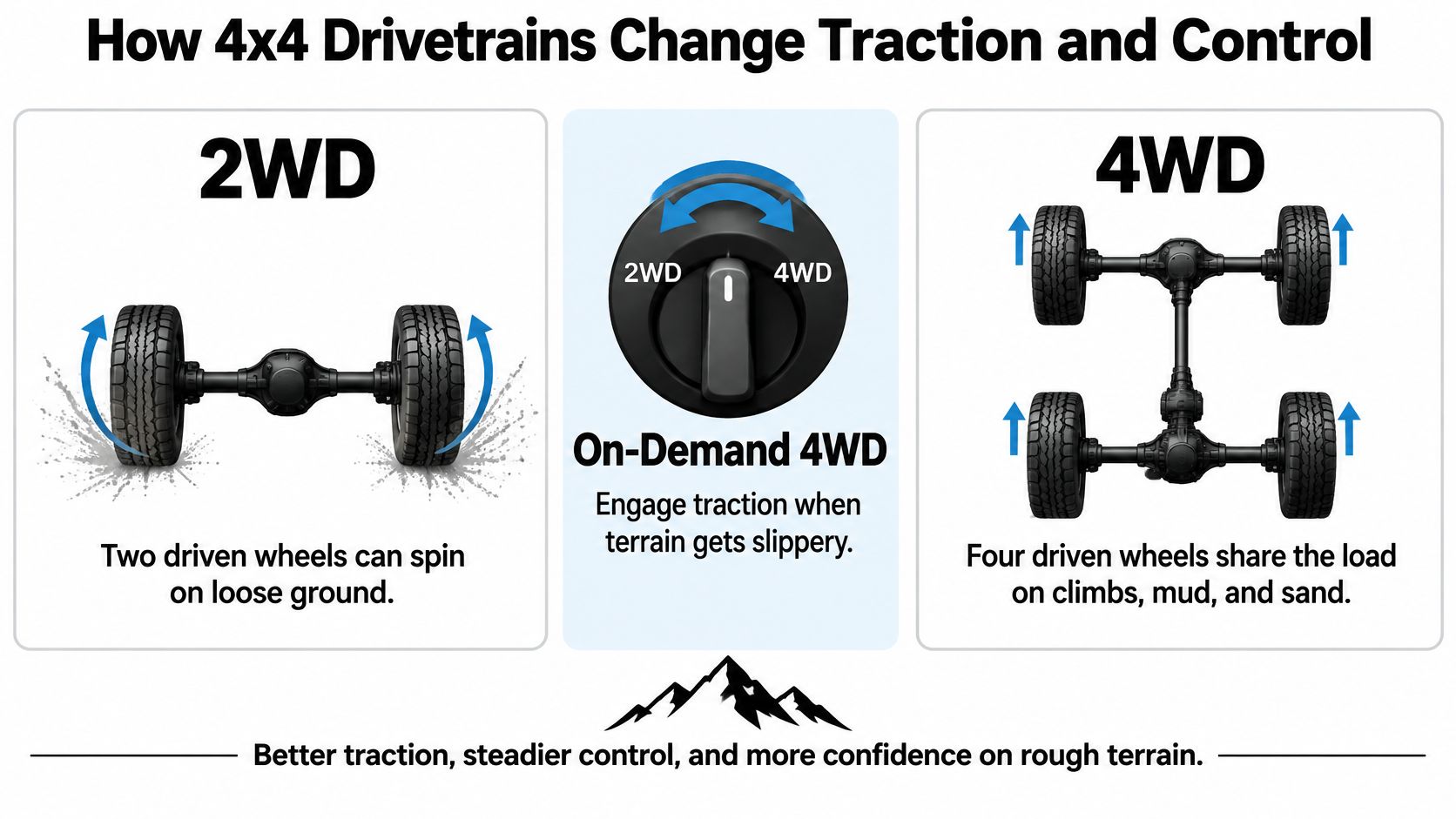
Most modern machines use on-demand 4WD. Run 2WD on dry, hard trails where you want lighter steering. Switch to 4WD before a mud hole, creek exit, snow patch, or steep loose climb, not after you've already lost momentum.
A locking rear differential forces both rear wheels to turn together. That helps when one wheel sits on slick clay and the other has grip, and it's useful on steep grades. It also makes tight turns fight you on pavement or dry rock, so disengage it when you don't need it.
Where Four-Wheel Drive Stops Helping
Traction isn't stability. CDC-hosted engineering research on ATV rollover reports that increasing speed and slope angle sharply reduces the bump size needed to initiate rollover, with one modeled example at approximately 20 km/h on a 12.5° slope materially reducing the required bump height.
That matters on side slopes. Four-wheel drive can keep you moving across a traverse while momentum, a hidden stump, and an abrupt steering correction combine to lift the uphill side. Slow down before you enter the slope, keep steering inputs small, and treat tire pressure and suspension settings as stability settings, not comfort settings.
Watch how selectable drive changes wheel behavior in this short demonstration before you test it yourself.
- 4WD helps most: Straight climbs, mud exits, sand, snow, and slow rock steps.
- 4WD misleads: Side slopes, off-camber turns, and fast descents where braking and body position matter more.
- Tires decide grip: Aggressive tread bites in mud but wanders on hardpack, while worn tires waste the drivetrain.
Matching Sport 4×4 ATVs to Trail, Hunting and Farm Work
| Task | What matters most | Sport 4×4 ATV | Electric UTV |
|---|---|---|---|
| Trail riding | Speed, suspension travel, traction | Strong fit | Fits slower, mapped trails, range shorter under load |
| Hunting access | Quiet approach, gear carry, rack or trailer | Good for scouting, limited hauling | Quiet, carries gear and game in a dump bed |
| Fence and livestock checks | Reliable starts, daily range, cargo | Works for light checks | Good with overnight charging and seats |
| Farm and ranch chores | Towing, cargo, passengers, uptime | Limited for heavy loads | Strong fit for hauling and seated work |
| Warehouse or construction yard | Cargo, low noise, no exhaust | Poor fit | Good fit for hauling and quiet operation |
Trail Riding
Say your Saturday is forty miles of forest trail with creek crossings, whoops, and short rocky climbs. The sport ATV wins because you can stand, lean, and pick narrow lines between trees. Speed and suspension travel aren't vanity specs here. They're how you clear rough sections without getting beaten up.
An electric UTV can run mapped, moderate trails, but it's wider, heavier in feel, and built for a calmer pace. You'd choose it to carry a passenger and a cooler, not to chase trail feel.
Hunting Access
Scouting is different from retrieval. A sport 4×4 ATV gets one hunter, a pack, and a rifle or bow into tight country, especially where a wider vehicle won't fit between trees or through a gate.
Once an animal is down, the math changes. A rack or small trailer limits what comes out in one trip, while a dump bed carries game, stands, feed, and wet gear without strapping everything around the rider. Quiet electric running also helps on the approach, but it doesn't erase the need to manage scent, wind, and entry routes.
Farm and Ranch Chores
Daily chores expose weak fits fast. Checking fence with pliers, staples, and a small chainsaw suits a utility ATV. Hauling mineral tubs, towing a loaded trailer, carrying a second person to open gates, or making twenty stops along a feed line suits a UTV.
List your two most frequent jobs, with the load and passenger count for each, before you look at a single model. If either job needs a seated passenger, buy for that job first.
I'd also count idle time. A vehicle that's quick between stops but forces three trips for supplies is slower across the whole morning than a bedded machine that makes one.
Electric Options and Whether Range Fits Your Day
An electric UTV replaces the engine with a motor and lithium battery. You lose oil changes and much engine service, but range stops behaving like a fuel gauge on a flat road. Hills, payload, mud, speed, cold weather, 4WD use, and accessories all draw from the same stored energy.
Do the Battery Arithmetic First
A 72V, 150Ah battery holds approximately 10.8 kWh nominal capacity, found by multiplying volts by amp-hours and dividing by 1,000. That number tells you the size of the tank. It doesn't tell you how far you'll go with a loaded bed on soft ground.
If you're comparing models in this class, start with the battery and drivetrain listings for an electric 4×4 UTV for sale and translate each range claim into your own route, load, and reserve.
One Workday Scenario
Say you run a three-hour fence and livestock check. The bed carries posts and tools, two climbs are wet grass, you use 4WD through a low crossing, and you make one winch pull to move a fallen limb. That day uses far more energy than an empty run down a flat lane at steady speed, even if the odometer distance is identical.
Cold mornings widen the gap. So do underinflated tires, deep mud, and holding higher speeds between pastures. A winch, lights, and heater fan aren't free either, though short winch pulls usually matter less than an hour of climbing with a full bed.
Plan around a usable reserve, not the maximum figure. I'd map your longest normal day, add a margin for a detour or recovery, and make overnight charging the habit that resets the vehicle for morning. The Campus E1 is one example of an electric side-by-side built around that daily charge and work pattern.
Ownership Costs, Maintenance and Safety Habits
| Item | Typical cost | When it comes due |
|---|---|---|
| Oil change (gas) | A routine service expense | At the manufacturer's interval |
| Clutch service (gas) | More than an oil change; cost depends on the work required | When slipping or per service schedule |
| Tires | Cost varies with tire choice and damage | When worn or damaged |
| Routine annual upkeep, normal use | About 10–15% of purchase price | Yearly estimate |
| Electric drivetrain oil change | Not needed | Battery and motor checks per the manual |
Hayden Outdoors' cost guidance puts routine annual upkeep at about 10–15% of a vehicle's purchase price. Actual costs depend on use: mud can pack bearings and brakes, heavy loads wear tires and clutch components, and rocky trails can damage wheels. Clutch work generally costs far more than an oil change. For scheduled service planning, see this guide to UTV maintenance costs.
Electric models eliminate engine oil changes and much engine work, but still need checks of tires, brakes, suspension, steering, battery connections, and charging equipment.
Safety Habits That Matter Most
The Insurance Institute for Highway Safety's ATV fatality statistics report that in 2024, 70% of fatally injured U.S. ATV riders died in crashes involving no other vehicles. Safe speed, sound judgment, and terrain awareness matter even when no traffic is present.
- Wear protection: Use a helmet, eye protection, gloves, long sleeves, and boots.
- Get trained: Learn braking, climbing, and turning before carrying gear on steep ground.
- Match age to machine: Keep children on age-appropriate models only.
- Plan slopes: Scout side slopes and keep speed low before crossing them. Four-wheel drive may help maintain traction, but it cannot prevent a rollover or make a steep slope safe.
- Skip alcohol: Don't ride after drinking, and don't carry passengers on a single-rider ATV.
A Short Maintenance Rhythm
Before each ride, check tire pressure and tread. Uneven pressure can affect steering and stability. During regular use, test the service brakes and parking brake weekly. After muddy or rocky rides, inspect CV boots, drivetrain guards, and fasteners. Check battery health and charging cables on electric models.
Audience FAQs for Sport 4×4 ATV Buyers
Trail Riders and Passengers
Can a sport 4×4 ATV carry a passenger? No, not unless the manufacturer built and rated it for two riders. Most straddle-seat ATVs are single-rider machines, and a passenger shifts weight, blocks your movement, and has no proper seat or belt. Put passengers in a side-by-side.
Hunters and Access Tracks
Do I need four-wheel drive for hunting access? You need it when access tracks are wet, steep, rutted, or sandy enough to spin two wheels. On dry, flat lease roads you may not. The bigger limit is often carry space, so decide how gear and game come out before opening morning.
Farm Owners Considering Electric
Can an electric side-by-side replace a gas 4×4 for a full workday? It can if your route, load, and charging routine fit with reserve to spare. Test your longest day, not your shortest. If you can't charge overnight where the vehicle parks, the plan is weak no matter what the brochure says.
Parents and Young Riders
At what age can children ride? Follow the manufacturer's age guidance and engine size limits for the specific model. Never put a child on an adult ATV because they can reach the controls. Reach isn't strength, judgment, or braking control.
Budget and Electric Buyers
Is a used sport ATV a good buy? It can be if the frame is straight, the 4WD engages cleanly, CV boots aren't torn, and clutch work isn't overdue. Budget for tires and first-year service instead of spending every dollar on purchase price.
Does stated range hold with a full bed? No. Payload, hills, mud, and 4WD reduce practical range, so test an electric model with the load and terrain you use.
Buyer's Checklist and Test Ride
Use this visual checklist on the dealer floor, then confirm each item on the spec sheet or during the ride.
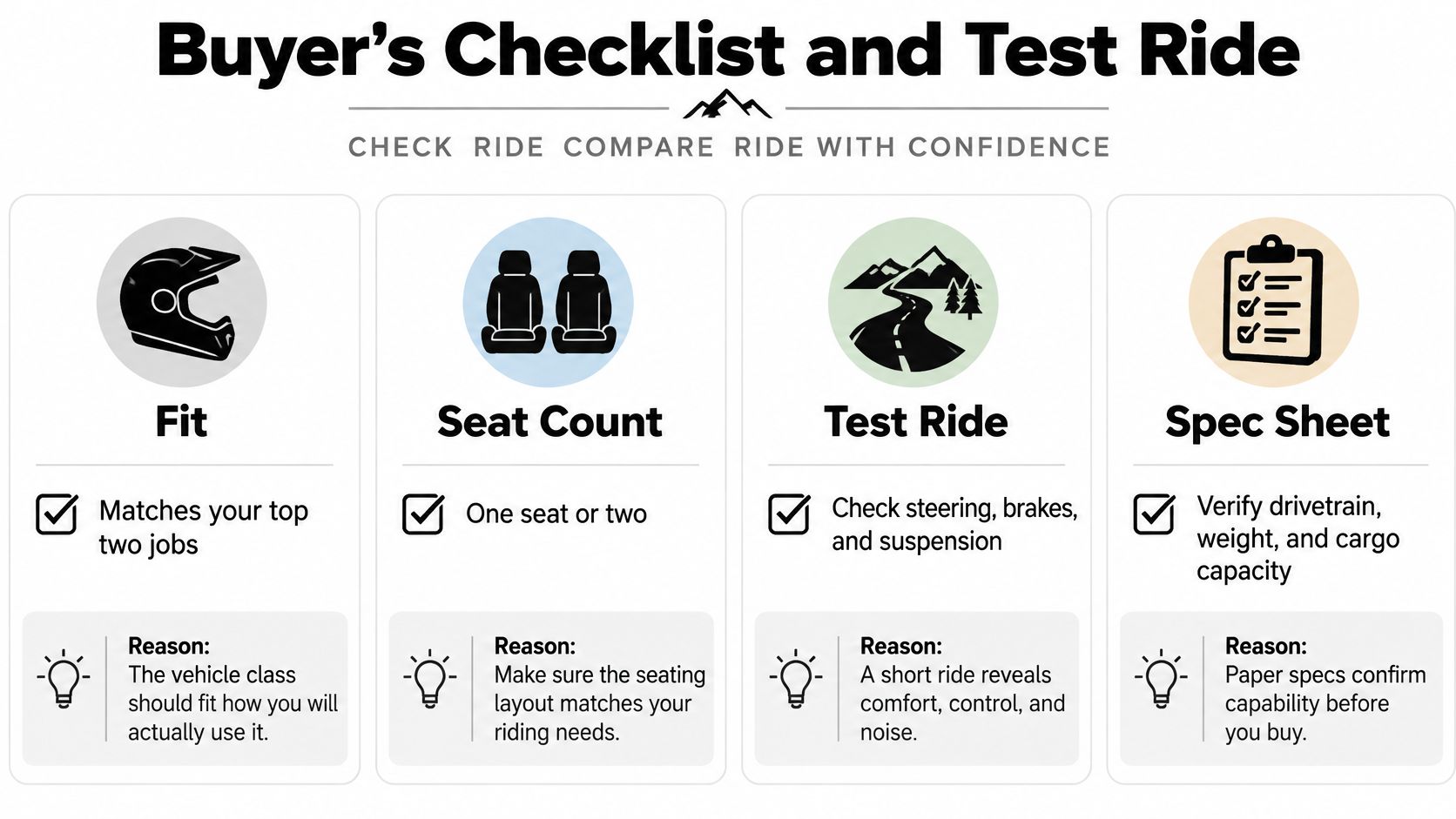
Fit and Drivetrain
- Top two jobs: The class matches your trail, hunting, or hauling work, because the wrong class makes every accessory a workaround.
- Seat count: Seats match the people you carry, because improvised passengers create the safety problem.
- Ground clearance: Clearance suits your rocks, ruts, and creek exits.
- Drive switching: 2WD and 4WD engage smoothly, and a locking rear differential is available if you climb loose grades.
- Tires: Tread suits mud or hard ground, not just the showroom floor.
Protection and Running Costs
Confirm seat belts and a roll cage on a side-by-side, and price a helmet, eye protection, and gloves with any ATV. Check towing rating, rack or bed capacity, top-speed setting, parking brake behavior, and dealer service access. For electric models, get battery warranty and charging time in writing.
Then decide in three steps. First, name your top two jobs and match them to the task table. Second, run the shortlist against protection and capacity items. Third, test on a real slope with your normal load, and note anything the dealer can't confirm in writing.
If seated, quiet, daily hauling fits your work, the Campus E1 is a practical option with a 20 kW motor, a 72V 150Ah lithium battery, on-demand 2WD and 4WD, an electric power dump bed, and up to 60 miles on a single charge. You can find an authorized Campus EV dealer near you to book a test drive, and you should confirm specifications and availability before buying since products may change without notice.
If your work calls for seated hauling, quiet hunting access, and a vehicle that charges overnight, Campus EV builds electric UTVs for that job. Visit Campus EV to look at the Campus E1, compare it against your top two tasks, and find a dealer where you can test it with your own load in the bed.