
You're probably looking at a utility ATV for sale because you've got real work to do. Feed to move. Fence to check. Trails to cover. Maybe you also want something that can pull double duty on hunting weekends or carry tools around a large property without dragging a full-size truck into wet ground.
That's where a lot of buyers get stuck. The listing photos all look capable, the spec sheets all sound tough, and every machine claims to be versatile. But the right choice depends less on branding and more on how you use it in practice. A machine that feels perfect on a dealership floor can turn into a poor fit once you're loading sprayers, creeping through mud, or trying not to spook game at dawn.
The market itself reflects that shift in buyer thinking. Utility-focused machines dominate off-road demand, and electric options are drawing more attention from buyers who care about noise, maintenance, and day-to-day operating ease. If you also haul your machine to different properties or trailheads, it's worth looking at best toy haulers with living quarters so your transport setup matches the same work-and-weekend reality.
Table of Contents
- Your Search for the Perfect Utility ATV Starts Here
- What Makes an ATV a True Utility Vehicle
- Decoding Key Specs and Features That Matter
- The Big Decision Gas vs Electric Utility Vehicles
- Is a Utility ATV Always the Right Choice
- Smart Shopping and Financing Your Purchase
- Essential Maintenance for Long-Term Reliability
Your Search for the Perfect Utility ATV Starts Here
A serious utility ATV buyer usually isn't shopping for fun first. You need a machine that starts when it's cold, carries weight without feeling tippy, and handles rough ground without beating you up by midday. That's a different standard than buying a sport quad for trail speed.
The larger market backs that up. The utility terrain vehicle segment accounted for 71.18% of North American ATV and UTV revenue in 2025, and the same market is projected to grow while electric models are the fastest-growing propulsion type at a 7.62% CAGR even though gasoline still holds the majority share, according to North America ATV and UTV market data. Buyers aren't just searching for any off-road machine. They're sorting through work-focused options and increasingly comparing gas against electric.
Practical rule: Buy for the task you repeat every week, not the one weekend a year when you want maximum speed or maximum mud performance.
That matters because a search for a utility ATV for sale often starts with one question and turns into three. First, what size machine do you need. Second, should it be gas or electric. Third, do you even want an ATV, or would a UTV make more sense once cargo, passengers, and comfort enter the picture.
A good buying decision comes from being blunt about your workload. If your machine spends most of its life checking fence lines, hauling mineral, dragging a small trailer, and crossing narrow trails, an ATV may be exactly right. If you need quieter operation near livestock, a simpler ownership routine, or better cargo management, you may be looking at the wrong category altogether.
What Makes an ATV a True Utility Vehicle
A real utility ATV isn't just an ATV with a camouflage paint option and a hitch ball. It's built around work. The frame, racks, bodywork, tires, suspension, and gearing all lean toward traction, stability, and carrying capability instead of sharp handling at speed.
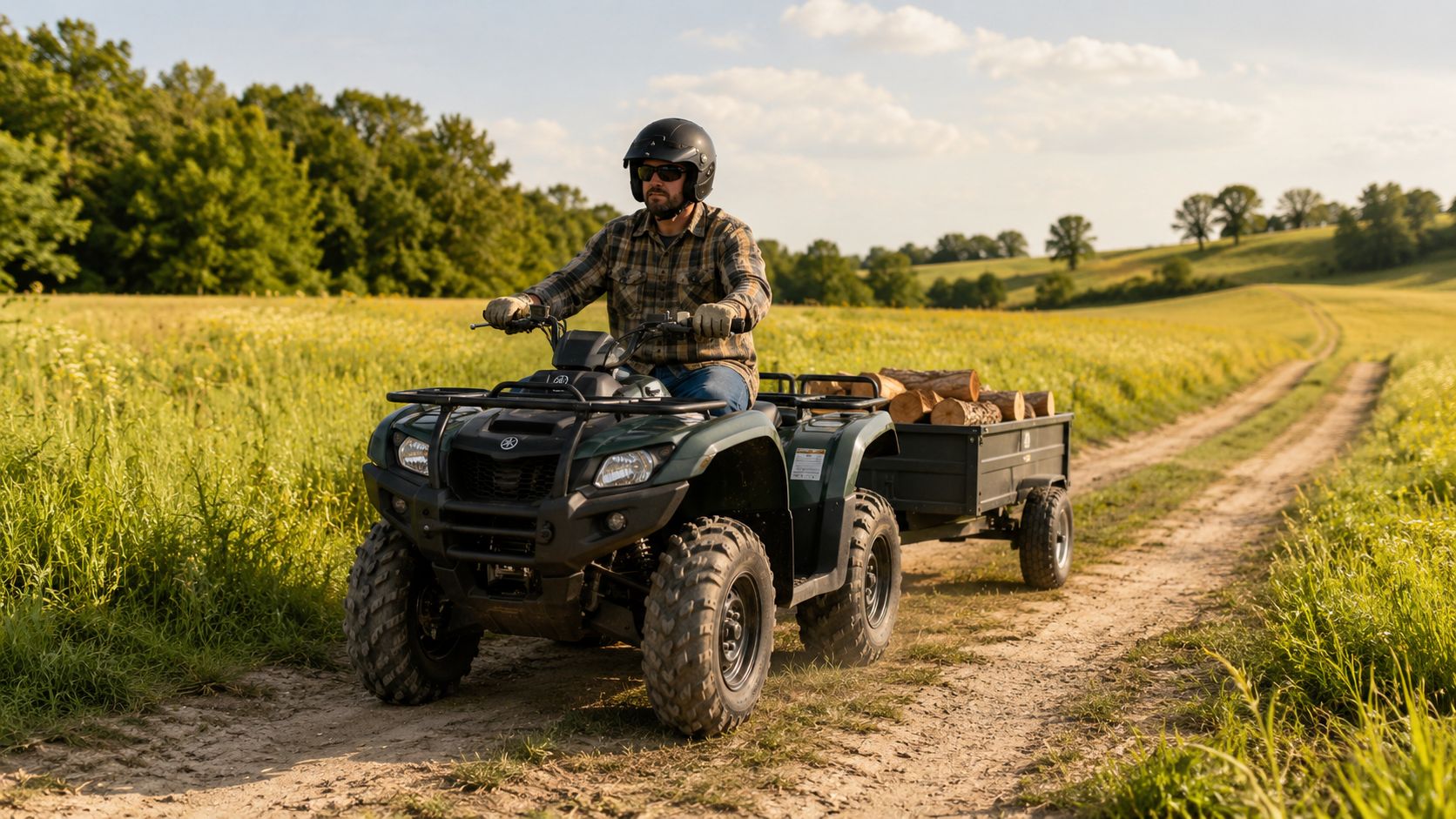
The category is large for a reason. Utility ATVs held 56% of the market share in 2025, with projected volume rising from 408,035 units in 2026 to 540,627 units by 2035 at a 3.2% CAGR, based on global ATV market reporting and utility segment data. That lines up with what buyers on farms, ranches, and acreage properties already know. These machines are work tools before they're toys.
Built for chores first
Sport ATVs usually advertise quick steering, lighter feel, and aggressive riding posture. Utility models go the other direction.
Look for these signs:
- Front and rear cargo racks: You want strong, usable rack space for feed bags, fencing tools, chainsaws, sprayer tanks, or hunting gear.
- Receiver or tow setup: A utility machine should look ready to pull a small trailer, drag, or implement without aftermarket improvisation.
- Durable body panels: Hard use means brush, mud, gate posts, and boots. Utility plastics need to take abuse without making you baby the machine.
- Work-oriented tires: Utility tires prioritize traction and durability over flashy tread patterns that look good online and wear badly in mixed use.
- Stable stance and suspension: A good work ATV should feel planted while carrying a load, not nervous or top-heavy.
How to spot a work machine fast
Start with the rider position. A utility ATV usually gives you a more upright seating posture and a layout that lets you shift your weight while still managing a load or trailer. Then look at the machine from the side. If the proportions suggest cargo and traction first, you're in the right category.
The quickest test is simple. Ask yourself whether the machine looks ready to carry tools before you ever add accessories.
A mainstream rec/utility example helps show what that means in practice. Honda's Rubicon 700 uses a 675 cc liquid-cooled single-cylinder four-stroke, an automatic torque-converter transmission, independent double-wishbone suspension, and 26-inch tires, with 6.9 inches of front travel and 8.0 inches of rear travel, as shown on Honda's rec/utility ATV lineup. Those details aren't just brochure language. They translate into usable traction, better load stability, and more confidence on rough ground.
What doesn't work well for utility duty is a machine that forces you to compromise every time you use it. Soft-looking racks, low-profile tires, and a sport-biased stance usually lead to frustration once the novelty wears off.
Decoding Key Specs and Features That Matter
A listing can throw a lot at you. Engine size, transmission type, suspension travel, tire size, cooling system. Most of that matters only if you know how it changes the machine in the field.
Engine size that fits real work
For most adult buyers, 500 to 700 cc is the useful middle ground. That range is commonly matched to hard trail riding, larger adults, and heavy work loads, while 700 to 1000 cc machines fit more specialized use such as deep mud and hill climbing, according to engine size guidance from SuperATV.
That sweet spot works because it gives you enough low-end pull for trailers, hills, and cargo without pushing you into a bigger, heavier, thirstier machine than you need. A lot of buyers over-shop engine size. They see the biggest number and assume it's safer. In practice, too much machine can make slow technical riding less pleasant and daily chores more cumbersome.
If you're pairing an ATV with hydraulic attachments or supporting equipment, it also helps to understand the basics of flow and load demands. Buyers working around implements can get PTO pump advice from MA Hydraulics to better understand how power delivery and work equipment interact, even if the ATV itself isn't a PTO machine.
What the rest of the spec sheet is telling you
Engine size gets attention, but the rest of the machine decides whether you'll like living with it.
A good utility spec sheet should make you ask these questions:
- Is it 4WD capable: If your ground gets slick, rutted, or uneven, 4WD matters more than bragging rights.
- What transmission does it use: Automatic torque-converter and CVT-style setups are popular because they're easy to use at low speed and while towing.
- How is it cooled: Liquid cooling usually handles sustained work better than a machine that feels happier on shorter, lighter runs.
- What do the tires suggest: Taller, more aggressive utility tires usually help with clearance and grip, but they can also affect ride feel and steering effort.
- How much suspension travel is usable: More travel sounds good, but load stability and composure matter more than showroom numbers alone.
Here's the plain-language version of those specs:
| Spec | What it means in real use |
|---|---|
| Engine displacement | How much reserve power you'll have under load |
| 4WD | How well the machine keeps moving when ground gets ugly |
| Automatic transmission | How easy it is to crawl, tow, and stop-and-go all day |
| Suspension design | How stable the ATV feels on ruts, washouts, and uneven fields |
| Tire size | Affects traction, clearance, and how the machine carries weight |
A machine can look great on paper and still miss your use case. For example, trail-focused buyers often care more about nimble steering and ride comfort, while landowners care more about rack usability, low-speed control, and whether the machine feels calm with gear strapped on.
The Big Decision Gas vs Electric Utility Vehicles
A major transformation has occurred in the buying process. Ten years ago, many work buyers didn't seriously consider electric. Now they do, and for good reason.
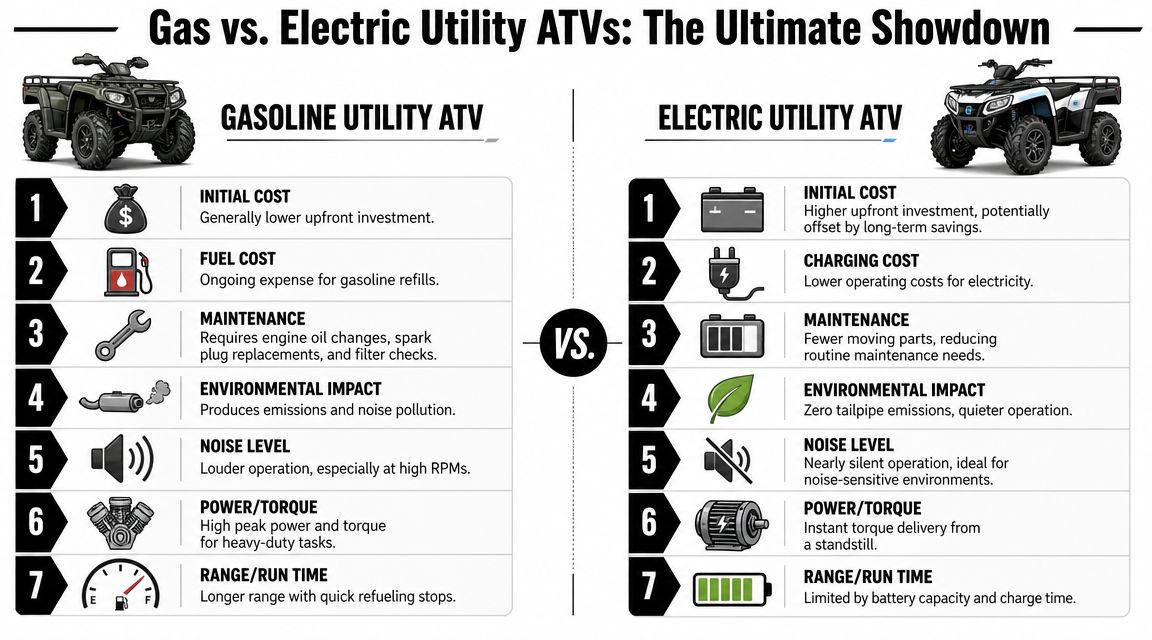
Gas remains the familiar choice. It's still the majority powertrain in the broader market, and it fits buyers who need long run time, quick refueling, and easy operation far from charging access. Electric appeals to a different buyer profile. It's especially attractive where noise, maintenance simplicity, and low-speed torque matter more than all-day refueling flexibility.
Where gas still makes sense
A gas utility ATV is usually the better fit when your days are unpredictable. Maybe you're covering a lot of ground, carrying extra fuel is easy, or the machine has to work on remote acreage with no convenient charging setup.
Gas also suits buyers who:
- Need fast refueling: Stop, fill, go back to work.
- Run long shifts away from buildings: You don't need to plan around charge time.
- Operate in mixed recreation and work use: Gas still fits buyers who want one machine for chores and longer backcountry loops.
- Prefer a familiar service path: Most owners already know the rhythm of oil, filters, plugs, and fuel system upkeep.
The downside is the upkeep. Engines ask for more routine attention. Noise is higher. Vibration is usually more noticeable. If you're checking livestock before sunrise or slipping into a hunting area, that sound matters.
Where electric changes the equation
Electric utility vehicles have a different feel. The first thing most riders notice is the quiet. The second is how immediate the torque feels from a stop. For repeated low-speed work, that's useful, not just interesting.
Electric tends to make more sense when:
- You work near houses, barns, or animals: Quiet operation changes the whole experience.
- Your routes are predictable: Daily loops on a property are easier to manage than unknown distances.
- You want less routine maintenance: Fewer moving parts usually means a simpler ownership routine.
- You value smooth control: Electric delivery is often easier for stop-start work and low-speed maneuvering.
Quiet operation isn't a luxury if you're around livestock, neighbors, or wildlife. It changes when and where you can use the vehicle without creating problems.
The compromise is planning. Charging matters. Run time matters. If your workday regularly extends beyond a predictable route, gas is still hard to beat for convenience.
Here's the side-by-side view.
| Feature | Gasoline | Electric |
|---|---|---|
| Initial ownership feel | Familiar to most buyers | Different buying logic, often chosen for operating simplicity |
| Refueling or charging | Quick refueling | Requires charge planning |
| Routine maintenance | More engine-related service items | Fewer routine mechanical service points |
| Noise | Louder in use | Much quieter |
| Low-speed torque feel | Strong, especially in larger engines | Immediate from a standstill |
| Best use pattern | Long, remote, irregular workdays | Predictable routes, quiet zones, repeated property work |
Neither one is automatically better. Match the powertrain to the job. Buyers get into trouble when they buy gas out of habit or electric out of curiosity without being honest about how the machine will live.
Is a Utility ATV Always the Right Choice
A buyer spends a week searching for a utility ATV for sale, then realizes the job calls for a different machine. That happens all the time. The label "utility ATV" pulls in anyone who needs off-road work capability, even if an ATV is only one of several workable options.
The better question is not which ATV to buy first. It is whether an ATV is the right vehicle type at all. Buyers should compare platforms based on access width, cargo layout, passenger needs, towing demands, noise limits, and how often the machine stops and starts, a practical framework also reflected in Polaris off-road ATV pages.
When an ATV is the better tool
An ATV earns its keep when the route is narrow and the load is light.
- Tight access: Gates, wooded trails, and narrow two-track routes often favor an ATV.
- One-person jobs: Fence checks, spot spraying, quick inspections, and hauling a few tools fit the ATV layout well.
- More rider control on rough ground: Some operators prefer shifting body position and picking lines actively on uneven terrain.
- Simpler transport: An ATV is usually easier to load on a smaller trailer or fit in a wider range of hauling setups.
For solo property work, that setup makes sense. A good utility ATV feels quick, direct, and easy to thread through places a wider machine will fight.
When a UTV fits the job better
A UTV starts to make more sense once the work involves volume, repetition, or another person. Getting in and out all day matters. So does having a bed instead of trying to strap everything to racks.
| Need | ATV | UTV |
|---|---|---|
| Carrying a second person | Limited | Usually more practical |
| Cargo management | Rack-based | Bed-based and easier to organize |
| Ease of entry and exit | More active rider movement | Better for frequent stops |
| Operator learning curve | Better for experienced ATV riders | Easier for mixed-skill users |
| Quiet site work | Depends on powertrain | Strong fit if electric |
I have seen plenty of owners force an ATV into chores that really belong to a side-by-side. Feed bags, fencing supplies, tool buckets, coolers, spray tanks, and one extra rider add up fast. The machine may still move the load, but it stops being convenient.
For some properties, an electric UTV is the better buy than any utility ATV. The Campus EV lineup, including the Campus E1 electric side-by-side UTV, fits that role well for buyers who need quiet operation, higher cargo capacity, and a more stable work platform for farms, campuses, hunting land, and large private properties.
If you keep wishing your ATV had a dump bed, a passenger seat, and less noise, the problem is probably vehicle type, not brand choice.
ATVs fall short in repetitive utility work with bulky cargo, frequent stops, or regular two-person use. That does not make them inferior. It means they are specialized. If your priority is trail access and solo mobility, buy the ATV. If your priority is hauling, organization, quiet operation, and side-by-side practicality, a UTV can be the smarter machine from day one.
Smart Shopping and Financing Your Purchase
A clean listing doesn't tell you much. Sellers know how to wash mud off plastics and take photos from flattering angles. What matters is whether the machine has been maintained, how it was used, and what it will cost after you bring it home.
Dealer lot or private sale
A dealership may offer more documentation, a clearer inspection process, and financing options. A private sale can be attractive if you know what you're looking at and you're comfortable walking away fast when something feels off.
Check a used machine in this order:
- Cold start behavior: Ask that it not be pre-warmed. A cold start tells you more than a machine that's already running.
- Rack and hitch wear: Cosmetic scratches are normal. Bent mounts or obvious overload damage are different.
- Tires and wheels: Uneven wear can point to alignment, suspension, or hard-use issues.
- CV boots and underbody: Torn boots, grease sling, and impact scars tell a more honest story than the seat does.
- Brakes and controls: Levers, pedal feel, and parking brake condition show whether the owner stayed on top of basics.
- 4WD engagement: If equipped, test it on appropriate ground and make sure it engages cleanly.
Look past the asking price
One marketplace currently shows used utility ATV pricing from $450 to $34,999, with an average of $8,252, according to used utility ATV listings on AutoTrader. That's useful for context, but sticker price alone can mislead you badly.
Real ownership cost also includes:
- Registration and insurance: Small line items add up over time.
- Maintenance catch-up: A cheap machine often needs immediate service.
- Accessories you need: Winch, plow, better racks, storage, or work lights.
- Tires: A worn set can change the deal math quickly.
- Downtime risk: If the machine is for property work, unreliability has a cost.
A budget buyer can make a smart purchase with a used machine. The mistake is buying the cheapest acceptable ATV instead of the least expensive one to own over the next few seasons.
Essential Maintenance for Long-Term Reliability
A utility machine earns its keep through consistency. Most expensive failures start as ignored small problems. Catch them early and the machine stays useful instead of becoming a shop project.
The short checklist that prevents expensive downtime
For gas models, stay disciplined with fluids, air filtration, and driveline checks. Utility work means dust, water, and slow heavy loads. That combination punishes neglected machines fast.
Keep your routine simple:
- Check fluids often: Engine oil and coolant condition tell you a lot before a warning sign becomes a repair bill.
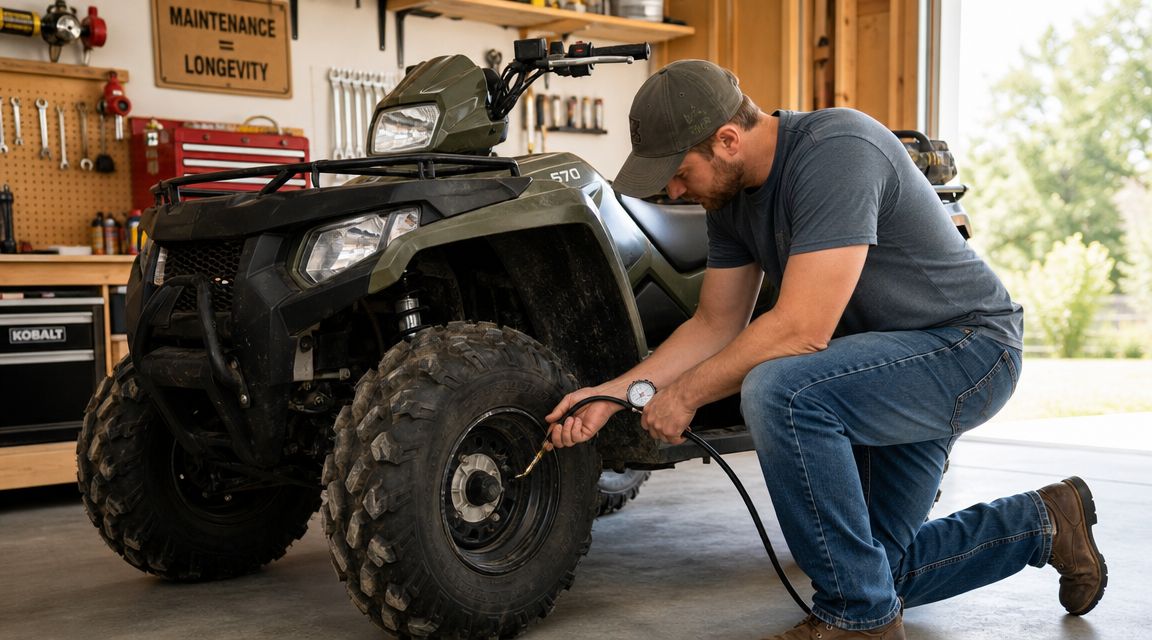
- Watch tire pressure and tread: A utility ATV that carries gear on bad tires feels unstable and works harder than it should.
- Inspect CV boots and axle areas: Small tears become bigger failures if mud and grit keep getting in.
- Test brakes before each serious workday: Stopping with cargo or on slopes isn't the place to discover weak brakes.
- Clean what traps heat and debris: Mud packed around components shortens service life.
If you're comparing driveline durability more broadly across work vehicles, this guide on assessing 4WD reliability for trade is a useful outside reference for thinking about long-term ownership risk and what reliability patterns matter.
What to watch on electric models
Electric models trade engine maintenance for battery and charging discipline. Keep connections clean, follow the charging routine recommended for the vehicle, and don't store it carelessly for long periods.
This walkaround video gives a useful maintenance mindset for utility machines in regular use:
The basics still matter on electric machines. Tires, brakes, suspension joints, steering components, and chassis fasteners don't care what powertrain you chose. Owners sometimes assume electric means maintenance-free. It doesn't. It means a different maintenance profile.
If your search started with a utility ATV for sale but your priorities are quiet operation, practical cargo handling, and an easier work vehicle setup, take a look at Campus EV. Their electric utility vehicle lineup is relevant for buyers who want a side-by-side platform for farms, hunting property, campuses, and other daily-use environments where noise and operating simplicity matter.