
You're standing beside a UTV with a fresh set of highly rated mud tires, wondering why the steering feels heavy, the tires rub at full lock, and the rear tread is already wearing unevenly. The marketing promised more traction. The machine now feels less predictable on the trail and less useful around the property.
That experience is common because UTV tire reviews often judge a tire in isolation. Real ownership depends on the match between tire size, wheel clearance, load capacity, tread design, inflation, and the work you do. A tire that shines in deep mud may be a poor choice for hunting roads, hardpack trails, or daily farm hauling.
The right question isn't just, “Which tire has the best rating?” It's, “Which tire will carry my machine, clear my wheels, handle my terrain, and wear at a cost I can accept?”
| UTV use | Tire direction | Tread and lug focus | Main compromise |
|---|---|---|---|
| Deep mud | Aggressive mud tire | Lugs above 25 mm, directional self-cleaning tread | More noise, drag, and hardpack wear |
| Mixed trails and property work | Mixed-use utility tire | Lugs from 18 to 25 mm, balanced tread | Less specialized in extreme mud or technical terrain |
| Hardpack trails and light utility | Trail tire | Lugs under 18 mm, often non-directional | Limited deep-mud clearing |
| Heavy hunting or work loads | Load-focused tire | Capacity and sidewall construction before maximum lug depth | May sacrifice comfort or nimble handling |
Table of Contents
- Why UTV Tire Reviews Usually Miss the Fitment Problem
- UTV Tire Market Trends and What They Mean for Buyers
- Comparing UTV Tire Types by Terrain and Tread Design
- How to Choose UTV Tires Using Load Range and Ply Ratings
- Best UTV Tire Choices for Hunting, Off-Road, and Utility Use
- How to Avoid Buyer Regret and Maximize Tire Value
Why UTV Tire Reviews Usually Miss the Fitment Problem
A rider chooses a top-rated mud tire for wet fields and muddy trails. The first ride seems convincing. Deep lugs pull hard, yet the UTV wanders on firm ground, steering effort increases, and the tread feels harsh between muddy sections.
That does not automatically indicate poor tire quality. It often indicates a poor application match.
A review may accurately praise traction while omitting whether the tire fits the original wheel, clears suspension parts, supports the vehicle at working weight, or behaves properly at the owner's usual pressure. Hunting, ranch, and construction machines carry different combinations of passengers, tools, fuel, racks, and cargo. A tire that feels controlled on a lightly loaded recreational UTV can feel vague, stressed, or difficult to steer on a working rig.
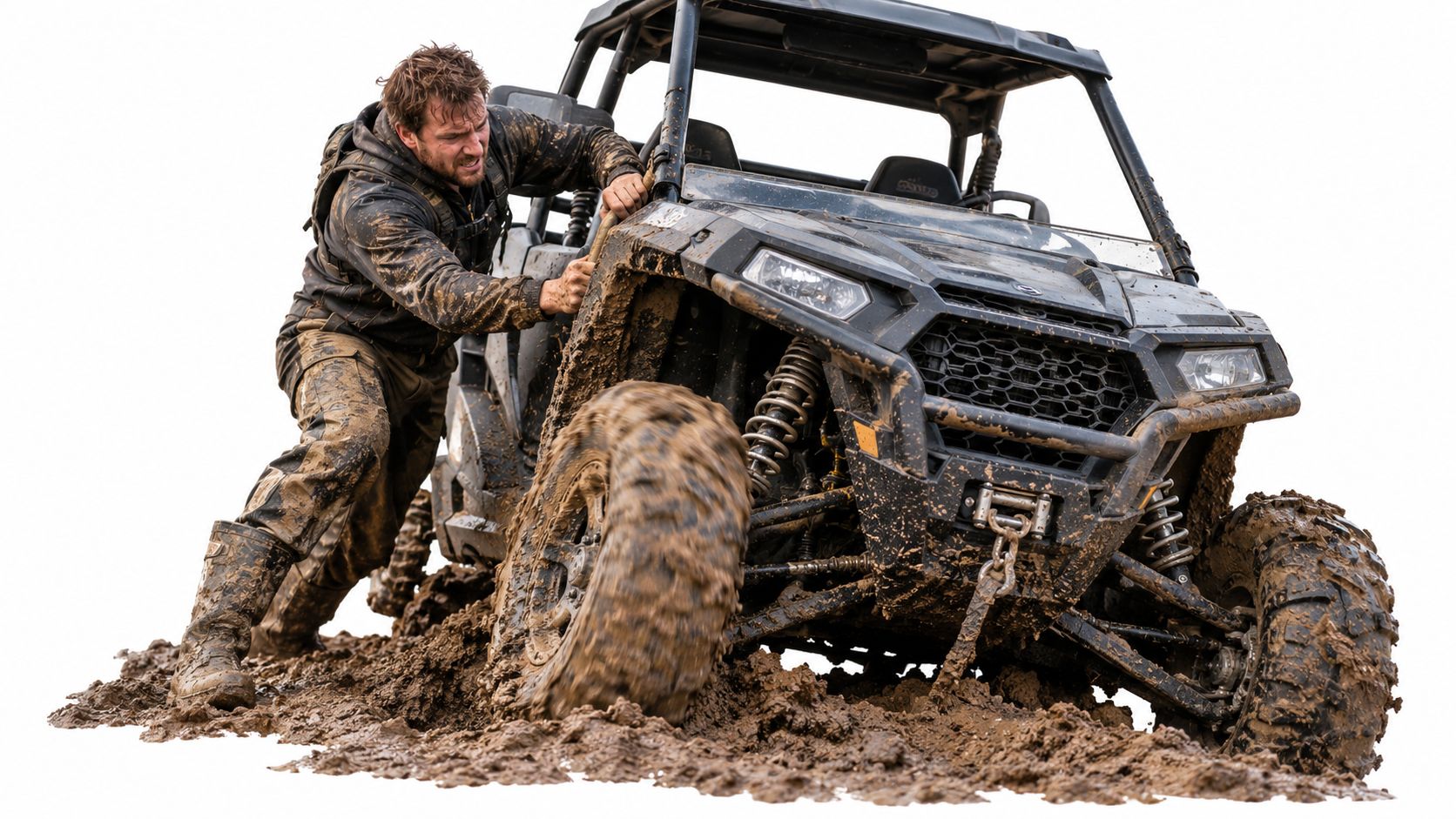
Fitment creates expensive surprises
Check the entire fitment before judging a tire by its diameter. Confirm the listed width, wheel diameter, bolt pattern, offset, suspension clearance, steering clearance, and compatibility with the intended wheel. A wider or taller tire can change steering feel, rubbing, and suspension clearance even when it mounts without obvious difficulty.
The same confusion appears when riders use ATV, UTV, and side-by-side as interchangeable terms. A clear explanation of what a side-by-side is helps identify the vehicle category, but model-specific manufacturer guidance still determines whether a tire and wheel combination is appropriate.
Practical rule: If a review does not address fitment and workload, treat it as a traction impression rather than a buying decision.
Star ratings hide setup mistakes
Negative feedback often centers on fitment problems rather than tire quality, while one large review base reports 87% five-star reviews and 3% one-star reviews in the cited roundup. The figures do not show that every complaint results from installation error. They do reinforce the buying lesson: a well-made tire can disappoint when its size, wheel, pressure, or load application is wrong.
Read reviews for patterns in rubbing, bead seating, steering effort, sidewall behavior, and tread wear. Give greater weight to reports from machines carrying similar loads and running on similar surfaces. A ranking without details about the UTV, setup, and workload cannot explain whether the tire failed, or whether the fitment created the problem.
UTV Tire Market Trends and What They Mean for Buyers
A tire that looks like a bargain can become expensive after it rubs the fender, overloads the wheel, or wears quickly under a working UTV. The expanding UTV tire market gives buyers more choices, but it also makes correct sizing, construction, and load selection more important than just finding a highly rated tread.
One market report values the global ATV and UTV tires market at USD 1.51 billion in 2025, projecting USD 2.31 billion by 2035 at a 4.30% CAGR, with North America holding a 37.18% share according to the published market data. That projected growth reflects continuing demand for replacement tires across recreation, farming, ranching, hunting, and utility work. For riders, the practical benefit is a broader aftermarket with more choices for different machines, surfaces, and workloads.
Growth doesn't eliminate the need to compare carefully
A separate estimate places the category at USD 385.8 million in 2018, rising to USD 698.1 million by 2026 at a 7.5% CAGR, while another framing values it at USD 887.99 million in 2024, reaching USD 1.73 billion by 2032 at an 8.70% CAGR in its market analysis. The differing totals and forecast periods show why market figures should not be treated as direct price predictions. They use different definitions and methods.
The common point is more useful for buyers: manufacturers are serving recreation, military, and utility applications with increasingly specialized products. That variety can improve availability, yet it also increases the chance of choosing a tire built for the wrong job.
A mud tire may add unnecessary steering effort and rolling resistance on firm trails. A lighter recreational tire may wear rapidly when a UTV carries tools, game, or a loaded trailer. An oversized tire can also create rubbing or alter handling even if it mounts successfully.
Check the vehicle's approved size range, wheel width, clearance, inflation guidance, and expected operating load before comparing tread claims. A practical guide to quad pricing can help place tire costs within the wider vehicle investment. The right comparison is not the cheapest tire or the most aggressive pattern. It is the tire that fits the machine and carries its real workload without creating avoidable replacement costs.
Comparing UTV Tire Types by Terrain and Tread Design
A UTV that feels planted on a packed forest route can become difficult to steer after the same tire is fitted for deep mud. Tread geometry affects grip, cleaning, steering effort, noise, and wear. Lug depth, lug spacing, tread direction, and contact area also influence whether a tire suits the terrain or only looks aggressive in a product photo.
Independent UTV tire guides generally place under 18 mm in hardpack and trail territory, 18 to 25 mm in mixed riding, and above 25 mm in deep mud as summarized in this tire guide. Use those ranges as a starting filter, not as a substitute for checking vehicle size, clearance, axle load, and the conditions you ride in.
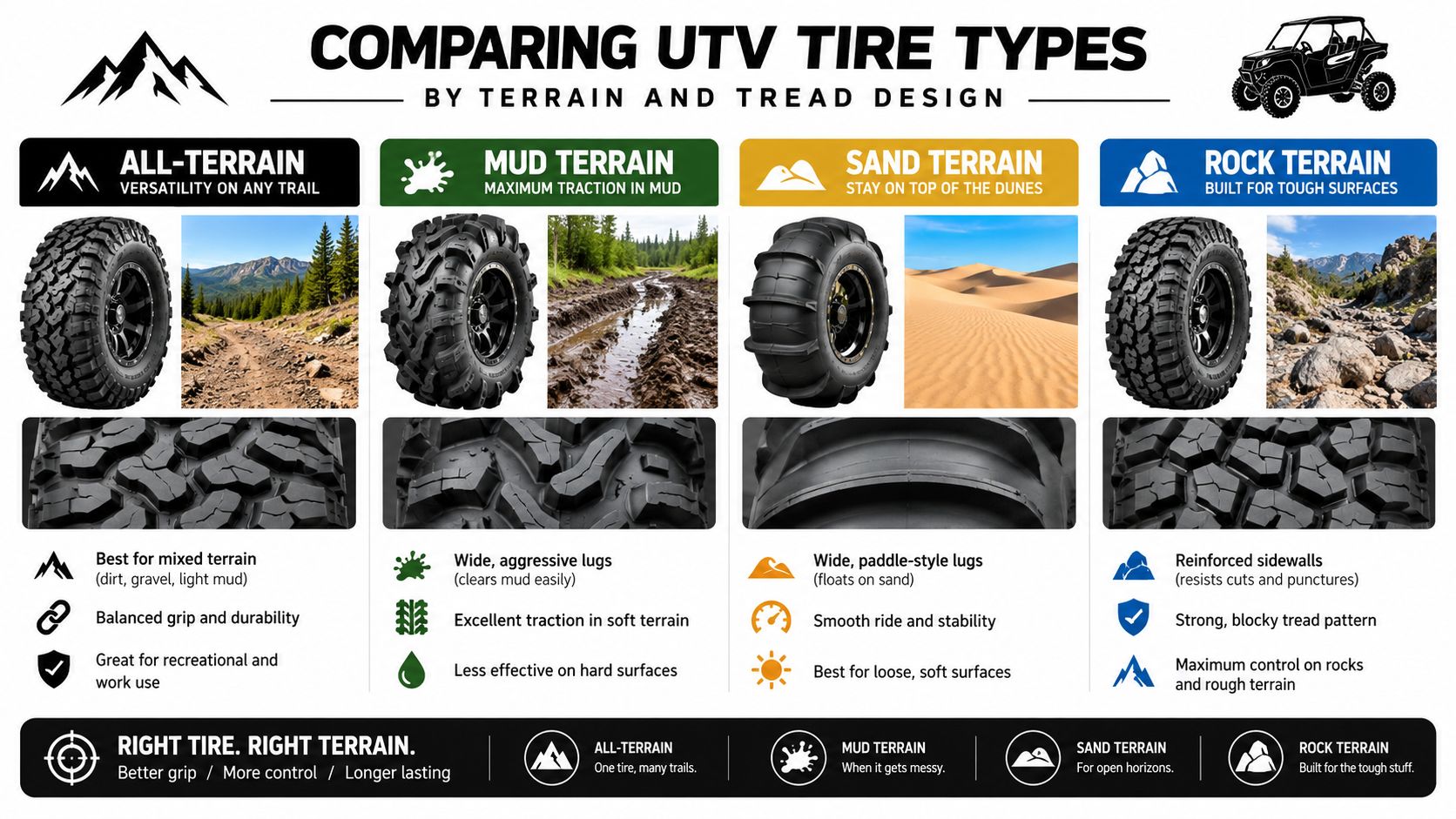
Trail tires favor control and consistent wear
A packed gravel access road with shallow ruts exposes the strengths of a trail tire. Tread under 18 mm generally suits hardpack, gravel, packed forest roads, and light mud. The shallower pattern keeps more rubber in contact with firm ground, giving the UTV a settled feel through turns and reducing the sensation of climbing over every rut.
A non-directional tread often fits machines that split time between trails, yards, roads, and work lanes. It tends to wear evenly and allows more flexible tire rotation. That can matter more than maximum mud bite when a UTV accumulates regular road miles.
The compromise appears when the route becomes soft. Smaller lugs have less ability to reach firmer material below mud, while tighter spacing can fill with dirt and reduce usable traction.
Mud tires trade manners for self-cleaning
A UTV buried to its axles in wet clay needs a tread that can keep shedding material as the wheels turn. Mud tires with lugs above 25 mm use taller, widely spaced blocks to bite into loose ground and give mud room to exit. Directional patterns can improve this cleaning action by moving material outward during rotation.
That recovery advantage carries costs on firm trails. Tall lugs can make steering feel busier, increase noise, and wear faster on hard surfaces. They can also distract buyers from fitment: a tire that looks capable may still rub, overload the machine, or alter handling if its size and construction do not match the UTV.
Mixed-use tires balance bite and road manners
For a machine moving between wet pasture, gravel, wooded trails, and occasional mud, a balanced tread in the 18 to 25 mm range often provides the most usable compromise. It offers more open space and bite than a shallow trail pattern without making every firm surface feel harsh or unsettled.
Non-directional mixed-use tires suit work machines and fleets because even wear simplifies rotation. A directional pattern can be the better choice where mud clearance matters more, but the owner must preserve the intended rotation direction during service. Choosing this middle ground can reduce the hidden cost of replacing a tire that was technically capable, yet poorly matched to the UTV's daily terrain and load.
How to Choose UTV Tires Using Load Range and Ply Ratings
Load selection starts with the machine at its heaviest realistic working condition, not its empty showroom weight. Add passengers, tools, racks, hunting equipment, feed, fencing supplies, or building materials. Then compare that use with the vehicle manufacturer's tire and payload guidance.
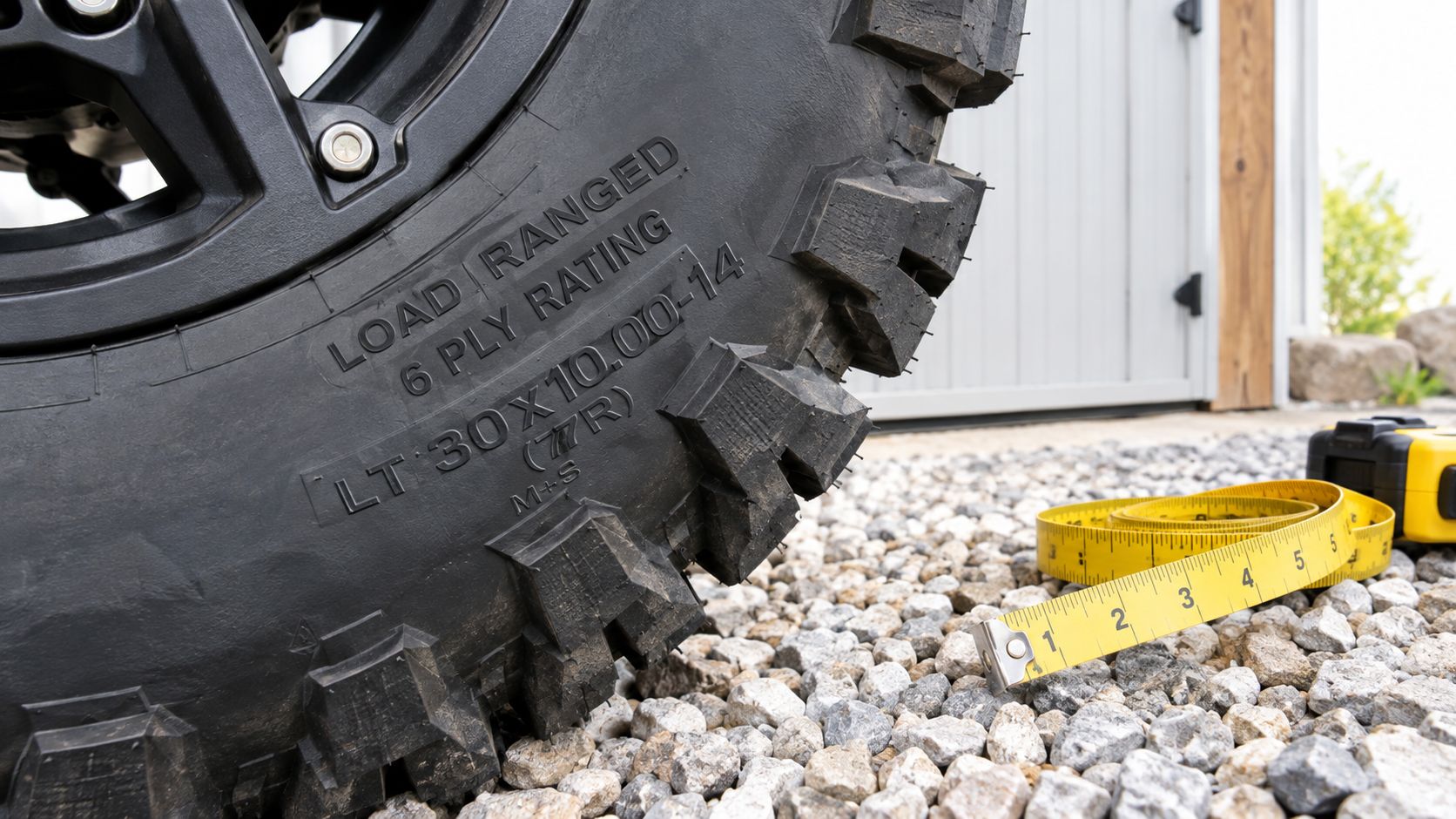
Read the sidewall before reading the reviews
The sidewall gives you the starting facts: tire size, wheel diameter, construction markings, maximum load information, and inflation limits. Ply rating describes construction strength and category, not a simple promise that more is always better. The correct selection must support the application while remaining compatible with the wheel and vehicle.
Use this sequence:
- Record the original specification. Note front and rear sizes, wheel diameter, recommended pressure, and the machine's stated load guidance.
- Estimate the working load. Include people and cargo you typically carry, not only the occasional empty ride.
- Check the replacement rating. Confirm that the tire's stated capacity and construction suit the loaded axle and terrain.
- Verify wheel compatibility. A tire's size and rating do not confirm that its bead, width, or fit works with your wheel.
- Set pressure from the manufacturer's guidance. Do not copy a pressure from a different tire or UTV without a reason.
Why overloading shows up as handling trouble
An overloaded or poorly matched tire can feel soft, vague, or unstable. Heat builds in the tire as it flexes, and repeated heavy work places greater stress on the casing and sidewall. An overbuilt tire may provide durability, but it can also deliver a harsher ride or less compliance when the UTV is lightly loaded.
That's why the heaviest-looking option isn't automatically the right one for a hunting machine. Hunting trips may need sidewall protection and reliable load support, while a recreational trail rig may benefit more from predictable steering and lower rolling resistance.
Load first, traction second: A tire that can't support the machine's real job isn't a performance tire for that job.
Pressure also deserves regular attention. Check it when the tires are cold, inspect for cuts and bulges, and look for uneven tread wear that suggests an alignment, pressure, rotation, or loading issue.
For a visual reference on how size markings appear beside the tread and sidewall, watch the following installation-focused video.
Best UTV Tire Choices for Hunting, Off-Road, and Utility Use
There is no single best UTV tire for every rider. The right choice depends on the terrain, cargo, and compromises your machine faces most often. A tire should suit the regular route and workload, not the unusual condition that appears once a season.
Hunting and property access
A hunting rig may travel quietly over hardpack, leaves, gravel, and wet ground before reaching a stand. Prioritize quiet tread and predictable steering over maximum lug depth. Moderate lugs can clear occasional mud without causing excessive vibration or wandering between hunting areas.
Fitment becomes more demanding when the UTV carries racks, coolers, tools, or game. Check clearance with the suspension loaded and the steering at full lock. A tire that barely clears while parked can rub when the machine compresses through a rut, turning a sizing mistake into damaged tread, bodywork, or lost trail time.
Trail riding and recreation
Trail riders who spend most of their time on firm ground should look for controlled steering, even wear, and protected sidewalls. A non-directional pattern can suit mixed routes because it usually allows more flexible rotation and helps maintain consistent wear.
For long gravel access roads, lower vibration and stable tracking often matter more than aggressive appearance. If the trails regularly become deep and soupy, move toward a mixed-use design rather than choosing the tallest available lug. That preserves more predictable behavior on the firm terrain you ride most frequently.
Farm, ranch, and construction work
Work UTVs need dependable support for their actual cargo before they need maximum mud performance. Match tire construction and capacity to the machine's working load, then choose a tread for the ground around the property. Moderate lugs suit vehicles moving between pasture, gravel, packed soil, and occasional wet areas.
The best farm UTV options can help frame the vehicle's wider job, but tire selection still depends on the exact load, wheel specification, and available clearance. A tire labeled “utility” is not automatically suitable for every payload or wheel.
A simple decision filter
Use the most common conditions as the first filter:
- Mostly hardpack and roads: Choose controlled handling, consistent wear, and a compatible load rating.
- Mixed trails, pasture, and wet ground: Choose balanced tread and sidewall strength suited to cargo.
- Regular deep mud: Choose open, directional tread with deep lugs, while accepting poorer hardpack manners.
- Heavy daily hauling: Choose capacity, casing durability, and confirmed fitment before aggressive appearance.
A correct tire can feel average in the wrong application. A well-matched set usually works better because its size, construction, and tread support the job your UTV performs.
How to Avoid Buyer Regret and Maximize Tire Value
The purchase price is only one part of tire cost. A wrong size can force a return, a wheel mismatch can require new hardware, and an unsuitable tread can wear quickly on the surfaces you use most. Add mounting, balancing, lost work time, and repeated replacement, and the cheapest-looking option may become the expensive choice.
Start with a written fitment check. Keep the original tire sizes, wheel details, clearance notes, load requirements, and intended pressure in one place before you compare models. If a seller can't clearly confirm compatibility, pause the order instead of assuming the tire will work.
Build a service routine around the job
Inspect the tires before demanding rides. Look for cuts, punctures, separated tread, sidewall damage, and unusual wear. Rotate only when the tread pattern and manufacturer instructions allow it. Directional tires may require a specific rotation arrangement, while non-directional designs generally offer more flexibility.
Inflation deserves the same discipline. A pressure that works for an empty trail ride may not be appropriate for a loaded work run, and a pressure borrowed from another tire can create poor contact or excessive flex. Use the vehicle and tire manufacturer's guidance as the baseline, then watch how the tire wears and handles under the actual load.
Judge value by useful service, not star count
A high review score can tell you that many buyers were satisfied, but it can't tell you whether their machines, wheels, cargo, and terrain match yours. Reviews become useful when you extract details about the setup. Give extra weight to comments that mention the exact size, clearance, workload, pressure, and surface.
The best tire is the one that stays predictable after the novelty wears off.
Appearance also affects upkeep. After cleaning mud from the sidewalls, use a suitable product and choose the right applicator if you apply tire dressing, so you can work neatly around the tread and valve area. Cosmetic care won't fix a load or fitment error, but careful maintenance makes damage and wear easier to spot.
Before buying, ask yourself three questions:
- Will it fit? Confirm the wheel, clearance, size, and steering range.
- Will it carry the job? Match construction and capacity to the loaded machine.
- Will it suit most rides? Choose for your regular terrain, not a rare extreme.
Those checks do more for long-term satisfaction than chasing a top-ranked tire without reading the details.
Campus EV offers electric UTVs and electric powersports built around practical quality, value, and reliability for hunters, farmers, ranchers, construction workers, and warehouse teams. Visit Campus EV to explore the Campus E1 electric side-by-side and choose a work-focused vehicle with the same attention to fitment, load, and real-world use that you apply to your tires.