
You're parked below the ridge before daylight, trying to keep the wind in your favor. The machine is only a few hundred yards from the glassing point, but the sound of the approach still matters. A gasoline UTV announces every throttle input. An electric model lets you crawl in with a smoother, quieter drivetrain, then sit without exhaust heat, vibration, or an idling engine working against you.
That advantage is real, but it doesn't make every electric side-by-side a hunting vehicle. The best electric UTV for hunting is the one that completes your actual mission, with your gear, on your terrain, under your access rules. It must reach the hunting area, carry equipment or harvested game, return with energy in reserve, and stay within the routes where motorized travel is legal.
The U.S. Fish and Wildlife Service recorded 14.4 million hunters age 16 and older in its 2022 National Survey. Those hunters made 165 million hunting trips and spent 241 million days hunting, which means a hunting UTV needs to survive repeated field use rather than occasional recreational outings. The 2022 National Survey also recorded 11.5 million big-game hunters, making reliable access, cargo capacity, and recovery ability central buying criteria.
| Electric UTV class | Best hunting use | Main advantage | Main limitation |
|---|---|---|---|
| Compact utility model | Small properties, short scouting routes, predator or hog control | Maneuverability and simple charging | Limited room and loaded range |
| Mid-size two-seat model | Western deer and elk access, rougher public-land routes | Better clearance, traction, payload, and range | Heavier and more expensive |
| Crew or range-extended model | Camp support, farm work, multiple passengers, heavy hauling | Seating, cargo, and mission flexibility | Added cost, size, and system complexity |
Table of Contents
- What Hunters Actually Need From a UTV
- Hunting-Specific Requirements That Drive the Specs
- Comparing the Main Electric UTV Classes
- Planning Real Range for a Hunt Day
- Where Electric UTVs Are Legal to Use
- Best Electric UTV Picks for Common Hunting Setups
- Cold Weather Range and Charging Reality
- Outfitting Your Electric UTV for the Field
- Buying Checklist and Ownership Costs
- Final Evaluation and Field Testing Checklist
- Hunting Electric UTV Questions Answered
What Hunters Actually Need From a UTV
Before sunrise, you ease along a timber road toward a glassing ridge. An electric UTV can cover that approach with far less low-speed drivetrain noise than a gas machine, then shut down without leaving a hot engine ticking beside the trail. Animals can still hear tires over rock, suspension movement, loose gear, and a careless throttle hand. Quiet propulsion helps, but it does not make the vehicle silent.
Judge the machine by the hunt it must complete. A useful electric UTV carries a bow or rifle, pack, cooler, climbing stand, recovery equipment, and field-dressing supplies. It may also need to bring out a quartered deer or pull a small trailer with feed, water, or fencing material. That makes payload, bed access, ground clearance, traction, and recovery points more important than a headline horsepower figure.
Score the vehicle against the hunt
Start with the hardest legal trip you expect to make. Map the route from the gate to camp, blind, glassing point, and recovery area. Add the return distance, terrain changes, passenger weight, cargo, and the energy needed to get home. An electric UTV should finish that route with reserve, not arrive at the far end relying on perfect weather and an empty bed.
Public-land access adds another filter. The Bureau of Land Management manages approximately 245 million acres, and more than 99% of BLM-managed public lands are open to hunting. It also reports 60 million annual visits from hunters, anglers, hikers, off-highway-vehicle riders, and other recreationists. BLM hunting and fishing information makes the buying priority clear: treat an electric UTV as a low-impact access and utility tool, then verify the specific motorized routes, seasonal closures, and local rules.
Practical rule: Buy for the hardest legal trip, heaviest expected load, and longest return route, not the easiest ride around the driveway.
Gas still wins some missions
Gas remains the better choice for a remote hunt that requires long travel away from charging, repeated heavy towing, or fast recovery after a distant animal goes down. It refuels quickly and usually has broader dealer and parts support. Electric charging commonly takes 4 to 12 hours, so an overnight outlet plan matters more than brochure range. Independent guidance places typical range around 25 to 45 miles per charge under stated conditions. Independent electric UTV range and charging guidance
Choose electric when every outing returns to a cabin, barn, or property charger and the route fits the vehicle's usable reserve. Choose gas when a fuel can is your only dependable energy source.
Hunting-Specific Requirements That Drive the Specs
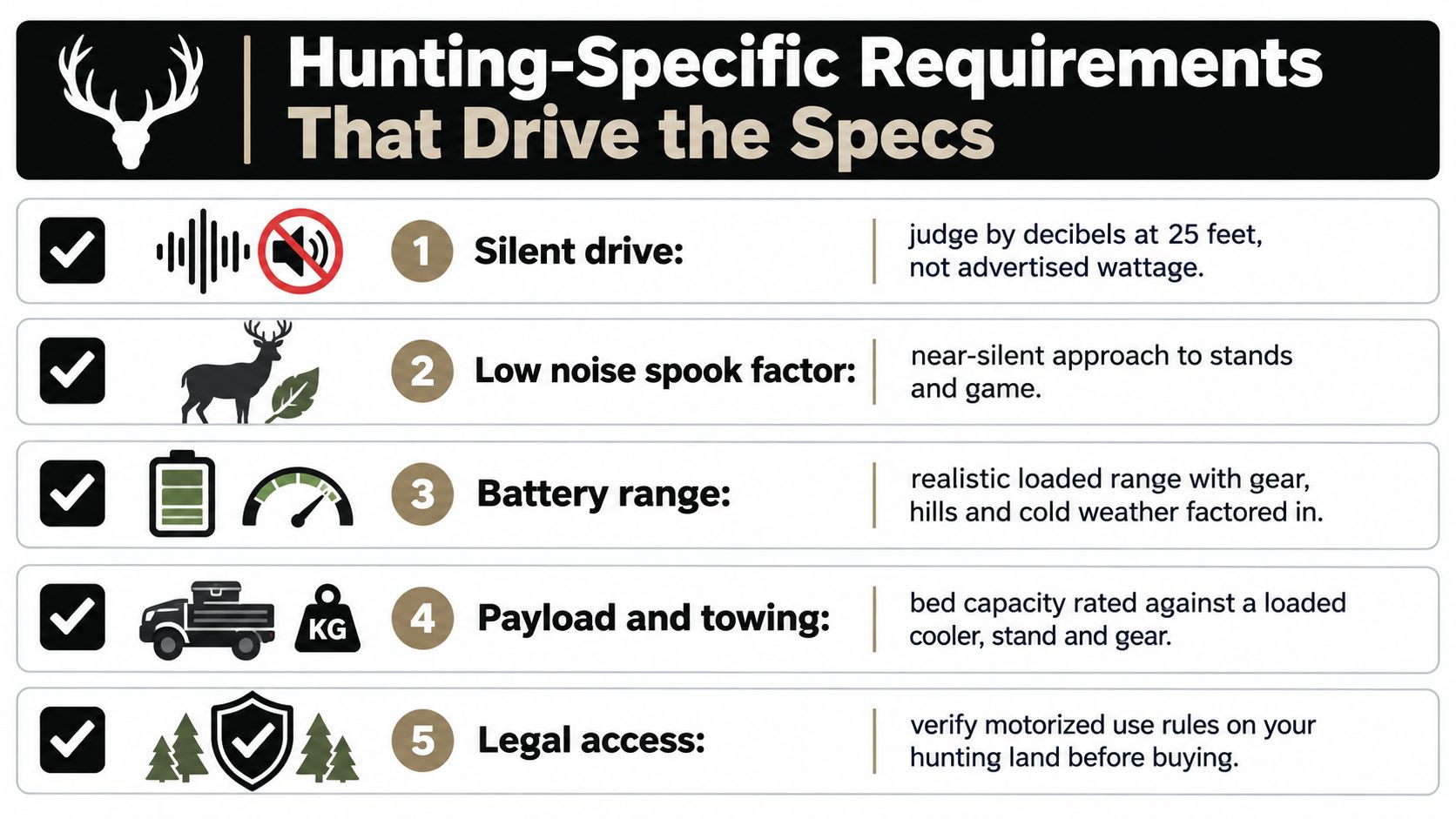
A hunting UTV earns its place by completing the mission safely, with battery reserve left for the return trip. Horsepower is a poor first filter. Hunting travel usually happens at controlled speed, over uneven ground, with passengers, weapons, packs, and recovery equipment aboard. Start with noise, traction, usable energy, and load capacity.
1. Judge quiet operation in context
Electric motors produce less low-speed drivetrain noise than gasoline engines, but “silent” is a marketing shortcut. One technical comparison places gasoline UTVs around 80 to 90 decibels and electric models generally below 60 decibels, while another places electric operation around 60 to 70 decibels. Hunting UTV noise and utility guidance explains why those figures are comparisons, not a guarantee for every vehicle or trail.
Evaluate the complete machine. Tire tread, reduction gears, cooling fans, suspension movement, and loose cargo can become the dominant sounds. Choose predictable throttle mapping, a controllable low-speed setting, and regenerative braking over a headline power figure when easing toward a stand.
2. Treat heat and scent as field factors
A battery-electric UTV produces no tailpipe exhaust while moving and avoids the fuel and oil odors associated with a combustion engine. That makes close-range access easier to manage, especially when stopping near a blind or glassing position.
The vehicle is not scent-free. Tires collect soil and vegetation, occupants bring human odor, and a winch or gearbox can still create heat. Park downwind, limit unnecessary movement, and use the quiet drivetrain as an access advantage rather than a reason to drive closer to game.
3. Calculate loaded range
Build the range plan around the longest expected round trip, not the distance from the parking area to the first stand. Count passengers, firearms, packs, recovery equipment, cargo, slopes, loose soil, headwind, and cold weather. Rated range is a starting point. Hills, payload, soft terrain, and weather can reduce the distance available in the field.
Keep a meaningful battery reserve for changing conditions, a recovery, and the final route back. Range-efficiency guidance for electric UTVs offers practical ways to reduce energy waste, but careful driving cannot compensate for a battery that is too small for the route. If the hunt requires a long detour or an animal recovery far from the trailhead, size the vehicle for that harder mission.
4. Demand useful clearance and traction
Ground clearance matters on routes with ditches, embedded rocks, ruts, and fallen timber. Four-wheel drive, a locking or limited-slip differential, proper skid protection, and tires suited to the soil matter more than a high top-speed figure. Compare available tread and sidewall options in these UTV tire reviews.
Smooth electric torque helps at close range. The motor responds immediately at low speed, letting you climb or ease over an obstacle without repeatedly revving an engine and breaking traction. Keep tire pressure appropriate for the surface, because the wrong pressure can erase the advantage of good drivetrain control.
5. Size the bed for recovery work
Check payload and towing separately. A vehicle that carries hunting gear comfortably may still struggle with a loaded trailer or harvested game on a difficult climb. Published towing ratings vary by model, so compare the rated capacity with your actual trailer, recovery equipment, passengers, and field load.
Weigh the equipment you routinely carry before buying, then include the recovery load. A dump bed, strong winch, receiver hitch, and durable bed liner serve real hunting needs. They are working equipment, not showroom extras.
Comparing the Main Electric UTV Classes
Electric UTVs fall into three useful hunting categories. The right class depends less on brand reputation than on whether the machine can complete your route with its intended load and still fit the legal trail.
| Class | Example / use case | Stealth | Range under load | Ground clearance | Payload and towing | Best fit |
|---|---|---|---|---|---|---|
| Compact utility | Small acreage, predator control, short scouting loops | Strong at low speed | Best on predictable, short routes | Adequate for maintained trails and light rough ground | Limited compared with larger platforms | One or two occupants with modest gear |
| Mid-size two-seat | Western deer and elk access | Strong, if tires and accessories stay quiet | Better battery and load capacity | Better suited to ruts, rocks, and slopes | Balanced utility for gear and recovery | Hunters covering rougher public-land routes |
| Crew or range-extended | Camp support, farm work, multiple occupants | Quiet electric drive, but larger machines create more tire and body noise | Strongest mission flexibility, especially with added energy support | Depends on chassis and loaded weight | Best for passengers, trailers, and heavy equipment | Farms, shared camps, and extended utility work |
Compact utility models
Compact machines turn tightly and take less room on narrow routes. That matters on small properties where a full-size side-by-side constantly catches branches, clips gates, or forces you to widen an established trail.
Their weakness is margin. A small bed fills quickly, and every passenger or heavy recovery load takes a larger share of available energy. Choose this class when the property is familiar, charging is close, and the main mission is quiet access rather than long-distance hauling.
Mid-size two-seaters
This is the strongest general-purpose class for a serious solo or paired hunter. You get more room for gear, stronger chassis components, useful clearance, and a better chance of completing a rough route without stressing the platform.
The trade-off is weight. A larger machine consumes more energy climbing and moving through soft ground, so its advertised range still needs a loaded-route test. Fit aggressive but appropriately quiet tires, a winch, underbody protection, and lighting that supports safe legal travel without turning every approach into a spectacle.
Crew and range-extended models
Crew cabs make sense when the vehicle also supports a farm, ranch, or base camp. They can carry more people and equipment, but their longer wheelbase and greater weight can become liabilities on tight hunting trails.
Range-extended or hybrid-electric designs address the biggest electric objection, remote energy. They add complexity and may introduce engine noise when the generator runs. Choose one because your mission requires sustained field operation, not because a larger battery sounds impressive.
Planning Real Range for a Hunt Day
A hunt that ends at the trailhead is only successful if the UTV can also bring back your gear, an animal, and anyone who needs help. Advertised range gives you a baseline, not a route plan. Mud, hills, loose ground, tire pressure, payload, stop-and-go driving, headwind, and cold all increase energy use. Two occupants, a full cargo bed, or a recovery load can change the result even when the dashboard shows plenty of range.
Plan the longest round trip from the parking area, including the distance to and from the hunting route. Start with a full battery and hold back roughly 20% capacity for terrain changes, an injured animal, a stuck partner, or an unexpected detour. Electric UTV range planning guidance reports that hills, payload, loose terrain, and wind can reduce usable performance, with practical range often reaching only 60% and 80% of the rated figure.
Use the route, load, and weather for the decision. A UTV efficiency guide for improving energy use can help you reduce avoidable consumption, but efficiency adjustments do not replace a reserve.
A worked mission without brochure optimism
Take a hunt with a modest outbound route, a loaded cargo area, a harvested deer on the return, and temperatures near freezing. The distance may look manageable on paper, yet climbing, soft ground, extra weight, and cold air all raise consumption. A route that works for an unloaded scouting trip may fail during recovery.
If the machine uses most of its displayed range before the return begins, the plan is already wrong. Keep the vehicle warm when possible, limit unnecessary stops and hard acceleration, and begin the trip with enough charge for the complete mission. Regenerative braking can recover some energy on descents, but it cannot replace reserve capacity.
The return trip is part of the hunt. If the vehicle can reach the stand but cannot bring you, your gear, and the animal back safely, it does not have enough range.
Charge immediately after returning so the next outing starts predictably. Set tire pressure within the manufacturer's recommended range for the terrain. On the final leg, use smooth throttle inputs and avoid unnecessary speed, especially after the battery gauge enters its reserve.
Where Electric UTVs Are Legal to Use
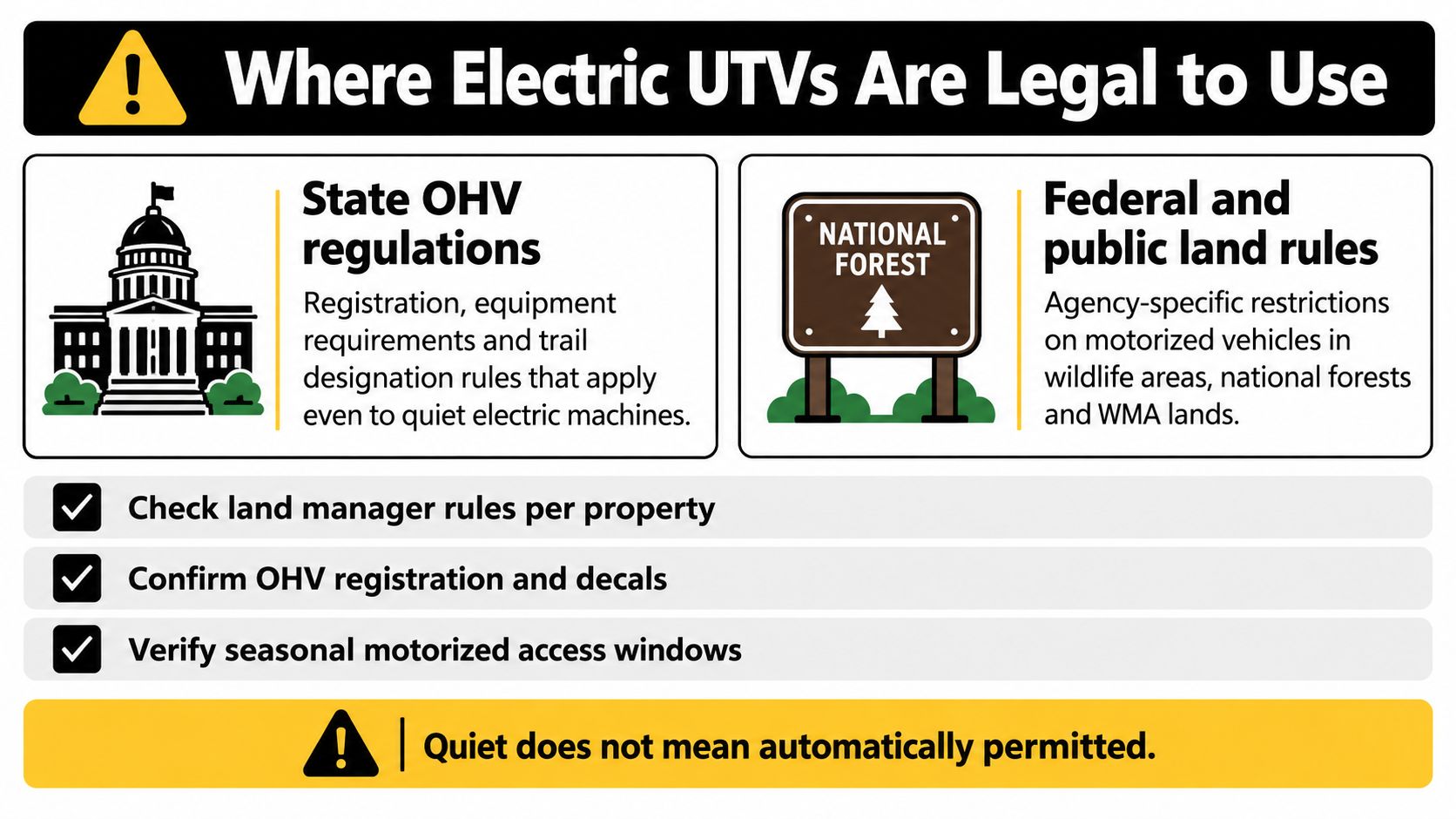
Quiet operation doesn't create access rights. A battery-powered side-by-side can still be classified as a motor vehicle or OHV, and public-land managers can restrict it to designated roads and trails. The route, parking location, seasonal closure, and vehicle classification matter more than the sound coming from the motor.
Texas provides a clear example. The state restricts motor vehicles, including electric vehicles, to designated roads or trails in the relevant public-land context, and most public-land OHV operators need the applicable decal. Texas Parks and Wildlife public hunting FAQ is the kind of state-level resource you should check before loading the machine.
Minnesota and Montana show why one state's process can't be copied into another. OHV classifications, wildlife-management-area rules, seasonal closures, and route restrictions vary by jurisdiction and land manager. In Montana, hunters may also need to remain on legal roads or trails and walk from the parked machine rather than treating a quiet UTV as an invitation to use single-track or cross-country routes.
Verify these items before the trip
- Vehicle classification: Confirm whether the state treats the model as an ATV, UTV, OHV, or another category.
- Registration and decals: Check title, registration, decal, and insurance requirements.
- Route designation: Obtain the current motor-vehicle-use map or equivalent route map for the property.
- Seasonal access: Look for closures affecting roads, trails, wildlife areas, and hunting units.
- Recovery permission: Confirm whether the land manager permits motorized game retrieval and where you may park.
Use the quiet drivetrain to reduce disturbance on a legal route. Don't use it to justify an illegal shortcut, a closed trail, or parking closer to game than the rules allow.
Best Electric UTV Picks for Common Hunting Setups
The best choice changes with the property. A compact machine is often the smarter hunting tool on a small whitetail tract, while a mid-size two-seater is easier to justify in rough western country. A farm operator may need a utility platform that treats hunting as one task among many.
| Hunter profile | Key need | Recommended class | Example configuration |
|---|---|---|---|
| Small-property whitetail hunter | Quiet access, tight turns, gear transport | Compact utility | Two-seat layout, dump bed, quiet tires, roof, windshield, and low-speed drive |
| Western public-land elk hunter | Clearance, traction, recovery, and route margin | Mid-size two-seat | Four-wheel drive, aggressive terrain tires, winch, skid protection, lighting, and the largest practical battery |
| Farm and predator-control operator | Bed utility, towing, and a partner seat | Crew or utility platform | Dump bed, receiver hitch, winch, windshield, roof, work lights, and charging at the farm base |
Small-property whitetail
This hunter benefits most from compact dimensions and predictable charging. The vehicle may travel only short loops between a parking area, food plot, blind, and recovery point, so maneuverability matters more than maximum battery size.
The Campus E1 fits this use case as a compact electric side-by-side option with selectable two-wheel and four-wheel drive, 11 inches of ground clearance, a 3,000-pound winch, a 2,500-pound towing capacity, and an electric power dump bed, based on the product information supplied by Campus EV. Keep the configuration simple. Choose tires that won't make unnecessary noise, add a windshield for cold mornings, and leave room in the bed for recovery and field-care equipment.
Western public-land elk
Choose the mid-size class for rougher access and longer approach routes. Four-wheel drive, clearance, a winch, protection underneath, and a battery sized for a loaded round trip matter more than a high top-speed rating.
This is also where electric can fall short. If the route is remote, steep, cold, and far from a charger, gas remains easier to support. Don't buy an electric model for an elk unit until you've checked the route map, measured the round trip, and identified a recovery plan.
Farm and predator control
A farm operator should prioritize utility over hunting-specific accessories. The vehicle may carry feed, fencing tools, traps, water, and a second person before it ever carries a rifle.
A crew or utility platform works when the larger footprint fits the property. Specify a durable bed, tow hardware, a winch, roof, windshield, and work lighting. If the machine must spend long days away from the charger, a range-extended configuration may be more practical than a battery-only model, provided you accept the added complexity and potential engine noise.
Cold Weather Range and Charging Reality
Cold weather is where optimistic electric UTV planning usually falls apart. Lithium-ion batteries deliver reduced capacity, power, efficiency, and charging performance at low temperatures. Research also identifies serious limitations below 0°C, including the risk of lithium plating during charging, as described in this Alaska-focused analysis of electric-vehicle batteries.
The same analysis reports that a standard lithium-ion battery can deliver only 1.25% of nominal power density at −40°C. That figure isn't a UTV range promise or a prediction for every battery pack. It demonstrates why a single advertised range number can't represent every hunting condition.
Use a temperature-adjusted plan
Before a cold-weather trip, estimate range in stages:
- Start with the manufacturer's advertised range.
- Apply a temperature factor based on tested performance in comparable conditions.
- Apply a terrain and load factor for hills, mud, snow, tire pressure, passengers, and cargo.
- Subtract the distance needed to reach a safe charging point or return route.
- Keep a conservative reserve instead of planning to arrive with an empty pack.
The factors should come from your own route data whenever possible. A flat gravel loop in mild weather tells you little about a snow-covered climb with a full bed.
Charging below freezing needs a plan
Don't assume an unheated barn is automatically suitable for charging. Ask the manufacturer whether the pack includes temperature management, whether it must warm before charging, and what charging limits apply when the battery is below freezing. Charging a cold pack without the required management can accelerate degradation.
Store the UTV where the battery can remain within the manufacturer's recommended temperature range. If the vehicle has a preconditioning function, use it before departure. If it doesn't, allow appropriate warming time rather than demanding maximum power immediately from a frozen pack.
Cold also changes how the vehicle feels. You may notice weaker acceleration or reduced climbing ability before the battery appears empty. That matters on the return trip, especially if the route includes steep grades, deep snow, or mud.
Winter standard: Plan around available power, not just remaining battery percentage.
A portable generator or charging station may help, but compatibility, output, ventilation, and manufacturer limits must be checked first. Never improvise a charging setup beside dry hay, fuel, or enclosed combustion equipment.
Outfitting Your Electric UTV for the Field
A hunting build should reduce noise and protect the battery from unnecessary work. Start with the route and task, then add equipment. Bolting on every available accessory can consume payload, increase drag, create rattles, and complicate recovery.
Build the load in this order
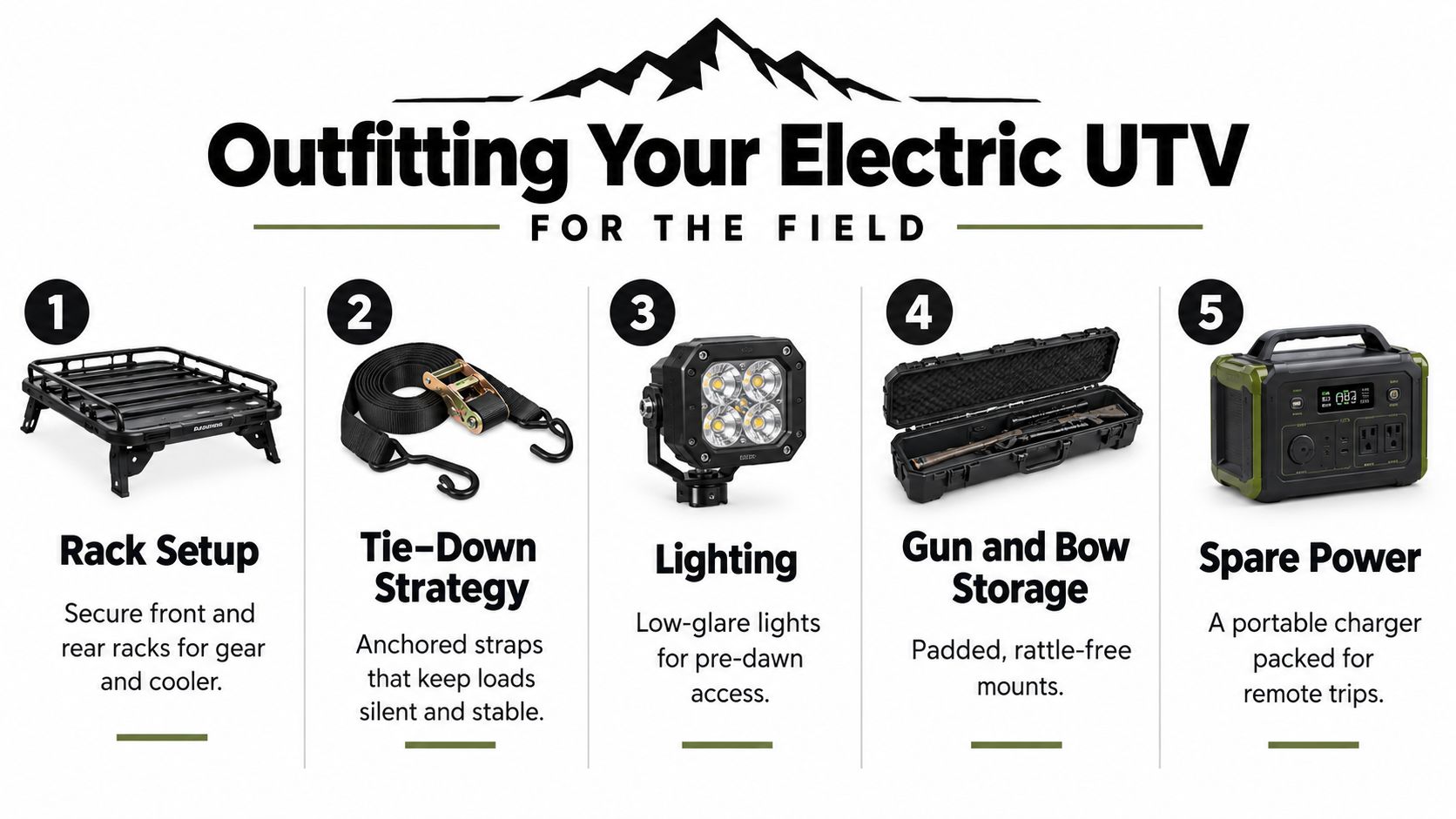
1. Secure the working platform.
Choose front and rear racks that fit the vehicle's rated limits. Keep frequently used items reachable without climbing into the bed or shifting the main load.
2. Stop movement before it starts.
Use anchored straps, padded dividers, and closed containers. A quiet motor won't help if a cooler lid, bow case, or recovery tool rattles over every rut.
3. Add useful lighting.
Use low-glare lighting for pre-dawn access and preserve the ability to switch lights off before reaching sensitive areas. Aim beams at the trail, not into surrounding habitat.
4. Protect firearms and bows.
Install padded, rattle-free mounts that keep equipment away from tires, suspension components, and loose cargo. Store ammunition and optics where moisture and impact won't damage them.
5. Plan recovery and spare power.
Carry a compatible portable charging solution only after confirming its output and the UTV's charging requirements. Pack recovery straps, a tire repair kit, and a tool set before adding convenience accessories.
The Campus E1 is one electric side-by-side option positioned for hunting and wildlife observation, with features including on-demand two-wheel or four-wheel drive, 11 inches of ground clearance, a 3,000-pound winch, front and rear hitch receivers, and an electric power dump bed. Verify current specifications and accessory compatibility before building a loadout.
A tire choice can change the entire feel of the vehicle. Review UTV tire information from Campus EV and match tread, sidewall strength, and pressure to your actual surface. Aggressive tires may improve traction while also increasing rolling resistance and ground noise.
Test the complete setup before opening day. Drive the route with the intended passenger, gear, and bed load. Listen for contact points, check visibility around the racks, and confirm that the winch, hitch, lights, and tie-downs remain usable without unloading half the vehicle.
Buying Checklist and Ownership Costs
Before signing a purchase order, test the vehicle against the property where you'll use it. A showroom floor can't reveal how the machine handles your gates, ruts, slopes, mud, trailer, or charging routine.
Inspect the mission-critical details
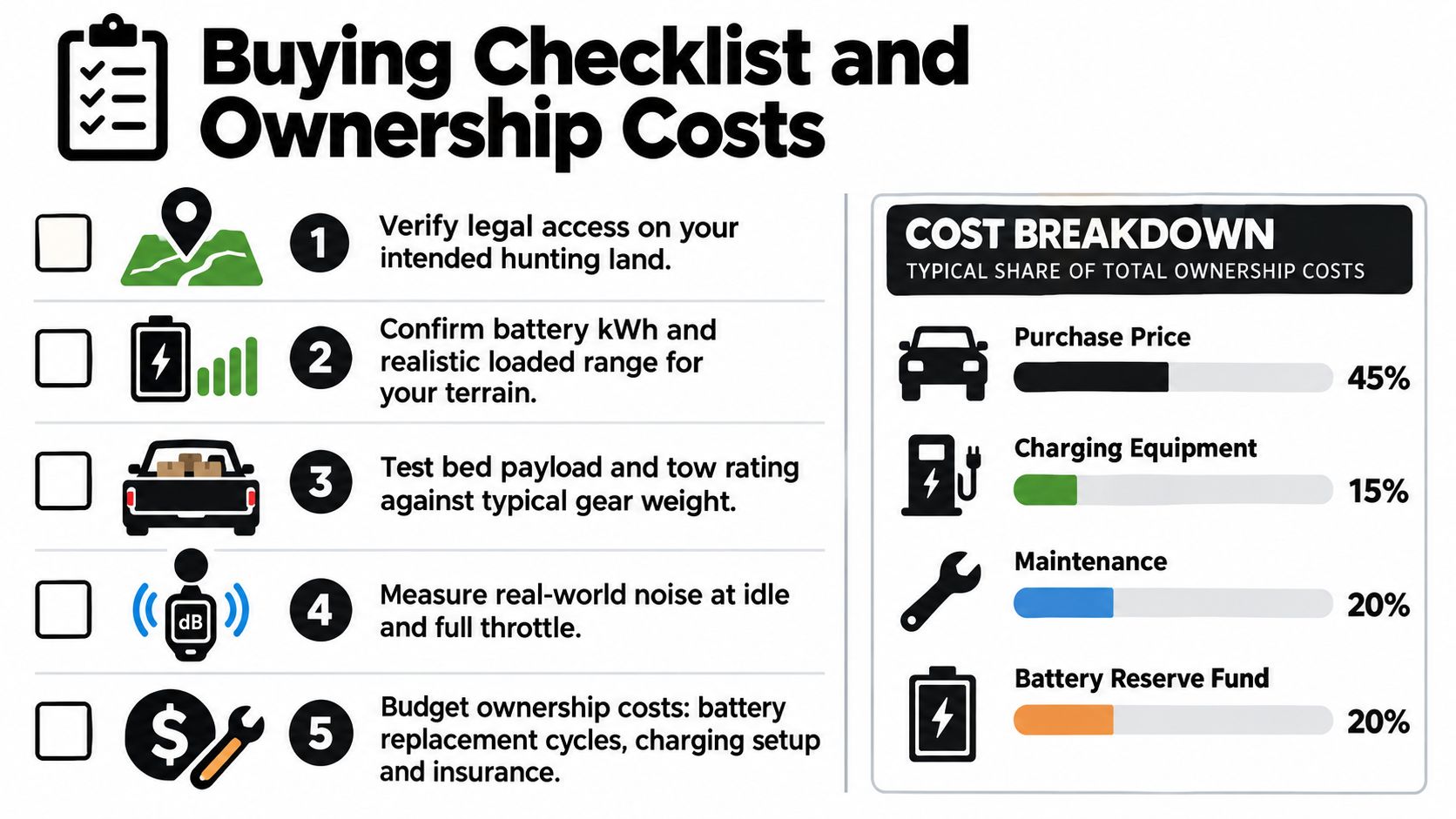
- Verify legal access: Identify the exact roads, trails, parking areas, and seasonal windows for your hunting unit.
- Confirm loaded range: Ask for battery capacity and test the machine with realistic occupants, gear, tires, and terrain.
- Check payload and towing: Compare the ratings with your normal equipment and expected game-recovery load.
- Inspect the chassis: Look at clearance, approach and departure angles, skid protection, tire options, and winch mounting.
- Evaluate support: Confirm battery warranty, replacement availability, parts access, and service distance before buying.
Budget beyond the purchase price
Your ownership budget includes charging equipment, registration, insurance, tires, winch maintenance, suspension work, battery care, and eventual battery replacement. Electricity can cost less to use than gasoline for repeated short trips, but the result depends on local energy rates, route length, vehicle weight, and charging losses.
Electric drivetrains remove oil changes, spark plugs, and several combustion-engine service items. They don't remove wear from tires, brakes, bearings, suspension, gearcases, or battery connections. Electric UTV maintenance guidance provides a useful maintenance framework, but your service schedule should follow the manufacturer's instructions.
Store the machine where temperatures stay moderate, avoid leaving the battery fully charged for extended storage unless the manufacturer directs it, and keep terminals and charging connections clean. A portable charger or solar setup can help at camp, but don't assume either will restore a severely depleted pack quickly enough for an emergency recovery.
The right next step is a property test ride. Load the machine with the gear you carry, drive the route you hunt, and check the battery after the return leg. That test tells you more than a brochure range figure.
Final Evaluation and Field Testing Checklist
A showroom floor hides the problems that matter in hunting country. Before buying, drive the UTV slowly, load it realistically, listen carefully, and test the controls in conditions that resemble your access roads.
Test the chassis, controls, and sightlines
Start with low-speed movement. Listen for CVT whine, drivetrain clatter, suspension squeaks, loose panels, and rattling accessories. A quiet machine should remain quiet when it crosses roots and uneven ground, not only while idling on smooth pavement.
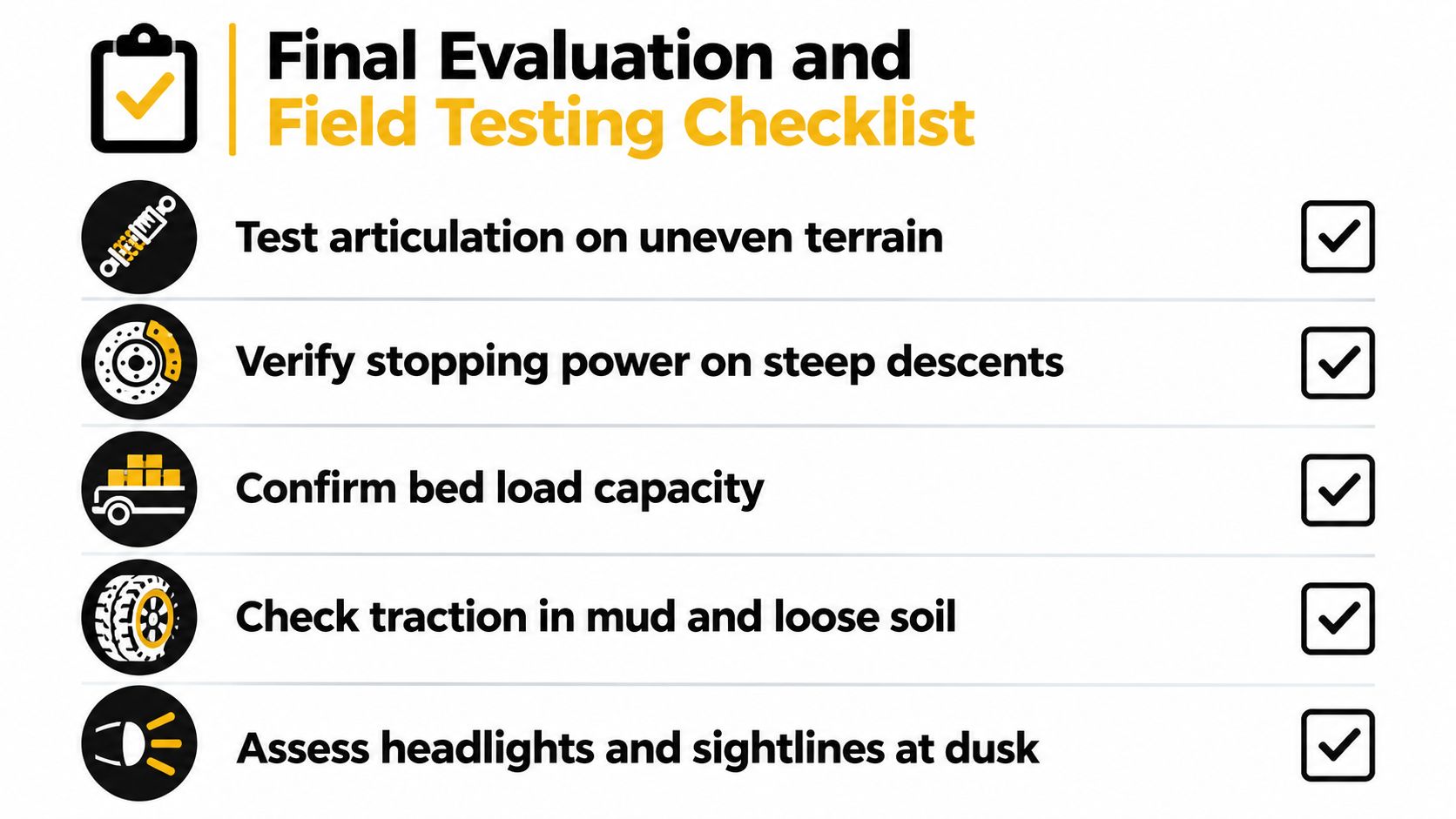
Use this field checklist:
- Suspension articulation: Cross uneven terrain slowly and watch whether the tires maintain contact without harsh chassis movement.
- Braking confidence: Test controlled stops on an incline and confirm that the pedal remains predictable during descents.
- Low-range control: Climb a steep section without excessive throttle. The machine should move steadily rather than surge.
- Steering and width: Turn through the tightest trail you regularly use. Check mirrors, bodywork, and turning clearance.
- Visibility: Sit in every intended seat and inspect blind spots, hood height, mirrors, and sightlines at dusk.
- Cargo access: Open the bed, tailgate, storage compartments, and tie-down points while wearing the clothing and gloves you hunt in.
- Accessory fit: Mount or test the gun rack, bow carrier, winch controls, roof equipment, and lighting before finalizing the purchase.
Test it loaded, not empty
An unloaded UTV can feel quick and nimble. Add passengers, packs, recovery equipment, and a realistic cargo load, then repeat the same route. Pay attention to braking distance, steering effort, suspension bottoming, tire clearance, and whether the bed remains stable over side slopes.
For electric models, repeat the test with the accessories and load you expect to use. Confirm the charge indicator behavior, charging connection, parking requirements, and cold-weather plan. For gas models, listen to how the engine and drivetrain behave under sustained load and check whether heat or exhaust placement creates problems around passengers or cargo.
Make the final choice
Choose a compact gas utility UTV when remote refueling, long operating days, and heavy recovery work outweigh stealth. Choose a larger utility platform when your hunting routine includes a crew, guide service, ranch work, or family transport. Choose electric when quiet access and low-speed disturbance control are central requirements and your charging plan is dependable.
The best side by side UTV for hunting isn't the machine with the loudest specification sheet. It's the one that carries the people and load you use, moves safely through your terrain, and lets you approach the field without creating more disturbance than necessary.
Campus EV offers electric UTV and powersports options centered on the Campus E1, with quiet operation and smooth low-speed control relevant to hunting and wildlife observation. Review the lineup at Campus EV, then compare its charging, range, payload, and seating fit against the conditions you hunt in.
Hunting Electric UTV Questions Answered
Will cold weather reduce electric UTV range? Yes. Cold temperatures reduce battery performance, especially below freezing. Store the machine away from extreme cold, start with a full charge, and reserve extra capacity for winter hunts. Charging can commonly take 4 to 12 hours, so Electric UTV range and charging information supports planning around the slowest turnaround.
Can you charge at a hunting camp? A standard outlet works if the UTV can stay at a cabin or barn for several hours. A 240-volt connection charges faster than a 120-volt outlet, but remote camps may have neither. Portable power stations or solar panels can supplement camp charging. Keep enough battery for the return route.
How are electric UTVs registered? States commonly place electric side-by-sides under the same OHV or off-road rules as comparable gas machines. Road conversion, equipment, and access requirements vary. Check the state, land manager, and hunting unit before driving onto public land.
Does a published decibel figure mean the UTV is silent? No. It provides a comparison point, not a promise of stealth. Tires, rocks, suspension, cargo, and driving technique still create noise. Approach slowly and respect nearby hunters.
Campus EV offers electric UTVs for quiet, low-speed utility, hunting access, property work, and off-road use. Compare its configuration with your route, payload, and charging plan at Campus EV before choosing it for your next hunt.