
The barn door's open, the truck's loaded, and there's another fence line to check before supper. You're looking up a Polaris electric UTV for sale because you want to know whether an electric side-by-side can handle the work, not just make a quiet lap around the dealer lot.
Start with the route, the load, and the place you'll plug in. The RANGER XP Kinetic has published battery and charging details that make it possible to plan around real jobs. The Campus EV E1 is another option for property and utility work, but don't assume its listed range or features answer every question about a long day in the field. A good buying decision comes down to whether the machine can finish your routine and get back to power without disrupting the work.
| What to compare | Polaris RANGER XP Kinetic | Campus EV E1 |
|---|---|---|
| Battery and range | Two battery choices, with published range depending on trim | Check the current model specification and verify range against your route |
| Charging | Portable Level 1/Level 2 cord; Polaris recommends 240 V for faster charging | Confirm the charger and circuit requirements with the dealer |
| Work fit | Full-size utility tasks, hauling, and towing within rated limits | Evaluate the equipment and features against your property's jobs |
| The deciding question | Can your route and workload fit the battery and charging plan? | Can the dealer verify that the model meets your daily work needs? |
Table of Contents
- Where You Stand Before You Shop
- What Polaris Sells in the Electric Lineup
- Polaris XP Kinetic vs Campus EV E1 Side by Side
- Real-World Range and Charging Logistics
- Matching the UTV to the Work
- Dealer Availability, Financing, and the Test Ride
- Final Recommendation and Buyer FAQs
Where You Stand Before You Shop
You may be replacing a gas Ranger that's spent years hauling feed, checking water, and dragging tools from the barn to the far fence. Or you may own a smaller property and want a quieter machine for chores that start and finish near the house. A fleet buyer might be comparing an electric side-by-side for campus grounds or warehouse work, where predictable routes and a nearby charging outlet matter more than covering open country.
Those buyers don't need the same UTV. Before you price trims, answer three questions: what work will it do, what terrain will it cross, and where will it charge? If most trips are repeatable and local, electric deserves a serious look. If the machine must spend a long day far from power while pulling heavy loads through steep or muddy ground, the charging plan may be the harder problem than the motor.
Write down the work before comparing machines
Be specific about the chores. Are you moving supplies between buildings, checking a hunting property, hauling a loaded bed across uneven ground, or towing equipment along hills? A machine that covers a short loop several times a day may fit electric use well. A route that keeps getting longer, steeper, or more heavily loaded needs more breathing room.
Then look at where the work ends. A barn or shop with suitable AC power gives you a practical place to recharge. A remote cabin or job site with no dependable outlet changes the equation, particularly if the UTV can't return to power before the next shift.
Straight advice: Don't buy on the assumption that every advertised mile will be available while towing, climbing, or working in rough conditions. Match the machine to your hardest regular day, not your easiest test ride.
That doesn't mean electric only belongs on easy properties. Quiet operation and predictable local routes can make it a sensible work tool. But if your work routinely runs beyond charging access, keep a gas option in the conversation or solve the charging location before you sign.
What Polaris Sells in the Electric Lineup
A useful choice starts with how long the machine needs to work before it can get back to power. The RANGER XP Kinetic is available in two battery configurations: the Premium with a 14.9 kWh battery and up to 45 miles of range, and the Ultimate with a 29.8 kWh battery and up to 80 miles. Those are manufacturer-published maximums, not a promise of range with a load on your property. Polaris notes that use and environmental conditions affect range in its XP Kinetic specifications and charging information.
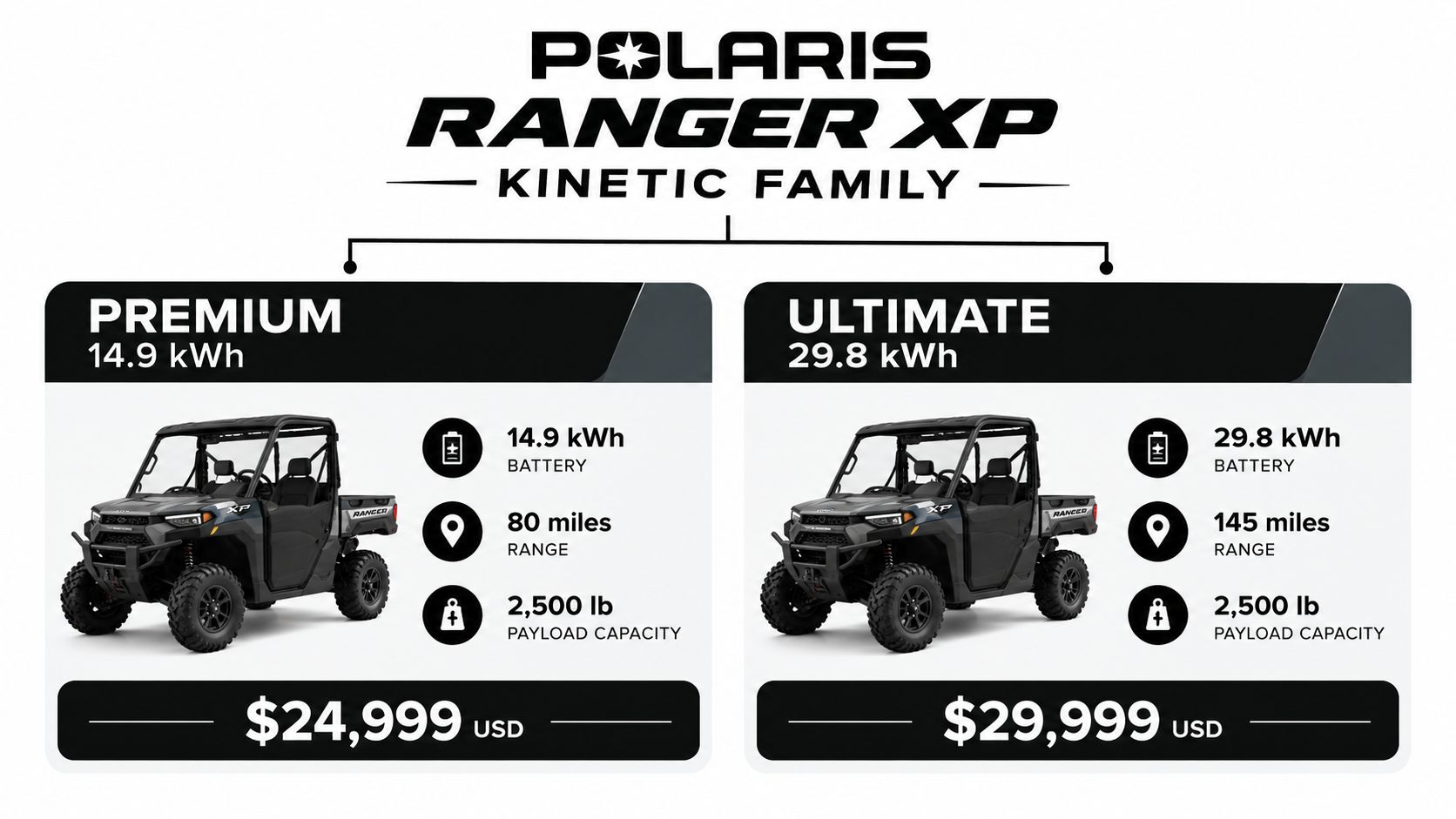
Shared muscle, different energy reserve
Both trims have a 110 hp electric motor producing 140 lb-ft of torque. Polaris lists 1,500 lb of payload capacity and 2,500 lb of hitch towing capacity. These ratings help establish what the machine can carry and tow. They do not tell you how far it will go while doing that work.
The battery and onboard charger are the main differences between trims. The Premium has a 3 kW onboard charger, while the Ultimate has a 6 kW onboard charger. Polaris gives a best-case recharge time of as little as five hours from empty with a 240 V outlet. Check the circuit and charging setup with your dealer before counting on that timing.
| Trim | Battery | Published range | Onboard charger |
|---|---|---|---|
| Premium | 14.9 kWh | Up to 45 miles | 3 kW |
| Ultimate | 29.8 kWh | Up to 80 miles | 6 kW |
For ranch, farm, or property work, start with the Ultimate if your day includes long routes, regular towing, or limited chances to plug in. Its larger battery gives you more room between charges. The Premium suits shorter, repeatable chores when the machine can return to a charging point. An easy loop near the shop is a different job from a loaded run across the property, so choose for the workday you need to cover.
Before you buy, get the dealer's current quote and specification sheet for the exact machine. Confirm its trim, battery, charger, rated capacities, and included equipment. The charger matters as much as the battery if your schedule depends on plugging in between shifts.
Polaris XP Kinetic vs Campus EV E1 Side by Side
A comparison only helps if it puts the differences that affect your work in the same place. The XP Kinetic has published battery, range, payload, towing, and onboard-charger specifications. For the Campus EV E1, get the dealer to verify the exact current equipment and charging details before treating any comparison as final.
| Spec | Polaris XP Kinetic Ultimate | Campus EV E1 |
|---|---|---|
| Motor | 110 hp electric motor, 140 lb-ft torque | Ask the dealer to confirm the current motor specification |
| Battery | 29.8 kWh | Confirm current battery specification with the dealer |
| Published range | Up to 80 miles | Request the current model's rated range and conditions |
| Payload | Up to 1,500 lb | Verify the rated capacity for the exact configuration |
| Hitch towing | Up to 2,500 lb | Confirm towing rating and restrictions |
| Charging hardware | 6 kW onboard charger; portable Level 1/Level 2 cord | Confirm onboard charger, cord, and compatible circuits |
| Dealer financing | Ask a Polaris dealer for current terms | Ask an authorized Campus EV dealer for current terms |
Compare how each machine fits the job
For ranch work, don't choose by horsepower alone. Ask how the UTV behaves at low speed with a load, what the bed can handle, and whether the machine can make your usual route and still return to a charging point. Check dump-bed operation and winch equipment on the exact E1 configuration, and compare those items with the XP Kinetic you're pricing.
Cab and controls matter too. The Campus E1's CarPlay and Android Auto integration may suit an operator who values familiar phone-based navigation and audio. Polaris buyers should check the Ride Command equipment on the particular model and trim they're looking at. Neither feature replaces a conversation about parts, service, and local dealer support.
For a closer look at how another electric side-by-side compares with the E1, use this Campus E1 and Kandi Innovator comparison. Then use the same approach at the dealership: compare rated capacity, battery and charger details, work equipment, service access, and the actual route you need to cover.
My advice is simple: choose the XP Kinetic if its published utility ratings and your Polaris dealer support line up with the job; choose the E1 only after the dealer confirms its equipment and ratings against your specific work. Don't fill missing details with assumptions just because two machines share the same broad category.
Real-World Range and Charging Logistics
A full day's route is the true range test. Polaris lists up to 80 miles for the XP Kinetic Ultimate and up to 45 miles for the Premium, with range affected by speed, terrain, weather, cargo, acceleration, maintenance, and use. As noted earlier, those published figures are a starting point for planning, not a substitute for testing the work you expect the UTV to do.
Real-world outcomes change with the machine's configuration and workload. Mixed work, steep terrain, towing, and cold weather all affect how far a charge will carry you. A loaded bed, repeated climbs, mud, stop-start driving, tires, and temperature can reduce the distance available for work. Plan for the tough parts of the route, not just the easy miles.
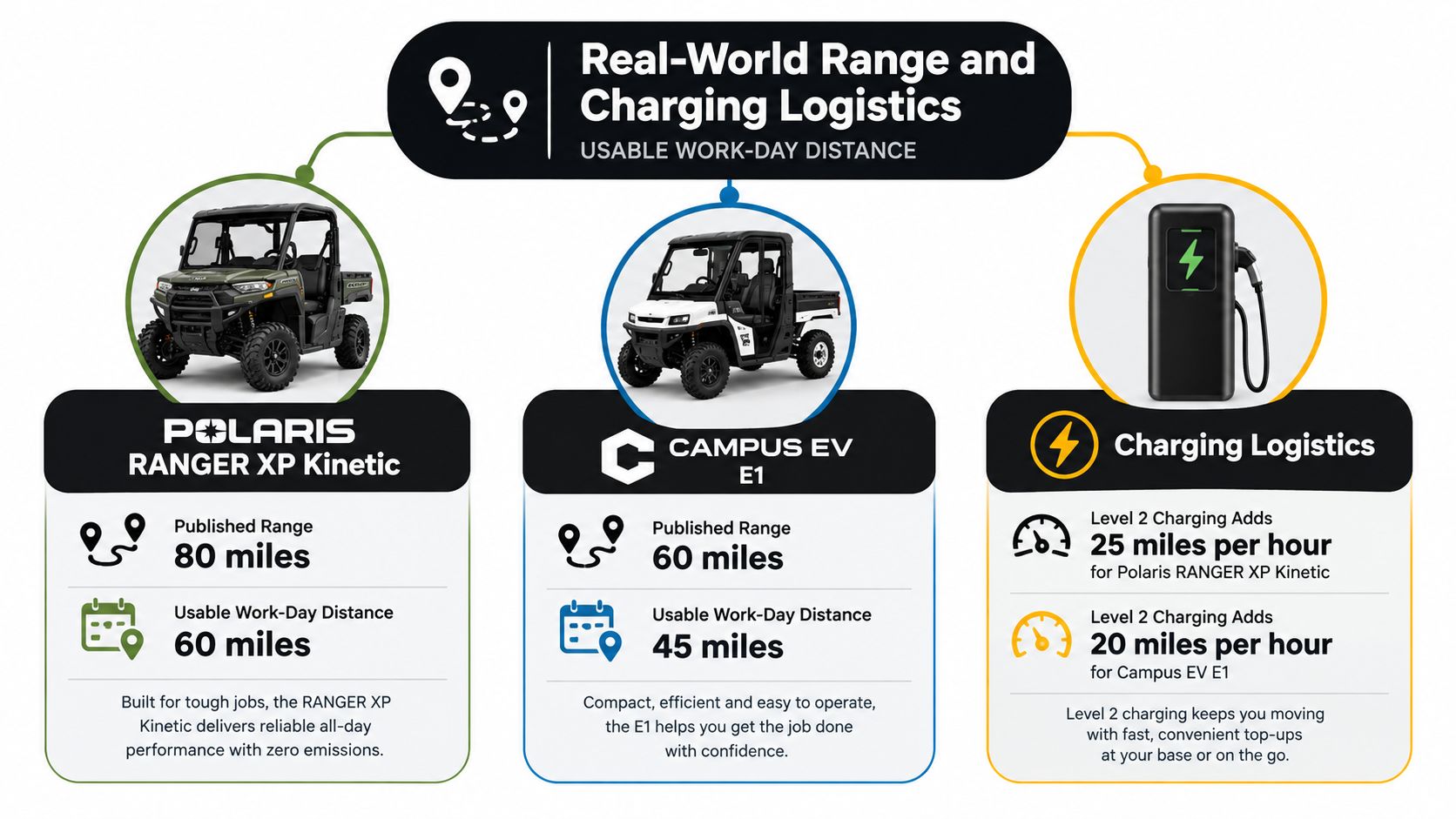
Put the route on paper
Walk the route before shopping. Mark the climbs, towing, frequent stops, heaviest loads, and nearest dependable charging point. For repeated trips, tally the full day's travel. Keep enough reserve for the return and the extra job that tends to appear before quitting time.
Then check where the machine will sit between shifts. The XP Kinetic comes with a portable cord for Level 1 or Level 2 charging, and Polaris recommends a 240 V supply for faster charging. The Ultimate has a 6 kW onboard charger; the Premium has a 3 kW charger. Charging capability only helps if your barn, shop, cabin, or job site has suitable power. Have a qualified electrician or dealer confirm what the property can support.
Workday rule: If you can't point to where the UTV will recharge, you haven't finished planning the route.
Don't build your plan around finding a DC fast charger for a depleted battery. Set up your day around the machine's AC charging arrangement and confirm what the model supports before buying. If the route finishes away from power, plan a return to the barn, add a charging location, or keep another vehicle available.
Driving habits and route choices affect how much work you get from each charge. Review these electric UTV efficiency practices when planning for terrain, load, and daily use. Map the route, account for its hardest sections, and make sure the charger is where the machine finishes.
Matching the UTV to the Work
The same electric side-by-side can be a good fit for one property and the wrong tool for another. Match the machine to the work pattern, not the idea of owning an electric vehicle.
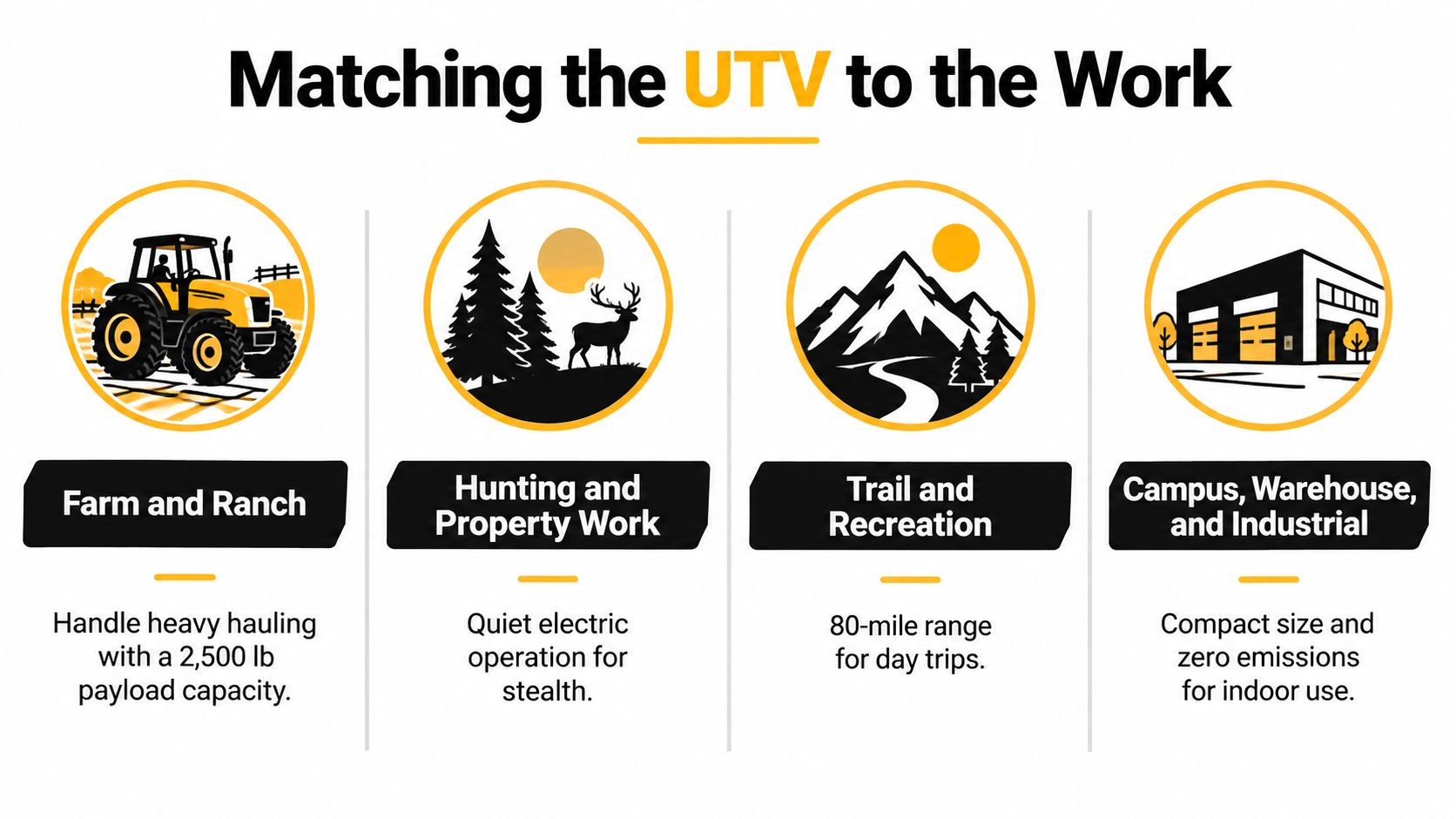
Farm and ranch
If your day includes long fence lines, loaded beds, or regular towing, put the XP Kinetic Ultimate on the test-drive list first. Its larger battery gives you more published range capacity than the Premium, but the route and charging plan still decide whether it'll finish your workday. A Campus EV E1 may suit a ranch or farm with a predictable loop and dependable charging, provided its dealer verifies the payload, towing, and equipment you need.
When you're comparing electric UTVs with other farm equipment, it's also sensible to review how you protect your farm equipment and whether your coverage reflects the machines you rely on. Treat that as part of the ownership conversation, not as a substitute for checking the UTV's capabilities.
Hunting and property work
For a cabin property with short trips and a place to plug in, the XP Kinetic Premium may be enough. The E1 is also worth a look if its configuration suits the work and the dealer confirms the charging setup. Quiet operation can be useful around a property where engine noise is unwelcome, but don't mistake quiet for unlimited range. Plan the return route and charging point before taking the machine far from the cabin.
Trail and recreation
Trail use asks a different question: can the machine cover your intended ride and get back to power, and do the trails permit it? Check local rules, terrain, and range. If your outing depends on long stretches away from charging, a larger battery or a different vehicle plan may be necessary. Don't buy a utility UTV for a trail day based only on its maximum published range.
Campus, warehouse, and groundskeeping
For repeated trips on a defined property, charging access may be easier to plan than it is on a spread-out ranch. Compare bed utility, winch equipment, service support, and whether the machine can move supplies through the spaces where it'll work. For indoor use, confirm operating requirements and site rules with the facility rather than assuming any UTV is appropriate.
Campus EV sells the E1 through authorized dealers, so ask the dealer to demonstrate the features you'll use and confirm service arrangements. On any property, the right machine is the one that completes the work you assign it and can recharge where the next shift begins.
Dealer Availability, Financing, and the Test Ride
A dealer conversation should answer more than what the machine costs. Ask who services the electric drivetrain, where parts come from, what battery coverage includes, and how the dealer handles a machine that needs attention during the work season.

Take the test ride on ground that resembles your property. Drive slowly over the kind of surface you work on, try the bed and controls, and ask the salesperson to explain charging and routine service. A smooth lap on a dealer lot won't tell you how the machine behaves on your hills or with your normal load.
Before you discuss financing, get the full written quote and current terms for the specific trim. Ask about warranty coverage for the vehicle and battery, what's excluded, and whether an extended plan is available. For a general look at electric side-by-side pricing considerations, see Campus EV's electric side-by-side pricing guide.
Before signing, check the tires, brake feel, charger cable, and connector. Ask whether software updates are current and request a written plan for evaluating range under your intended workload. If the dealer can't explain how the machine will be supported locally, keep shopping.
This walk-through gives a look at the buying conversation. Bring your route, load expectations, and charging-location questions with you, and ask the dealer to address each one before you commit.
Final Recommendation and Buyer FAQs
| Your work pattern | My recommendation |
|---|---|
| Long property routes, towing, or fewer chances to recharge | Start with the XP Kinetic Ultimate and test it against the hardest route |
| Short, repeatable chores near a suitable outlet | Compare the XP Kinetic Premium and Campus EV E1 against your equipment needs |
| Work often ends far from AC power | Solve charging access first, or keep a gas backup plan |
What range should I expect under load? Don't plan around the maximum. Workload, terrain, weather, and driving conditions affect real-world range, so test a representative route with the dealer.
Will cold weather affect range? It can. Plan conservatively and confirm how your chosen machine performs in the conditions where you'll use it.
Can I DC fast-charge it? Don't assume so. Verify supported charging methods with the dealer and plan around the AC setup for the model you're buying.
What if the battery runs low mid-route? Recovery depends on getting the UTV back to a compatible AC charging source. If that's not practical on your property, rethink the route or the vehicle choice.
Book a test ride with your normal route in mind. Bring the load you typically carry, ask the dealer to walk through charging at your property, and don't buy until the machine and the workday make sense together.
Campus EV offers the E1 electric UTV through authorized dealers for property, farm, ranch, hunting, and utility work. Visit Campus EV to review the E1, locate a dealer, and arrange a test drive that matches the jobs you need it to do.