
It's dark, the gate is still frozen shut, and you've got feed, tools and a second person to get across a field that turned soft overnight. The truck will rut the track. The tractor is overkill for a short run. What you need is a machine that starts easily, carries a load, grips when the ground gives up, and still has enough energy left to get you home. That's the test for any work vehicle.
Table of Contents
- Why Electric Side by Side 4×4 Choices Matter at Work
- How Electric Side by Side 4×4 Utility Vehicles Work
- Key Specifications That Shape Daily Utility Work
- Electric and Gas Side by Sides Compared
- Real-World Uses Across Farms Ranches and Job Sites
- Charging and Cold Weather Planning for Reliable Uptime
- Maintenance and Ownership Requirements for Electric UTVs
- Choose the Right Electric Side by Side 4×4
Why Electric Side by Side 4×4 Choices Matter at Work
A farmer loading the bed before sunrise, a rancher checking fence lines, or a hunter moving gear into damp ground all ask the same question. Will this vehicle finish the route today, with this load, on this terrain? An electric side by side 4×4 isn't just a quieter version of a gas machine. It's a different energy system, and that changes how you plan your day.
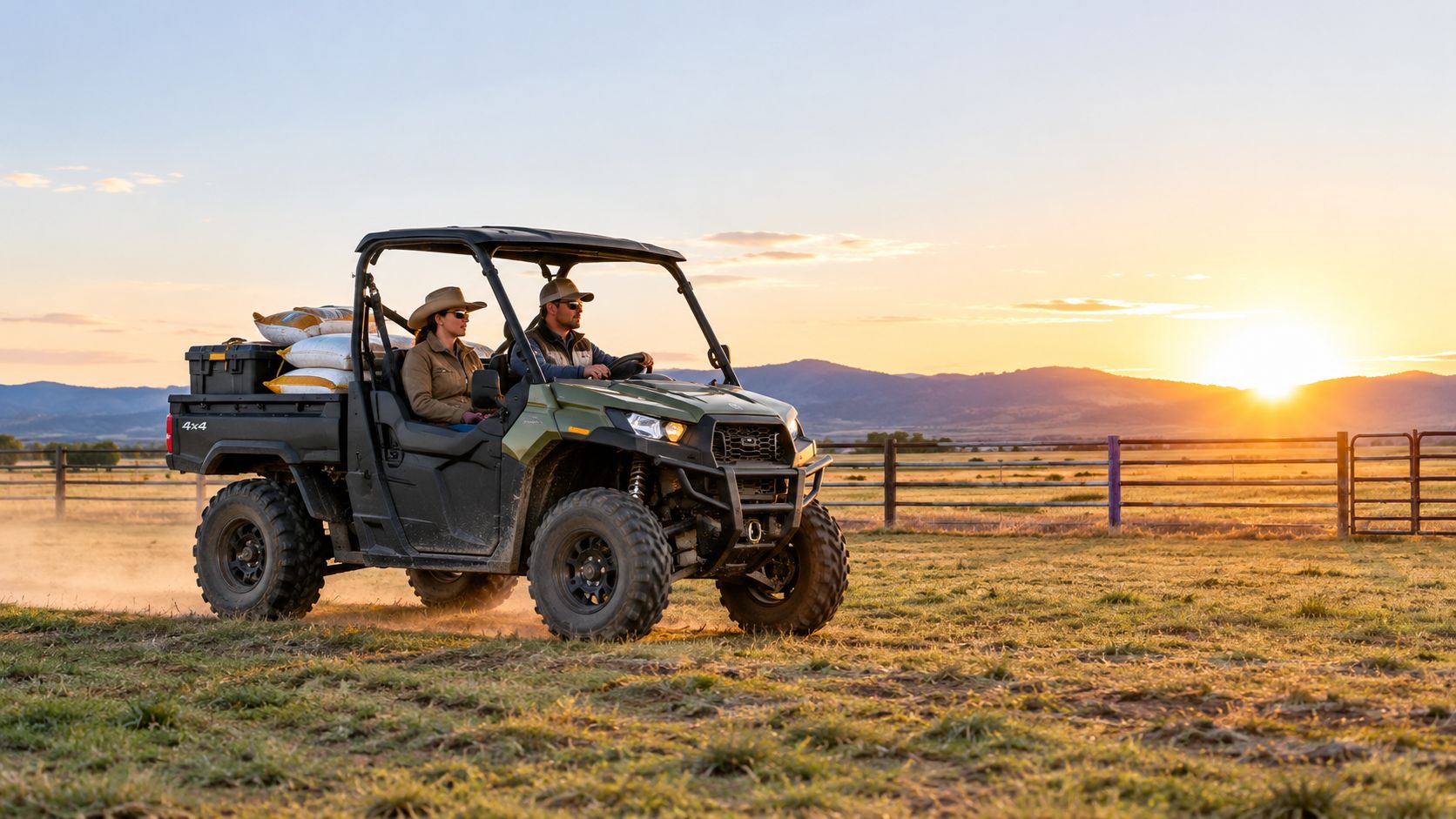
Four-wheel drive helps you climb, cross mud and keep moving on loose ground, but traction alone doesn't guarantee a finished job. Usable range, payload, charging access and uptime decide whether the vehicle fits. If your route is a repeatable loop back to a barn where it can charge overnight, an electric model can suit you well. If your day is long, remote and unpredictable, you'll need reserve capacity or a backup plan.
The Principle to Carry Forward
Don't start by chasing the longest headline range or the biggest motor number. Start with your duty cycle, the actual pattern of distance, stops, loads, terrain and recharge time you live with each week. A vehicle that completes your normal work predictably, even on a cold or heavy day, is more useful than one that looks stronger on paper.
The best electric 4×4 side-by-side is the one that can complete your day's work predictably, not the one with the longest headline specification.
That idea guides every comparison that follows, from how the machine works to how you test, charge and maintain it.
How Electric Side by Side 4×4 Utility Vehicles Work
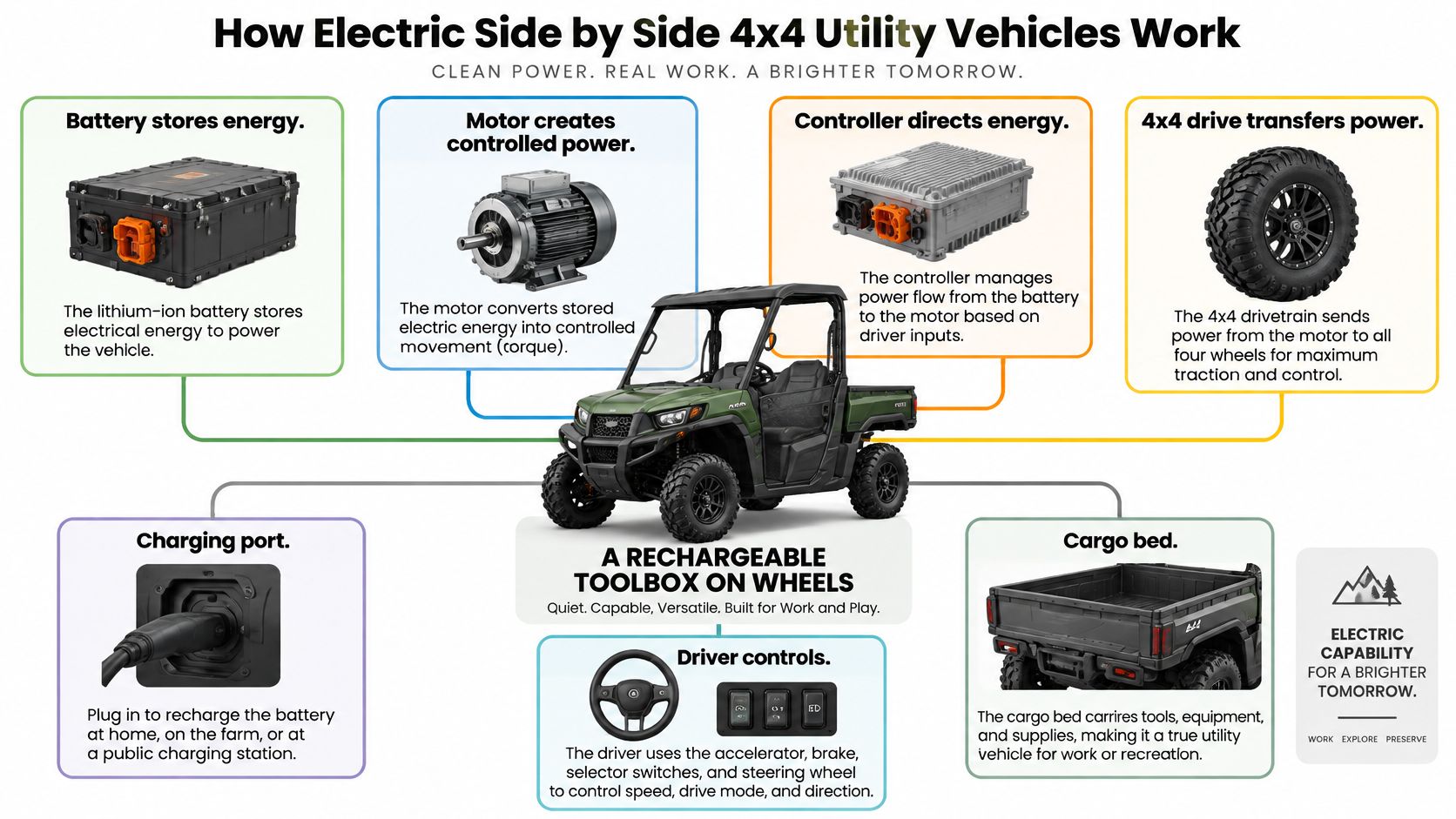
Think of an electric side-by-side as a rechargeable toolbox on wheels. The battery is the stored energy. The motor turns that energy into movement. The controller, an electronic unit between them, decides how much power flows in response to your pedal, your drive mode and the load on the wheels.
The visual below maps those parts so you can see how they cooperate.
Battery Motor and Controller in Plain Terms
The battery pack stores electricity when you charge it. A larger, healthy pack can support longer or harder work, but it doesn't create power on its own. The motor converts stored energy into turning force. Many work-focused models use a permanent-magnet synchronous motor, often shortened to PMSM. You don't need the engineering detail to use it well. In practical terms, it's a type of electric motor known for controlled, responsive power delivery at low speed, which helps when you're easing over ruts or starting on a slope with a load.
The controller manages that delivery. It limits power when needed, coordinates drive modes and helps protect the battery and motor. When you select two-wheel drive or four-wheel drive, you're choosing how the system sends power to the ground. Two-wheel drive is often enough for firm, flat surfaces. Four-wheel drive sends effort to all four wheels for better traction on mud, snow, loose soil or hills. It describes the drive system, not a promise that every trail, slope or load will be safe.
Why the Layout Matters for Work
A side-by-side puts driver and passenger next to each other, with a steering wheel, seating and usually a cargo bed behind you. That's different from an ATV you straddle and steer with handlebars, and different from a motorcycle or passenger car built mainly for roads. It's also smaller and more nimble than a full-size utility tractor, trading heavy implement capacity for easier access across fields, woods and job sites.
This is now a substantial category, not a fringe experiment. Grand View Research estimated the global electric utility-vehicle market at USD 20.3 billion in 2024 and projected USD 29.0 billion by 2030, with electric utility task vehicles accounting for more than 34% of 2024 revenue and North America representing 33%, in its electric utility-vehicle market report. Treat those figures as broad market context across several vehicle types, not as proof that any single model fits your job.
Key Specifications That Shape Daily Utility Work
Specifications only help if you translate them into work decisions. A number on a brochure tells you what was possible under the maker's test conditions, with a known load, on a known surface. Your route has two people, a loaded bed, soft ground and a hill on the way back.
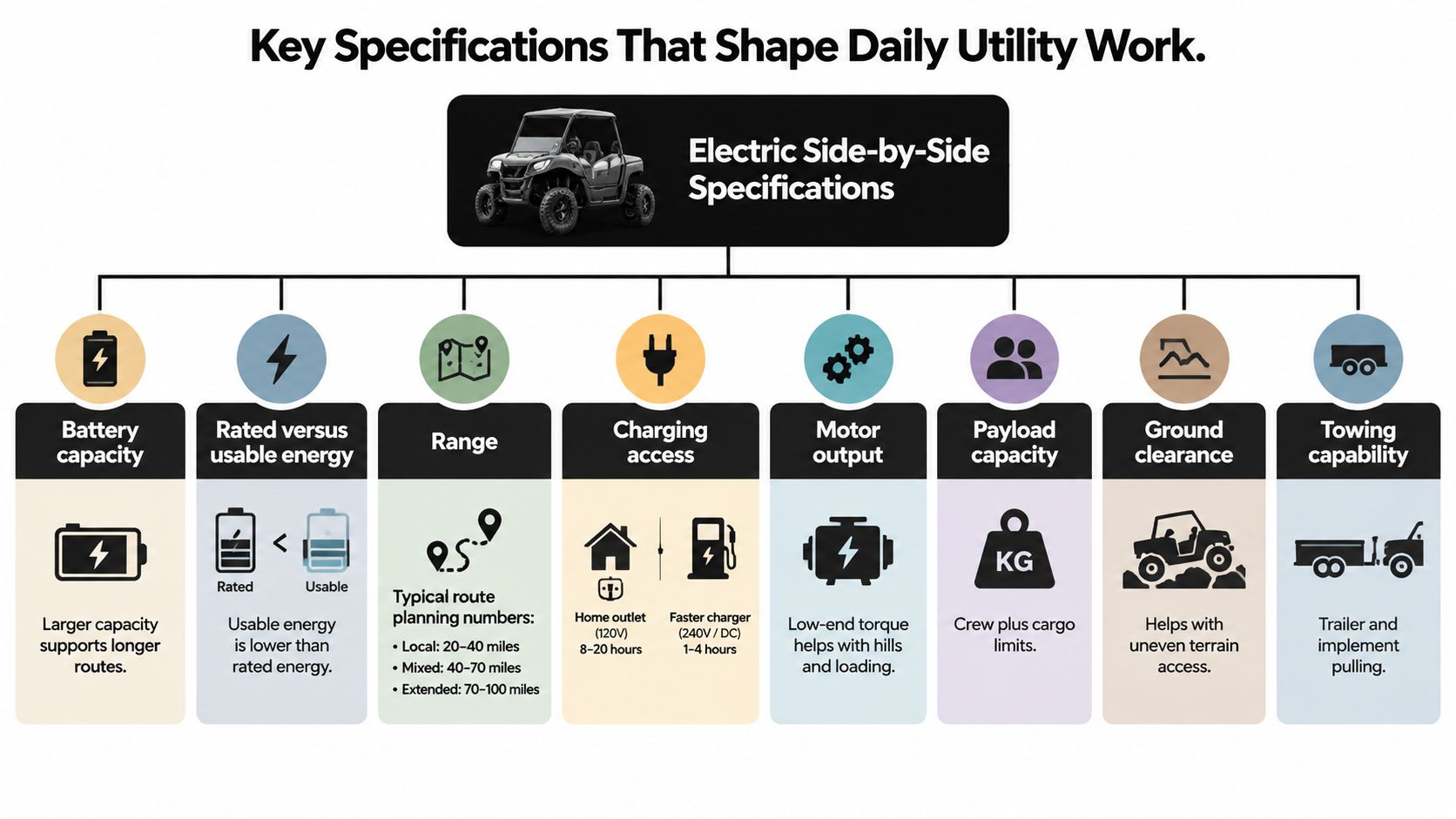
The diagram below groups the specifications that most affect daily utility work.
Energy Range and Charging
Battery capacity describes how much energy the pack can store. Makers express it in volts and amp-hours, and those figures can't be compared in isolation across different systems. Rated energy is the nominal figure. Usable energy is what you can draw on in normal use, and it's typically lower because the system protects the battery at the top and bottom of charge.
Range is where buyers get tripped up most often. "Up to" means a best case, not a loaded guarantee. Ask how the figure was measured: at what load, what speed, on what surface. Then ask about charging access, because range is only half the question. Where will you plug in? How long does a recharge take from the level you normally return with? Does that window fit the gap between morning and afternoon rounds?
Power Traction and Load Handling
Motor output is usually shown in kilowatts. It gives a rough sense of available power, though utility work rewards controlled low-speed pulling, clean hill starts and predictable behavior with a trailer on. On-demand 2WD and 4WD lets you run two-wheel drive on firm ground and engage four-wheel drive when traction drops, which helps you manage grip and energy use at the same time.
Work through these load questions before you compare prices:
- Payload: How much combined weight of people, cargo and accessories can you carry without exceeding the maker's limit?
- Towing: What trailer weight is allowed, and does that rating change on slopes or rough ground?
- Ground clearance: Can the vehicle cross your ruts, rocks, stumps and drainage edges without hanging up underneath?
- Tires: Are the fitted tires suited to your mix of turf, gravel, mud, snow or hard surfaces, and are replacements easy to source?
- Bed and winch: Does a dump bed speed up your unloading, and is the winch there for self-recovery, moving obstacles or both?
A worked example helps. One work-focused model, the Campus E1, pairs a 20 kW PMSM motor with a 72V 150Ah lithium battery, rated at up to 60 miles of range, according to the maker's Campus EV E1 product page. Take that 60 miles as a question, not an answer. Ask the dealer what it looks like with a loaded bed and a trailer on soft ground, because the 3,000 lb winch and the electric dump bed change how you use the energy, not how much of it you have. The on-demand 2WD/4WD decides how much grip costs you in battery terms. CarPlay and Android Auto earn their place only if the screen stays readable with gloves on, in dust and glare.
Watch the short video below for practical details like bed operation, controls and low-speed handling rather than styling.
Before you decide, ask the dealer for comparable figures on loaded range, towing behavior, charging time and terrain performance. If two brands measure differently, you aren't comparing like with like until you test both on your own route.
Electric and Gas Side by Sides Compared
There's no universal winner here. Electric and gas side-by-sides solve the same transport problem with different trade-offs, and the right choice depends on how predictable your work is and where you can refuel or recharge.
Electric power delivery feels smooth and controlled at low speed, which helps with careful maneuvering around gates, livestock, buildings and people. It's also quieter, a real advantage for early starts, hunting approaches and work near homes or animals. Gas machines deliver power through an engine and transmission you're probably more familiar with, and they can be refueled quickly when fuel is available.
Electric and Gas Side by Side Decision Factors
| Decision Factor | Electric Side by Side | Gas Side by Side |
|---|---|---|
| Refueling pattern | Needs a charging window and a suitable power source | Needs stored fuel or a fuel run, then refuels quickly |
| Operating pattern | Suits repeatable routes returning to a base | Suits long, remote or unpredictable days |
| Noise | Quiet at work and at idle | Louder engine and exhaust noise |
| Routine upkeep | No engine oil or fuel-system servicing, but battery, tires and brakes still need care | Engine, fuel and exhaust systems add service items |
| Range planning | Plan around usable charge and reserve | Plan around fuel carried and access to more fuel |
| Cold weather | Battery energy and charging can be affected by cold | Range is generally less affected, though starting and fluids still matter |
Where Each Power Source Fits
Cold weather deserves careful wording. Neutral government research found that battery-electric vehicles lost about 41% of range at 20°F compared with roughly 10% for internal-combustion vehicles, in the U.S. Department of Energy cold-temperature BEV performance report. That research is not UTV-specific, so don't use it as a direct prediction for any side-by-side. Use it as a warning to leave a larger reserve and to test charging in your own winter conditions.
An electric machine is compelling when your routes are repeatable, your daily distance fits a conservative energy budget, and charging is available where the vehicle sleeps. A gas machine may be simpler when you're far from power, your schedule changes without warning, or you can't accept a long recharge between jobs. Judge by route predictability and uptime, not by a generic claim that one fuel always wins.
Real-World Uses Across Farms Ranches and Job Sites
The same specification means different things in different jobs. A quiet run to a hunting stand, a stop-start feed round and a warehouse yard move all use energy and traction differently, so work through your own scenario before you shop.
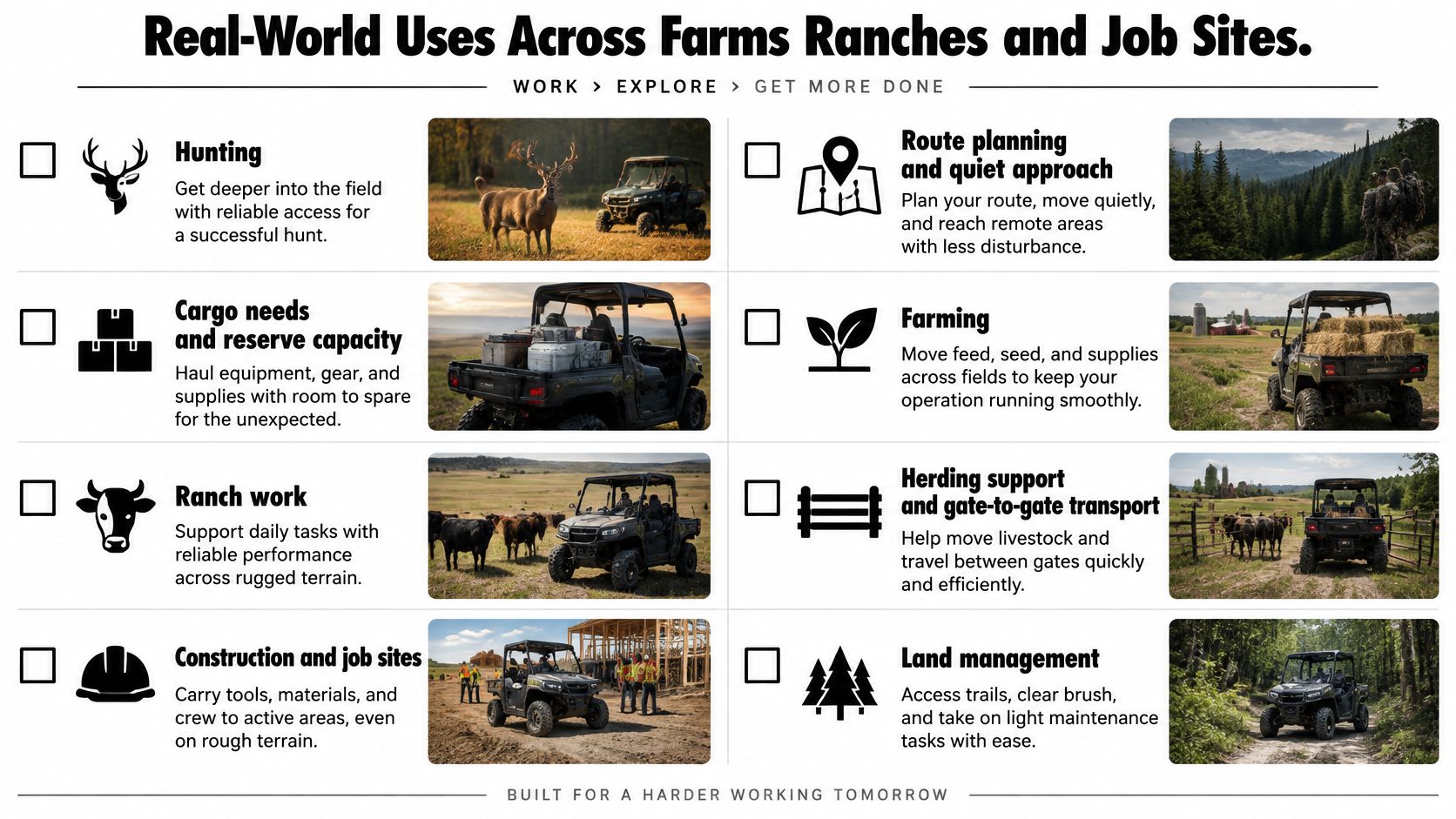
For hunting, the appeal is a quiet approach and controlled movement on trails, plus space for gear. Your risk is distance from a charger. Plan the route in and out, allow for softer ground on the return, and keep a reserve rather than planning to arrive nearly empty. Cargo needs change after a successful hunt, so test the bed and tie-down points with realistic bulk, not just weight.
For farming and ranching, the pattern is repetitive. You'll open gates, cross fields, stop often, load and unload, and return to the same buildings. That routine can suit overnight charging well, especially when daily routes are known. This guide to an electric utility vehicle for farm work is a helpful prompt for listing your own feed, fencing and field tasks before you choose. Check how the bed handles your usual supplies, whether attachments or a small trailer fit your gates and tracks, and whether tires protect turf you need to preserve.
Construction Property and Warehouse Use
On construction and property jobs, low-speed control, visibility and load handling matter more than top speed. You'll carry tools and crew across uneven ground, use a dump bed for material, and need a charging spot that doesn't block other equipment. Confirm site rules, surface conditions and who is responsible for plugging in at the end of a shift.
In a warehouse setting, be careful. A side-by-side is an off-highway utility vehicle, not a universal indoor materials handler. It may suit large yards or hard-surface transport between buildings, but aisle width, flooring, ventilation rules, turning space and pedestrian safety can point you toward different equipment indoors.
That legal distinction matters everywhere. California's DMV defines a utility-terrain vehicle as a motor vehicle designed for off-highway operation, suspended on four tires, and controlled with a steering wheel, and registration, identification, trail access and road-use rules remain jurisdiction-specific, in the California DMV off-highway vehicle introduction. Capability doesn't equal permission, so check where you're allowed to operate before you buy.
Charging and Cold Weather Planning for Reliable Uptime
Manage an electric UTV as an energy system, not as a vehicle with one fixed range number. Temperature, payload, terrain, tire choice, auxiliary loads like lights or a winch, and charging conditions all change how much usable energy you have and how quickly you can replace it.
Cold can reduce usable battery energy and slow charging because the battery management system protects a cold pack by limiting charge rate. That's why a vehicle that handled a route easily in autumn may feel tighter in winter, and why a recharge that fit your evening routine in mild weather may run longer after a cold, loaded day. The non-UTV research noted earlier is directional only. Your own route test matters more.
A Practical Test Protocol You Can Run
- Drive your real route loaded: Carry typical people, cargo and tools over flat ground, hills and the softest surface you normally cross.
- Record start and end charge: Note state of charge, distance, time, weather and any winch, light or dump-bed use.
- Test low-speed hauling: Include stop-start work and any trailer use, since steady cruising doesn't represent most utility jobs.
- Compare charging locations: If possible, note how charging behaves in a heated space versus an unheated barn or outdoor spot.
- Set your reserve: Decide the lowest charge you're willing to reach at the farthest point from home, then plan routes around that buffer.
Practical rule: Plan winter work around the energy you measured on a loaded cold route, not around the highest range figure in a brochure.
Overnight charging is enough when the vehicle returns to the same base, the next start time is predictable, and the recharge finishes comfortably before you need it. Scheduled charging means you plan plug-in times around shifts. Opportunity charging means you top up during lunch or loading breaks. If neither closes the gap on your longest days, consider whether a backup vehicle, a shorter route split or a gas machine for remote days is the honest solution. This overview of how to improve electric UTV efficiency can help you think through driving and charging habits, but it won't replace your own measurements.
If you maintain other battery-powered winter equipment, you'll recognize the same planning habit. Keeping batteries stored sensibly, allowing extra charge time in the cold and testing under load also applies when you review battery powered snow blower picks for clearing the yard or barn entrance before the UTV goes out.
Maintenance and Ownership Requirements for Electric UTVs
An electric drivetrain removes some familiar engine jobs, but it doesn't make a work vehicle maintenance-free. You're swapping part of the routine, not deleting it. Tires, brakes, suspension, steering, lights and accessories still live outdoors, carry loads and wear out.
Build a simple habit around each use. Check tire condition and pressure, because underinflated or damaged tires affect traction, handling and energy use. Inspect brakes, steering and fasteners, look over suspension components after rough ground, and confirm lights and displays work before dawn or dusk runs. Keep charging connections clean and dry, use the correct charger, and follow the owner's manual for charging and storage rather than copying advice meant for a different battery system.
Care for Accessories and Storage
A winch needs cable or rope inspection, fairlead and hook checks, and controlled spooling so it works when you're stuck rather than tangling. A dump bed needs its lifting mechanism, latch and bed surface kept clear of packed mud and debris. Wash off mud, dust and salt exposure as directed, taking care around electrical connections. Store the vehicle where charging is safe and practical, and follow model-specific guidance for periods when it won't be used.
High-voltage battery and motor work isn't a general DIY category. Use authorized service guidance for electrical faults, software issues or battery concerns. Before you buy, ask about battery warranty coverage, charger replacement, parts availability and authorized technicians. This breakdown of UTV maintenance cost considerations is a useful starting point for building your own list of questions, as long as you confirm the exact terms for the model you're buying.
Facilities teams already think this way about other equipment. Just as you'd find the right scrubber for warehouses by matching the machine to floor type, area and upkeep capacity, you'd match an electric UTV to your route, surfaces and service support.
Choose the Right Electric Side by Side 4×4
A ranch hand who runs the same fence line every morning has a different shortlist than a crew hauling tools between buildings. The right choice starts before you talk to a dealer. Write down your shortest and longest normal routes, your typical and maximum payload, any towing or attachment needs, terrain, climate, operating hours and where the vehicle will charge. Add legal access and acceptable downtime. If you can't describe the job, the specifications won't tell you much.
Then compare models using consistent measures. Ask each dealer the same questions about loaded range, charging time from a realistic starting level, payload, towing limits, ground clearance, tire options and warranty. A headline range figure means little until you know the conditions it was measured under.
Test the Work You Will Do
A demonstration drive only counts if it resembles your day. Check steering, visibility and low-speed control with a passenger and a load aboard. Operate the bed or dump function, look at winch access, sit in both seats, and check whether the displays stay readable in bright light. Drive representative terrain if the dealer allows it, including a slope start and a tight turn, and note ride comfort over the surfaces you'll cross daily.
Match the vehicle to your real duty cycle. A hunter needs reserve energy for remote returns. A farmer or rancher needs repeatable daily hauling. A construction crew needs uptime across shifts, and a property or warehouse operator needs suitable surfaces and charging discipline. Offers such as 0% APR financing may shape how you buy, but financing doesn't determine whether the vehicle fits the work.
Choose the electric side by side 4×4 that covers your measured routes and loads, with energy to spare on your hardest normal day.
If you're ready to test that fit against your own farm, ranch, hunting property or job site, explore the electric UTV options, dealer support and financing information from Campus EV dealers. Bring your route distances, typical loads and charging location with you, and ask for a demonstration that reflects the work you'll do.