
The day starts before sunrise. You're checking the stock, carrying feed, and hoping the fence repair won't turn into a long walk back for tools. A utility vehicle can make those chores easier, but only if it has the grip, carrying capacity, and usable battery for the work your property demands.
That's the right way to judge an electric utility vehicle for farm work. Don't start with the range figure on a brochure. Start with the jobs you need to do, the loads you carry, the ground you cross, and where you can recharge.
Table of Contents
- A Morning on the Property With an Electric UTV
- What an Electric UTV Actually Is on a Farm
- Reading the Specs That Actually Matter
- Matching Real Farm Duty Cycles to Battery Life
- Attachments and Chores That Make the UTV Pay for Itself
- Electric Versus Gas UTVs on the Farm
- A Realistic Worksheet for Total Cost of Ownership
- Charging Logistics, Maintenance, and a Buying Checklist
A Morning on the Property With an Electric UTV
The first trip is a livestock check. You roll across firm ground with a few tools and feed in the bed, then slow down near a gate. Quiet operation can be useful around animals, but the vehicle still needs enough traction and carrying capacity for the route and load. A bench seat may suit a short trip with a helper; a cargo bed matters more if feed, fencing supplies, or a toolbox travel with you.
By the time you reach the far fence, the ground has changed. A damp patch and a shallow slope make on-demand four-wheel drive more valuable than a high top speed. You stop, unload a post driver and pliers, and handle the repair without leaving the vehicle behind in a spot where it might need a recovery. A winch can be useful insurance, but it doesn't replace choosing a safe route or staying within the vehicle's limits.
The next chore is hauling. An electric dump bed can save awkward lifting when you're moving feed or clearing debris, while a hitch lets the UTV pull a small trailer if the vehicle's towing rating and the trailer's load are suitable. Those features only help if the vehicle can manage the combined weight on the terrain you cross.
Start with the hardest regular chore, not the easiest one. A light fence check tells you little about battery demand during a loaded uphill trip.
That's why powertrain, bed layout, traction, and charging access matter more than a headline spec in isolation. The vehicle needs to finish the day's routine without leaving you short of battery or cargo space. Judge it by what it can do between the first livestock check and the last trip back to the shed.
What an Electric UTV Actually Is on a Farm
An electric utility terrain vehicle, or UTV, is a small side-by-side built to carry people and gear over rough ground. On a farm, think of it as a compact transport and hauling tool, not a substitute for every vehicle or machine in the equipment shed.
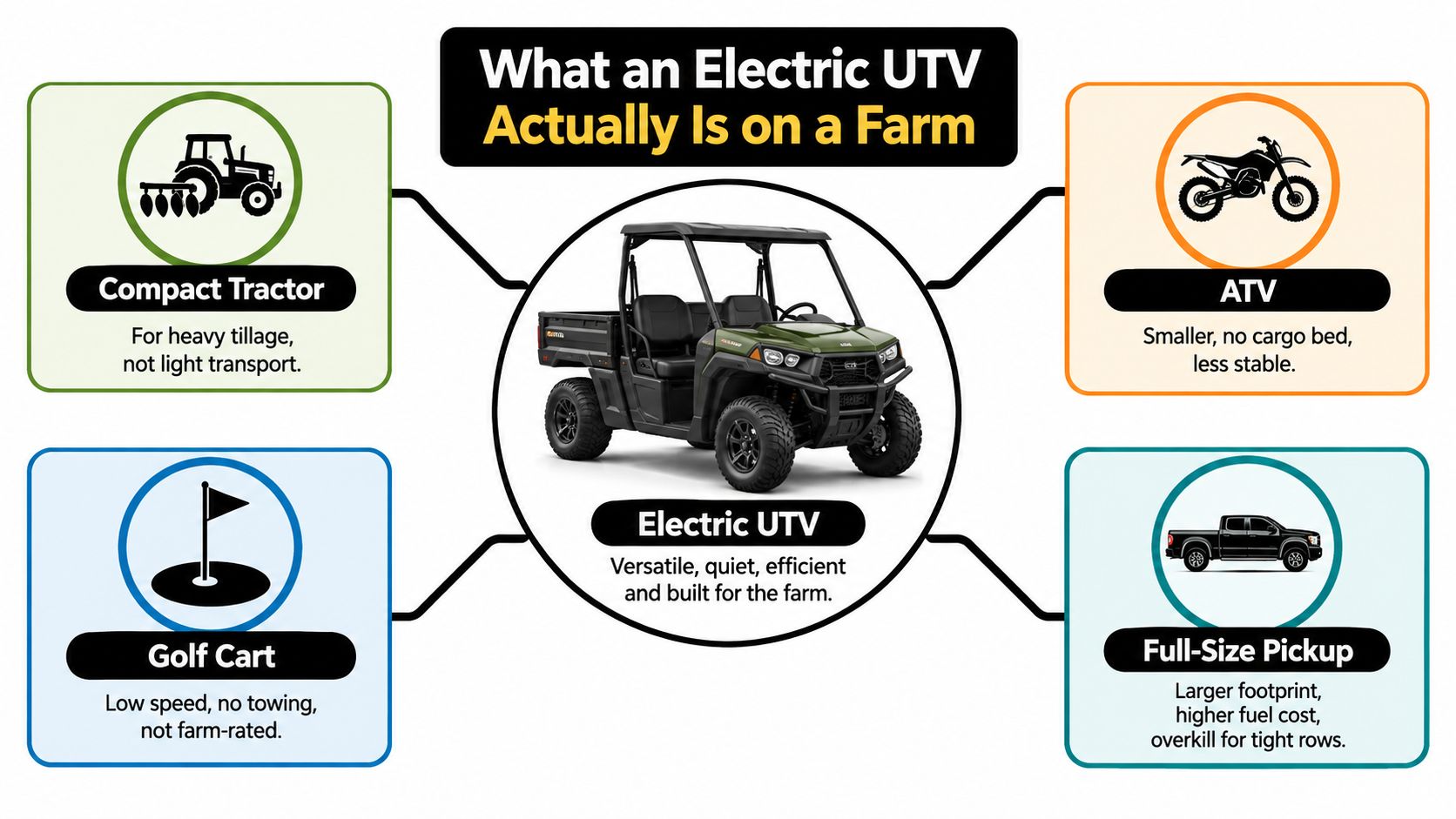
The easiest way to place it is by comparing jobs:
- Compact tractor: Better suited to heavy field work such as tillage. A UTV is for transport and lighter property chores.
- ATV: Usually smaller and lacks a side-by-side seating layout and cargo bed, which can limit how it carries people and supplies.
- Golf cart: Designed for smoother, more predictable surfaces, not necessarily farm terrain, towing, or utility work.
- Full-size pickup: Useful for road travel and heavier loads, but can be cumbersome in tight lanes, around livestock, or between rows.
Under the bodywork, the key components are the battery, motor, controller, and drivetrain. The battery stores energy; the controller manages its delivery to the motor. A permanent-magnet synchronous motor, or PMSM, is one motor type you may see in specifications. On-demand two-wheel drive and four-wheel drive let the driver select extra traction when conditions call for it, while an electric dump bed can make unloading easier.
The U.S. Environmental Protection Agency estimated that the country had approximately 146 million pieces of off-road equipment in 2022, and about 99% were rated below 25 horsepower, a range identified as having significant potential for battery electrification (EPA's off-road vehicle assessment). That's broad context, not a claim that a UTV can replace a tractor. It reinforces the more practical point: many light transport and property-maintenance jobs don't require a full-size field machine.
If your routine is livestock checks, short trips between buildings, fence inspections, or moving supplies, a UTV may fit. If the work involves sustained heavy tillage or all-day high-load hauling, look to equipment designed for that duty.
Reading the Specs That Actually Matter
A spec sheet is useful when you translate each figure into a job. A large motor number alone doesn't tell you how much feed you can haul uphill, and a maximum range doesn't tell you whether the vehicle can complete a winter workday.
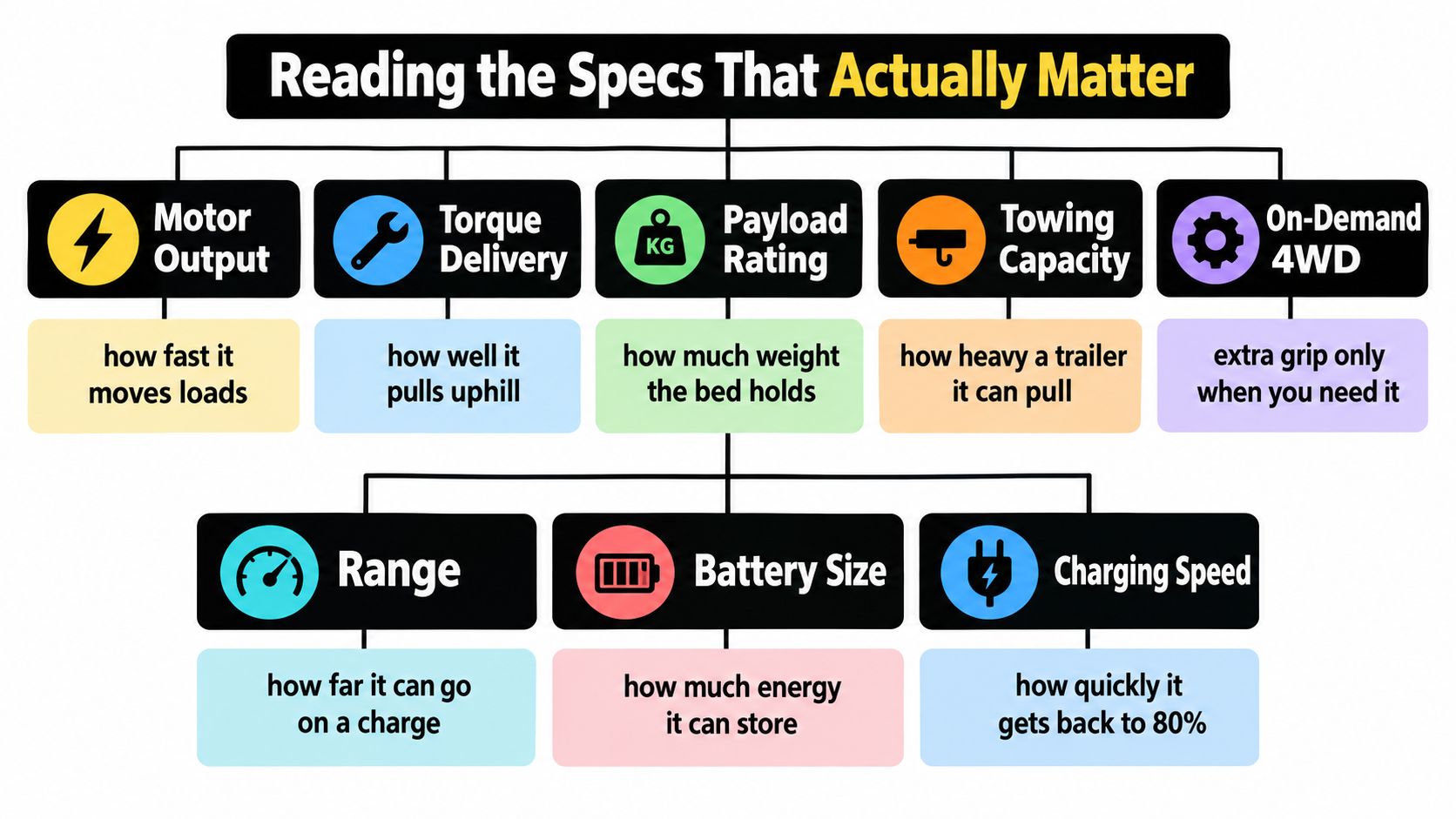
Match the rating to the chore
Motor output describes available power, but it isn't a payload or towing rating. Torque, the turning force delivered to the wheels, is especially relevant at low speeds when you're starting with a load or moving up a grade. Ask a dealer to explain how the vehicle behaves under load, rather than judging from motor output alone.
Payload is the weight carried in the vehicle, while towing capacity applies to what it pulls behind. Keep the two separate in your planning. Feed, tools, passengers, and accessories all contribute to the vehicle's load, and a trailer adds its own demands on the drivetrain and brakes.
Four-wheel drive can help on loose or uneven ground, but it can also increase energy use. A winch's rated pull tells you about the winch, not the vehicle's safe recovery limits or the strength of the anchor point. Treat recovery equipment as a tool that requires sound technique, not as permission to get stuck.
Read battery and range figures with care
The Campus E1 is a concrete reference point: its listed configuration includes a 20 kW PMSM motor, a 72 V, 150 Ah lithium battery, and a range of up to 60 miles. Those are product specifications, not a promise of the same result under every load and condition. Its electric dump bed and on-demand 2WD/4WD also show why a buyer should review the complete configuration, not only the battery or motor.
Agricultural field research measured electric-tractor battery power averaging 6.25 kW during light work, 8.76 kW at medium load, and 14.51 kW during heavy-duty work. Reported usable times fell from roughly 3.00 hours to 1.25 hours as load rose (electric-tractor field research). A UTV isn't a tractor, but the load pattern is instructive: heavy work draws energy faster than light travel.
Battery capacity, charger input, and charging time belong in the same conversation. Also ask about accessories such as lights, a winch, or a heater, since using them affects the energy available for driving. A useful test question is simple: can this setup handle my heaviest recurring chore and still get back to a charging point?
Matching Real Farm Duty Cycles to Battery Life
A range estimate becomes useful only after you describe the route and workload. The same UTV may make several light trips over firm ground, then struggle to complete a shorter day of loaded hauling through mud or up slopes. Plan around energy demand, not just miles.
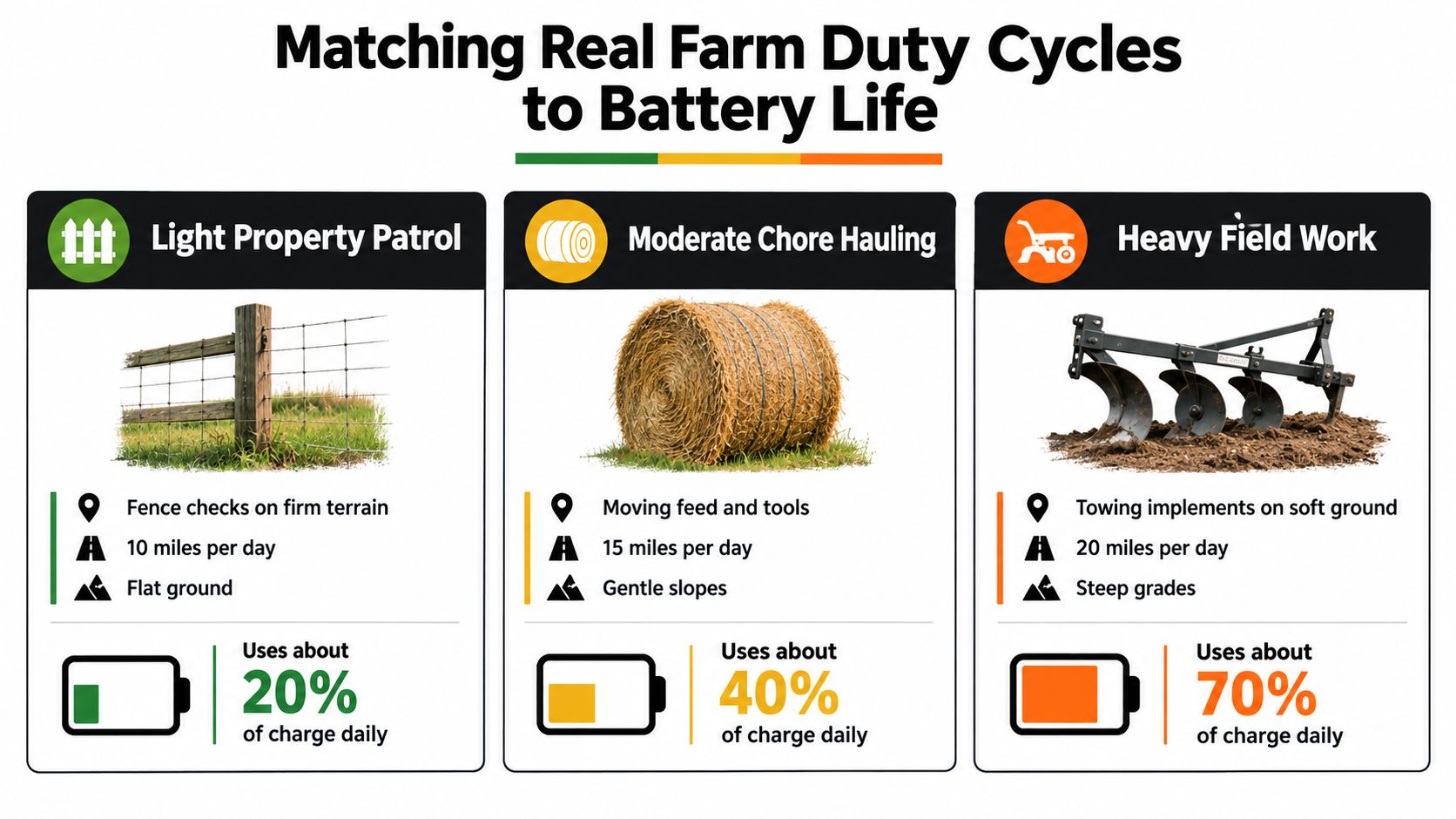
Use these three scenarios to structure a dealer conversation. The daily distances and battery-use percentages shown in the infographic are illustrative examples, not measured performance claims for a particular UTV.
Light property patrol
Fence checks and livestock inspections on firm, mostly level ground are the easiest case. The bed may carry a few tools, and the vehicle may return to the shed between chores. Record the route, load, and likely stops. That gives you a baseline to compare with the demanding days.
Mixed chore hauling
Moving feed or fencing supplies, crossing gentle slopes, and switching into four-wheel drive when needed adds more load and variation. Repeated starts, soft patches, and accessories can make this route draw more power than steady travel. If you're trying to reduce energy use, practical measures such as route planning and load management are covered in this guide to improving electric-UTV efficiency.
Loaded 4WD work
Towing or carrying a heavy load through soft soil, steep ground, or cold weather is the stress test. Available coverage reports that heavy hauling and steep terrain can reduce usable range from roughly 45 miles to 25–30 miles in comparable farm-oriented electric vehicles. It also reports lithium-battery range reductions of about 15–20% in ordinary winter temperatures and as much as 20–40% in severe cold (farm-use range and cold-weather discussion). These figures are context, not a prediction for every model or property.
Keep a reserve. Don't schedule the last demanding trip around the maximum range displayed in a brochure or dashboard.
Write down the hardest recurring route, estimate its load and terrain, and ask the dealer to explain how those conditions affect usable battery. Then plan a charging point or backup option before the day gets tight.
Attachments and Chores That Make the UTV Pay for Itself
A UTV earns its space by taking recurring jobs off your hands. Make a list of the chores you'd use it for, then check which equipment makes each task safer or less tiring.
- Feed and debris: A powered dump bed can simplify unloading feed, soil, or cleanup material. Check the bed's rated load and whether the material fits without blocking safe visibility.
- Fence repairs: A winch may help with recovery or controlled pulling, but use proper rigging and a suitable anchor. Carry the hand tools and repair supplies in a secured box.
- Trailer work: A receiver hitch makes it possible to connect compatible trailers or implements. Confirm towing limits, tongue weight requirements, and braking arrangements for the intended load.
- Snow or material spreading: A light plow or spreader may suit property maintenance, but conditions and attachment weight can change traction and battery demand.
- Water or spraying: A tank or sprayer needs a secure mount, compatible electrical connections, and a load that stays within the vehicle's ratings.
Separate must-have features from nice-to-have accessories. If hauling feed is a daily job, bed capacity and easy unloading deserve priority. If the vehicle mostly carries a person and a toolbox, a larger cargo setup may not justify its cost or weight.
The Campus E1 is one example of a farm-oriented electric UTV configuration, with an electric dump bed and a winch listed among its features. Before choosing any model, compare the bed and accessory options with your work list, and review what a UTV with an electric dump bed can and can't handle.
Attachments aren't free of trade-offs. A tank, plow, or trailer adds weight or drag, and the UTV still has to manage the terrain. Ask the dealer how each intended attachment affects payload, towing, ground clearance, and practical working range.
Electric Versus Gas UTVs on the Farm
Neither powertrain suits every farm. Electric can be convenient for repeated short trips and low-speed chores, while gasoline can be easier to refuel during a long day far from a charger. Compare the way each vehicle fits your work schedule, not just its purchase price.
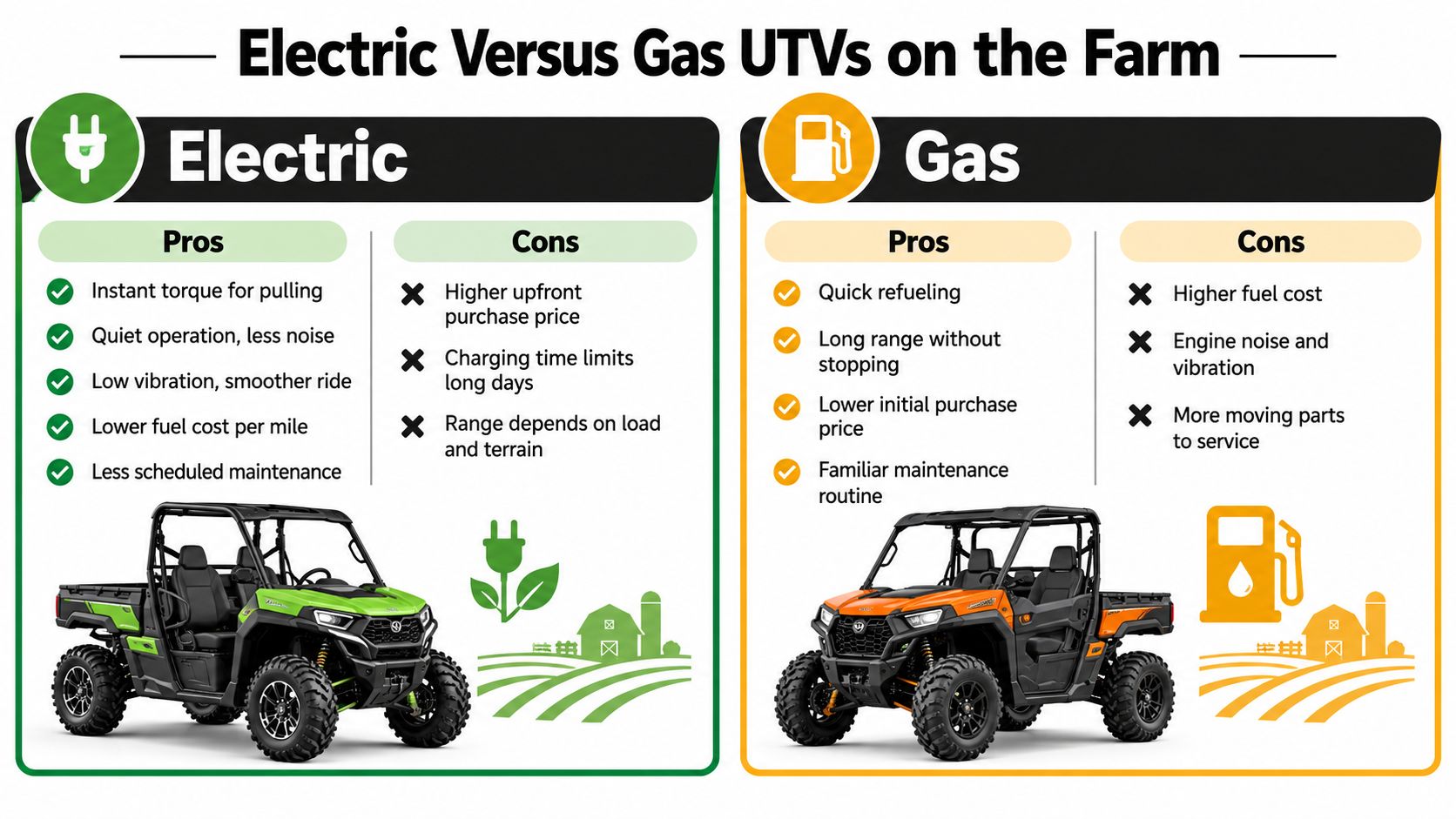
| Farm consideration | Electric UTV | Gas UTV |
|---|---|---|
| Low-speed work | Quiet operation and responsive power can suit short trips and repeated stops. | Engine noise and vibration may be more noticeable during nearby work. |
| Energy supply | Requires a suitable charging routine and time to recharge. | Refueling can be quicker where fuel is available. |
| Maintenance | No gasoline engine to service, but tires, brakes, suspension, battery care, and other components still need attention. | Engine and drivetrain servicing form part of routine ownership. |
| Long remote days | Range and charging access may limit uninterrupted work. | A fuel supply can support longer stretches of work between stops. |
| Purchase and long-term cost | Battery and charger costs should be considered alongside energy and maintenance. | Fuel and scheduled engine service should be included in the comparison. |
A 2022 review of electric and autonomous agricultural off-road equipment reported that a hybrid-electric multifunction tractor produced approximately 17% fewer emissions than a comparable diesel tractor. The review also estimated that battery and eventual battery-replacement costs represented about 52% of an electric tractor's total purchase price (peer-reviewed review of agricultural off-road equipment). Those findings concern tractors, not a direct electric-versus-gas UTV test. They're useful context for thinking about emissions and battery economics, but they don't settle which UTV is right for a particular farm.
An electric model may fit properties with frequent short routes, dependable charging, and work that doesn't require all-day remote hauling. A gas model may be more practical where refueling is available but charging isn't, or where the vehicle must keep working without a planned recharge. Low-use owners should also examine whether their expected fuel and service savings can reasonably offset any higher upfront cost.
A Realistic Worksheet for Total Cost of Ownership
A useful cost comparison doesn't start with a generic savings claim. It lists the expenses you'll pay, then uses your local prices and likely operating schedule.
Begin by gathering the vehicle prices and financing terms for both powertrains. Add the items below as separate lines:
- Energy: Estimate annual electricity use from your route and workload, then multiply by your local electricity price. For gas, estimate fuel used for the same work and apply your local fuel price.
- Routine service: List expected maintenance for each vehicle using dealer estimates. Keep tires, brakes, and other wear items separate so they don't disappear inside a broad “maintenance” figure.
- Charging setup: Include the charger, installation, and any electrical work your site needs. Limited charging infrastructure can be a barrier for rural users, and a 240-volt installation is reported to cost roughly $800–$2,500, depending on equipment and site requirements (rural charging and installation context).
- Battery risk: Ask about warranty coverage, replacement terms, and the expected cost if a battery eventually needs replacement. Treat this as a risk to investigate, not as a guaranteed expense on a specific schedule.
- Financing and resale: Compare the full financing terms and consider what you expect to recover when you sell. Don't assume an incentive applies until you confirm its eligibility and availability.
| Cost line | Hobby farm, electric vs. gas | Working ranch, electric vs. gas |
|---|---|---|
| Annual energy | Enter local electricity cost vs. gasoline cost for light use. | Enter local electricity cost vs. gasoline cost for heavier seasonal work. |
| Routine maintenance | Use dealer estimates for both vehicles and your expected hours. | Use dealer estimates that reflect the ranch's workload and service schedule. |
| Charger installation | Add the actual quote for the property. | Add the actual quote, including any extra work needed at the charging location. |
| Battery replacement risk | Record warranty terms and a replacement estimate, if available. | Record warranty terms and a replacement estimate, then consider workload and downtime. |
| Financing and resale | Compare offers and realistic resale expectations. | Compare financing and resale under the same ownership period. |
| Total | Add the lines without assuming a payback. | Add the lines and check whether the extra use changes the result. |
For a hobby farm with light use, low fuel displacement can make charging installation harder to justify. A working ranch may get more use from reduced refueling and routine engine service, but heavy work also makes battery and downtime planning more important. The worksheet only becomes a comparison when you fill it with quotes and local prices.
If you're reviewing financing alongside the equipment costs, EV finance from Nomu Finance Limited is a resource to compare with dealer terms. Check eligibility, fees, and the full repayment cost before making a decision.
Charging Logistics, Maintenance, and a Buying Checklist
Charging works best when it fits the workday. A dependable AC charging point at a barn, shop, or equipment shed lets you return the UTV between chores rather than waiting for a depleted battery at the end of a long shift. Before buying, confirm charger input needs, circuit capacity, connector compatibility, weather protection, and whether the manufacturer permits charging in dusty or wet conditions.
A technical study of electric agricultural machinery identifies charging availability as a field-use constraint and describes a mobile charging system that can recharge an electric tractor in roughly 1.5–2 hours using a high-capacity lithium-ion energy store (study of charging for electric agricultural machinery). That's a research example, not a guaranteed UTV charging time. For a remote property, ask whether scheduled opportunity charging, a backup vehicle, or another charging arrangement is needed to keep chores on schedule.
Electric drivetrains still need routine care. Follow the manufacturer's guidance for the battery and charger, and inspect brakes, tires, suspension, lights, hitch components, and electrical connections. A dealer can provide model-specific service intervals; compare those costs with gas-vehicle service using the same ownership assumptions. This guide to UTV maintenance costs can help you organize questions for that conversation.
Before signing, match each specification to a real job:
- Traction: Does 2WD/4WD selection suit the soft ground, slopes, and tracks on your property?
- Load: Are bed payload and towing ratings appropriate for feed, tools, passengers, and trailers?
- Battery and charging: Can the vehicle finish the hardest recurring route with a reserve, and can you recharge where the workday allows?
- Equipment and support: Do the attachments fit your chores, and can the dealer explain service, warranty, and battery coverage?
- Safety and rules: Confirm lighting, seat belts, rollover protection, passenger limits, and local rules for operating off-road vehicles on your property. Follow the manufacturer's guidance for protective equipment and safe recovery.
Campus EV offers electric UTVs for farm, ranch, and property work, including the Campus E1 with on-demand 2WD/4WD and a powered dump bed. Compare its specifications with your hardest regular chores and charging setup, then visit Campus EV to review the available options.