
You're halfway through a morning property round when the work starts stacking up. Feed needs moving to the far pasture, a fallen limb is blocking the access lane, and the dump bed is waiting for gravel at the gate. A gasoline UTV can handle the work, but it brings engine noise, exhaust, warm-up time, and another fuel system to maintain. An electric off-road UTV with a dump bed approaches the same jobs differently, with quiet low-speed power and charging planned around the property.
The hard question isn't whether an electric machine can move a load. It's whether it can finish your loaded route, over your terrain, in your weather, with enough energy left to get back. Maximum trail range rarely answers that question. Payload, 2WD or 4WD operation, repeated stops, bed lifting, tire pressure, winching, and cold temperatures all reshape the working range.
Table of Contents
- What Is an Electric Off-Road UTV With a Dump Bed
- How Electric Drivetrains and Dump Beds Work Together
- Electric Versus Gas UTVs for Property Work
- Key Specs to Evaluate Before Buying
- Real-World Range and Cold Weather Performance
- Common Use Cases and Property Applications
- How to Choose the Right Electric UTV
- Maintenance, Safety, and Seasonal Care
What Is an Electric Off-Road UTV With a Dump Bed
An electric off-road UTV with a dump bed is a battery-powered side-by-side utility vehicle designed to carry people, equipment, and materials across uneven ground. Instead of a gasoline engine and transmission, it uses an electric motor, battery pack, controller, and drivetrain. Behind the seats, a powered cargo box tilts so the operator can unload soil, mulch, gravel, feed, firewood, or debris without climbing in with a shovel.
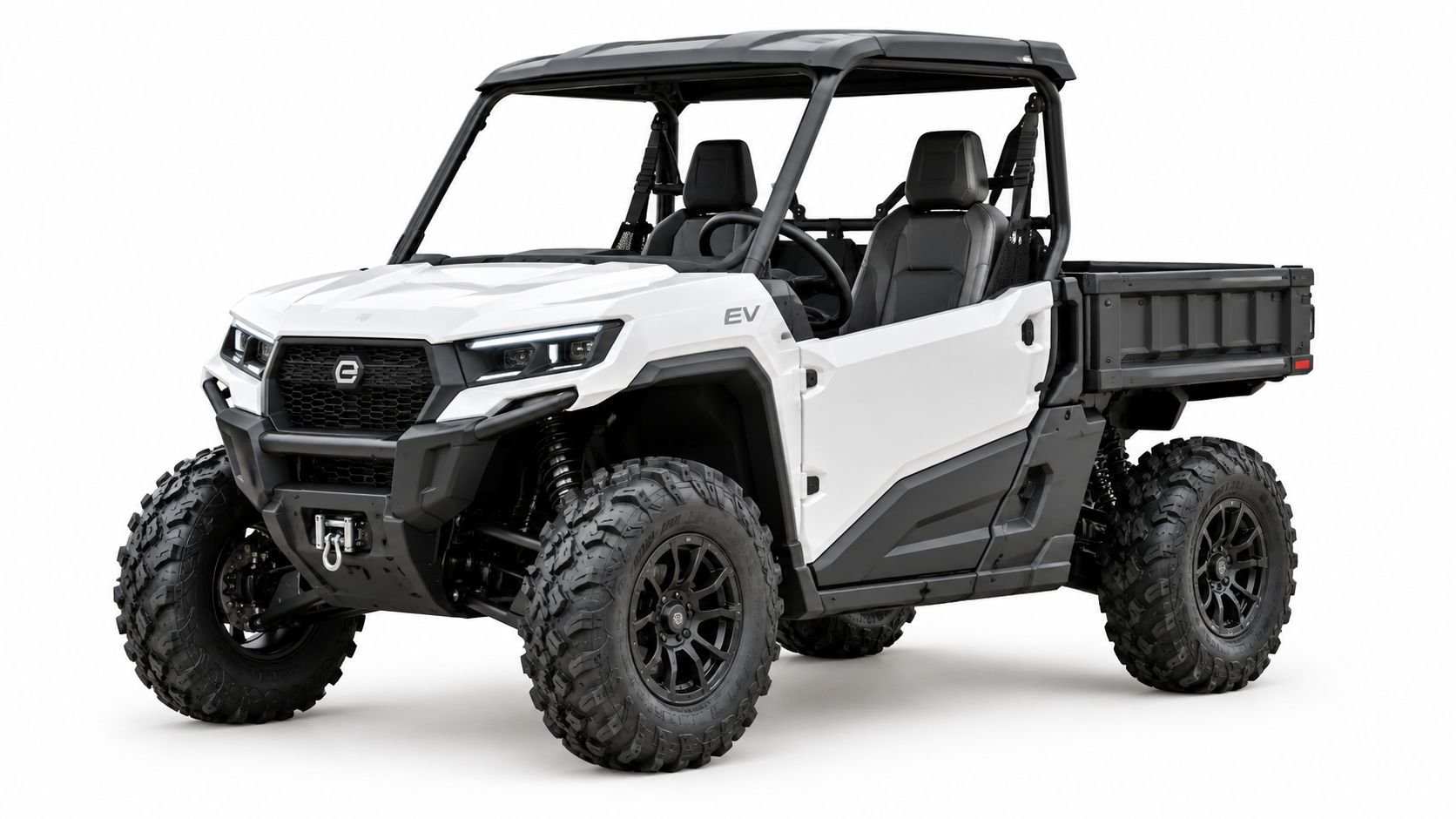
On a working property, the difference shows up in the small jobs. You can move fencing supplies before breakfast, carry feed through a pasture, collect branches after a storm, and return with an empty bed without starting an engine or hauling material by hand. Electric motors also deliver power immediately, which suits the stop-and-go rhythm of barn work, yard maintenance, and short climbs.
The dump bed is useful because it changes the labor involved in bulk hauling. It doesn't make an overloaded vehicle safe, and it doesn't remove the need to check the ground before tipping. It lets the operator unload in a controlled area, provided the material, slope, and bed capacity remain within the manufacturer's limits.
For readers still sorting out the difference between an ATV and a side-by-side, this explanation of what a side-by-side is provides useful background. A UTV generally offers a seated passenger compartment, steering wheel, protective structure, and a cargo platform, making it more suitable for shared property work than a single-rider ATV.
The same machine can feel like a quiet utility cart on a flat yard and a demanding off-road tool on a loaded hill. That's why the battery, motor, tires, bed, and charging setup have to be evaluated as one working system.
A short visual demonstration can help show how the vehicle combines passenger seating, off-road clearance, and a rear cargo bed:
How Electric Drivetrains and Dump Beds Work Together
An electric drivetrain and a dump bed share the same energy reserve. That sounds obvious, but many buyers read the motor specification, range claim, and bed capacity as separate features. On a work route, they interact constantly.
A loaded UTV needs strong low-speed torque to pull away from a stop, climb a soft section, or maintain motion through mud. Electric motors are well suited to that pattern because they can produce useful torque without waiting for engine speed to build. The controller, gearing, tire grip, and battery's ability to deliver current determine how that torque feels at the ground.
The bed mechanism adds another electrical demand. A hydraulic or electric lifting system draws energy from the vehicle's battery, as do lights, a winch, cabin equipment, heating, and other accessories. One lift cycle won't define the day, but repeated loading and unloading belongs in the duty cycle, especially on a property where the vehicle makes short trips and stops often.
Read the specification as a system
A battery rating gives you stored energy under stated conditions, not a guaranteed workday. The vehicle may consume energy through traction, regenerative braking, auxiliary equipment, and repeated acceleration. Weight, terrain, operating mode, and tire condition all affect the result.
California's Air Resources Board is collecting this kind of information through a field project covering 40 zero-emission heavy-duty off-road machines and 120 zero-emission heavy-duty trucks. The project records vehicle-control data at 10 Hz, along with GPS position, real-time vehicle weight, energy consumption, charging time and location, charger specifications, and operating duration. Its measurements include motive energy, regenerative braking, auxiliary loads, and air-quality effects. The Air Resources Board's project description shows why a utility buyer needs more than a maximum-distance claim.
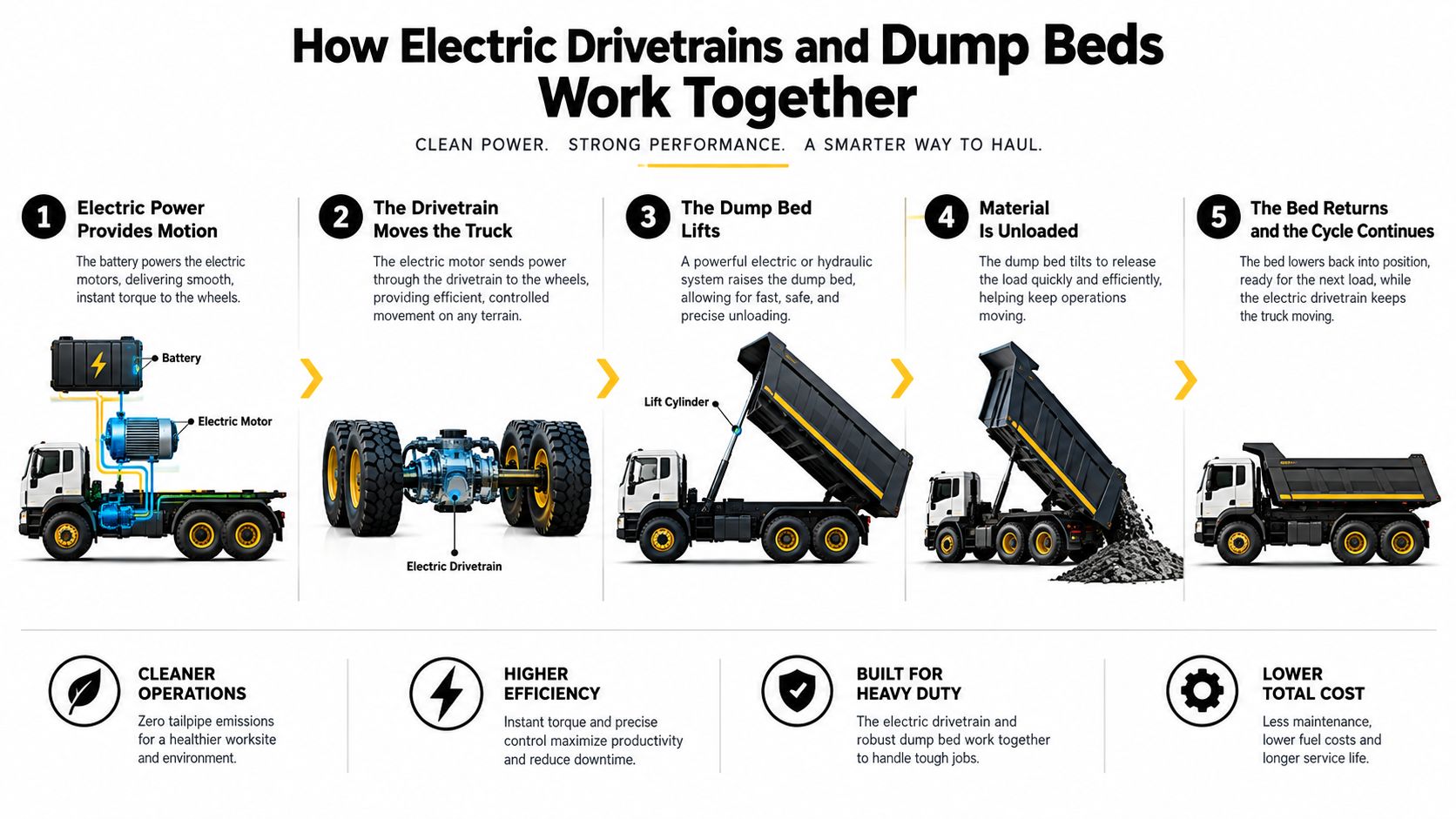
For an electric UTV, the practical sequence looks like this:
- The battery supplies the controller, which manages power delivery to the motor.
- The motor turns the drivetrain, producing traction for starts, climbs, and steady travel.
- The load changes the demand, with material weight and terrain requiring more energy.
- The dump mechanism uses stored energy, reducing the reserve available for driving.
- Charging restores the reserve, subject to outlet capacity, battery temperature, and charger limits.
Battery-electric operation produces no tailpipe emissions during use, although the wider environmental footprint still depends on electricity generation, manufacturing, and battery production. The useful buying lesson is simple: compare the full work cycle, not just motor power.
Electric Versus Gas UTVs for Property Work
Electric and gasoline UTVs solve similar jobs, but they fit different operating patterns. A gas machine is easier to refuel far from buildings, while an electric machine is easier to start, quieter around livestock and wildlife, and less demanding in routine engine service.
For daily property work, electric ownership removes engine oil changes, spark plug replacement, fuel-system maintenance, and some of the noise associated with combustion equipment. It also avoids on-site exhaust while operating in enclosed or semi-enclosed areas such as barns, warehouse yards, and equipment buildings. That doesn't make an electric UTV maintenance-free. Tires, suspension, brakes, steering, driveline components, battery connections, and the dump mechanism still need attention.
Gas remains convenient where charging is difficult. A fuel can restore operating ability quickly, while an electric UTV needs an appropriate outlet and enough parked time. Remote ranches, large timber properties, and construction sites without dependable electrical access may prefer the flexibility of combustion, especially if the workday includes long continuous travel.
The ownership trade-off
Electric models can have a higher purchase price, and battery replacement is a long-term consideration that buyers should discuss with the dealer. In exchange, owners may gain a simpler propulsion system and lower routine engine-service demands. The right comparison isn't just sticker price against fuel cost. It includes working hours, charging access, service availability, local electricity, downtime, and how often the vehicle replaces a gasoline trip.
Independent life-cycle research adds useful context. A 2024 Nature Communications study compared electric, internal-combustion, and hybrid vehicles using a cradle-to-grave framework that included vehicle production, charging infrastructure, electricity use, and operation. Across the United States and the scenarios examined, electric vehicles had lower greenhouse-gas intensity than comparable internal-combustion and hybrid vehicles, although results varied by vehicle category, electricity mix, charging system, and manufacturing impacts. The full life-cycle analysis is relevant context, not a promise that every UTV has the same result.
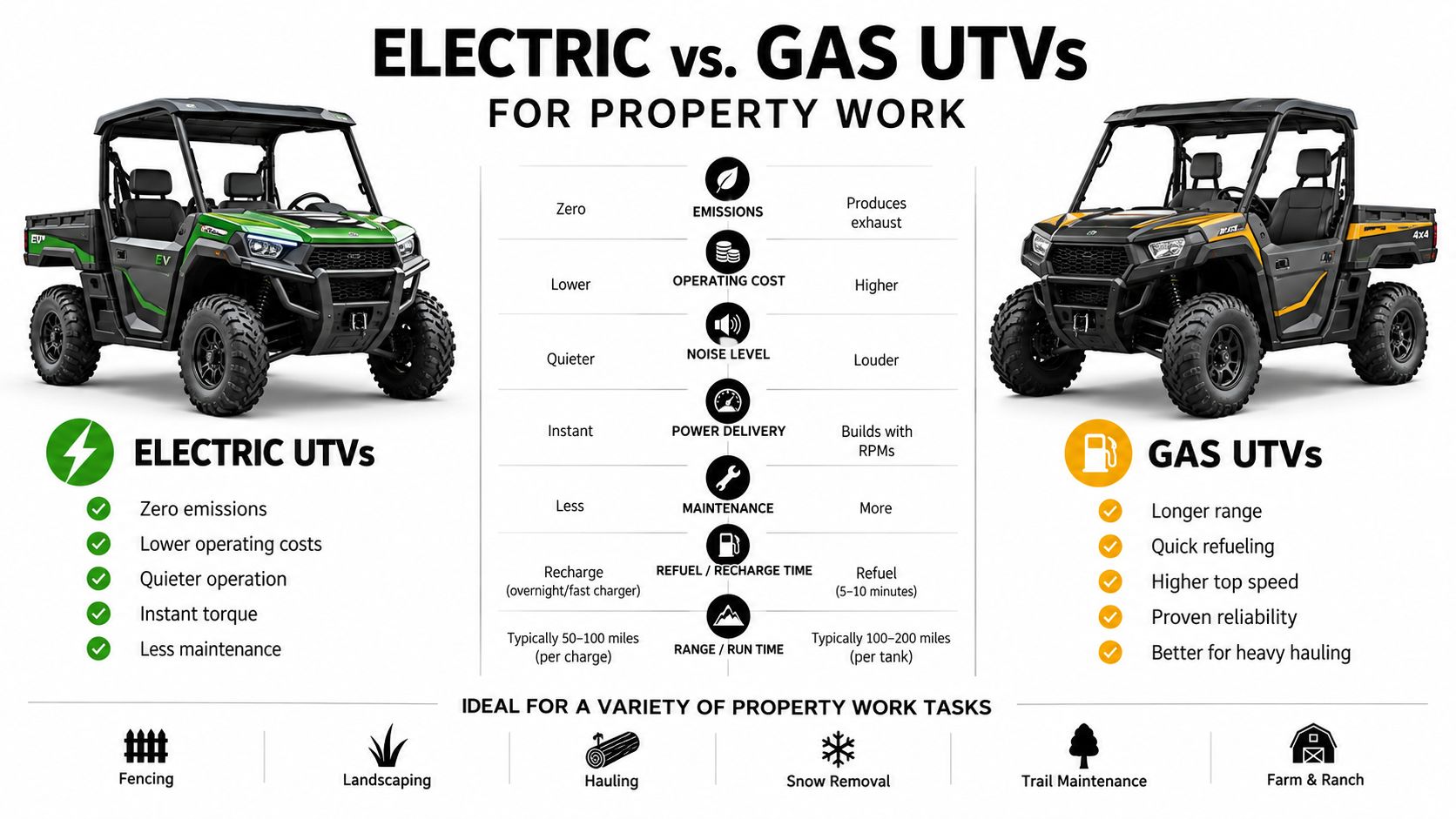
Practical comparison: Gas offers refueling flexibility. Electric offers quiet, immediate operation and no tailpipe exhaust. Your property layout decides which advantage matters more.
Noise deserves its own consideration. Quiet electric travel can help around horses, cattle, homes, camps, and hunting areas, but tires, suspension, bed hardware, and cargo still make sound. Electric power reduces drivetrain noise. It doesn't turn a loaded utility vehicle into a silent machine.
Key Specs to Evaluate Before Buying
Start with the job, then read the specifications. A buyer hauling feed across firm lanes has different needs from one carrying soil over rocky slopes. Payload, terrain, duty cycle, and charging access should carry more weight than a headline horsepower figure.
Match the bed to the load
Payload is the first filter. Check the manufacturer's maximum bed payload, total vehicle payload, towing rating, and any restrictions on slopes or raised-bed operation. Bed volume matters too, but a large box can tempt operators to carry more weight than the chassis, tires, suspension, or brakes can safely manage.
Dump height and tailgate design affect whether you can unload into a trailer, spread material beside a lane, or empty the bed over a low wall. A bed that tilts is useful only when its hinges, lift system, and latch are built for the work you do.
Evaluate traction and terrain
Ground clearance, suspension travel, tire construction, and approach and departure angles determine how the UTV handles ruts, rocks, mud, and uneven access roads. Selectable or on-demand 2WD and 4WD lets the operator use extra traction when needed rather than driving every trip with all wheels engaged.
Motor torque matters most during loaded starts and climbs. Battery voltage and amp-hour capacity establish the energy foundation, but neither number predicts a dependable route without knowing how much weight the vehicle carries and how often it works in 4WD.
Check the charging routine
A vehicle that fits the work but not the charging setup will frustrate you. Confirm whether the supplied charger works from your available outlet, where the vehicle will be stored, and whether a dedicated circuit is required. A 240V installation may suit a busy farm or maintenance yard better than relying on a distant outlet, but the vehicle's charger determines the actual benefit.
| Specification | Why It Matters | Typical Range |
|---|---|---|
| Payload rating | Sets the safe material and equipment load | Model-specific |
| Dump-bed capacity | Determines how much loose material can be moved per trip | Model-specific |
| Battery voltage and capacity | Establishes nominal stored energy | Model-specific |
| Drive mode | Balances traction and energy use across terrain | 2WD, 4WD, or selectable |
| Ground clearance | Helps the chassis clear ruts, rocks, and debris | Model-specific |
| Charging system | Determines whether the machine fits the property's electrical access | Outlet and charger dependent |
A useful specification sheet should also disclose winch capacity, tire size, brake design, water protection, battery warranty, replacement support, and dealer service. If those details are missing, treat the range claim cautiously.
Real-World Range and Cold Weather Performance
The range number on a brochure usually describes a favorable test or light-use condition. Property work is harsher. A loaded bed, soft ground, steep grade, low tire pressure, frequent 4WD use, winching, and repeated stops can consume energy faster than steady travel on a firm trail.
Think in duty cycles instead of one maximum figure:
- Unloaded travel uses the least energy when the route is firm and relatively level.
- Loaded utility work adds the mass of feed, tools, fencing, soil, or debris.
- Sustained 4WD increases traction capability but can raise energy demand.
- Winter operation reduces available battery energy and can slow charging.
A 72V, 150Ah battery has about 10.8 kWh of nominal stored energy, before charging losses and real operating conditions are considered. Research on lithium-ion temperature behavior explains why cold batteries show higher internal and polarization resistance, causing voltage to reach the battery-management cutoff sooner. Cold charging can also create lithium plating and permanent degradation.
Cold changes the work plan
The U.S. Department of Energy found that battery-electric vehicle range fell 41% at 20°F, compared with 10% for an internal-combustion vehicle under its tested conditions. The DOE cold-ambient performance report concerns battery-electric vehicles broadly, so it shouldn't be treated as a precise prediction for every UTV. It does show why winter reserve planning matters.
Outdoor storage can make the problem worse. An NREL Fairbanks case study reported range reductions of up to 69% for vehicles stored outdoors, a result that demonstrates the risk of cold-soaked equipment rather than a guaranteed UTV outcome. The NREL case study supports a conservative approach for farms, ranches, hunting camps, and unheated sheds.
Store under cover, avoid returning with no reserve, and follow the manufacturer's instructions before charging a very cold pack. Allow the battery to warm when required, precondition where supported, and plan extra energy for snow, mud, 4WD, lights, heaters, and accessories. For owners comparing outlet options, this guide to Level 2 EV charging times helps explain how charging power and available time affect turnaround.
Use these electric UTV efficiency practices alongside conservative route planning. In hot weather, shade, ventilation, cooling after heavy work, and avoiding prolonged high-state-of-charge storage can reduce thermal stress. Operation above approximately 50 °C can accelerate capacity loss and reduce range, according to the cited lithium-ion research.
Common Use Cases and Property Applications
The best application is usually a repeated route with predictable stops, moderate distances, and a reliable place to charge. Electric dump-bed UTVs suit properties where the vehicle spends much of the day moving between barns, fields, gates, storage areas, and work zones rather than traveling continuously far from support.
On a farm, the bed can carry feed bags, fencing tools, posts, and harvested material. The operator should still separate dense loads from bulky light material and keep the route's steepest sections in mind. On a ranch, quiet movement can be useful around livestock, while ground clearance and selectable 4WD matter when pasture lanes become soft or rutted.
Hunters often value quiet access and the ability to carry camp gear or retrieve game. That use demands careful reserve planning because the vehicle may be stored at a remote property with limited charging. A full bed, rough trails, low temperatures, and long recovery routes create a much harder duty cycle than an unloaded scouting trip.
Where the bed earns its keep
Campus and warehouse maintenance teams can use an electric side-by-side for debris collection, groundskeeping, light material transport, and work near buildings where exhaust is undesirable. Landscaping crews may appreciate quiet operation near homes, parks, and public spaces, although they still need to confirm payload and charging logistics for a full day of repeated trips.
Construction users should treat the machine as a site utility tool, not a replacement for equipment designed for heavy earthmoving. It can carry tools, supplies, and light loose material across a site, but loose ground, ramps, high loads, and frequent bed cycles require a clear operating plan.
For brush and vegetation work, it helps to understand the difference between hauling debris and processing it. This overview of forestry mulching provides useful context on the specialized machinery used to grind vegetation in place. An electric UTV can support that work by moving tools, fuel-free supplies, or cleared debris, but it isn't itself a forestry mulcher.
The strongest fit is a property with short utility loops, frequent low-speed tasks, and overnight charging. The weakest fit is a remote, high-mileage route where the vehicle must carry heavy loads continuously and has no dependable charging point.
How to Choose the Right Electric UTV
Begin with a work log rather than a shopping list. Write down the route, typical payload, steepest climb, softest ground, number of daily trips, winter temperature, and where the vehicle can charge. That list will expose whether you need more traction, more bed capacity, faster charging, or only better reserve discipline.
Filter models by the difficult day
The easy day shouldn't determine the purchase. Test the machine mentally against the day when the bed is full, the trail is wet, the temperature is low, and a return trip is unavoidable. Ask the dealer how the battery-management system behaves in cold weather, whether the vehicle supports preconditioning, and what charging equipment is included.
Inspect the details that brochures often compress:
- Bed and chassis: Confirm the dump-box payload, latch design, lift operation, and ability to carry dense material safely.
- Traction: Check whether 2WD and 4WD selection suits your ground, and whether the tires match mud, gravel, pasture, or hard surfaces.
- Service: Identify the authorized dealer, battery warranty, parts availability, diagnostic support, and repair process.
- Charging: Measure the distance to the outlet and decide whether the existing electrical setup supports your turnaround needs.
- Ownership: Compare financing, insurance, tires, routine service, electricity, and expected downtime rather than looking only at the purchase price.
A Campus EV E1, for example, combines selectable 2WD and 4WD, 11 inches of ground clearance, an electric dump bed rated for 550 pounds, and a 72V, 150Ah battery. Those figures come from the product information provided for this guide, but they still need to be matched against your route, load distribution, and charging routine. The right model is the one whose limits fit the job without requiring optimistic assumptions.
Maintenance, Safety, and Seasonal Care
Electric propulsion reduces engine service, but utility work still punishes neglected machines. Inspect tires, wheel fasteners, steering, suspension, brakes, skid protection, battery connections, charging hardware, and dump-bed hinges. Look for packed mud around moving parts, damaged wiring, loose cargo hardware, and signs that the lift mechanism is working harder than it should.
The dump bed deserves a safety check before every loaded trip. The U.S. Forest Service identifies UTV rollovers associated with overloaded cargo beds, modified bed configurations, improperly baffled tanks, grades beyond a loaded vehicle's capability, and excessive side slopes. As cargo gets heavier or shifts rearward, the combined center of gravity moves upward and backward, reducing stability and front-axle traction during climbs. The Forest Service UTV safety guidance is especially relevant to dump-bed operation.
Keep the load low and controlled
Weigh unfamiliar cargo when possible. Dense material belongs low and centered, loose material must be secured, and the manufacturer's payload, slope, and side-slope limits are absolute operating boundaries. Return the bed fully down and latch it before crossing uneven ground. A raised bed changes the vehicle's mass distribution and can make a stable setup dangerous.
ROPS, seat belts, trained operators, and manufacturer-approved modifications are practical controls, not decorative equipment. Don't add a tank, extension, rack, or homemade bed modification without understanding how it changes weight and balance.
Protect the battery through the seasons
In winter, store the vehicle under cover, avoid deep discharge, and follow the manufacturer's instructions for charging a cold battery. After sustained towing, steep climbing, or heavy dump-bed work, allow the pack to cool when required. In hot conditions, shade and ventilation are useful, and prolonged storage at a high state of charge can add thermal stress.
For a practical ownership checklist that covers service considerations beyond the battery, review electric UTV maintenance costs. A disciplined inspection routine protects the expensive components, but safe loading protects the operator first.
Campus EV offers electric UTVs for hunting, farming, ranching, property maintenance, and off-road utility work, including the Campus E1 with selectable 2WD and 4WD and an electric dump bed. Compare the vehicle's duty-cycle fit, charging needs, and load limits for your property, then visit Campus EV to review the available configuration and dealer support.