
It's still dark when you're trying to fit a bow case, a pack, and a thermos into a machine that already feels too small for the job, or too big for the gate you need to squeeze through. That's the exact spot a two seater UTV is built for. It's not a toy and it's not a tractor. It's a small, side by side work partner for one operator and sometimes one helper, and it only earns its keep if it fits your ground, your load, and your workday.
Table of Contents
- Why the Two Seater UTV Category Matters Now
- How a Two Seater UTV Is Laid Out
- Where Two Seater UTVs Earn Their Keep
- Why Two Seaters Win on Maneuverability and Cost
- Weighing Cargo Space Against Passenger Seating
- Planning Range for an Electric Two Seater
- Choosing a Two Seater or a Larger Side-by-Side
Why the Two Seater UTV Category Matters Now
A landowner heading out to check a fence may spend the morning alone, then need a passenger to help repair a gate. That mix of solo work and occasional company helps explain the appeal of a two seater. It fits jobs where one person does most of the driving, with room for a second when the task calls for it.
Two seat utility terrain vehicles, commonly called side by sides, first served commercial work such as moving people and tools around farms, plants, and job sites. Private owners later adopted the same basic layout for property chores, hunting, and trips between buildings. The design crossed over because those jobs often call for a practical transport machine, not a full crew vehicle.
From Work Fleet to Front Porch
Today, UTVs serve both commercial operators and private owners. The North American UTV market is broad enough to include landowners, hunters, farm and ranch workers, construction crews, and public agencies. The exact balance varies by use and location, so a shopper is better served by looking at the jobs a machine is built to handle than by relying on a single market split.
That change in ownership has shaped what buyers expect. A property owner may use the same machine to check a fence, haul gear for a hunt, and carry feed. It needs to manage different chores without becoming awkward for everyday trips. A two seater suits that pattern when one driver is usual and a passenger is helpful, rather than constant.
A two seater answers a practical question: who rides along on most workdays?
Electric models follow the same basic pattern. Their appeal depends on the work they can complete, not just on being electric. Quiet operation may be useful around livestock or wildlife, but it is not automatically safer. A quieter machine can be harder for nearby people to hear, so the driver needs to manage speed, visibility, and passenger attention. Everyone riding should stay seated and follow the machine's safety rules.
Range deserves the same practical check. Treat it like a workday budget: list the route, expected loads, terrain, and time away from a charger, then confirm the model can cover that work with room to spare. A range estimate on its own may not match a demanding day on your property.
That context gives you a sound starting point for comparing machines. Consider how the layout supports your usual tasks, what the compact size trades away, and whether an electric model can finish the day you expect it to.
How a Two Seater UTV Is Laid Out
Think of a two seater UTV like a small pickup that someone shrank and stripped down for dirt. You've got a little cockpit up front, a short bed in back, and a steel frame around you. Once you see it that way, every spec sheet gets easier to read.
Start with the cab. Two seats sit side by side, close enough that you can talk without shouting. You steer with a wheel, not handlebars, and you sit in the machine rather than on it. That seated position, with a backrest and a belt, is a big part of why folks moving from an ATV feel more settled on long, slow work.
The Bed, the Frame, and What Moves You
Behind the seats is the cargo bed. On work models it often dumps, like a tiny dump truck, so you can drop gravel, mulch, or feed without hand shoveling every bit. A winch up front, if fitted, isn't for show. It's for pulling yourself out of a wet ditch, dragging a log clear, or easing a heavy load where your arms can't.
- 2WD for easy ground: Use it on dry roads, packed lanes, and barn lots where traction is good and you want simple, efficient driving.
- On-demand 4WD for trouble spots: Switch it on for mud, loose gravel, wet grass, and grades where a rear tire alone would spin and dig a hole.
- Low, steady power delivery: Electric drive gives you pulling force at low speed without revving, which helps when you're creeping up to a gate or easing through timber.
Around all of that is the rollover protection structure, the cage you see over the cab. Don't treat it as decoration or a roof rack. Its job is to preserve survival space if the machine tips, and it only does that job if you stay inside it, belted, with doors or nets closed and in good repair.
Check it like tack: Belts should latch clean, doors or nets should close tight, and the cage should show no bends, cracks, or loose mounts. If any of that looks tired, fix it before you haul anybody.
Safety isn't a footnote here, it's part of the layout. A CDC analysis identified 79 side by side crashes involving 104 injured people, with rollovers accounting for 50% of cases and two-thirds of victims ejected. That pattern explains why belts, side restraints, and a sound cage belong at the top of your inspection list, not at the bottom. A pretty bed and a strong motor won't help if the basic protection around you is worn out.
Where Two Seater UTVs Earn Their Keep
The fastest way to judge this size is to run it through three ordinary days. Specs tell you what's possible. A real Tuesday tells you what's useful.
On a solo hunt, the job is simple and fussy at the same time. You're carrying a pack, a case, maybe a game cart, and you're trying to get in quiet and get out without a second trip. A two seater gives you a bed for gear, a second seat for a pack or a partner, and a footprint that fits old logging lanes where a full size truck would be folding mirrors. The photo below shows that first light loading routine most owners know by heart.
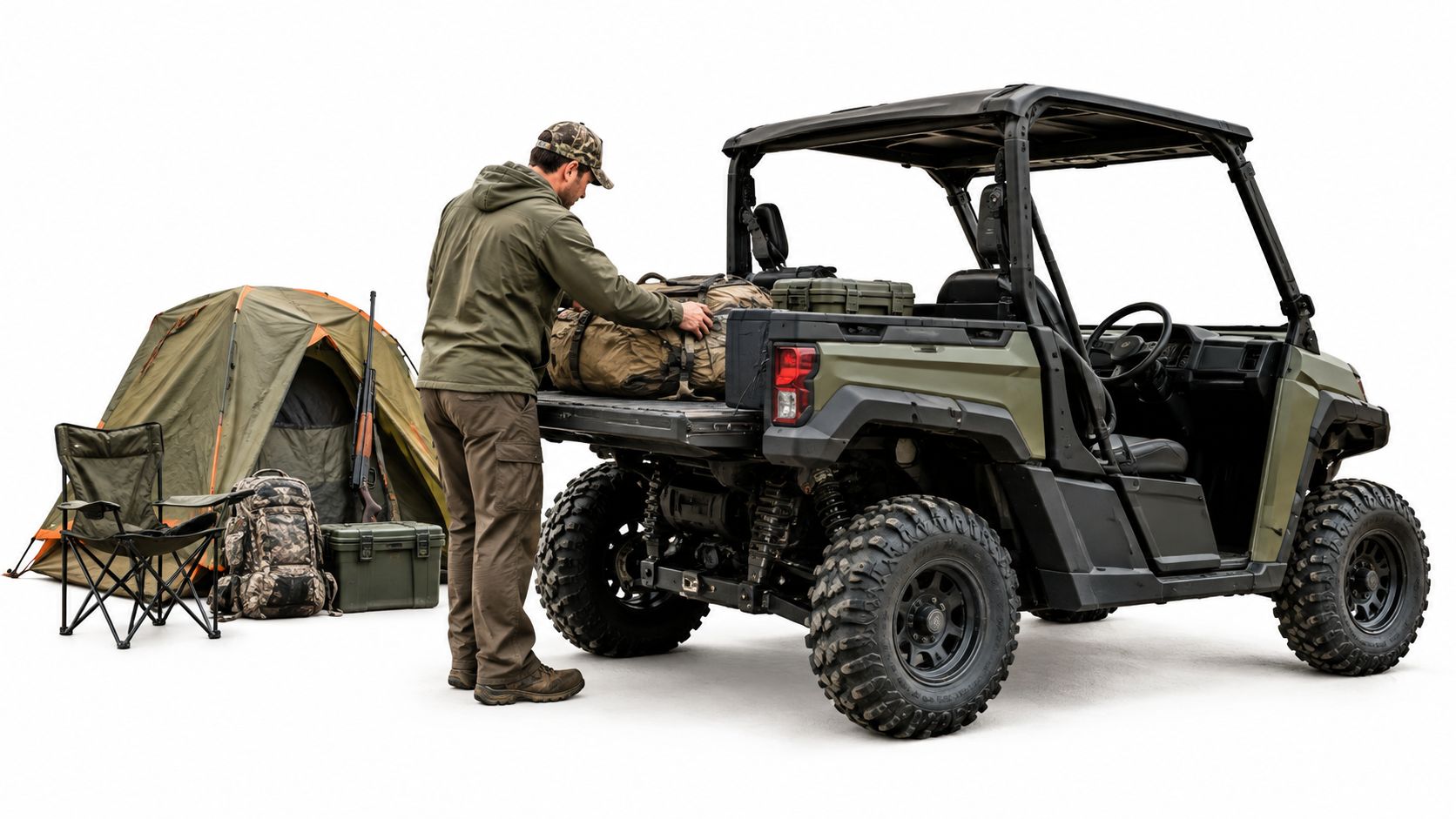
If hunting is your main use, it helps to read a focused breakdown of electric UTV features that matter for hunting before you assume any bed and any tire will do. Ground clearance, quiet approach, and where wet gear rides on the way out matter more than a flashy light bar. For a single hunter, the empty passenger seat isn't wasted space. It's dry storage that keeps optics and layers out of the bed dust.
Fence Lines at Seven, Materials Yard at Noon
A farm chore run looks different. You're checking fence with pliers, staples, and a small chainsaw, then hauling feed to a back pasture, then running tools to a broken gate. You climb in and out all morning. A two seater shines there because it's easy to park tight against a fence, easy to turn around in a lane, and big enough for a helper when you need someone to hold wire or open gates.
The short video below gives you a feel for that stop, start, load, and go rhythm in a working machine.
On a construction site or in a warehouse yard, the same machine becomes a mule. A crew member runs fittings from a container to a trench, a supervisor rides along to look at a problem, and the vehicle slips between stacked materials that would stop a pickup. Nobody's joyriding. The value is short trips, tight turns, and no wasted walking.
Notice the pattern across all three days. One main operator does most of the driving. A second person rides sometimes, not always. Cargo is real but rarely huge. That pattern is the sweet spot for two seats, and it's also where the tradeoffs start to show.
Why Two Seaters Win on Maneuverability and Cost
A two seater wins for the same reason a compact sedan beats a long bed truck in a crowded parking lot. Less length and less weight make every turn simpler. On your property, that shows up as fewer three point turns and fewer moments where you're backing up hoping you don't clip a post you can't see.
Maneuverability is the headline advantage. A shorter wheelbase turns tighter in timber, in orchard rows, and in barn aisles. You can nose up to a gate, spin around in a lane, and thread between trees without planning the move like a chess game. New drivers feel this right away, because the machine goes where you point it without a lot of trailer like swing behind you.
Four Levers Worth Judging Separately
- Purchase cost: Fewer seats and a smaller body usually mean a lower entry price than a larger crew model, though trim and accessories can narrow that gap fast.
- Weight on soft ground: A lighter machine is less eager to sink and spin on wet pasture, and it's simpler to winch out when you guess wrong.
- Trailer and storage fit: A compact machine loads easier, parks in a smaller shed corner, and leaves room for implements you already own.
- Energy use: On an electric model, moving less mass takes less battery for the same trip, which helps on repetitive short runs around a property.
Don't read that list as four separate bragging points. They feed each other. A lighter machine that turns tight will spend less time reversing, less time spinning tires, and less energy correcting mistakes. That's real efficiency, the kind you feel in your shoulders after a long day.
If you're constantly backing up to make a turn, the machine is too big for the ground, no matter how good the deal looked.
Be candid about the price side too. Lower purchase cost doesn't always mean lower total cost if you immediately bolt on a cab, a heater, bigger tires, and a pile of racks to make up for space you needed in the first place. Buy the size that fits the job plain, then add accessories that solve a problem you've had.
The tradeoff is sitting right there in plain sight. You gain agility and simplicity by giving up room. Room for people, room for cargo, room for both at once. That competition between the second seat and the bed is where most buyers either get it right or spend a year annoyed.
Weighing Cargo Space Against Passenger Seating
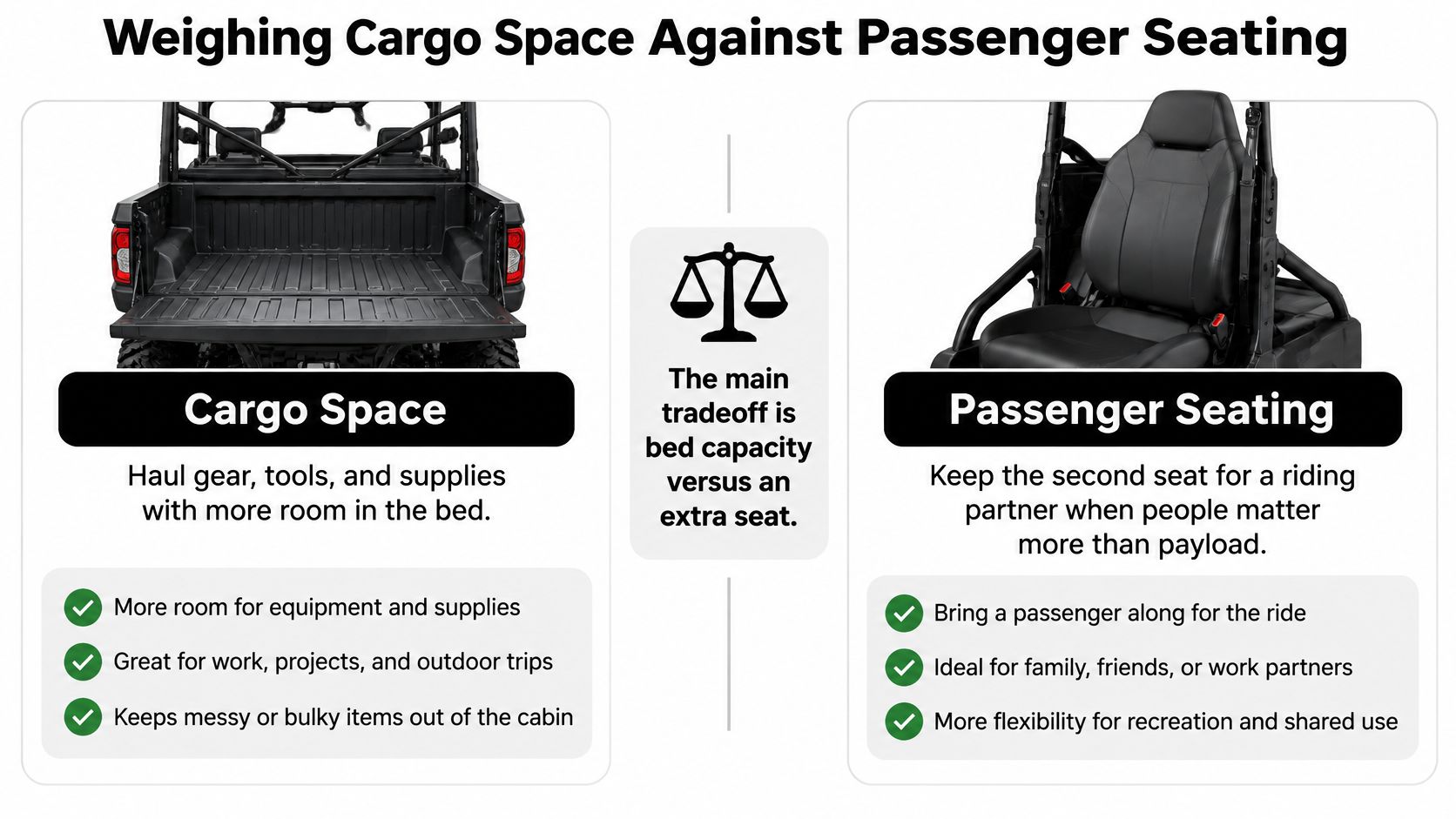
Here's the argument every two seater buyer has with himself in the driveway. Do I need that second seat for a person, or do I need every inch I can get for stuff? There's no clever answer that gives you both at full size. You're choosing which shortage you'd rather live with.
Cargo first looks like this. Feed sacks, fencing supplies, a cooler, a tool box, and a harvested deer don't care about comfort, but they do care about a flat floor and tie down points. A dump bed earns its keep when you're moving loose material, and a clean, square bed beats a sculpted one when you're trying to fit a tote or a case without it sliding into a corner.
Passenger first looks different. A spouse checking cattle with you, a hired hand holding a gate list, a site supervisor who needs eyes on a trench, that's real work too. Two people can split tasks, spot hazards, and handle a stuck machine far better than one person yelling at a winch remote. The chart below lays the tradeoff out side by side.
A Passenger Changes the Math and the Handling
A second person isn't just extra weight. That weight sits high and to one side, cargo in the bed shifts the center of gravity rearward, and a load stacked tall makes side slopes feel tippy sooner. Slow down with either one. Slow down more with both, and keep heavy items low, forward in the bed, and tied down so a bump doesn't move your load for you.
Passenger discipline is not optional gear. Research summarized in guidance that occupants must stay inside the rollover protective structure using seat belts or harnesses also warns that rollovers can occur even at low speeds and on flat ground, and that helmets may still be needed because the structure and belts do not prevent every head injury. Teach that before the first ride, not after the first scare.
- Belt and door check: Both occupants belted, doors or nets latched, loose gear secured before the machine moves.
- Plain communication: Agree on words for stop, slow, and hold on, and have the passenger keep hands inside the cage.
- Slope honesty: If a slope feels questionable with a load and a passenger, walk it first or pick another line.
One more hazard hides in the feature folks brag about most. An electric machine is quiet, and quiet can surprise people. Workers with earbuds, a dog asleep by a barn, livestock drifting across a lane, none of them hear you coming the way they'd hear a gas engine. Treat low noise as something to manage. Slow near blind corners, use lights in work yards, and give a short horn tap or a call out where people expect engine noise to warn them.
Planning Range for an Electric Two Seater
Forget the big number on the brochure for a minute. Range on an electric two seater works like a feed budget. You've got so much in the bin at sunrise, every trip takes a scoop, and you'd better keep a reserve for the job you didn't plan. Buyers who think that way rarely get stranded. Buyers who chase one best case mileage figure often do.
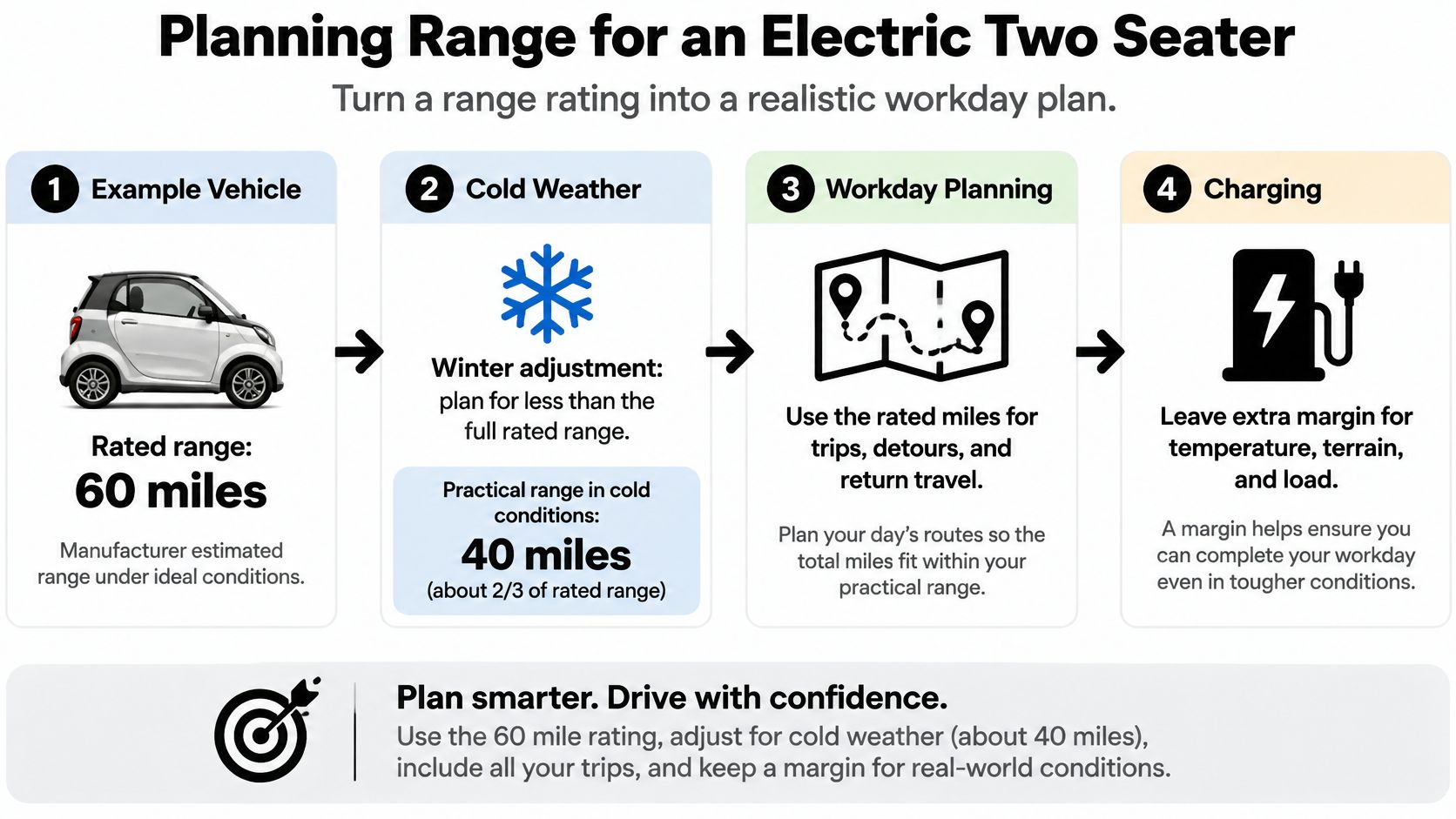
Start with a worked example you can check yourself. U.S. Department of Energy testing found battery electric vehicle range fell approximately 41% at 20°F compared with warmer conditions. For a 60 mile rated electric UTV, a comparable reduction implies roughly 35 miles of practical cold weather range, before terrain, payload, tire pressure, towing, or accessory loads are counted.
That drop isn't the battery being lazy. Cold slows the chemical reactions inside the cells, raises internal resistance, and leaves you with less usable energy. At the same time you're asking for more, with lights on longer, a heater running, and tires pushing through cold mud or snow. Less supply, more demand. That's the whole story.
Build a Workday Budget You Can Test
Write your budget on paper before you buy. List your normal route, the farthest point you must reach, passenger and cargo weight, hills or mud, any towing, and the coldest mornings you'll really work in. Then set a return reserve and treat it as untouchable, the energy you keep for a detour, a winch pull, or helping someone else get unstuck.
- Measure a real route: Drive or map your actual loop, don't guess from memory, and count the return trip, not just the way out.
- Track use by job: Note state of charge at the start and finish of fence work, feeding, and hunting runs so each job gets its own honest number.
- Charge with the weather in mind: Follow practical guidance on improving electric UTV efficiency, store indoors when you can, and favor battery heating or thermal management for cold climates.
Field rule: Plan the day on your winter range, with a reserve left over. If the route only works on the summer brochure number, the route doesn't work.
Don't confuse distance with operating hours, either. Ten steady miles on a flat lane is easy work. Two hours of creeping, stopping, dumping, winching, and restarting on a grade can drain a pack without racking up many miles at all. Property work lives in that second world, so judge a machine by whether it finishes your shift pattern, not by whether it wins a flat road mileage contest.
Before you sign anything, ask for a demonstration on ground like yours, loaded like yours. Run your measured route, watch the charge drop, and do the math with your reserve included. If two people can finish the job and roll home with energy to spare in cold weather, you've got a fit. If you're doing hopeful arithmetic in the dealer's parking lot, you don't.
Choosing a Two Seater or a Larger Side-by-Side
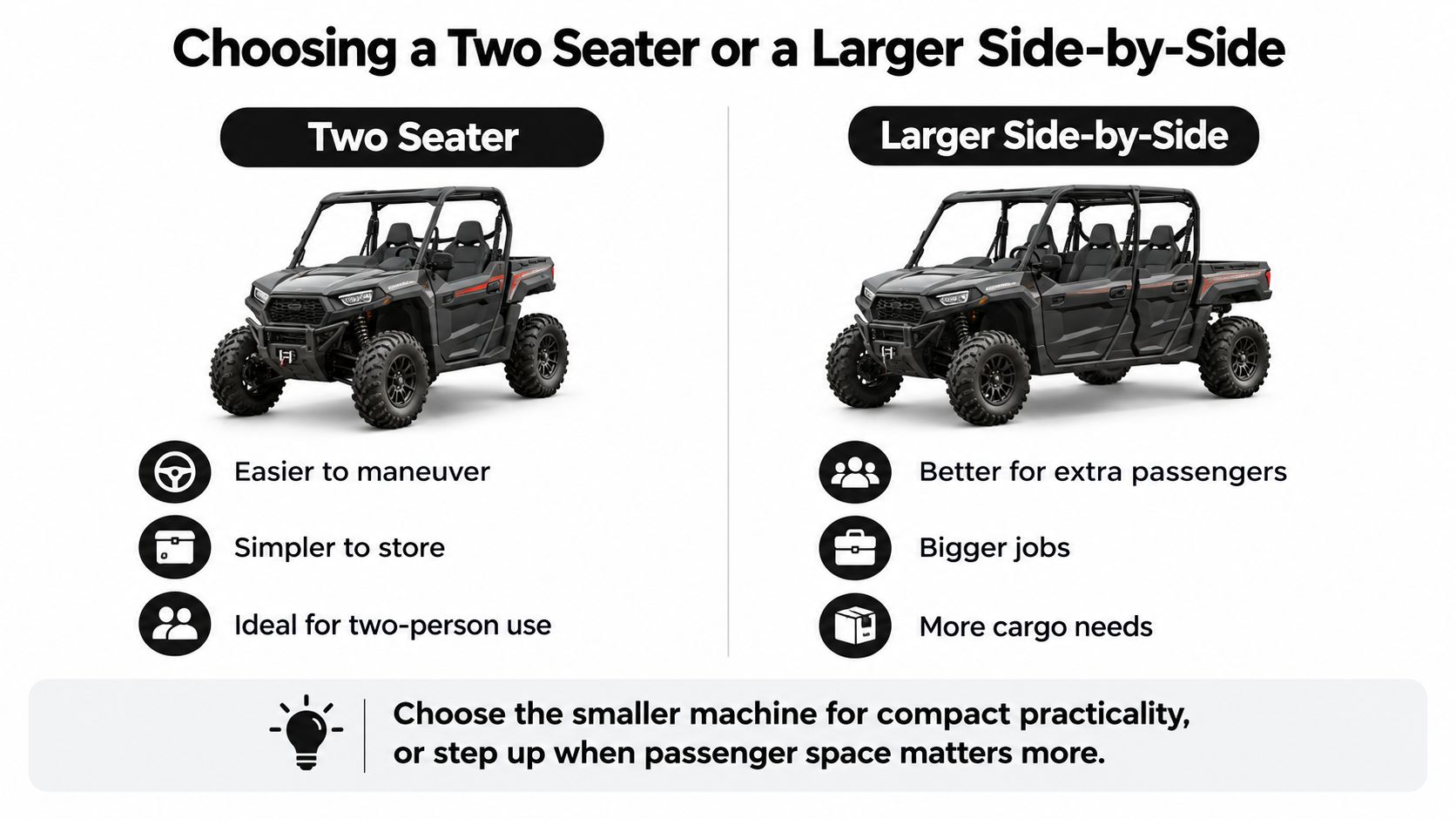
By now the choice should feel less like a guess and more like matching a tool to a chore list. A two seater suits a solo operator or a pair with moderate loads and predictable routes. A larger side by side suits regular crew hauling, bigger cargo, or long days where extra room stops being a luxury and starts being the job.
Use the table as a straight talk checklist. Read down each row and mark which column sounds like your normal week, not your best weekend story.
Two Seater Versus Larger Side-by-Side Decision Criteria
| Criterion | Two Seater Fit | Larger Configuration Fit |
|---|---|---|
| Regular occupants | Driver alone or with one passenger | Three or more people ride often |
| Cargo pattern | Moderate bed loads, tools, feed, game | Bulky loads or crew gear on most trips |
| Ground and gates | Tight trails, barn aisles, narrow gates | Open lanes and wide work yards |
| Trailer and storage | Limited shed or trailer space | Room for a longer, heavier machine |
| Duty cycle | Predictable loops with time to charge | Long shifts, steep ground, heavy hauling |
If you're leaning bigger because passengers show up every week, compare your needs against a larger electric side by side seating layout rather than squeezing people into a bed or onto a lap. That's not a gray area. Extra riders belong in proper seats with belts, inside a protective structure, or they don't ride.
Duty Cycle Decides the Electric Question
For electric models, duty cycle is the tie breaker. Independent cold environment research found repeated short trips with heavy starts, steep terrain, payload, winching, or frequent four wheel drive use consume energy faster than steady travel on level ground, and vehicles stored outdoors can lose substantially more range than those stored in heated environments. A machine that's fine for flat pasture loops may disappoint on a hilly, stop and start work site in winter.
As one concrete reference point, Campus EV offers the Campus E1, a three seat electric UTV with a 20 kW PMSM motor, 72V 150Ah lithium battery, up to 60 mile range, on-demand 2WD/4WD, an electric dump bed, a 3,000 lb winch, and CarPlay and Android Auto, sold through authorized dealers with 0% APR financing. Note the seat count when you compare. A three seat bench is a different layout from a two seater, and it may suit you better or worse depending on how often that middle spot would hold a person versus a tool bag.
Your next step is small and specific. Write your range budget, measure your gates and trailer, list who rides in a normal week, and take that sheet to a dealer for a loaded demonstration on similar ground. The machine that fits that sheet, with reserve to spare, is the right size.
Build your range budget first, then check it against a real machine like the Campus E1 electric UTV with its dump bed, winch, and on-demand four wheel drive for hunting, farm, and ranch work. Visit Campus EV to review specifications and contact an authorized dealer to arrange a demonstration on ground like yours.