
You've loaded three workers, a toolbox, feed, and a day's worth of supplies into an electric side by side 4 seater. The first few miles are easy. Then the trail turns soft, the grade rises, and the battery gauge starts moving faster than expected. By mid-shift, the machine still has room for people, but not much reserve for the work.
That's the central buying problem. A four-seat electric UTV gives you crew capacity, but the extra passengers add weight, increase rolling resistance, reduce cargo flexibility, and often push the vehicle into more demanding drive modes. The right choice depends less on the longest advertised range and more on whether the machine can complete your actual duty cycle with people, tools, terrain, and a charging plan.
| What you're comparing | Practical range or capacity | What it means at work |
|---|---|---|
| Electric UTV payloads | Roughly 440 to 1,300 lb | Four adults can consume a substantial share before tools or materials are loaded |
| Full-size electric UTV range | About 45 miles in benchmark-style listings | Treat the figure as a ceiling for planning, not a guaranteed shift distance |
| Work-focused example | 5,000 W motor, 1,100 lb payload, 45-mile range | Useful balance of hauling capability and endurance, subject to terrain and load |
| Typical work range | About 25 to 45 miles per charge | Short routes and overnight charging fit better than unrestricted all-day roaming |
| Common charging time | About 4 to 12 hours | A vehicle rotation plan may matter as much as battery size |
The figures above come from independent electric UTV roundups, including heavy-duty electric UTV benchmark specifications and work-oriented range and charging reviews.
Table of Contents
- The Reality of Hauling Crews and Gear Off-Road
- Why Electric Utility Vehicles Are Taking Over Work Fleets
- The Payload and Range Penalty of Four Seats
- Calculating Your Real-World Shift Range
- Matching the Machine to the Mission
- Designing a Charging Strategy for Full Workdays
- Final Recommendations for Your Fleet or Property
The Reality of Hauling Crews and Gear Off-Road
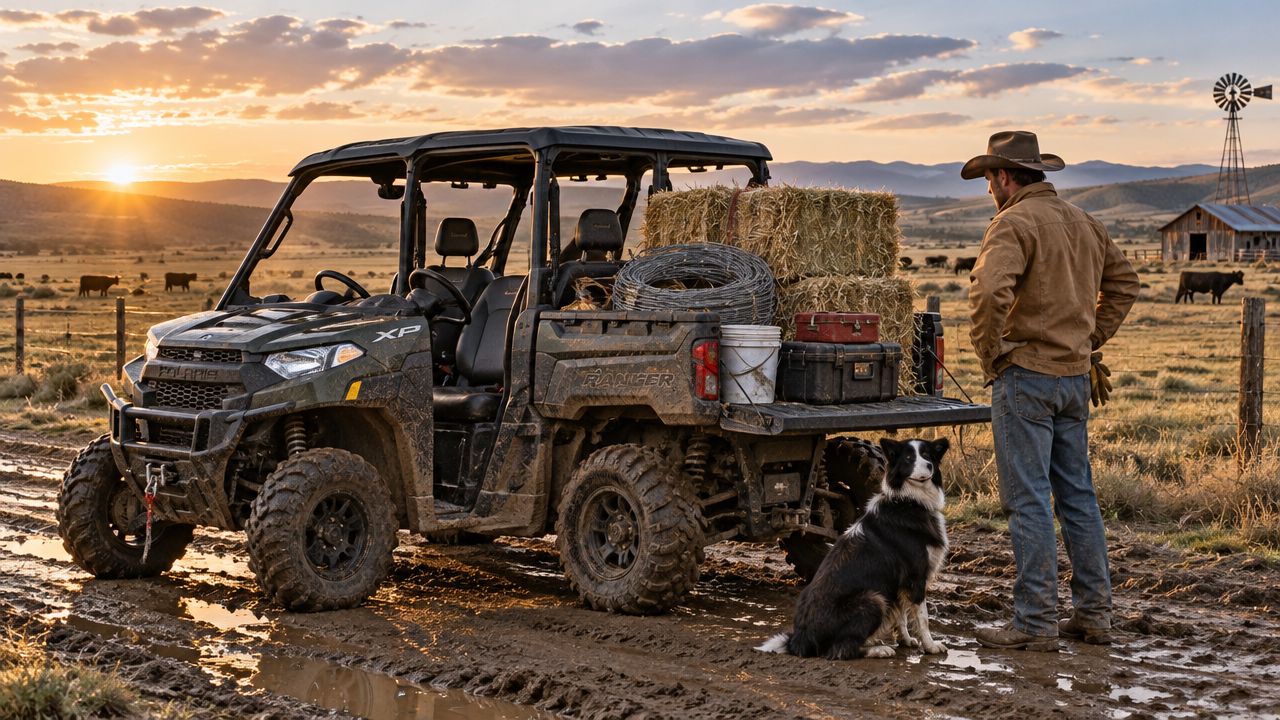
A ranch crew rarely leaves with four empty seats. One person carries fencing tools, another brings a cordless saw, someone loads feed or a sprayer, and the rear cargo area fills with straps, gloves, fluids, and spare parts. Add mud, gates, slopes, and repeated stops, and the machine is doing much more than carrying passengers from one point to another.
A four-seater solves the crew problem neatly. It also changes the operating equation. The longer chassis and second row add structure and weight, while four occupied seats can consume payload that a buyer may have mentally reserved for cargo. A vehicle that feels lively with one driver can feel slower and less efficient with a full crew.
The seat count changes the job
The first question isn't “How many seats do I want?” Ask instead, how many people must travel together, and what must travel with them?
A two-seater usually gives you better visibility around the vehicle, a shorter turning footprint, and more flexible bed space. It suits a driver and helper who carry equipment, inspect property, or make repeated trips between a yard and a work area. A four-seater earns its keep when splitting the crew would slow the job, create safety concerns, or require a second vehicle.
The trade-off becomes obvious on mixed routes. Four workers may reach a remote fence line in one trip, but the same four workers may leave no useful capacity for posts, wire, tools, or feed. If the vehicle has a dump bed, the passengers still compete with the bed for the machine's rated payload.
Practical rule: Count people, clothing, tools, fluids, and cargo together. The rating applies to the combined load, not just the material in the bed.
Before buying, learn what a side-by-side is and distinguish a passenger-oriented layout from a utility platform. Buyers who need a compact people mover for grounds work may also benefit from comparing adjacent options, such as this Lounge Wagon guide to wagons, especially where low-speed passenger transport matters more than towing or rough-trail clearance.
What fails in practice
The weak approach is to fill every seat first and solve the cargo problem later. That often leads to a trailer, a second trip, or overloaded storage that affects braking, handling, and range.
The stronger approach is to map your busiest normal load, not your lightest test run. If four seats are essential, choose a machine with a useful payload margin after passengers. If four seats are only occasional, a two-seater with a trailer or a second vehicle may deliver better daily productivity.
Why Electric Utility Vehicles Are Taking Over Work Fleets
Electric UTVs have moved beyond the experimental stage because their strengths match controlled work environments. Instant motor response helps with low-speed starts and towing. Quiet operation suits wildlife management, campuses, warehouses, and properties where engine noise creates a problem. Fewer routine powertrain service tasks can also simplify fleet scheduling.
The market is expanding at both the broad utility-vehicle level and the electric UTV level. One independent estimate valued the global electric utility vehicle market at USD 20.35 billion in 2024 and projected USD 29.07 billion by 2030, with a 6.7% CAGR from 2025 to 2030. The same estimate identifies electric UTVs as a growth engine because operators increasingly use them for towing, hauling, and farm surveying. See the Grand View Research electric utility vehicle market estimate.
Adoption is no longer theoretical
Historical adoption data supports the shift. One market report said electric UTVs represented 18% of global UTV sales in 2023, compared with 12% in 2021, while electric UTV sales grew 48% in 2023 to nearly 200,000 units worldwide. The same source reported more than 46,000 electric UTVs sold in North America in 2023 and a 38% increase in Asia-Pacific adoption. Those figures are reported in the utility vehicles UTV market analysis.
That growth matters to a fleet manager because product support, parts availability, and operator familiarity tend to improve as adoption expands. It doesn't remove the need to check battery service, charging equipment, ground clearance, and payload ratings. It does show that electric side-by-sides now have a meaningful operating history across consumer and work markets.
Why four seats appeal to work teams
Four seats can reduce driver duplication. A grounds supervisor can move a small crew through a large property, a ranch hand can bring help to a remote task, and a warehouse team can reach multiple zones without starting separate gas vehicles. The value comes from fewer separate trips and simpler coordination, not from the seat count alone.
Fleet operators also need more than vehicle specifications. Planning routes, workers, stops, and vehicle availability is part of the same operational problem addressed by mobile workforce management for utilities. An electric UTV fits best when managers treat it as a scheduled work asset rather than an oversized golf cart.
The Payload and Range Penalty of Four Seats
Adding a second row changes the job the machine can perform. The chassis, seats, longer wheelbase, and passenger weight consume capacity before tools or materials enter the bed. On a muddy ranch route, that extra mass also asks more from the motor and battery at every climb, turn, and stop.
Read the rating as a combined load
A published payload rating normally covers occupants and cargo together. Four adults at 180 pounds each would use 720 pounds of a 1,100-pound rating, leaving 380 pounds for boots, tools, spare equipment, and bed cargo. Heavier passengers reduce that reserve further. A vehicle that appears capable on paper may therefore carry little practical material once the second row is full.
The penalty is not limited to the remaining bed capacity. Suppose a four-seater is advertised for 45 miles. A full crew, tools, soft ground, hills, repeated starts, and four-wheel drive can cut the usable distance sharply, even when the load remains within the rating. Treat the advertised figure as a controlled-condition reference, not a guaranteed workday.
| Metric | What to check | Work impact |
|---|---|---|
| Combined payload | Occupants, tools, materials, and accessories | Passenger weight can consume most of the capacity before loading begins |
| Towing | Model rating, hitch, braking, and terrain | A trailer adds rolling resistance and may reduce the battery reserve |
| Motor output | Low-speed pulling under the planned load | More output does not guarantee endurance on hills or soft ground |
| Advertised range | Test conditions and expected duty cycle | Crew weight and difficult surfaces make the published distance less useful |
When the second row costs you the bed
A two-seater usually makes better use of available payload when the assignment centers on hauling feed, fencing supplies, equipment cases, or warehouse materials. Its shorter configuration can also fit more easily through narrow lanes and around buildings. The trade-off is that workers may need a second vehicle or extra trip to reach the same task.
A four-seater earns its space when moving people together prevents those additional runs. A supervisor can take a small crew to a remote repair, or a ranch hand can bring assistance without dispatching another vehicle. If the crew spends more time carrying material than riding, the second row becomes an operating cost rather than a convenience.
Tire choice adds another penalty or advantage. Review tread patterns and terrain fit through this UTV tire review resource before specifying a fleet setup. Aggressive mud tires can improve traction in soft ground, yet their rolling resistance on firm surfaces may reduce efficiency. Balance passenger capacity, cargo needs, surface conditions, and charging access before choosing the four-seat layout.
Calculating Your Real-World Shift Range
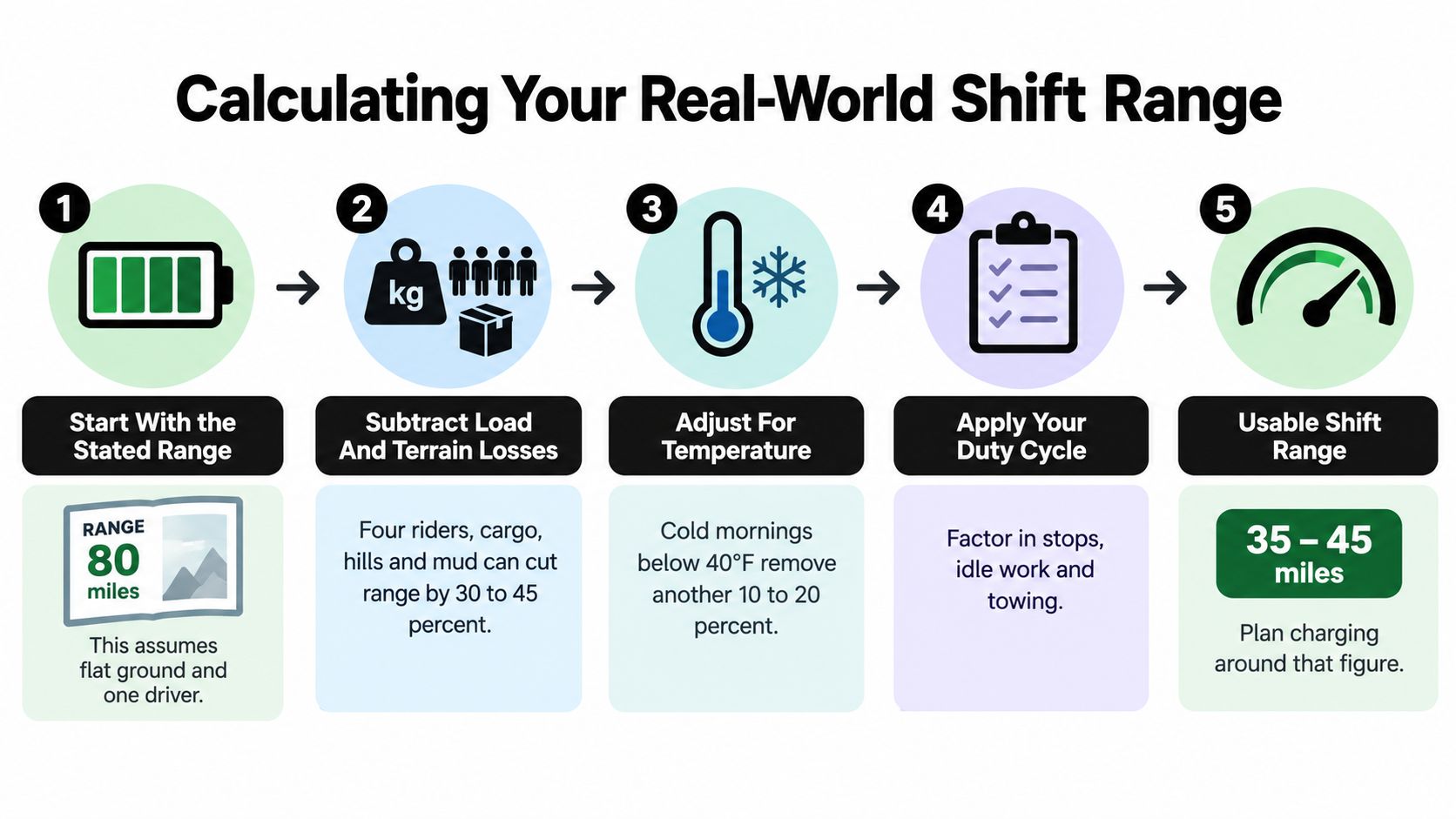
A four-seat electric UTV can show a respectable range during a light demonstration, then fall short during a muddy workday with a full crew. Treat the advertised figure as a reference point. Your usable shift range depends on passenger weight, cargo, tire choice, terrain, drive mode, stops, and time spent working at low speed.
Mode selection changes the result sharply. One independent review recorded about 18.6 miles in 2WD, 12.3 miles in front-wheel drive, and 9.4 miles in full 4WD. Broader electric side-by-side roundups place typical range around 20 to 60 miles. These figures appear in the independent electric side-by-side range review.
Build a duty-cycle estimate
Use a simple calculation before scheduling a crew. Start with the 45-mile benchmark figure from your test or specification sheet. If four adult passengers reduce usable range by 20%, the estimate becomes 36 miles. Apply a further 25% penalty for the muddy sections described earlier, and the practical shift range falls to 27 miles. That is the figure to compare with your route, not the original 45-mile claim.
Adjust the inputs for your own operation:
- Record the stated range. Note the published figure, battery size, drive mode, and test conditions.
- Apply the passenger penalty. Include the driver and three passengers, then account for tools, cargo, and accessories.
- Add terrain penalties. Mark mud, sand, grades, and sections requiring sustained four-wheel drive. Use a separate reduction for each demanding surface rather than assuming the route is uniform.
- Count working time. Gates, inspections, loading, towing, and low-speed maneuvering consume energy even when the vehicle covers little distance.
- Set a reserve. If the route needs 20 miles, do not plan around a 20-mile usable estimate. Leave capacity for weather, recovery, and an unexpected detour.
Use a route test before committing
Run the vehicle on your actual route with four representative passengers and normal cargo. Record starting charge, distance, terrain, drive mode, weather, stops, and ending charge. Repeat the test on the softest or steepest route, not only on a firm demonstration loop.
A machine that finishes a light test run is not necessarily ready for your heaviest shift.
Cold weather, soft ground, hills, and accessory loads deserve separate checks. Operations that return to a central yard between trips may manage with a smaller range. Crews working away from chargers need a larger battery and a clear reserve.
Matching the Machine to the Mission
The right four-seater depends on what the passengers are doing once they arrive. A hunting party values quiet movement and predictable low-speed control. A farm crew needs traction, towing, and a bed that accepts dirty equipment. Construction workers need protection, stability, and enough payload reserve to carry tools without turning every trip into a calculation.
Hunting and wildlife work
Noise is often the deciding factor. Electric propulsion supports quiet travel near wildlife and makes conversations easier without engine noise. Range still matters, but hunting routes are often better suited to planned loops than uncontrolled roaming.
Prioritize selectable drive modes, strong ground clearance, reliable low-speed control, protected battery placement, and weather protection. Avoid paying for recreational performance features that don't improve access, concealment, or recovery.
Farms and ranches
Farm work exposes weak payload planning quickly. You may need four seats during inspection or repair work, then need the same machine to carry feed, tools, or fencing supplies. A removable or adaptable rear seating arrangement can be more useful than a permanently fixed passenger layout.
Towing capacity, bed design, hitch access, traction, and service support deserve more attention than top speed. A vehicle that can move a crew but requires another trip for materials may not be the productive choice.
Construction and warehouse operations
Construction sites punish exposed components and poor maneuverability. Look for a durable frame, protected underside, usable mirrors, lighting appropriate to the site, and a turning footprint that works between structures. Warehouses and campuses place greater value on quiet operation, predictable charging, and low-speed control.
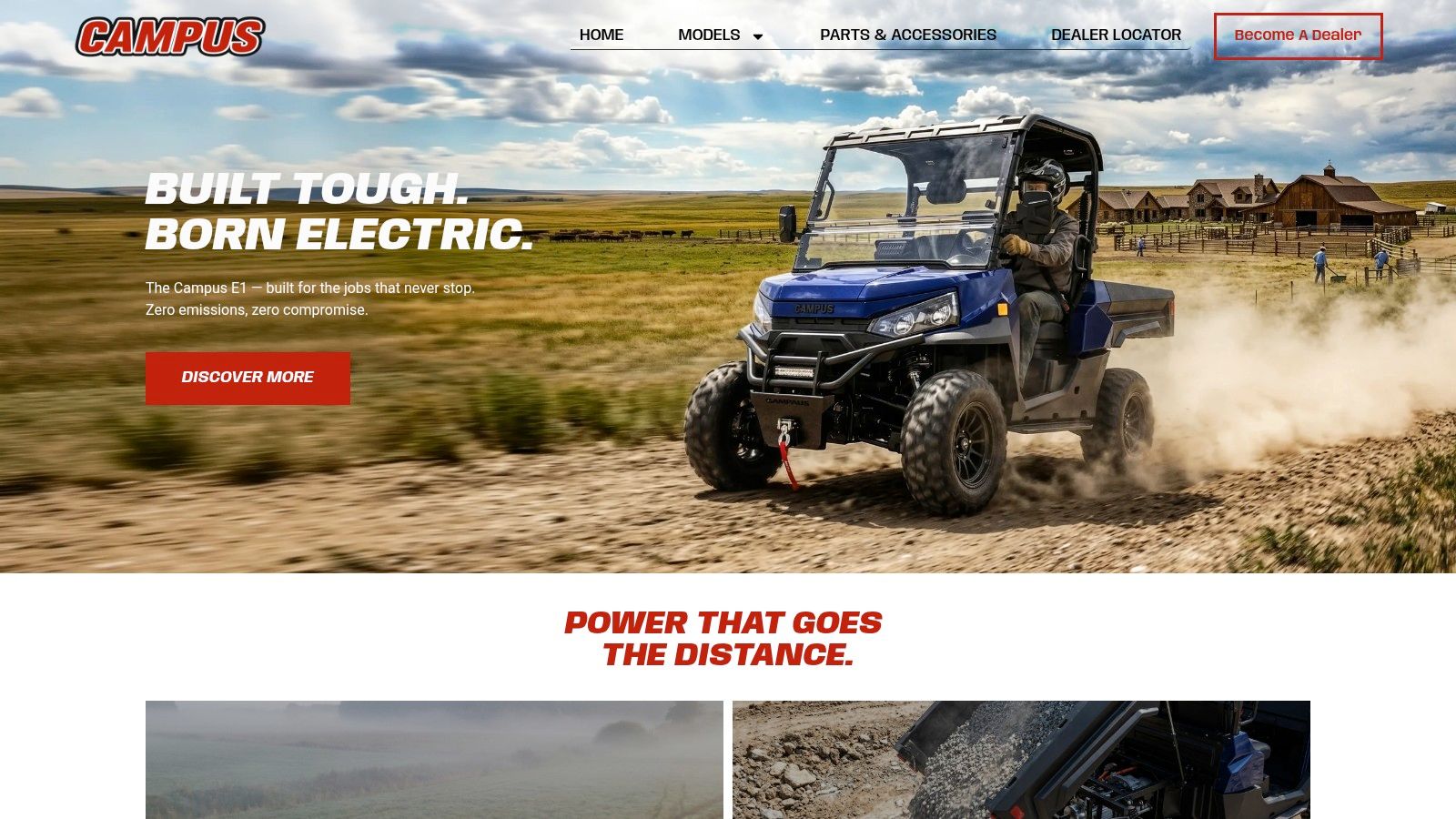
Campus EV offers the Campus E1 electric side-by-side UTV, positioned for campuses, warehouses, farms, and grounds operations. Its published utility specifications include 2WD/4WD, a 550-pound electric dump bed, 1,500 pounds of towing capacity, and 11 inches of ground clearance, according to the product information supplied for this guide.
The four-seat configuration is most useful when the crew routinely travels together. If the bed carries real value and passenger trips are occasional, compare the same platform against a two-seat machine before deciding.
The visual below shows the type of work-oriented layout buyers should examine, including seating position, bed access, and overall proportions.
Designing a Charging Strategy for Full Workdays
A four-seat electric UTV can finish a workday with passengers aboard and still return short on energy. Published figures often place work-oriented models at 25 to 45 miles per charge, with charging taking 4 to 12 hours. Treat those numbers as planning limits, not a guaranteed shift length. A loaded machine in mud, hills, cold weather, or repeated low-speed work can need a recharge sooner. Review the electric UTV range and charging overview alongside your own route records.
Start with the return point
Base the charging plan at the location where the vehicle naturally ends its shift, such as a ranch yard, warehouse dock, maintenance building, or equipment shed. That point already supports parking, inspections, tools, and shift changes.
Measure route distance with the full passenger and cargo load. If the UTV returns during the day, overnight recovery may cover the cycle. If it stays in the field, schedule a spare unit or a mid-shift top-up instead of relying on an emergency return.
Match the charger to downtime
A Level 1 charger can suit light overnight recovery when the battery has enough time and the outlet is dedicated. A Level 2 charger is more practical for a heavily used four-seater or a mid-shift top-up, but it requires a suitable circuit, compatible equipment, weather-protected mounting, and an electrical review before installation. Confirm the vehicle's required amperage with the manufacturer or installer. Include trenching, conduit, disconnects, permits, and panel capacity in the installation budget rather than pricing the charger alone.
For a vehicle expected to cover 45 miles, estimate required battery capacity in kWh as 45 multiplied by its tested kWh-per-mile consumption, then allow for charging losses and reserve. Use the loaded test result, not the brochure range.
Keep a written routine:
- End-of-shift check: Record battery state, damage, tires, and charging status.
- Assigned parking: Protect connectors from mud, water, and impact.
- Rotation plan: Keep a charged unit available during plugged-in periods.
- Battery records: Track interruptions and unusual range loss.
Driving technique, tire choice, route planning, and load control also reduce avoidable energy use. Use this guide to improving electric vehicle efficiency when refining the operating plan.
Final Recommendations for Your Fleet or Property
Choose a two-seater when one operator and one helper do most of the work, cargo occupies the bed, or routes are narrow and repetitive. Choose a four-seater when transporting the full crew together prevents duplicated travel and the remaining payload still covers the tools and materials required for the job.
Before signing an order, ask the dealer or manufacturer for answers in writing:
- Combined payload: Does the rating include all passengers and cargo?
- Loaded range: What testing supports the range figure, and under what load?
- Drive modes: How does the vehicle behave in 2WD, 4WD, and low-speed work?
- Charging requirements: What outlet, charger, recovery time, and installation conditions apply?
- Battery support: Who handles diagnosis, replacement, and warranty service?
- Work equipment: Is the dump bed, hitch, lighting, roof, windshield, and protection package included?
- Terrain fit: Can the tires, clearance, suspension, and turning footprint handle your property?
The total operating cost includes more than the purchase price. Electric propulsion can reduce routine drivetrain maintenance and eliminate fuel handling, but a battery-powered machine still incurs charging infrastructure, tires, downtime, replacement parts, and operator training. Review commercial installation requirements with a provider familiar with charging solutions for businesses in 2026 before placing several vehicles into service.
The best buying decision is the one that survives your worst normal day. Load four people, add the gear you carry, drive the rough route, and reserve enough energy to return without gambling on the final battery segment. A four-seater earns its space when it moves people and materials efficiently, not when it merely fills every seat.
Campus EV offers electric utility vehicles built around practical work such as grounds maintenance, warehouse transport, farming, and property operations. Review the Campus E1 specifications against your passenger load, payload needs, route length, and charging setup, then visit Campus EV to discuss whether its four-seat platform fits your daily duty cycle.