
You're standing at the yard gate with three other people, tools in hand, and a two seater that forces a choice. Either someone walks, or you make two trips and lose the morning. That's the problem a UTV 4 seater solves, and it's also where buyers get misled. Seat count is easy to see. Payload, safety for four occupants, and whether charging fits your working day are harder, and they matter more than motor power or the range number on a brochure.
Table of Contents
- What Makes a Four-Seat UTV Different
- Specs That Decide Whether a 4-Seat UTV Fits
- Electric Range Depends on Cold, Load and Terrain
- Hunting, Farm, Construction and Transport Use Cases
- How to Plan Charging for Daily Work Shifts
- Safety Rules for Four Occupants on Rough Ground
- Decide Whether an Electric Four-Seater Fits Your Work
What Makes a Four-Seat UTV Different
A crew of four steps out of one vehicle at a ranch gate, each person from a belted seat, with fencing tools already in the cargo bed. That's the layout in plain terms. A four-seat side-by-side has two front bucket seats, a rear bench, a cargo bed, a rollover structure, and a seat belt for each occupant.
The trade against a two-seater is straightforward. You gain seats for a work crew, hunting group, or family. You accept a longer chassis, more weight, and less payload left per person once everyone climbs in. If you mostly ride as a pair on tight ground, a two-seater UTV layout may suit you better.
UTVs started as work vehicles for industrial sites, construction, farming, ranching, and turf maintenance. Yamaha's Rhino arrived in 2004 and Polaris's RZR followed three years later, pulling the category toward recreation, as SEMA's powersports market history describes.
By 2023, consumer applications accounted for approximately 87.5% of nearly 569,000 North American UTV sales in that same market history. A four-seater is much like a crew cab truck. The seats changed who buys it, but the job underneath is still hauling people and gear. Judge a four-seater as a work vehicle first, then ask how electric power changes that work.
Specs That Decide Whether a 4-Seat UTV Fits
Before comparing motor power or advertised range, check whether the vehicle can carry your crew safely and handle the day's work. A four-seat UTV is like a crew-cab truck: the people, equipment, and trailer all draw on the vehicle's capacity. Ratings differ by model, so use the exact vehicle's specifications rather than a category-wide estimate.
| Spec | What to Check | Typical Four-Seat Value | Why It Matters |
|---|---|---|---|
| Occupant capacity | Seat belts for every seat | Four belted seats | Every rider needs a belt |
| Payload | Rated cargo plus passengers | Check rating for exact model | Four adults and gear use it quickly |
| Towing capacity | Hitch rating and tongue weight | Check rating for exact model | Trailer load adds to payload stress |
| Cargo bed | Floor length, dump or rack | Fixed, dump, or rack options | Sets what fits and how it unloads |
| Ground clearance | Lowest point under the frame | Check under loaded suspension | Clears rocks, ruts and stumps |
| Drive system | 2WD, 4WD or on-demand | Campus E1, on-demand 2WD/4WD | Traction on slopes and wet fields |
| Electric motor and battery | Motor kW, pack voltage and amp-hours | Campus E1, 20 kW PMSM, 72V 150Ah | Sets power and stored energy |
| Rated range (electric) | Test conditions stated | 40 to more than 100 miles, Campus E1 up to 60 | A benchmark, not a field result |
| Winch rating | Line pull | Check rating for exact model | Recovery on soft or steep ground |
| Price band | Dealer or list price | Gas four-seater, $25,499 to $36,099 (2024 Can-Am Maverick X3) | Sets the budget baseline |
Read Payload Before Power
Payload is the combined weight of passengers and cargo. Four adults carrying coats, tools, feed, or game can use much of that allowance before anything goes in the bed. Check the model's rated payload, then compare it with your actual crew and gear. If little capacity remains, extra motor output will not solve the fit problem.
Towing capacity needs the same model-specific check. Confirm the hitch rating and tongue-weight limit, then account for passengers and cargo. A trailer's weight affects the vehicle, so its advertised towing figure cannot be judged on its own.
Read the Battery as Stored Energy
A 72 V, 150 Ah pack stores about 10.8 kWh nominal, calculated by multiplying voltage by amp-hours. That is energy stored on paper, not the amount available for driving. Battery-management limits, lights, heaters, tire resistance, payload, speed, and temperature all affect the energy that reaches the wheels.
Range figures also depend on test conditions. An unloaded run on flat ground does not represent a loaded ranch route, so compare the conditions before comparing numbers. As a budget reference, four-seat Can-Am Maverick X3 models were listed at $25,499 to $36,099 in 2024 in Dirt Wheels Magazine's 2024 UTV buyers guide.
Three checks first: payload minus your actual riders, hitch rating against your actual trailer, and usable range under your actual conditions.
Make those checks before weighing price. A lower-cost UTV 4 seater that cannot carry your crew within its rating, tow your trailer safely, or complete the route with reserve does not fit the job.
Electric Range Depends on Cold, Load and Terrain
A four-seat UTV can leave the yard with a full battery and still fall short of its advertised range. The result depends on the crew, cargo, terrain, and temperature. Check those limits before comparing motor power or relying on the headline range.
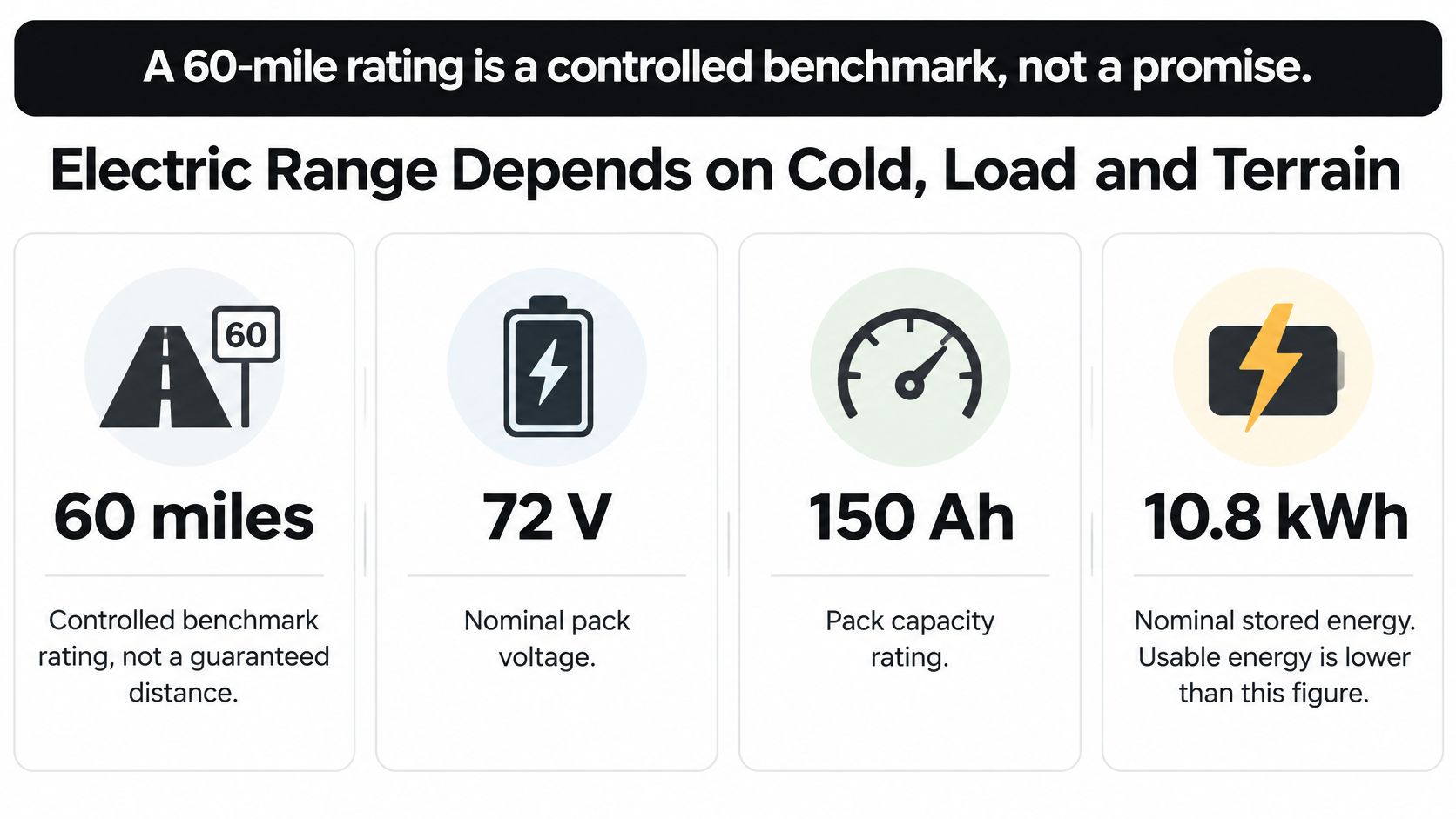
The Campus E1 example shows how stored energy relates to range. Its 72 V, 150 Ah lithium pack holds about 10.8 kWh nominal. That is the energy in the battery on paper, not all energy available for driving. Battery management limits, accessories, payload, speed, and rolling resistance all affect how far it can go.
Temperature also changes battery performance. NREL battery thermal research identifies temperature as a factor in battery power, charge acceptance, efficiency, available energy, safety, reliability, and life-cycle cost. The research associates an operating range around 15°C to 35°C with better performance and longevity.
A rated range shows what the lab can do. Your reserve shows whether you get home.
What Cold Does to the Number
Cold-weather figures from battery-electric vehicle testing can help with UTV planning, but they are not UTV test results. The Department of Energy cold temperature BEV research found that typical conditions around 20°F reduced range by 41%. At 0°F, average losses were about 50%, with maximum losses of 59% in some driving conditions.
| Condition | Share of Rated Range Left | Approx. Miles From a 60-Mile Rating | Planning Note |
|---|---|---|---|
| Controlled benchmark | 100% | 60 | Manufacturer test, not field use |
| Around 20°F | About 59% (41% loss) | About 35 | Typical cold-weather loss |
| Around 0°F | About 50% average, about 41% at worst | About 25 to 30 | Keep a reserve for the return leg |
The table is a starting point, not a route guarantee. A crew of four, work gear, repeated stops, soft ground, or steep terrain can use energy faster than a controlled test. A truck-and-crew analogy helps: the heavier the crew and equipment, and the harder the route, the more effort it takes to finish the same trip. Add cold conditions, and the available margin gets smaller.
Use a reserve method when planning. Estimate the route's demands from its surface, hills, cargo, and expected work, then set aside charge for lighting, heating, winching, and the trip back. If the plan leaves no margin, shorten the route or choose a vehicle that fits the duty cycle. An advertised range cannot make up for a charging gap or an overloaded day.
Hunting, Farm, Construction and Transport Use Cases
| Use | Specs to Prioritize | Typical Load | Electric Watch-Out |
|---|---|---|---|
| Hunting | Range to remote stands, quiet drive, cargo for gear and game | Two to four hunters, gear, field-dressed game | Cold dawn starts cut range |
| Farm and ranch | Payload, towing, tire flotation, dump bed | Feed, fencing, tools, trailer hauls | Wet-soil compaction, charging in unheated barns |
| Construction | Payload, winch, ground clearance, durability | Tools, materials, crew of two to four | Heavy cycles drain the pack, charge between shifts |
| Property and transport | Seat belts, comfort, light cargo, running cost | Crew of four plus light tools | Short routes suit electric best |
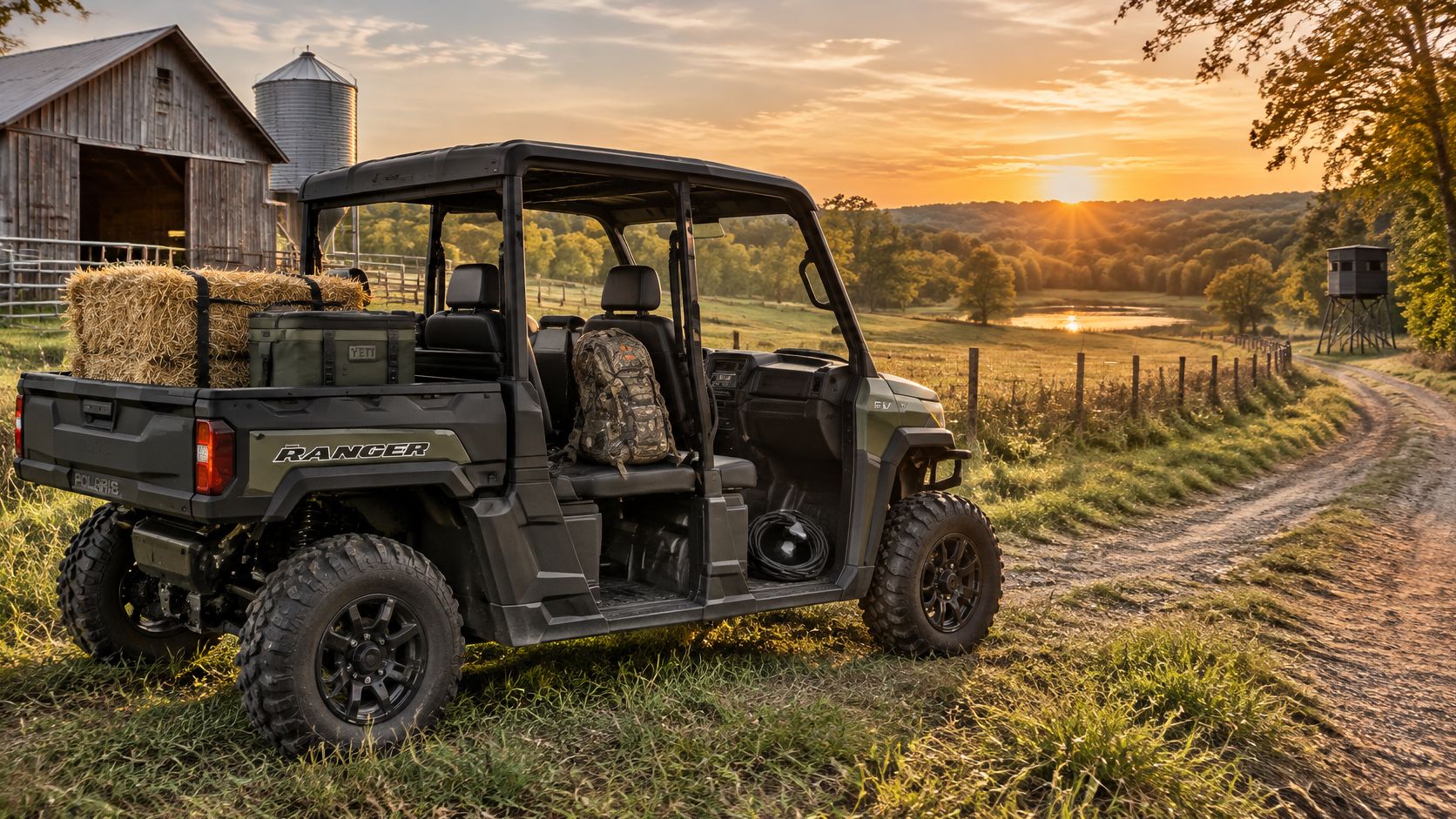
Hunting rewards quiet operation and cargo room, but the coldest start of the day is also the start with the least available energy. Construction work is different. Short, heavy, repeated cycles drain a pack through load rather than distance, so miles alone won't predict your day.
Property transport is the lightest duty here. Short, predictable routes with a charger at base suit an electric UTV 4 seater well. Problems start when buyers size the vehicle for that average day, then ask it to do the heaviest farm job in winter.
Tire Rules for Farm and Ranch Ground
For field work, follow these rules in order. 1. Remember that tire inflation pressure largely determines ground pressure, while axle load governs deeper compaction, and greater axle loads increase risk below roughly 10 inches, as Oklahoma State extension soil compaction guidance explains. 2. Set pressure with passengers, cargo, battery mass, and accessories included, never for an unloaded vehicle. 3. On wet fields, cut unnecessary payload and avoid repeated passes. 4. Use load-rated tires and verify pressure against actual axle load. 5. Route around saturated ground and use 4WD only when traction requires it.
Size the vehicle for the most severe duty you realistically expect. The average day won't strand you. The hard day will.
How to Plan Charging for Daily Work Shifts
The best electric four-seater may not be the one with the longest advertised range. It may be the one whose battery, charger, storage location, and daily duty cycle align. Work through the plan below before you buy, using your real routes rather than a brochure.
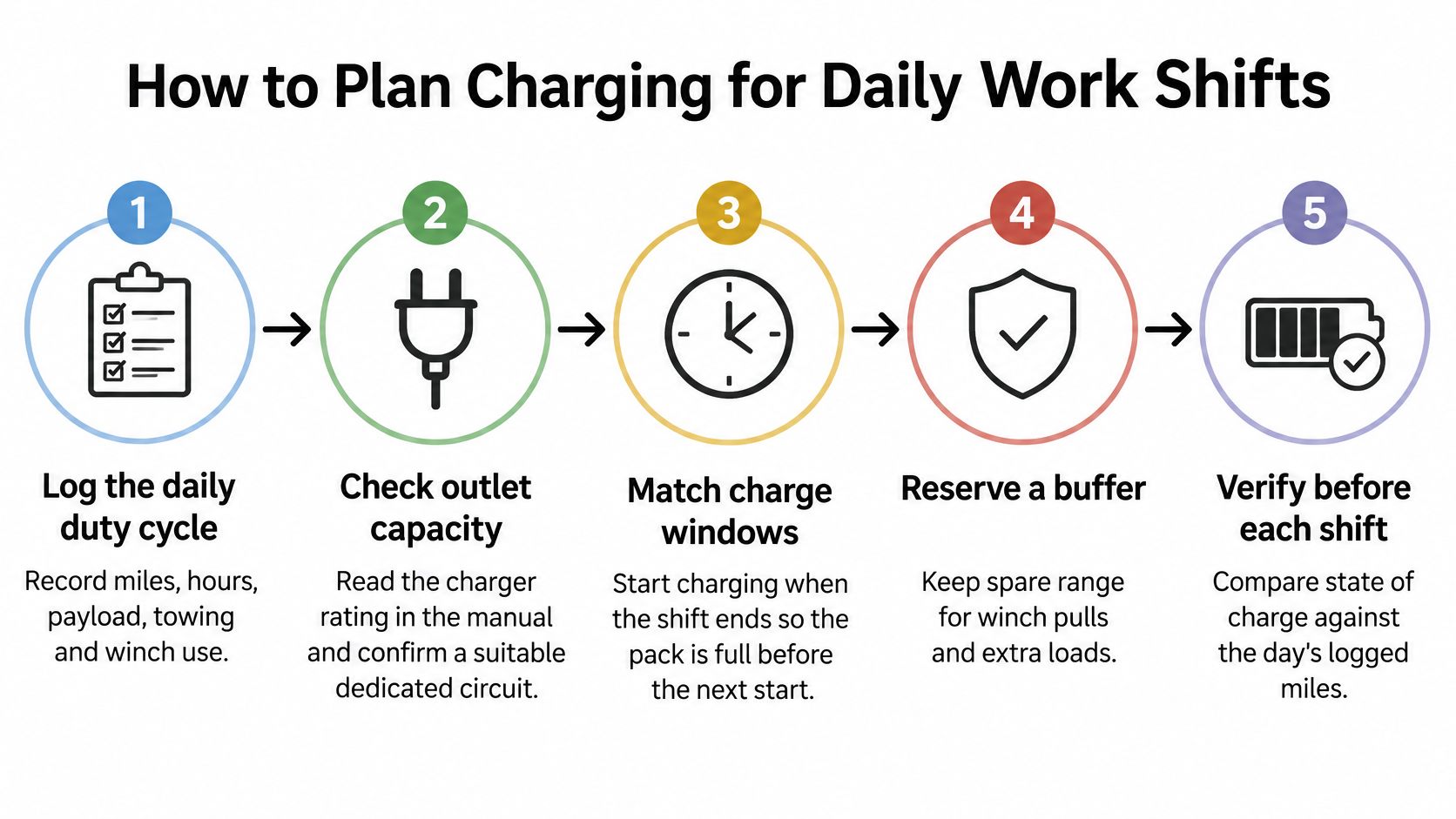
- Log the daily duty cycle. Record miles, hours, payload, towing, and winch use for a typical week and a hard week. You can't size charging for work you haven't measured.
- Check outlet capacity. Read the charger rating in the manual and confirm a suitable circuit in the garage, barn, or warehouse. Don't assume an old barn circuit will carry it.
- Estimate charge time. Divide the energy you need by charger output, then add losses. For example, going from 30% to 100% on a 10.8 kWh nominal pack needs about 7.6 kWh, roughly 5 hours on a 1.5 kW charger before losses.
- Match windows to the day. A lunch top-up can cover short shifts. Long or heavy shifts usually need an overnight full charge, starting when the vehicle parks.
- Plan winter separately. Keep the vehicle in a sheltered or heated space where you can, and avoid charging aggressively while the pack is cold. University of Alaska cold weather EV research identifies slower charging, lower available power, and keeping vehicles plugged in during extreme cold as major operational issues.
- Build a low-return contingency. Decide now what happens when the vehicle comes back low after heavy hauling or winching. A second vehicle, a delayed start, or a second charging point are all better than improvising.
The short video below is worth watching with your own shift pattern in mind, noting where your vehicle would park and plug in.
Site matters as much as charger size. A home garage usually offers the most reliable overnight window. A barn may be unheated with limited circuits, a warehouse may allow scheduled charging between shifts, and a remote site may need a generator or portable power. For shared vehicles, assign charge windows to each driver, require the UTV to go back on the charger after every shift, and log who returned it low. Those habits, covered further in guidance on improving electric UTV efficiency, expose heavy-use patterns early.
Count downtime as an ownership cost, in hours of unavailable vehicle per week. Add a second charging point only when one charger's window can't fit the logged duty cycle.
Safety Rules for Four Occupants on Rough Ground
A crew of four needs the right truck-like foundation before motor power matters: enough payload for people and cargo, and restraints and rollover protection that keep occupants inside the vehicle. On a slope, rut, or soft shoulder, a loaded UTV can tip. The driver's first priorities are a safe load and secure passengers, not top speed.
The U.S. Consumer Product Safety Commission off-highway vehicle report records 2,211 off-highway-vehicle deaths associated with 2,156 incidents during 2016 to 2018. This is broad context, not a four-seat UTV fatality rate: the report covers off-highway vehicles with more than two wheels.
For a buyer, the practical lesson is about how to manage a crew, not how to infer an individual's odds from broad totals. In a rollover, an arm outside the frame can be struck or trapped. Keep every occupant inside the protective structure, and make sure the vehicle's capacity suits the people and equipment aboard.
Before the Vehicle Moves
- Belts on everyone: Buckle all occupants before moving. The rollover structure can protect people only if restraints keep them inside it.
- Structure intact: Check that rollover protection is undamaged and properly maintained. Do not rely on bent parts or improvised repairs.
- No extra riders: Carry no more people than the seats and belts are designed for.
- Limbs inside: Keep arms and legs within the frame, especially on slopes and uneven ground.
- Speed controlled: Reduce speed when carrying a load, crossing side slopes, or travelling over unfamiliar terrain.
- Load counted: Add passengers and cargo together, then keep the total within the UTV's payload rating.
- Training first: Let new drivers learn the vehicle unloaded before they take a full crew to work.
A four-seat UTV is a crew carrier as well as a work vehicle. Check the payload rating against the people, tools, and other cargo you expect to carry, then verify that every occupant can buckle in. A faster motor cannot protect an unbelted passenger on the rear bench.
Decide Whether an Electric Four-Seater Fits Your Work
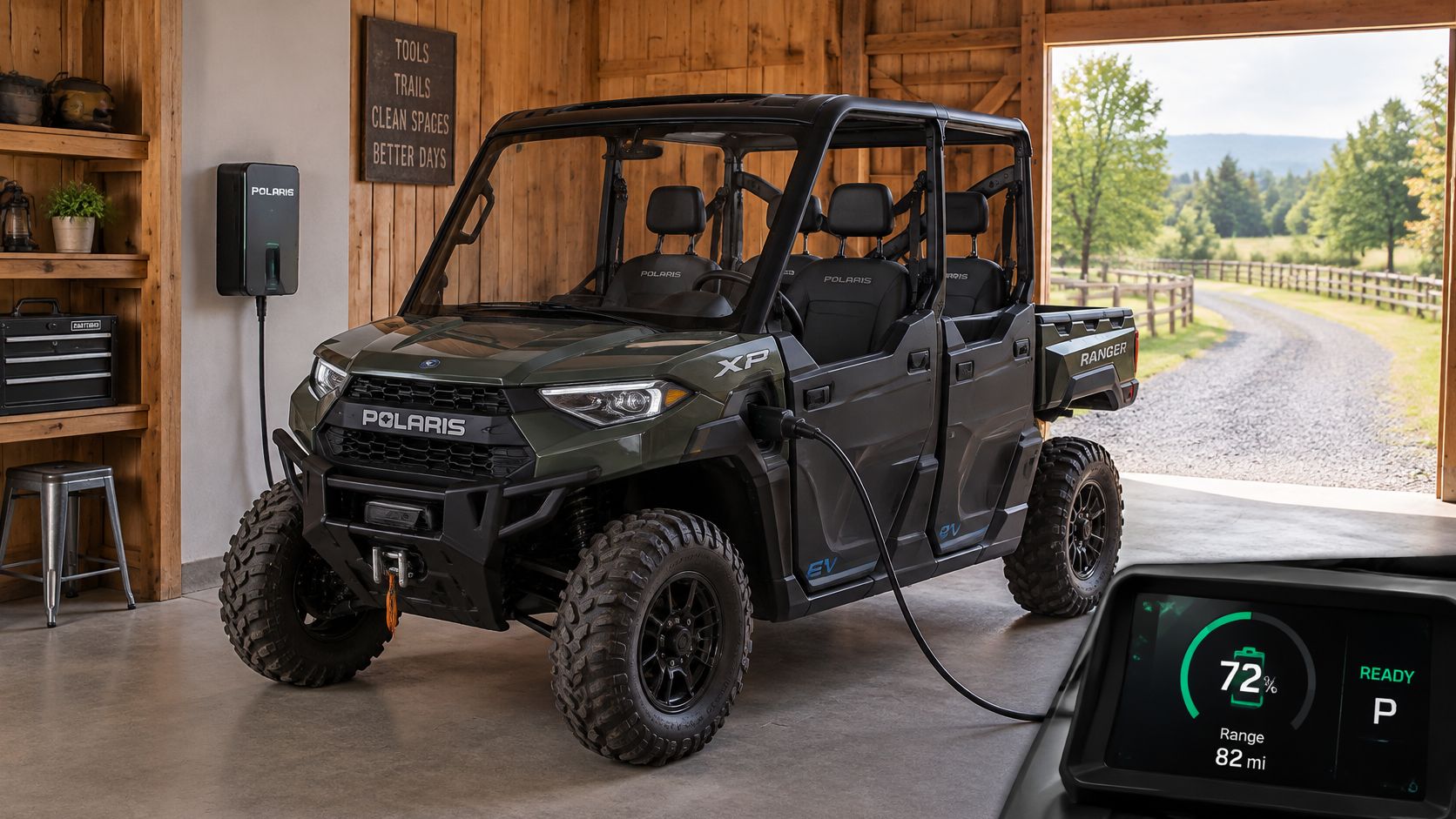
A crew of four, tools in the bed, and a full shift ahead make payload and charging fit more important than motor power alone. An electric four-seater suits work with predictable daily routes, charging at the parking site, and a typical load within the vehicle's rating. Long trips far from power, severe cold without sheltered storage, or frequent heavy towing may favor gas.
Write down four details before comparing models: daily miles and hours, including the return trip; the coldest working conditions and where the vehicle will be stored; charger location and circuit capacity; and typical payload and towing load, including passengers, tools, and game. These answers describe the duty cycle, much like a truck's route and cargo determine whether it can finish a workday without a fuel or charging stop.
Use the Campus E1 as a benchmark against those needs. It has a 20 kW PMSM motor, 72V 150Ah lithium battery, up to 60 miles of range, on-demand 2WD/4WD, an electric dump bed, a 3,000 lb winch, and CarPlay and Android Auto. Its advertised range is one reference point: AutoMadeSimply's electric four-seat UTV guide describes electric four-seat UTVs with ranges from 40 to more than 100 miles per charge. Actual fit depends on load, weather, terrain, and charging access.
Take your figures to a dealer, compare current side-by-side prices, and ask for payload, towing, and cold-weather range for the exact configuration. Then request a loaded test run with your crew aboard.
If your routes are short and charging is available at base, ask Campus EV about the E1's payload, dump bed, and winch. Bring your logged miles, storage conditions, and typical crew load, and request a loaded demonstration before deciding.