
The most repeated advice on a side-by-side is also the most expensive one: if the tire clears the fenders, buy the tallest tread you can find. On an electric UTV that habit spends battery on rotating mass and softens the torque the motor needs for a loaded grade. A side by side tire size comparison has to treat diameter as a gear change, width as a steering and energy choice, and load rating as the only figure that says the tire can carry people, cargo, and tongue weight. A slightly taller, lighter, correctly load-rated tire often clears the obstacle with less range loss than a heavy mud tire of the same nominal height. Read the sidewall before you fall for the tread.
Table of Contents
- Common UTV Tire Sizes Compared
- Decode the Sidewall and Load Rating
- How Diameter Width and Offset Change the Drive
- Range and Climbing When Tires Get Taller
- Tire Sizes for Hunting Farm and Trail Work
- Match the Tire to the Machine
Common UTV Tire Sizes Compared
Taller is not automatically better. The useful shopping band is wide, and most of it is the wrong tire for a workday.
A 2025 Performance Plus Tire guide states that UTV tire diameters generally begin at about 25 inches and extend beyond 35 inches, while widths can reach 15 inches for high-performance applications. That span is a catalog, not a recommendation. The rows below are nominal sidewall sizes, not measured inflated diameters. Two tires both marked 27 inches can differ by a fraction of an inch once tread depth, carcass, and the measuring rim are real. Confirm overall diameter on the maker's spec sheet before you order.
How to read the height column
| Size designation | Diameter (in) | Width (in) | Wheel (in) | Taller than 25 in |
|---|---|---|---|---|
| 25×8-12 | 25 | 8 | 12 | baseline |
| 25×10-12 | 25 | 10 | 12 | 0% |
| 26×9-12 | 26 | 9 | 12 | about 4% |
| 27×9-14 | 27 | 9 | 14 | about 8% |
| 27×11-14 | 27 | 11 | 14 | about 8% |
| 28×10-14 | 28 | 10 | 14 | about 12% |
| 30×10-14 | 30 | 10 | 14 | about 20% |
| 32×10-15 | 32 | 10 | 15 | about 28% |
| 35×10-15 | 35 | 10 | 15 | about 40% |
| 30×15-14 high-width example | 30 | 15 | 14 | about 20% |
The last column is height gain versus a 25-inch baseline, and circumference moves with it. A 26-inch tire is about 4 percent taller. A 27 is about 8 percent. A 28 is about 12 percent. A 30 is about 20 percent. A 32 is about 28 percent. A 35 is about 40 percent. Width does not change that percentage. The 25×8-12 and the 25×10-12 share a height. So do the 27×9-14 and the 27×11-14. The 30×15-14 row is there so the width extreme is visible: still about 20 percent taller than 25, and far wider than a ranch or yard tire needs to be.
Wheel diameter changes down the table. The 25-inch rows sit on 12-inch wheels. Many 27- and 28-inch sizes move to 14 inches. The 32- and 35-inch rows use 15-inch wheels. A taller marking is not a bolt-on if your hubs are built for a smaller wheel.
Shopping rule: Circle only sizes inside the vehicle maker's approved diameter. Load capacity, gearing, and the job you actually do pick the winner from that short list.
A 26- or 27-inch step is a small gear change. A jump toward 32 or 35 inches is a different machine. Keep the circled sizes, then judge them on load and on the work, not on how aggressive the shoulder looks in a photo.
Decode the Sidewall and Load Rating
Two tires can carry the same size marking and be different products. Dimensions tell you whether a tire fits. The rest of the sidewall tells you what it can carry, at what pressure, and at what weight cost to your battery.
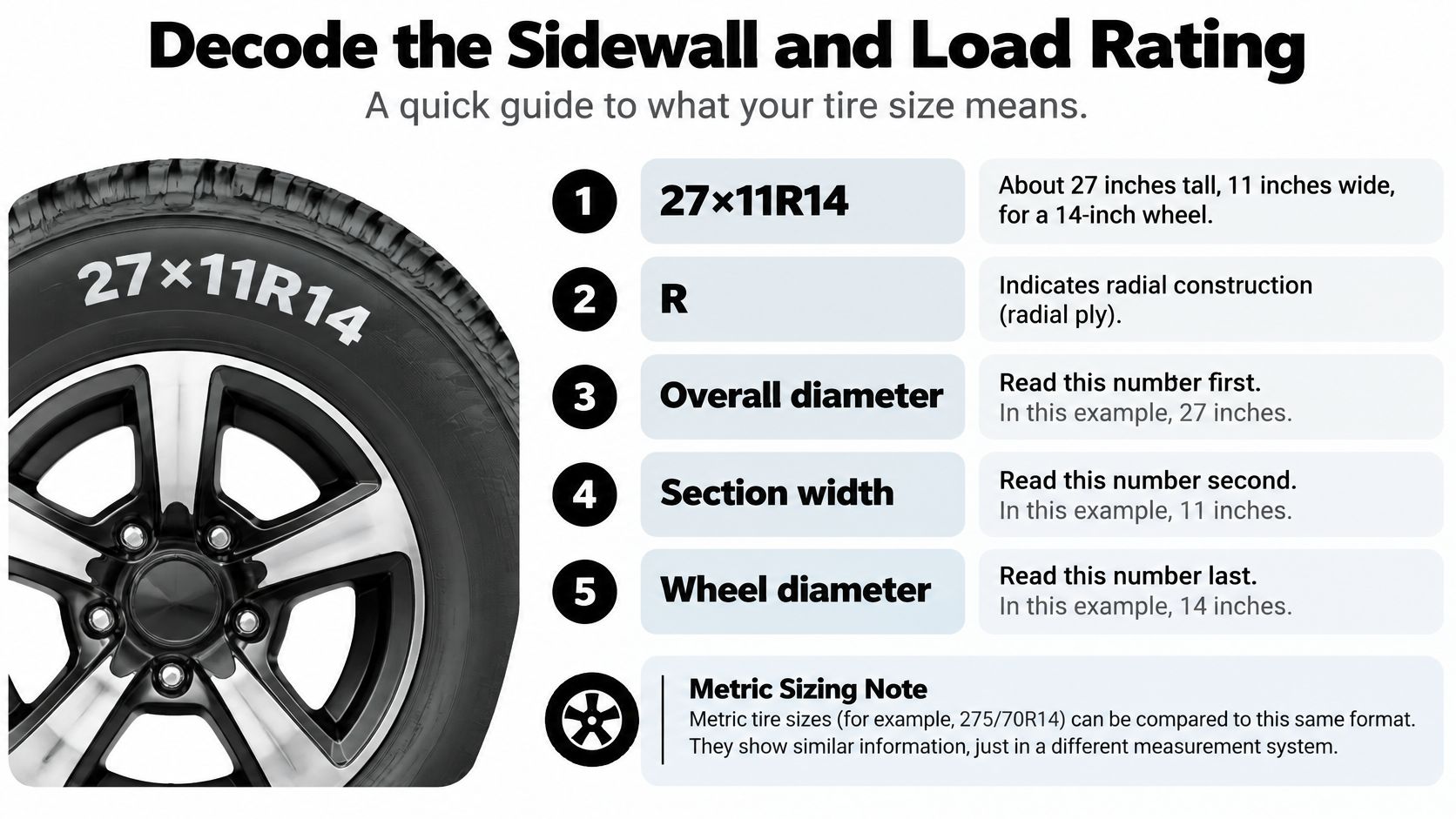
Read the designation in order
Take 27×11R14. Overall diameter comes first, about 27 inches tall. Section width is next, about 11 inches. Wheel diameter is last, a 14-inch wheel. The R marks radial construction. Flotation sizes used on UTVs put those inch figures up front. Metric and P-metric codes look equivalent on a page and are not. NHTSA warns that apparently equivalent metric and P-metric designations can use different load-capacity formulas and recommended pressures, so a casual substitution can overload the tire.
The same federal interpretation explains why identical dimensions can carry very different loads. A vehicle maker's tire label must identify a tire suitable for the vehicle's gross axle weight rating, and load range is what separates two tires that measure the same. In one NHTSA example, a 7.50-20 tire is offered in load ranges D, F, and G, rated from 2,750 pounds in load range D to 4,150 pounds in load range G: a 1,400-pound gap, about 50.9 percent above the lowest rating. Read that as a federal principle rather than a UTV fitment you can order.
Sidewall size and the Tire Identification Number do different jobs. NHTSA's identification history notes that Federal Motor Vehicle Safety Standard No. 109 took effect on January 1, 1968, with labeling molded into passenger-car tires made after August 1, 1968, while the size portion of the Tire Identification Number was set on November 10, 1970 and the government size-code table was rescinded on November 8, 1972. The molded size tells you fitment and rating. The identification number supports traceability. Copy the full molded marking, not a phrase like "bigger and more aggressive."
Same look, different pounds
Published ATV and UTV listings show the same split at work-tire scale. Pit Bull Tires lists one 25.5×10R14 at 730 lb at 7 psi and 1,045 lb at 14 psi, and a 25.5×8R12 at 410 lb at 7 psi and 480 lb at 12 psi. These are tire-level ratings. They are not permission to exceed axle rating, GVWR, wheel rating, or the maker's pressure limits.
| Example | Pressure | Rated load | What it shows |
|---|---|---|---|
| 25.5×10R14 | 7 psi | 730 lb | Wider 14-inch tire at low pressure |
| 25.5×10R14 | 14 psi | 1,045 lb | Same tire at higher listed pressure |
| 25.5×8R12 | 7 psi | 410 lb | Narrower 12-inch tire at low pressure |
| 25.5×8R12 | 12 psi | 480 lb | Still well below the 10-inch tire |
At 7 psi the wider 14-inch tire already carries 730 lb. At its higher listed pressure it reaches 1,045 lb. The narrower 12-inch tire tops out at 480 lb on the published sheet. Width and wheel diameter are not the load story. Pressure and construction are.
Before you order, write down the full designation, load range or ply rating, maximum load, recommended inflation, approved rim width, and construction. Then compare load index, pressure window, carcass, tread depth, and measured weight. Higher ply ratings generally add puncture resistance and load capability, and they also add mass. Every added pound is rotating, unsprung weight. It dulls acceleration and draws more from the battery on every launch and every climb.
Two tires of the same nominal size can also steer differently, because carcass stiffness, load rating, and the pressure you run change how the contact patch behaves. The heavier-duty option is not automatically the better-steering one. For an electric UTV the practical filter is this: pick the lightest tire whose load rating covers your real axle load with margin, then run the pressure that rating assumes. A mud tire that outweighs the job costs range on every mile, while a correctly rated lighter tire clears the same obstacles with less energy per trip.
For a field check, add occupant weight, cargo, and tongue weight, divide by the tires that carry that load, and stay under the sidewall maximum at the pressure you will run. Size, load capacity, and inflation are one package, especially with people, tools, or a trailer aboard.
How Diameter Width and Offset Change the Drive
Treat diameter as a gearing change. The felt result shows up before the tire ever looks "too big" in the wheel well.
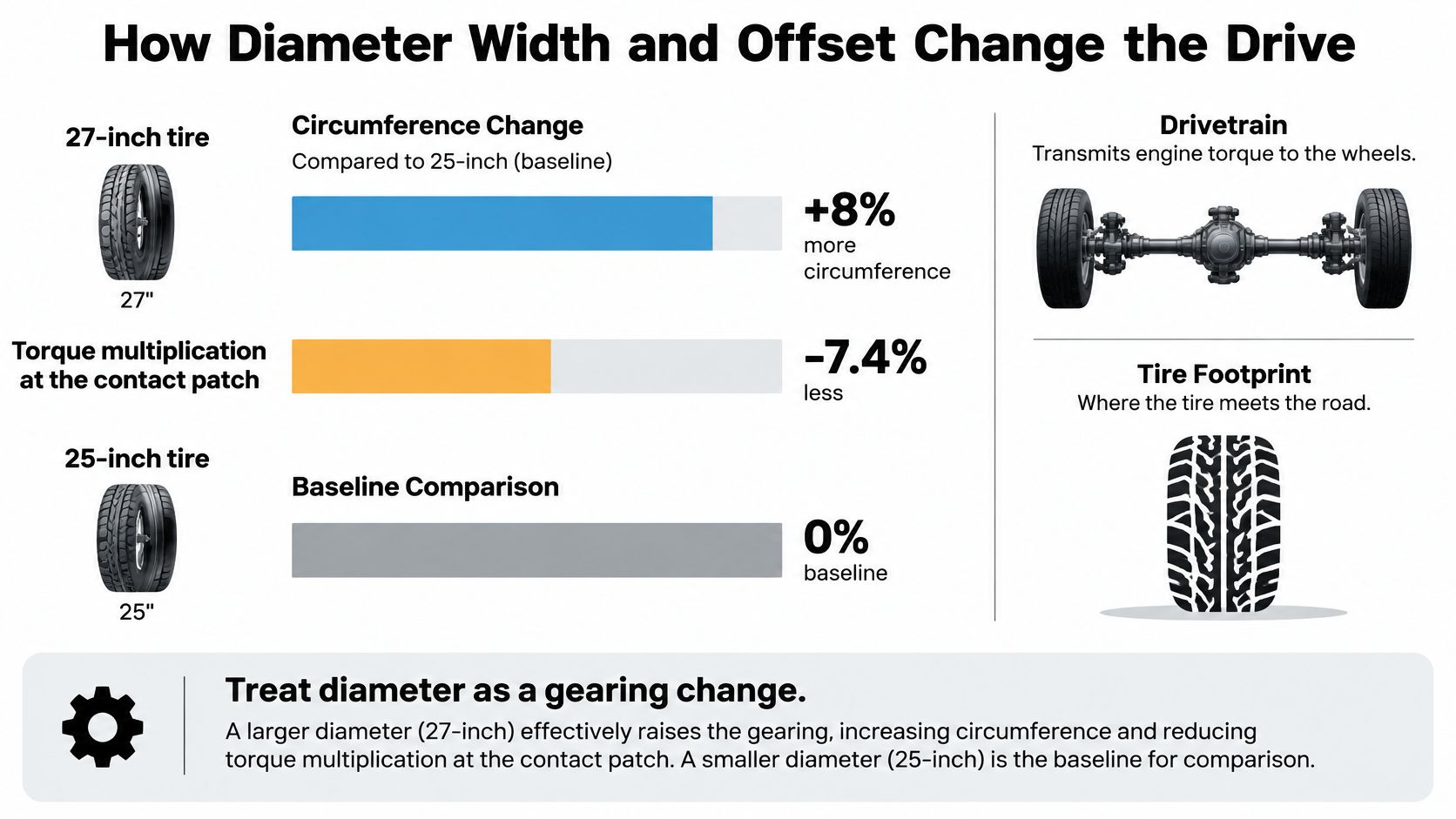
A 27-inch tire against a 25-inch tire
Read a flotation size as overall diameter by section width, then wheel diameter. Polaris's off-road tire guide uses 27×11R14 as about 27 inches tall, 11 inches wide, and compatible with a 14-inch wheel. On an electric UTV, that guide's gearing example is the one that matters: a 27-inch tire has about 8 percent greater circumference than a 25-inch tire, which cuts motor torque multiplication at the contact patch by roughly 7.4 percent and lowers motor rpm at a given road speed by about 7.4 percent.
You feel that as a softer launch, less hill-climbing margin, and weaker regenerative braking. You gain ground clearance, and you may gain theoretical top speed if the motor still has rpm left. The same ratio scales. Circumference versus a 25-inch calibration is about 4 percent at 26 inches, about 8 percent at 27, about 12 percent at 28, about 20 percent at 30, about 28 percent at 32, and about 40 percent at 35. Motor rpm does not fall by that same percentage. It falls by one minus the old diameter divided by the new one. A 30-inch tire on a 25-inch calibration is about 20 percent larger around, and rpm at the same road speed drops by about 16.7 percent. If the speedometer assumes the smaller tire, indicated speed sits about that far below true speed, because the meter still counts the short circumference.
| Tire diameter | Circumference vs 25 in |
|---|---|
| 26 in | about 4% |
| 27 in | about 8% |
| 28 in | about 12% |
| 30 in | about 20% |
| 32 in | about 28% |
| 35 in | about 40% |
Use the circumference column for trip distance and for how far indicated speed lags. Use the 25-over-new-diameter ratio when you care about motor rpm and regen strength. A stack of UTV tire reviews is useful only after you have those two numbers for the size you are holding.
The clip below walks through why a taller tire changes how the machine pulls, not just how it looks.
Width and offset
Moving from an 8-inch front tire to a 10-inch tire increases nominal section width by 25 percent. Actual contact area still depends on inflation, carcass stiffness, tread design, and how much the soil gives. Wider tires can float and put power down on loose ground. They also raise steering effort, scrub, and energy use. That is a poor trade on hard two-track and packed yard surfaces.
Offset moves the tire sideways, not up. More positive offset narrows the track and can tuck the tire into the A-arm. More negative offset widens the stance, loads wheel bearings harder, and can scrub a fender lip. Neither change is a fit until you cycle the suspension.
Select sizes inside the vehicle maker's approved diameter range. Verify clearance at full steering lock and full suspension compression, with the tire at the pressure the maker specifies, before you call the size a fit.
Range and Climbing When Tires Get Taller
Fitment tells you almost nothing worth paying for. A 30-inch tire can clear the fenders and still be the wrong tire, because a 25-to-27 step and a 27-to-30 step change loaded acceleration, hill climbing, regenerative and friction braking, energy use, and usable range.
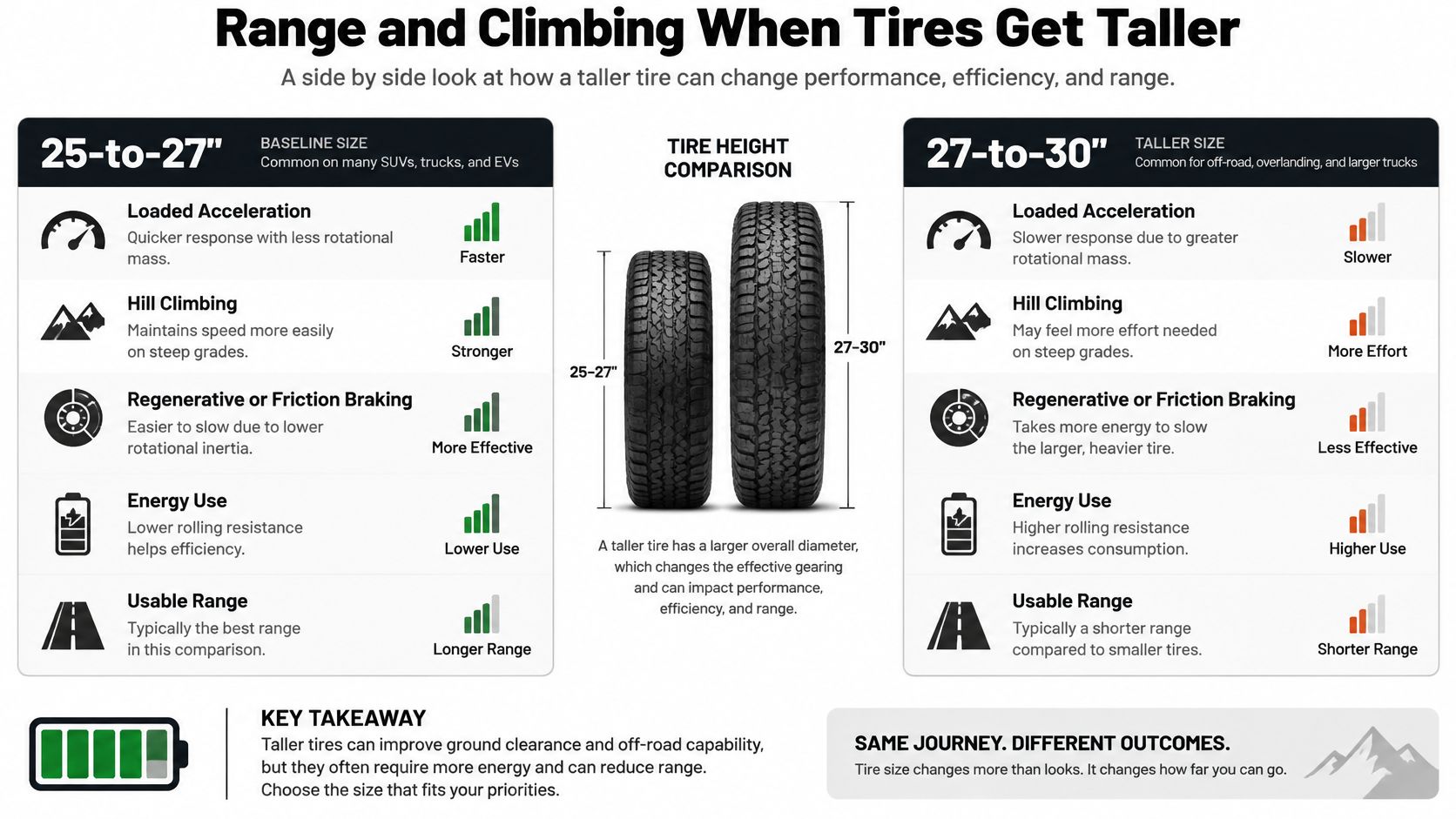
A taller tire raises effective gearing and softens acceleration. A heavier tire adds rotating mass that the motor has to spin up and the brakes have to stop on every dip and every grade. Side by Side Source's UTV tire catalog shows the swaps buyers make, including 25-to-27 and 27-to-30 inches, and those are exactly the changes worth pricing in torque and range before purchase. Two costs hide in that arithmetic. Underinflation raises rolling resistance on any surface, and extra carcass weight charges interest on every rotation.
On a utility machine the loads stack. Cargo, a trailer near the 2,500 lb tow rating, a grade, and cold air all sit on top of whatever the tire already costs. Hunters, ranchers, and warehouse or construction crews hit that stack on ordinary days, not just on the worst weekend of the year. A heavy mud carcass spends energy on every rotation even on a hard ranch road, and dropping pressure to widen the footprint raises the bill further.
A test you can repeat
Record tire weight, pressure, tread type, payload, terrain, and temperature. Note usable range and how the machine pulls on one known hill before the swap and after it. Keep the route, the load, and the state of charge as close as you can. One pasture loop with an empty bed will flatter a mud tire that fails once the dump bed is full.
The best upgrade is the smallest change that clears the obstacle and still carries the load.
A slightly taller, lighter, appropriately load-rated tire can add useful clearance with less range loss than a heavy mud tire of the same nominal diameter. Prefer that lighter step when most miles are two-track, gravel, or pasture. Accept the heavier carcass only when flotation or puncture resistance is the actual job. If range already limits the workday, improve efficiency on the tires you already run, starting with pressure, before adding rotating mass.
The tallest tire that clears the fender is a clearance fantasy. The tire that maintains its pull and regen on a loaded grade is the one still performing when it counts.
Tire Sizes for Hunting Farm and Trail Work
There is no single winning size. Match the band to the majority of days, not the worst weekend of the year.
| Job | Size band | Priority | Main risk |
|---|---|---|---|
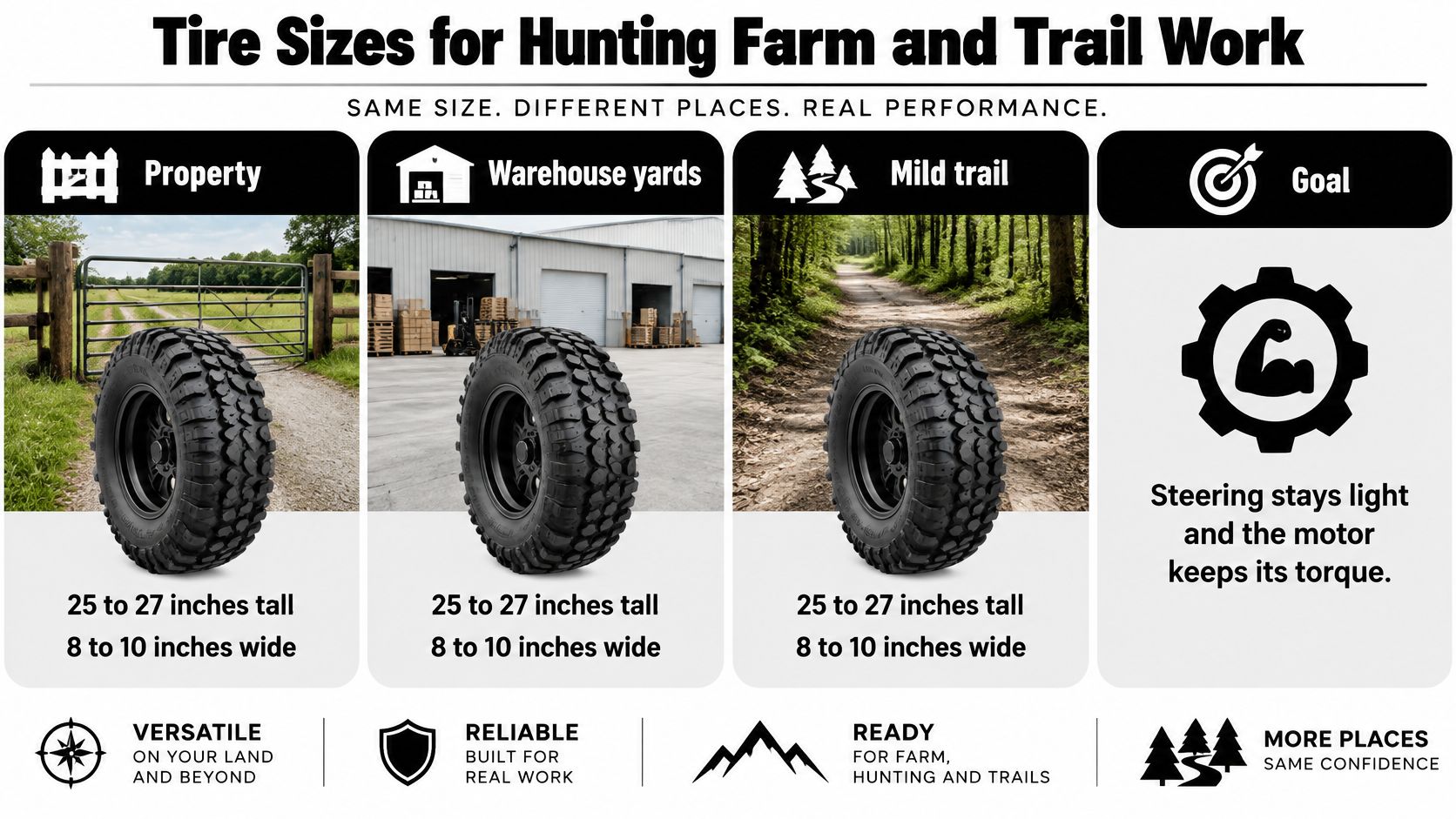
| Property, yard, and mild trail | 25–27 in tall, 8–10 in wide | Steering feel and range | Wide tires add scrub and energy use |
| Mud and hunting trails | 27–30 in tall, 10–11 in wide | Flotation and clearance | Heavy mud carcass cuts range and braking feel |
| Farm, ranch, and towing | Near approved stock diameter, higher load range | Payload and climb torque | Tall tires soften grades with a trailer |
| Rocks and deep ruts | 28–30 in, moderate width | Clearance without extreme mass | Rubbing at full lock or compression |
Where each band goes wrong
Property, warehouse yards, and mild trail stay at 25 to 27 inches tall and 8 to 10 inches wide. Steering stays light, and the motor keeps the torque and range it was built with. The failure mode is width. An extra two inches of section looks planted in a photo and then scrubs through every paved crossing and packed lane, burning energy you wanted for the afternoon loop.
Mud and soft woods trails are the case for 27 to 30 inches and about 10 to 11 inches wide, and only when the route is soft. Flotation is the priority. A heavy mud carcass is the penalty: duller braking feel and a shorter day on the same charge. A hunter who trails out and sits can tolerate that weight better than someone who covers the same miles every morning. If the hunting rig is mostly a quiet transport between stands, look at how hunting utility vehicles are used before you spec a swamp tire for a gravel lease road.
Farm, ranch, and towing should keep diameter close to the approved stock size and spend the money on a higher load range and a tougher carcass. Tongue weight and a full bed punish a tall, soft tire on grades. The climb goes vague first, then the motor works harder for the same hill.
Rocks and deep ruts want 28 to 30 inches at a moderate width. That buys clearance without jumping to a 32- or 35-inch mud tire. The risk is mechanical, not cosmetic. A tall tire with the wrong offset rubs at full lock or full compression, even if it looks fine sitting in the shop.
Pick the row that matches most of your days. A seasonal hunter can live with a heavier tire. A rancher who runs the same loop at dawn cannot.
Match the Tire to the Machine
Decide in this order, and stop when a step fails.
- Stay inside the maker's approved diameter for that machine's wheels and fender clearance.
- Copy load, pressure, and rim width off the sidewall. Keep tire load under the axle rating and GVWR with people, cargo, and tongue weight aboard.
- Check clearance at full lock and full compression with the offset you will run, at the pressure the maker specifies.
- When two tires give the same height gain, buy the lighter one.
That order fits an electric work UTV, not a dune toy. Circle one size band from the nominal chart and one job row that matches most days, then verify wheel diameter, load rating, and approved tire options for that exact model before you order.
On our Campus E1, an electric UTV, stock ground clearance is 11 inches, towing is up to 2,500 lbs, and the electric dump bed hauls 550 lbs. Those figures already assume a tire that can put torque to the ground with a trailer on a grade. A taller, heavier mud tire does not raise the tow rating. It spends part of the motor's pull just turning itself. Confirm the approved wheel and tire options for your E1 with us or an authorized dealer, using the sidewall package from step 2, before a set ships.
After the first charged workday, compare indicated speed on a known stretch with true distance, and run the same hill you used as a baseline. If launch, climb, or regen feels worse and the obstacle was already clearing, step back to the lighter tire. The right size is the one that finishes the job with margin left in the battery, not the one that looks largest under the fender.
Campus EV builds electric UTVs for hunting, farming, ranching, and property work, and the Campus E1 is set up to tow and haul with on-demand four-wheel drive rather than to wear the tallest mud tire in the catalog. If you are matching tire size to range, climb, and a real payload, start with the machine's approved diameter and load rating. Visit Campus EV to compare the Campus E1 and find an authorized dealer.