
At six in the morning, a hunter loads a ladder stand, decoys, a cooler and a rifle, then faces a long gravel road between the truck and the hunting area. After dark, the trip may run the other way with a deer to retrieve. The right vehicle can make those jobs manageable, but only if it fits the load, terrain and access rules.
A UTV isn't just transportation on a hunting property. It needs to carry people and gear, handle difficult ground, and help bring game out without exceeding its limits. Electric and gas models can both do that work, but they differ in refuelling, noise and maintenance.
Table of Contents
- Why Hunters Need a Utility Vehicle
- Hunting UTV Types Compared at a Glance
- Features That Matter Most on a Hunt
- Electric vs Gas Hunting UTVs and What Quiet Really Buys
- Pre-Trip Access Checklist for Public and Private Land
- Maintenance and Running Costs Over Time
- Choose Your Hunting UTV Model Step by Step
Why Hunters Need a Utility Vehicle
A hunting UTV earns its place by solving repeat problems: moving bulky gear, getting across rough access roads and hauling a load back out. Cargo space helps with stands and decoys; a winch and four-wheel drive matter when mud or slopes complicate travel. A well-chosen model also cuts the effort of repeated trips between the truck, camp and hunting area.
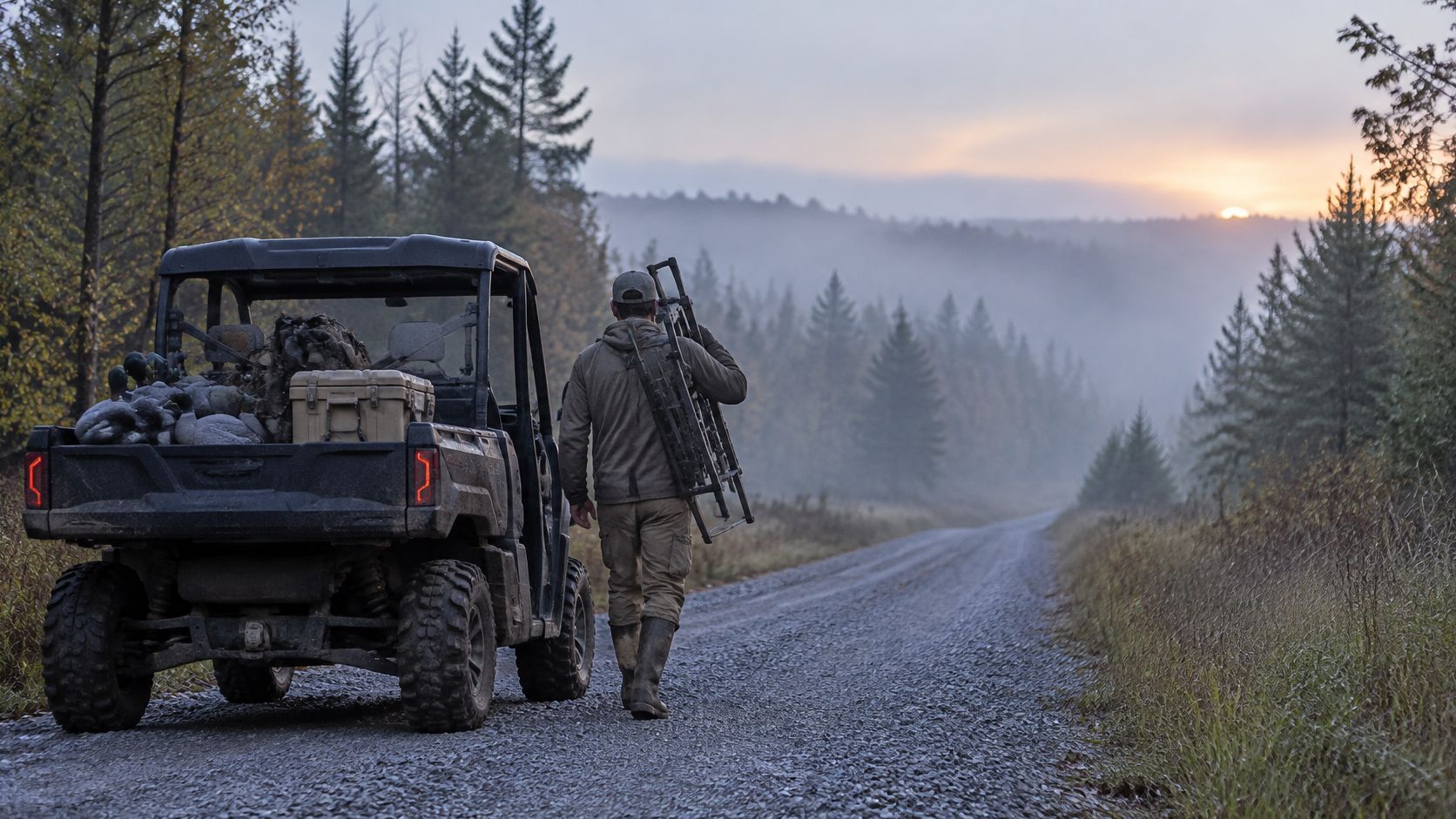
This isn't a niche need for people who hunt only once in a while. The U.S. Fish and Wildlife Service's 2022 National Survey of Fishing, Hunting, and Wildlife-Associated Recreation counted 14.4 million hunters aged 16 and older, who made 165 million hunting trips during the year. Those figures describe hunting activity, not UTV purchases, but they show why practical transport and hauling can matter across a season.
The same survey counted 11.5 million people pursuing big game across 92 million trips. That's a lot of travel and logistics, from packing equipment in to retrieving game afterward. Battery power is part of the wider off-road scene, too: the U.S. Environmental Protection Agency estimated approximately 12 million electric-powered pieces of off-road equipment in the U.S. fleet during 2023 in its off-road action plan. That figure covers off-road equipment broadly, not hunting UTVs.
For hunting, the useful test is straightforward: can the vehicle carry your party, haul your equipment and handle retrieval on the routes you're allowed to use? Those three jobs should shape every buying decision.
Hunting UTV Types Compared at a Glance
Seats determine who rides, payload determines what you can haul, and the drive system affects how the vehicle handles mud and slopes. Compare those factors together: a larger cab may help bring a hunting party along, but passengers and accessories also use capacity that could otherwise carry cargo.
| Type | Seats | Typical payload | Best hunting role | Power |
|---|---|---|---|---|
| Two-seat utility | 2 | 500–1,000 lb | Scouting and quick access for one or two hunters | Gas or electric |
| Side-by-side with cargo bed | 2 | 600–1,200 lb | Hauling stands, decoys and gear | Gas or electric |
| Four-seat crew with bed | 4 | 1,000–1,500 lb | Moving a hunting party and gear together | Mostly gas |
| Heavy-duty work UTV | 2 | 1,500–2,500 lb | Ranch and property work, towing and heavy loads | Gas or electric |
| Electric side-by-side with dump bed | 2 | 500–1,000 lb | Quiet, repeated short hauls on access roads | Battery-electric |
The payload column gives typical ranges across the category, not a promise for any single machine. The capacity label on the vehicle and the figure in the manual are the governing numbers, and two models in the same row of this table can sit hundreds of pounds apart.
A two-seat utility model suits a solo hunter or a pair who mainly need to get to a location and carry a manageable load. A side-by-side with a cargo bed keeps two seats while giving stands, decoys and coolers a dedicated place. Check that the bed's dimensions, tie-down points and rated capacity match the equipment you take.
A four-seat crew model can move a group together, but extra seating doesn't come free. More passengers take up payload, and the bed may offer less useful space than a two-seat utility model. If most trips involve only one or two hunters, buying seats that usually go unused can be a poor trade.
Heavy-duty work UTVs make sense when the machine will also move material around a ranch or property, or tow on suitable routes. An electric side-by-side with a dump bed fits repeated short hauls, especially where low noise and convenient charging matter. In every category, deduct the weight of racks, a roof, a winch and other accessories from the rated total before counting on it for a retrieval load.
Buying rule: Match the seats to the people who usually ride, then check the remaining payload against the gear and retrieval load. Don't assume the advertised bed capacity is still available once the vehicle is occupied and accessorized.
Features That Matter Most on a Hunt
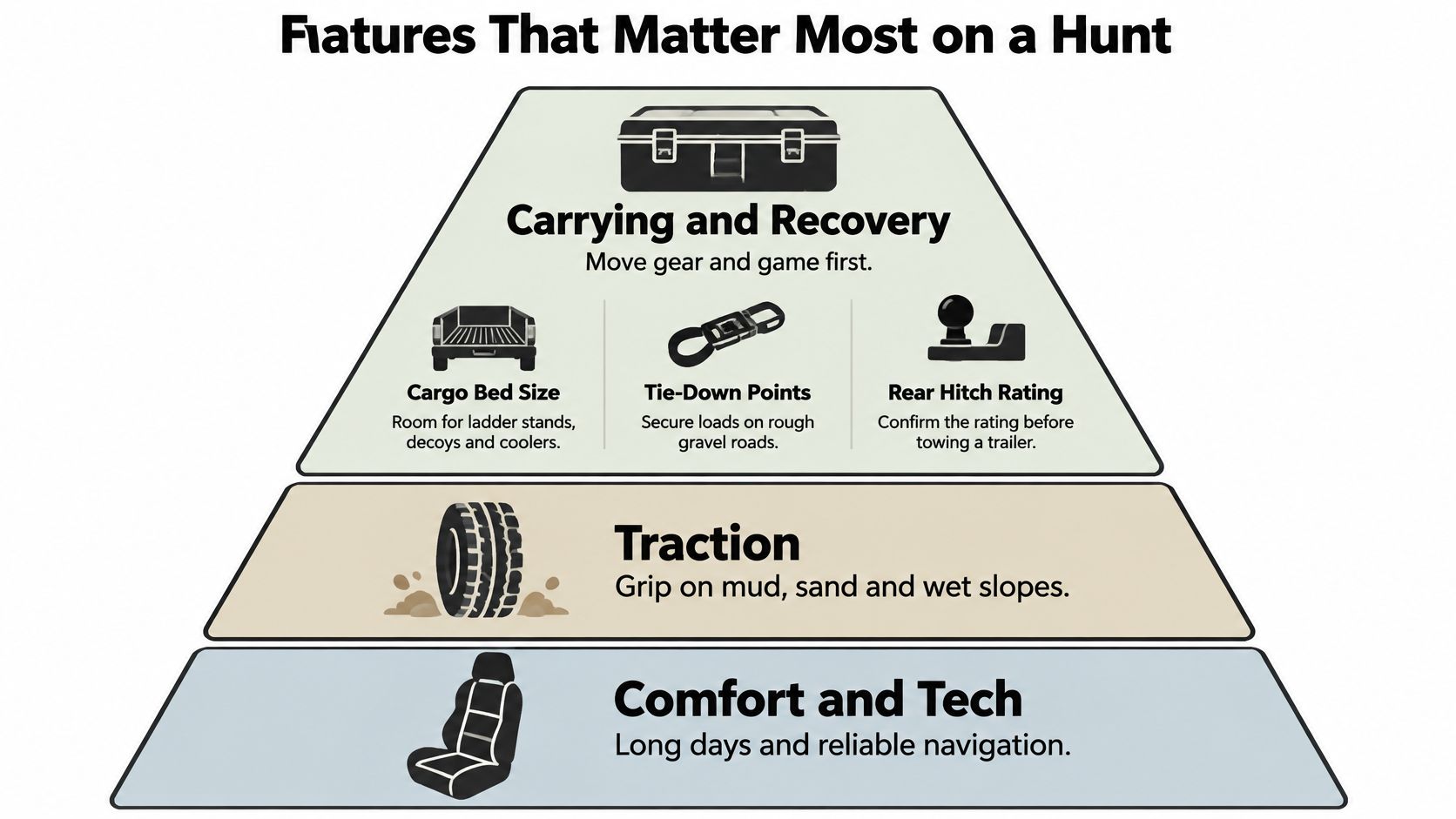
Start with carrying and recovery. A bed that fits your ladder stand, decoys and cooler is more useful than one that looks large but leaves no safe way to secure a bulky load. Inspect the tie-down points, and check the rear hitch rating in the manual before attaching a trailer. If you're considering a winch, match its rating and mounting setup to the work you expect it to do; a remote and a reliable anchor point matter as much as the winch itself.
Set up for traction, not just horsepower
Selectable 2WD and 4WD give you options as conditions change. Engage 4WD before tackling mud, loose clay, deep leaves or a steep ascent, rather than waiting until the tires are already spinning. Use smooth throttle, especially in an electric UTV, because strong low-speed torque can reach the tire's traction limit quickly.
Tire pressure also affects how the vehicle grips soft ground. SAE modeling of off-road traction found that reducing pressure can improve tractive efficiency and drawbar pull by increasing the tire's contact patch and reducing sinkage-related losses. But too little pressure can damage sidewalls, build heat, degrade steering response or unseat a bead. Stay within the manufacturer's pressure limits, slow down on low-pressure tires, and restore pressure before sustained hard-surface travel. For tire options, compare UTV tire reviews against the terrain and load you expect.
Don't overlook the driver's needs
Ground clearance helps with ruts and uneven tracks, while seat belts and a protective cab structure support safer travel. Useful lighting matters when you leave before dawn or return after dusk. A secure phone mount keeps navigation visible without leaving a phone loose in the cab.
The included video offers another look at UTV features to consider when setting up for off-road use.
Electric vs Gas Hunting UTVs and What Quiet Really Buys
| Factor | Electric hunting UTV | Gas hunting UTV |
|---|---|---|
| Tailpipe emissions during use | None at the point of operation | Direct at the point of operation |
| Idling and warm-up loss | No engine idling or warm-up | Fuel burned while idling and warming |
| Noise profile | Mainly tire noise and low motor whine | Engine and exhaust noise that carries well past the vehicle |
| Range per charge or tank | Model-specific | Model-specific, often longer between refuelling stops |
| Refuelling or recharging | Charge at home or in a shop, usually over hours | Refuel at a pump in minutes |
| Cold-weather range | Battery performance can drop in low temperatures | Engine can start reliably, fuel economy can drop |
A gas UTV engine is considerably louder than an electric drivetrain, where most of what reaches your ears is tire noise and a low motor whine. That gap is real, and it helps on a quiet approach. Quieter does not mean undetectable, though. Tires on gravel, suspension over ruts, loose cargo, a winch motor and cooling fans all announce the machine.
Speed and movement still matter as much as the powertrain. Slow down near a hunting area, secure anything that could rattle, and switch off accessories you do not need. Noise exposure is also a separate concern from wildlife disturbance; hunters who want context on how sound affects hearing can review statistics on hearing loss from noise.
Electric drivetrains avoid engine idling and warm-up losses, which suits repeated short trips from a barn or trailhead. Gas is more practical on long remote routes where carrying fuel is easier than finding somewhere to charge. Range for either type depends on the machine and how it is used. Cold, hills, mud, payload and frequent winching all drain a battery faster than a flat, dry trail does.
Less engine noise can help, but it doesn't make an off-route approach legal or guarantee that game won't react. The advantage only counts when you stay on permitted routes and manage speed and cargo noise.
Pre-Trip Access Checklist for Public and Private Land
A quiet electric UTV doesn't get a legal exception just because it runs on electricity. The land manager, vehicle classification, route and activity determine what's allowed. Check before loading up, and make sure the rule covers the specific place and purpose of your trip.
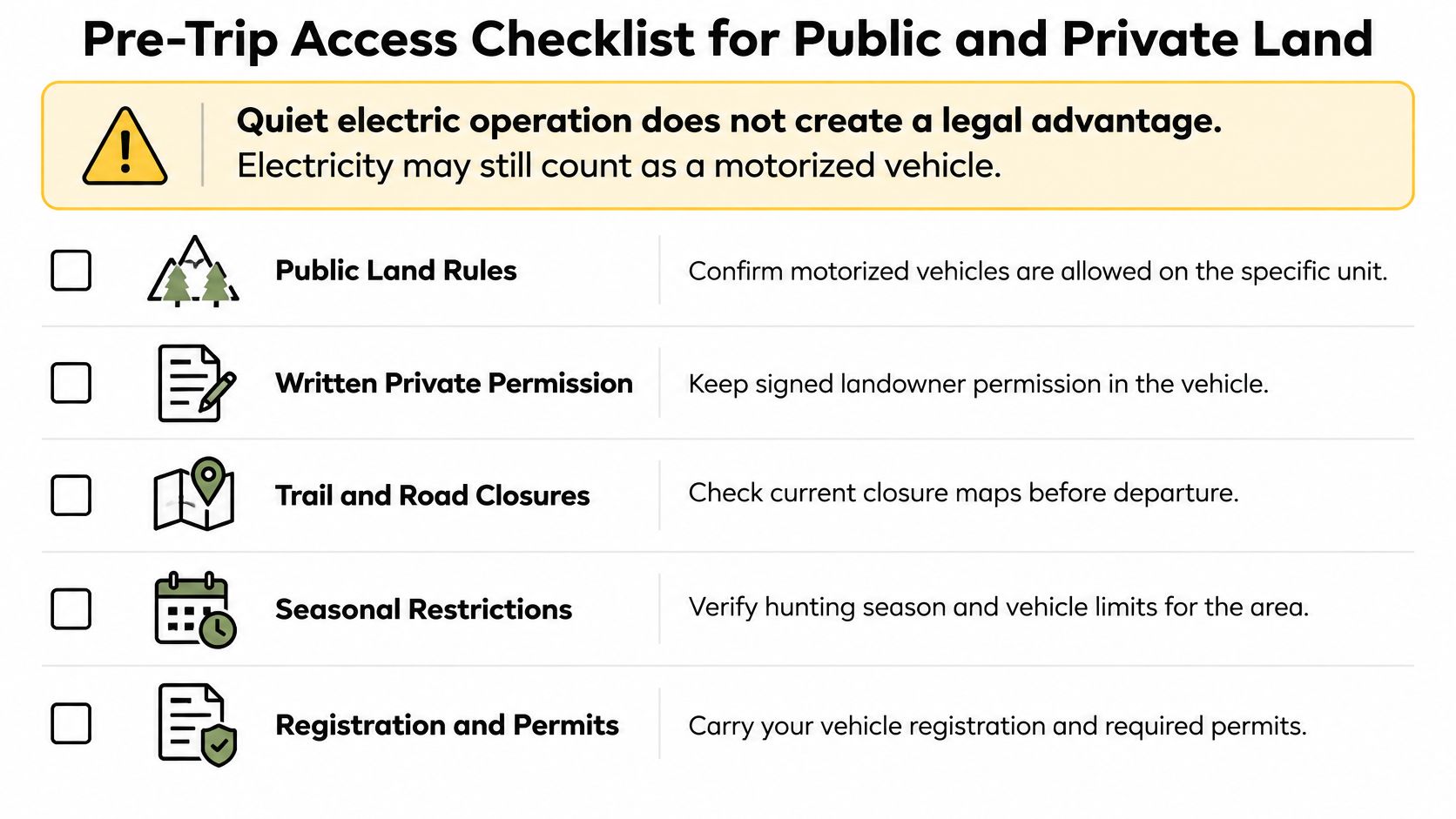
Identify the land manager. Start with the state wildlife agency, federal agency or private owner responsible for the property. Their rules may differ even across nearby parcels, so a route that is legal on one side of a fence line can be prohibited on the other.
Check how the agency classifies your UTV. Many land managers treat any vehicle driven by a motor, including an electric motor, as a motorized vehicle. That classification decides whether your machine is limited to established roads open to full-size vehicles or barred from an area entirely, regardless of how quiet it is.
Confirm which roads and trails are open. Don't treat a visible track as an open route. A worn path can be a game trail, a fire line or someone else's illegal shortcut. Check current maps and signs, and confirm whether off-route travel is allowed at all.
Separate travel from hunting activity. Rules for travelling to a hunting area may differ from rules for pursuing or retrieving game. Driving to a stand at dawn and crossing a field to recover an animal can fall under different restrictions, so ask the agency how the rules apply to each part of the trip.
Look for seasonal exceptions and special permissions. Some public lands allow off-trail OHV use only under narrow hunting and trapping exceptions, while otherwise restricting travel away from signed roads and trails. A specific exception shouldn't be assumed to cover every vehicle or every property.
Verify documents and access conditions. Check registration, permits, insurance requirements and access hours. Some refuges exclude OHVs even where hunting is allowed, which is why property-specific checks matter more than the general category of the land.
Save the relevant agency page or closure map before leaving, and keep written private-land permission with you. For a vehicle and trailer combination, check that your trailer setup suits the surface; this guide to fitting all-terrain wheels to work trailers can help you assess that part of the route. Pack other off-road essentials only after you've confirmed the route is open to your vehicle.
Maintenance and Running Costs Over Time
Electric UTV operating costs can be lower for repetitive work, but the savings depend on how and where you use the vehicle. In a six-month field demonstration at Eglin Air Force Base, the Electric Power Research Institute recorded approximately 60% lower energy cost for two battery-electric UTVs than for conventional gasoline UTVs. That EPRI field demonstration is a useful benchmark, not a promise: terrain, payload, temperature, charging rates, battery age and annual hours all affect the result.
| Maintenance item | Gas UTV | Electric UTV |
|---|---|---|
| Engine oil and filter | Change per manual interval | Not required |
| Air filter | Inspect often in dust; replace per manual | Inspect cooling vents and cabin filter per manual |
| Spark plugs | Replace per manual interval | Not required |
| Drive belt | Inspect for wear; replace when worn | Check drivetrain and service requirements in the manual |
| Coolant | Replace per manual interval | Check motor and controller cooling per manual |
| Battery | Maintain starting battery | Monitor pack health and budget a replacement reserve |
Compare actual energy use per operating hour with local fuel costs instead of relying on advertised range. Add the cost of charging equipment, routine service and a battery replacement reserve to the purchase price. For gas, include fuel and the service intervals listed in the owner's manual.
Electric doesn't mean maintenance-free. Keep vents clear, watch for warning indicators, and follow the battery manufacturer's storage and charging instructions during cold months. Gas models need their engine service, filters and ignition components maintained, particularly after dusty or wet rides.
For a side-by-side ownership review, check the UTV maintenance cost guide and use the manufacturer's service schedule for the exact model. The sensible comparison is total cost over your expected use, not energy price or advertised range alone.
Choose Your Hunting UTV Model Step by Step
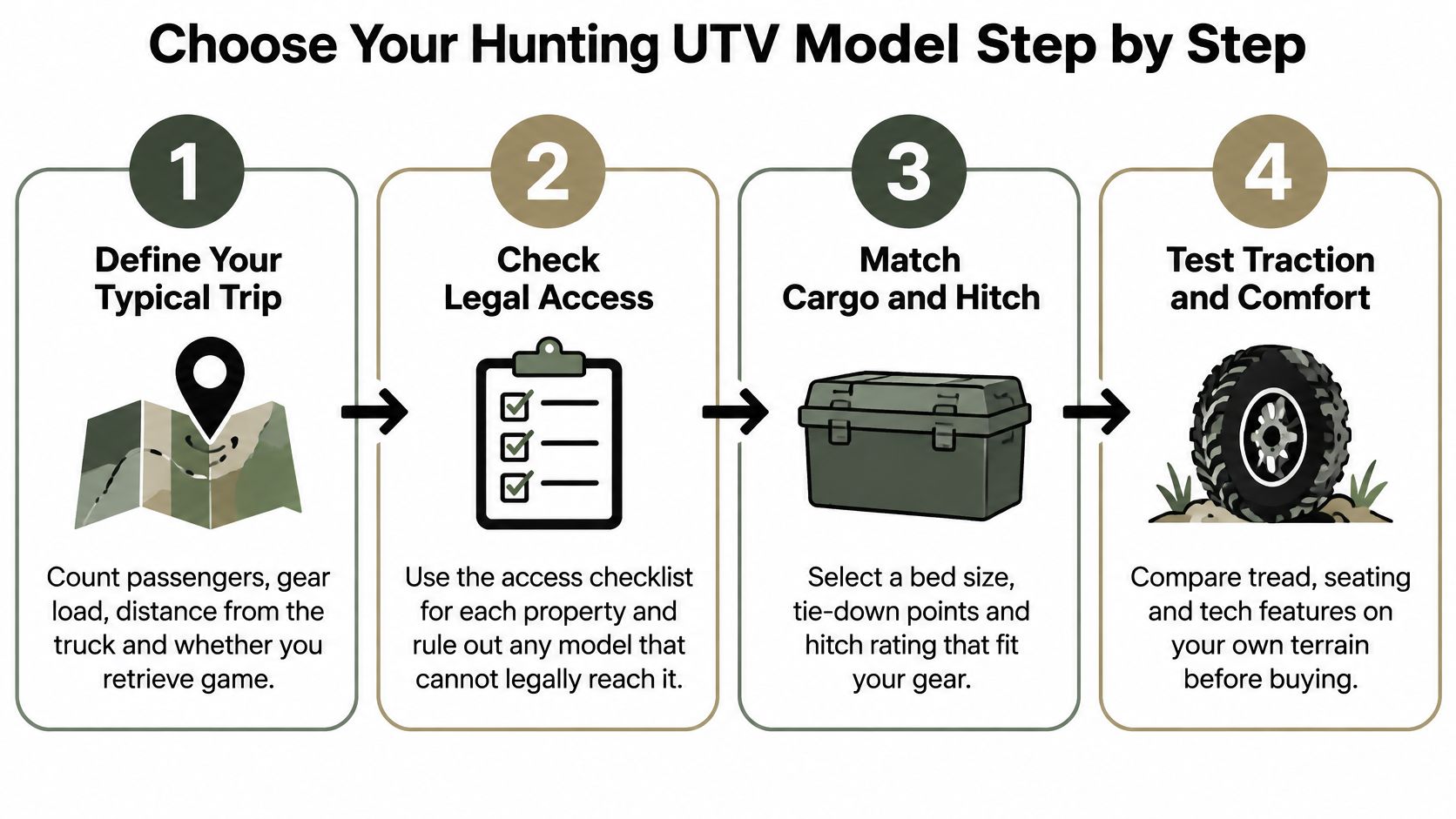
Write down a typical trip. Count the passengers, gear, distance from the truck and whether you'll retrieve game. Include the bulky items that are easy to underestimate, such as a ladder stand, cooler or recovery equipment.
Check legal access property by property. Use the agency's vehicle definitions, route maps and hunting rules. Rule out any model that can't legally travel where you need to go.
Match seats, payload and bed space to the load. Check the vehicle's capacity label, manual, bed dimensions and hitch rating. Account for passengers and accessories, then leave capacity for the return trip with game rather than buying to the limit of a one-way load.
Test the terrain and powertrain. Confirm that the model offers the traction, tire setup, clearance and recovery equipment your routes call for. Consider how you'll charge or refuel, and how cold weather, distance and towing affect your routine. If you're fitting lights or a winch, review off-road lighting and winch installation tips before choosing accessories.
Electric suits repeated short hauls on legal roads and property work where low engine noise and convenient charging fit the day. Gas may suit long remote runs, refuelling stops and heavy towing when charging access is limited. As one option to assess, the Campus E1 is an electric side-by-side with a dump bed and selectable drive modes. Check its published payload, towing limits, range and access rules against your actual trip before deciding.
Campus EV offers electric UTVs for hunting, ranching, farming and property work, including the Campus E1 side-by-side. Compare its specifications and dealer availability with your route, load and charging needs at Campus EV.