
You started looking at Electric Utility Vehicles for Sale because the gas side-by-side is too loud at dawn, too thirsty on short loops, or not welcome inside a barn or yard. That's a good reason to look. It's not a good reason to buy the first listing with a big mile number.
A work UTV earns its keep on repeatable days. It leaves from the same place, hauls a known load, climbs the same hills, and comes back to charge where it already parks. Judge every listing against that day, not against a photo or a maximum-range claim.
Table of Contents
- Which Electric UTV Fits the Work
- Usable Range Payload and Charge Planning
- How to Shop Listings and Dealers Safely
- Pre-Purchase Inspection and Charge Safety
- Price Financing and Ownership Break-Even
- Confirm the Deal and Book a Dealer Drive
Which Electric UTV Fits the Work
Start by naming your actual job. Hunters, farmers, ranchers, large-property owners, and construction or warehouse crews don't need the same machine, even when a listing calls all of them utility use.
The broader market shows why careful matching matters. The Powersports Business UTV market analysis reported approximately 520,000 UTVs retailed across North America in 2024, with utility-combination vehicles at 48% of the market and pure utility vehicles at 15.5%. Most sales served consumer applications, so many listings are written for recreation first. Your job is to translate a recreational listing into work terms.
Match the Electric UTV to the Workday
Use the table as a filter. If a vehicle can't meet the capacity, drivetrain, and charging place in your row, a lower price doesn't fix it.
| Job | Typical day | Capacity to require | Drivetrain | Charge place |
|---|---|---|---|---|
| Hunting | Dawn approach, quiet trail miles, winch recovery | Light gear plus a recovery winch | On-demand 4WD | Home or camp, overnight |
| Farm chores | Feed runs and tool hauls on short loops | Dump bed near 550 lb haul and tow near 2,500 lb | 2WD most of the day, 4WD in mud | Barn or shop on an approved circuit |
| Ranch patrol | Hills, fences, and stock checks | Tow, winch, and stake sides | 4WD with locking rear differential | Headquarters, overnight |
| Large property | Mixed pavement, grass, and gates | Moderate cargo and easy steering | 2WD as the default | Garage outlet checked for amperage |
| Jobsite or yard | Low-speed hauling through a shift | Payload and torque over top speed | 4WD on loose ground | Dry ventilated bay, no household cord assumed |
Hunting rewards a quiet approach, but quiet doesn't help if you can't recover the vehicle. You need trail range with reserve, a working winch, and a full overnight charge at home or camp.
Farm chores are usually short, loaded, and repetitive. A dump bed, tie-downs, and steady low-speed pulling matter more than top speed. You'll spend most firm-ground trips in 2WD and save 4WD for mud, wet grass, and loaded turns on soft ground.
Ranch patrol adds hills and uncertain traction. On-demand 4WD helps you keep moving without running all four wheels all day. A locking rear differential matters when one rear wheel lifts or spins on loose rock.
Circle One Row Before You Shop
Large-property work is different again. You may cross pavement, lawn, gravel, and gates in one loop. Electric power steering reduces effort during slow turns, and your garage circuit becomes part of the purchase decision.
Jobsite and warehouse yards need low-speed torque through a full shift. The vehicle also needs a proper charge bay where cords won't cross traffic and water won't pool around the charger.
Practical rule: Circle one primary row, then write three numbers at the top of your notes, tow rating, bed payload, and return-to-base range with about 30% reserve.
Those are your three essentials. Every later question, range, price, inspection, and financing should test those numbers against real duty. If you can't fill them in yet, you're not ready to compare listings.
Usable Range Payload and Charge Planning
Treat the sticker range as a ceiling. It may describe a light load, mild weather, firm ground, and steady driving. Your workday probably includes stops, loads, soft patches, and time spent with the wheels barely turning.
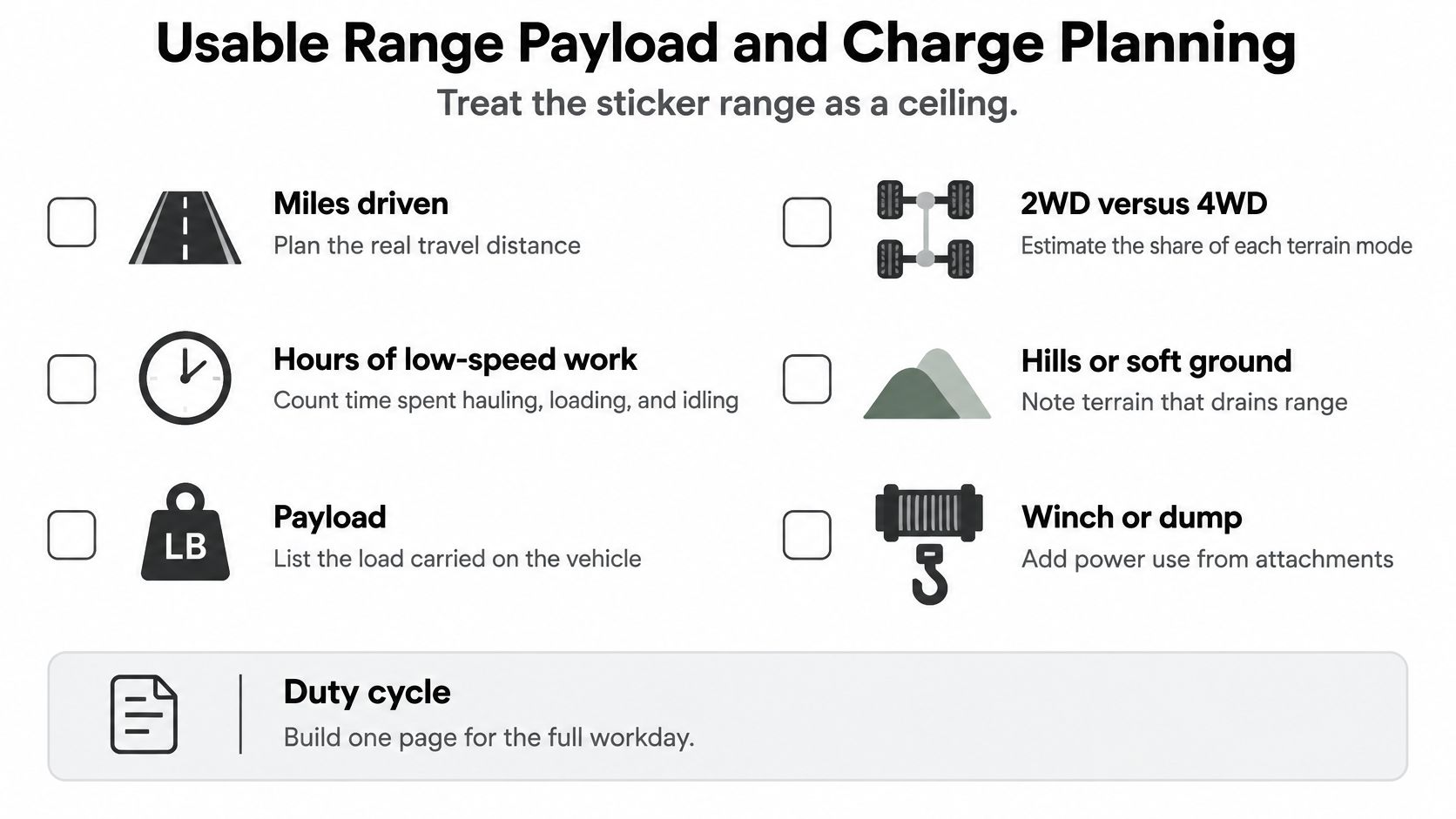
Build a one-page duty cycle before you ask a dealer whether a model has enough range. Write down miles driven, hours of low-speed work, payload, share of 2WD versus 4WD, hills or soft ground, and winch or dump cycles. Add about 30% reserve so a detour, headwind, cold morning, or extra tow doesn't strand you.
This checklist turns a vague route into numbers you can compare.
Separate return-to-base days from remote work. A farm UTV that returns to the barn at lunch and again at night has a predictable charging pattern. A hunting trip or multi-day ranch loop may not, and that difference is more important than a small difference in advertised miles.
Haircuts From Advertised UTV Range
| Condition | Planning rule | Ask or do |
|---|---|---|
| Advertised maximum miles | Ceiling, not the workday | Was it on-road or loaded utility duty? |
| Cold near -10°C | Cut more than one-third versus mild weather | Add reserve and charge indoors |
| Payload, hills, soft ground, 4WD | Extra draw the mile sticker ignores | Log miles and hours, not miles alone |
| 72 V 150 Ah pack | About 10.8 kWh nominal before losses | Request usable kWh and wall charge time |
| Winch pulls or dump cycles | Energy used with the wheels barely turning | Count cycles against the reserve |
| No outlet on the route | Return-to-base only | Skip generator charging unless the maker approves it |
Cold needs special respect. The University of Strathclyde cold-weather EV charging paper found EV range can fall by more than one-third at -10°C versus approximately 21.5°C, and it cited a Winnipeg test where a Nissan Leaf declined from 162 km at 28°C to 44 km at -26°C. Those are passenger EV figures, not UTV results, so use them as a conservative warning, not as a prediction for a specific side-by-side.
Cold packs can also charge more slowly because the battery management system limits current to protect the cells. That's why sheltered or indoor charging helps both tomorrow's range and tonight's charge time.
Ask for Usable Energy, Not Just Voltage
Voltage multiplied by amp-hours gives nominal energy. It doesn't tell you how much the vehicle lets you use, how much remains in reserve, or how much energy you'll draw from the wall. Ask for usable capacity, expected charge time on the approved charger, and whether the range figure came from on-road driving or loaded utility duty.
Check the charge location before you believe any range claim. Rural charging usually happens at the house, barn, or shop, so confirm outlet type, amperage, grounding, and cable route. If your land has no grid service at the parking spot, reviewing power options for land without utilities can help you think through storage and supply before you commit to a vehicle that must charge there.
Don't build your plan around a portable generator top-up unless the manufacturer approves that charger, supply, and temperature window. A generator that runs lights isn't automatically a safe or effective UTV charger.
A model passes when it finishes tomorrow's route with reserve and plugs in where it already lives.
How to Shop Listings and Dealers Safely
Shopping safely is mostly about refusing to skip steps when a good photo makes you impatient. Work in order, because each step prevents a different expensive mistake.
Electric models are also arriving from more sellers than before. The Global Market Insights off-road vehicle market report valued the global off-road vehicle market at $26.68 billion in 2025 and projected $41.19 billion by 2035, while electric powertrains generated approximately $1.07 billion in revenue in 2025 and were forecast to expand at a 24.4% compound annual growth rate through 2035. More choice is useful, but it makes dealer support and written terms even more important.
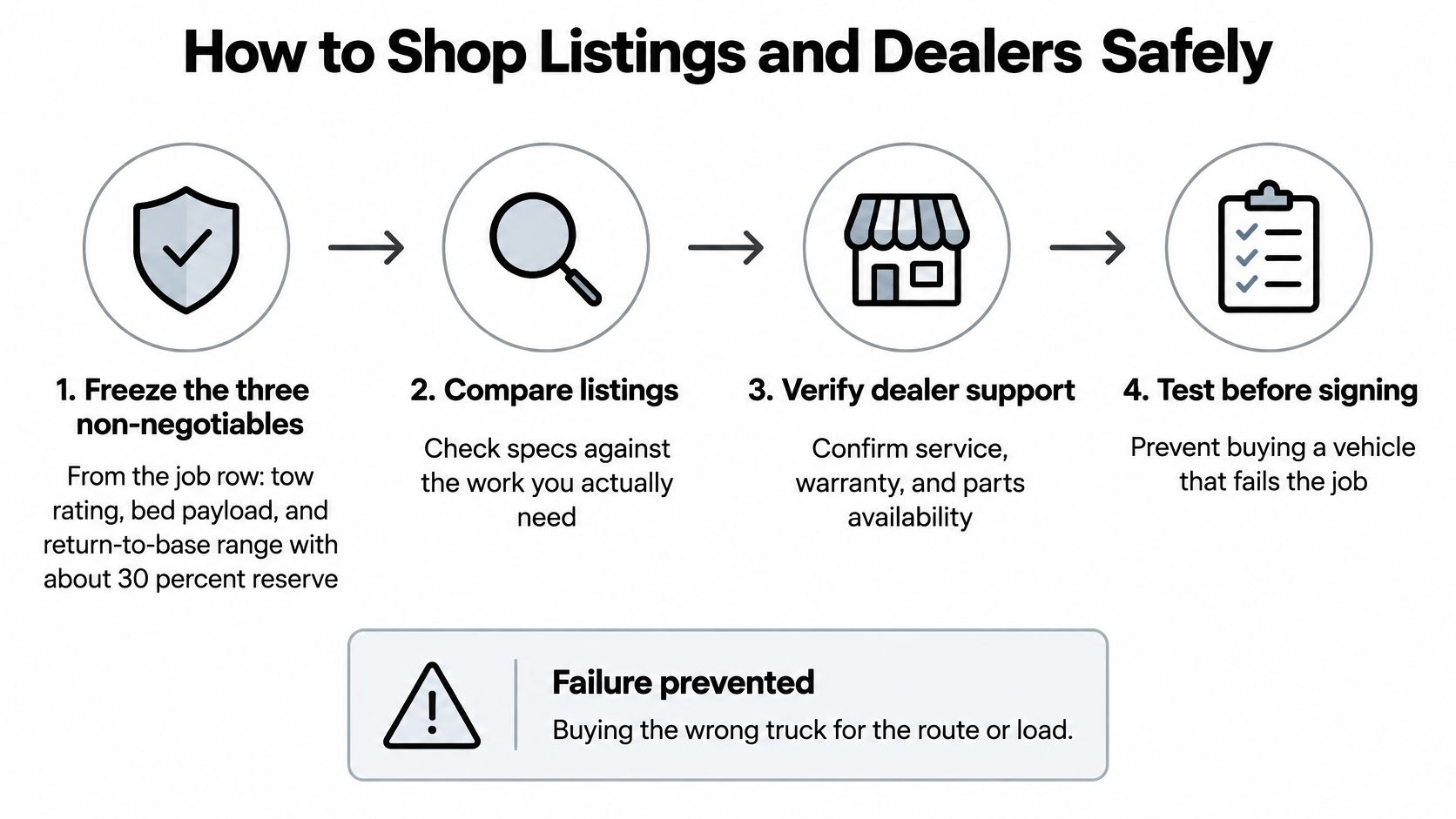
This flow keeps the purchase tied to your job row.
Seven Steps in Order
- Freeze the three key requirements: Keep tow rating, bed payload, and return-to-base range with reserve at the top of every listing note. Skip vehicles that miss them, which prevents buying an attractive machine that can't do the job.
- Choose an authorized dealer: Prefer a dealer you can visit over a private ad asking for a wire transfer. When you're searching for local electric UTV dealer support, confirm who's responsible for service, parts, and warranty work after delivery.
- Book a loaded test drive: Ask to drive on a hill and loose or muddy ground, with weight in the bed or a tow load if the seller allows it. An unloaded parking-lot loop hides weak pulling, poor traction, and steering effort.
- Use every work control: Switch between 2WD and 4WD, lock the rear differential where fitted, run the dump bed through a full cycle, and spool the winch under control. You're testing the features you'll rely on, not just the motor.
- Match the paperwork: Compare the VIN, title, and odometer or hour meter with the listing before any deposit. A mismatch is a stop, not a detail to sort out after payment.
- Get support in writing: Ask for battery warranty terms, parts availability, charger details, and service contacts on paper. Also ask about charge-error history and, for a used vehicle, whether the pack sat stored full or empty for long periods.
- Pay through a traceable route: Pay the dealer or a verified escrow service using the details already confirmed. Refuse a last-minute account change, which is a common point where a legitimate looking deal becomes a wire-transfer scam.
Listings can change or sell out, so don't treat a screenshot as a reservation. Get the VIN, included charger, accessories, fees, and warranty terms attached to the quote.
You're not being difficult by asking for a loaded drive and written terms. You're separating a seller who supports work use from one who's only moving inventory.
Pre-Purchase Inspection and Charge Safety
An electric UTV inspection has two parts. First, check that the vehicle and paperwork are sound. Second, confirm you can charge and store the battery safely at your farm, ranch, jobsite, or warehouse.
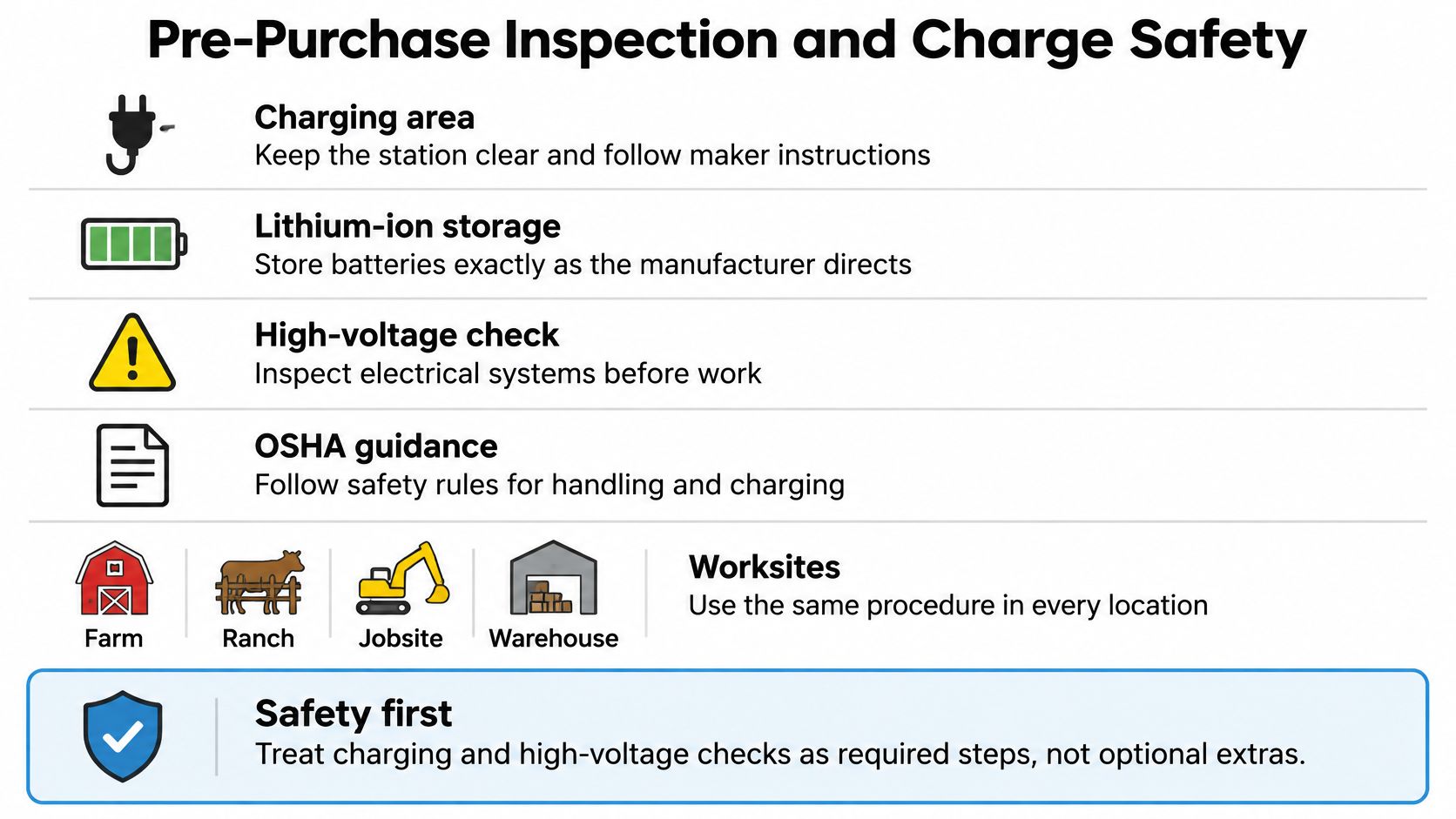
The OSHA lithium-ion battery safety guidance advises following the manufacturer's instructions for lithium-ion battery storage, use, charging, and maintenance. Army battery-safety guidance adds an important limit, use only authorized charging equipment and procedures, because charging outside the approved temperature range can create cell damage risks.
Use the safety checklist as a pass-fail walkaround, not as background reading.
Inspection Pass and Walk-Away Signs
| Check | Pass | Walk away |
|---|---|---|
| Title and VIN | Match the listing and seller | Mismatch or missing paperwork |
| Battery warranty | Years and prorated terms on the contract | Verbal promise only |
| Charger and circuit | Maker-approved, correct amps, grounded | Unknown cord or aftermarket charger assumed fine |
| Pack and cables | Dry, intact, no heat smell or codes | Swelling, odor, damage, or water |
| Work gear | Dump, tie-downs, 4WD, and diff lock work | Demo skips the features you will use |
| Tires and suspension | Wear fits the stated hours | Hidden off-road damage |
Read the battery warranty closely. Years alone don't tell you enough. You need to know which years are full replacement, which are prorated, what capacity or failure qualifies, and who performs the work.
If you're comparing a used electric UTV listing, apply the same table without lowering the charger and battery standards. A used discount disappears quickly if the approved charger is missing or the enclosure has water damage.
The Every-Charge Habit
After delivery, inspect the battery enclosure, connectors, cables, and charger before every charge. Remove wet or damaged equipment from service instead of drying it off and hoping for the best.
Charge only with the approved charger on the correct supply. Keep the space cool, dry, ventilated, and clear of combustible materials, and don't assume a household outlet, extension cord, or aftermarket charger is suitable until amperage, grounding, connector fit, and manufacturer approval are verified.
Write down abnormal heat, odor, swelling, error codes, or slower charging. A short log helps a dealer diagnose a pattern and helps you notice decline early. Fleets should also train users on emergency shutdown and lockout procedures and schedule periodic inspection of high-voltage components.
Don't judge the deal by purchase price while ignoring circuit cost, inspection time, safe storage, and seasonal range loss.
Price Financing and Ownership Break-Even
Electric doesn't always cost less to own. It can, especially under heavy daily use, but the result depends on your hours, local energy prices, charger cost, financing, and dealer support.
The Douglas Insights ATV and UTV market analysis places comparable electric models at a premium of roughly $2,000 to $5,000 over gasoline models, while another industry estimate it cites describes electric vehicles as having approximately 70% lower fuel expenses. Neither number alone gives your break-even point, because a vehicle driven a few weekends a year has very little fuel expense to cut.
Build your own five or eight year model. Include annual miles or operating hours, electricity and gasoline prices, charging equipment, routine service, battery warranty exposure, financing interest, downtime, and resale value. Our UTV maintenance cost guide can help you separate routine service from the off-road wear that electric power doesn't remove.
When the Electric Premium Can Pay Back
Enter your own hours and prices in the middle columns. The point isn't to force a yes. It's to see which workload row you occupy.
| Workload | Annual hours | Premium over gasoline | Fuel saving | Break-even read |
|---|---|---|---|---|
| Light property | Enter yours, low seasonal use | $2,000 to $5,000 | Little to save | Often never, buy for quiet chores |
| Farm or ranch | Enter yours, daily return-to-base use | $2,000 to $5,000 plus charger install | Up to about 70% lower fuel expense, per one industry estimate | Possible if hours stay high and power is cheap |
| Commercial yard | Enter yours, high-hour shift use | Premium plus inspection labor and downtime | Up to about 70% lower fuel expense, per one industry estimate | Most plausible inside five to eight years with solid dealer support |
A light-property owner may never recover the premium through energy savings. That doesn't make the purchase wrong. It means you're buying quiet starts, simple short trips, and less routine engine service, not a fuel payback.
A busy farm, ranch, or yard gives the electric model more hours in which to repay its premium. Even there, lower routine maintenance isn't the same as lower total cost. Tires, suspension, brakes, winches, and drivetrain components still wear in dirt and under load.
Battery replacement risk belongs in the model too. Strong warranty coverage reduces exposure during the covered period, but it doesn't remove downtime if the vehicle is waiting for diagnosis or parts. Dealer support therefore has financial value, not just convenience value.
Negotiate in the Right Order
Ask for the out-the-door price in U.S. dollars first. Then separate documentation fees, freight, setup, charger, accessories, and financing interest so you can see what you're paying for.
Ask what a 0% or low-APR offer requires, including credit approval, term, down payment, and whether taking the rate removes a rebate. A rebate paired with a higher rate can cost more than the promotional rate. Confirm any tax credit or utility rebate for your state and vehicle type instead of assuming a passenger EV credit applies to an off-road work vehicle.
Pull written quotes from more than one authorized dealer when you can. Keep the battery warranty page beside the payment page, because the cheapest monthly payment isn't useful if support is thin.
Confirm the Deal and Book a Dealer Drive
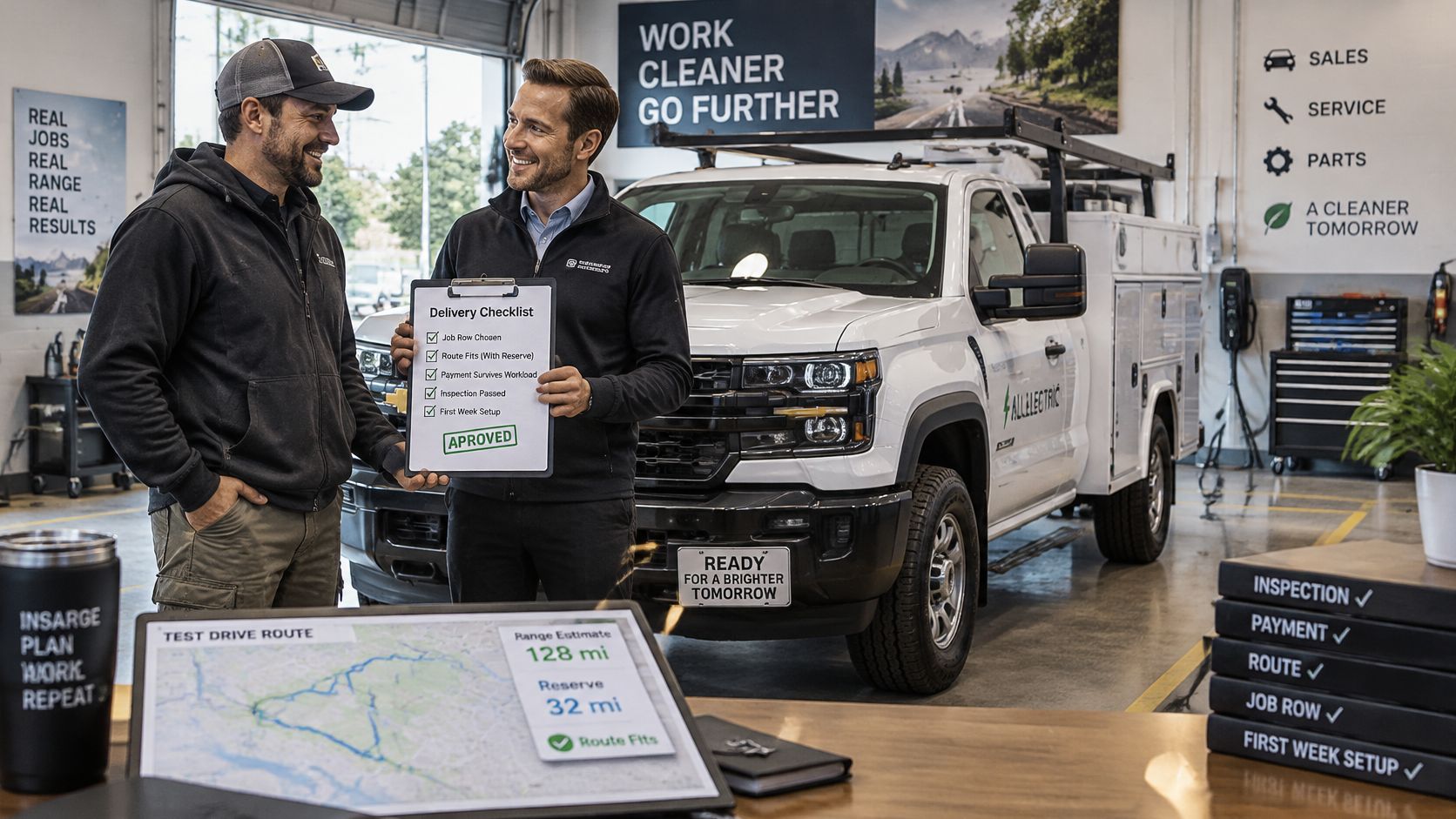
By the time you're ready to sign, four checks should already be done. Your job row is chosen, the route fits with reserve, the payment survives your workload test, and the inspection passed.
This final conversation should confirm the exact vehicle, charger, warranty, and delivery terms before money moves.
Your First Week With the Vehicle
- Park where it will charge: Confirm the approved charger runs correctly on that circuit before the first full workday.
- Run one real chore loop: Use your normal load and route before adding accessories, so you get a clean baseline.
- Log the day: Record miles, hours, payload, terrain mode, and state of charge at return. After a week, you'll have measured range instead of a guess.
- File the support packet: Keep the warranty, charger instructions, dealer parts contact, and purchase paperwork together where operators can find them.
For hunting, farm, ranch, or property buyers, the Campus E1 is one eligible option to test against your row. It's sold through authorized dealers, and you can find a nearby dealer to book a test drive. We offer 0% APR for 36 months on the Campus E1, but you should confirm current eligibility, rate, and term directly with the dealer in writing because financing terms vary.
Watch the vehicle working before your visit, then insist on your own loaded drive at the dealer.
Compare that written quote with your break-even row. Walk away if the vehicle fails the reserve test, the title doesn't match, or the charger and warranty terms stay vague.
The right electric utility vehicle isn't the one with the boldest listing. It's the one that shows up charged, carries your load, and finishes tomorrow's loop without drama.
Bring your job row, duty-cycle worksheet, and break-even numbers to a loaded test drive, and make the vehicle prove it can finish your real loop with reserve. Visit Campus EV to find an authorized dealer, book that drive, and get the Campus E1 warranty and financing terms in writing before you decide.