
You're standing in a barn doorway doing the math again. The old gas machine needs fuel, an oil change, and a repair you didn't budget for, and you've got fence to check before dark. You search for electric UTV dealers near me on your phone, get a neat list of pins, and wonder which one knows electric utility work. That list is useful. It isn't a decision. The dealer closest to your gate may have nothing to test, no one trained on batteries, and no plan when a charger fails on a Sunday. Treat distance as your first filter, then verify support, range, and service before you spend anything.
Table of Contents
- Why Electric UTV Dealer Proximity Is Only the Start
- Find and Verify Electric UTV Dealers Locally
- Compare Dealers on Sales Fit and Ownership Support
- Match Electric Range to Your Workday
- Test Rides and Dealer Questions That Reveal Support
- Spot Red Flags Before You Sign
- Make a Confident Local Dealer Decision
Why Electric UTV Dealer Proximity Is Only the Start
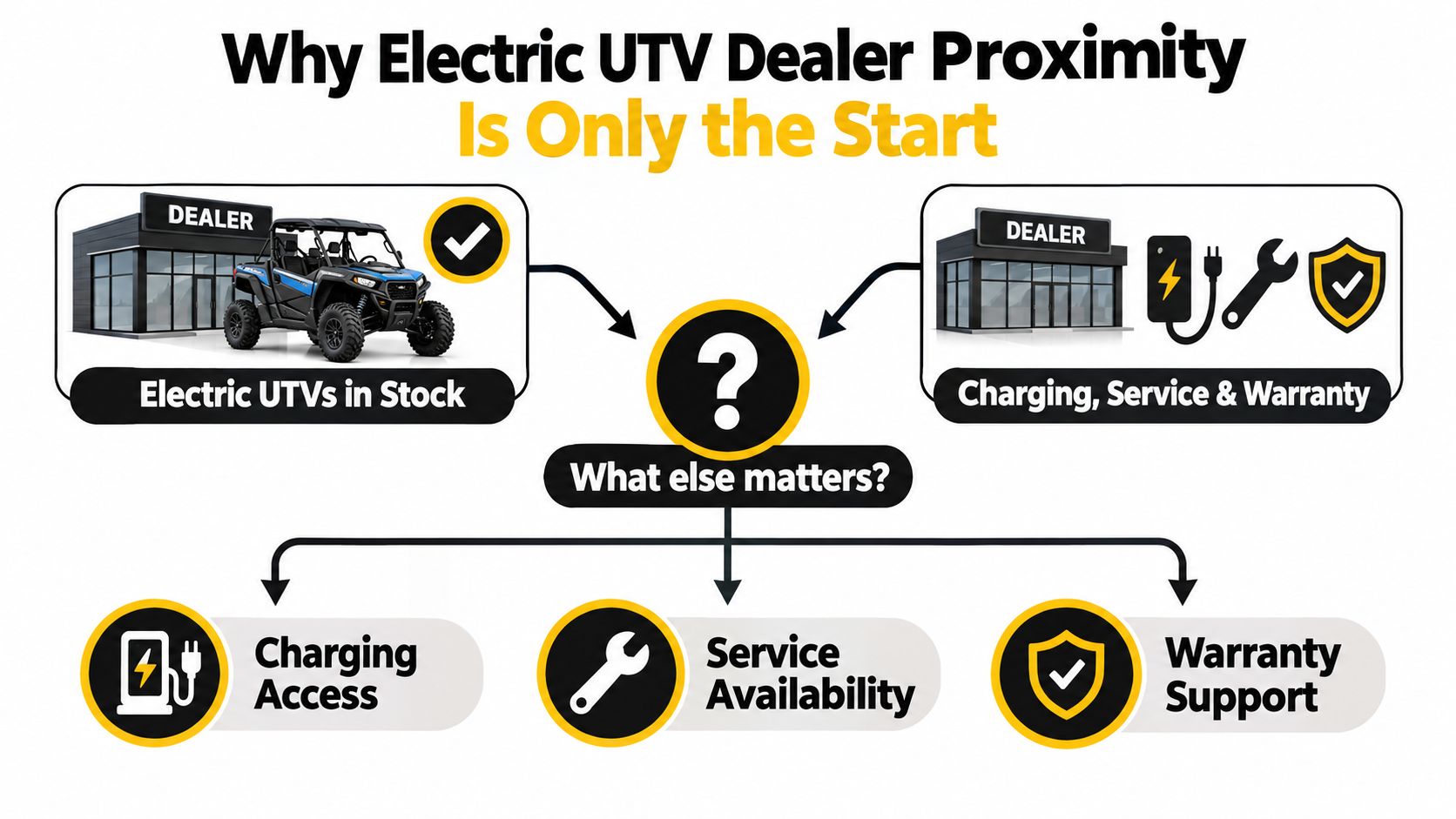
A buyer I talked through this with had two dealers within a short drive. Dealer A had an electric side-by-side on the floor, polished and ready. Dealer B had one unit out back, but the service manager could walk through charging at the barn, who handles warranty claims, and what parts they keep on the shelf. Dealer A looked better. Dealer B was the safer buy.
That gap is the whole point of searching for electric UTV dealers near me. You're not buying a showroom visit. You're buying years of battery care, controller diagnosis, drivetrain service, and recovery help when the machine stops far from a paved road.
Who Dealers Serve Now
You should expect dealers to take individual landowners seriously, because that's who buys most UTVs today. Commercial use was approximately 60% of North American UTV use in 2000, with consumers at about 40%, but by 2023 consumers represented approximately 87.5% of the 568,944 UTVs retailed in North America, according to Powersports Business reporting on UTV market sales. That consumer group includes farmers, ranchers, hunters, estate owners, and homestead users. In plain terms, people like you are the market, not an afterthought to fleet sales.
So ask ownership questions first, before you ask about color or accessories.
- Service capability: Who diagnoses battery, charger, controller, and drivetrain faults, and where does that work happen?
- Parts on hand: Which wear and electrical parts do they stock, and what gets ordered?
- Test ride access: Can you drive the actual configuration you'd buy, loaded the way you'd use it?
- Warranty path: Who files the claim, who approves it, and who gives you a straight answer on timing?
Practical rule: If a dealer can't name who services the electric drivetrain, proximity doesn't matter. You're close to a building, not to support.
Work through discovery, then verification, then a workday test. Don't reverse that order because a pin on a map looks convenient.
Find and Verify Electric UTV Dealers Locally
Build a shortlist you can defend, not a screenshot of map results. Start broad, then cut hard.
Step 1 Search by Place and Task
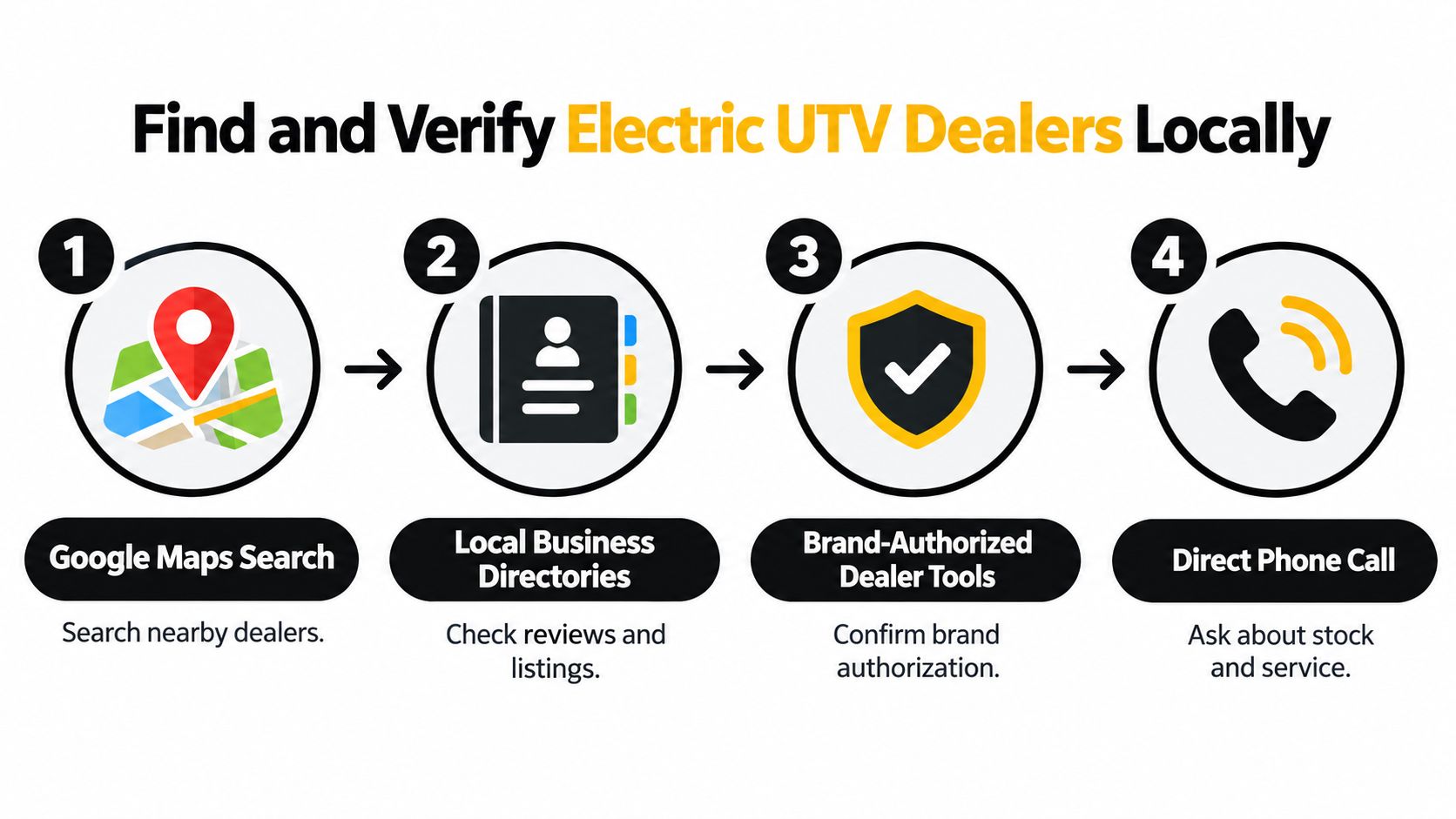
Search Google Maps and local directories using your city, county, and realistic travel time, not just your ZIP code. Try combinations with electric UTV, electric side-by-side, and the work you do, such as farm, ranch, or hunting. Save each result's address, phone, website, hours, and service counter number if it's listed separately.
Then check brand-authorized dealer locators. A general powersports listing doesn't prove a store is authorized to sell or service a specific electric model. Authorization matters for warranty work and parts ordering.
Step 2 Clean the List
Delete duplicates, closed locations, and listings that only sell unrelated equipment. You'll find gas-only shops, trailer lots, and rental yards mixed into results for electric UTV dealers near me. They're not options until they prove they sell or service electric side-by-sides.
Regional depth helps here. A SEMA-commissioned report recorded approximately 670,000 UTV models sold in the United States from 2010 through 2012, with the South at 44% of national side-by-side sales volume, the Midwest at 27%, and the West at 21%, as summarized in OpenPR coverage of the U.S. 4WD UTV market. Areas with a long ownership base tend to support parts, accessories, and experienced technicians. Use that as context, not as proof about any single store.
Step 3 Call and Confirm
Call every survivor. Ask four direct questions and write down the answers word for word.
- Do you currently sell electric UTVs, and which configurations can I see in person?
- Do you service them here, including battery and charger diagnosis?
- Can I book a test ride, and what terrain or tasks are allowed?
- Who handles warranty and parts if something fails in the first season?
Organize what's left by sales capability, electric expertise, service support, and drive time. Two verified dealers beat ten unverified pins every time.
Compare Dealers on Sales Fit and Ownership Support
Don't rank dealers by who sounds friendliest. Rank them by what they'll confirm in writing. A good salesperson helps you configure a machine. A good dealership stands behind it after the paperwork clears, and those are different tests.
Separate the conversation into two piles. Sales fit covers inventory, utility configuration, test ride policy, and financing. Ownership support covers charging guidance, warranty administration, parts stock, technician access, and pickup or mobile help. If a dealer is strong on the first pile and vague on the second, keep shopping.
Use a Worksheet, Not Memory
Carry this table into every visit and fill it in with confirmed answers only. Leave a cell blank if nobody will commit. Blank cells are information.
Electric UTV Dealer Comparison Worksheet
| Evaluation Area | What to Ask or Verify | Best Evidence | Buyer Decision |
|---|---|---|---|
| Electric inventory | Which models and configurations are on site today? | Model and option sheet you can take home | Proceed or wait for stock |
| Utility fit | Payload, towing, dump bed, winch, and 4WD for your jobs? | Demonstrated functions, not a brochure | Fits work or doesn't |
| Charging guidance | Where and how would you charge at your property? | Written charger requirements | Barn ready or upgrade needed |
| Service and parts | Who services battery, charger, controller, and drivetrain? | Named service contact and parts process | Acceptable support radius or not |
| Warranty | Who files, approves, and performs warranty work? | Warranty terms in writing | Clear path or red flag |
| Recovery help | Pickup, mobile service, or roadside recovery options? | Written policy or service agreement | Covered or self-reliant |
| Financing | What terms apply to your exact configuration? | Signed quote with full terms | Affordable or walk away |
Weight the rows by your work. A hunter hauling gear into wet timber should press on towing, winching, and recovery. A farmer moving feed daily should press on payload, dump bed function, charging routine, and parts lead times. A warehouse operator running short loops all shift should press on charging access between runs and who services the machine with minimal downtime.
Before you sign anything, read up on ongoing costs so dealer promises meet real numbers in your head. This breakdown of electric UTV maintenance costs and ownership expenses gives you a baseline for asking what routine service includes and what's billed separately.
Don't accept a verbal assurance where a written term exists. If it's promised, it can be printed.
The best dealer for you is the one whose worksheet has the fewest blanks in the rows your property depends on. Price matters, but it belongs after support, not before it.
Match Electric Range to Your Workday
A headline range number can't tell you whether a machine finishes your day. Your route can. Build the route first, then judge the vehicle against it.
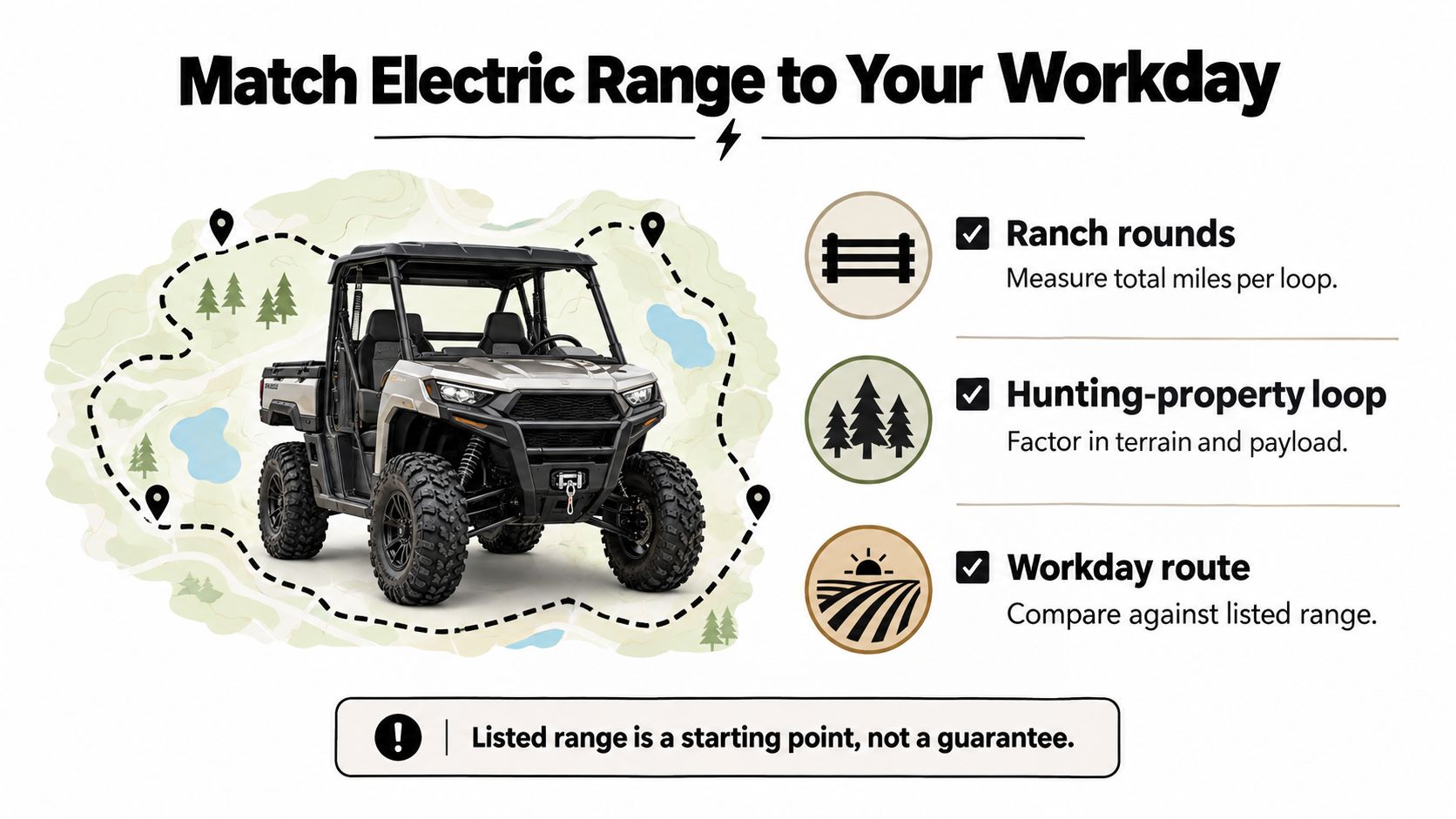
Write Your Duty Cycle Down
For one typical hard day, not your easiest day, record:
- Route distance: Total miles for fence checks, feeding, stand access, or site loops, including return trips.
- Hours and stops: Low-speed running, idling at gates, and repeated short hops between buildings.
- Load: Payload in the bed, trailer weight, passengers, and tools.
- Conditions: Hills, mud, sand, tire pressure, 4WD use, cold or heat, winching, and accessory loads like lights or sprayers.
Add a reserve on top. You don't want to plan a day that only works if every mile goes perfectly and the battery ends empty at the barn door.
Market coverage places many entry-level electric UTVs around 30 to 45 miles of off-road range and mid-range models around 55 to 75 miles, with charging taking roughly 4 to 12 hours depending on battery size and equipment, according to MarketIntelo analysis of the electric UTV side-by-side market. Treat those bands as context for questions, not as a promise for your terrain, load, or weather.
Decide Where Charging Actually Happens
Ask the dealer to map charging to your buildings. Overnight 120V charging suits a machine that returns to the same barn each evening and sits until morning. Faster 240V options suit tighter turnarounds, shared machines, or a second shift at a warehouse or construction site. Confirm which equipment the dealer supports, what your property needs to install it, and what you'd do at a remote lease or off-grid pasture with no outlet at all.
If there's no dependable charging point on your route, that's not a minor detail. It's a deciding factor, and a closer showroom doesn't fix it.
Simple habits protect usable range too, and this guide on improving electric UTV efficiency in daily use covers driving and load choices worth discussing with the dealer before delivery. Bring your worksheet to that conversation. A dealer who'll work through your actual miles, hours, and reserve with you is worth more than one who repeats a brochure figure.
Test Rides and Dealer Questions That Reveal Support
A test ride around a flat parking lot tells you almost nothing. Ask for a ride that resembles your work, and use the visit to interrogate support while you're standing in front of the people who'd provide it.
Run the Machine Like You Mean It
Confirm in advance what's permitted. Ask whether you can drive an extended loop, use 2WD and 4WD, load the bed, operate the dump function, spool the winch, and plug in the charger yourself. Operate every control you'll touch daily. If you'll tow, ask how towing is demonstrated or documented if a trailer test isn't allowed on site.
Pay attention to low-speed control, visibility with a load, and how the machine behaves stopping and starting on a slope if the dealer has suitable ground. Note anything you couldn't test. Untested is not the same as capable.
Ask the Service Questions Directly
Limited service networks remain a material constraint on electric off-road adoption, particularly in remote and off-grid applications, as noted in IndexBox analysis of the electric all-terrain vehicle market. So don't soften these questions.
- Diagnosis: Who here is trained on battery, charger, and controller faults, and what diagnostic equipment do you use?
- Parts: Which parts do you stock, which do you order, and how do you communicate lead times?
- Warranty work: Do you perform it here, and who is my named contact from claim to completion?
- Recovery: If the machine stops on my property, do you offer mobile service, pickup, or recovery, and within what area?
- Handover: What charging and battery care training do I get at delivery, in writing?
Evidence packet: Leave with the exact model configuration, options, availability, delivery timing, service contact, and every unresolved limitation written down. If it isn't recorded, you'll be renegotiating it later from memory.
Judge the quality of answers, not the confidence behind them. Named contacts, written procedures, and honest limits beat smooth generalities. A dealer who says a part is ordered, not stocked, and tells you the process is more trustworthy than one who waves and says they'll handle it.
Compare packets side by side at your kitchen table. That's where the better dealer usually becomes obvious.
Spot Red Flags Before You Sign
A low price and a clean showroom can hide a weak support plan. Slow down when answers get slippery, especially near the desk where contracts come out.

Watch for these warning signs:
- No complete summary: The dealer won't provide the full model, option, and accessory list for the quoted price.
- Pressure to decide now: You're pushed to sign before reading warranty or financing terms at home.
- Vague range claims: Runtime promises don't connect to your route, load, or terrain worksheet.
- No electric service path: Nobody can explain battery, charger, or controller service in concrete steps.
- Unrealistic recovery promises: Pickup or parts help is guaranteed verbally with no written policy behind it.
- A token test ride: You're limited to a brief unloaded loop when your job needs working terrain and attachments.
Distinguish a real limitation from an evasive answer. A straight dealer names the constraint, documents it, and offers a practical next step, such as ordering a part, scheduling a longer demonstration, or referring you to another authorized location. An evasive dealer changes the subject back to price or urgency.
This short video is worth watching before any signing appointment, as a reminder to review terms calmly rather than at the sales desk.
Your responses are simple. Postpone the purchase. Request confirmation in writing. Check another authorized dealer. It's also worth comparing new dealer offers against what's available among used electric UTVs for sale so urgency doesn't do your negotiating for you.
Transparency about a limitation is a selling point. An unconditional promise with nothing behind it is not.
Make a Confident Local Dealer Decision
A nearby showroom is convenient, but it does not prove you can get dependable support after purchase. Use your worksheet and service evidence to decide whether the dealer fits your work, then map the full support radius: who handles the machine, where parts come from, and what happens when the nearest service point cannot help.
Weight It by Your Work
For a hunter who drives to stands before daylight, prioritize quiet low-speed control, winching, recovery arrangements, and a practical charging point at camp or home. A rancher making daily rounds needs range reserve, a useful dump bed, accessible parts, and a named service contact who can respond during calving season. For construction or warehouse work, focus on charging between shifts, the process for handling downtime, and where the UTV goes for service when daily use cannot wait.
The priorities change with the job, but the decision standard stays the same: confirm the configuration, build a charging plan around your property, and identify who will service the battery, charger, controller, and drivetrain. Map that support radius before buying, not after a breakdown.
Final Go or Wait Checklist
Say yes only when you can confirm every item:
- Configuration confirmed: The quote lists the exact model, options, and accessories.
- Test ride completed: You operated the drive system, bed, winch, and charger, or documented what could not be tested.
- Workday plan written: Route miles, hours, load, and terrain are matched against the machine's range and your reserve.
- Charging settled: Your property has a confirmed charging location, voltage, equipment, and backup plan.
- Support radius mapped: You know the nearest authorized service point, parts process, warranty contact, and recovery options.
- Terms reviewed at home: You have read the financing, warranty, and delivery timing away from the sales desk.
Use a specific model to see whether a dealer can answer practical questions. The Campus E1 specifications include a 20 kW PMSM motor, a 72V 150Ah lithium battery, up to 60 miles of range, on-demand 2WD/4WD, an electric dump bed, a 3,000 lb winch, CarPlay and Android Auto, and 0% APR financing through authorized dealers, per Campus EV's published model and dealer information. Treat that list as a starting point, not proof the machine fits your property. Check availability, compare the range with your actual route and workload, confirm charging at your barn, and get a clear answer about local service.
Use electric UTV dealers near me to build your shortlist. Distance puts a dealer on the map; workday fit, a mapped support radius, and written terms justify your signature.
Campus EV sells the Campus E1 electric UTV for hunting, farming, ranching, and property work through authorized dealers. Ask a dealer to help verify range, charging, and local service support. Use the dealer locator, book a test ride, and bring your workday worksheet to the service team by visiting Campus EV today.