
You've got feed to move before rain, a fence line to check, and a hunting trail that turns slick after a wet night. A listing promises strong power, long range, and serious towing, but it doesn't tell you whether the machine will finish that day with enough charge to get home.
When you're searching for a 4×4 side by side UTV for sale, start with your hardest working day, not the best-looking specification. Electric can suit predictable property routes exceptionally well. Gas still deserves a place on the shortlist when the work runs far from power or doesn't stop long enough to recharge.
Table of Contents
- Matching 4×4 Side-by-Side Specs to Your Work
- How On-Demand 4WD Changes Real Ground Performance
- Range, Charging and Battery Life Under Real Loads
- Payload, Towing and Slope Limits to Check
- Total Cost of Ownership and When Electric Pays Off
- Pre-Purchase Mistakes and Dealer Checks
Matching 4×4 Side-by-Side Specs to Your Work
Matching drive mode and specs to your job
| Job | Drive setting | Spec to prioritize | Ask the seller |
|---|---|---|---|
| Hunting access roads and food plots | 2WD on gravel, 4WD on wet clay and ruts | Ground clearance and tire type | What tread is fitted, and how does the differential lock engage? |
| Small farm chores and feed runs | 2WD for daily runs, 4WD when traction under load requires it | Low-speed motor torque and bed haul | What's the remaining bed allowance after accessories? |
| Ranch fencing and hillside work | 4WD with locking rear differential where the manual permits | Towing, winch capacity and usable battery energy | What are the rated grade and tongue-weight limits? |
| Construction or property worksite | 4WD for mud and loose ground | Bed payload and winch rating | What are the gross vehicle weight and hitch ratings? |
| Warehouse and facility yards | 2WD on paved surfaces | Payload, braking and visibility | What brake system is fitted, and what do the mirrors cover? |
The largest number on a listing matters less than the specification that matches your work. A hunter needs clearance beneath the loaded vehicle, not just an unloaded measurement. A farm buyer needs enough cargo allowance left after fitting a toolbox, enclosure, and other equipment.
Drive settings in this table are starting points, not instructions to engage a lock on every hillside. Surface grip, steering demands, and the manufacturer's operating instructions determine the right setting.
Read beyond the motor headline
Motor power and low-speed torque aren't interchangeable. Kilowatts describe how quickly the motor can deliver work, including sustained pulling and higher-speed operation. Torque at the wheels determines pulling force, but gearing, controller limits, tire grip, and battery output all affect what reaches the ground.
Ask for continuous and peak motor ratings, the duration allowed at peak output, and the conditions behind any climbing demonstration. A brief unloaded climb doesn't establish loaded working capability.
Battery voltage and amp-hours also belong together. Amp-hours alone won't tell you how much energy the pack stores, so don't compare batteries by that figure without checking voltage and usable capacity.
Make occupant protection a purchase criterion
The U.S. Consumer Product Safety Commission's off-highway-vehicle safety information covers risks across several vehicle categories, including ATVs and side-by-sides. Its guidance supports treating protection and operating practices as core buying criteria, rather than assuming a drivetrain choice makes a vehicle safe.
Check occupant protection, rollover resistance, restraints, lighting, braking, and visibility. Every occupant needs an appropriate seat and restraint, and the operator needs to understand the machine's limits.
Pick the table row closest to your work and take its questions to every listing. Reject answers that substitute enthusiasm for a written specification.
How On-Demand 4WD Changes Real Ground Performance
Think of 2WD as running shoes on pavement and 4WD as boots on muddy ground. Each suits a different surface. Driving every paved yard in locked four-wheel drive isn't a badge of capability, and waiting until the rear tires dig holes isn't a good traction strategy.
On-demand systems don't all operate identically. Some engage additional drive automatically under specified conditions; others require a driver selection. Confirm what the switch does instead of assuming the dashboard label describes the entire system.
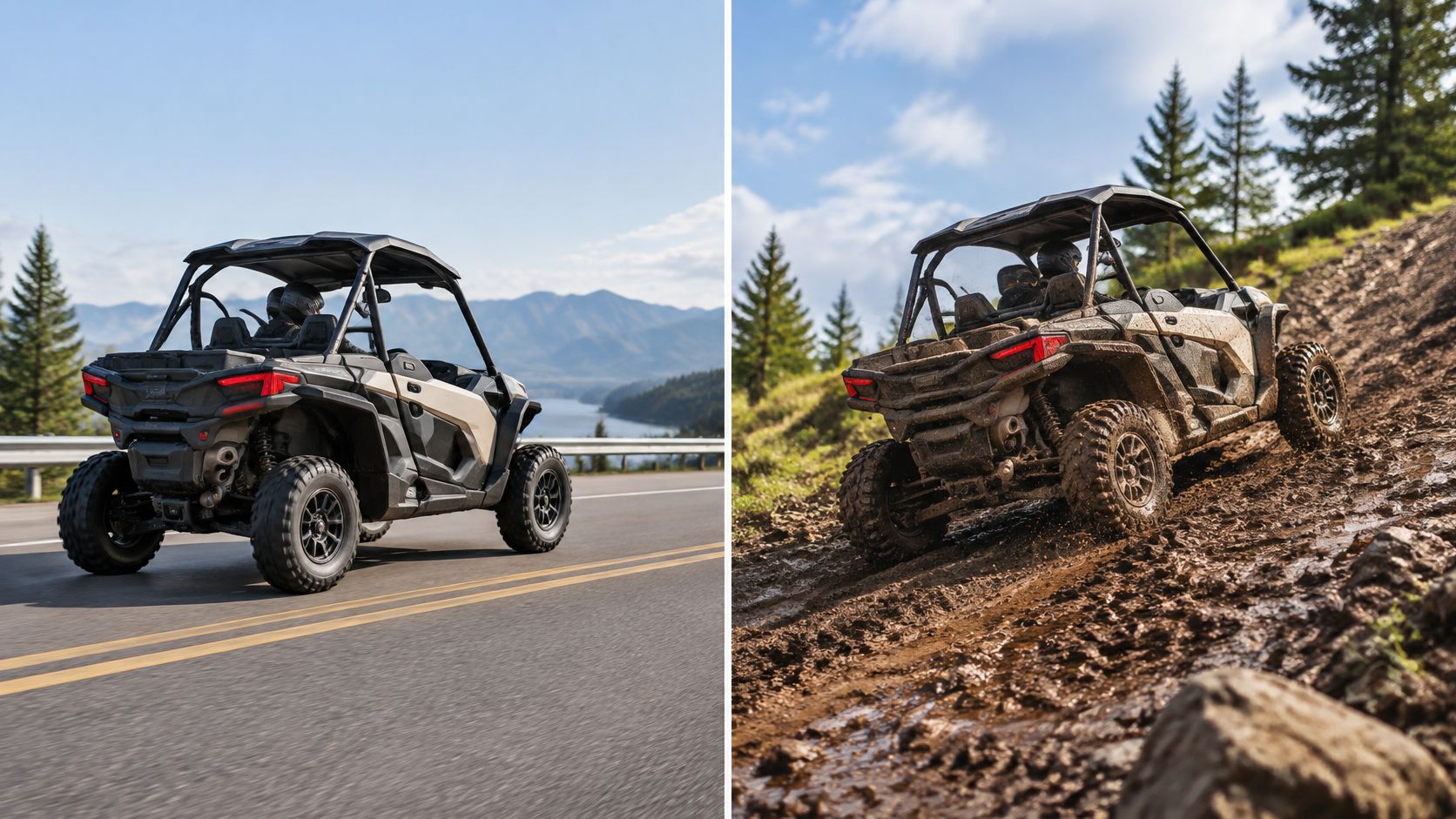
Test engagement before difficult ground
Use 2WD on firm surfaces where the manual recommends it. Select 4WD before entering a questionable patch, following the prescribed speed and engagement procedure.
A locking rear differential couples the rear wheels so they turn together. That helps when one rear tire has less grip, but it can also increase steering resistance and tire scrub. Disengage it when the operating instructions call for it.
Run this demo on an approved route with the dealer:
- Establish steering feel. Drive on dry gravel in 2WD and notice turning effort, response, and unusual drivetrain noise.
- Verify the engagement procedure. On a gentle approved incline, test 4WD using the manual's instructions. Test moving engagement only if the manufacturer explicitly permits it; otherwise stop as directed.
- Check the differential lock. On suitable loose ground, confirm engagement and disengagement with the dealer. Don't deliberately create a dangerous wheel-slip situation to prove it works.
Put market popularity in perspective
Global Market Insights estimated that 4WD represented 65% of the global UTV drive-category market in 2025, while agriculture and farming accounted for 33.77% of global UTV volume. These are commercial estimates, useful as directional context rather than proof that any particular vehicle suits your property.
The practical question is whether the system engages predictably, gives useful control, and disengages without trouble.
Extra traction doesn't add payload, prevent rollover, or make a fast turn sensible.
A machine that climbs confidently can still be unsuitable for the descent, the turn at the top, or the load you're carrying. Judge the complete route, not just the muddy entrance.
Range, Charging and Battery Life Under Real Loads
Rated range needed for each daily work pattern
The following is a hypothetical screening exercise, not a field-range prediction. Its allowance adds thirty percent to route distance; that's a distance cushion, not a guarantee of finishing with that percentage of battery remaining.
| Daily work pattern | Daily distance | Rated range needed with the illustrative reserve | Overnight charging covers it? |
|---|---|---|---|
| Hunting access road and camp loop | Ten miles | Thirteen miles before terrain adjustments | Yes, if the charger replaces the day's energy overnight |
| Small farm, barn-to-field runs | Fifteen to twenty miles | About twenty to twenty-six miles before terrain adjustments | Yes, subject to confirmed refill time |
| Ranch fence checks and feed runs | About twenty-eight miles | About thirty-six miles before terrain adjustments | Yes, if the pack refills every night |
| Heavy hills, towing and winching day | Measure the complete loaded route | Route distance plus reserve, checked against loaded energy use | Treat as marginal until tested; arrange a top-up |
| Multi-shift worksite with repeated trips | Fifty miles or more | About sixty-five miles or more before terrain adjustments | Not on overnight charging alone if the shift exceeds usable range |
Advertised range is a test-condition result, not guaranteed field distance. Temperature, hills, payload, tire pressure, speed, repeated acceleration, and electrical accessories change the energy needed for the same route.
The table multiplies each illustrative distance by the reserve factor. It doesn't convert mud or towing into an invented mileage penalty. A hypothetical vehicle rated for sixty miles might pass the short-route screen, yet fail a demanding loaded day; the longest example already exceeds that rating before load adjustments.
Compare energy, then validate the route
The nominal-energy calculation for a 72V 150Ah pack is approximately 10.8 kWh, before reserve limits, conversion losses, and battery-management restrictions; the U.S. Department of Energy's battery guidance also identifies operating-temperature limits and explains why higher average temperatures can shorten battery life.
Nominal energy isn't the same as usable energy. Ask for usable capacity, permitted temperatures, charging cutbacks, and the load, speed, surface, and conditions used for the advertised range.
Build your working-day check around:
- Route logging. Record the complete day, including detours, return trips, and hills.
- A deliberate cushion. Choose a reserve suited to the consequences of running short.
- Loaded validation. Compare consumption on representative ground, rather than trusting distance alone.
- Refill time. Confirm the charger can replace the energy used before the next departure.
Check the charging location before buying
Approximate refill time starts with energy to replace divided by charging power, with additional allowance for losses and charging taper. Use the charger's actual input requirements, not the outlet's appearance.
For a barn or shop installation, On Time Home Services' explanation of power capacity for homes and businesses provides useful electrical-service context. Have an electrician confirm the specific circuit and protection required by the charger.
Use our electric UTV efficiency guidance when preparing the vehicle for a route test. Correct setup helps, but it won't make an undersized battery suitable for an oversized working day.
Payload, Towing and Slope Limits to Check
Compare the load with every applicable rating. Motor power doesn't determine whether a trailer, bed load, or recovery pull is safe. A vehicle can have enough power to move something while exceeding a structural, braking, or stability limit.
Write down passengers, tools, cargo, recovery gear, and installed accessories. Include trailer tongue load wherever the manufacturer's payload definition requires it, and distinguish the vehicle's overall carrying allowance from the separate bed limit.
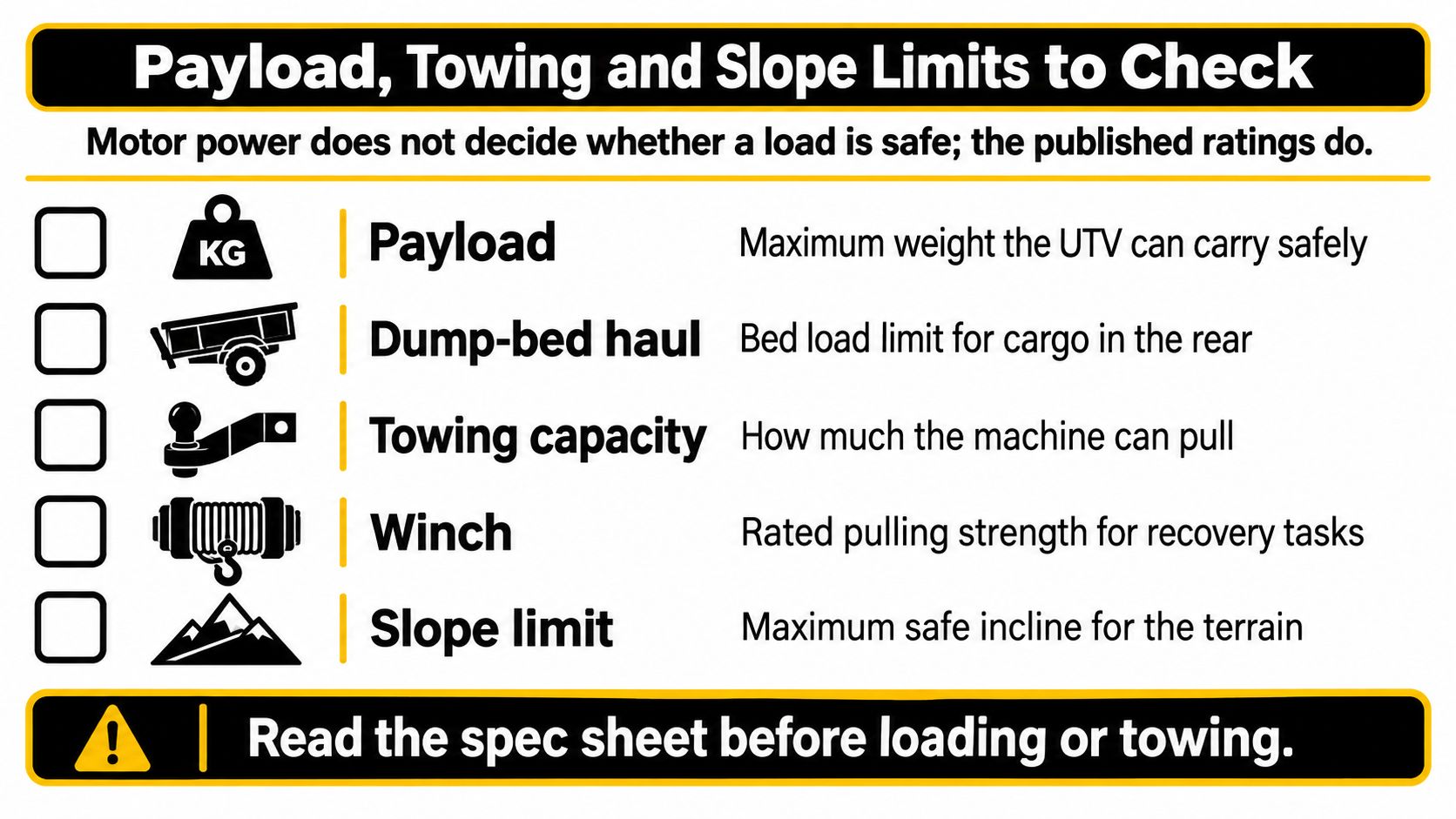
Read each rating for its actual purpose
- Payload. Establish what's included in the manufacturer's definition and subtract everything you're adding.
- Dump-bed haul. Check the cargo limit separately, including restrictions on distribution and dumping.
- Towing capacity. Verify permitted trailer weight, tongue weight, braking requirements, and terrain restrictions.
- Winch rated line pull. Treat this as a recovery-equipment rating, not towing capacity or permission to pull from any attachment point.
- Gross vehicle weight rating. Confirm the fully loaded vehicle remains within its maximum permitted total weight.
Inspect the hitch label and mounting arrangement at each receiver. Don't assume a front receiver has the same permitted use as a rear receiver, or that fitting a stronger hitch increases the vehicle's rating.
Loading rule: Passing one rating doesn't cancel another. The most restrictive applicable limit controls the job.
Choose the route before committing to the slope
OSHA's ATV and UTV guidance recommends choosing the least-grade route, avoiding cross-slope travel when possible, moving straight up or down slopes, and slowing before turns; its associated heavy-equipment guidance also advises keeping loads low and balanced and positioning the load upgrade on grades above 10%.
Apply those principles without treating general guidance as a replacement for the vehicle manual:
- Inspect the approach. Look for holes, soft shoulders, hidden ruts, and a safe exit.
- Secure the load low. Prevent tools and materials from sliding or shifting during a turn.
- Check the grade instructions. Establish the manufacturer's restrictions for loaded travel, towing, and descent.
- Lower the bed before moving. A raised bed changes stability; don't drive away after dumping with it raised.
Before signing, obtain written payload, towing, tongue-weight, gross-weight, and grade information. If the seller can't supply a critical limit, don't use a demonstration video as a substitute.
Total Cost of Ownership and When Electric Pays Off
Break-even time equals the electric price premium divided by annual running-cost savings. Include the required charging installation in the upfront difference, then use realistic operating costs for the same work.
If annual savings aren't positive, there's no running-cost payback. Electric may still offer useful quiet operation or convenient on-site charging, but those are separate reasons to buy.
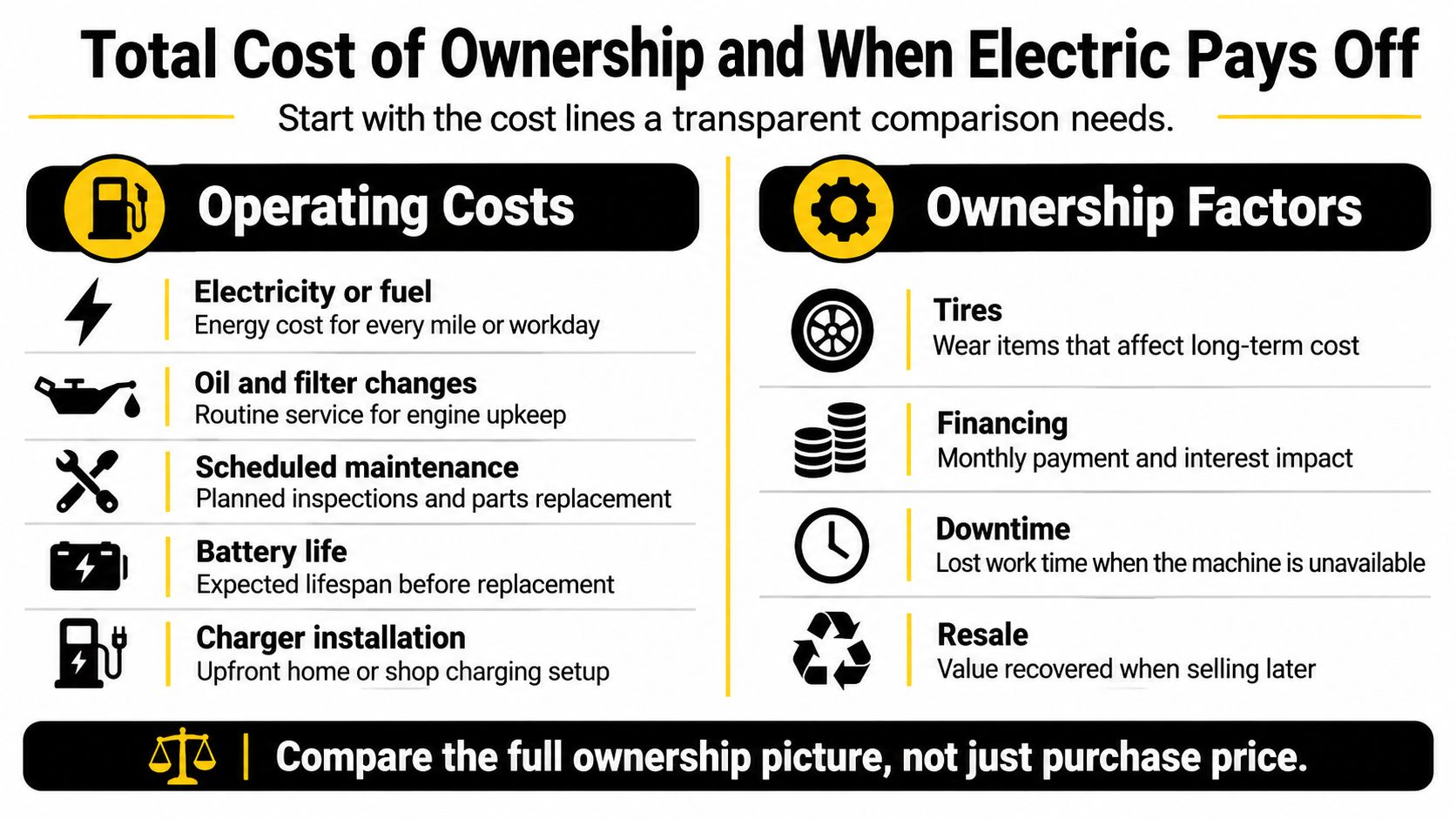
Compare the complete ownership bill
Include electricity or fuel, oil and filters, scheduled maintenance, battery replacement exposure, charger installation, tires, financing, downtime, and eventual resale. Electric doesn't eliminate brakes, suspension, bearings, tires, or drivetrain inspections.
Use actual dealer service schedules and your energy prices. Our UTV maintenance cost guide can help organize the service side of that comparison without assuming every maintenance expense disappears.
Global Market Insights' U.S. off-road-vehicle assessment places the average UTV selling price at roughly $16,500 in 2025 and identifies affordability as a barrier for budget-conscious agricultural buyers. That's market context, not a quote for a particular electric or gas model.
Which side usually wins for each buyer type
| Buyer type | Usage pattern | Charging access | Usually wins |
|---|---|---|---|
| Hunters | Few hours a year | Camp power may be unavailable | Gas when an electric premium can't be recovered |
| Small farms | Predictable routes | Overnight charging | Electric when daily work fits the pack |
| Ranches | Long distances | Far from power | Gas for refueling flexibility |
| Construction crews | Multiple shifts, heavy towing | Limited charging between shifts | Gas unless charging and loaded endurance are proven |
| Warehouse or property users | Scheduled use | Scheduled charging | Electric when utilization supports the premium |
For a hypothetical calculation, suppose electric costs three thousand dollars more after charging setup and saves one thousand dollars annually in running costs. Simple payback is three years, before financing differences, resale, or major repairs. Those are illustrative inputs, not vehicle prices or promised savings.
The hunter may never accumulate enough use to recover that premium. The farm buyer may put the machine to work regularly enough for savings to matter, while the remote ranch operator may reasonably pay more in fuel to avoid charging-related interruptions.
A cheaper working day isn't a saving if you need another vehicle to finish it.
Ask how long you'll keep the UTV and whether the battery warranty and expected replacement exposure fit that ownership period. Quiet operation and fewer engine-service tasks can justify a close financial result, but they shouldn't hide an unsuitable duty cycle.
Pre-Purchase Mistakes and Dealer Checks
A hunter buys on peak motor output, then discovers the battery doesn't suit a long scouting route with a camera trailer. A farm buyer orders before checking the barn's electrical supply. A ranch buyer mistakes traction for permission to carry an unsuitable hillside load.
Each is a preventable purchasing mistake. Size the machine around the complete assignment, and make the dealer demonstrate the details that matter.
A dealer walkaround is the place to identify those details before the drive.
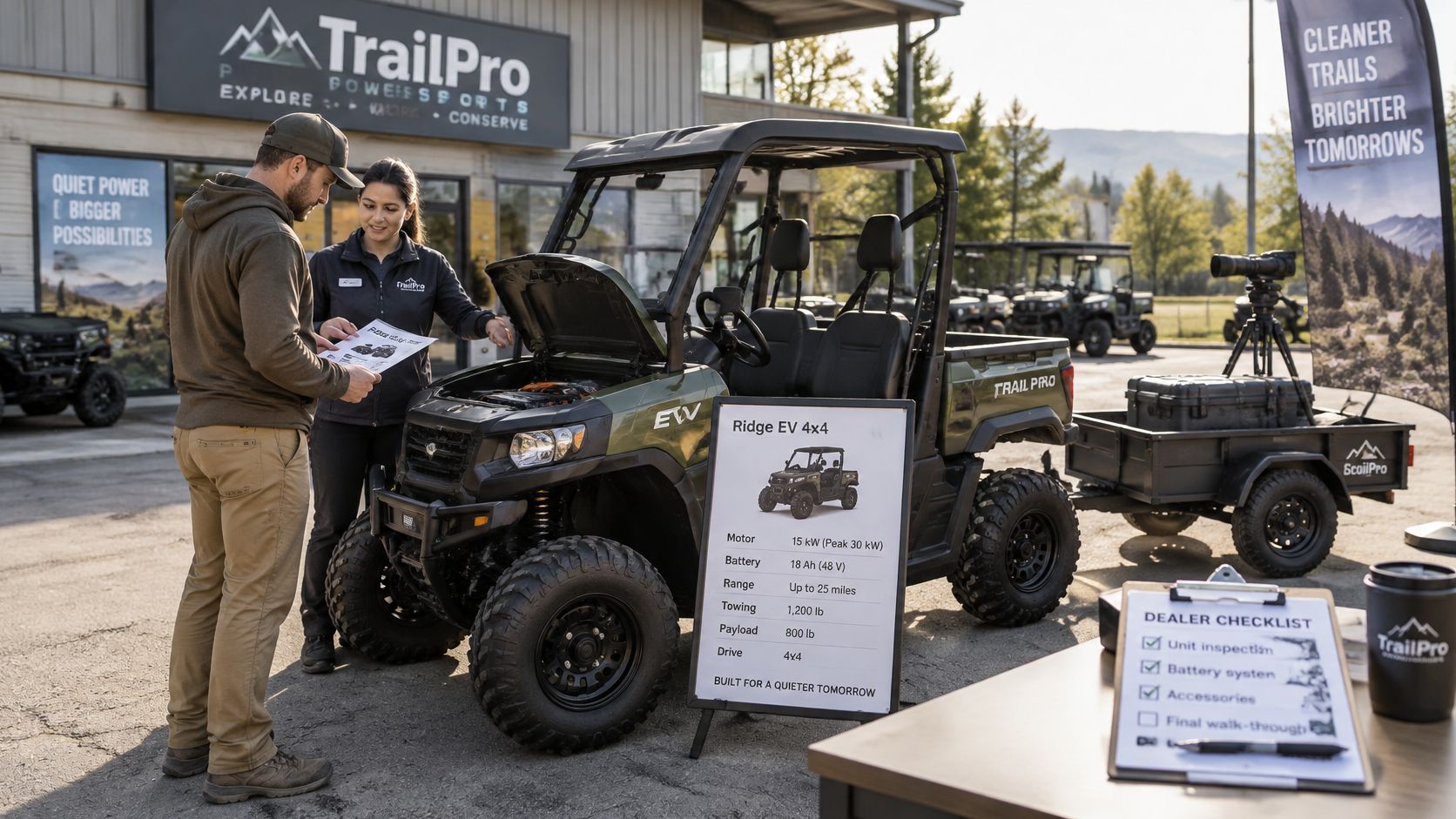
Bring a work description, not just a budget
Give the dealer your longest route, expected passengers, trailer details, cargo list, charging location, and difficult terrain. Ask for a demonstration with a representative load on your ground where available and safe, rather than accepting an empty lap around a flat lot.
We sell the Campus E1 through authorized dealers, and qualified buyers can access 0% APR financing for 36 months. Use our Campus EV dealer finder to arrange a test drive and confirm current eligibility and written purchase terms with your local dealer.
During the demonstration, focus on what would interrupt your work:
- Control operation. Follow the approved drive-mode and differential-lock procedures, and confirm the indicators match the selected setting.
- Work equipment. Operate the dump bed and inspect the winch, controls, attachment points, cable or rope, and fairlead.
- Cab usability. Check visibility around the load, mirror coverage, entry and exit, and access to frequently used controls.
- Stopping behavior. Have the dealer demonstrate appropriate braking and parking procedures on an approved test area.
Use the video as an additional look at the vehicle, not as proof that your intended load or slope is approved.
Get the ownership commitments in writing
Read the battery warranty separately from the rest of the vehicle warranty. Establish whether capacity loss is covered, what exclusions apply to commercial use or storage, and who handles diagnosis, transport, and repairs.
Confirm the service location and ask about availability of the parts most likely to stop work. For a used electric UTV, request diagnostic information, charging history where available, and inspection of the battery enclosure, connectors, underbody, and accessory wiring.
The purchase quote should identify the charger, freight, setup, dealer fees, taxes, accessories, and delivery arrangements. Compare financing by total amount paid and contract conditions, not monthly payment alone.
Buy when the demonstration answers your work questions and the written specifications support the intended job. If a critical answer remains vague, keep shopping rather than paying to discover the limitation at home.
Campus EV offers the Campus E1 electric side-by-side through authorized dealers for hunting, farm, ranch, and property work. Visit Campus EV to explore the vehicle and arrange a test drive with your route, load list, and charging requirements in hand.