
You've already walked two lots this month. One salesperson quoted a range figure, another talked about torque, and neither asked what you haul, how far your longest route runs, or where you'd plug the machine in at night. That's the gap in most searches for electric UTV dealers near me: the listings tell you who has inventory, not who can keep a work machine running for the next five years.
I'd treat the dealer visit as an audit rather than a shopping trip. Bring your own numbers, demand the paperwork in writing, and make the demonstration happen with weight in the bed on ground that looks like yours. The dealers who welcome that process are the ones worth buying from.
Table of Contents
- Match Your Work to the Right Electric UTV
- How to Find Nearby Electric UTV Dealers
- Vet Each Dealer Before You Visit
- Run a Loaded Test Drive Safely
- Plan Charging at Your Property
- Compare Real Costs and Financing Offers
- Choose and Book Your Loaded Test Drive
Match Your Work to the Right Electric UTV
Start with your working day, not the spec sheet. A hunter wants a quiet approach near game, enough range for a full day of scouting, and four-wheel drive that engages without fuss on a wet cut-over. A rancher hauling feed wants towing capacity, a bed that dumps without a shovel, and traction on sloped pasture. Warehouse and construction crews care about payload, hours per shift, and no tailpipe emissions in semi-enclosed spaces.
Those use cases aren't equally served by every model on a lot, and availability varies by region. IMARC Group's electric ATV and UTV market report valued the global electric all-terrain vehicle and utility-terrain vehicle market at about USD 1.4 billion in 2025 and identified North America as the leading regional market, which explains why electric side-by-sides show up more often here, but it doesn't guarantee the dealer fifteen minutes away stocks one. Confirm stock by phone before you drive.
Fill in this worksheet before you contact anyone. These six numbers become the single yardstick you hold every dealer against:
- Longest route: one-way distance and the return leg, not an average loop.
- Payload: typical pounds in the bed and on the seats, plus the heaviest day of the season.
- Towing weight: the trailer, drag harrow or mower you pull.
- Terrain: wet grass, sloped pasture, gravel, sand or clay.
- Duty cycle: hours per day and days per season.
- Accessories: winch, extra cargo racks, lighting, anything that adds weight or draw.
Browse electric utility vehicle reviews to narrow the field, then let your worksheet, not a brochure, decide which two or three machines deserve a loaded test.
How to Find Nearby Electric UTV Dealers
Search in the order that wastes the least time. Most buyers start with whoever ranks first and end up driving an hour to a shop that only sells gas machines.
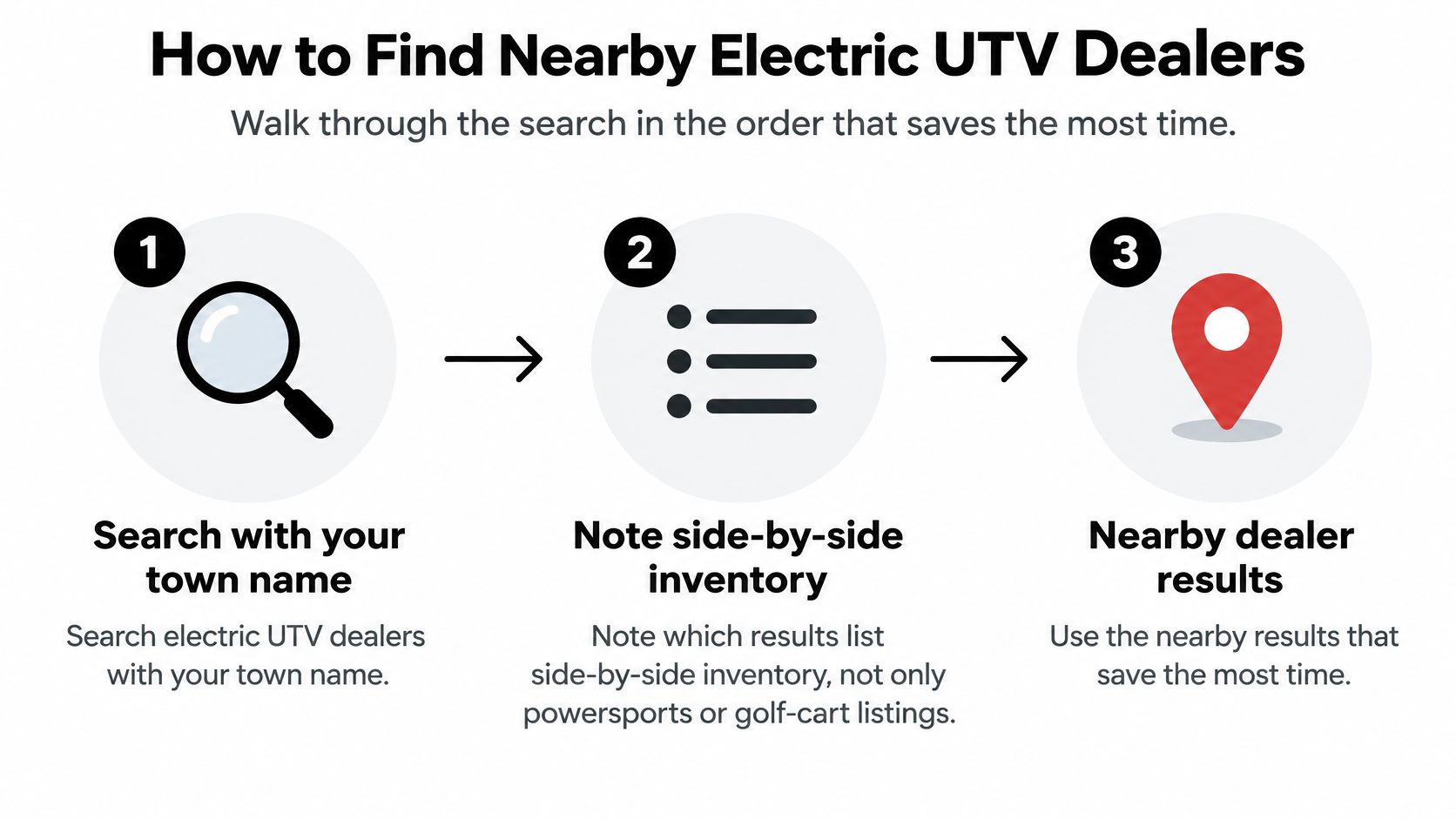
Work the search in five moves
- Search with your town name. Type electric UTV dealers plus your town or county and note which results list side-by-side inventory. Plenty of hits are powersports shops or golf-cart sellers that don't stock a work-capable electric machine at all.
- Open each manufacturer's dealer locator. Only an authorized dealer can perform warranty work, so a shop that appears in a general search but not in the manufacturer's locator is a service risk from day one.
- Cross-check our locator. You can find a Campus EV dealer near you to book a test drive, then compare that result against your other locator hits to see who's close.
- Call and ask two questions. Is an electric model on the lot right now, or can one be brought in for a demo? And who physically performs the service, the shop's own technician or a traveling rep?
- Get the quote by email. A written quote locks the price, the accessories and the delivery charge. You can request a quote through our website, and you should ask every other dealer for the same document.
Distance matters most after the sale
Keep two or three dealers within a drive you'd accept for routine service, not just for the purchase. If you live well outside town, ask about mobile service visits and how fast parts ship, because a dealer two hours away still matters when a warranty repair takes the machine off your farm for a week.
Record each dealer's name, distance, service contact and how long they took to answer in one spreadsheet. That log makes the later comparisons quick, and it tells you something a showroom never will: how a shop behaves when you're asking questions instead of signing paperwork.
Vet Each Dealer Before You Visit
Use this table as your call script. Every row is a check to run before you spend a Saturday driving somewhere, and the right-hand column is your walk-away trigger.
| Check | What Good Looks Like | Red Flag |
|---|---|---|
| Authorization and warranty | Written confirmation the dealer is authorized and performs warranty work | Vague answers or no service department |
| Written spec sheet | Motor power, battery voltage and amp-hours, payload, towing, clearance, drive modes, charger type and warranty exclusions | Verbal specs only |
| Loaded demonstration | Demo ride with realistic load on terrain like your route | Short empty-lot ride or high-speed cornering |
| Parts and technician response | Common parts in stock and a stated response time | Parts only available to order with no timeline |
| Battery and charger support | Battery warranty terms, charger requirements and a replacement pathway | Cannot document range conditions or charger needs |
| Total-cost estimate | Charging, tires, winch, battery service, delivery and financing itemized | One price with no breakdown |
Why the paperwork beats the pitch
The Department of Energy's Charging Ahead guide for fleet electrification states that extreme temperatures, high speed, aggressive driving and heavy loads can reduce electric-vehicle range, with battery performance especially affected by extreme cold and battery aging more affected by extreme heat. That's exactly the combination a farm or hunting machine lives in, so an advertised range figure isn't a work distance. Size the vehicle for your longest planned route plus a reserve, then ask the dealer to repeat the demonstration with your expected payload and accessories fitted.
The E1 is sold through authorized dealers, and that's the standard to hold every brand to. Confirm the shop's status directly rather than assuming a logo on the door means factory backing. Ask who submits a warranty claim, whether the technician has been trained on the battery and drive system, and what happens if a controller fails in the middle of calving season.
Practical rule: a dealer who can't document measured range conditions, charger requirements, battery warranty terms and a local service pathway is a higher-risk choice than one who can put all four in an email.
Sort your shortlist into three piles
After the calls, sort dealers into documented and ready, promising but missing paperwork, and not worth the drive. Book visits with the first group only. Give the second group one chance to send the missing spec sheet or warranty terms within a few days. Drop the third, no matter how good the price looks, because a discount doesn't cover a machine sitting dead for a month waiting on a part nobody can source.
Run a Loaded Test Drive Safely
A short empty-lot ride proves almost nothing. It won't tell you how the machine brakes with a full bed, whether it holds a line on a side slope, or if the motor fades halfway up the grade you climb every morning.
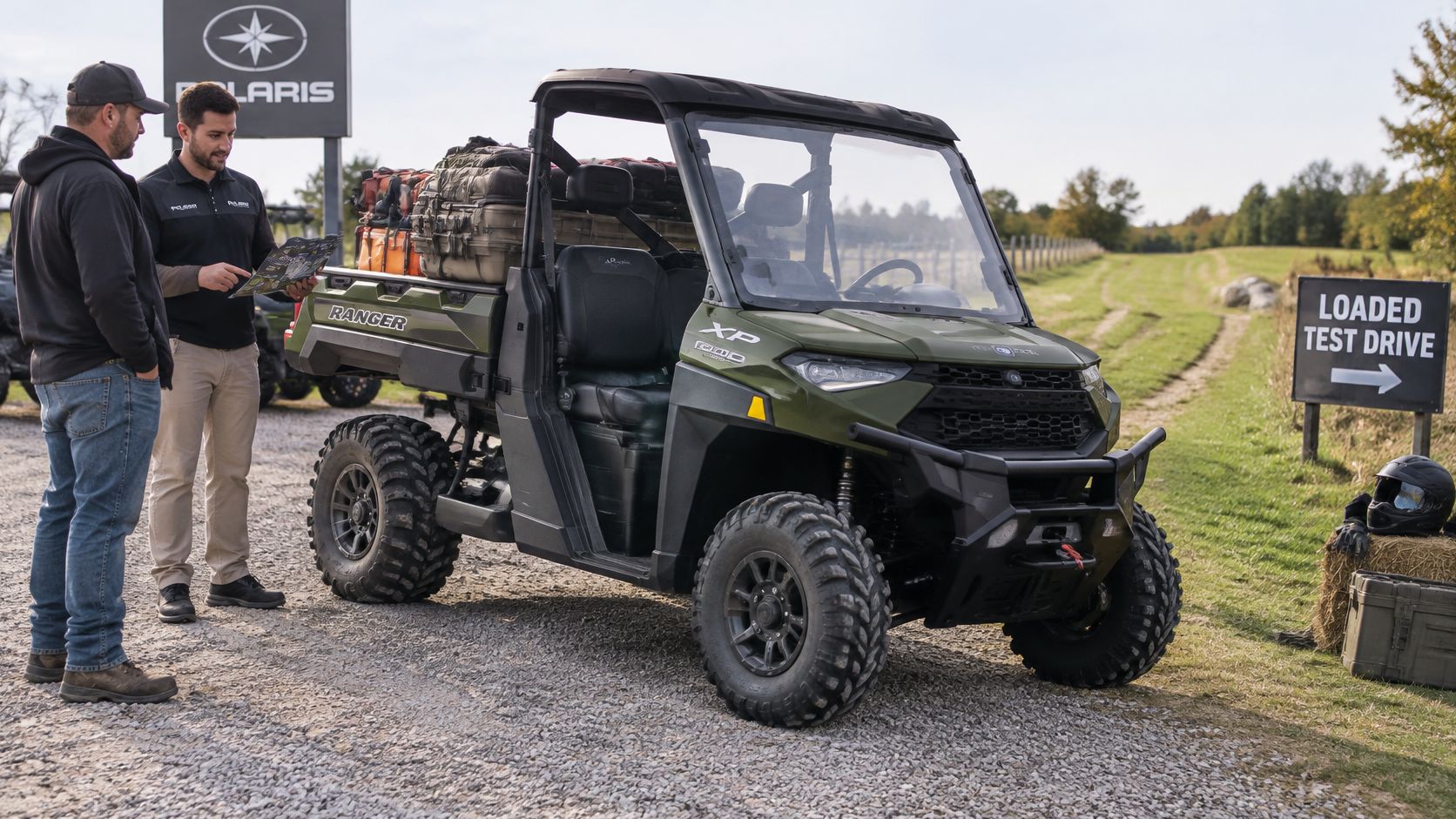
The stakes justify the extra effort. In a CPSC review of 801 fatal ROV investigations, more than two-thirds involved a rollover and approximately one-fifth involved a turn on level terrain before the rollover, with improper loading, high speed and changing surfaces such as gravel or sand identified as contributing factors, according to the CPSC OHV annual report. Loading and surface changes are precisely what your work involves, so test them under control rather than discovering them at speed.
The loaded test, in order
- Load it first. Fill the bed to a realistic weight with sandbags or feed, and bolt on the winch or cargo rack you plan to run.
- Belts and restraints. Check belt fit for every seating position and confirm the occupant restraint system before moving.
- Low-speed control and 4WD. Engage four-wheel drive on a grade, at walking pace, and feel how the machine puts power down. In 4WD with the differential locked, the Campus E1 climbed a steep grade without running out of power, and that's the kind of climb you should ask any dealer to repeat on a slope like yours.
- Hill start and slope parking. Both with the load on. Watch for rollback and for how the parking brake holds.
- Bed and winch. Cycle the dump bed loaded, then check how the winch mounts and where the cable routes. The E1 tows up to 2,500 lbs and hauls 550 lbs in its electric-powered dump bed, so bring weight that tests those ratings rather than a token bag.
Here's a walkthrough of what a proper utility side-by-side evaluation looks like on real ground.
Evaluate braking, steering, stability, visibility and belt fit throughout, and ask what operator training comes with delivery. Reject any demonstration that encourages high-speed cornering or skips the owner's manual, rated load limits, tire-pressure guidance and local registration or trail-use requirements. Close by asking for range at your payload on your terrain, measured, not quoted from a brochure.
Plan Charging at Your Property
Answer three questions about your own land before you talk to a salesperson. Is there grid power at the work site? Is there a usable circuit in the barn or shop? And what happens on a day when the machine is forty acres from the nearest outlet?
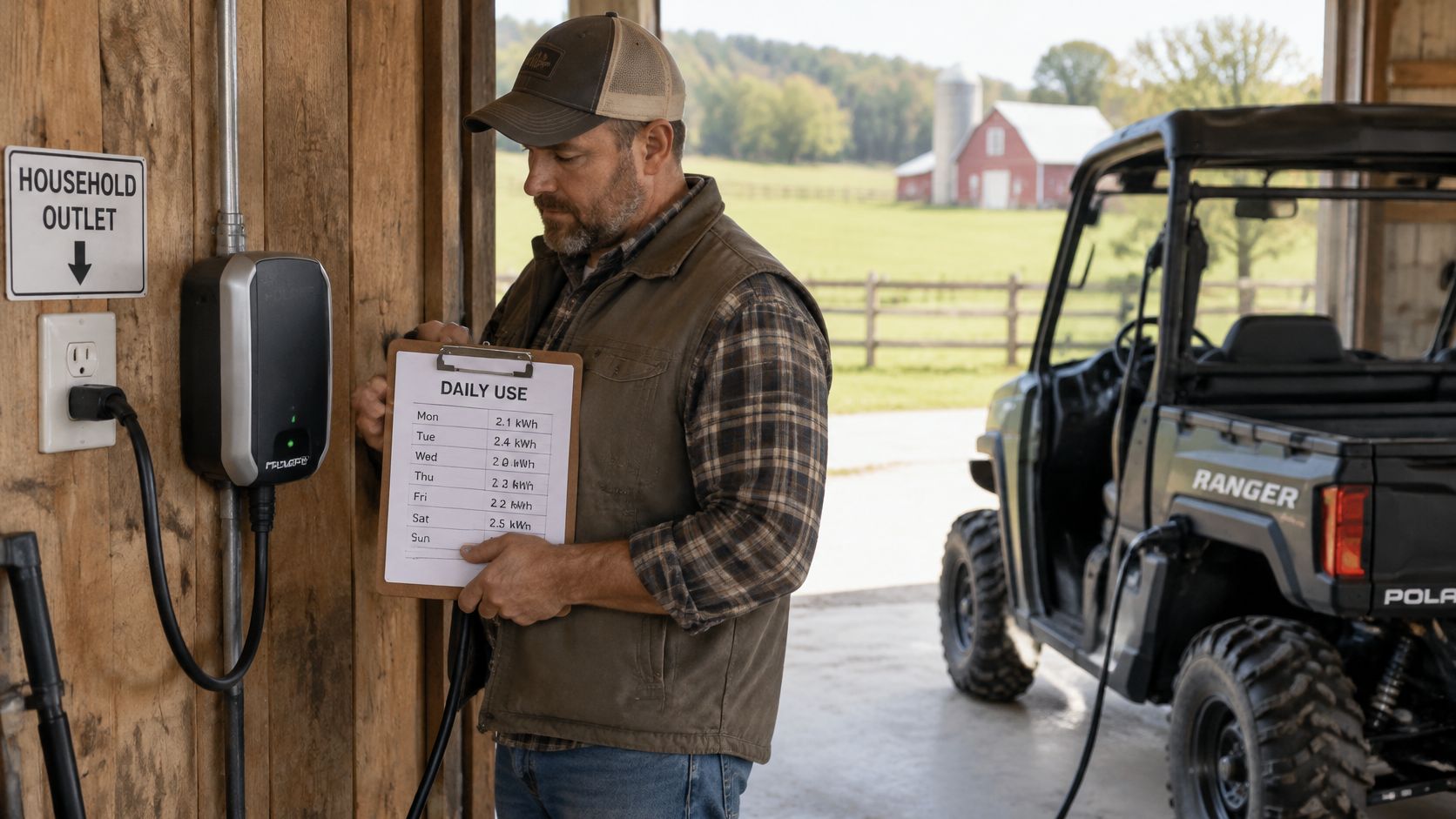
Those questions decide usability more than a headline mileage figure. Mark Wide Research's electric UTV market analysis found that 46% of potential buyers cite battery cost and charging-station availability as challenges, while rural and off-road infrastructure limitations affect about 25% of potential buyers. Remote agricultural properties may lack the grid capacity for overnight charging and can need generator backup, which is a wiring problem, not a vehicle problem.
| Charging Setup | Best Fit | What to Ask the Dealer |
|---|---|---|
| Household outlet | Topping up light use | Charge time from empty and the extension-cord gauge and length needed |
| Dedicated Level 2 circuit | Daily farm, ranch or crew use in a barn or shop | Circuit amperage, plug type and whether the charger is onboard or external |
| Generator backup | Remote hunting camps and off-grid fields | Whether the charger runs on generator power, and the minimum generator size set by the charger's input draw plus startup headroom |
| Solar with battery storage | Off-grid properties with reliable sun | Panel and storage size needed for a full overnight charge |
Size the energy, not the miles
Work from the pack, then from your day. The Campus E1 runs a 20 kW motor and a 72V 150Ah lithium battery, with on-demand 2WD/4WD and an electric power dump bed. Ask any dealer for the same voltage and amp-hour figures and the empty-to-full charge time on both a household outlet and a Level 2 circuit. Then estimate how much of that stored energy your hours, hauling, towing and repeated short trips consume in a day, because a machine that needs a full recharge every afternoon has different wiring needs than one that runs two hours a week. Our guide on how to improve efficiency covers the driving and load habits that stretch a charge further.
Cold weather cuts battery performance, so plan winter charging around the hours you actually work, and never run a charger through a light-gauge cord coiled on a barn floor.
If the answer involves a new dedicated circuit, get an electrician's quote before you sign for the machine. Black Rhino Electric's guide to home EV charger installation explains what a proper circuit, breaker and outlet installation involves, so you can price that work into your total instead of discovering it after delivery.
Compare Real Costs and Financing Offers
Sticker price tells you almost nothing about whether an electric machine is cheaper for your work. Annual hours do. A ranch running the machine every day amortizes charging equipment and any battery risk across a lot of work; a hunter using it a dozen weekends a season doesn't, and shouldn't expect the same payback.
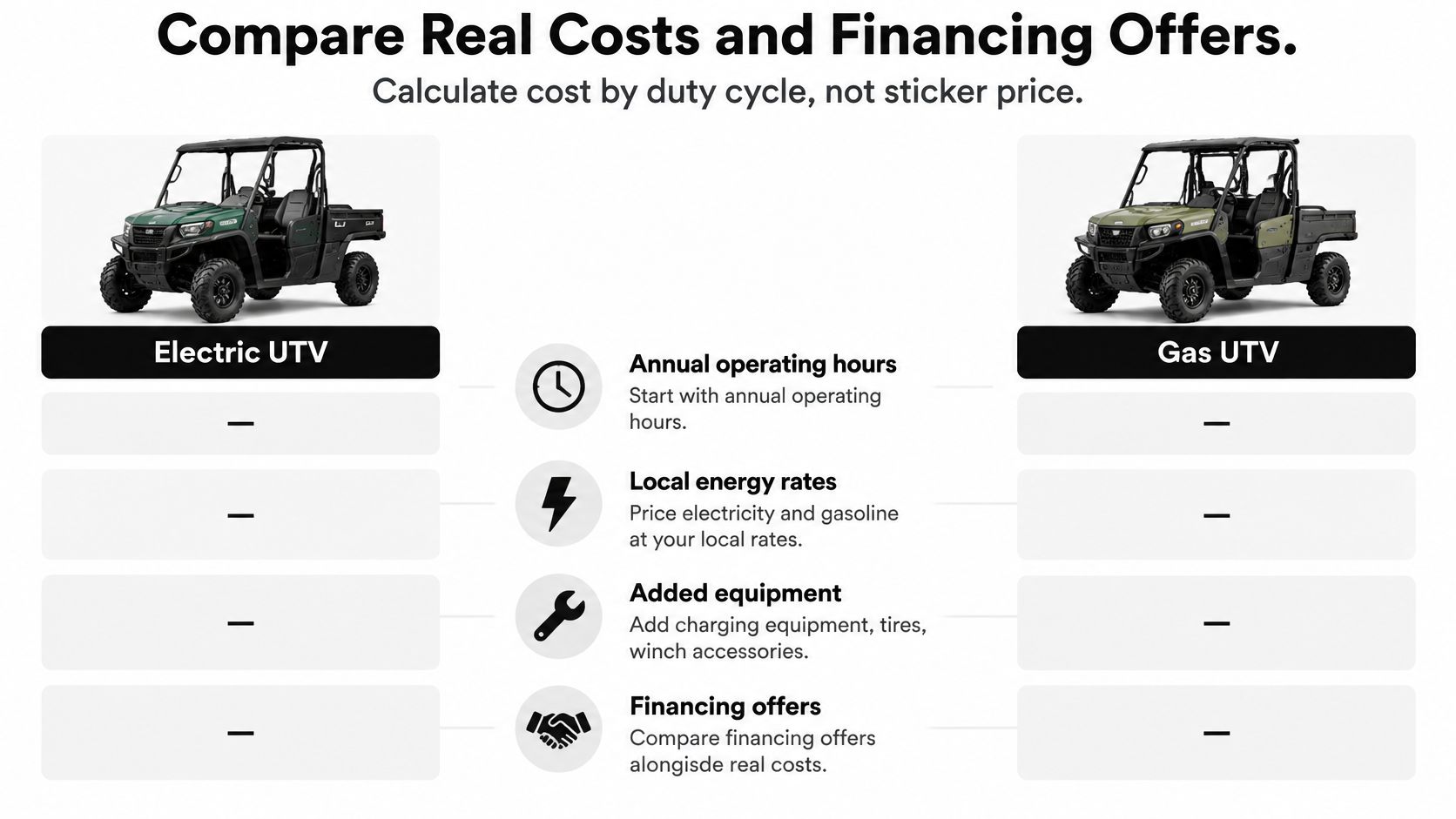
Dataintelo's all-electric UTV market analysis estimates annual operating savings of roughly $3,200 to $5,100 over five to seven years in some utility applications, and about 40% fewer drivetrain service interventions than diesel equivalents. Treat those as a ceiling for high-use utility duty, not a promise for a seasonal recreational machine.
| Cost Factor | Electric UTV | Gas UTV | What to Request |
|---|---|---|---|
| Routine maintenance | Fewer scheduled service items and no oil changes | Oil, filter, spark plug and belt service | Written service interval list |
| Energy cost | Electricity per charge at your local rate | Gasoline per hour of work | Estimated cost per work day at your rates |
| Drivetrain service | Fewer drivetrain service interventions than a diesel equivalent | Clutch, belt and driveline wear items on a scheduled basis | Dealer service records and expected intervals |
| Battery replacement | Battery warranty length and replacement price | Not applicable | Warranty term and written replacement quote |
| Operating savings | Scale with annual hours in utility work | Scale with fuel burn and hours | Your own five-year cost run at your hours |
| Financing | Promotional rates such as 0% APR, set by dealer and lender | Standard rates set by lender | Term, monthly payment and whether the offer applies to your exact model |
Run two scenarios, not one
Build the first scenario as a daily farm route: your real hours, your local electricity rate against local gasoline, plus charging equipment, tires, winch, battery service, delivery and financing. Build the second as a seasonal hunting setup with far fewer hours and a possible generator or wiring upgrade. If the electric machine only wins in the first scenario and you live the second, buy for quiet operation and low routine maintenance rather than for payback you won't reach.
On financing, ask for the term, the monthly payment, the total amount financed and whether a promotional rate applies to the exact model and configuration you've chosen. We offer 0% APR for 36 months on the Campus E1, with retail financing available for qualified buyers through our local dealers, and our explainer on what 0% APR financing means covers the conditions worth reading before you sign. Quote every offer in U.S. dollars so the numbers line up side by side.
Choose and Book Your Loaded Test Drive
Once the written offers are in hand, treat the checks as a pass-or-walk-away test. A dealer earns your visit only if it clears all five:
- Authorization and warranty service confirmed in writing, with a named service contact.
- Spec sheet, warranty terms and charger requirements match the salesperson's verbal claims, line for line.
- A loaded demo on terrain like your route, with your payload and your accessories fitted.
- A charging plan that works at your property, including the day with no outlet available.
- An itemized total-cost estimate and financing terms in writing, in U.S. dollars.
If two dealers pass, put their offers side by side and choose the one with the shorter service path, because downtime costs more than a small price difference. If none pass, widen the radius rather than lowering the bar. Don't sign financing until the loaded drive confirms what the paperwork claims.
The right local dealer documents its claims in writing and proves them on your terrain, under your load.
For questions about the Campus E1 or dealer availability before you visit, reach us at +1 972-268-6160 or hello@campus-ev.com with your route distance, payload and towing weight, and we'll tell you plainly whether the machine fits the work.
We build the Campus E1 for hunting, farming, ranching and property work, sell it through authorized dealers who handle warranty and service, and back it with 0% APR for 36 months for qualified buyers. Bring your worksheet numbers, ask for the written spec sheet and charger requirements, and book a loaded test drive at a dealer near you. Visit Campus EV to find your closest dealer and request a quote.