
The most repeated advice about electric utility vehicles is to buy the one with the longest rated range. Ignore it. A rated range is a ceiling measured on flat ground, with an empty bed, one occupant and moderate speed, and it tells you nothing about the loop you drive.
What decides a working vehicle is a different question. Can it finish your loaded day, on your grades, with your trailer, and still get back to a charger with reserve? That's the test this framework is built around.
Electric UTVs are mainstream work equipment now. Electric UTVs were the largest vehicle-type segment of the global electric utility-vehicle market in 2023, at 29.52% of total market value inside a market worth about $13.84 billion, according to The Business Research Company's electric utility vehicle report. Farmers, ranchers, construction crews and warehouse managers are already running them on fixed routes.
So judge the machine on the workday, not the sticker. Everything below is built to do exactly that.
Table of Contents
- Electric UTV Review Scorecard at a Glance
- How to Run a Loaded Field Test Before You Buy
- Real Range Under Hunting, Farm and Ranch Loads
- Charging Times for Barns, Shops and Remote Sites
- Ownership Costs and Verdicts by Usage Pattern
- Confirm the Fit and Book a Test Drive
Electric UTV Review Scorecard at a Glance
Eleven rows, filled the same way for every machine you test. That's the whole method, and it beats every flowing-narrative review you'll read this year.
The category is expanding fast enough that you'll compare more models next season than this one. Independent technical literature places the electric ATV and UTV market at about $707.6 million in 2021, with a projection of roughly $3.845 billion by 2030 (MDPI World Electric Vehicle Journal). Utility work is what drives that growth: utility side-by-sides represented 42.3% of global electric SSV market revenue in 2025, around $2.03 billion, according to DataIntelo's electric SSV market report. These machines haul, tow and climb, so score them as work equipment rather than recreation.
Copy this scorecard, add a column for each model you test, and leave a cell blank rather than guessing at it.
| Criterion | What to Verify | Campus E1 | Polaris Ranger XP Kinetic reference |
|---|---|---|---|
| Motor | Continuous output and drive type | 20 kW PMSM motor | Unverified |
| Battery | Capacity and chemistry | 72V 150Ah LiFePO4 lithium | Unverified |
| Rated range | Miles on a single charge, tested under load | Up to 60 miles | Up to 80 miles |
| Towing | Hitch rating, not bed rating | Up to 2,500 lbs | Unverified |
| Bed payload | Cargo rating of the dump bed | 550 lbs | Unverified |
| Drivetrain | 2WD or 4WD and differential lock | On-demand 2WD/4WD, locking rear differential | Unverified |
| Ground clearance | Clearance over ruts, brush and stumps | 11 in | Unverified |
| Full charge time | Hours on your actual circuit | See charging table | See charging table |
| Battery warranty | Coverage period and replacement terms | 10 years, full replacement for the first 5 years | Unverified |
| Low-speed torque | Pulling response on grades | Pulled a zero-turn mower up a wet clay bank in a recovery test | 140 lb-ft |
| Financing | APR and term | 0% APR for 36 months | Unverified |
Reading the Rows
Rated range, towing and bed payload are three separate numbers. Never average them, never swap them, and never let a salesperson quote one when you asked about another. A machine can tow a loaded trailer and still run out of bed space for the tools that trailer was meant to feed.
Battery warranty is a cost line. Coverage length and replacement terms decide what year six costs you. Read the prorated period, not just the headline years.
Low-speed torque is what you feel on a grade. It's the row that explains why an electric drivetrain pulls smoothly from a stop with a loaded trailer, even when its pack is smaller than you'd like.
The Campus E1 fills most rows from its own specification sheet: a 20 kW motor, a 72V 150Ah LiFePO4 lithium battery, on-demand 2WD/4WD with a locking rear differential, an electric power dump bed, and up to 60 miles on a charge, with 2,500 lbs of towing and 550 lbs in the bed.
Fill this scorecard for every model you test. When a dealer can't supply a row, that blank is information too.
How to Run a Loaded Field Test Before You Buy
A dealer lot tells you almost nothing. A loaded loop on your own ground tells you nearly everything, and it takes an afternoon.
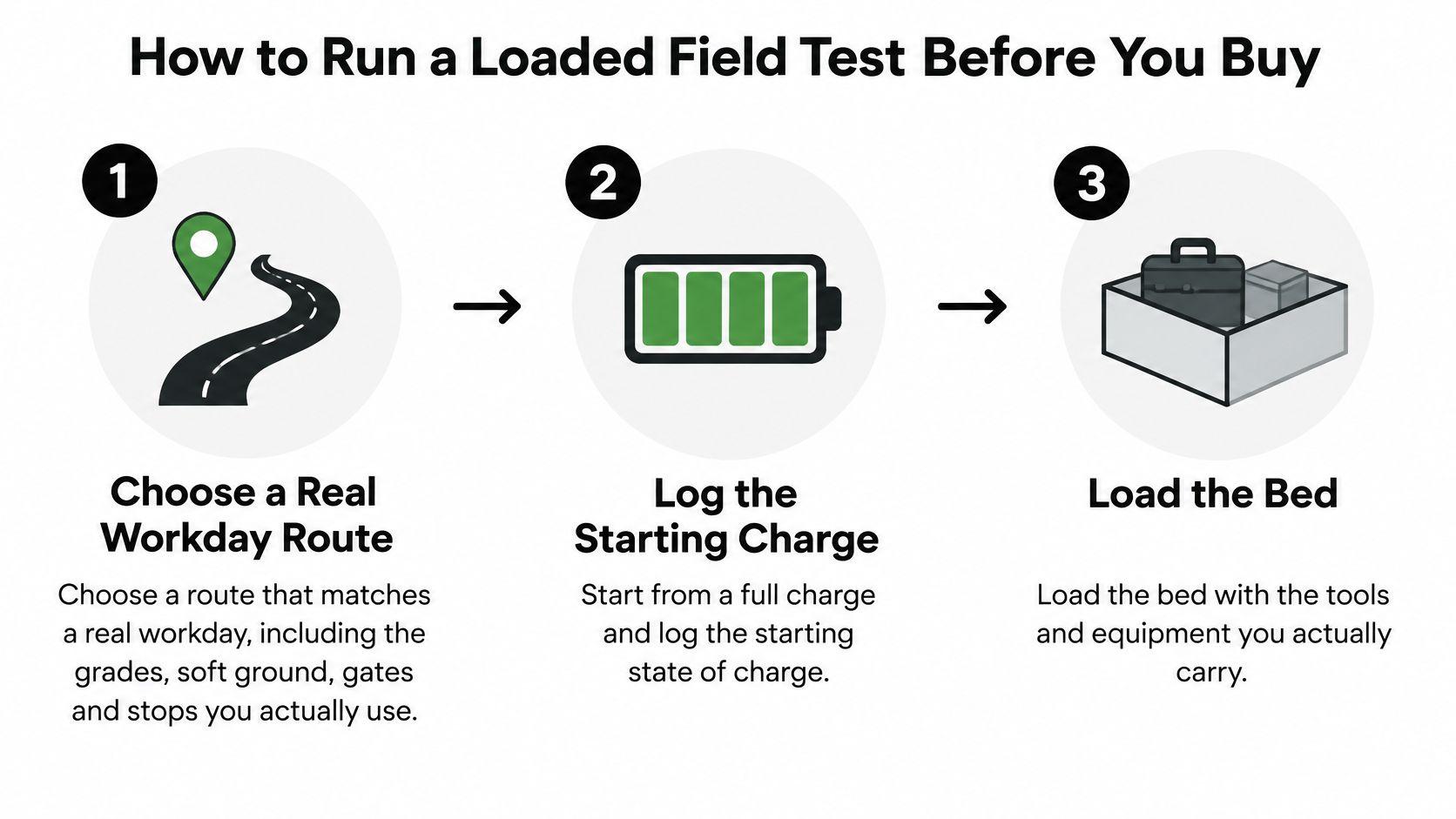
Build the route from a real workday. Map the grades, soft ground, gates and stops you use, because a smooth test loop flatters any machine and teaches you nothing about the one you'll drive in February.
Start from a full charge and log the starting state of charge. Without a recorded starting percentage, the drain you measure at the end is a number with no meaning attached to it.
Load the bed and hitch the trailer you tow. An empty test measures the vehicle; a loaded test measures your job, and the difference is often the whole purchase decision.
Run the loop in 2WD, then repeat it in 4WD with the differential locked on the steepest section. Four-wheel drive is the setting that drains the pack fastest and the one you'll engage when conditions turn, so you need both numbers.
Record miles, battery consumed, surface type, grade and ambient temperature at each leg. A range result without those variables can't be repeated or compared to the next machine.
Repeat a loaded uphill restart at low state of charge. Climbing under load drains a pack faster than flat running, and low-charge behavior is where electric drivetrains differ most from each other.
Compare charging time against your next required shift. A slow charge is fine overnight and useless at 6 a.m. if the machine comes back at 40%.
Independent comparison work on electric UTV operating requirements treats payload, towing, battery energy, charging access, sustained uphill performance and low-state-of-charge behavior as separate acceptance criteria, and it warns specifically that cargo-bed capacity and towing capacity shouldn't be treated as interchangeable (Ekingwoo's electric vs hybrid UTV comparison). That's the discipline the loop above enforces.
Campus reports that in 4WD with the differential locked, the Campus E1 climbed a steep grade without running out of power, and that in a recovery test it pulled a zero-turn mower back up a wet clay bank of about 20 degrees. Treat both as manufacturer claims to confirm on your ground, with your own equipment and your own trailer attached.
The rule that settles most arguments: if the machine can't repeat your loop twice with the load you actually carry, the range figure on the sticker is decoration.
Report rated payload and hitch capacity separately in your notes, and write down whether 4WD was engaged for every figure you record. Otherwise you'll be comparing a 2WD number from one test to a 4WD number from another.
Real Range Under Hunting, Farm and Ranch Loads
Two published buying guides give wildly different answers about the same class of machine. One estimates roughly 25 to 35 miles for an electric Ranger under heavy load or towing, against about 45 miles in combined use, while another lists 50 to 70 miles for mixed property work, as reported in this guide to the electric Polaris Ranger.
That spread isn't dishonest. It's what happens when a distance is quoted without the load, the surface and the temperature attached to it. A rancher planning fence checks and feed runs can't schedule a day off a number that could be 25 or 70.
| Load Scenario | Range Reference | What to Record |
|---|---|---|
| Empty, flat, 2WD | Rated figure is the ceiling, up to 60 miles for the Campus E1 | Miles driven and starting and ending state of charge |
| Heavy bed load or towing | Roughly 25 to 35 miles for an electric Ranger in one guide | Bed weight, hitch load and trailer type |
| Combined mixed use | Roughly 45 miles for an electric Ranger in the same guide | Route length, stops and idle time |
| Mixed property use | 50 to 70 miles in another guide | Surface type and number of stop-start cycles |
| Steep grades and mud in 4WD | No published figure in either guide | Grade percentage, surface and 4WD and differential status |
| Cold weather | No published figure in either guide | Ambient temperature and range against the same route in warm weather |
Turning a Test Run Into a Working Radius
Stop thinking in maximum range and start thinking in a safe working radius with a reserve. You get there with arithmetic, not optimism.
Run your loaded loop from full and note the miles covered against the percentage of charge consumed. Say the loop covers 18 miles and uses 40% of the pack: that's about 0.45 miles per point of charge. If you plan to run between 90% and 30% of charge, a 60-point window works out to roughly 27 miles, and you'd hold back a portion of that as the return reserve before you commit to a route.
What moves that number hardest, in rough order of impact:
- Bed load and trailer weight. Every pound you add pulls energy out faster on grades than on the flat.
- 4WD and the locked differential. Engagement is worth the traction and costs you range.
- Grades, mud and soft ground. Sustained climbing is the biggest drain on any pack.
- Cold and heat. Both cut usable capacity, and cold bites hardest on short winter loops.
- Winch use and idle time. A recovery or a stuck log pulls hard from a standing position.
If your route is fixed and the machine still returns tight on charge, the habits that stretch run time matter more than a bigger advertised number, and these ways to maximize electric UTV performance are worth reading before you blame the vehicle.
Here's the honest division. Electric UTVs suit repeated local routes that end at a charger: feeding, fencing, stand access from a camp with power, yard work, warehouse loops. Long remote loops and unpredictable towing still favor gas. The Campus E1's up to 60 miles is the ceiling of its range, not the working distance you should plan around.
Charging Times for Barns, Shops and Remote Sites
Treat a dedicated 240-volt circuit as the working default, and treat 120-volt charging as the fallback for short property loops.
MotorTrend's first-drive testing of the Polaris Ranger XP Kinetic makes the gap concrete: a full recharge from empty took about 10 hours from a standard 120-volt outlet, about 5 hours on 240 volts, and roughly 3.5 hours with the optional 9-kW charging setup (MotorTrend's Ranger XP Kinetic first drive).
Across the class, most electric UTVs depend on Level 1 or Level 2 AC charging rather than the DC fast-charging networks built for passenger cars, and full charges commonly run from about 5 to 12 hours depending on battery size and equipment (DogNotebook's electric UTV guide). The circuit, not the brochure, sets your day.
| Charging Setup | Approximate Full Charge | Best Fit |
|---|---|---|
| Standard 120-volt outlet | About 10 hours (Polaris test) | Overnight charging on short property loops |
| Dedicated 240-volt circuit | About 5 hours (Polaris test) | Daily farm, ranch or hunting use |
| 240-volt with 9 kW charger | About 3.5 hours (Polaris test) | Tight turnaround between shifts |
| General AC range across models | About 5 to 12 hours depending on battery and equipment | Planning a charging window for any model |
| Generator or solar-plus-battery | Set by the generator or battery bank, not the vehicle | Remote sites without grid access |
| Campus E1 on each setup | No verified figure published | Ask the dealer for the circuit requirement |
The Problems Nobody Mentions
A long extension cord run drops voltage and slows a charge to a crawl. A barn built in 1978 often has no outlet within reach of where you park, and the panel may not carry a dedicated circuit without an upgrade. A remote hunting site has no grid at all, which leaves a generator or a solar-plus-battery bank as the only realistic power source.
Get an electrician's estimate for the circuit before you buy the vehicle, not after. Confirm the amperage your chosen setup needs, and if you're upgrading the hardware that connects the vehicle to the supply, these best EV chargers are a sensible starting point for comparing units and current ratings.
Then match the charging window to the next shift. An overnight fill covers a morning loop. It doesn't cover a machine that comes back at lunchtime with half a day of work left.
Confirm the circuit requirement and the charge time for the exact model you're testing, on your own power supply, before you sign anything.
Ownership Costs and Verdicts by Usage Pattern
The cost question isn't whether an electric UTV is cheaper than gas. It's which usage pattern makes it cheaper, because the answer flips depending on hours, charging access and downtime.
Start with a price anchor. The global utility terrain vehicle market was valued at $9.6 billion in 2025, representing an estimated 575,141 units at an average selling price of $16,800, according to Sigmadax's UTV industry statistics. At that price level, a few thousand dollars in charger installation, battery risk or missed work decides the purchase, and a fuel-savings table alone won't show it to you.
Two terms change the math more than any other. The Campus E1 battery carries a 10-year warranty from the original retail purchase date, with full battery replacement for the first 5 years and prorated coverage for years six through ten, which removes most of the replacement risk people worry about. Campus EV also offers 0% APR for 36 months on the Campus E1, with retail financing for qualified buyers through local dealers.
Four Usage Patterns, Four Verdicts
Low-hour property use. A few hours a week of hauling, mowing runs and firewood. Electric wins here, clearly, because you charge at home on a dedicated circuit and the fuel saving plus near-zero routine maintenance accumulates without any logistics problem. Model the charger install, insurance and depreciation carefully.
High-hour farm work. Daily feeding, fence checks and hay runs from a barn with 240-volt power. Electric wins on running cost once daily hours climb, because fuel and maintenance savings scale with hours. Model battery condition after the warranty period, downtime if a repair needs a dealer 90 minutes away, and whether you have a second machine to cover a bad day.
Seasonal hunting. Camp access, stand checks, dragging game. Electric wins when the camp has power or a reliable generator, because the quiet drivetrain is a genuine advantage near game. Model cold-weather range loss, remote charging and the trailer you'll haul it on.
Commercial duty. Warehouse yards, construction compounds, campus maintenance. Electric wins on predictable daily loops that return to a charger, where the quiet operation and low-speed torque pay off every shift. Model missed work time and service availability, because a commercial machine that idles for a week costs more than the fuel it saved.
Remote property with long loops and no charger is the one pattern where gas still fits without argument.
| Usage Pattern | Where Electric Tends to Win | Costs to Model |
|---|---|---|
| Low-hour property use | Charging at home on a dedicated circuit | Charger installation, insurance and depreciation |
| High-hour farm work | Daily hours where fuel savings add up and charging is reliable | Battery condition after warranty, downtime and service access |
| Seasonal hunting | Access near a charging point or a reliable generator | Cold-weather range loss, remote charging and hauling |
| Commercial duty | Predictable daily loops that return to a charger | Missed work time, service availability and charging downtime |
The Cost per Operating Hour Math
Add up purchase price, charger installation, electricity, insurance, maintenance and the value of any missed work, subtract expected resale, then divide by the hours you'll run the machine in a year. Do the same calculation for the gas alternative over the same hours. The pattern that wins is the one with the lower cost per operating hour, not the one with the lower sticker.
The maintenance side deserves its own line. Belts, oil changes, filters and the small failures that eat a Saturday disappear on an electric drivetrain, and the maintenance cost profile of an electric UTV is where high-hour operators find most of their savings.
Decision rule: choose electric when your daily route returns to a charger with reserve. Choose gas when the route doesn't, no matter how good the electric numbers look on paper.
Confirm the Fit and Book a Test Drive
You've got the scorecard, the loaded loop and the cost math. Now narrow the field to one or two machines and test them properly.
Write down your loaded workday. Payload, towing, route, number of stops and the charging window you can realistically offer between shifts.
Fill the scorecard for every shortlisted model. Enter towing, payload, range and charging figures, then mark each unverified cell so you don't compare an estimate against a published number.
Shortlist only the models whose verified figures cover the full workday with reserve. If a machine needs the entire pack to finish the loop, it doesn't cover it.
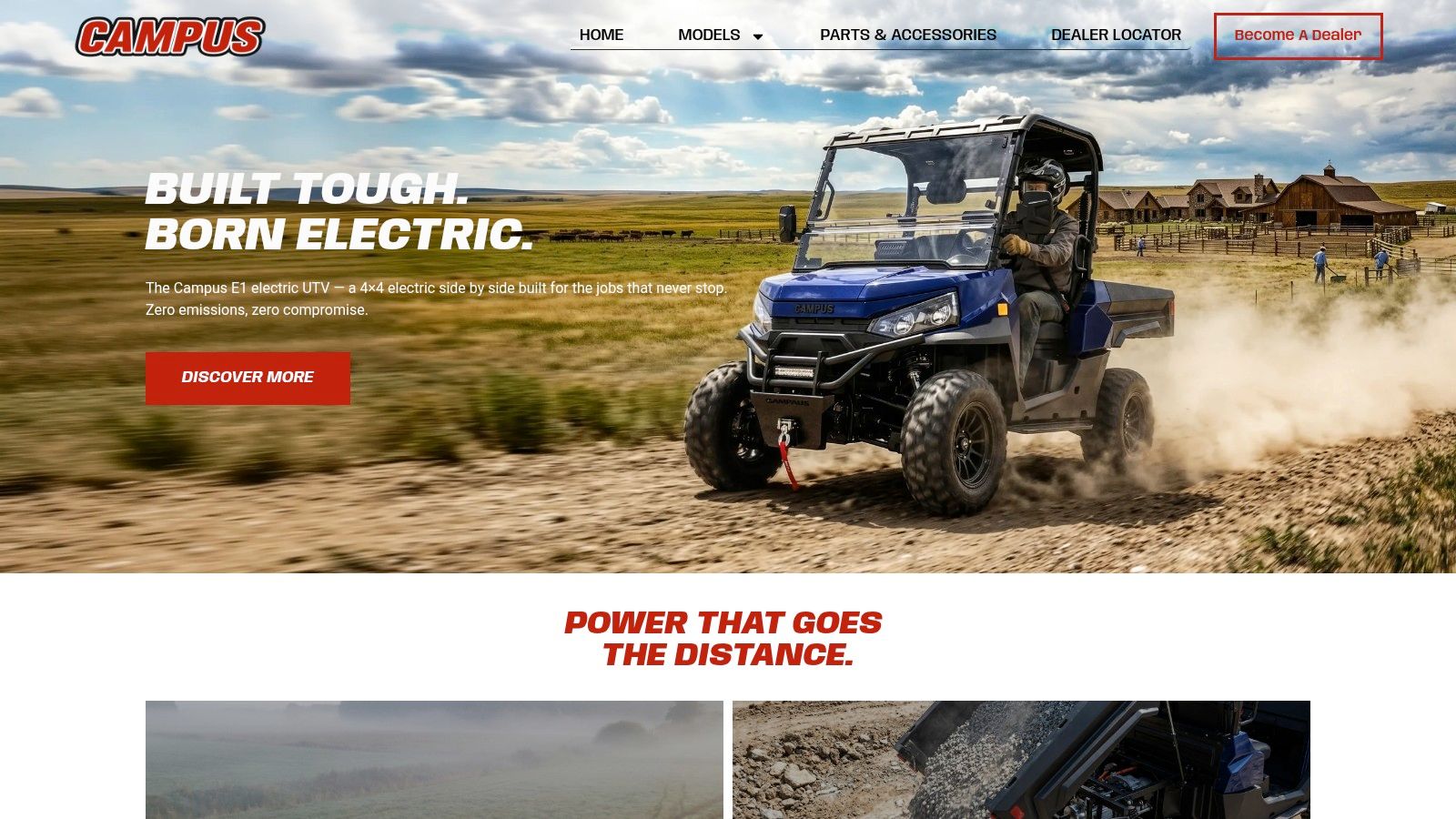
Book a test drive and run the loaded loop yourself. Use the dealer locator to find a Campus EV dealer near you, bring your own equipment, and record state of charge at each leg of the route.
Get the commitments in writing before you sign. Ask the dealer to confirm the charging requirement, the battery warranty terms and your financing eligibility in writing. Campus EV answers questions at +1 972-268-6160 and hello@campus-ev.com, and you can request a quote through the website for the exact configuration you tested.
All prices are in U.S. dollars unless stated otherwise, and they can change, so ask for a current quote on the build you drove rather than the one in the brochure.
The right electric UTV is the one that completes your full workday and returns to a charger with reserve. Not the one with the highest range number on the window sticker.
Campus EV builds the E1 for exactly this kind of work: a 4×4 electric UTV with a 20 kW motor, a 72V 150Ah LiFePO4 lithium battery, up to 60 miles of range, 2,500 lbs of towing and a 550 lb electric dump bed, sold through authorized dealers with 0% APR for 36 months. Take your own trailer and your own loop to a dealer, and judge it the way this article says to judge it. Visit Campus EV to request a quote or book a test drive.