
Most electric UTV buyers start in the wrong place. They open a spec sheet, look straight at the headline range number, and assume that figure tells them whether the machine will survive a full shift on a farm, ranch, jobsite, or hunting lease. That habit leads to bad purchases.
A headline range figure is a ceiling under light conditions, not a daily work budget. Treat it like a guaranteed distance, and you'll end up rationing battery miles on a cold morning with a trailer hooked to the back. A useful Campus E1 review does the opposite: it separates published specifications from what happens under real loads, builds a repeatable test you can run yourself, and draws a clear line between fuel savings and total ownership cost.
Before deciding whether to buy or wait, you need three things: the exact numbers on paper, the gaps those numbers leave open, and a structured way to verify performance on your own ground.
Table of Contents
- Campus E1 Specs at a Glance
- How the Campus E1 Rides, Steers and Handles
- Battery, Charging and Real-World Range
- Payload, Towing and Hauling Limits
- Ownership Costs and Fuel Savings Compared
- Who Should Buy the Campus E1 and Who Should Skip It
- Frequently Asked Questions
- How far does the Campus E1 go on one charge?
- Does it charge from a normal wall outlet?
- Is the torque figure available?
- Can the Campus E1 be used on the highway?
- Does the 3,000 lb winch make it a 3,000 lb towing machine?
- Is 0% APR financing guaranteed for every buyer?
- What does a battery replacement cost?
- Confirm the Fit Before You Buy
Campus E1 Specs at a Glance
Campus EV lists the Campus E1 as its flagship 4×4 electric utility vehicle. Comparing its published figures against your heaviest weekly jobs gives you an immediate baseline before you ever visit a dealer lot.
| Spec | Campus E1 value | What to note |
|---|---|---|
| Motor | 20 kW PMSM | Peak and continuous output not published |
| Battery | 72V 150Ah LiFePO4 | About 10.8 kWh nominal, before usable capacity and losses |
| Range | Up to 60 miles per charge | Ceiling, not a planning number for loaded setups |
| Top speed | Limited to 35 mph | Capable of more than 40 mph |
| Drive | On-demand 2WD and 4WD | Locking rear differential |
| Ground clearance | 11 inches | Built for ruts, rocks, and uneven trails |
| Torque | Ask authorized dealer | Unpublished on standard spec listings |
| Towing | Up to 2,500 lb | Must be weighed alongside bed payload |
| Dump bed | Electric tilt, up to 550 lb haul | Stake pockets and four tie-downs included |
| Winch | 3,000 lb capacity | Recovery rating, not a towing capacity |
| Seating | Three people | Middle passenger uses a lap belt |
| Hitch | Front and rear 2-inch receivers | Supports trailers and mounted accessories |
| Charging | Standard wall outlet overnight | Ready for work the next morning |
| Sales | Authorized dealers, 0% APR for 36 months | Confirm current financing terms before signing |
How to Read This Spec Sheet
Three figures in this table deserve immediate scrutiny against your daily route. First, the 72V 150Ah LiFePO4 battery produces roughly 10.8 kWh of nominal stored energy (voltage multiplied by amp-hours), which sets the hard physical boundary for everything the vehicle does between charges. Every steep climb, heavy haul, and cold morning draws directly from that fixed pool.
Second, notice the 35 mph top-speed limit. The electric drivetrain can push past 40 mph, yet the factory governor caps travel at work speeds rather than road speeds. If your daily routine requires covering long stretches on fast county highways, that single specification settles the question early.
Third, check the missing line: torque. Standard listings don't publish a verified torque number for the 20 kW permanent-magnet synchronous motor, so you'll need to ask an authorized dealer for that specification and feel how the machine pulls on a live incline.
Spec-sheet rule: Match the range ceiling and 35 mph speed cap to your longest daily loop first, then check the 550 lb dump bed and 3,000 lb winch against your heaviest single task.
How the Campus E1 Rides, Steers and Handles
Electric utility vehicles behave differently from gas side-by-sides the moment you press the pedal. There's no engine warm-up, no belt engagement lag, and no shift delay between drive and reverse. That instant directional response matters when you're backing up to a trailer tongue in tight quarters, nudging through livestock gates, or shuttling pallets across a warehouse yard.
Low-speed maneuvering gets further help from electric power steering. Turning a loaded utility vehicle around tight barn corners, between trees on timber roads, or across narrow field gates takes far less shoulder effort at walking pace than unassisted steering. Pairing light steering with an automatic parking brake that sets itself whenever the vehicle stops removes a common annoyance during stop-and-go fence checks and feed runs.
Traction, Clearance and Cabin Controls
Traction management relies on on-demand 2WD and 4WD combined with a locking rear differential. On packed dirt, gravel lanes, and dry pasture, keeping the drivetrain in 2WD cuts mechanical drag and conserves battery charge. When mud, wet grass, or loose climbs threaten wheelspin, switching to 4WD and engaging the rear locker sends even pull across the back axle.
Undercarriage height shapes where you can take that traction. With 11 inches of ground clearance, the chassis clears typical farm ruts, washouts, and trail rocks without dragging the belly pan. Cabin visibility supports slow technical driving too, with large mirrors, a windshield on gas struts that stays open or closed while moving, LED lighting, and a speedometer you read directly through the steering wheel.
Because the motor's torque rating isn't published on the standard sheet, raw pulling power has to be judged in the seat rather than on paper. Reviewing how an electric UTV motor delivers power under load helps explain why immediate low-end response feels stronger at working speeds than peak horsepower alone suggests.
Test-Drive Handling Checklist
Don't settle for a flat parking-lot loop at a dealership. Put the vehicle through four concrete checks during a test ride:
- Walking-speed steering effort: Make full-lock figure eights at slow speed to verify how smoothly the electric power steering assists without feeling twitchy.
- Loaded grade climb: Put weight in the bed or bring two passengers, engage 4WD on a steady hill, and feel whether acceleration stays steady or bogs down.
- Reverse hill start: Stop partway up an incline, let the automatic parking brake set, shift straight into reverse, and confirm there's no roll-back or drivetrain hesitation.
- Brake feel and lock-in: Bring the vehicle to a firm stop from 25 to 30 mph, then release the pedals on a mild slope to see how cleanly the auto-park brake holds.
Battery, Charging and Real-World Range
Falling battery prices are the main reason electric utility vehicles have become practical work machines. According to the U.S. Department of Energy, EV battery-pack costs dropped to $185 per kilowatt-hour in 2019, roughly an 80% reduction from 2008 levels based on usable pack energy, with long-term federal targets aimed below $100 per kilowatt-hour and eventually toward $80 per kilowatt-hour alongside charging times of 15 minutes or less. Lower pack costs explain why a lithium utility vehicle can sit in a workable price bracket today, yet cheaper cells alone do not tell you how far a specific UTV will travel on your property.
To plan real work miles accurately, follow the energy chain in order:
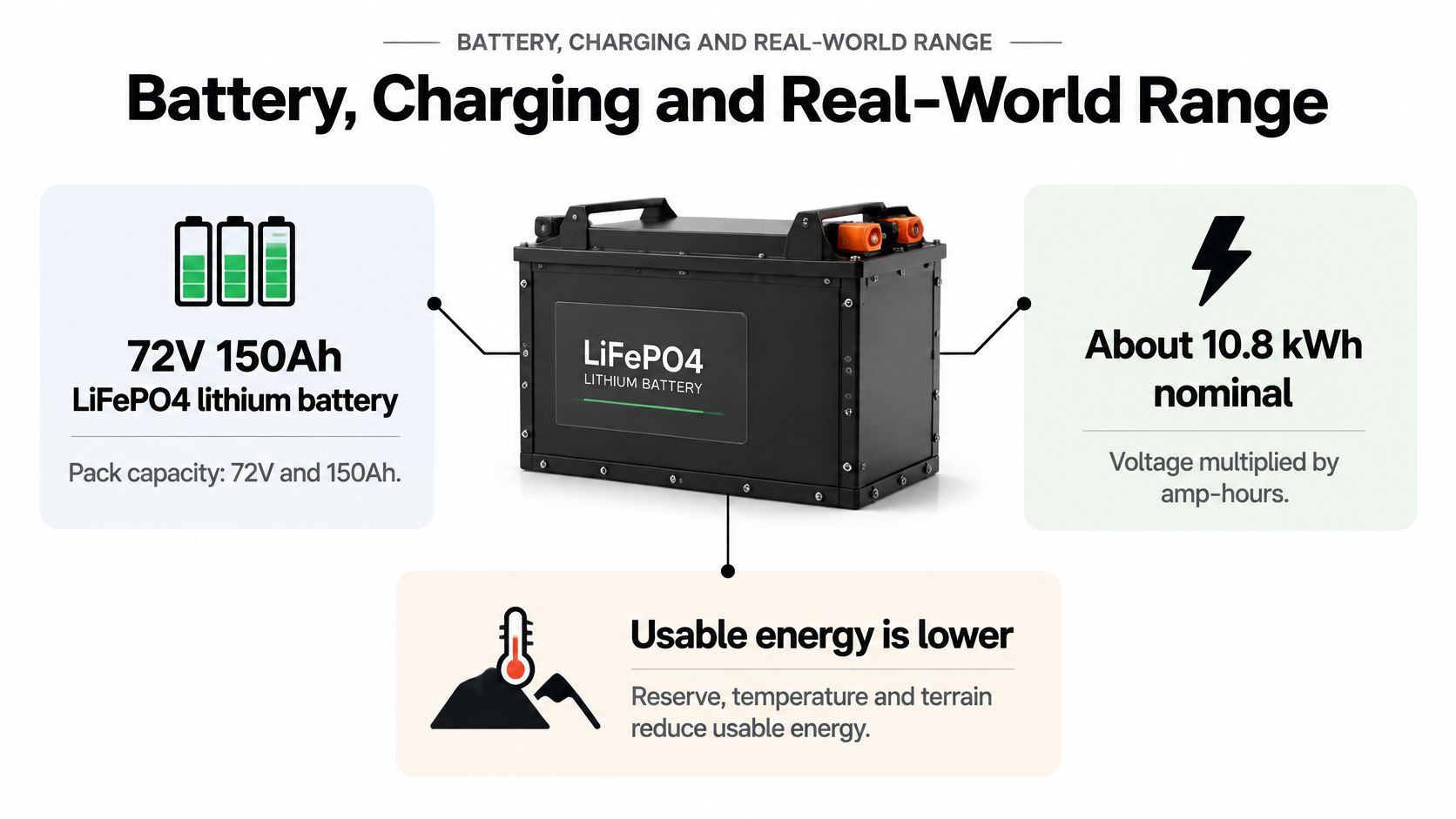
- Nominal pack energy: Multiplying 72 volts by 150 amp-hours yields approximately 10.8 kWh on paper.
- Usable energy: Battery-management reserves, charging losses, and cold ambient temperatures reduce the energy you can draw.
- Real miles under load: Rolling resistance from mud or soft turf, cargo weight, hill grades, 4WD engagement, speed, and running accessories all raise energy consumption per mile.
- Return-trip reserve: You still need enough buffer left at the far end of a pasture or hunting lease to get back to the outlet safely.
Why Advertised Range Is Only a Ceiling
The Campus E1 reviews page rates the vehicle at up to 60 miles per charge. Treat that figure as a ceiling rather than a planning guarantee, because no verified range number is published for specific loaded setups. Sixty miles covers repeated short barn chores with room to spare. A full-day remote hunt or steep ranch loop is a different problem, and closing that gap requires either a charging plan or a generous reserve margin.
Charging logistics shape daily usability as much as pack size. The Campus E1 plugs into a standard wall outlet overnight and comes out ready for work the next morning, which suits a machine that returns to the same barn every evening. Across the electric UTV category, higher-voltage charging hardware replenishes a pack considerably faster than a standard wall outlet, so the relevant question is turnaround time on your schedule. Charge time on a higher-output charger isn't published for the E1, so confirm compatible charger output and recharge duration directly with an authorized dealer before assuming a midday top-up is realistic.
An advertised range rating tells you what a vehicle can achieve on its best day. Your worst working day, loaded and cold, is the only number that protects you from walking home.
Repeatable Range Test Protocol
No video or review can replicate your exact hills, tire pressure, and winter mornings, even when reviewers drove the machine unpaid and reported. Running your own structured test replaces guesswork with hard numbers.
Start from a full charge with an empty bed on flat ground in 2WD, then change one variable at a time across separate runs. Keep tire pressure consistent and apply practical electric UTV efficiency habits like steady throttle control so driver behavior doesn't skew your readings.
| Test condition | Change from baseline | Record | Planning use |
|---|---|---|---|
| Empty bed, flat ground, 2WD | Baseline | Start and end state of charge, speed, tire pressure | Sets the best-case ceiling |
| Loaded bed to 550 lb, flat ground, 2WD | Payload | Same plus load weight | Shows the cost of cargo |
| Empty, hills, 4WD | Terrain and drive mode | Same plus elevation profile | Shows climb cost on your routes |
| Towing up to 2,500 lb, flat ground | Trailer | Same plus trailer weight | Shows towing range loss |
| Cold morning, loaded, 4WD | Temperature | Same plus air temperature at start | Shows winter range |
| Standard outlet vs higher-voltage charger | Charging voltage | Charge time and energy added | Shows overnight vs fast-turnaround planning |
Use the lowest mileage figure from your relevant conditions as your real planning number, then keep a reserve margin sized for the trip home plus unexpected detours. That number also feeds the ownership math: a machine whose worst-day range covers your longest route with reserve to spare justifies its purchase on fuel savings alone, while one that forces a midday charge or a second vehicle does not, no matter how cheap the electricity. If your test loop shows the E1 clearing your longest day with margin, buy. If it lands anywhere near the wire, wait or rework the route before signing.
Payload, Towing and Hauling Limits
Utility ratings look straightforward on a brochure until you combine cargo, passengers, and a trailer on uneven ground. The Campus E1's electric-powered dump bed tilts electrically to unload gravel, mulch, feed, or debris without manual lifting, and it's rated to haul up to 550 lb. Built-in stake pockets and four tie-downs let you build side extensions or strap down fencing panels, chainsaws, and coolers so weight doesn't shift mid-slope.
For pulled loads, the chassis is rated to tow up to 2,500 lb, supported by front and rear 2-inch hitch receivers. Having receivers at both ends widens how you work: pull a utility trailer or sprayer from the rear, or mount a cargo basket, spreader, or plow attachment up front.
Buyers frequently confuse the 3,000 lb winch with towing capacity. Winch capacity is a recovery rating designed to pull a stuck machine, drag a fallen limb, or haul an unpowered load short distances under controlled tension. It doesn't raise the vehicle's braking or chassis towing rating.
Three-Step Load Check Before a Work Shift
Payload and towing ratings interact directly because both add weight to the suspension, brakes, and electric drivetrain. Planning a maxed-out dump bed and a maxed-out trailer on the same trip strains braking stability and drains the pack rapidly. Run this quick check before loading up:
- Weigh your heaviest bed load: Confirm that feed sacks, tools, game, or building materials stay under 550 lb, and secure loose gear to the four bed tie-downs.
- Weigh the loaded trailer: Add the empty trailer weight plus its cargo to confirm the total stays under 2,500 lb before hitching up.
- Avoid stacking both maximums: If you're pulling near the towing limit, keep the dump bed light so steering control, stopping distance, and tongue weight stay predictable.
Route geography determines how well those limits fit your day. Short, flat hauling loops around a yard or barn easily accommodate frequent loaded trips, whereas long hilly tows draw down usable range fast and must be checked against your loaded-tow range test.
Ownership Costs and Fuel Savings Compared
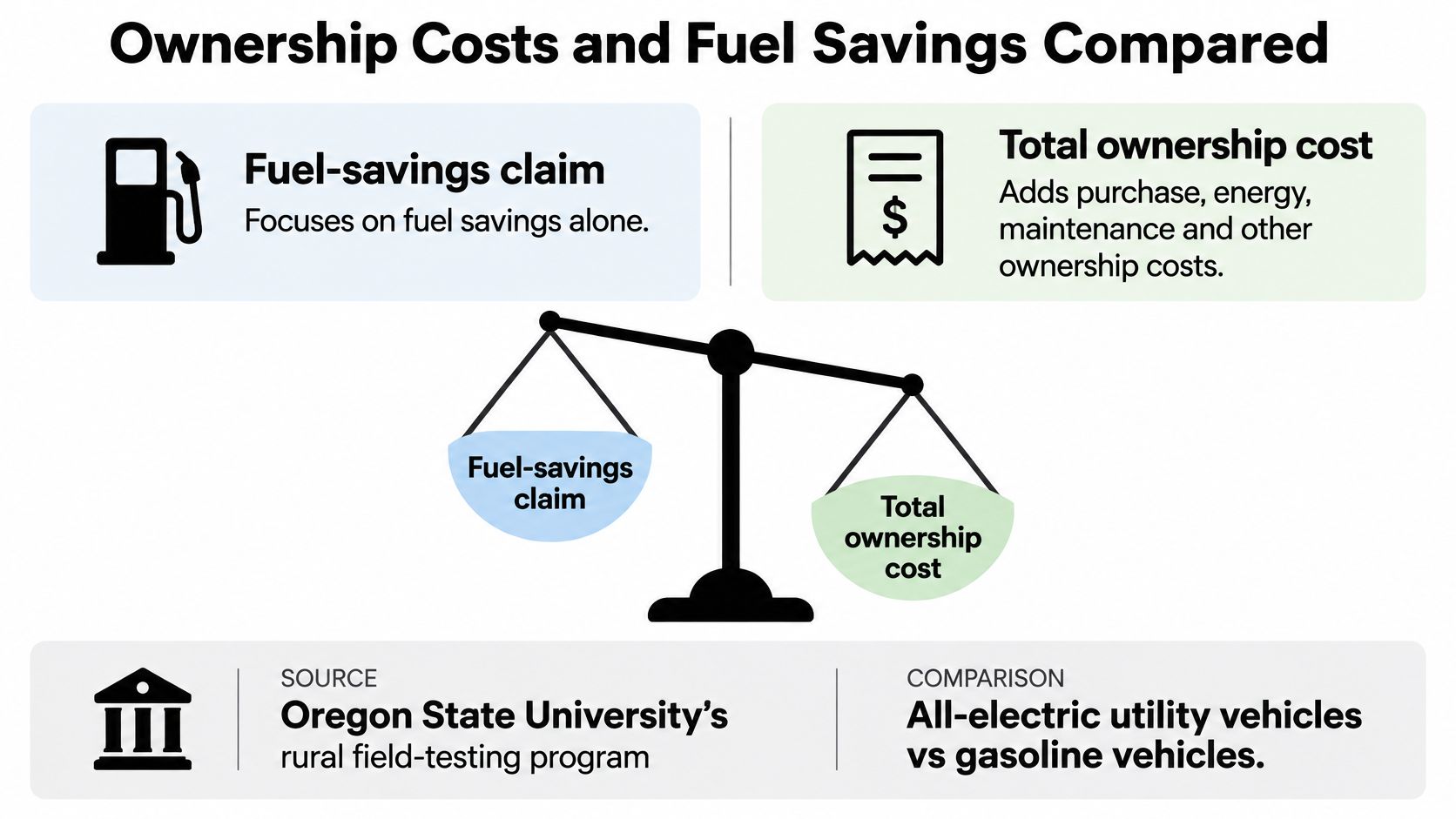
Electric utility vehicles often get pitched on fuel savings alone, which tells only half the financial story. In 2024, Oregon State University's College of Agricultural Sciences launched a rural field-testing program using four electric utility vehicles funded by a $176,000 Pacific Power grant across rural test locations. Researchers set out to track vehicle hours, fuel expenses, maintenance costs, and seasonal performance, estimating that the electric vehicles could cut fuel costs by 65% to 75% compared with the gasoline vehicles they replaced.
That 65% to 75% estimate is compelling for farmers, ranchers, hunters, property managers, and warehouse operators making repeated short trips near a power outlet. Still, it measures fuel expense only, not total ownership cost. Purchase price, financing terms, local electricity rates, tires, accessories, downtime, and future battery replacement all sit outside a fuel-only comparison.
Financing also affects cash flow over the first three years. We offer 0% APR for 36 months on the Campus E1 through authorized dealers, though you should confirm current eligibility and exact terms before committing. Use the checklist below to build your own complete ledger instead of guessing.
| Cost item | How to count it | Campus E1 figure |
|---|---|---|
| Purchase price | Dealer quote before financing | Confirm via authorized dealer quote |
| Financing | Monthly payment over the term | 0% APR for 36 months |
| Electricity per full charge | Energy used times local rate | Set by pack energy used and local kWh rate |
| Annual electricity | Charges per year times cost per charge | Calculated from your annual charge count |
| Annual gas for the replaced vehicle | Hours times fuel use times fuel price | Calculated from your gas log and fuel price |
| Battery replacement | Warranty terms and replacement quote | Request written dealer warranty and quote |
| Tires, accessories and downtime | Annual estimate from your use | Estimated from your terrain and duty cycle |
Maintenance Questions to Put in Writing
Skipping engine oil changes, spark plugs, and fuel-system work lowers routine shop time, yet electric UTVs still have wear parts that cost money. Before signing a purchase order, check a realistic breakdown of UTV maintenance costs and ask your authorized dealer to put four items in writing:
- Scheduled service intervals: Which inspections, brake checks, and drivetrain fluid services are required to keep warranty coverage valid.
- Battery warranty length and terms: Exact duration, cycle or capacity thresholds, and what usage voids coverage.
- Battery replacement quote: Current parts and labor pricing for replacing the lithium pack out of warranty.
- Wear-item expectations: Typical tire and brake pad replacement intervals for your terrain, load weight, and annual hours.
Real payback comes down to annual operating hours, charging access at home or on site, and local gas versus electricity rates. Compare your current annual gas bill directly against your projected annual electricity bill plus monthly financing payments, then layer in the items a fuel study can't price for you: tires, accessories, downtime, and long-term battery replacement.
Who Should Buy the Campus E1 and Who Should Skip It
No utility vehicle fits every property. Matching the machine to your actual duty cycle prevents buyer's remorse far better than chasing top-line specs.
| Use case | Campus E1 fit | Better choice when | Deciding factor |
|---|---|---|---|
| Farm and property chores | Strong for short loops near a power outlet | Routes exceed a full charge most days | Daily miles and charging access |
| Hunting | Good for quiet scouting and short trips | Full-day remote hunts beyond the planned range | Range margin and charging at camp |
| Commuting or warehouse yard | Good for repeated short trips with site or home charging | No charging point at the site | Charging access |
| Heavy hauling and towing | Fits the 550 lb bed and 2,500 lb tow rating | Loads regularly exceed the ratings | Payload and tow limits |
| Long or high-speed road use | Not suited, given the 35 mph limit | Regular highway or fast road travel | Speed and route type |
Other electric UTVs and gas side-by-sides differ substantially on range, charging hardware, pricing, and governed speed. Because manufacturer brochures rarely test under identical conditions, benchmark any competing model using written dealer figures across these exact same criteria rather than relying on headline claims.
Strengths and Trade-Offs
Stepping back from individual specs shows a clear pattern of advantages and constraints.
Where the Campus E1 stands out:
- Quiet, responsive operation: Silent running around livestock and game, instant throttle response, and zero shift delay between drive and reverse.
- Simple daily energy routine: No fuel cans or gas runs, with overnight recharging from a standard wall outlet.
- Capable work hardware: On-demand 4WD, locking rear differential, electric dump bed, and a 3,000 lb recovery winch.
Where the trade-offs sit:
- Speed and range boundaries: A 35 mph governor excludes highway travel, and the 60-mile range ceiling demands a healthy reserve margin under load.
- Specs you must verify locally: Torque output and higher-voltage charging times aren't published on standard listings, so an authorized dealer has to supply them.
Ask yourself three questions before comparing quotes: How many miles do you drive on your longest normal day, how many hours does the machine work, and can it plug in where it parks every night?
If the answers point to short, repetitive loops with reliable overnight power, the E1 lands squarely in its sweet spot. If you run remote all-day routes far from an outlet or regularly push past 35 mph, a gas UTV or a different platform will serve you better.
Frequently Asked Questions
How far does the Campus E1 go on one charge?
Published specs list up to 60 miles per charge, which is a best-case ceiling rather than a loaded work guarantee. Plan your daily routes around your own tested range with your normal cargo, terrain, and seasonal temperatures.
Does it charge from a normal wall outlet?
Yes, the Campus E1 plugs into a standard wall outlet overnight and is ready for work the next morning. Charging times using higher-output equipment aren't published, so verify compatible fast-charging options with an authorized dealer.
Is the torque figure available?
Torque isn't published on standard Campus E1 listings. Ask an authorized dealer for the official torque specification and evaluate low-speed pulling power yourself on a loaded hill during a test ride.
Can the Campus E1 be used on the highway?
No. The vehicle is governed to 35 mph for safety, keeping it strictly suited to off-road, property, warehouse, and low-speed utility work rather than highway travel.
Does the 3,000 lb winch make it a 3,000 lb towing machine?
No. The 3,000 lb winch rating covers recovery pulls, while chassis towing capacity is rated up to 2,500 lb through the 2-inch hitch receivers.
Is 0% APR financing guaranteed for every buyer?
Financing is offered at 0% APR for 36 months through authorized dealers, subject to current dealer terms and buyer qualification. Confirm active rates and monthly payments in writing before signing.
What does a battery replacement cost?
Out-of-warranty battery replacement pricing isn't published on standard listings. Request written battery warranty terms and a current replacement quote from an authorized dealer so you can factor long-term pack cost into your budget.
Confirm the Fit Before You Buy
Turn the specs and analysis into a concrete decision by running through three steps in order:
- Log one to two weeks of real work: Write down your daily mileage, typical cargo weights, steep climbs, total operating hours, and the exact spot where the UTV will park and plug in each night.
- Run your loaded range test: Take a demo unit across your actual terrain carrying your real load, recording starting and ending state of charge, tire pressure, air temperature, and speed.
- Collect written dealer answers: Because the Campus E1 is sold through authorized dealers, schedule a test ride with one and ask in writing for the torque specification, expected charge time on your specific outlet, full battery warranty and replacement terms, and a dated quote showing current financing details.
Decision rule: Buy the Campus E1 when your longest regular workday fits comfortably inside your tested loaded range with a return-trip reserve margin and a confirmed overnight charging spot. If your routes stretch past that buffer or power access is uncertain, solve your charging setup or evaluate a gas alternative before committing.
Campus EV builds the Campus E1 electric UTV with a 20 kW motor, 72V 150Ah LiFePO4 battery, on-demand 2WD and 4WD, electric dump bed, and 3,000 lb winch for farms, ranches, hunting leases, and worksites. To review detailed equipment specifications, check dealer locations for a loaded test ride, and confirm current 0% APR financing terms, visit Campus EV.