
The trailer is loaded, the grade turns to grease after rain, and the spec sheet in your hand says 20 kW. Someone told you that's about 27 horsepower, roughly what your old gas side-by-side made, and that machine needed a running start and a second attempt to get the load up the hill. You're entitled to ask what the electric motor does differently.
The short answer is that an electric UTV motor doesn't win by making more power. It wins because it delivers the power it has at zero rpm, through a controller that meters current in fine increments, and because the limit on a working machine is usually the battery's energy budget rather than the motor's rating. That reframes the whole buying question from a horsepower contest into a duty-cycle calculation.
The category is big enough that the distinction matters. North American UTV retail sales totaled nearly 520,000 units in 2024, with consumer applications accounting for more than 85% of sales, according to Power Products Marketing data reported by PowerSports Business, and the global electric utility vehicle market was valued at $20.3 billion in 2024, according to Grand View Research. Most of those machines spend their lives doing short, heavy, repetitive work, which is exactly the duty cycle where motor choice and energy budget decide whether you bought the right vehicle.
Sound decisions come from matching the motor to the hardest day of work you have, not the average one. The rest of this is the working version of that idea, from the battery terminal to the tire contact patch.
Table of Contents
- How an Electric UTV Motor Turns Battery Power Into Motion
- Motor Types and Efficiency Numbers Compared
- Torque and Power Delivery on Hills, Trails and Hitches
- Battery Energy and the Real Work Budget
- Cold-Weather Range and Charging Losses
- Match the Motor to Your Hardest Day
How an Electric UTV Motor Turns Battery Power Into Motion
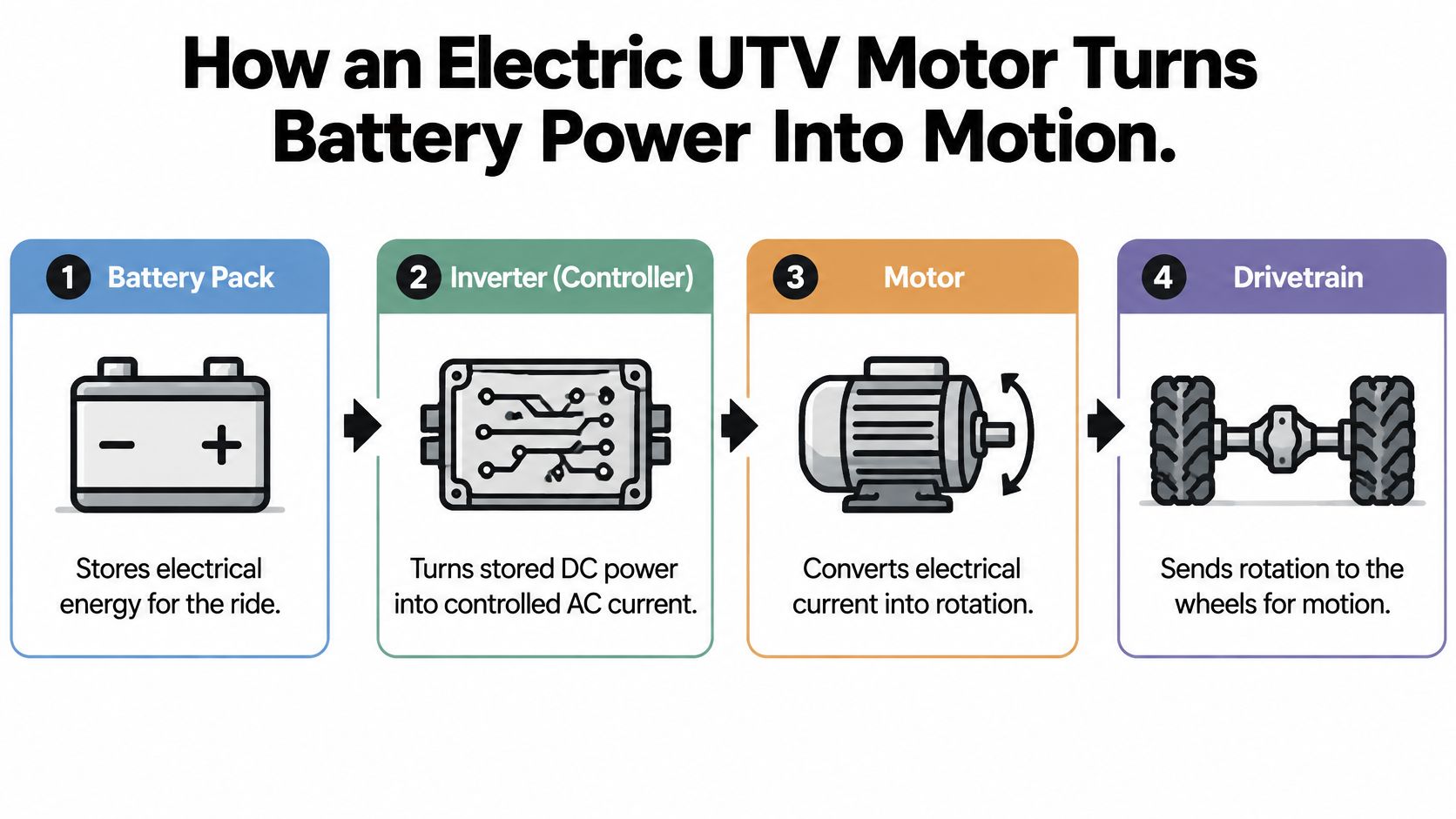
Every electric side-by-side runs the same basic chain. A battery pack stores electrical energy, an inverter (the controller) chops that stored direct current into controlled alternating current, and the motor turns current into rotation that the drivetrain sends to the wheels. The pack is the fuel tank, the controller is the throttle body and the timing advance rolled into one, and the motor is the crank.
A gas engine behaves like a bucket you have to fill before it pours. It needs rpm to make torque, it sheds much of its fuel energy as heat, and it needs a transmission to stay in a useful range. An electric motor behaves like a tap. Crack the handle and flow arrives immediately, at zero rpm, with no clutch slip and no downshift.
The energy path in four steps
- The battery stores energy. Cells hold chemical energy and release it as DC current on demand.
- The inverter converts that DC into controlled AC. The controller sets how much current flows and at what frequency, which governs both torque and speed.
- The motor converts current into torque. Magnetic fields push the rotor around, and the shaft spins.
- The drivetrain delivers torque to the wheels. Gear reduction multiplies twisting force at the tire contact patch, which is the number that moves your trailer.
Why the permanent-magnet motor became the default
Nearly every electric UTV on the market runs a permanent-magnet synchronous motor (PMSM), and the reason is in the name. A 2022 study published in IEEE Xplore describes PMSMs as among the most widely used propulsion motors in hybrid and electric vehicles, and notes the same machine can run in reverse as a generator during regenerative braking. High efficiency plus high power density in a compact housing is a hard combination to beat, so the design dominates.
That study also makes clear that motor efficiency isn't a fixed number. It shifts with speed, torque, temperature and inverter control, which is why an efficiency map across the operating range tells you more than one laboratory figure. Utility driving is the duty cycle that exposes this. You creep along a fence line with a loaded bed, run 20 mph down a gravel road, stop to winch, then climb a grade with the bed full.
A stated motor rating doesn't set hill-climbing ability, usable range or sustained hauling on its own. A 20 kW motor in a 72 V system is one part of a package that includes battery voltage, controller calibration, gearing, thermal management and four-wheel-drive strategy. Accessories draw on the same electrons, so the UTV winch accessories you add belong in the same calculation as the motor, not in a separate one.
Compare machines by finding all three parts on the spec sheet, motor, controller and battery, and checking that they're matched to each other. A large motor fed by a small pack is a short-lived combination.
Motor Types and Efficiency Numbers Compared
Two motor families illustrate different design priorities. A permanent-magnet synchronous motor (PMSM) uses magnets in its rotor, while a switched-reluctance motor creates rotation through magnetic attraction between its stator and rotor. PMSMs usually reach higher peak efficiency, while switched-reluctance designs avoid rare-earth magnets. Neither label alone tells you how much energy a utility vehicle will use during a workday.
| Motor or reference | Efficiency | Test condition or note |
|---|---|---|
| PMSM, compact EV design study | approximately 95.35% | Nominal modeled value at 7,000 rpm and 3.5 Nm |
A 2025 design study reported a nominal PMSM efficiency of approximately 95.35% for a compact electric-vehicle motor rated at 2.56 kW, 7,000 rpm and 3.5 Nm (Journal of Electrical Engineering and Technology). That is a modeled value at a specified operating point, not a promise that the motor will convert that share of battery energy into useful work throughout a day. A motor efficiency figure is more like a snapshot of one moment in a long shift.
Where the lab number leaks away
A motor's peak efficiency is not the same as battery-to-wheel efficiency. Between the pack and the ground, energy also goes to the inverter, drivetrain, tires and accessories. Tire slip on wet clay, a grade, payload, wind, repeated stops and starts, or running accessories all change the amount available for work.
The duty cycle matters. A motor may operate efficiently at one speed and load, then spend much of a utility vehicle's day creeping with a heavy load or responding to frequent changes in demand. That is why one headline percentage cannot tell you whether the machine will suit a particular job. Look for an efficiency map or torque curve showing how performance changes across operating conditions.
An electric drivetrain can put a large share of battery energy toward wheel torque without combustion, idling, exhaust or a multi-speed transmission. The practical question is how well the complete system performs under sustained load, not which motor type wins one peak-efficiency comparison. Consider thermal durability, low-speed control, regenerative behavior and energy used per task alongside the motor figure.
An efficiency figure without a speed and a load attached is decoration. Ask what the motor was doing when it hit that number.
Three questions to ask any seller
- At what speed and load was that efficiency measured? A peak result at one operating point says little about a day of hauling.
- Is low-speed torque control published? Smoothly metering current at walking pace matters when moving a load on the hitch.
- Is there an efficiency map across the operating range? A map or torque curve shows more than a headline percentage.
Use the table to compare the reported design figure, then judge motor types against the work cycle you expect. Cold starts, long periods under load and stop-start tasks all draw on the same finite energy budget. The motor's peak efficiency is one part of that budget, not a substitute for checking how the full powertrain performs over a working day.
Torque and Power Delivery on Hills, Trails and Hitches
Here is the difference most buyers never get explained clearly. Torque is the twisting force at the wheel. Power is how quickly that force gets work done. A 20 kW motor is about 27 horsepower, a figure you can place next to the gas machine in your shed.
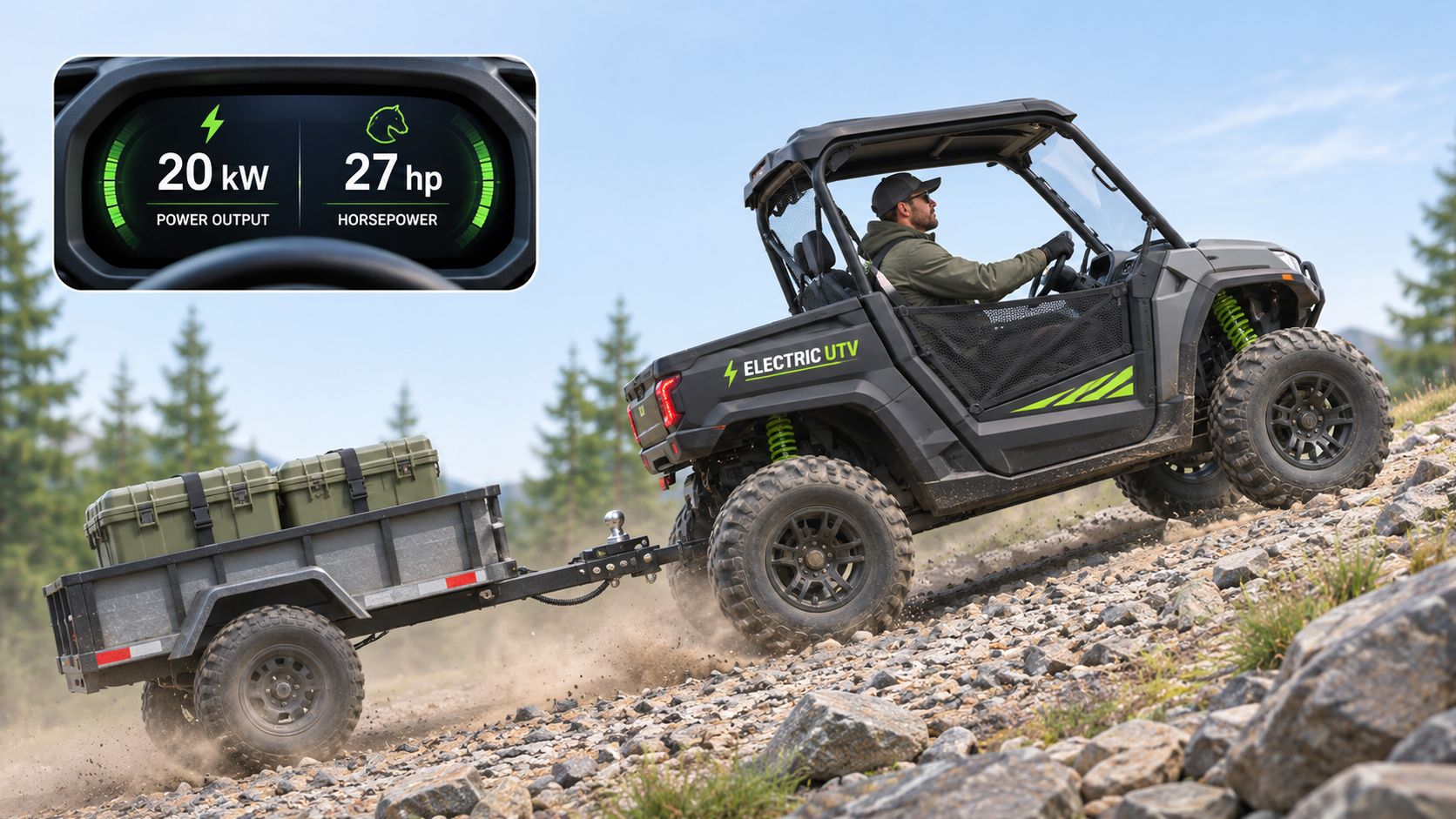
Think about hooking a loaded trailer in soft ground. A jerky driver stabs the throttle, spins a tire, and digs himself a hole. A patient driver feeds throttle steadily and walks the load out. Electric motors make the second style easy, because torque arrives at zero rpm without a torque converter filling or a clutch slipping. That is also why an electric side-by-side feels stronger than its horsepower number suggests when you first press the pedal.
Two field scenarios
Pulling a loaded trailer out of soft ground. Low speed, high torque demand, poor traction. What wins here is torque at zero rpm combined with grip. A machine with on-demand 4WD and a locking rear differential keeps pulling when one wheel starts to slip, because locking the axle stops the loose wheel from stealing all the drive.
Climbing a hillside with a dump-bed load. Steady grade, moderate speed, sustained current. Torque matters less than thermal headroom, because the motor pulls that load for a minute or more. A controller that manages current well separates a good machine from a cheap one.
Traction decides how much of that torque becomes forward motion, and tire construction changes the answer. Run a side-by-side tire size comparison before you blame the motor for a wheel that spins.
Where the output tapers
The controller limits current to protect motor windings and battery cells, so output tapers as temperatures rise during a long climb or a sustained tow. That's designed behavior, not failure. A machine with proper thermal management holds its torque longer before tapering, which is the difference between finishing the haul and stopping halfway up to let things cool.
When you compare machines, note the torque the motor can hold continuously, not only the peak figure on the brochure.
Battery Energy and the Real Work Budget
A workday is an energy budget, not a horsepower contest. The motor's kW rating describes how hard it can push; the battery's kWh describes how long it can keep pushing. Two machines with similar motors can have very different workdays if their battery capacity differs.
For a 72 V, 150 Ah pack, multiplying voltage by amp-hours gives roughly 10.8 kWh nominal. That is stored energy, not a promise of usable work time. The pack keeps a reserve, and the drivetrain and accessories draw from the same supply. A Campus E1, for example, uses a 72V 150Ah lithium battery, so its actual work budget depends on the tasks and conditions, not just the capacity figure.
What else draws from the pack
- A winch can demand substantial power during a pull, even if each pull is brief.
- LED lighting and a light bar use energy over time, especially during long winter evenings.
- A touchscreen, radio and USB charging are smaller loads, but they draw from the pack while work continues.
- An electric dump bed uses a short burst of power when raising a load.
Battery capacity affects operating time, while machine weight and remote terrain can make charging less convenient, as ATV.com's coverage of electric ATV battery power explains. The useful question is how much energy your own tasks consume.
The logging method you can repeat
- Choose a representative loop with the load you usually carry. Start with a full charge and record the battery percentage.
- Work the loop normally, including the gates, hill and reversing you would do on an ordinary shift.
- Record the ending percentage and the work completed, such as bales moved, loads dumped or fence posts set.
- Divide the percentage used by the units of work. That gives you a simple cost per task.
- Repeat the loop with your heaviest load. The demanding day is the better test of whether the battery budget fits.
A short, demanding job and steady trail driving draw energy at different rates. Winching and dumping may use more of the pack than gentle driving over the same period. That is why a maximum-range figure alone can give a poor estimate of a working day.
Practical rule: track battery percentage per work task, not only miles per charge. The task-based figure helps show whether the machine can finish your day; a range figure may describe a different route, load and driving pattern.
Driving style and tire pressure also affect energy use. The guide to how to improve efficiency covers adjustments that can reduce consumption. Keep a simple log by task, noting the starting and ending battery percentage alongside the work completed. Comparing similar tasks makes it easier to spot which jobs take the largest share of the pack.
If you are comparing the purchase budget as well as the energy budget, review borrowing costs for electric vehicles separately from the work log. Financing affects ownership costs, while the percentage-per-task record shows whether the battery can support the workload.
Log a full workday, including the heaviest tasks you expect to do. If the pack covers that day with margin, you have a more useful answer than a range estimate alone.
Cold-Weather Range and Charging Losses
A winter workday can draw down an electric UTV's energy budget faster than a summer loop. Cold can reduce the usable portion of the battery, while charging may take longer. Both affect how soon the vehicle is ready for another shift.
A U.S. Department of Energy cold-weather assessment found that preconditioning an electric vehicle before charging at -10°C reduced charging time by 28%, from 167 minutes to 120 minutes. That cuts roughly 47 minutes off a full charge, so warming the pack first recovers meaningful uptime in freezing weather (NLR research hub). Preconditioning means warming the battery before plugging in, either by running the vehicle briefly or using a pack heater where one is fitted.
| Condition | Effect | Owner action |
|---|---|---|
| Charging at -10°C without preconditioning | 167 minutes to full charge | Plan longer charge windows in freezing weather |
| Charging at -10°C after preconditioning | 120 minutes, 28% faster | Warm the pack before plugging in |
| Usable range in freezing starts | Less usable energy than the stored capacity figure suggests | Test one full work cycle at your local temperature |
| Low-speed mud work in cold weather | More energy per hour than steady trail driving on a warm day | Log energy per hour of work and compare with a warm day |
| Standard outlet vs dedicated 240V circuit | Charge time depends on charger rating and outlet capacity | Compare charge time on the outlet you actually use |
Where the usable range goes
A cold start, slow work in mud, hill climbs, towing, and long periods parked outdoors all draw on the same energy budget. The combined effect can leave less charge for the next task than a summer run would suggest. Treat winter range as its own planning figure, and leave a larger reserve when cold-weather work is demanding.
The motor may still turn the wheels, but the shift's energy use depends on what it is asked to do and for how long. Slow, loaded work can consume energy at a different rate from steady travel. That is why a single range figure is a weak guide to a full day of winter chores.
Standard outlet or 240V circuit
Compare charging on the outlet you have. A standard household circuit and a dedicated 240V installation differ in how much power they can deliver to the charger, so the same battery can take different amounts of time to refill. Time a real charge using your usual setup instead of relying on a generic estimate.
A winter test run you can repeat
- Record the starting charge and ambient temperature before moving.
- Run one fixed work cycle, using the same cycle you logged in summer.
- Record the ending charge when you park.
- Divide the percentage used by the work completed.
- Repeat on a mild day and compare the results to size your winter reserve.
For long idle periods, follow the manufacturer's guidance on storage state of charge rather than leaving the pack full or flat for months.
Match the Motor to Your Hardest Day
Choose the motor that covers your hardest real day with margin. Not the average day, not the best day, and not the spec sheet that wins a showroom comparison. The hardest day is the one that decides whether the machine earns its shed space in February or sits there while you take the truck instead.
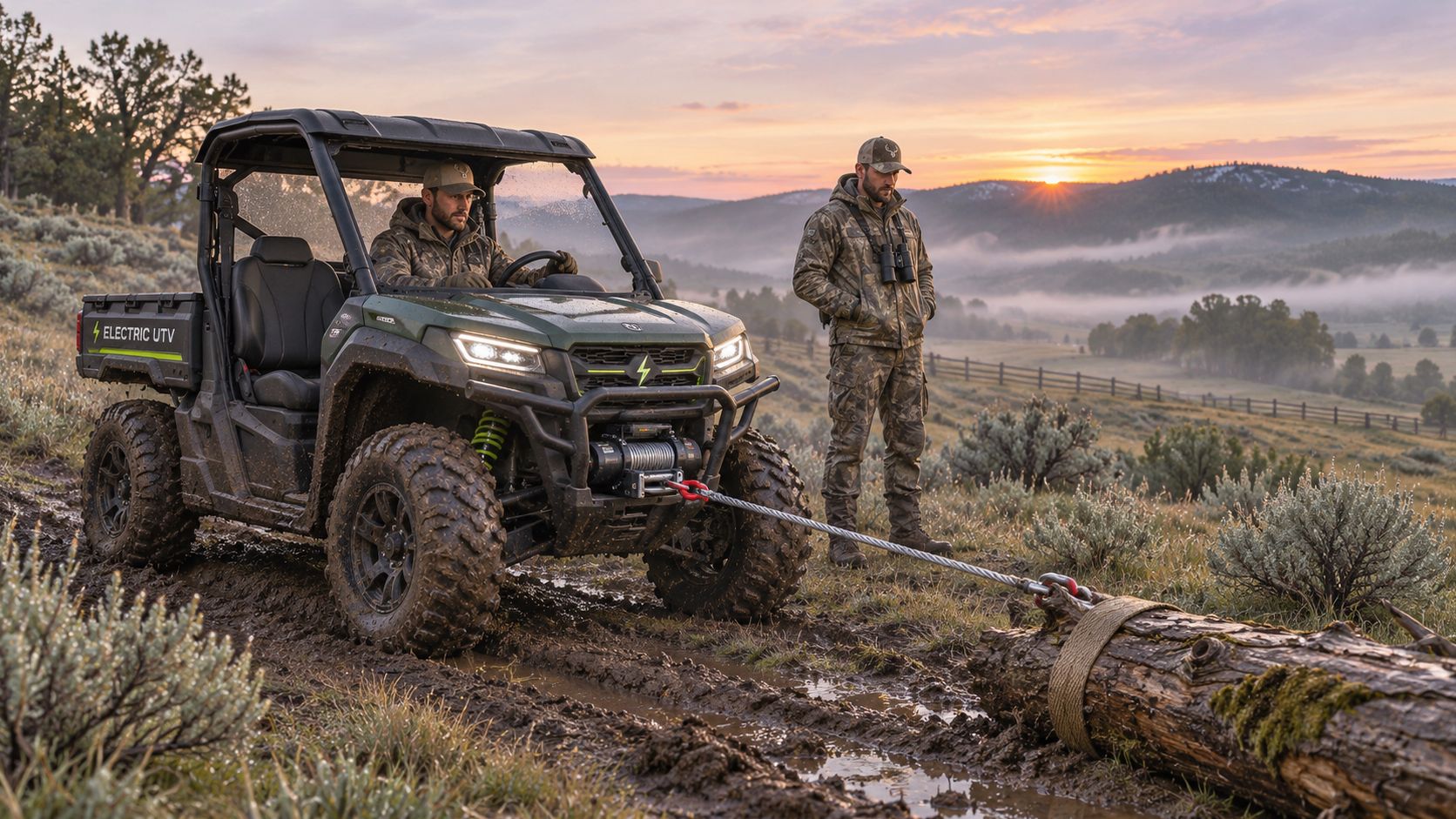
A motor that handles fifty-one weeks of light chores and quits on the week you needed it is the wrong motor, even if every other number looks better. That's the whole argument for sizing to the extreme rather than the mean.
What each user type should check first
| Use case | Main load | Energy priority | Motor check |
|---|---|---|---|
| Hunting access | Steady low-speed travel, occasional winch | Low energy per mile | Low-speed torque control and winch capacity |
| Farm chores | Short high-torque pulls and hauling | Energy per hitch job | Sustained torque under load and hitch rating |
| Ranch transport | Long distances, trailer towing | Full-day battery budget | Towing capacity and cold-weather range test |
| Warehouse work | Repeated starts, dump-bed loads | Battery percent per shift | Charging access and thermal limits |
| Job-site utility | Heavy loads on uneven ground | Energy per work task | Payload rating and traction on wet ground |
Rank your own priorities before you shop. If payload is the main concern, check towing and dump-bed capacity first and treat range as secondary. If distance matters most, build the energy budget per task first and let motor size follow. Hunters usually need quiet, low-speed control and enough winch to recover an animal or a stuck vehicle. Ranchers need the full-day budget plus a winter reserve. Warehouse and job-site users need to know how much pack one shift consumes and whether they can charge between shifts.
Five steps to a decision
- Write down the heaviest load and the longest working distance you'll cover, not the ones you'd like to.
- Convert that into battery energy using the work budget you logged, so you know the kWh the day demands.
- Note the coldest temperature you work in and apply the winter test before you commit.
- Confirm sustained torque and towing rating against that load, and ask what the motor holds continuously rather than at peak.
- Test drive on your own load, towing up a grade or running the winch, because that tells you more than any spec sheet.
As a worked example, take a machine built around a 20 kW permanent-magnet motor and a 72 V, 150 Ah pack. The pack's nominal 10.8 kWh sets the ceiling on the day, and the motor determines how confidently you use it. The Campus E1 fits that description: a 4×4 electric UTV with a 20 kW motor, a 72V 150Ah lithium battery, on-demand 2WD/4WD and an electric power dump bed, rated for up to 60 miles on a single charge. Treat that 60-mile figure the way you'd treat any range claim, as a starting point you verify against your own energy log.
Campus EV builds the Campus E1 around the exact problem this guide describes, pairing a 20 kW permanent-magnet motor with a 72V 150Ah lithium pack, on-demand 2WD/4WD and an electric dump bed so the machine's energy budget matches real hauling and towing work. Bring your trailer, your steepest grade and your coldest morning, and put the numbers to the test on your own ground. Visit Campus EV to find a dealer near you and book a test drive.