
The most popular advice on UTV winch accessories is to buy the biggest rating that will bolt on. That advice fails on an electric side-by-side. A winch is a low-voltage electrical load as much as it is a recovery tool. The high-voltage pack that drives the motor does not feed the solenoid, the remote, or the fuse. Extra capacity on the drum does nothing if the rope, block, shackles, and mount are not rated for the pull. A larger motor only cooks the 12-volt circuit if the wiring cannot carry the current.
I would start with three checks before any brand comparison: vehicle weight, a working-load limit on every piece of hardware, and a clean 12-volt supply. The rest of the kit exists to serve those three.
Table of Contents
- Winch Accessories at a Glance
- Sizing the Winch to Your UTV's Weight
- Rigging, Rope and Anchor Gear Rated for the Load
- Matching Accessories to Your Electric UTV's Wiring
- Choosing Accessories for Hunting, Farm and Property Work
- What a Complete Accessory Setup Costs
- Confirm Your Winch Setup Before You Buy
Winch Accessories at a Glance
Treat the kit as one system, not a pile of optional add-ons. The core kit is the winch, the rope, the hook, the mount, and the remote. Terrain and the kind of work decide the rest. Rated values beat brand names. A cheap block with a stamped working-load limit you can read is safer than a logo with no number on it.
| Accessory | Main job | Rating or fit check | Buy it when |
|---|---|---|---|
| Synthetic winch rope | Pulls the UTV out with less weight and easier handling | Rated at or above winch capacity; inspect for fraying | Standard on most kits; replace when frayed |
| Snatch block | Doubles pulling force in a 2:1 double-line pull | Working-load limit above the expected recovery force | Mud, snow, steep grades or heavy loads |
| Tree trunk protector and tree strap | Protects bark and carries load when anchoring to a tree | Strap and anchor rated for the pull | Any recovery that uses a tree |
| Fairlead | Guides rope evenly onto the drum | Matched to rope diameter | Rope bunches or wears at the drum edge |
| Hook and shackles | Connects rope to the anchor and the stuck vehicle | Rated at or above winch capacity | Always; replace the stock hook if its rating is unclear |
| Winch mount or bumper | Carries the winch and transfers load into the frame | Vehicle-specific and rated for the winch | Any new winch installation |
| Wired remote or controller | Runs the winch from a safe distance | Correct cable length and water resistance | When the operator must stand clear of the line |
| Rope damper or cable cover | Reduces stored-energy snap-back and protects the rope | Heavy enough to stay draped on the line for the whole pull | Recovery work and dusty or wet use |
| 12V wiring kit and fuse | Feeds power safely from the low-voltage system | Amperage and fuse size from the winch maker | Every installation on an electric UTV |
Synthetic rope is the pulling line, and the check is a rating at or above the winch plus a look for fraying before you spool out. A snatch block sets up a double-line pull, and its working-load limit has to sit above the force you expect. A tree strap with a trunk protector is the only acceptable tree anchor. A fairlead only earns its place when it matches rope diameter so the line lays flat. Hook and shackles connect the system, so an unmarked stock hook gets replaced. The mount moves the load into the frame, and a universal plate that does not match the bolt pattern is a failure point. A wired remote keeps you off the line. A damper stays on the rope so stored energy has somewhere to go. The 12-volt kit and fuse are not optional on an electric UTV.
Price the winch, the vehicle-specific mount, and the wiring kit first. Those three set cost and fit. Rope, block, and straps come after you know the drum and the bumper will fit the machine.
Sizing the Winch to Your UTV's Weight
Capacity is a vehicle-weight calculation. The U.S. Forest Service wildland-fire OHV standard recommends a winch with a single-line rating at least 1.5 times the vehicle's weight rating, because mud, slopes, rocks, and other resistance make recovery harder than a level pull. The same guidance says a snatch block on a double-line pull can reduce the load on the winch and cable by approximately half, provided the anchors, hardware, and rigging are up to the job.
Take GVWR from the owner's manual, not a brochure curb weight. Passengers, tools, and a full cargo bed are already inside that rating. A marketing "dry weight" will undersize the winch.
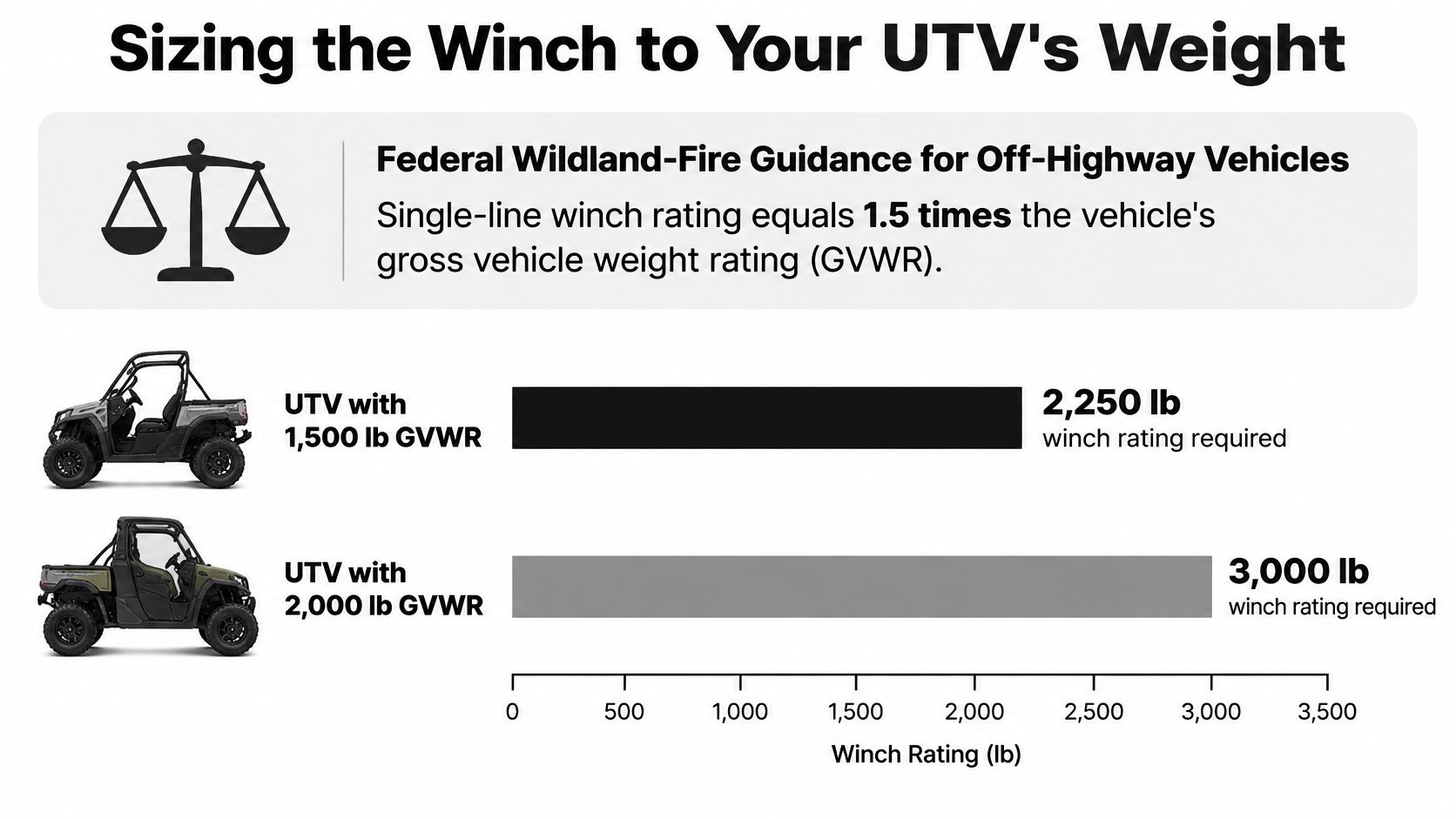
| UTV weight rating (GVWR) | Single-line winch minimum (1.5x) |
|---|---|
| 2,000 lb | 3,000 lb |
| 2,500 lb | 3,750 lb |
| 3,000 lb | 4,500 lb |
How to read a candidate spec sheet
A side-by-side with a 2,000-pound vehicle weight rating needs at least a 3,000-pound single-line winch under that Forest Service rule. The same machine, once you have a properly rated snatch block in the system, can be served by a winch closer to 1,500 pounds of single-line rating, because the block cuts the load on the winch roughly in half. Do not treat that reduction as a reason to buy an undersized drum and then skip the block. If the block stays in the toolbox, you are back to the full single-line number.
Find the single-line figure on the spec sheet and match it to the row for your GVWR. Reject anything below that row. Catalogs mix single-line and double-line numbers on the same page. If the listing does not say which one it is, do not buy it. A winch far above the rule adds weight on the nose, cost, and current draw without adding real safety on a pull you should never make past the rated limit. Steep ground changes how often you need that margin, which is why UTVs built for steep terrain belong in the same buying conversation as winch size.
Practical rule: If the sheet will not say "single-line," treat the number as unusable until the maker confirms it in writing.
Rigging, Rope and Anchor Gear Rated for the Load
A double-line pull changes the force path, not the laws of physics. You attach the snatch block to the stuck vehicle or the anchor, run the line through it, and bring the line back to the UTV. The winch then works through two parts of line. Energy Safety Canada recovery guidance.pdf) describes that 2:1 setup as theoretically doubling pulling force while cutting the load on the winch motor, which is exactly what you want in mud, snow, or on a steep section where rolling resistance climbs. Friction, line angle, anchor geometry, and whether the tires stay planted all eat into that gain. A higher-rated winch does not rescue an under-rated block, strap, shackle, or rope.
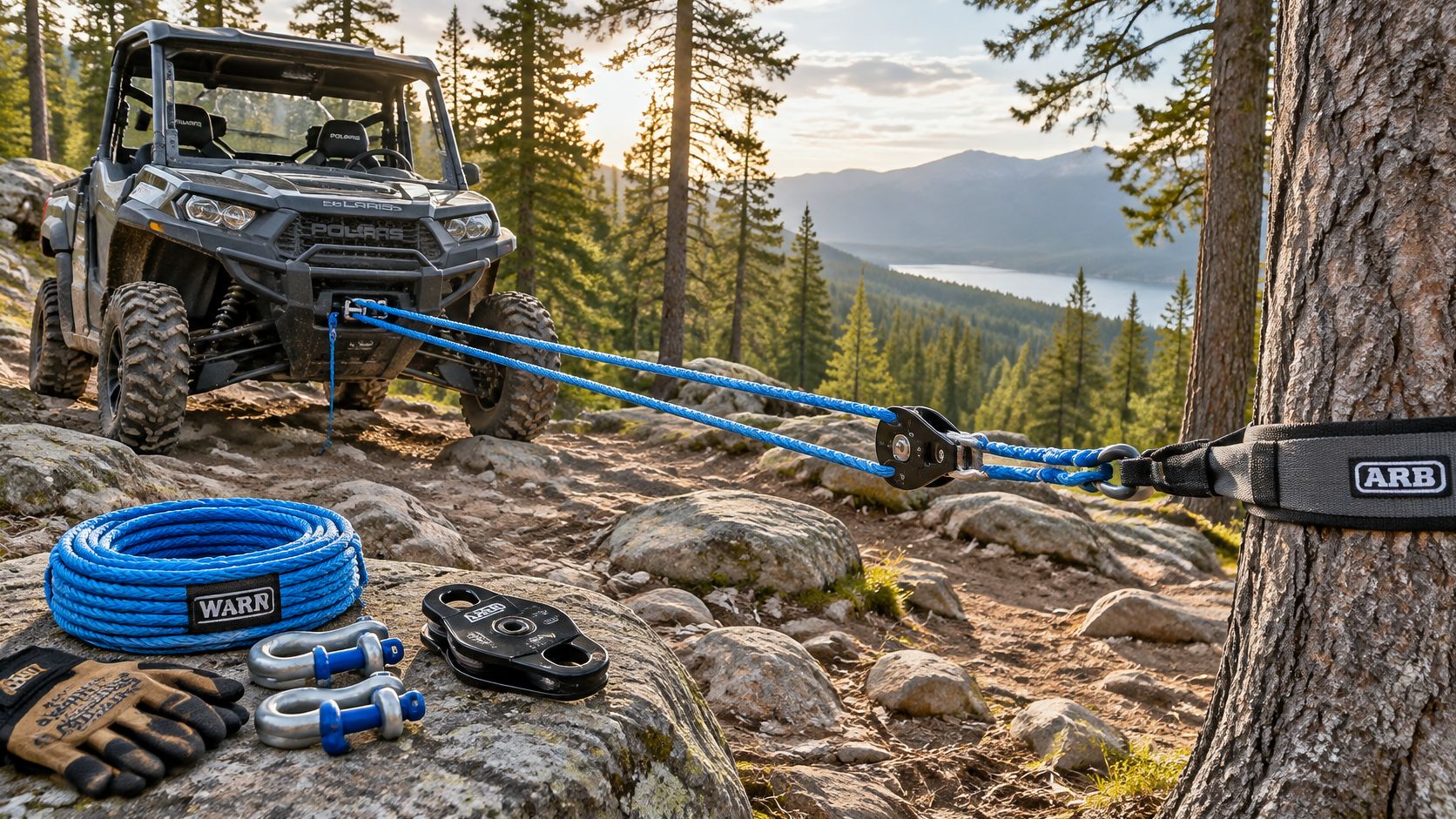
Rig the pull in this order
- Pick a rated anchor point. A thin bumper skin or a cargo tie-down is not an anchor.
- Attach the block to the stuck vehicle or to that anchor.
- Run the line through the block and back to a rated point on the UTV.
- Square the machine to the pull so the line does not leave at a sharp angle.
- Drape a damper over the line to cut stored-energy snap-back, and keep a controlled zone around it.
- Confirm the block, tree strap, shackles, mounting points, and synthetic rope each carry a working-load limit suitable for the expected force.
- Keep bystanders clear of the line for the whole pull.
The U.S. Fish and Wildlife Service ORUV policy points to the Forest Service wildland-fire standard, which limits a winch to vehicle recovery and rules out work such as moving logs. That standard sets required capacity at three-quarters of GVWR when a force-doubling device such as a snatch block is in the rig, and it prefers synthetic winch rope. The same policy says to fit a winch when the job makes an off-road utility vehicle likely to get stuck, requires the winch to meet the manufacturer's design for that specific vehicle, and notes that these machines are heavy enough that extra people may be needed if mechanical recovery fails.
Rope, hook, and the anchor side
Synthetic rope is lighter and easier to handle than steel, and it is the type that federal OHV standard prefers. Steel stores more energy, kinks, and can cut. Before each use, look for fraying, kinks, flattened strands, and damage near the hook. Hook, shackles, and fairlead are one set. Each connection should be rated at or above winch capacity, and the fairlead opening has to match rope diameter so the line spools evenly instead of stacking on one flange. On the anchor side, the tree strap carries the load and the trunk protector keeps the bark intact. Wrapping rope around a trunk cuts both the tree and the line.
A mount has to be the one approved for that vehicle. A plate that only shares a bolt pattern can still bend the bumper and unload the frame in the wrong place. Pack the rest of the recovery bag the same way you pack the winch, which is the point of a short list of off-road essentials rather than a random pile of hardware.
A short walk-through of a double-line recovery makes the line path easier to picture before you are standing in mud.
A winch that can drag a log is still the wrong tool for dragging a log. Recovery is the job. Material handling is not.
Matching Accessories to Your Electric UTV's Wiring
A big traction battery does not mean unlimited winch power. Electric side-by-sides run two electrical systems. The high-voltage traction battery drives the motor. The low-voltage 12-volt circuit powers the winch solenoid, the controls, and the lights. They are not interchangeable. Most accessory lists stop at a 2,500 to 3,500 lb winch, synthetic rope, a fairlead, a snatch block, a tree strap, and a hook. They skip whether the control wiring, solenoid, ground, fuse, and 12-volt accessory battery can live on a machine whose propulsion pack is high voltage.
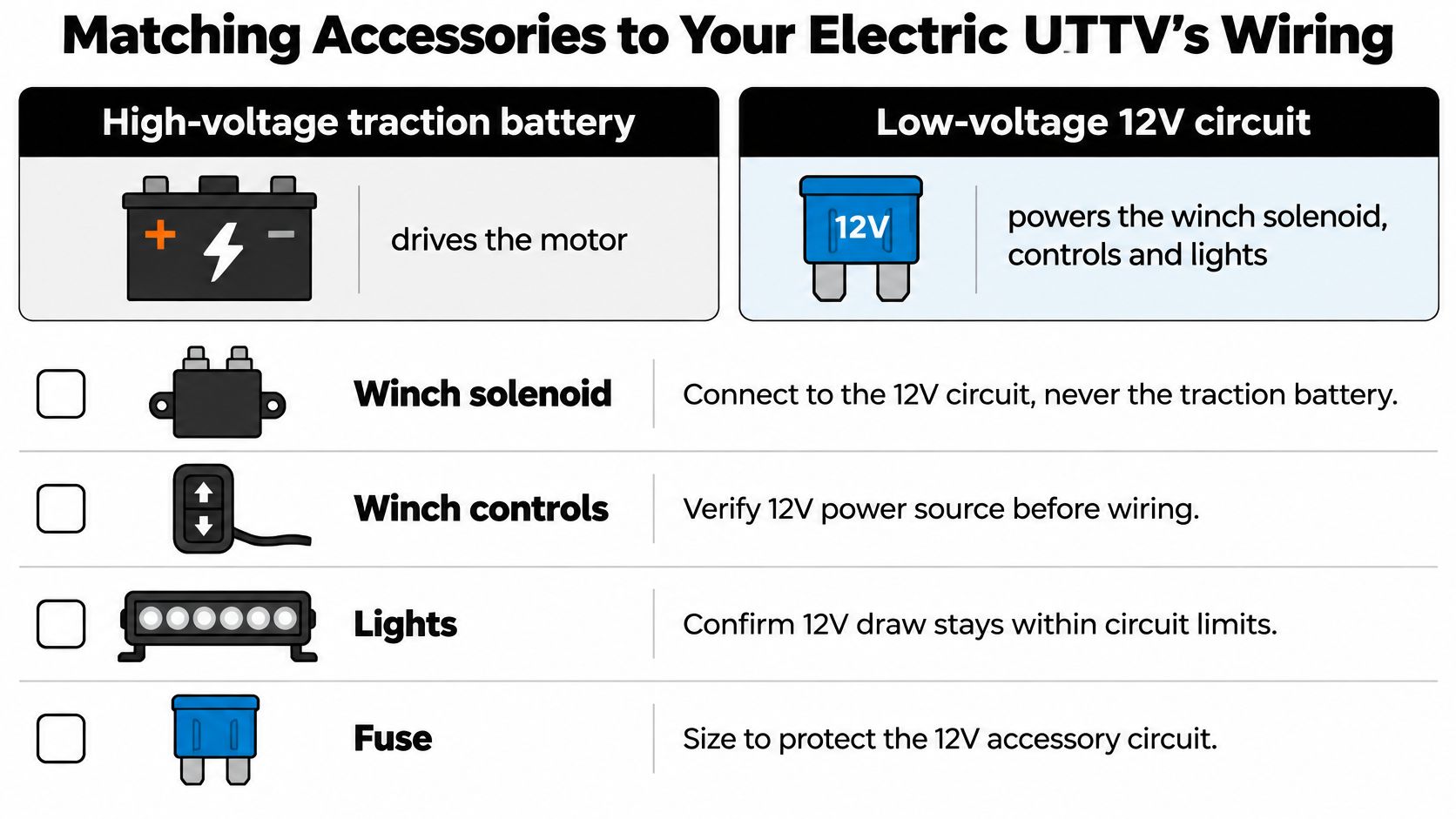
Standard winch instructions, including a typical Northern Tool winch manual, require connection to a clean 12-volt battery and warn against unsuitable accessories or wiring. Some electric UTVs already have a factory 12-volt converter that can feed that circuit. Others need an auxiliary 12-volt battery before the solenoid has a stable source. Guessing here is how you get a dead remote halfway through a pull.
Pre-install checks
- Read the winch manual for voltage and maximum current draw. Write both numbers down.
- Confirm the vehicle's 12-volt supply can carry that draw without sagging the rest of the accessory circuit.
- Match the solenoid, ground point, and fuse to the wiring kit. The fuse size comes from the winch maker, not from whatever blade fuse is already in the box.
- Use sealed connectors anywhere water, mud, or wash-down spray can reach the plugs.
- Check that the mount does not twist the frame or overload the battery tray. A strong winch on a weak tray is an electrical problem and a structural one.
- Get dealer approval before you drill or splice, so warranty coverage stays intact.
A larger winch is not automatically better. An accessory that exceeds the low-voltage supply or the mounting structure can cause electrical faults, overheating, or warranty trouble even when the advertised pulling number looks right. Hunters, farmers, and ranchers hit this gap most often, because a large traction pack feels like it should run anything bolted to the bumper.
Repeated high-current pulls also eat low-voltage energy. On a long work day that changes how you plan range. A second or third hard recovery is not the same load as cruising a trail. If the 12-volt side is already low, stop and switch to a double-line pull, a tow from another machine, or a charge, instead of holding the remote down until the solenoid chatters.
Choosing Accessories for Hunting, Farm and Property Work
The same winch does four different jobs. The accessories that earn their place change with the job. What does not change is the limit: this gear recovers the vehicle. It does not drag brush, skid logs, or winch a trailer onto a pad.
Hunting. A stalled climb or a mud hole on the way to a stand is the usual failure. Prioritize a wired remote so you can stand off the line in the dark, and a tree strap because the anchor is almost always a trunk. Synthetic rope stays manageable with gloves on, and a snatch block belongs in the bag for the one steep section that will not give up. Wireless-only control is the item I would skip here. Batteries die in cold blinds, and a cable does not.
Farm and ranch. The common pull is a machine sunk at a wet gate or a field edge, not a cliff extraction. Add a rope damper and a fairlead that keeps the line from sawing the drum flange while you inch out of ruts. A rated hook matters more than a longer rope. Leave the winch off fence posts, gates, and implement tongues. Those pulls side-load hardware that was never the anchor.
Property recovery. Distance and weather beat raw capacity. Spend on a mount and a wiring kit that stay sealed in dust and rain, then add rope length for a pull that starts farther from a solid anchor. A shiny bumper with open connectors fails the first time you wash the machine.
Crews on job sites and yards. The winch itself matters less than a clean electrical install and a rated package. Shared machines get abused. Label the fuse, keep the remote in one pocket of the cab, and do not let a helper "just hook to whatever is close."
Recovery is the job on all four lists. Rate the gear for the pull, and confirm it fits that exact UTV before the first time you need it.
If the season is mostly woods and field edges, start with the hunting set and add farm pieces only after the remote, strap, and rope are settled. A fuller look at what belongs on a hunting side-by-side sits with UTV hunting accessories, separate from the recovery bag.
What a Complete Accessory Setup Costs
Listed prices are a starting map, not a quote. Read capacity and what the box contains before you compare a number on a webpage.
| Product | Capacity | Listed price | Source |
|---|---|---|---|
| WARN VRX 25 powersport winch kit (Kawasaki) | 2,500 lb | $758.00 MSRP | Kawasaki listing, 2026 |
| Smittybilt XRC ATV/UTV utility winch | Not stated on the listing | From $189.99 | NAPA Auto Parts listing, 2026 |
| KFI Assault UTV winch | 5,000 lb | $479.00-$494.00 (previous price) | UTV Direct listing, 2026 |
Kawasaki's 2026 listing puts a WARN VRX 25 powersport winch kit at an MSRP of $758.00, and that kit includes a 2,500-pound winch, a vehicle-specific mount, and wiring. You are paying for fit, not only for a drum. NAPA Auto Parts listed a Smittybilt XRC ATV/UTV utility winch from $189.99 in 2026. That listing does not state capacity, so the low price is not comparable until you read the spec sheet. UTV Direct listed a KFI Assault UTV winch at 5,000 pounds with a previous price of $479.00 to $494.00 in 2026.
Cycle Gear stated in 2026 that ATV and UTV winches are commonly rated from 2,000 to 4,500 pounds, with heavier side-by-sides generally needing more capacity. A 5,000-pound unit sits above that usual band. It can be the right call for a heavy machine. It is extra cost and extra current on a lighter one that already clears the weight rule.
A bare winch price often leaves out rope, hook, snatch block, and remote. Budget those as separate lines unless the kit names them. Mounts and vehicle-specific wiring move the total more than a different hook finish does. Listed prices change, so confirm them at purchase rather than treating a 2026 shelf price as a standing quote.
Confirm Your Winch Setup Before You Buy
Buy the package that survives six checks, not the package with the largest number on the box. I would not order a winch until every line below is answered for the exact machine.
- Find the GVWR in the owner's manual.
- Set the single-line minimum from that figure using the weight rule, and reject any listing that will not say whether its number is single-line.
- Add a snatch block rated for the expected force if mud, snow, or steep ground is likely.
- Match rope, hook, shackles, and fairlead to the winch rating, and throw out any hook whose rating you cannot read.
- Confirm 12-volt wiring, fuse, and sealed connectors against the winch maker's specification, and clear the install so warranty terms stay intact.
- Compare the price of the complete package, including mount and wiring, not the winch alone.
Keep that list with the owner's manual. If you change bumpers, add cargo, or swap the rope, run the list again. Our Campus E1 carries a 3,000 lb winch, which is a useful reference point only after you have put your own GVWR next to it. The next action is a dealer, not another tab of parts. Find a Campus EV dealer near you, have the winch, mount, and wiring fitted to that specific UTV, and confirm the installation and warranty terms before the first pull.
Campus EV builds electric UTVs for hunting, farm, ranch, and property work, including side-by-sides that leave the factory with a recovery winch already in the plan. If you are matching rope, mounts, and 12-volt wiring to an electric machine, start with the vehicle rather than a generic powersport kit. Visit Campus EV to compare the lineup and book a dealer visit before you buy the rest of the recovery bag.