
A side-by-side is an off-road vehicle where passengers sit next to each other instead of straddling like a motorcycle, typically with a steering wheel, pedals, a cargo bed, and room for two to six people. In engineering terms, it's a non-straddle-seat vehicle with at least four wheels, a steering wheel, pedals, and a top speed of at least 25 mph, while common standards also set limits for width, gross vehicle weight, and cargo capacity (engineering definition and standard details)).
You may be looking at one because an ATV feels too cramped, a pickup truck is too large for narrow trails, or a golf cart doesn't have the traction and carrying ability your property demands. The name sounds simple, but it creates a common buying problem. “Side-by-side” describes the seating layout first, while “UTV” usually describes a utility-focused class of off-road vehicle. Those terms overlap, but they don't tell you whether a machine is built mainly for hauling, hunting, trail riding, or a jobsite.
Table of Contents
- The Side-by-Side in Plain English
- Where the Side-by-Side Came From
- The Four Classes of Side-by-Side
- Electric vs Gas Powertrains
- The Specs That Actually Matter
- Real-World Jobs a Side-by-Side Handles
- Safety Gear and Legal Basics
- Picking the Right Side-by-Side for Your Work
The Side-by-Side in Plain English
Start with the seats. On a side-by-side, the driver and passenger sit beside each other, like they would in a small car. An ATV, by contrast, uses a straddle seat, with the rider sitting astride the machine. A conventional car places passengers in rows, one behind another. The side-by-side format gives you a shared front cabin, easier conversation, and a more familiar driving position.
The simplest comparison is a neighborhood golf cart crossed with a small pickup truck. You get a steering wheel, gas and brake pedals, a gear selector, and usually a bench or bucket seat. Behind the occupants sits a cargo bed, which may carry tools, feed, hunting equipment, or maintenance supplies. Some models seat two people, while others add a second row and carry more passengers.
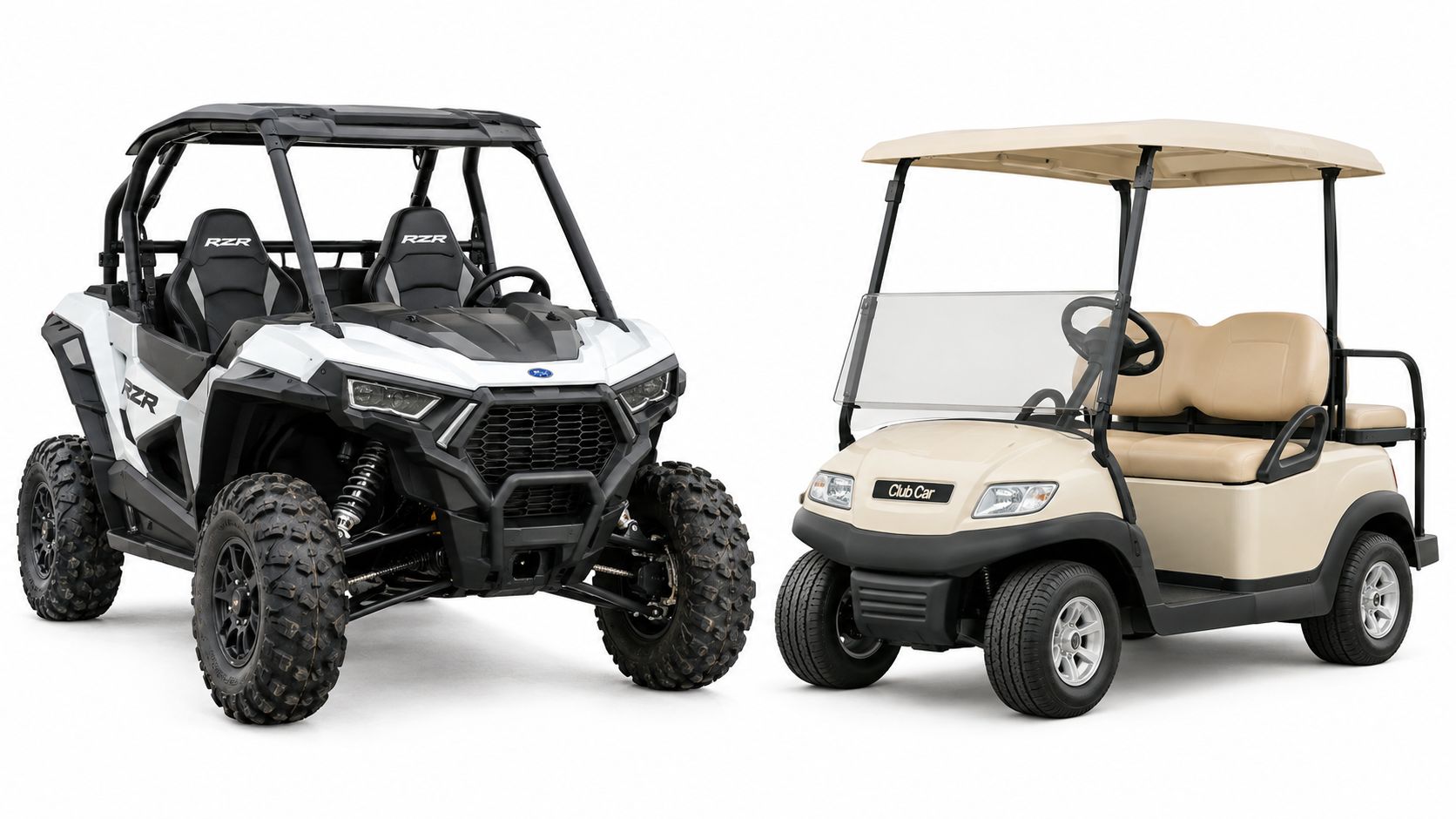
That layout explains why first-time drivers often find a side-by-side approachable. You don't need to balance the machine with your body as you would on an ATV, and you don't need to learn a motorcycle-style control arrangement. You steer, accelerate, brake, select the appropriate drive mode, and keep everyone belted into the protective structure.
Practical rule: The seating arrangement tells you what a side-by-side is. The bed, suspension, drivetrain, and legal equipment tell you what that particular side-by-side can do.
The same basic shape can serve four very different jobs: recreation, farm and ranch work, hunting, and worksite utility. A trail-focused model may give up bed space for suspension travel. A farm machine may do the opposite, prioritizing payload, towing, and durability over speed.
Where the Side-by-Side Came From
The modern UTV grew from a longer history of compact off-road utility vehicles. After World War II, the Willys Jeep showed how a small four-wheel-drive platform could carry people and cargo while moving across rough ground. That idea influenced later work vehicles designed for farms, properties, and industrial settings.
Earlier experimental machines also appeared in the 1970s, including the Lockley Wrangler, which some histories identify as an early side-by-side concept. These vehicles helped establish an important transition. Small off-road machines were moving beyond military inspiration and recreational experimentation toward dedicated commercial products.
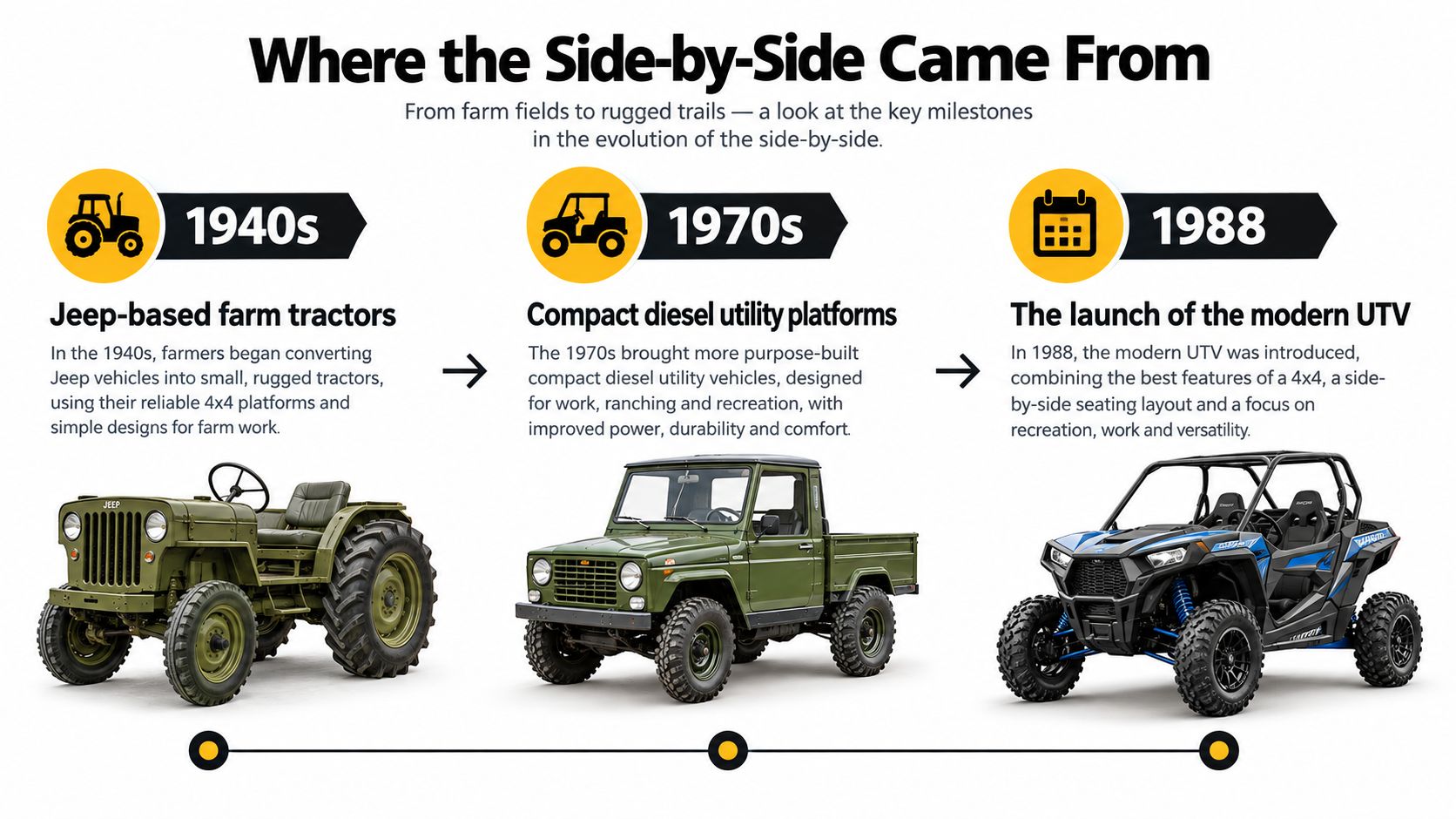
The major milestone came in 1988, when Kawasaki introduced the Mule 1000. Industry histories commonly describe it as the first modern utility side-by-side. Its two-seat arrangement and cargo-focused design gave manufacturers a clear commercial template, one that could serve farms, factories, resorts, and hunting properties (side-by-side history).
From there, the category split into distinct directions. Some manufacturers developed sport machines with more suspension travel and stronger trail performance. Others stayed focused on utility, adding practical beds, towing equipment, and work-oriented drivetrains. The newer enclosed-cab approach extends that same utility logic into colder, hotter, dustier, and more demanding workplaces.
Today, the key question isn't whether a vehicle looks like an old utility cart. It's whether its design matches the operator's daily environment. An open-cab trail machine and an enclosed work vehicle may share the same side-by-side seating arrangement, but they serve very different buyers.
The Four Classes of Side-by-Side
Manufacturers use different labels, but four broad classes make comparison easier. Look at seating, suspension travel, cargo capacity, and intended use, rather than relying on the badge alone.
| Class | Seating | Suspension | Cargo / Tow | Best For |
|---|---|---|---|---|
| Recreation | Usually two to four | Moderate travel with comfortable trail handling | Limited to moderate cargo | Casual trail riding and property exploration |
| Utility | Two or more, often with a bench | Tuned for stability and durability | Larger bed, tow hitch, stronger work focus | Farms, ranches, hunting, and jobsites |
| Sport | Usually two | Long travel with aggressive trail control | Limited bed space and less work emphasis | Dunes, desert runs, and performance riding |
| Crossover | Two to several occupants | Trail-capable without abandoning utility | Useful bed and practical towing ability | Buyers combining weekend recreation with work |
A recreation side-by-side generally gives you a balanced ride and enough room for passengers, but its cargo area may be secondary. It suits someone who wants to explore trails or move around a large property without demanding heavy hauling every day.
A utility model makes the bed and hitch central to the design. It may use bench seating, a dumping bed, selectable two- or four-wheel drive, and suspension chosen for stability under load. The practical distinction is simple: utility machines are built around the question, “What do I need to carry or pull?”
Sport models reverse that priority. They use long-travel suspension, aggressive tires, and powerful engines to handle fast or technical riding. The tradeoff is less room for tools, feed, or bulky equipment.
A crossover sits between those extremes. It can handle a trail day without feeling like a slow work cart, while still carrying enough equipment for property jobs. Buyers who want one machine for Saturday recreation and weekday maintenance often start here.
Electric vs Gas Powertrains
The power source changes how a side-by-side behaves during an ordinary workday. Electric and gas machines can both be useful, but they suit different operating patterns.
Electric drivetrains deliver torque immediately when the accelerator moves. That response helps with low-speed starts, repeated stops, ramps, and careful hauling around buildings. They also operate without noise, which can matter near livestock, public spaces, residential areas, warehouses, and event grounds. A lithium-powered electric work UTV can make sense for predictable routes with regular access to charging.
Gas machines remain practical when the work takes you far from buildings or fuel storage. Refueling is quick, and a gas side-by-side is often the straightforward choice for remote hunting trips, long trail days, and ranch work spread across a large property. A larger gas engine can also suit buyers who need sustained towing away from charging infrastructure.
| Dimension | Electric UTV | Gas UTV |
|---|---|---|
| Torque delivery | Immediate response at low speed | Strong response, depending on engine and gearing |
| Range or runtime | Best for planned routes and charging access | Suits long, remote trips and quick refueling |
| Payload work | Well suited to stop-and-go hauling | Useful for extended heavy-duty operation |
| On-site noise | Quiet operation | Noticeably louder engine and exhaust |
| Maintenance burden | Fewer engine-related service tasks | Requires fuel, oil, and engine maintenance |
Choose by route, not fashion: Short routes, frequent stops, and noise-sensitive sites point toward electric. Long distances, remote fuel access, and extended towing point toward gas.
Before comparing models, read a practical guide to electric side-by-side ATVs so the seating layout, utility role, and electric drivetrain don't get blurred together. The right choice depends less on the label and more on where the vehicle will spend its working hours.
The Specs That Actually Matter
A spec sheet can bury the useful information under horsepower figures and accessory lists. Start with the load your job creates, then work outward.
Torque and carrying ability
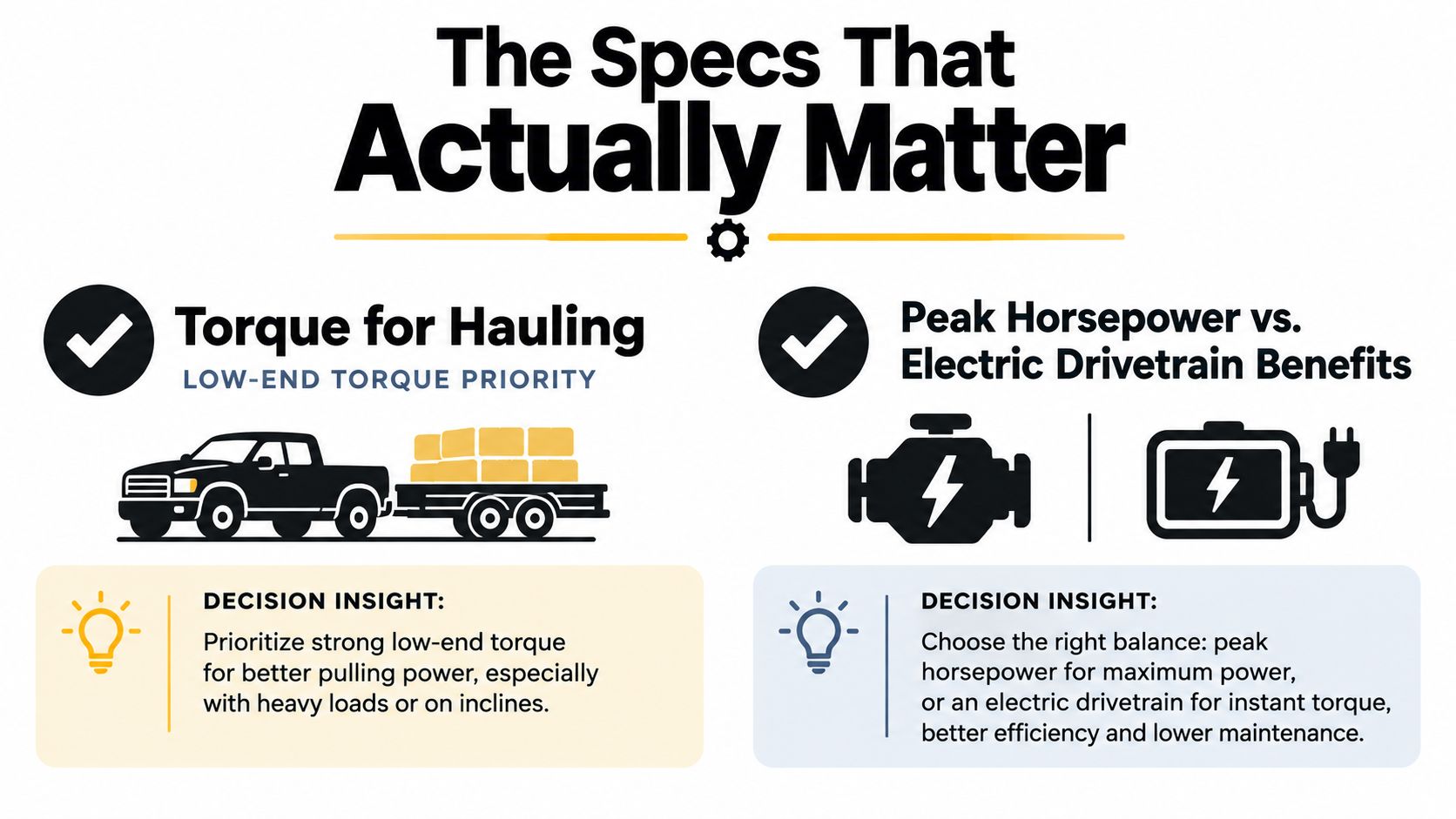
For hauling or towing, low-end torque matters more than peak horsepower. Torque affects how confidently the vehicle starts with a loaded bed or trailer. Electric drivetrains are especially responsive at low speeds, while gas machines depend more on engine size, gearing, and drive mode.
Next, check payload and towing capacity. Payload is the weight the vehicle can safely carry in the bed and cabin. Towing capacity is the weight it can pull through the hitch. Don't compare a large brochure number with your needs in the abstract. Add the occupants, tools, materials, and accessories you expect to carry.
Government procurement specifications illustrate the type of equipment buyers may require, including 2,500 lb of towing, 1,200 lb of hauling, selectable two- and four-wheel drive, and independent front and rear suspension (example procurement specifications). Those figures belong to the specified procurement requirements, not every side-by-side.
Clearance, dimensions, and daily fit
Ground clearance and approach angle decide whether the machine crosses ruts, rocks, and shallow obstacles without striking underneath. For a rough pasture, fixate on clearance at the lowest point. For a trailer or storage shed, measure overall width and height before you buy.
Bed dimensions matter as much as payload. Published UTV cargo boxes range from approximately 29.5 by 45.2 by 10.6 inches to 38 by 54.5 by 12 inches, so two vehicles with similar carrying ratings may accept very different loads (published UTV dimensions). If you carry feed bags, fencing supplies, bins, or a cooler, measure those items first.
Finally, check seating, hitch type, drive modes, and expected range or runtime. The number to prioritize is the one tied to your work: payload for materials, towing for trailers, bed dimensions for bulky loads, clearance for rough ground, and runtime for a full shift.
Real-World Jobs a Side-by-Side Handles
A side-by-side earns its place when it removes repeated walking, lifting, or truck repositioning from a workday. The best match depends on the route and load.
On a ranch or large property, a utility-class machine with a practical cargo bed and strong hitch handles fence inspections, feed runs, tools, and property checks. Selectable four-wheel drive helps when the surface changes, but the bed and towing rating usually matter more than a sporty suspension setup. A buyer comparing farm machines can also use this guide to the best farm UTV as a starting point for matching utility features to daily chores.
Hunting creates a different brief. A midsize recreation or crossover model may be easier to place on narrow trails, while range, roof coverage, and storage racks determine whether the machine remains useful once you load equipment. Hunters who need dependable communication across separated vehicles or a large property may also benefit from planning an UHF radio installation for 4WD, particularly where mobile coverage is unreliable.
A construction yard needs a vehicle that carries a worker and materials without turning every short trip into a pickup-truck maneuver. A utility side-by-side with a protective structure, dump bed, and suitable hitch can move tools, fasteners, and supplies between work areas. The useful question is not whether it looks rugged. Ask whether the bed accepts the items your crew moves every day.
On a campus, warehouse, or grounds route, an electric work UTV can reduce noise around pedestrians and buildings while handling facilities checks, security patrols, and maintenance runs. Predictable loops, frequent stops, and indoor or near-building operation favor electric power, provided the charging plan fits the shift.
Safety Gear and Legal Basics
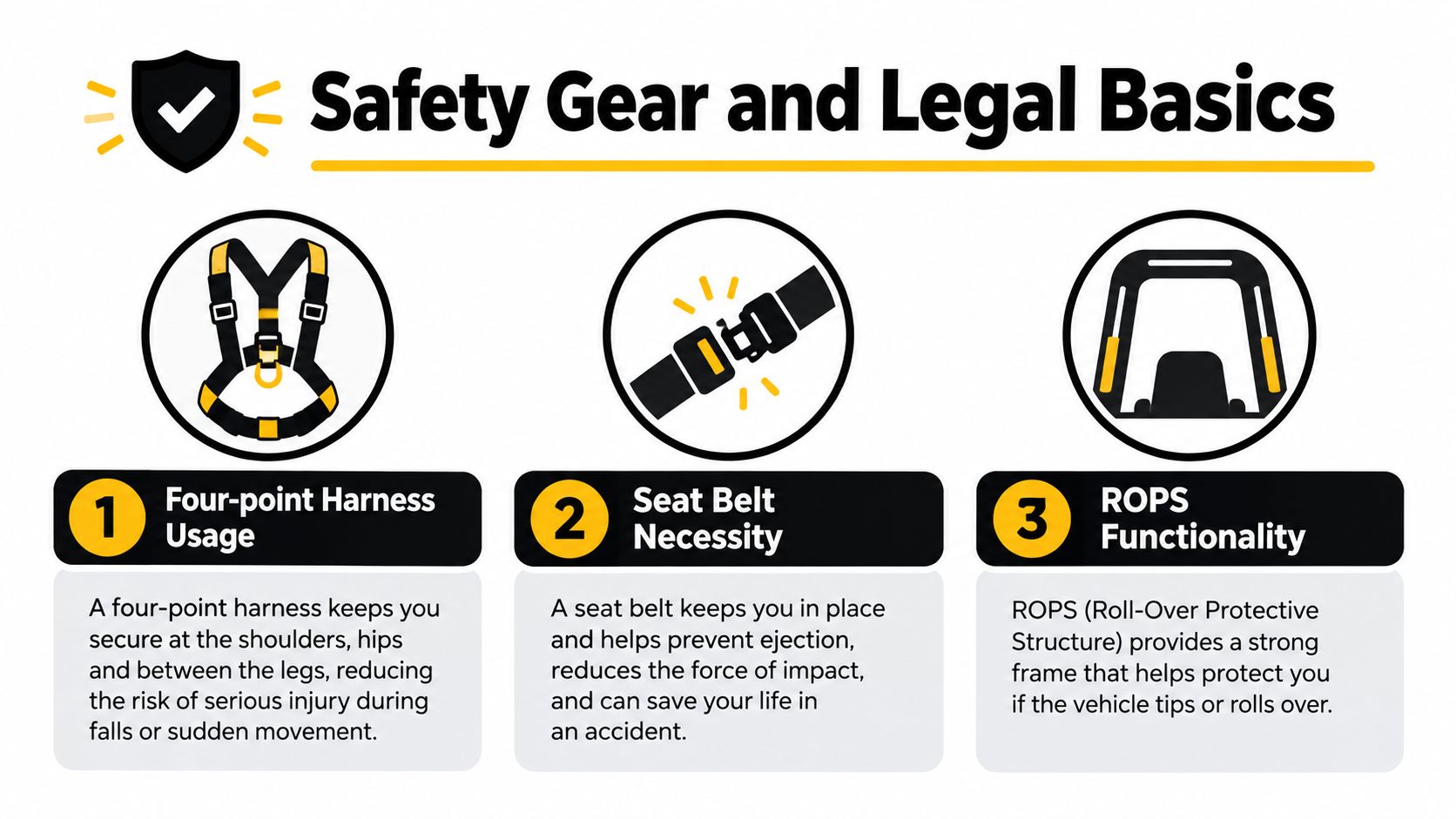
A side-by-side gives occupants a protective cage, but the cage can't protect someone who isn't secured inside it. The ROPS, or rollover protective structure, works with the seat belt or harness. Every rider should remain seated and belted, even during a slow trip across familiar ground.
A practical setup includes:
- Seat belt or four-point harness: Use the restraint installed or approved for that vehicle, and keep it fastened whenever the machine moves.
- Helmet: Use a DOT-approved helmet when rules require it, for younger riders, or when an open-cab vehicle is traveling over rough terrain.
- Eye protection: Goggles or a face shield keep dust, branches, and debris away from the eyes.
- Foot and hand protection: Closed-toe boots and gloves improve control and protect against common trail and worksite hazards.
Passenger and operator rules vary by jurisdiction, park, and vehicle type. Many parks don't allow passengers under 12 in front seats, restrict operators under 16 without supervision, and apply stricter requirements to youth models. Treat those as common rules to verify, not a universal substitute for local law.
Road use creates another trap. Most side-by-sides remain OHV vehicles for private land, approved trail systems, or limited farm crossings. Some jurisdictions allow restricted low-speed or neighborhood operation, while others don't. Check registration, lighting, insurance, helmet, and equipment requirements before entering a public road.
Hands-on training can be more valuable than reading another manual. Courses associated with organizations such as ROHVA or DirtWise can help operators practice hill control, controlled turns, braking, and obstacle awareness before a mistake happens on a slope.
Picking the Right Side-by-Side for Your Work
Choose the machine by answering five questions in order.
- What is the primary job? Ranch chores and construction point toward utility. Trail riding points toward recreation or sport. Mixed use usually points toward crossover.
- How far does it travel in a day? Short, repeatable routes can suit electric power. Remote properties and long trail days often favor gas.
- How many people ride along? Two-seat and multi-seat layouts solve different problems, but extra seats can reduce bed space and change the machine's footprint.
- What payload and towing ability are essential? Write down the heaviest regular load, the trailer weight, and the largest item that must fit in the bed.
- Where will it run? Private land, public trails, campuses, warehouses, and jobsites can have different safety, access, and road-use requirements.
A cattle operation covering a large property and pulling a bale feeder should begin with a torque-focused utility profile, a long bed, and a hitch matched to the trailer. A vineyard that needs quiet row coverage may prefer an electric utility vehicle because low noise and predictable routes matter more than remote refueling.
Buyers commonly overspend in three places. They choose sport suspension for a slow jobsite, skip an enclosed cab and heater despite working through changing weather, or ignore bed dimensions while focusing on a headline payload figure. If the machine will carry boxes, bins, fencing materials, or tools, compare those measurements directly. For truck and equipment planning around landscaping work, reviewing work trailer specs for landscaping can also help you think in terms of real load dimensions rather than abstract capacity.
A used gas machine can be the rational choice when fuel access is easy, the route is remote, and the vehicle has a serviceable maintenance history. A purpose-built electric work UTV such as the Campus E1 may fit daily campus, warehouse, or grounds work where routes are predictable, noise matters, and avoiding routine fuel handling is useful. Review available utility ATVs for sale only after you know the work profile you need to match.
The short version is simple. Side-by-side names the seating arrangement. Class tells you whether the vehicle leans toward recreation, utility, sport, or crossover. Powertrain determines how it handles distance, noise, torque, and refueling. The right machine is the one whose bed, seats, suspension, drivetrain, and legal equipment match the job you perform.
Campus EV offers electric UTVs, including the Campus E1 electric side-by-side, for utility-focused routes around campuses, warehouses, farms, and grounds operations. Visit Campus EV to review the available electric powersports range and decide whether a quiet, predictable electric work vehicle fits your daily needs.