
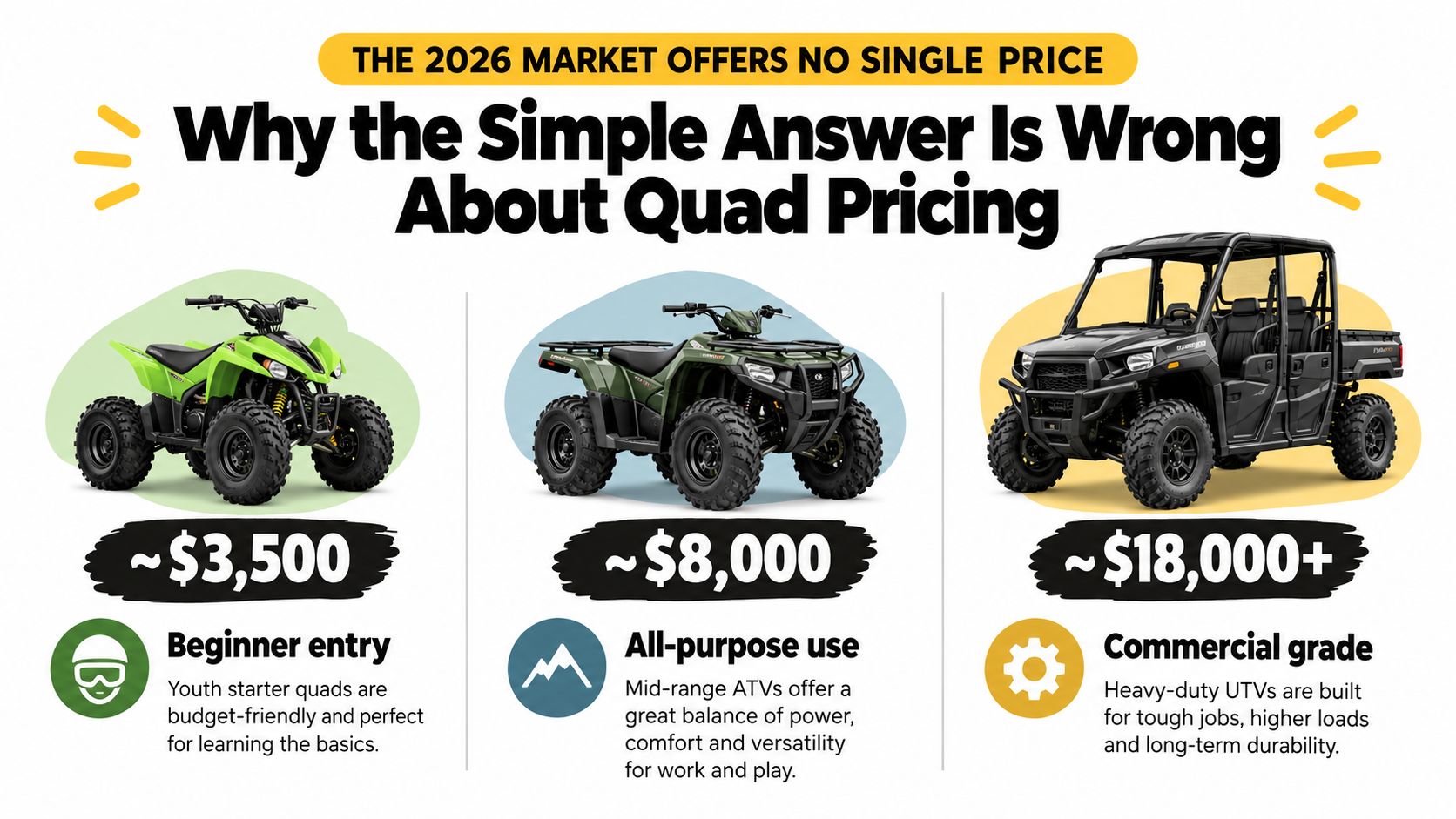
Youth ATVs cost around $2,500–$3,750, adult utility quads commonly run $6,000–$11,500, and larger heavy-work machines reach $14,000–$18,000+. But the sticker price is only the first part of answering how much a quad really costs, because fuel, maintenance, downtime, and equipment can change the final bill.
Most price guides stop at the dealer window. That advice works only if you're buying a machine for occasional recreation and don't care what it costs to keep running. Farmers, ranchers, hunters, construction crews, and warehouse operators need a more useful answer. They need to know what the machine can carry, pull, survive, and cost each time it goes to work.
Table of Contents
- Why the Simple Answer Is Wrong About Quad Pricing
- What Really Drives Quad and UTV Prices
- Gas ATVs Versus Electric UTVs in Real-World Cost
- The Hidden Ownership Costs Most Buyers Miss
- Where and How to Buy a Quad Safely in 2026
- Choosing the Right Quad for Your Actual Workload
- Final Steps to Make a Confident Quad Purchase Decision
Why the Simple Answer Is Wrong About Quad Pricing
The popular advice is to search for one average quad price. That's the wrong starting point. A small youth ATV, a recreational trail machine, an adult utility quad, and a two-seat UTV may all appear under the same casual search term, but they serve different jobs and occupy very different price bands.
Recent market data shows youth ATVs starting around $2,500–$3,750, adult utility models commonly costing $6,000–$11,500, and larger 850cc–1000cc or 6×6 machines reaching $14,000–$18,000+. See the four-wheeler price breakdown for the market ranges behind those categories.
The sticker price answers only one question
The purchase price tells you what the dealer or seller wants before you add the rest. Your real budget also includes delivery or destination charges, dealer preparation, financing, registration, insurance, accessories, service, tires, fuel or charging, and repairs.
Those costs don't affect every buyer equally. A hunter who rides short distances on weekends may care more about purchase price and storage. A rancher who uses a vehicle every working day should care about reliability, service access, carrying ability, and the cost of taking a machine out of service.
Practical rule: Buy for the work you'll actually do, not for the lowest number in a search result.
A cheap quad can be good value when the workload is light and the machine has a sound service history. It becomes expensive when an undersized drivetrain, weak cargo setup, or neglected maintenance forces you to repair, replace, or rent equipment later. The right question isn't "how much is quad?" It's "which quad gives me the required capability at a manageable ownership cost?"
What Really Drives Quad and UTV Prices
A quad's price usually reflects capability rather than arbitrary markup. Engine size matters, but it isn't the only factor. Drivetrain, suspension, frame strength, cargo design, towing equipment, warranty support, and parts availability can matter more once the vehicle leaves the showroom.
A recreational machine may be light and responsive on trails. A farm or ranch utility model needs different hardware, such as practical cargo racks, selectable drive modes, underbody protection, a winch mount, and compatibility with work attachments. A larger machine can cost more because its components are designed to tolerate heavier loads and rougher daily use.
Read the specification as a work requirement
Start with the job, then inspect the specification:
- Load and towing: Match the vehicle to the trailer, sprayer, feed, tools, or materials you intend to move. A machine that struggles under routine loads wastes time even if its purchase price looked attractive.
- Terrain and traction: Two-wheel drive may suit maintained ground, while loose soil, mud, slopes, and uneven fields can justify selectable four-wheel drive and a locking differential.
- Suspension and clearance: Better suspension improves control and comfort over broken ground. Ground clearance helps with obstacles, but it doesn't remove rollover risk.
- Protection and accessories: Skid plates, a winch, racks, a cargo box, and weather protection can be useful, but price them before comparing vehicles.
- Service support: A nearby dealer and readily available parts can be worth more than a small saving on a machine that requires long-distance transport for basic repairs.
The broader category has enough scale to support many vehicle types. One market estimate values the global ATV market at USD 4.77 billion in 2024 and projects USD 6.01 billion by 2030, implying a 4.0% CAGR from 2025 to 2030. Those are projections, and market estimates vary, but they show why manufacturers continue to offer everything from recreational quads to work-oriented side-by-sides. The figures come from this ATV and quad market estimate.
The term UTV also covers a different driving experience. A side-by-side normally gives occupants a seat, steering wheel, pedals, and more room for tools or cargo. For a plain-language explanation of that distinction, see what a side-by-side is. Electric versions add further variables, including battery capacity, charging arrangements, duty cycle, and replacement planning. Their higher or lower value depends on how the vehicle is used, not on the power source alone.
Gas ATVs Versus Electric UTVs in Real-World Cost
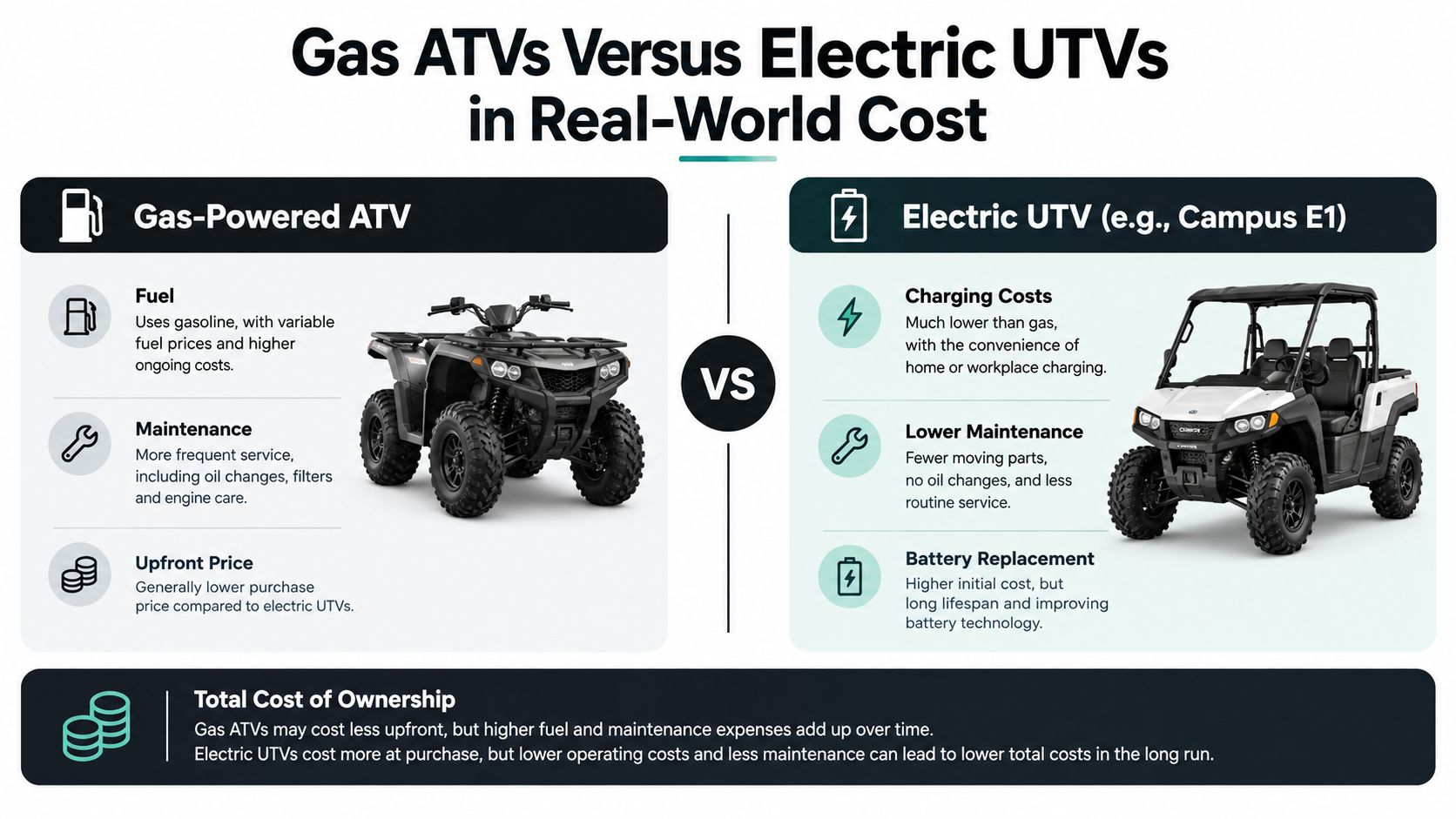
Gas remains familiar because fuel is widely available, refueling is quick, and most powersports dealers know the mechanical systems. A gasoline ATV or UTV can also make sense where work happens far from electrical service or where long, unpredictable operating days are common.
The purchase price is only one side of that choice. Gas equipment needs engine oil, filters, spark-related service, fuel-system care, and mechanical attention across its working life. Fuel use also rises when the vehicle carries loads, climbs slopes, idles, or spends long days moving between jobs.
The operating profile changes the calculation
An electric UTV typically asks for more planning at purchase. You need to understand charging access, expected range for the route, battery warranty terms, and what happens when the battery eventually needs service or replacement. Those questions matter more than a quiet showroom test ride.
In return, an electric drivetrain has fewer routine mechanical service items than a gas engine. It doesn't need engine oil changes, and it can operate without tailpipe emissions. That may suit properties where noise disturbs livestock, wildlife, neighbors, or workers.
| Cost area | Gas ATV or UTV | Electric UTV |
|---|---|---|
| Purchase decision | Familiar technology and broad dealer choice | Battery size, charging, and warranty need closer review |
| Routine service | Engine fluids, filters, belts, and combustion-related checks | Fewer drivetrain service tasks, with battery and electrical checks |
| Daily energy | Fuel purchases and refueling | Electricity and charging access |
| Work fit | Strong choice for remote or unpredictable routes | Useful for quiet, repeatable routes with charging available |
| Long-term risk | Mechanical wear and fuel exposure | Battery aging and replacement planning |
The comparison isn't “gas is bad, electric is good.” A gas machine may be the sensible tool for remote work with no reliable charging. An electric vehicle can be the more practical option for repeatable property rounds, facilities, hunting land, or light utility work where quiet operation and low routine maintenance matter.
For buyers comparing a traditional ATV with a work-focused electric vehicle, electric side-by-side ATV options provide a useful category reference. Review the actual duty cycle before deciding. The vehicle that costs less on day one may not cost less after repeated fuel, service, and downtime.
The Hidden Ownership Costs Most Buyers Miss
The first payment gets attention because it's visible. Ownership costs arrive in smaller bills, which makes them easier to ignore until the quad has been working for a while. A machine used around a farm, ranch, jobsite, or warehouse can accumulate costs through fuel, service, tires, storage, insurance, registration, attachments, and lost working time.
Don't assume every owner faces the same bill. Local rules affect registration and insurance, while terrain and workload determine tire wear, brake use, suspension stress, and drivetrain strain. The useful approach is to build a personal operating budget before you compare two vehicles.
Build the budget around your working day
Write down the costs that apply to your use:
- Energy: Estimate how often you'll refuel or charge, then compare that pattern with the vehicle's expected operating routine.
- Maintenance: Include scheduled service, fluids, filters, belts where applicable, lubrication, brake work, and inspections.
- Wear items: Tires, wheels, brakes, winch components, batteries, and cargo equipment eventually need attention.
- Ownership administration: Check registration, insurance, storage, and any local access requirements before buying.
- Downtime: Put a value on missed work when the machine is unavailable or waiting for parts.
A used quad can reduce the initial outlay, but the seller's asking price doesn't reveal how the vehicle was treated. Mud, heavy towing, neglected lubrication, hard landings, and poor storage can leave you with a low-priced machine that needs immediate work. A well-maintained used vehicle may be a sound purchase, while a neglected one can erase the saving quickly.
Electric ownership changes the list rather than eliminating it. Charging may reduce routine energy and service spending for suitable routes, but the buyer must understand battery condition, replacement terms, charging equipment, and expected daily use. Gas ownership carries familiar service requirements, while electric ownership makes battery planning more important.
Ownership test: If the vehicle is essential to daily work, count the cost of one unavailable machine, not just the cost of one repair.
Make two comparisons before signing. First, compare the complete out-the-door purchase price. Second, compare the running pattern over the period you expect to keep the vehicle. That simple exercise exposes whether a low sticker price is genuine value or just a low entry point.
Where and How to Buy a Quad Safely in 2026
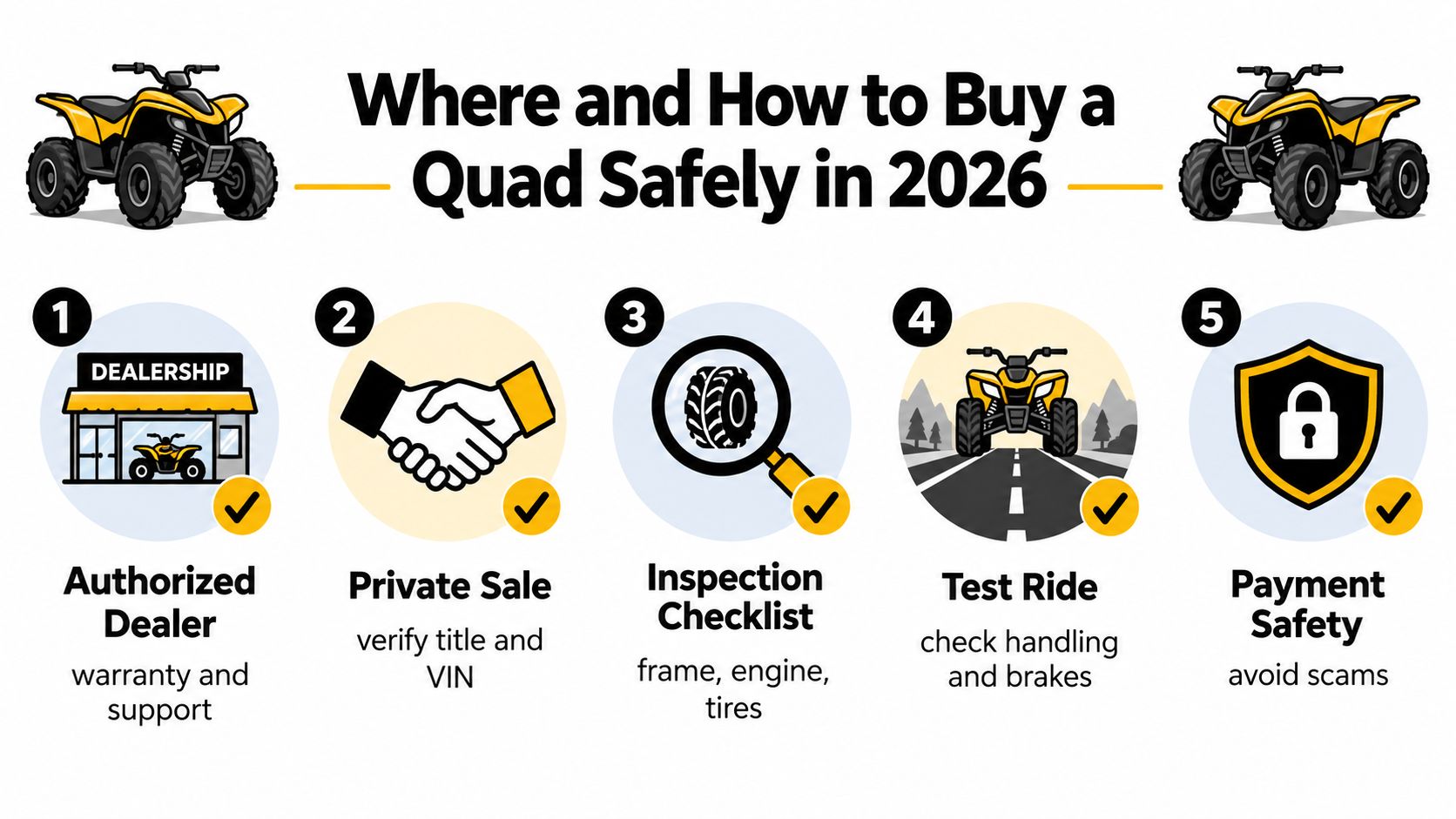
The safest purchase usually begins with a seller who can explain the vehicle's history and support it after the sale. An authorized dealer may provide warranty administration, parts access, and a clearer route for service. A private seller can offer a useful machine at a fair price, but you need stronger proof of ownership and condition.
The vehicle category also matters. The U.S. Consumer Product Safety Commission's off-highway vehicle report defines a UTV as an off-highway vehicle with four or more pneumatic tires, seating for two or more occupants, automotive-type controls, and a maximum speed of 25 mph or less. That distinction separates work-oriented UTVs from traditional single-seat ATVs and helps you compare like with like.
Use a disciplined inspection
- Confirm the identity: Match the VIN to the title, registration, service records, and seller's identification. A Vektracer ATV history report can help you investigate the vehicle's recorded background before money changes hands.
- Inspect the frame: Look for cracks, fresh paint, bent sections, weld repairs, and impact marks around suspension mounts.
- Check the drivetrain: Start the engine cold if it's gas-powered. Listen for unusual noise, inspect fluid condition, and test drive engagement of drive modes. For electric machines, check charging behavior, warning lights, battery condition, and connector damage.
- Examine wear points: Inspect tires, brakes, steering joints, wheel bearings, suspension, winch, racks, and underbody protection.
- Test the controls: The quad should track predictably, brake evenly, shift cleanly, and respond without excessive play or vibration.
Never let a seller rush the inspection because another buyer is supposedly waiting. Get the total price in writing, including fees and accessories. Avoid sending payment for a vehicle you haven't verified, and confirm the warranty terms rather than relying on a casual promise.
Choosing the Right Quad for Your Actual Workload
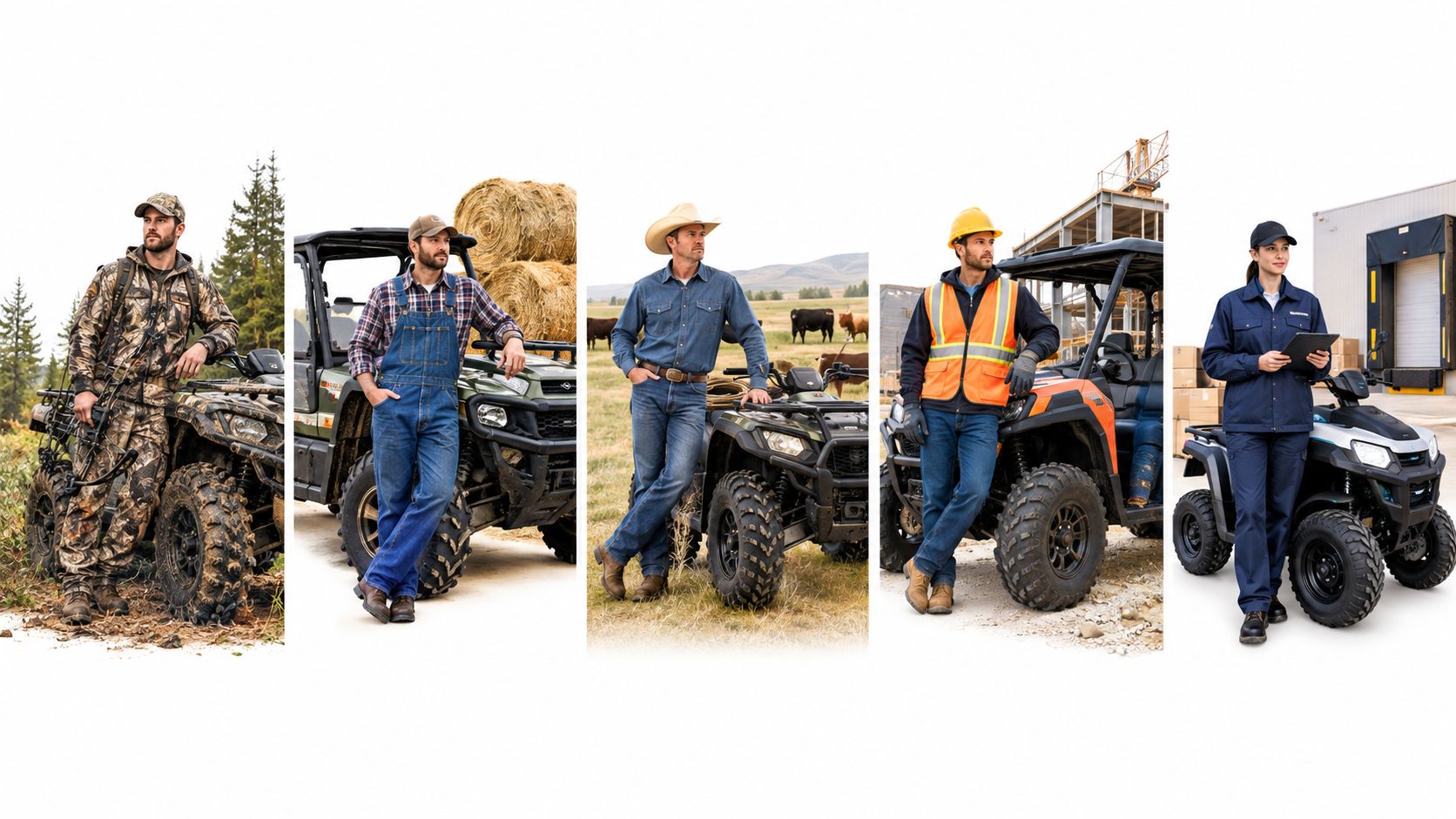
The right quad depends on what you ask it to do every week. A hunter may prioritize quiet movement, manageable width, storage, and low disturbance. A farmer may need racks, towing ability, four-wheel drive, and simple access to service. A rancher often values durability and carrying capacity over trail speed.
Match the machine to the job
| User | Sensible starting point | What to verify |
|---|---|---|
| Hunter | A manageable utility ATV or quiet electric UTV | Ground clearance, storage, noise, and access restrictions |
| Farmer | Adult utility ATV for routine field work | Racks, towing, four-wheel drive, service access |
| Rancher | Heavier utility ATV or UTV | Durability, cargo, passenger needs, and long working days |
| Construction worker | Work-oriented UTV | Payload, protection, traction, and attachment compatibility |
| Warehouse operator | Electric utility vehicle where routes are repeatable | Charging access, turning space, runtime, and indoor suitability |
A small quad makes sense when the job involves inspection, light transport, hunting access, or occasional property maintenance. It becomes the wrong tool when you regularly carry bulky materials, need a second occupant, tow demanding loads, or spend full days on rough ground.
For buyers who need a utility-focused electric option, the utility ATV inventory from Campus EV is one place to compare the category. Treat any listed vehicle as a starting point for verification. Confirm payload, charging arrangements, service support, warranty coverage, and fit with your route before comparing it with a gas machine.
The cheapest suitable tier is usually better than an oversized vehicle that spends most of its time underused. The most expensive mistake is choosing a machine that cannot handle the workload, then paying for attachments, repairs, or replacement sooner than planned.
Final Steps to Make a Confident Quad Purchase Decision
Answering how much a quad costs properly requires two figures. The first is the complete purchase price. The second is the cost of keeping the vehicle useful for the work you expect it to perform.
Before you sign, ask the seller for an itemized out-the-door quote. Check whether destination, preparation, accessories, registration support, financing charges, and warranty options are included or separate. Compare vehicles on the same basis, because a bare machine and a work-ready machine aren't equivalent purchases.
Run the final checks
- Confirm the job: Write down the load, terrain, route length, passenger needs, storage requirements, and towing demands. If the vehicle fails one essential requirement, don't let a discount change the decision.
- Review the service path: Identify the nearest capable dealer or repair shop, ask about parts availability, and read the maintenance schedule.
- Compare energy use: Gas buyers should examine refueling frequency and service needs. Electric buyers should verify charging access, battery coverage, expected duty cycle, and replacement arrangements.
- Inspect the complete vehicle: On a used machine, check the VIN, title, frame, drivetrain, steering, brakes, tires, suspension, and signs of hard use.
- Price the accessories separately: A winch, cargo box, plow, protection, or charger can change the final budget. Decide which items are necessary on day one and which can wait.
- Value downtime: If a failed machine stops feeding livestock, moving materials, or completing site work, reliability and support deserve more weight than a small initial saving.
Traditional gas ATVs remain practical for remote, irregular, and demanding work where refueling is easier than charging. Electric UTVs deserve serious consideration for quiet, repeatable routes where lower routine maintenance and charging access fit the operation. Neither powertrain removes the need for inspection or sensible workload matching.
The best purchase isn't automatically the cheapest quad or the most powerful one. It's the machine whose capability, service plan, energy source, and total ownership cost align with the work you will perform.
Campus EV offers electric utility vehicles centered on the Campus E1 side-by-side UTV, giving buyers another route when quiet operation, charging, and reduced routine mechanical service matter. Visit Campus EV to review the available electric powersports options and request information for your workload.