
You leave the yard before sunrise with a full battery, a loaded electric UTV, and a list of jobs that looks manageable on paper. By midday, the vehicle has spent too much energy climbing rough ground, the next task is on the opposite side of the property, and the operator is rushing because charging time wasn't included in the plan. The problem usually isn't the motor alone. Efficiency depends on the relationship between the vehicle, the route, the workload, the charging system, and the person operating it.
Learning how to improve efficiency with an electric UTV means measuring the whole operation rather than chasing a single range figure. A well-managed Campus E1, or any comparable electric side-by-side, can support hunting, ranching, farm, construction, and warehouse work, but only when the daily system matches the machine's capabilities. The practical target is simple: complete more useful work with less wasted travel, energy, downtime, and physical effort.
Table of Contents
- Diagnosing Your Current Operational Baseline
- Tracking the Right Metrics for EV and UTV Operations
- Practical Techniques for Electric UTV Riding and Maintenance
- Optimizing Charging Habits and Route Planning
- Personal Productivity Habits for Commuters and Riders
- Building a Long-Term Efficiency Culture
Diagnosing Your Current Operational Baseline
A ranch hand may spend the first hour checking fencing, return for tools, drive back to a water point, and then cross the property again because a delivery was added to the schedule. The UTV may be moving constantly, yet the operator isn't producing much more. Before changing tires, adding chargers, or replacing vehicles, document where time and energy disappear.
The U.S. Department of Energy's fleet framework uses four steps, Plan, Collect, Strategize, and Implement, and it applies well to electric UTV operations. Start by defining the mission. A hunter's priorities may be quiet access and low-impact travel, while a warehouse manager may care about repeated material movements, payload, and predictable turnaround. Farmers and construction teams need to account for terrain, weather, access roads, and the consequences of downtime.
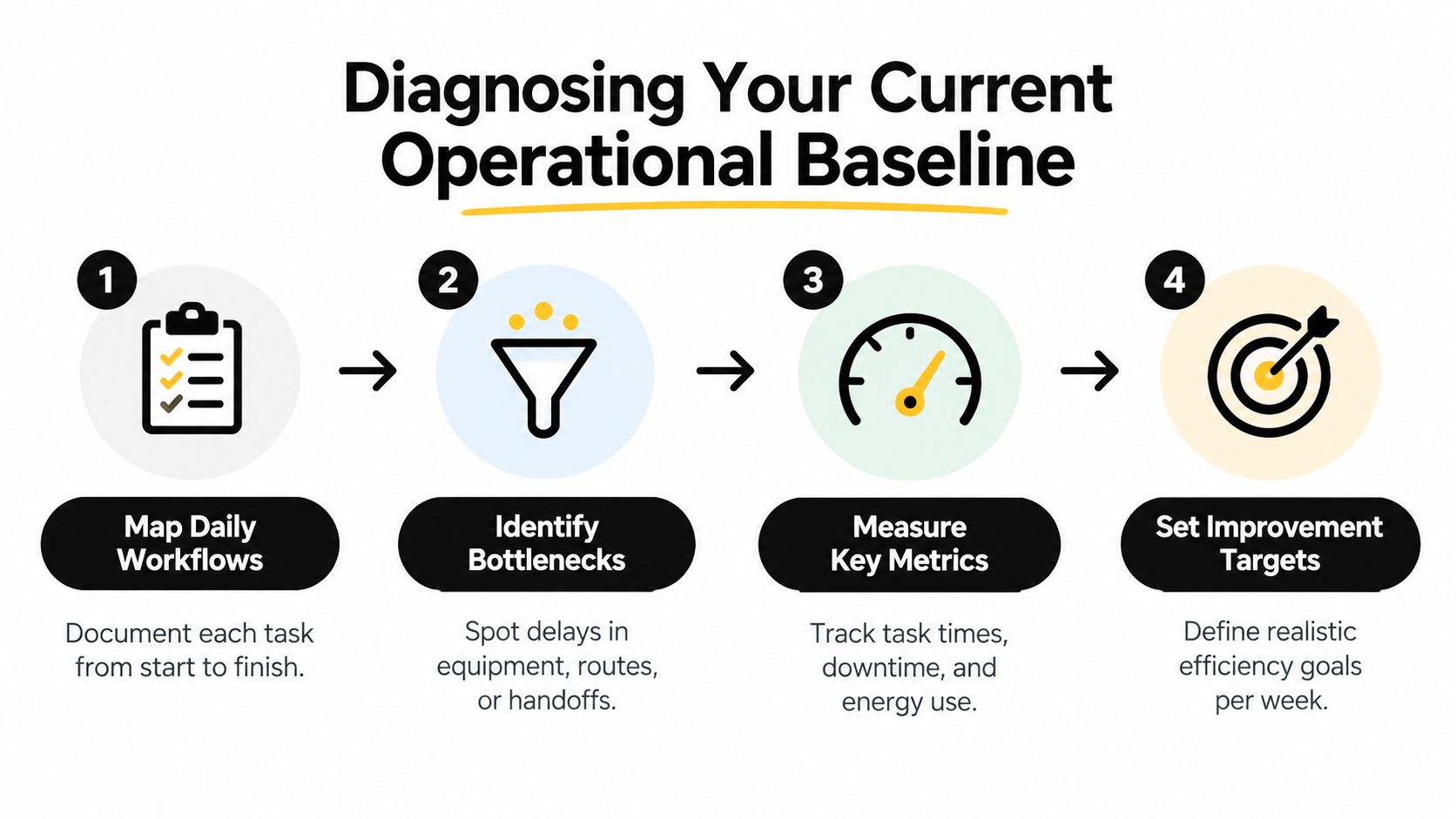
Build a mission-level profile
Collect information at the asset level, not just by department or shift. For each UTV, record:
- Utilization: Which hours are spent driving, working, waiting, loading, and charging?
- Downtime: Separate scheduled maintenance, charging delays, recovery from stuck terrain, and unplanned faults.
- Route conditions: Note slopes, mud, loose soil, paved surfaces, repeated stops, and heavy traction demands.
- Workload: Log passengers, tools, cargo, trailers, and the type of task completed.
- Operating conditions: Record temperature, weather, and whether the vehicle starts the day fully charged.
The baseline should also include mileage, trip count, idle time, and maintenance history. The DOE specifically recommends using asset-level utilization, downtime, mileage, trip count, terrain, cargo, and maintenance data to support fleet decisions through its fleet management framework.
Turn observations into decisions
Use the data to distinguish a vehicle problem from a workflow problem. If one UTV uses more energy because it carries heavier loads uphill, comparing it directly with a lightly loaded unit on flat ground will lead to a bad conclusion. Likewise, buying another vehicle won't fix a schedule that sends operators back to the same storage area repeatedly.
Create a simple weekly review with three questions:
- Which tasks consumed the most travel time or battery capacity?
- Which delays came from the vehicle, and which came from planning or handoffs?
- What single change can be tested without disrupting safety or service?
A baseline also helps you evaluate equipment before purchase. If you're comparing electric powersports options, review practical operating details alongside price, including how much a quad costs, expected payload, charging access, service support, and the work the vehicle must perform.
Practical rule: Don't optimize a number you haven't defined. First decide what productive output means for your operation, then measure the energy and time required to deliver it.
Tracking the Right Metrics for EV and UTV Operations
Data becomes useful only when it changes a decision. A dashboard full of battery percentages can still leave an operator unsure whether to alter a route, move a charger, reduce payload, or reschedule a task. Track metrics that connect directly to work completed.
Start by separating inputs from outputs. Inputs include energy consumed, driving time, labor time, vehicle capacity, and charging availability. Outputs include completed inspections, delivered materials, serviced plots, picked orders, or reached hunting locations. This prevents a common error, treating movement as productivity.
Compare similar operations
A warehouse campus and a hilly ranch shouldn't share the same benchmark. Even two farms may differ because one uses flat gravel lanes while the other requires repeated climbs through soft ground. A fair comparison groups facilities or routes with similar size, output mix, automation, terrain, labor intensity, and payload requirements.
Data Envelopment Analysis, or a similar frontier model, offers a practical way to do this. One warehouse study found that input-oriented benchmarking could identify up to 22% improvement potential by examining receiving and shipping productivity, storage utilization, and cycle-time reductions in put-away and order picking, as described in the warehouse efficiency study. That figure applies to the study's setting, not automatically to an electric UTV fleet, but the method is valuable.
Define a peer group, normalize the inputs and outputs, calculate relative efficiency, isolate the weakest process steps, and retest after changes. If one site completes similar work with fewer trips and less waiting, investigate the workflow before assuming its drivers are just working harder.
Track metrics that expose hidden waste
For an electric side-by-side such as the Campus E1, a useful operating sheet should include:
- Energy per mission: Compare battery consumption with the task completed, not with distance alone.
- Travel share: Separate productive travel from deadhead travel between work areas.
- Cycle time: Measure loading, driving, unloading, and handoff time for repeated jobs.
- Storage utilization: In warehouse work, note whether poor item placement creates unnecessary vehicle movements.
- Charging downtime: Record when the vehicle is unavailable because of charging, not merely when it is plugged in.
- Payload and terrain: Pair energy readings with cargo and route conditions.
- First-pass completion: Track whether the operator finishes the task or must return for tools, parts, or instructions.
Ignore vanity metrics such as raw miles driven when they don't explain output. A longer route may be justified if it avoids a steep, rough section or combines several jobs. For a broader maintenance and performance framework, the guide on how to boost efficiency 2026 with OEE can help teams connect equipment availability, performance, and quality instead of reviewing speed in isolation.
The key is to make each metric answerable. If a number doesn't tell you what to change, remove it from the daily report.
Practical Techniques for Electric UTV Riding and Maintenance
A vehicle can lose useful range long before a battery fault appears. On a wet ranch track, an overloaded UTV may spin its tires, climb slowly, and demand repeated throttle inputs. The operator reaches the same destination, but the machine has converted more stored energy into heat, tire slip, and drivetrain strain than into useful movement.
I once saw this pattern in field work where the crew blamed the battery after a vehicle returned with less charge than expected. The route had changed, the cargo bed was full, and tire pressure had fallen. The battery was reporting the consequence of the operating conditions, not necessarily a failure.
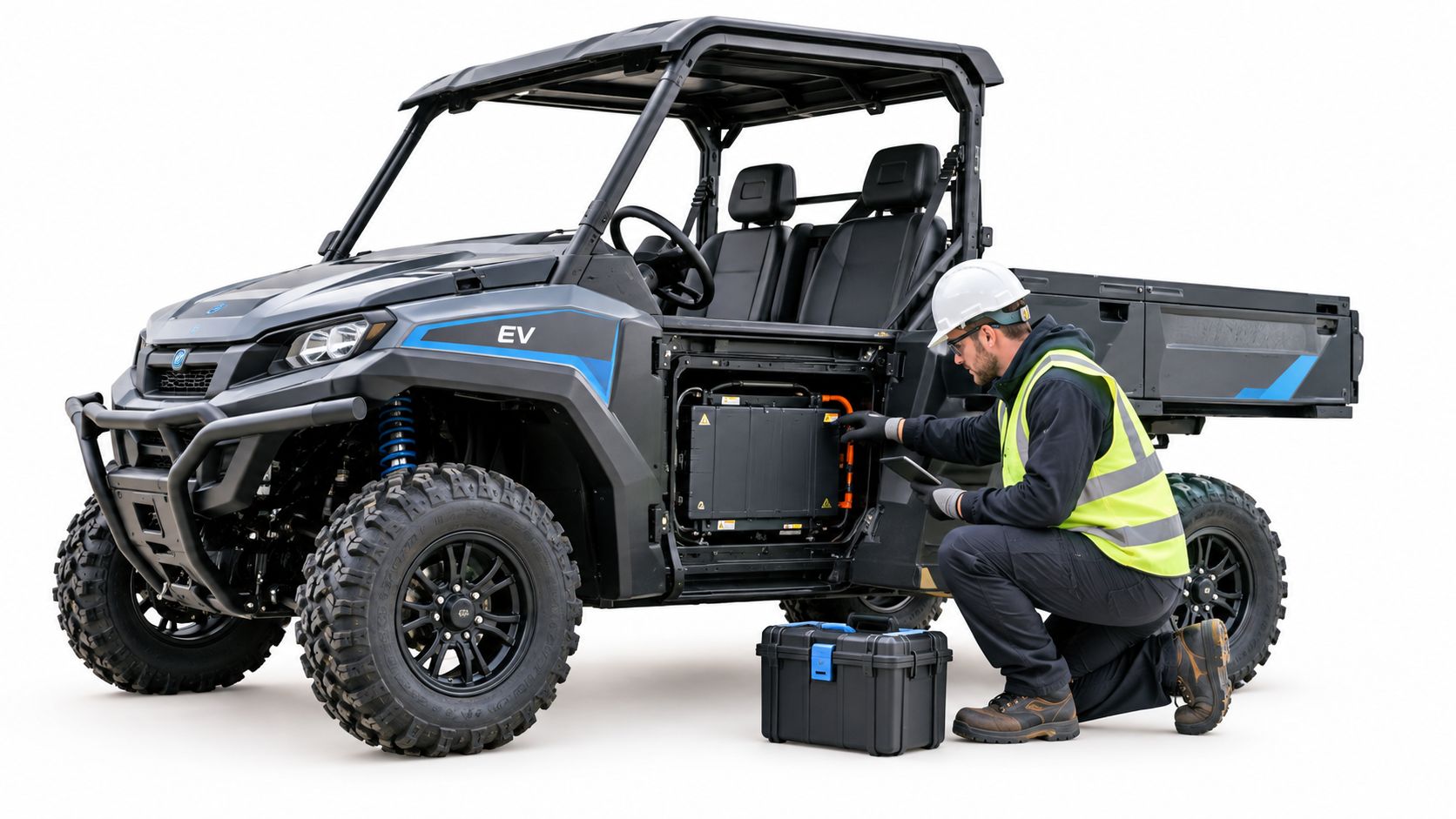
Reduce avoidable load
Carry the tools and materials required for the route, but don't treat the cargo bed as permanent storage. Extra weight increases the effort required to accelerate, climb, stop, and traverse soft surfaces. Load heavy items low and secure them so they don't shift during turns or rough travel.
Use a staging point when practical. A farm operator may keep fencing supplies near the day's inspection zone instead of carrying every possible part across the property. A warehouse team can prepare a route-specific load rather than sending the vehicle out with mixed items that require sorting at each stop.
Drive for traction, not drama
Aggressive throttle use creates poor results on loose ground. Smooth acceleration, steady speed, and early route selection usually preserve more energy than repeated bursts followed by braking. On a slope, keep momentum without rushing, choose a line with better traction, and avoid unnecessary corrections that force the drivetrain to work harder.
The same principle applies to obstacles. If a shallow detour avoids mud, ruts, or a steep climb, the longer-looking path may require less energy and reduce the chance of recovery downtime. Quiet, controlled driving is also useful for hunting operations where disturbance matters as much as speed.
Maintain the systems that transfer power
Build a pre-shift check into the operator's routine:
- Tires: Check pressure against the manufacturer's specification and inspect for cuts, embedded debris, or uneven wear.
- Drivetrain: Look for unusual noise, binding, damaged components, or signs of contamination.
- Brakes and steering: Test response before carrying a load or entering remote terrain.
- Battery area: Keep connections and surrounding surfaces clean and inspect for damage.
- Cargo and accessories: Confirm that racks, tools, trailers, and tie-downs are secure.
Maintenance knowledge transfers across electric powersports, and the electric bike maintenance guide offers a useful reference for building disciplined inspection habits. Follow the UTV manufacturer's service schedule for vehicle-specific battery, drivetrain, suspension, and brake requirements.
Industrial systems show why these basics matter. The IEA notes that industry represents nearly 40% of total energy demand, while one industry analysis estimates that about 67.5% of input energy can be lost before reaching its intended purpose through issues such as fouled heat exchangers, poor combustion control, compressed-air leaks, and steam-trap failures, as summarized by ENERGY STAR's industrial sector analysis. An electric UTV has a smaller system, but the lesson is the same: maintenance, controls, and operating technique determine how much input becomes useful work.
Optimizing Charging Habits and Route Planning
Charging shouldn't be treated as a separate activity that happens after the schedule is written. It belongs inside the route plan. If the vehicle must travel back across a farm to reach a charger, the charging location has already created wasted mileage and operator time.
Begin with the work pattern. Mark the yard, workshop, warehouse, field entrances, loading areas, and regular service zones. Then identify where the UTV naturally pauses. A charger near a break area, equipment shed, or shift handoff point may be more useful than one positioned beside the main office.
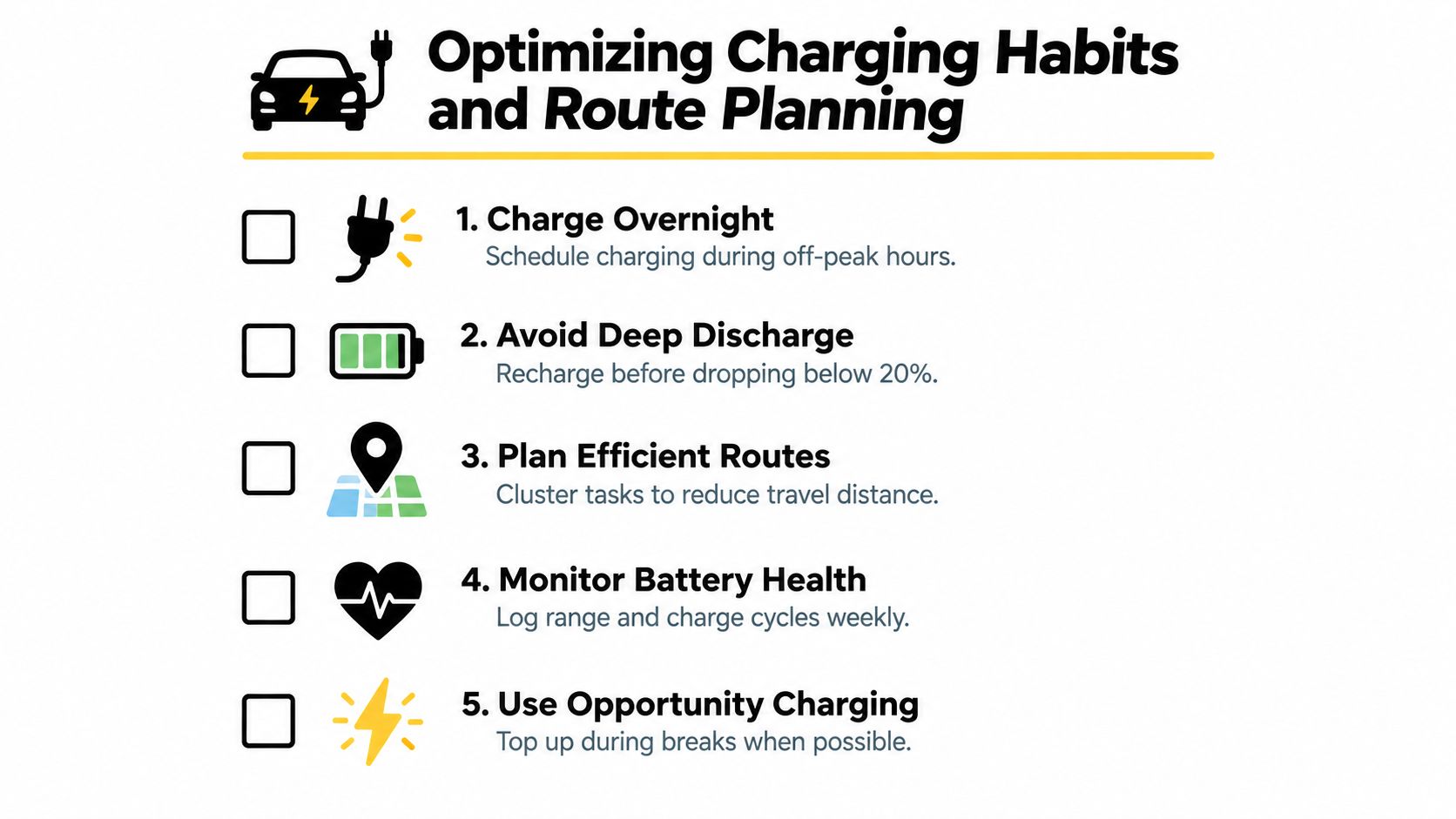
Match routes to the battery's working day
Cluster nearby tasks into one mission. A ranch inspection route should combine fence, water, and gate checks in the same area where possible. A warehouse route should group put-away or replenishment tasks by zone rather than sending the UTV back and forth between distant aisles.
Elevation and surface also belong on the map. Two routes with similar distances can demand very different energy if one includes soft ground and repeated climbs. Use telemetry and operator notes to mark high-consumption segments, then test whether a smoother route, altered task order, or different payload reduces the energy burden.
Don't promise a universal rule about minimum battery percentage or charging frequency. The right threshold depends on the manufacturer's guidance, temperature, load, terrain, and the distance to a safe charging point. Operators should set a conservative reserve based on their own baseline rather than copying a rule from a different vehicle or site.
Use charging pauses deliberately
Opportunity charging can work when the vehicle naturally stops for loading, meals, inspections, or shift changes. It shouldn't create extra trips or cause operators to interrupt productive work just to reach a plug. For general charging principles aimed at residential drivers, EVChargers.eu's guide for home EV owners provides useful background, but commercial UTV managers still need to follow the vehicle and charger manufacturer's instructions.
Review the embedded demonstration for additional context on charging and electric vehicle operation.
Keep a weekly log of starting charge, ending charge, route conditions, payload, charging duration, and unfinished work. If range appears to decline, compare those conditions before blaming battery health. A useful charging plan removes mid-shift uncertainty without encouraging risky deep discharge or unnecessary charging cycles.
Personal Productivity Habits for Commuters and Riders
Driving faster doesn't automatically create more output. It may shorten one leg while increasing fatigue, rough handling, errors, recovery time, and unfinished work. A field operator who arrives at the next location tired and missing a tool hasn't improved the operation, even if the trip itself was quick.
Measure return on time rather than speed alone. Ask what the operator completed, whether the work met the required quality, whether a second trip was needed, and how sustainable the workload felt. Recent guidance on organizational efficiency highlights the need to connect visibility into work and resources with staffing and burnout rather than treating speed as the only outcome, as discussed in this organizational efficiency analysis.
Plan around human energy
Match demanding tasks to the operator's strongest part of the shift where possible. Loading, climbing, repeated lifting, and long inspections place different demands on the body than driving between locations. A schedule that alternates physical effort with lower-strain tasks can protect attention and reduce rushed decisions.
Use short, predictable pauses to check the vehicle, hydrate, review the next route, and confirm tools. These pauses aren't wasted if they prevent a return trip or identify a tire, brake, or cargo problem before the vehicle enters remote terrain.
A simple shift record can include:
- Work completed: Which jobs were finished to the required standard?
- Rework: Which tasks needed correction, extra travel, or a second visit?
- Operator condition: Was fatigue, heat, cold, or discomfort affecting decisions?
- Route friction: Where did waiting, searching, loading, or unclear instructions slow the shift?
- Next action: What should change tomorrow?
Protect attention from unnecessary switching
Give the operator a clear mission, a route order, and a defined escalation process. Constantly adding small requests through radio, phone, or in-person interruptions creates the same kind of fragmentation that damages office workflows. Batch non-urgent jobs by area and reserve capacity for safety-critical or time-sensitive tasks.
Checklists help, but don't make them so long that operators skip them. A short pre-departure list should confirm charge status, tires, cargo, route, communication method, and the next charging opportunity. At the end of the shift, record exceptions while they remain fresh.
Generative AI can help with route summaries, maintenance reminders, or converting operator notes into a consistent report, but it shouldn't decide whether a vehicle is safe, whether a remote route is suitable, or whether a critical maintenance issue can wait. Research from the Federal Reserve Bank of St. Louis reports that self-reported generative AI time savings may translate to only about a 1.1% increase in aggregate productivity in the analysis it discusses, so AI should support a measured workflow rather than replace operational judgment. The same source is available through its analysis of generative AI and work productivity.
The useful question isn't “How fast did we move?” It's “What valuable work did we finish without creating the next problem?”
Building a Long-Term Efficiency Culture
A single efficient route is helpful. A repeatable system is more valuable because it keeps producing improvements after the original idea has been forgotten. The strongest programs turn baseline data, maintenance checks, charging routines, and operator feedback into normal work rather than special projects.
The IEA reports that global energy efficiency progress improved to 1.8% in 2025, up from about 1.0% in 2024, while the long-run average since 2019 remains 1.3% per year, below the COP28 goal of 4% annual improvement by 2030. Its analysis also says energy used per unit of GDP fell globally by 36% between 1990 and 2021, illustrating how gains can compound over time. The broader industrial findings are relevant to UTV fleets too, with early savings commonly identified through structured energy management and larger cumulative gains over longer programs, as described by the International Energy Agency's energy efficiency analysis.
Make improvement part of the shift
Assign ownership. Someone should review telemetry, someone should manage maintenance records, and operators should have a clear way to report route friction or equipment concerns. Don't punish people for reporting inefficient conditions. If workers hide problems because they expect blame, managers lose the information needed to fix the system.
Use a short operating rhythm:
- Daily: Check the vehicle, confirm the mission, and record exceptions.
- Weekly: Review energy, downtime, unfinished work, and repeated travel.
- Monthly: Test one workflow or route change and compare it with the baseline.
- Seasonally: Reassess payloads, terrain, charging locations, accessories, and staffing.
A unified communication tool can help teams share work instructions, inspection reminders, and feedback without scattering information across messages and paper notes. If you're evaluating choosing a unified employee app, focus on whether it supports the communication habits your operators will use.
Build decisions around evidence
The long-term position is straightforward. Efficiency isn't driving harder, charging more often, or buying more equipment by default. It means matching the vehicle to the mission, reducing unnecessary movement, preserving battery and drivetrain health, and measuring completed work alongside energy use and human workload.
Keep the baseline visible. When the team sees why a route changed, why a charger moved, or why a payload limit matters, compliance becomes easier. Review failures without turning them into personal criticism, then convert the lesson into a route rule, checklist item, maintenance task, or training example.
If you manage the whole operating system, an electric UTV becomes more than a quiet replacement for a gas vehicle. It becomes a measurable work platform whose daily output can improve through better routing, disciplined charging, careful riding, reliable maintenance, and realistic workload design.
Campus EV offers electric UTV and powersports options, including the Campus E1 electric side-by-side for hunting, ranching, farm, construction, and warehouse work. Review the vehicle details and operating fit at Campus EV, then compare its payload, route demands, charging access, and maintenance requirements with your baseline before planning a fleet change.