
You're probably doing what most riders do. You roll the bike out, glance at the battery bars, maybe squeeze a brake lever, and head off hoping nothing feels strange halfway through the ride. That works until the day the rear tire is soft, the chain is dry, the battery wasn't seated all the way, or the brake that felt “mostly fine” on the driveway turns vague in traffic.
That's why learning how to maintain an electric bike isn't really about memorizing a list of chores. It's about building a routine where the battery, drivetrain, brakes, tires, and fasteners all get checked in the same rhythm. On an e-bike, those systems lean on each other. A neglected chain adds drag. Underinflated tires make the motor work harder. Weak brakes force you to ride tense and late-brake more often. None of that stays isolated for long.
The good news is that most of the work is simple. A rider with a floor pump, chain lube, a rag, hex keys, a torque wrench, and a little consistency can handle the bulk of it. The trick is knowing what deserves attention before every ride, what belongs on a weekly check, and what needs a seasonal reset.
Table of Contents
- What Real E-Bike Maintenance Looks Like
- The Pre-Ride and Weekly Inspection Routine
- Battery Care That Actually Extends Life
- Motor, Drivetrain, Brakes, and Tires Working Together
- Maintenance Schedules for Commuter, Off-Road, and Value-Focused Riders
- Seasonal Storage and Troubleshooting Common Problems
What Real E-Bike Maintenance Looks Like
Real e-bike maintenance is boring in the best way. It's the same short sequence done often enough that problems show up early, while they're still cheap and easy to fix.
A lot of guides separate battery care from “bike stuff” as if the motor system lives in one world and the chain, tires, and brakes live in another. In practice, that's not how the bike behaves. The bike is one load-bearing machine. If tire pressure drops, range suffers and handling gets dull. If the chain gets filthy, the motor has to push through extra friction. If brakes drag, you'll feel it as lost speed, shorter range, and heat where you don't want it.
The six habits that matter
These are the habits that keep an e-bike dependable:
- Pre-ride visual check for obvious problems before they become roadside problems.
- Weekly mechanical inspection for wear, bolt security, and anything that's slowly drifting out of spec.
- Battery charging discipline so the most expensive consumable on the bike lasts as long as it reasonably can.
- Drivetrain cleaning and lubrication because torque chews through dirty parts fast.
- Brake and tire upkeep because stopping and grip matter more than any display setting.
- Seasonal storage routine so the bike doesn't come out of winter with a tired battery, rusty chain, and flat-spotted tires.
Practical rule: If a maintenance step improves safety, efficiency, and battery life at the same time, do that step first.
What works and what doesn't
What works is rhythm. A minute before the ride. A slightly deeper look once a week. A proper cleaning and storage routine when weather or mileage demands it.
What doesn't work is waiting for symptoms. E-bikes usually warn you in subtle ways first. The chain gets louder. The bike feels slower for the same assist level. The brakes stop feeling crisp. The battery charge behavior gets sloppy because charging habits got sloppy. By the time a rider says, “It suddenly started acting up,” the bike has often been asking for attention for a while.
Most owners don't need to become motor technicians. They do need to become good observers.
The Pre-Ride and Weekly Inspection Routine
You roll the bike out, press the power button, and everything looks normal. Then two blocks later the rear tire feels vague, the brake lever comes too close to the bar, and the motor is working harder than it should because the basics were skipped. That is how small maintenance misses turn into expensive wear on an e-bike.
A good routine has two speeds. The pre-ride check catches safety problems and obvious drag. The weekly check catches the slow stuff. Chain wear, loose bolts, pad wear, battery contact grime, and little changes in wheel or rotor alignment. On an e-bike, those systems are connected. A dirty drivetrain and soft tires do not just make the bike feel bad. They also waste battery range and load the motor unnecessarily.
A useful visual reference helps if you want something you can save on your phone:
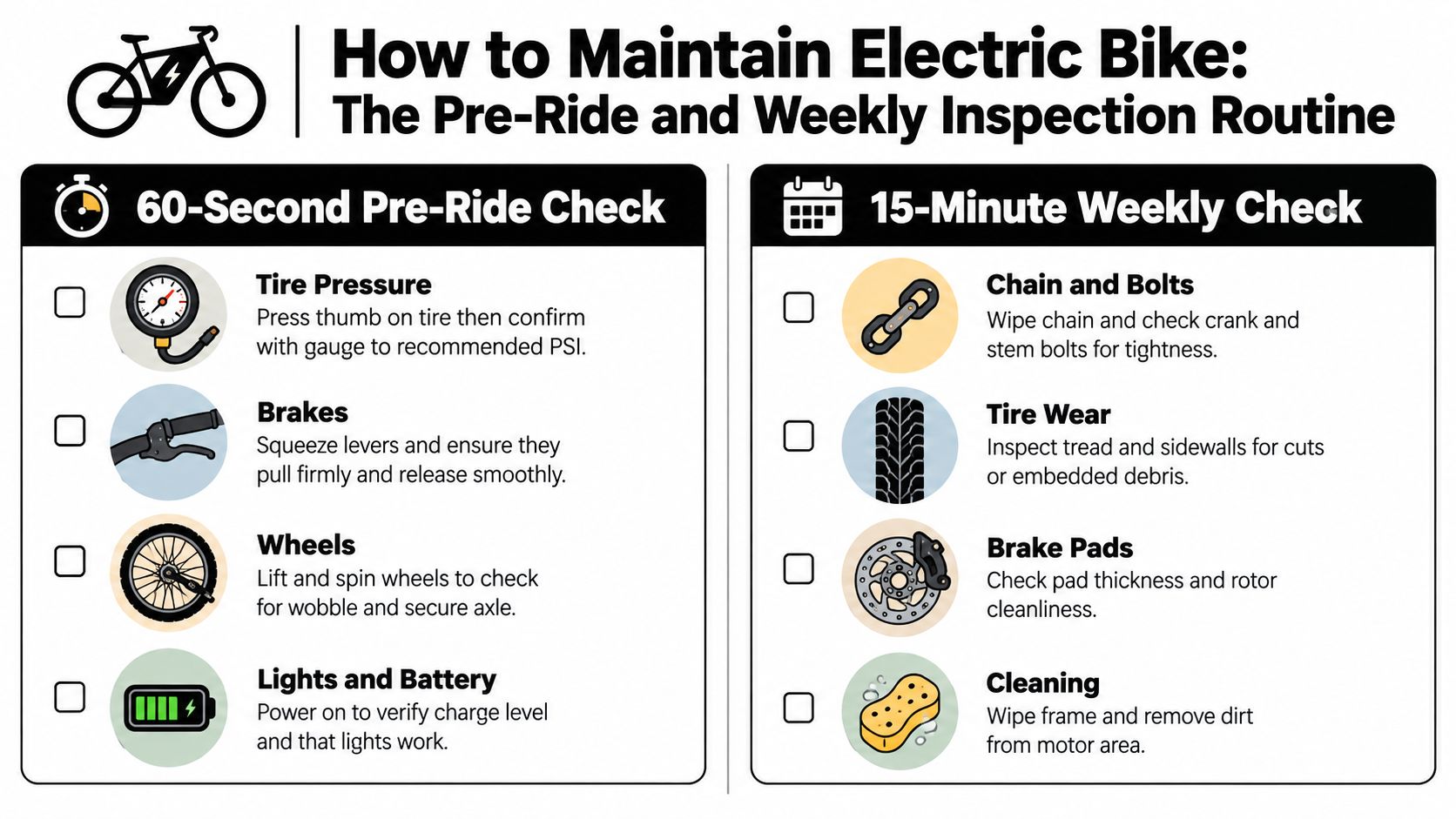
The 60-second pre-ride check
Do these checks every ride, even if the bike was fine yesterday.
- Check tire pressure first. Use a floor pump with a gauge when possible. A thumb squeeze is only a rough filter. Slightly low pressure on a regular bike feels inefficient. On an e-bike, it also costs range and puts more stress into the tire casing and wheel.
- Squeeze both brake levers. They should feel firm and engage consistently. If one lever pulls farther than usual, feels spongy, or starts biting late, sort it out before riding.
- Confirm the battery is seated and locked. No movement, no half-latched pack, no dirty mounting rail.
- Check wheel security. Make sure the thru-axles or quick releases are tight, especially after fixing a flat or transporting the bike.
- Power the bike on and scan the display. Look for warning icons, odd battery readings, or controls that do not respond cleanly.
- Listen while rolling the bike a few feet. Rotor rub, chain clatter, a new rattle, or a ticking wheel usually means something has changed since the last ride.
If time is short, do not skip the brakes, tires, and battery mount. Those three checks prevent the largest share of roadside problems I see on heavily used commuter and cargo e-bikes.
The 15-minute weekly check
Once a week, slow down and inspect the bike with intent.
- Measure chain wear with a checker tool. Motor torque wears chains faster than many owners expect, and replacing a chain on time is far cheaper than replacing a chain, cassette, and chainring together.
- Clean the chain, cassette, and chainring enough to see what is happening. You are not polishing the bike. You are removing grit so wear is visible and lubrication can do its job.
- Check spoke tension by feel and sound. One spoke that has gone noticeably loose often shows up before the wheel goes badly out of true.
- Put a tool on key bolts. Stem, handlebar clamp, crank bolts, rack mounts, fenders, and axle hardware deserve regular attention on a heavier bike that sees more vibration.
- Wipe battery contacts and the mounting area with a dry cloth. Dirt and moisture around the pack can lead to intermittent cutouts that riders often mistake for a motor problem.
- Inspect brake pads and rotors. E-bikes eat brake pads faster, especially with heavier riders, cargo, hills, or wet commuting. Check pad thickness before braking power gets vague.
- Watch for system faults. Intermittent assist, speed sensor misreads, and display errors are often easier to catch in the garage than during a ride.
This is also the point to match maintenance to how the bike is used. A paved-path commuter may get through the week with a quick wipe and chain check. An off-road rider or a rider trying to stretch parts on a budget should be stricter here, because mud, grit, and high torque shorten the service window fast.
If you want another rider-friendly checklist with a slightly different layout, the Rider 18 e-bike care tips are worth comparing against your own routine.
Later, if you want to watch someone walk through the basics rather than read them, this video is a useful companion:
Screenshot checklist
Save this and use it:
Before every ride
- Tire pressure
- Brake lever feel
- Battery seated and locked
- Axles or skewers tight
- Lights and display working
- Quick listen for unusual noise
Weekly
- Chain wear check
- Clean cassette and chainring
- Check spoke tension
- Torque check key bolts
- Wipe battery contacts
- Inspect pads and rotors
Five minutes in the garage is cheaper than a cassette, a brake bleed, or a wasted battery charge on a bike that was dragging the whole ride.
Battery Care That Actually Extends Life
A rider finishes a wet commute, plugs the bike in at 15%, leaves it at 100% all weekend, then heads out Monday in max assist because the tires are a little soft and the chain is dirty. That routine looks harmless. It ages the battery faster and piles extra load onto the rest of the bike at the same time.
Battery care works better when you stop treating it as a separate chore. Charge habits, storage habits, assist levels, tire pressure, and drivetrain drag all affect how hard the pack has to work. That matters more on e-bikes that see real use, especially commuters, trail bikes, and budget-conscious setups where every replacement has to last.
Lithium-ion e-bike batteries commonly last about 500 to 1,000 full charge cycles, which often works out to roughly 3 to 5 years of regular use before noticeable capacity loss. Some higher-quality packs can reach 5 to 7 years with good care, according to EVELO's battery lifespan overview.
Charge for the ride you are actually doing
Daily charging usually works best in the middle of the pack, not at the top of it. For routine use, keep the battery in the 30% to 80% band. Charge to 100% when you know the next ride will use it soon. For storage, leave it around 40% to 60%.
That pattern reduces time spent sitting full, which is one of the habits that shortens battery life. Levy Electric's maintenance guide also notes that better charging habits can make a meaningful difference in cycle life over time.
Battery care numbers that are worth remembering
| Situation | Target State of Charge | Temperature Range | Notes |
|---|---|---|---|
| Daily commuting | 30% to 80% | Moderate indoor temperature | Good default for riders who charge often |
| Long ride tomorrow | 100% | Charge in stable, non-extreme conditions | Full charge makes sense when you will use it soon |
| Storage | 40% to 60% | Cool, dry place out of direct sunlight | Avoid storing it empty or fully charged |
| Cold-weather charging | Partial charge preferred | Don't charge below freezing. Let a cold battery warm before charging | Bosch eBike Systems battery care guidance recommends avoiding charging in very cold conditions |
Heat, drag, and assist choice all matter
A battery does not age only at the charger. It also ages under load. Long climbs in high assist, repeated full-throttle starts, cargo weight, low tire pressure, and a dirty drivetrain all increase current draw and heat.
This is the trade-off riders feel in the world. Higher assist is there to be used, and sometimes it is the right choice. But if the bike is always in its highest mode because the chain is dry or the rear tire is underinflated, the battery is covering for mechanical drag you could have fixed in five minutes.
Use the lowest assist level that keeps the ride comfortable and practical. That saves battery wear and cuts stress across the drivetrain. The same operating logic applies to heavier electric machines, including an electric side-by-side ATV. Less unnecessary load usually means longer component life.
Charging and storage habits that prevent expensive mistakes
Use the charger specified by the bike or battery maker. Charge in an area with clear space around the battery, away from flammable materials. Let the battery cool after a hard ride before plugging it in.
The NSW bicycle maintenance advice covers the basics well: use the recommended charger, disconnect after charging, and store the battery in a cool, dry place out of direct sunlight. If you want a plain-language refresher on charger habits and how to keep batteries charged, that resource is useful because it focuses on daily owner behavior rather than workshop jargon.
A few habits prevent a lot of trouble:
- Do not leave the battery plugged in for days.
- Do not charge it right after a hard, hot ride.
- Do not charge it while it is freezing cold.
- Do not use a random charger because the plug fits.
Store the battery half full, keep it out of temperature extremes, and make the bike roll easily so the pack is not doing extra work every ride.
If the battery shows swelling, overheating, impact damage, a burnt smell, or charger-port damage, stop there and get it inspected professionally.
Motor, Drivetrain, Brakes, and Tires Working Together
A rider comes in saying the motor feels weak, the range dropped, and the bike has started making noise under load. Half the time the motor is doing its job. The rest of the bike is what changed.
That matters because an e-bike does not wear parts in isolation. Motor torque goes through the chain, cassette, chainring, wheel, tire contact patch, and brakes every ride. If the chain gets rough, the tire pressure drops, or a brake starts rubbing, the motor has to push through that extra resistance. You feel it as drag, noise, shorter range, or inconsistent assist.
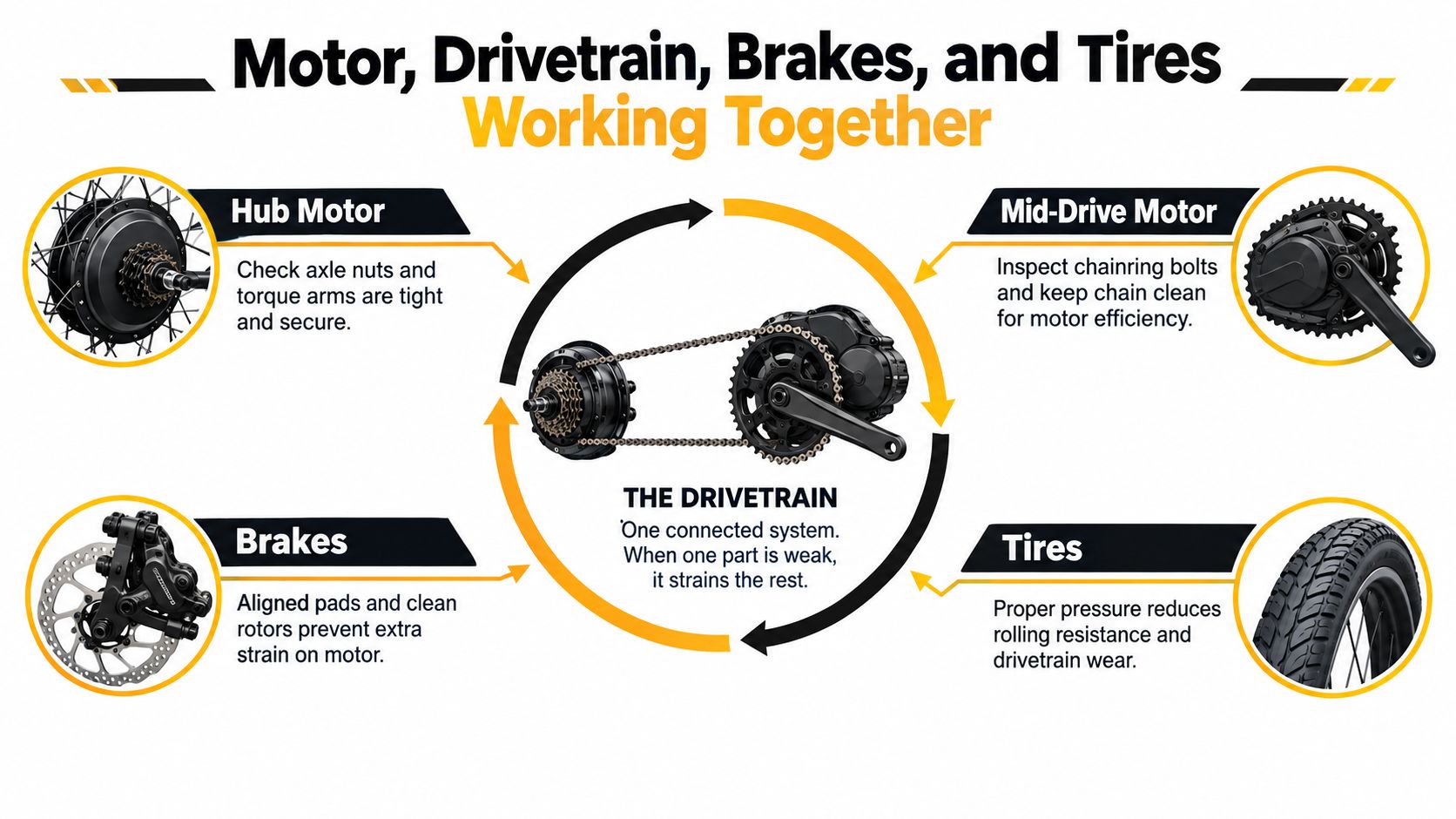
Start where the motor meets the bike
Hub motors and mid-drives fail in different ways, so the checks are different too.
On a hub motor, look closely at axle nuts, washers, and torque arm hardware. Any looseness there can damage the dropout, stress the wiring, and turn a cheap fix into a wheel or frame problem.
On a mid-drive, inspect the motor mounting bolts, chainring bolts, and the bottom bracket area for movement, creaks, or dust lines that suggest parts are shifting. If assist starts cutting in and out, cadence sensing feels delayed, or torque response gets jerky, include sensors, wiring, and software in the diagnosis. Mechanical and electrical faults often overlap on these bikes.
The drivetrain usually sets the service pace
The chain is the part that tells you how hard the rest of the bike is working. On an e-bike, chains wear faster than many owners expect because they deal with higher torque and heavier average loads. Wait too long, and the cassette and chainring wear with it.
If you are learning that job yourself, this guide to replacing an e-bike chain is a useful owner-level walkthrough.
A dirty chain does more than make noise. It adds friction, shifts worse under assist, and asks the battery and motor to spend energy overcoming grime instead of moving the bike forward. That is the connection many maintenance guides miss. Drivetrain neglect is also battery neglect.
Use a chain checker. Do not judge chain wear by eye alone.
Brakes and tires affect assist feel more than riders expect
Brake rub is a range problem, a pad wear problem, and a heat problem. Soft tires are the same kind of issue. They slow the bike, make handling vague, increase casing flex, and force the motor to work harder on every acceleration.
This is why I check these four areas together after any complaint about sluggishness:
- Tires for pressure, cuts, casing damage, and embedded debris
- Brakes for rotor rub, pad thickness, rotor contamination, and lever feel
- Chain and cassette for wear, dry links, heavy grime, and poor shifting under load
- Motor mounting points and wiring for looseness, movement, or damaged connectors
That order saves time because the simple mechanical faults show up first and often explain the electrical complaint.
Match the fix to the rider
A light commuter on pavement can stretch parts much longer than a heavier rider hauling cargo, climbing hills, or riding rough surfaces. Off-road riders get more contamination. Budget-focused riders often keep chains and pads in service too long to save money, then pay for cassettes, rotors, or tires earlier than they should.
The trade-off is simple. Shorter maintenance intervals cost a little in supplies and time. Longer intervals cost more in hard parts.
If the bike feels slower, louder, or rougher than it did two weeks ago, do not start by blaming the motor. Check for drag, friction, and looseness first. That is usually where the problem starts.
Maintenance Schedules for Commuter, Off-Road, and Value-Focused Riders
A commuter can ride the same route for months and barely touch the bike beyond air and chain lube. Then winter grit shows up, the bike starts carrying a laptop, groceries, or a child seat, and wear speeds up all at once. An off-road bike does the same thing after one muddy weekend. A budget e-bike ridden hard gets there even faster.
That is why fixed interval charts only help up to a point. Real maintenance cadence has to match load, surface, weather, motor output, and part quality. Battery habits, tire pressure, brake drag, and chain condition are tied together on an e-bike. If one slips, the others usually get more expensive.
Why harder riders need a tighter schedule
Higher assist tempts riders to push through problems they would notice sooner on an acoustic bike. A slightly dry chain, a little rotor rub, or soft tires can hide behind motor support for a while. The bill still comes due in chain stretch, pad wear, lower range, and extra heat in the system.
Use the bike's workload to set the schedule. A flat, dry, light-load commuter can stretch checks farther than a rider hauling cargo through rain or an off-road rider grinding dust into every moving part. Entry-level parts also deserve shorter intervals. They can give good service, but they have less margin for neglect.
Maintenance cadence by riding style
| Component | Commuter | Off-Road | Value-Focused |
|---|---|---|---|
| Tire pressure | Check at least twice a week. Daily if carrying cargo or riding rough streets | Check before every ride | Check before every ride. Low pressure costs tires, range, and rims |
| Chain cleaning and lube | Wipe and relube after wet rides. Do a fuller clean on a regular mileage rhythm | Clean after muddy rides and relube often in dusty conditions | Stay strict here. Cheap chains are cheaper than cassettes and chainrings |
| Chain wear check | Check regularly if you ride high mileage or use high assist often | Check often. Grit speeds wear fast | Check early and replace the chain before it starts eating the cassette |
| Brake inspection | Look at pad thickness and rotor condition on a set monthly routine | Inspect after wet, gritty, or steep rides | Do not stretch worn pads. Pads are cheap. Rotors are not |
| Bolt check | Quick weekly check. Full torque check on a routine schedule | Check often after rough trails, drops, or transport on a rack | Monthly torque check is a good minimum |
| Battery contacts and mount | Inspect and wipe periodically, especially in rain season | Inspect often for dust, grit, and movement | Check often if the bike lives outside or gets frequent accessory changes |
| Professional service | Yearly at minimum, sooner for heavy mileage | Yearly at minimum, often sooner if the bike sees regular trail abuse | Yearly at minimum. Earlier service usually saves money on worn drive parts |
Three rider types, three workable plans
Commuter riders: set a weekly routine and keep it boring. That is the goal. Check tire pressure, brake feel, lights, and chain condition on the same day each week. If the bike sees rain, salted roads, or loaded panniers, shorten the gap between drivetrain service and pad checks. City miles look easy on paper, but stop-start riding and weather are hard on consumables.
Off-road riders: clean less for appearance and more for inspection. Mud hides sidewall cuts, loose spokes, bent rotors, and torn cable or sensor routing. I would rather see a trail bike cleaned enough to inspect properly than polished and under-lubed. After rough rides, plan on checking the battery mount and connector area along with the usual chain and brake work. Vibration and contamination tend to show up together.
Value-focused riders: spend early on the small parts. That saves the big parts. A chain replaced on time protects the cassette. Fresh pads protect the rotor. Proper tire pressure protects the casing and the rim. Riders who buy an affordable e-bike to replace car trips often put serious workload on it, and the same maintenance logic applies to other working vehicles, including a utility ATV used for daily hauling and stop-start work.
One more blunt point. If you ride harder than average, maintain the bike like you ride harder than average. That usually means shorter intervals than the manual suggests, not because the bike is fragile, but because e-bikes let wear hide longer before the rider feels it.
Seasonal Storage and Troubleshooting Common Problems
You park the bike in late fall after a wet ride, tell yourself you will clean it tomorrow, and roll it back out months later to a dead display, a dry chain, and brakes that feel wrong. That is the usual spring "mystery." Storage mistakes and basic wear tend to show up at the same time, which is why I treat storage and troubleshooting as one job.
Store the bike so it wakes up ready
Put the bike away clean, dry, and with the battery partly charged. Half full is a safe target for long storage. Do not store the battery fully drained, and do not leave it sitting at 100% for weeks unless the manufacturer specifically says that is fine for that pack. If the battery came in cold, let it warm up indoors before charging. Bosch also advises avoiding charging a battery that is below freezing and storing it in a dry place away from extreme temperatures, which matches what works in the shop over winter: Bosch eBike battery care and storage guidance.
A good storage routine is simple:
- Clean the drivetrain so old grit does not turn into grinding paste.
- Lube the chain, then wipe off the extra.
- Inflate the tires enough that they hold shape under the bike.
- Store the bike indoors if possible, away from damp air and big temperature swings.
- Remove the battery for longer storage if the bike maker recommends it.
- Check charge level about once a month, especially on older packs that self-discharge faster.
Battery and drivetrain care connect here more than riders expect. A neglected chain adds drag. Drag makes the motor work harder on the first rides back. That can make a healthy battery feel weak and send people chasing an electrical problem they do not have.
Troubleshoot in the right order
Start with the parts that fail often and check fast. If the bike will not power on, confirm the battery is fully seated and locked. Then check the charger, charging port, display, and main connectors you can access without opening anything. A lot of no-power complaints come down to a battery that is not clicked in all the way, a display that has gone to sleep, or contacts that picked up grime during storage.
Poor range needs the same discipline. Check tire pressure, brake drag, and chain condition before blaming the battery. On an e-bike, those three problems stack up quickly. The rider feels "battery loss," but the bike is often wasting energy through rolling resistance and friction.
Error codes deserve a calm read, not guesswork. Many point to a speed sensor alignment issue, a loose connector, or a restart procedure. If you already apply that kind of practical reliability thinking to bigger machines, the same logic shows up in questions like whether CFMoto vehicles are any good in real use. The answer usually depends less on internet mythology and more on maintenance habits, workload, and parts support.
Check air, brake drag, battery seating, and chain condition before you assume the motor or battery has failed.
Know when to stop wrenching
Home maintenance covers a lot:
- Tire and tube changes
- Brake pad replacement
- Basic brake adjustment
- Chain cleaning and lubrication
- Derailleur adjustment
- Bolt checks
- Routine battery handling and storage
Stop and book a shop visit if the next step involves opening the motor, opening the battery case, repairing damaged cells, or chasing an electrical fault you cannot isolate with confidence. That is the line that protects both the bike and the rider.
Good owners do their own regular work. Smart owners also know when a repair has crossed from normal service into electrical diagnosis.