
You're probably looking at a CFMoto right now for the same reason many buyers do. The machine looks better than expected, the spec sheet reads like it belongs to a pricier brand, and the price makes the established names feel uncomfortably expensive. Then the doubt kicks in. CFMoto has a mixed reputation depending on who you ask, and that usually turns a simple shopping decision into a risk calculation.
That hesitation is rational. “Are CFMoto any good?” isn't really a question about whether the plastics line up or whether the engine starts. It's a question about whether buying one is a smart long-term move. The actual answer depends less on badge loyalty and more on two things many reviews skip: which model years you're considering and what ownership will cost when it's time to sell.
Table of Contents
- The CFMoto Question You Are Asking
- Who Is CFMoto and Can You Trust Them
- Analyzing Build Quality and Performance Across the Lineup
- Reliability and Common Problems Over the Years
- How CFMoto Stacks Up Against the Competition
- The Final Verdict Who Should Buy a CFMoto in 2026
The CFMoto Question You Are Asking
A lot of buyers don't start with brand loyalty. They start with a budget, a use case, and a machine that seems to offer more than it should for the money. That's where CFMoto gets attention. You might have walked into a dealership looking for a trail UTV, a starter adventure bike, or a practical ATV, then stopped when the CFMoto on the floor looked unusually complete.
The tension is easy to understand. On one side, CFMoto often presents as the rational choice. You see modern styling, solid equipment, and a feature list that doesn't look stripped down. On the other side, you're buying into a name that still carries baggage from earlier perceptions of Chinese-made powersports products.
Practical rule: If you're asking whether CFMoto is “good,” you're already asking the wrong question. The sharper question is whether a specific CFMoto, from a specific model year, makes sense for how long you plan to keep it.
That distinction changes everything. A buyer who keeps a machine for years and does routine maintenance may judge CFMoto very differently from a buyer who trades often and cares about resale. A first-time owner may love the upfront value, then discover that exiting the vehicle matters almost as much as entering it.
This is why generic yes-or-no verdicts fail. CFMoto isn't best understood as a simple underdog success story or a cheap-brand warning label. It's better understood as a value brand whose strongest case comes from newer products, modern hardware, and improving credibility, but whose weakest point may still show up at trade-in time.
Who Is CFMoto and Can You Trust Them
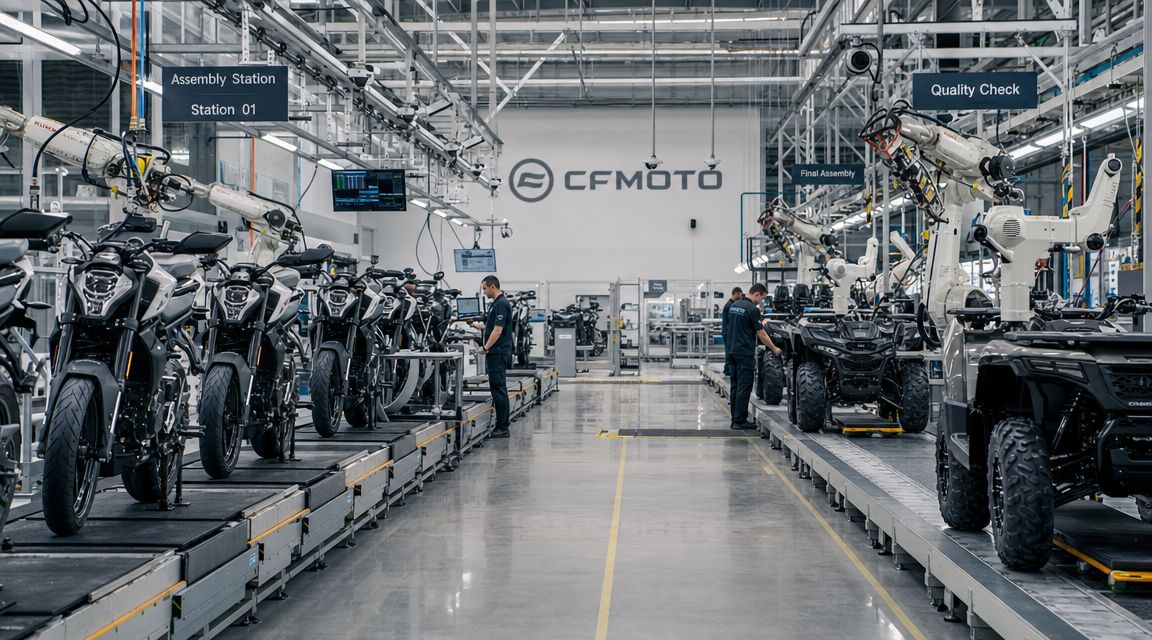
The easiest way to misread CFMoto is to treat it like a fringe brand trying to buy relevance with low pricing. That picture is out of date. The more useful frame is that CFMoto has become too large to dismiss as a novelty, and scale matters in powersports because buyers often use it as a proxy for dealer commitment, parts support, and brand staying power.
Scale matters more than image
A strong signal comes from global volume. According to MotorCyclesData's CFMoto sales report, CFMoto's global 2-wheeler sales increased by 10.1% in 2025 to just over 250,000 units, after a previous year of +79% growth. That doesn't prove every machine is excellent, but it does prove the brand has moved beyond the “maybe they'll disappear” phase.
Crossing 250,000 units changes how the brand should be evaluated. Small brands can generate buzz. Large and still-growing brands usually reflect something harder to fake, which is sustained buyer acceptance across more than one market and more than one product class.
Here's why that matters in practical terms:
- Dealer confidence: Dealers tend to invest more seriously in brands they believe will keep moving units.
- Parts confidence: Buyers worry less when a brand looks likely to remain relevant.
- Used-market confidence: Even if resale remains softer than legacy rivals, a growing installed base gives future shoppers more familiarity with the badge.
The market doesn't hand long-term growth to a powersports brand out of curiosity alone. Buyers have to keep saying yes.
What buyers should take from that
Trust in powersports is never built on one thing. It comes from product, support, and evidence that the company isn't only discounting its way into garages. CFMoto's growth suggests the brand has crossed into a different category. It now deserves to be judged as a serious mainstream alternative, not merely as a gamble for price-sensitive buyers.
That doesn't mean you should treat it like Honda, Yamaha, Polaris, or Can-Am in every area. It means the old shorthand dismissal no longer works. If you still think of CFMoto as a fly-by-night budget name, you're shopping with stale assumptions.
Analyzing Build Quality and Performance Across the Lineup
The strongest argument for CFMoto isn't “it's cheaper.” Cheap by itself rarely wins experienced riders. The stronger argument is that CFMoto has gotten good at offering hardware that doesn't feel bargain-basement. That's why the brand keeps drawing buyers who expected to laugh it off and instead find themselves doing serious comparisons.
Why the hardware matters
A useful baseline comes from the street-bike side because the specs are clearly documented. RevZilla noted that the U.S. 300-series bikes use a 292 cc liquid-cooled single rated at 29 hp with slipper clutch and ABS, while the 700-series uses a 693 cc liquid-cooled parallel twin claimed at 74 hp in its first impressions of the U.S. lineup. Those details matter because they show a pattern, not just a one-off trim level. CFMoto isn't presenting entry and mid-level products as stripped utility tools. It's pairing competitive output with modern rider aids.
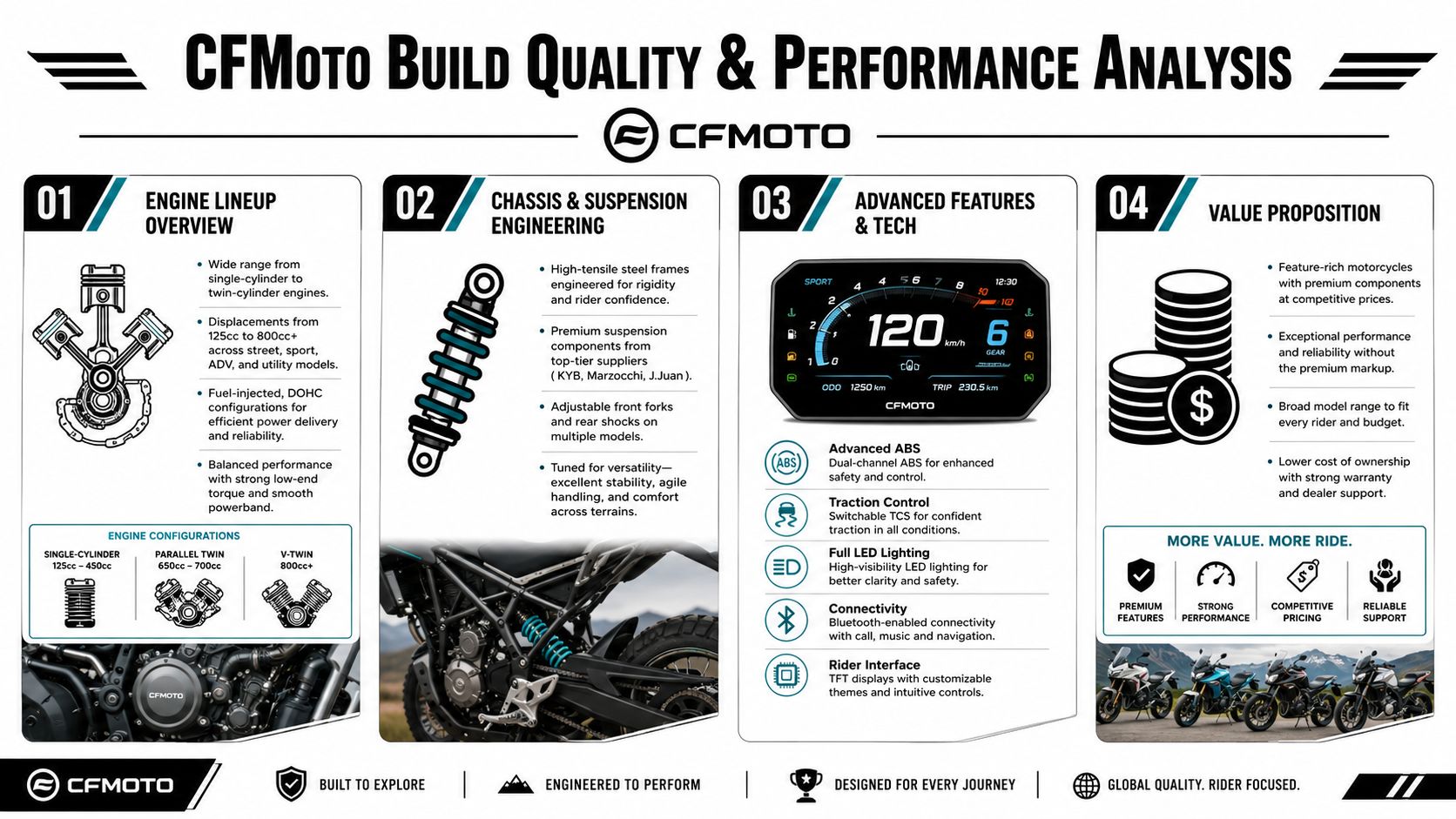
That blend changes how buyers experience value. A slipper clutch and ABS aren't marketing fluff on a beginner or commuter motorcycle. They affect confidence, ease of use, and day-to-day ride quality. A liquid-cooled engine also signals that the company isn't taking the lowest-tech path available.
An independent UK dealer summary makes the same broader case from another angle. It describes CFMoto as offering an estimated 50,000+ mile average lifespan with proper maintenance, fuel economy of up to 65 mpg on certain models, some smaller-capacity models exceeding 70 mpg, power outputs ranging from 15 hp to 95 hp, and Euro 5 compliance in its CFMoto buyer guide. That mix of durability, efficiency, and regulatory compliance helps explain why many buyers no longer see the brand as “cheap transportation” but as a legitimate value option.
What that means beyond motorcycles
The same logic carries into the ATV and UTV side even when the exact equipment list varies by model. CFMoto's appeal usually comes from how much seems included relative to the ask. Buyers notice that immediately. They don't just see a lower price. They see a machine that often looks complete, current, and ready to use without the obvious feeling that key features were held back.
That matters because powersports buyers don't compare in a vacuum. They compare the whole ownership impression.
A good CFMoto usually wins attention in three ways:
- Feature density: The machine often appears generously equipped for its class.
- Modern engineering cues: Liquid cooling, electronic systems, and safety hardware make the product feel current.
- Real-world usability: The bike or off-road machine tends to be easy to understand and easy to live with.
One review of the 450MT, also known as the Ibex 450 in some markets, highlights how newer CFMoto products are judged on ride behavior rather than novelty. The review notes fully adjustable suspension, a low seat height, stable geometry, and a 24,000-mile (40,000 km) valve-clearance inspection interval in this 450MT review video. That's the kind of detail riders care about once a brand has cleared the credibility hurdle. The conversation moves from “Is this thing legit?” to “How does it behave, and how much work will it ask of me?”
Reliability and Common Problems Over the Years
Many articles become sloppy. They treat CFMoto reliability as one static answer, as if a machine from an older era and a current machine should be judged the same way. That's the wrong lens.
The biggest mistake buyers make
The most useful reliability question isn't “Are CFMoto machines reliable?” It's “Which years deserve trust?” Coverage often blurs those together, which leaves buyers with anecdotes instead of a usable framework.
A more grounded view comes from 395 Motorsports' reliability discussion, which argues that the strongest pro-CFMoto case is tied to 2018+ modernization. That's important because it gives shoppers a rough dividing line. The conversation shouldn't center on the entire brand history as one block. It should center on whether you're buying from the earlier reputation or the newer one.
Buying filter: If you're shopping used, the model year matters almost as much as the model itself.
That doesn't mean every post-2018 CFMoto is automatically a safe bet. It means the buyer should stop using broad, stale brand judgments and start evaluating by era, maintenance history, dealer support, and intended ownership length.
What to look for on a used CFMoto
If you're considering an older or used machine, paperwork and seller habits matter more than the badge. A clean, well-documented machine from the better years can be a smarter buy than a neglected unit from any brand.
Focus on practical checks:
- Service history: Look for routine maintenance records, not just a seller's verbal reassurance.
- Electrical function: Test switches, lights, dash behavior, and accessory systems.
- Cold start behavior: A machine that starts and settles cleanly tells you more than a warmed-up one.
- Dealer proximity: Before buying, confirm you have realistic service support nearby.
- Ownership intent: If you plan to flip it soon, resale risk deserves extra weight.
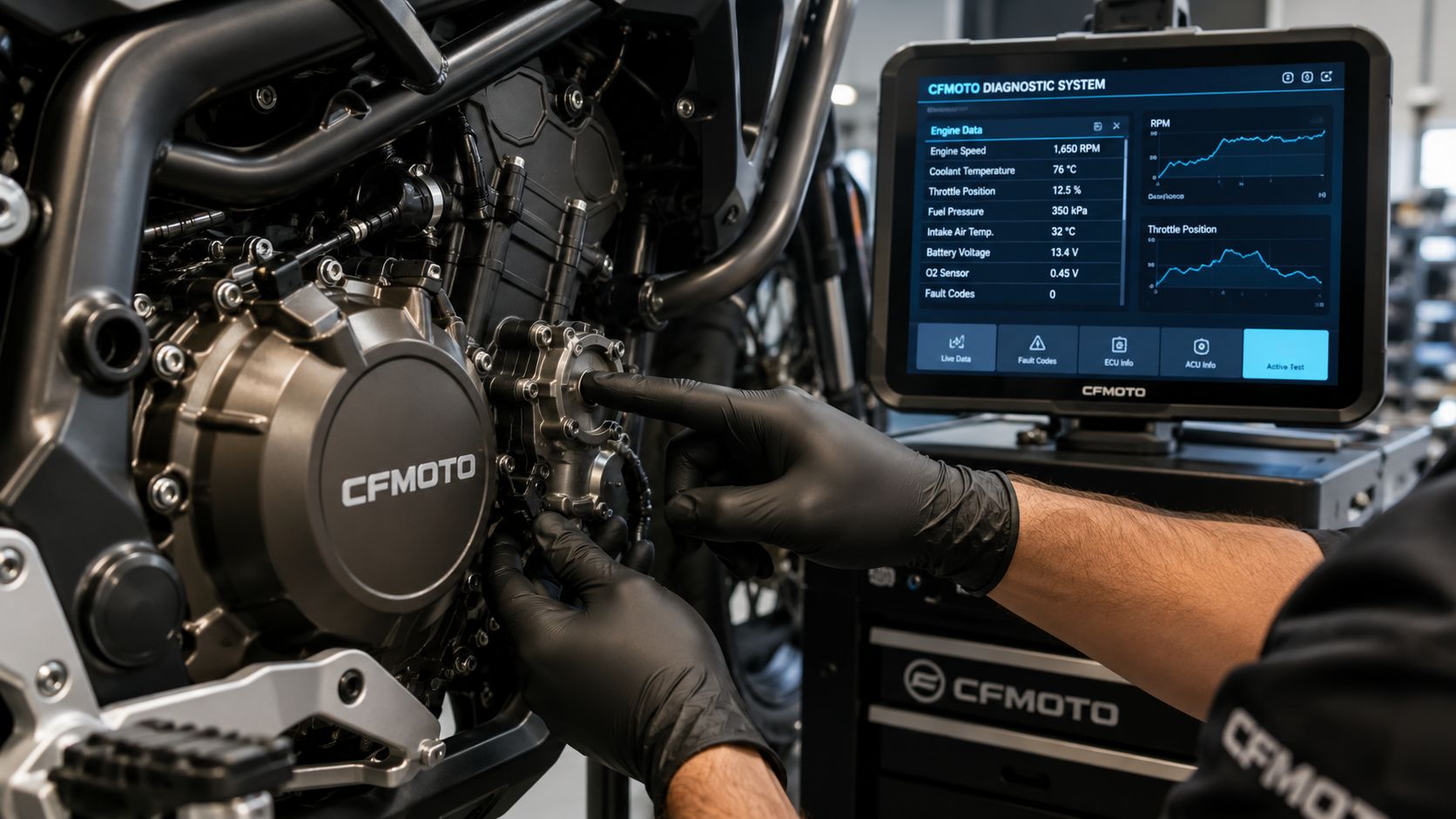
Here's a useful reality check on diagnostics and service support:
How newer models changed the conversation
What's changed with newer CFMoto products is less about one miracle improvement and more about the total package feeling more mature. Manufacturing, fit and finish, component choice, and maintenance burden all seem to matter more in the current discussion than old reflexive doubts.
That change is especially visible when riders discuss how newer machines behave over time. Instead of talking only about whether the machine breaks, they talk about whether it feels sorted. That's a more advanced kind of approval. Riders start debating suspension tuning, service intervals, and resale rather than wondering whether the brand belongs in the conversation at all.
Still, balance is the critical factor. Even supporters often concede that long-term ownership economics can be less favorable if resale is weak or if support is thinner than with a legacy brand. Reliability isn't just engine survival. It's also how easy the machine is to keep on the road or trail without friction.
How CFMoto Stacks Up Against the Competition
The sharpest way to answer “Are CFMoto any good?” is to stop judging the brand in isolation. A machine can be good and still be the wrong buy if the ownership math doesn't fit your priorities. This is especially true in the UTV world, where buyers often focus on purchase price and ignore the cost of getting out later.
The ownership equation most shoppers miss
A recurring theme in owner discussion is that CFMoto's lower upfront price can be offset by weaker resale value. That point comes up directly in this owner discussion about CFMoto value and resale, and it's the most important contrarian point in the whole debate.
A lot of first-time buyers think value begins and ends on day one. Experienced buyers know it often ends on day resale, trade, or replacement. If a cheaper machine loses ground when you sell it, the “deal” may not stay as attractive as it looked in the showroom.
That doesn't automatically make CFMoto the wrong choice. It means the brand tends to favor owners who plan to keep the machine longer, get strong use from the included equipment, and don't depend on top-tier resale.
Buy CFMoto for the ownership experience you expect to use. Don't buy it for a future exit that may reward an established badge more heavily.
2026 UTV value comparison
The comparison below doesn't assign invented price or depreciation figures. Instead, it uses the categories that drive ownership outcomes.
| Metric | CFMoto ZForce 800 Trail | Polaris RZR Trail S | Campus E1 Electric UTV |
|---|---|---|---|
| Upfront value feel | Strong feature-for-money appeal | Usually bought on brand trust and established market presence | Appeals to buyers focused on electric operation and simplicity |
| Brand perception | Improving fast, but still debated by some used buyers | Familiar and proven in the eyes of many shoppers | Different category, often evaluated on use case rather than tradition |
| Resale confidence | More uncertain, especially if you trade frequently | Typically stronger because the market knows the badge well | Depends heavily on local demand and buyer comfort with electric |
| Maintenance profile | Conventional gas UTV upkeep and wear items | Conventional gas UTV upkeep with broad support familiarity | Fewer routine engine-related service demands, but charging fit and use case matter |
| Best use case | Value-focused recreation and ownership over a longer horizon | Buyers who want known-brand confidence and easier future exit | Property owners, hunters, campuses, and low-noise users |
| Main tradeoff | Cost to exit can narrow the advantage | Higher entry barrier | Not ideal for every trail rider or every charging situation |
Which type of value are you buying
Many CFMoto reviews stop too early. They conclude that the machine offers a lot for the money, which is true, then fail to ask what kind of buyer benefits most from that.
Three buyer mindsets produce three different answers.
First, there's the front-loaded value buyer. This person wants the most visible equipment and capability for the least initial spend. CFMoto often makes the strongest case here.
Second, there's the resale-sensitive buyer. This owner trades often, watches used listings closely, and wants a machine that remains easy to move. Legacy brands usually feel safer here.
Third, there's the operating-simplicity buyer. This person may care less about badge history and more about quiet running, fewer routine service demands, and use on property or around work sites. That's where an electric alternative changes the conversation entirely.
CFMoto isn't weak because it doesn't dominate all three categories. It's specialized in a different kind of value than many shoppers initially assume.
The Final Verdict Who Should Buy a CFMoto in 2026
So, are CFMoto any good? In 2026, the honest answer is yes, with conditions that matter a lot.
They're good enough that dismissing them outright is lazy analysis. They've earned serious consideration on scale, equipment, and the maturity of newer products. But they're also not a one-size-fits-all answer, because total cost of ownership still depends heavily on model year, support access, and resale expectations.
The buyer who fits CFMoto best
CFMoto makes the most sense for the buyer who wants maximum visible value and plans to keep the machine long enough to use that value. If you maintain your own equipment, don't panic over badge prestige, and prefer getting more hardware up front, CFMoto can be a smart buy.
It also suits the rider or off-road owner who's shopping newer model years and treating the brand as it exists now, not as it was once perceived. That distinction matters.
The buyer who should be more careful
If your plan is to trade quickly, rely heavily on dealer turnaround, or protect resale above all else, you should slow down and compare hard with legacy brands. In that ownership style, CFMoto's day-one appeal can narrow over time.
The same caution applies to shoppers looking at older used units without documentation. On a brand where the model-year story matters, “cheap and available” isn't enough reason to buy.
The smartest way to decide
Use a short decision test:
- Choose CFMoto if you want strong feature content, you're focused on newer models, and you expect to keep the machine long enough to benefit from the upfront value.
- Choose a legacy gas brand if resale, dealer density, and long-established ownership confidence matter more than getting the most equipment on day one.
- Choose an electric utility option if your priority is quiet operation, simple day-to-day use, and a work-oriented ownership experience. If that sounds like you, it's worth comparing what's available in the utility ATV lineup at Campus EV.
The best verdict is this: CFMoto is no longer the risky punchline many buyers still assume. It's a credible value brand whose newest products deserve real consideration. The catch is that you should buy one with a clear plan for how long you'll own it and how much you care about the cost to exit.
If you're comparing gas and electric side by side, Campus EV is worth a look. Its electric utility-focused lineup gives buyers another way to think about value, especially if quiet operation, low routine maintenance, and worksite practicality matter more to you than traditional gas-brand familiarity.