
The most popular advice about the Polaris RZR XP 1000 is also the least useful: buy one because it's supposedly the best sport side-by-side for everyone. That's wrong. The RZR XP 1000 is an excellent high-speed recreational machine, but its performance-first design creates ownership compromises that matter a lot more to ranchers, hunters, contractors, and property owners than another horsepower claim.
A better buying question is simple: what job will the machine perform most often? If you want to attack rough trails quickly, the RZR's engine, CVT, AWD system, and long-travel suspension make a convincing argument. If you need quiet transport, dependable low-speed work, secure cargo, and low routine maintenance, the case is less comfortable. Recall exposure and recurring fit-for-purpose complaints deserve as much attention as the specification sheet.
Table of Contents
- Why the RZR XP 1000 Reputation Is More Complicated Than the Brochure
- Engine, Drivetrain, and the Numbers Behind 110 Plus Horsepower
- Suspension, Ground Clearance, and How the Chassis Behaves Off Pavement
- Real Ownership Complaints Most Reviews Skip Past
- The 2024 Battery Terminal Recall and What It Means for Buyers
- RZR XP 1000 Compared to Electric UTV Alternatives Like the Campus E1
- Who Should Buy a RZR XP 1000 and Who Should Look Elsewhere
Why the RZR XP 1000 Reputation Is More Complicated Than the Brochure
The RZR XP 1000 earned its reputation. Polaris introduced it for the 2014 model year with the new ProStar 1000 engine, 999 cc displacement, claimed 107 horsepower, a 90-inch wheelbase, and 13.5 inches of ground clearance, as described in Polaris' launch coverage of the RZR XP 1000. It was a major step beyond the RZR XP 900 and quickly became a serious benchmark in the sport UTV class.
That history explains why buyers still treat the model as a default answer. The platform has a large aftermarket, familiar controls, strong trail capability, and a powertrain formula that stayed recognizable across later years. But a machine can be influential without being the right tool for every owner.
The brochure leaves out the ownership workload
The XP 1000 is built to carry speed across rough ground. That means the driveline, suspension, clutching, brakes, and chassis all work harder when the driver uses the machine as intended. A fast desert run and a slow day hauling fencing are completely different duty cycles, yet many buyers shop as if a sport UTV should handle both with equal ease.
The ownership risk is also more than mechanical wear. Polaris issued a recall affecting certain 2024 and 2025 RZR XP 1000 and XP 4 1000 vehicles, involving a battery terminal cover that could be damaged by the seat base and expose the positive post. The U.S. Consumer Product Safety Commission recall alert reports about 25,000 vehicles globally and three incidents, including two fires and one melted-wire case.
Practical rule: A used RZR isn't ready to buy until its VIN recall status is checked and the battery area has been inspected.
The other problem is fit. Owner-focused coverage has highlighted exposed or vulnerable lower arms, a glove box that may not stay closed, and dust pushed downward by the exhaust at low speed, as discussed in this RZR XP 1000 rock-use review. Those complaints don't make the RZR a bad machine. They show that it's optimized for sport riding, not quiet, tidy, low-speed work.
Engine, Drivetrain, and the Numbers Behind 110 Plus Horsepower
The RZR XP 1000's core engine is a 999 cc, four-stroke DOHC twin-cylinder. Polaris pairs it with an automatic Polaris Variable Transmission, or PVT, and true on-demand AWD with selectable 2WD behavior. In plain terms, the engine makes power, the CVT keeps the revs in a useful range, and the drivetrain sends traction where it's needed without asking the driver to operate a manual gearbox.
The original launch version claimed 107 horsepower. Later XP 1000 models standardized around 110 horsepower, while current XP 1000 specifications list 114 horsepower. Polaris' published specifications for a later XP 1000 configuration also list a 90-inch wheelbase, which helps explain the machine's ability to turn tightly while remaining manageable on trails. The historical and model-year details are documented in Polaris' XP 1000 specifications.
What the power feels like
The XP 1000 doesn't need a turbocharger to feel aggressive. Its naturally aspirated twin responds directly to throttle input, and the CVT lets the engine stay in its effective power band during climbs, loose surfaces, and repeated acceleration. That makes the machine easy to drive quickly, but it also makes throttle discipline important on slick rock, wet grass, and narrow wooded trails.
The true on-demand AWD system is useful when the surface changes suddenly. In 2WD, the RZR can feel lighter and more playful. In AWD, the front wheels contribute when traction demand rises. The system is valuable for maintaining momentum, but it doesn't erase poor line choice or excessive speed.
Key powertrain specifications by generation
The table below summarizes the verified launch, later, and current figures published by Polaris.
| Model Year / Trim | Engine Output | Drivetrain | Wheelbase | Claimed Top Speed |
|---|---|---|---|---|
| 2014 launch XP 1000 | 107 hp | Automatic PVT, AWD/2WD | 90 in. | Not specified in verified data |
| Later XP 1000 models | 110 hp | Automatic PVT, AWD/2WD | 90 in. | Not specified in verified data |
| Current XP 1000 platform | 114 hp | Automatic PVT, true on-demand AWD/2WD | 90 in. in the cited owner specification | Not specified in verified data |
Don't buy the XP 1000 for a top-speed number that isn't consistently established in the available data. Buy it because the engine and CVT deliver strong acceleration and maintain momentum over rough terrain. That's where this drivetrain earns its keep.
Suspension, Ground Clearance, and How the Chassis Behaves Off Pavement
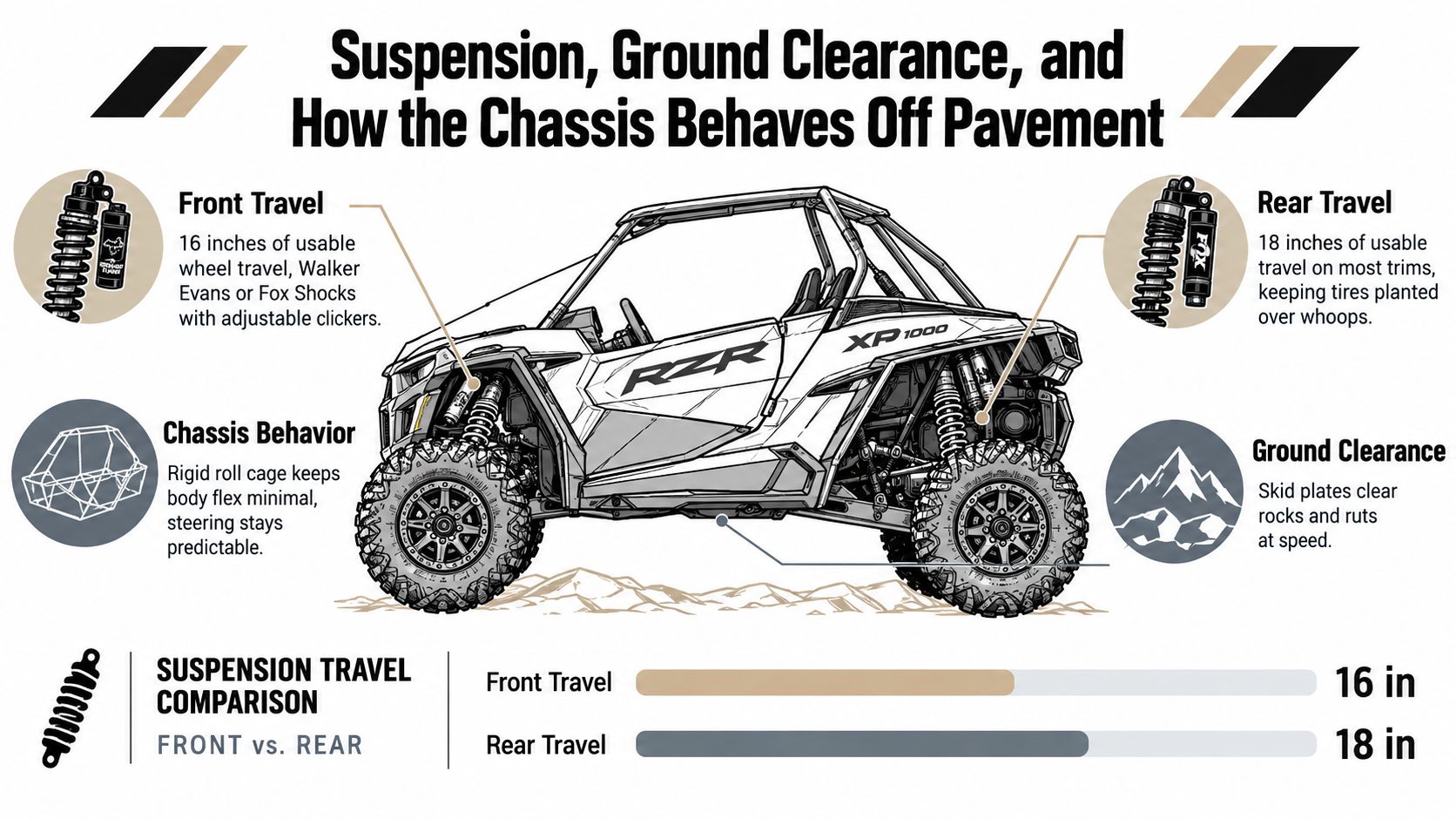
The RZR XP 1000's suspension is the reason it feels much more capable than a basic utility side-by-side at speed. Current XP 1000 specifications list 16 inches of front wheel travel, 18 inches of rear wheel travel, and 14.5 inches of ground clearance. Earlier published configurations list 13.5 inches of ground clearance, so buyers must compare the exact model year and trim rather than assume every XP 1000 has identical dimensions.
Why travel matters on the trail
Suspension travel is the amount of wheel movement available before the suspension reaches its limits. More usable movement lets the tires follow whoops, ruts, and uneven ground while the chassis stays more controlled. The longer rear travel also helps the rear tires remain connected when the machine crests uneven terrain.
That doesn't mean the XP 1000 floats over everything. A short wheelbase improves maneuverability, but it also makes weight transfer more noticeable. Polaris' owner documentation lists a 90-inch wheelbase, 1,460-pound dry weight in one current configuration, and 29-inch tires, figures provided in the RZR XP 1000 owner specifications. The chassis can change attitude quickly when you lift off the throttle, brake hard, or turn sharply on a slope.
The payoff is speed retention. The compromise is less calm, predictable behavior at crawl speed than a purpose-built utility machine. Technical rock work exposes that difference, especially when the driver needs precise tire placement instead of suspension capacity.
The chassis trade-off
Long-travel sport suspension can absorb rough terrain impressively, but it can also feel tall and busy on tight trails. Ground clearance protects the chassis from ruts and rocks, while the broad suspension movement helps prevent harsh bottoming. Neither feature replaces skid plates, sensible tire pressure, or careful inspection after hard impacts.
For tire selection and pressure decisions, consult a detailed UTV tire review resource before fitting aggressive aftermarket rubber. Larger or heavier tires can change steering effort, clutch load, braking feel, and suspension response. That is where many “upgrades” become an ownership expense instead of a capability gain.
Real Ownership Complaints Most Reviews Skip Past
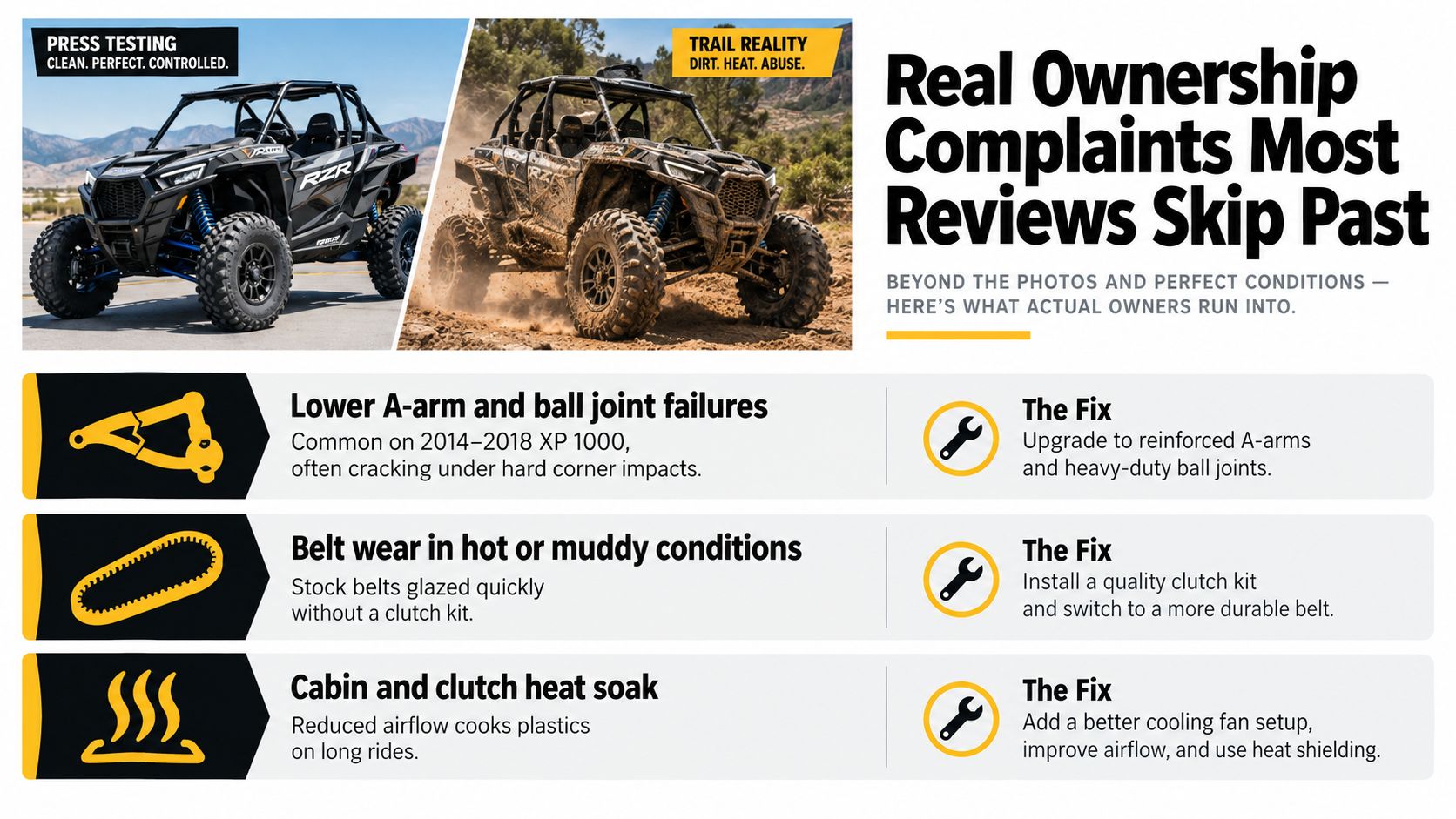
Magazine tests usually happen on prepared routes with a support truck nearby. Daily ownership happens in dust, mud, cold starts, rocks, and storage yards. That difference explains why a machine can receive praise during a test ride and still frustrate an owner after months of real use.
The complaints that deserve a pre-purchase inspection
Lower suspension components take abuse when the RZR is driven hard through rocks or fitted with accessories that change loading. Inspect the lower arms, ball joints, bushings, and mounting points for bends, looseness, cracked paint, or fresh replacement hardware. A clean-looking machine with oversized tires may have worked much harder than its hours suggest.
Storage is another weak point. Owners have reported glove-box latches that don't hold securely, and dust or water can reach ports and accessories when the compartment doesn't seal properly. A loose latch isn't just an annoyance. It can turn phones, charging equipment, and paperwork into trail casualties.
The exhaust can also push dust downward during slow travel. That matters to hunters, ranch workers, and anyone riding behind the machine on a dry property. A vehicle designed to move quickly through open terrain isn't automatically pleasant during repeated low-speed chores.
What the mechanic sees after modifications
Aftermarket parts often expose the difference between useful and careless modification. Bigger tires, lift components, and aggressive riding can increase stress on suspension and clutch components. A buyer should ask which parts were changed, why they were changed, and whether the seller still has the original components.
The belt and clutch system deserves attention too. Look for belt dust, glazing, burnt odor, unusual engagement, or inconsistent acceleration. A neglected CVT can become an expensive interruption, especially when a machine is used far from a dealer.
For general powersports context, this quad ownership guide is useful when comparing purchase price with the less visible costs of tires, service, protection, and accessories. The RZR's ownership tax isn't a reason to avoid it. It's a reason to budget.
The following video offers another visual reference for the platform and its trail behavior.
The 2024 Battery Terminal Recall and What It Means for Buyers
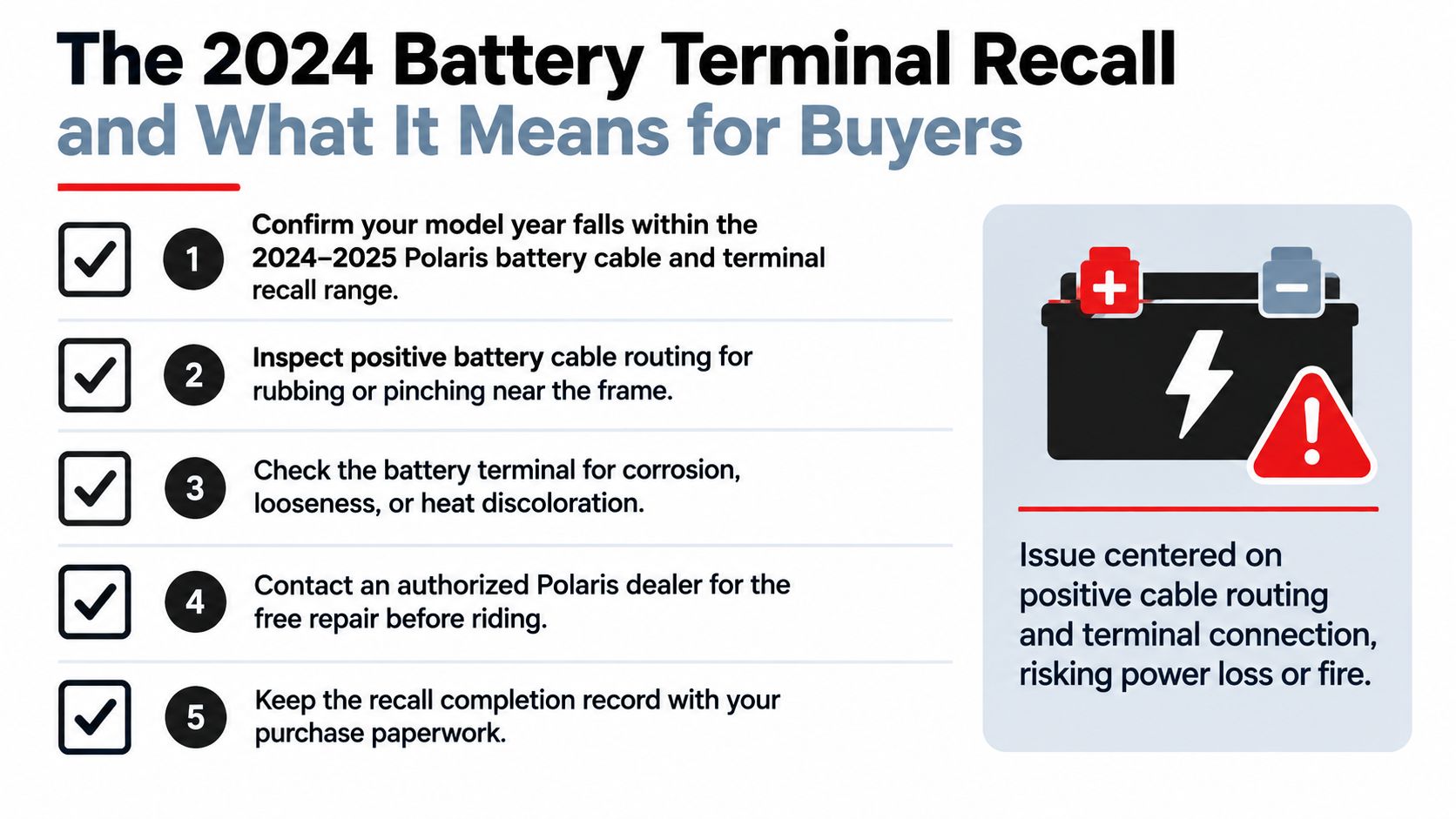
The recall changes how I'd inspect a used RZR XP 1000. The issue involved the red battery terminal cover being damaged by the seat base, which could expose the positive post and create an electrical short or fire hazard. Polaris reported the recall for certain 2024 and 2025 models, with the affected population and incident history detailed by the CPSC safety alert.
Inspect before you negotiate
Don't rely on a seller saying “the recall was handled.” Ask for documentation and inspect the battery area yourself. The repair path should be confirmed through an authorized Polaris dealer, and recall status should be checked using the machine's VIN.
Use this checklist:
- Verify the VIN: Confirm whether the specific machine is included in the recall.
- Inspect the terminal cover: Look for cracking, displacement, heat discoloration, melted plastic, or evidence of contact with the seat base.
- Check cable routing: Look for rubbing, pinching, or an aftermarket battery installation that changes the original fit.
- Request repair records: Keep the dealer documentation with the purchase paperwork.
- Stop if damage is visible: Don't ride an affected machine with a damaged terminal area until the repair has been completed.
A recall repair remains relevant even when the machine is outside its normal warranty period. The important question isn't whether the seller has owned it for a long time. It's whether the safety action was completed correctly.
The wider ownership lesson
Sport UTVs package a powerful engine, battery, wiring, fuel, and suspension hardware into a compact space exposed to dust, vibration, water, and impact. Electrical problems deserve the same inspection attention as wheel bearings and ball joints.
For fleet operators, a recall isn't just a paperwork issue. One machine out of service can interrupt a workday, strand a crew, or create a safety problem in a remote location. Verify the fix before you value the machine as “ready to work.”
RZR XP 1000 Compared to Electric UTV Alternatives Like the Campus E1
The XP 1000 and an electric UTV solve different problems. The Polaris is a recreational performance machine with a high-output combustion engine, CVT, and long-travel suspension. An electric UTV such as the Campus E1 is aimed at buyers who value quiet movement, simplified power delivery, and work-focused operation.
That distinction matters more than brand loyalty. A hunter approaching a blind before daylight, a rancher moving between gates, and a warehouse operator working around people may gain more from low noise and easy control than from sport suspension capacity.
Compare the job, not the brochure
| Factor | RZR XP 1000 | Electric UTV such as the Campus E1 |
|---|---|---|
| Noise | Combustion engine noise is a central part of operation. Polaris lists a weighted sound pressure level of 86.7 dB(A) at the rider's ear in its owner documentation. | Electric drive is the quieter option in principle, which can be valuable around wildlife, workers, and neighboring properties. Confirm the exact vehicle's operating specifications before purchase. |
| Routine service | Requires attention to engine fluids, fuel system, CVT components, suspension, and drivetrain wear. | A simpler electric drivetrain can reduce engine and CVT service, but tires, brakes, suspension, battery care, and charging still matter. |
| Low-speed work | Strong capability, but throttle, clutch engagement, engine heat, and exhaust dust can make slow chores less pleasant. | Smooth low-speed control suits property work, campuses, farms, and industrial routes. |
| High-speed recreation | This is the RZR's home territory. The engine, AWD system, and suspension are designed to maintain pace over rough trails. | Electric UTVs aren't the natural choice for repeated high-speed desert riding or sport use. |
| Fuel and energy | Uses gasoline and depends on fuel storage, fuel quality, and combustion-system maintenance. | Uses electricity and depends on charging access, battery condition, and local energy rates. |
| Best fit | Trail riders who want acceleration, suspension performance, and a large sport-UTV aftermarket. | Work-focused owners who prioritize quiet operation, reduced mechanical complexity, and predictable low-speed use. |
An electric side-by-side deserves serious consideration when the machine spends more time hauling, patrolling, checking livestock, or moving tools than it does attacking rough trails. The electric side-by-side and ATV guide is a useful starting point for comparing that category without treating every UTV as a sport machine.
Where the RZR still wins
The RZR delivers a kind of trail response electric work vehicles generally aren't designed to replicate. Its 999 cc twin, CVT, AWD system, and long-travel chassis support fast terrain changes and repeated acceleration. If your weekends revolve around rough recreational riding, that matters.
But don't mistake capability for efficiency. A sport UTV carries systems designed for speed even when the owner only needs to move slowly around a property. For work buyers, the unused performance becomes weight, noise, fuel dependence, and more components to maintain.
Who Should Buy a RZR XP 1000 and Who Should Look Elsewhere
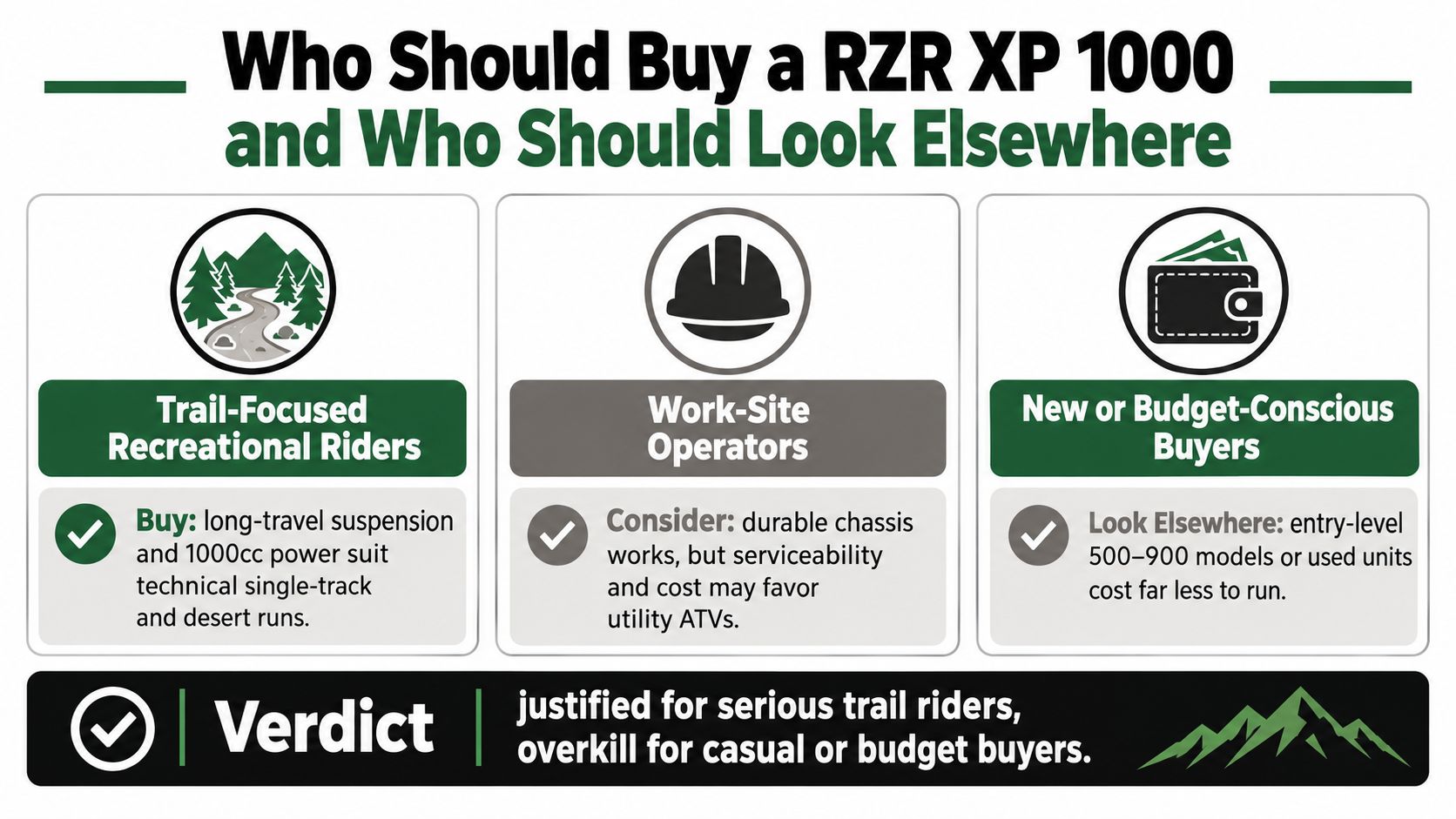
Buy the RZR XP 1000 if you're a committed recreational rider. You'll appreciate the responsive twin-cylinder engine, strong acceleration, AWD traction, long-travel suspension, and deep aftermarket support. You should also be comfortable inspecting suspension components, monitoring the CVT, checking recall status, and repairing damage from aggressive terrain.
Three buyer profiles
Trail-focused recreational riders should buy with confidence. The RZR makes sense when speed, suspension movement, and aftermarket customization are the main priorities. It's especially compelling for owners who ride often enough to understand the machine's service needs and who won't confuse a sport platform with a utility workhorse.
Worksite operators should slow down before signing. A ranch, farm, construction site, or warehouse may need low-speed control, quiet operation, cargo security, and easy daily service. The RZR can perform those tasks, but its performance hardware doesn't make it the most economical or comfortable choice for them.
New and budget-conscious buyers should inspect used machines carefully. A low purchase price doesn't eliminate wear. Check the lower arms, ball joints, tires, CVT behavior, storage seals, battery area, and recall records. A neglected used XP 1000 can turn its attractive entry price into a repair project.
Make the decision with four questions
- Where will you ride most? Open rough terrain favors the RZR. Tight property routes and work yards may favor an electric UTV.
- How much noise can you tolerate? Wildlife, neighbors, workers, and resort guests all change the answer.
- Will you maintain a CVT sport machine? If belt, suspension, fuel, and electrical checks sound like chores you'll avoid, choose a simpler platform.
- Do you need performance or productivity? The RZR is justified by recreational performance. Work buyers should demand a clear operational reason before paying for capability they won't use.
My verdict: The RZR XP 1000 is a strong sport UTV, but it isn't a universal best buy. Choose it for fast recreational riding, not because its reputation has made the decision for you.
Campus EV offers electric UTVs built around the quieter, lower-maintenance side of powersports, including options for hunters, farmers, ranchers, and worksite operators. If your priority is practical daily transport rather than high-speed trail performance, visit Campus EV and compare the electric approach before buying a gas-powered sport machine.