
The feed truck is loaded, the north pasture gate is still iced over, and you've got a fence inspection before the next weather front arrives. You need a machine that can carry tools, climb without drama, check water tanks, and get back to the shed with enough charge left to work tomorrow. That's the central question behind the search for the best electric UTV for ranchers.
I've learned not to start with the biggest battery or the most exciting top-speed claim. Start with the ranch's daily route, working load, terrain, weather, and charging point. The Campus E1 is a strong fit for many short-loop ranch operations, but it isn't a universal replacement for a gas workhorse. The right choice depends on how your ranch operates.
Running a farm rather than a ranch? The same criteria apply to an electric UTV for farm work: feed runs, fence checks and hauling tools between barns. This guide works as a farm electric UTV buyer guide too.
Table of Contents
- Why Ranchers Are Switching to Electric UTVs
- The Seven Criteria That Matter for Ranch Use
- Electric Versus Gas UTVs on the Ranch
- Campus E1 and How It Compares to the Field
- What a Real Ranch Day Looks Like in the Campus E1
- Charging the Campus E1 on a Real Ranch
- Configurations, Accessories, and Ownership Costs
- Which Electric UTV You Should Buy
Why Ranchers Are Switching to Electric UTVs
At first light, a ranch UTV earns its keep in small, repeated jobs. You drive from the barn to the feed lot, stop at a water trough, cross a rocky pasture, check a gate, and turn around before breakfast. Later, the same vehicle carries fencing tools, pulls a light trailer, or hauls a panel back to the shed.
That stop-and-go pattern suits electric drive. An electric motor delivers quiet, immediate movement without asking you to warm up an engine at every stop. It also eliminates tailpipe emissions where you're working, which matters in enclosed sheds, near livestock, and around buildings.
But electric power doesn't erase the practical risks of ranch driving. A CDC-supported occupational safety review hosted by OSHA recorded 2,090 ATV injuries and 321 ATV fatalities in the United States between 2003 and 2011, with three out of five occupational deaths occurring in agriculture. The same safety guidance describes UTVs as generally safer than ATVs because UTVs typically provide roll bars, seat belts, speed governors, and a wider, heavier platform.
My rule: Buy an electric UTV as a work vehicle first. Battery capacity matters, but rollover protection, restraint systems, stable handling, lighting, and sensible loading matter more.
Your first calculation should be a route, not a brochure claim. Measure the longest normal loop, include the return trip, note the steep sections, and record what you carry. Then check whether the equipment shed can restore the energy overnight.
The Campus E1 electric utility vehicle belongs on the shortlist because its basic layout matches common ranch chores. The decision still comes down to seven questions: range under load, charging access, payload and towing, terrain capability, livestock-friendly noise, maintenance burden, and total ownership cost.
The Seven Criteria That Matter for Ranch Use
A ranch UTV proves itself on the same chores, over and over. Buy on duty cycle and infrastructure first, battery second. If the machine cannot finish your normal loop, get charged where it sleeps, carry the load you ask of it, and handle your ground without drama, the rest is sales talk.
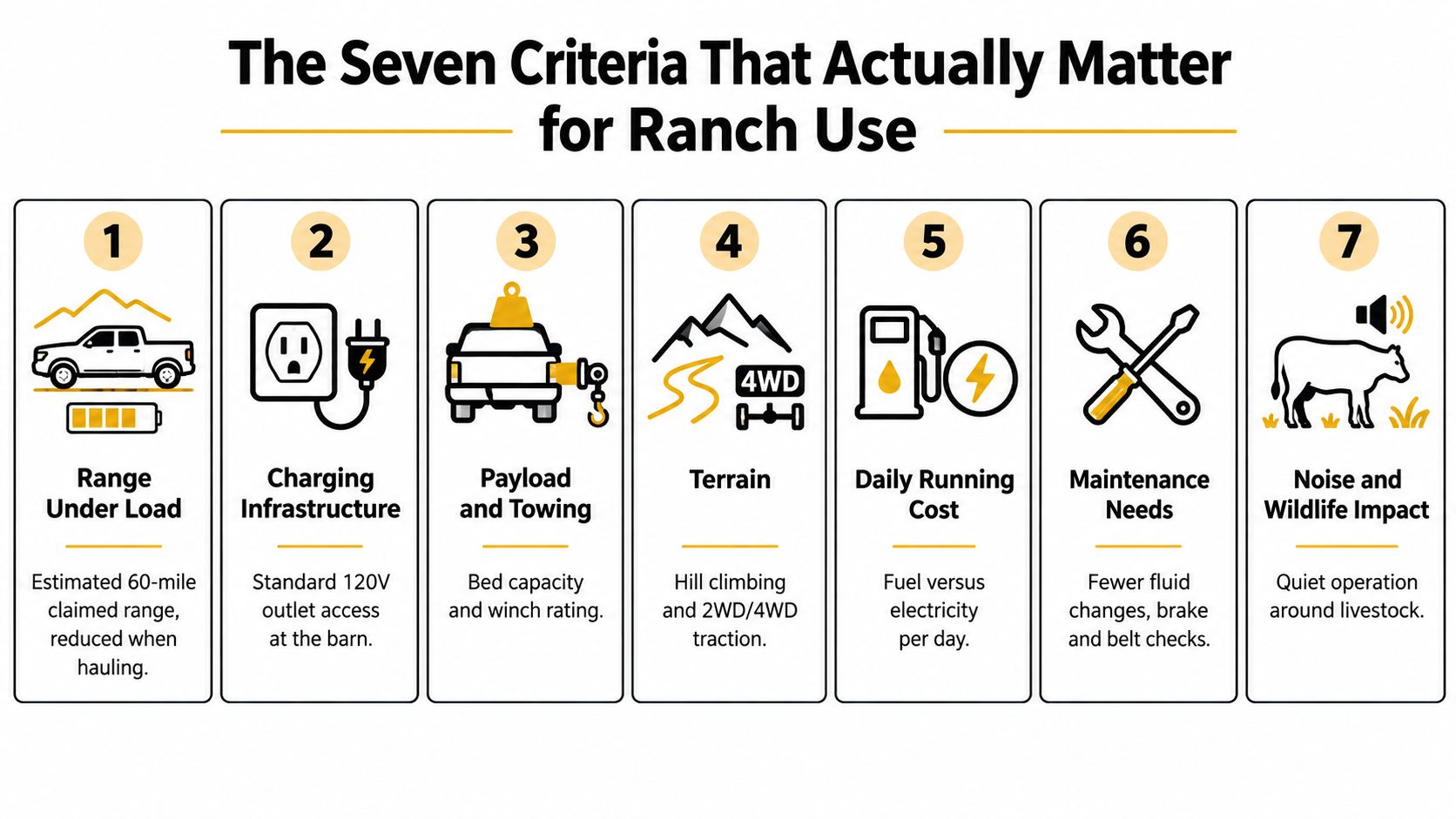
Range under load
Start with the longest real work loop on your place, not the advertised figure. Include the return trip, the steep pull, the feed or tools in the bed, and any towing. Then leave yourself reserve, because ranch work rarely goes exactly as planned. Manley Farms explains the range gap well. Real-world electric UTV performance often trails the headline number once hills, cargo, terrain, and temperature enter the picture.
Charging infrastructure
This comes before brand loyalty. A charger by the equipment shed beats extra capacity you cannot replace overnight. Check the outlet, circuit, cable reach, weather exposure, and where the machine will park every night. If the vehicle lives a long walk from power or gets left at a remote barn, your battery choice stops mattering and your charging setup becomes the bottleneck.
Payload and towing
A ranch bed is for feed sacks, fencing tools, mineral, chains, and whatever else the day adds. The hitch needs to handle small trailer duty without turning the machine into a slug on hills. Look at the manufacturer's ratings for the exact setup you are buying, then judge whether they fit routine ranch work instead of occasional light use.
Terrain and traction
Mud, ruts, loose rock, creek crossings, and wet grass expose weak machines fast. Prioritize 2WD and 4WD capability, ground clearance, controlled low-speed pulling, and stable suspension. Top speed means very little on a ranch. Composure on bad ground means everything.
Daily running cost
Electric can cut fuel use and lower day-to-day operating expense if your routes are repetitive and your charging is simple. The EIP-AGRI farm electromobility report also notes lower fossil-fuel use, reduced local emissions, and less sound. Those gains are real. They depend on how your ranch runs.
Maintenance needs
Electric drive cuts engine-related service, but it does not cut inspection discipline. Tires, brakes, steering, suspension, electrical connectors, battery condition, and recovery gear still need regular attention.
Noise and livestock impact
Quiet operation helps around cattle, horses, and wildlife, especially near pens, sheds, and water points. It does not replace good handling. It does make repeated checks less disruptive.
One more point gets overlooked. Ranch access is part of the job. If your routes depend on controlled entry at remote gates, review practical gate access system evaluation criteria along with the vehicle itself. A UTV that reaches the gate easily still needs a reliable way to get the right people through it.
Electric Versus Gas UTVs on the Ranch
Electric and gas UTVs don't win the same jobs. Electric is strongest on repeated, low-speed routes with frequent stops and a predictable return to a charger. Gas remains easier for long remote runs, quick refueling, and properties where power is unavailable at the working base.
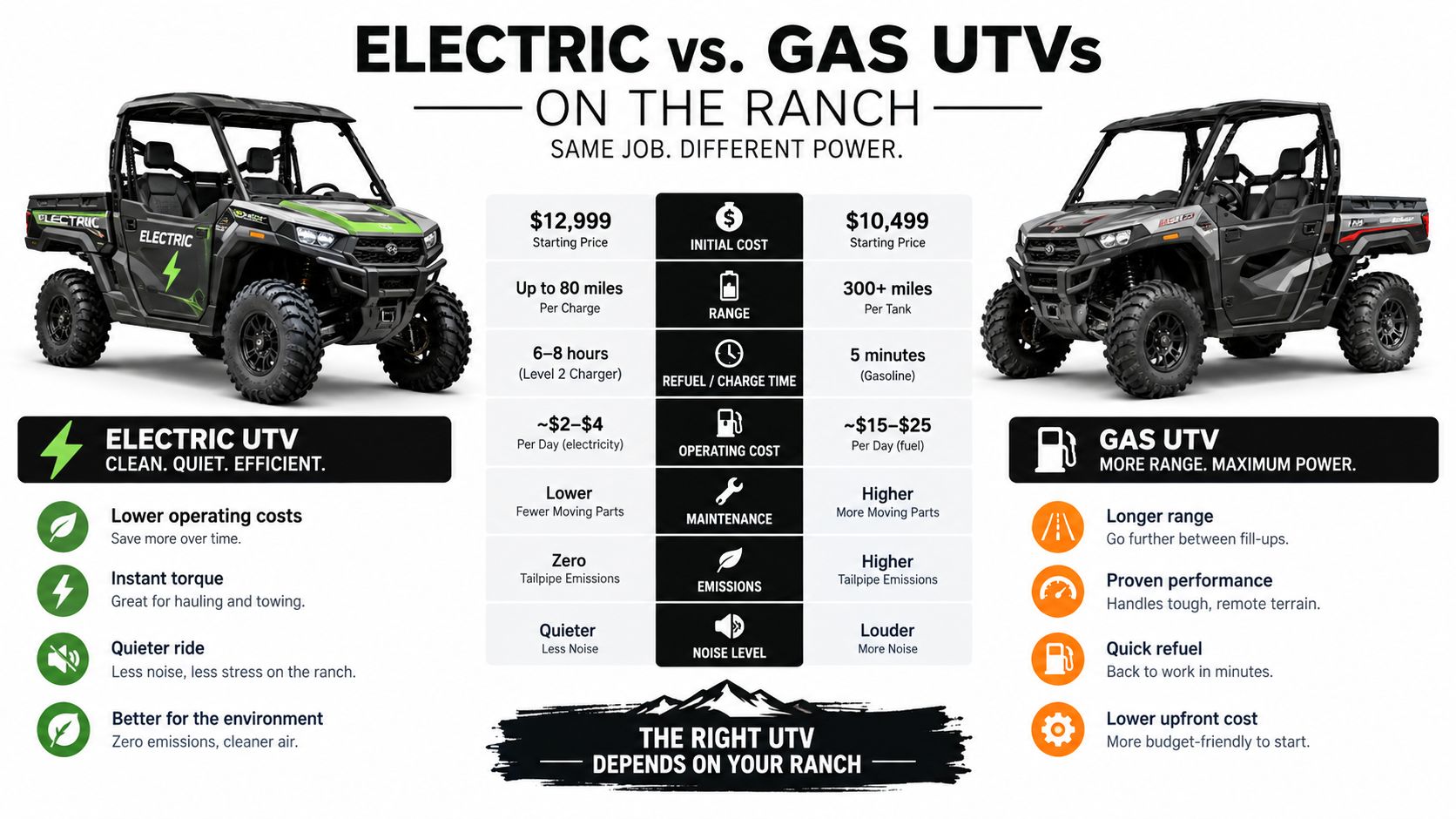
| Ranch requirement | Electric UTV | Gas UTV |
|---|---|---|
| Frequent short chores | Strong fit, especially with overnight charging | Capable, but engine operation adds noise and fuel use |
| Livestock checks | Quiet operation helps reduce disturbance | More familiar, but louder |
| Remote pasture routes | Requires route planning and a recovery reserve | Easier to extend a trip with fuel |
| Cold weather | Battery performance can decline in demanding conditions | Refueling remains straightforward |
| Maintenance | Fewer engine-related service tasks | Familiar service schedule, including engine and fuel-system work |
| Charging or refueling | Charging can take roughly 4 to 12 hours, depending on equipment and battery size (published charging estimates) | Refueling is fast where fuel is available |
| Local worksite emissions | No tailpipe emissions at the worksite | Produces exhaust while operating |
Electric also has a practical sound advantage. The European Commission report cited earlier describes reduced sound and local emissions as benefits of electric farm equipment. That doesn't mean an electric UTV is silent, or that it's automatically safer. It means the machine changes the working environment around barns, livestock, and property lines.
Gas still has the cleanest answer for a ranch with a long fence route, distant grazing leases, or no dependable outlet near the shed. You can carry fuel and continue working. An electric machine needs a route plan, a charge reserve, and a recovery plan when weather or towing pushes consumption higher than expected.
My recommendation is simple. Choose electric for predictable daily loops near power. Choose gas for long, irregular, remote work. If your ranch does both, a mixed fleet is often more practical than forcing one vehicle to cover every duty.
Campus E1 and How It Compares to the Field
The Campus E1 is built around a 20 kW PMSM motor and a 72V 150Ah lithium battery, which represents approximately 10.8 kWh of nominal stored energy before usable battery limits, drivetrain losses, terrain, and accessories. Campus EV lists a claimed range of up to 60 miles, but that number still needs to be tested against your loaded route and seasonal conditions.
Its ranch-oriented equipment is the important part. The E1 offers on-demand 2WD and 4WD, an electric dump bed, and a 3,000 lb winch. It's sold through authorized dealers, and Campus EV lists 0% APR financing through those dealers. The vehicle also includes CarPlay and Android Auto, useful conveniences but not reasons to buy a ranch machine.
The comparison below uses profiles rather than invented competitor specifications. A long-range electric model may suit a larger property, while a gas workhorse remains the safer choice for remote, unpredictable routes.
| Criterion | Campus E1 | Long-range electric | Gas workhorse |
|---|---|---|---|
| Best duty cycle | Short and medium ranch loops near a charger | Longer planned routes with charging support | Remote or irregular routes |
| Power system | 20 kW PMSM motor | Larger battery or efficiency-focused electric system | Internal-combustion engine |
| Battery or fuel planning | 72V 150Ah lithium battery and loaded-route reserve | More range potential, with added battery and charging considerations | Fuel availability and carried reserve |
| Traction | On-demand 2WD and 4WD | Depends on configuration | Commonly available in work-focused models |
| Work equipment | Electric dump bed and 3,000 lb winch | Varies by model | Broad accessory and service familiarity |
| Where it leads | Quiet daily chores and simple stop-start work | Route coverage | Fast replenishment and remote flexibility |
| Where it trails | Extreme range, cold-weather margin, and power-free bases | Purchase and infrastructure complexity may rise | Noise, exhaust, and engine-related service |
The E1 is my primary recommendation for a typical small or mid-size ranch with reliable power and work concentrated around a barn, house, or equipment shed. It stretches when the ranch demands long all-day loops, repeated heavy towing, or winter work far from a charger.
What a Real Ranch Day Looks Like in the Campus E1
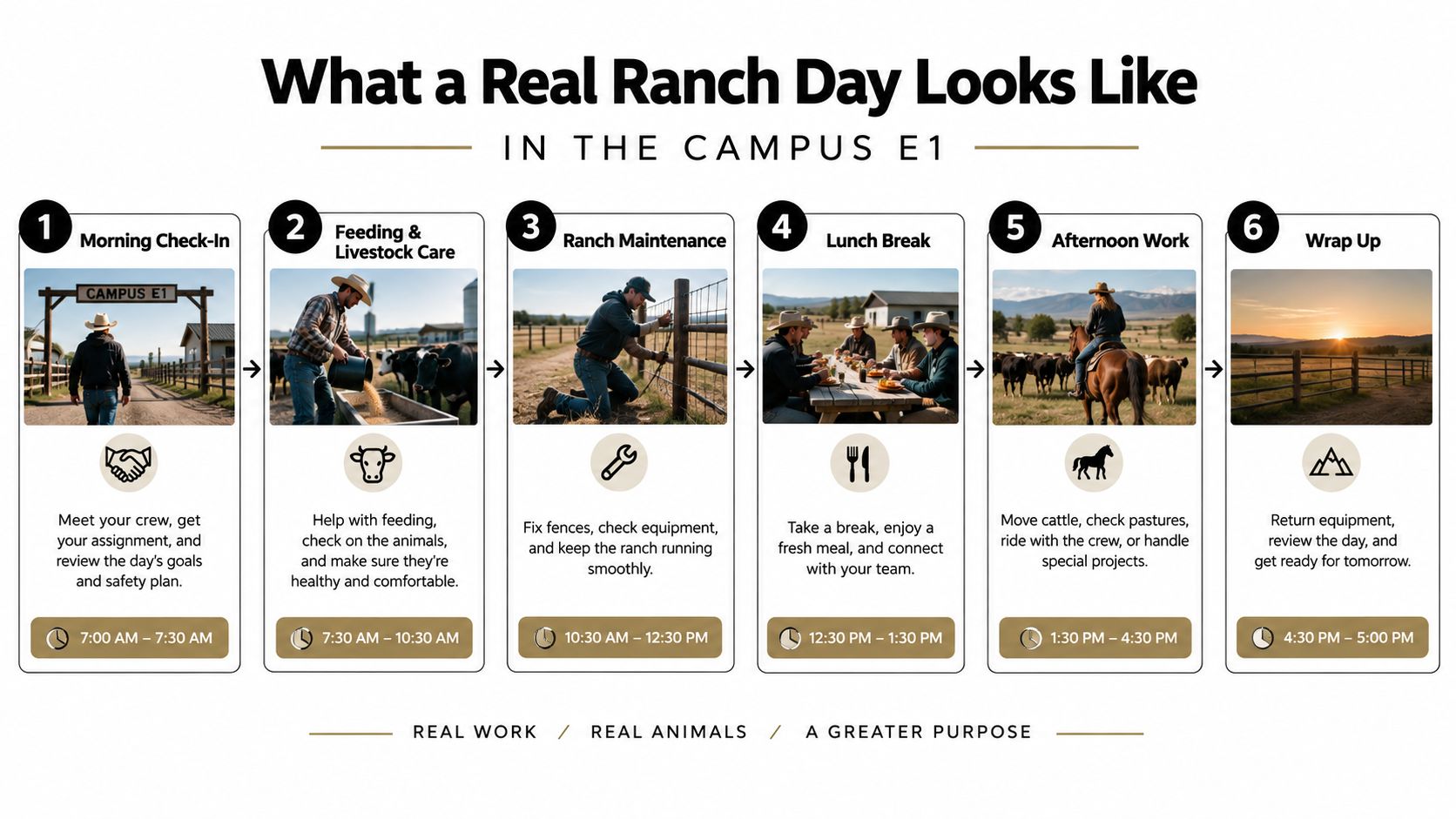
First light is where the E1 either makes sense or starts showing its limits. You leave the shed with feed in the bed, a few hand tools, and a list that looks normal for a ranch day. Water checks, a fence pass, a quick trailer move, then back with a gate panel. That kind of stop-start loop is the right way to judge an electric UTV. Start with the route and where you end the day. Treat the battery as part of that decision, not the whole decision.
Morning work tells you a lot fast. If the first miles are rolling pasture and two-track, use 4WD only where traction calls for it and keep your speed sensible. A loaded bed, hills, rough ground, and cold weather all cut into usable range. Brochure distance is not ranch distance. If your place regularly stacks those conditions into one shift, plan around that instead of hoping the gauge stays generous.
By midmorning, the Campus E1 is in its element. Quiet matters around stock. Instant motor response matters when you are opening gates, easing up to a trailer tongue, or stopping every few minutes for fence checks. The electric dump bed also earns its keep once you start moving loose feed, tools, wire, or cleanup material and want to spend less time lifting by hand.
Keep the bed organized. Posts, gloves, chains, and cutters need a place, especially on rough ground. Loose gear sliding around the cab area is an easy way to turn a routine chore into a dumb problem.
Working test: Run your longest normal route with the intended payload, then come back with a real reserve. An empty-bed road run does not tell you much about ranch use.
Afternoon jobs are where you find the stretch point. A light trailer task or a water run is fine if the hitch setup is right and the ground is firm enough for the load. The winch is there for controlled pulling or recovery. It is not permission to ignore the vehicle's limits. Bringing a gate panel back to the shed is exactly the sort of short, repetitive work the E1 handles well, because it stays quiet, starts cleanly, and does not punish you with engine noise all day.
The day ends at the charger, not at whatever gate you finished on. If the E1 comes home with enough reserve for comfort and you can plug in at the same spot every night, it fits your ranch. If you keep finishing far from power, your problem is the route, the parking setup, or both.
The embedded video gives another visual reference for the vehicle and its intended use.
Charging the Campus E1 on a Real Ranch
Charging is where a good electric UTV plan either becomes dependable or falls apart. Start at the shed, not at the dealership. Identify where the E1 will park after work, then trace the shortest practical path to a protected outlet.
Published estimates place electric UTV charging at roughly 4 to 12 hours, depending on battery size and charging equipment, and standard household charging can be substantially slower than higher-voltage charging (charging guidance for electric UTVs). That makes overnight scheduling central to ownership.
The shed checklist
- Outlet voltage: Confirm what the supplied charging equipment requires before assuming an existing outlet is suitable.
- Circuit capacity: Ask an electrician to verify that the circuit can support charging without nuisance trips or unsafe loading.
- Cable distance: Keep the parking position close enough that the cable doesn't cross vehicle lanes, livestock paths, or wet ground.
- Weather protection: Use a dry, protected charging location and follow the equipment's instructions for outdoor use.
- Overnight parking: Choose one repeatable location, so the vehicle returns to the charger after every shift.
- Backup power: If the ranch uses a generator or solar-battery system, confirm compatibility before treating it as a charging backup.
- Second charging point: Consider another location at a remote barn only if the route genuinely requires mid-shift energy.
A moderate-range UTV with dependable overnight charging can be more useful than a longer-range model that sits far from a practical outlet. Your route schedule determines whether charging is a minor habit or a daily operational constraint.
Use Campus EV's efficiency guidance for electric UTV operation when you build the routine. Smooth acceleration, correct tire pressure, sensible loading, and route planning all help preserve usable energy.
Configurations, Accessories, and Ownership Costs
The right E1 configuration starts with the jobs you repeat. For a ranch, prioritize the work bed, winch, hitch equipment, lighting, protective roof or enclosure options, and tires suited to your ground. A cab enclosure can make winter chores more tolerable, while tool mounts keep fencing equipment from sliding around the bed.
Useful additions include:
- Recovery equipment: Upgrade or protect the winch setup according to the loads and terrain you face.
- Lighting: Add practical forward and work lighting for early feed runs and evening returns.
- Tire and wheel choices: Match tread and sidewall strength to mud, rock, grass, and road transitions.
- Cab protection: Consider doors, a windshield, or an enclosure where wind and precipitation routinely stop work.
- Storage mounts: Secure fencing tools, first-aid supplies, tow straps, and livestock-check equipment.
Ownership savings come from the operating pattern, not from the word “electric” alone. Electric drive removes engine oil, spark-plug, exhaust, and fuel-system tasks, but you'll still inspect brakes, tires, steering, suspension, electrical connections, battery condition, and the dump-bed mechanism.
A gas UTV adds engine, fuel, exhaust, and drivetrain service. It also gives you a familiar refueling process and a broad network of mechanics in many rural areas. The E1 trades that familiarity for simpler electric operation, quieter work, and a charging routine.
Before signing, ask the authorized dealer for the written warranty terms, battery coverage, service procedure, replacement-part availability, and expected inspection schedule. Ask who handles diagnosis if the vehicle stops working far from the dealership. Financing can also affect the decision, since Campus EV lists 0% APR financing through authorized dealers, subject to the dealer's terms.
Read Campus EV's guidance on UTV maintenance cost alongside your own labor rates and service access. A machine that saves shop visits but leaves you waiting for unavailable parts isn't a practical saving.
Which Electric UTV You Should Buy
For a small or mid-size cow-calf ranch with reliable power and short daily loops, buy the Campus E1 with a protected overnight charging point, practical lighting, and tires matched to your pasture. Its 2WD and 4WD selection, electric dump bed, and winch fit routine feed, fence, gate, and recovery work.
For a large spread with remote pastures, choose a longer-range electric model only if you can establish dependable charging at the working base. Otherwise, keep a gas UTV for distant routes. Don't make the electric machine carry a duty cycle it can't reliably finish.
For a multi-property ranch with mixed terrain and cold winters, use the E1 for predictable chores near the main shed and retain a gas UTV as the remote and seasonal backup. Ask the dealer about cold-weather operating guidance, charging requirements, service coverage, accessory compatibility, and the loaded range test for your route.
My buying advice is direct: map the ranch, measure the route, inspect the charging site, and test the vehicle with real cargo. If the E1 matches that duty cycle, it's a sensible electric work partner. If it doesn't, buy the gas or mixed-fleet solution instead of hoping a brochure number will change the geography.
Campus EV offers the Campus E1 electric UTV with a 20 kW PMSM motor, 72V 150Ah lithium battery, on-demand 2WD and 4WD, an electric dump bed, and a 3,000 lb winch for ranch and off-road utility work. Review the vehicle details, dealer availability, financing terms, and charging fit for your property by visiting Campus EV.