
A gas UTV is coughing awake in the cold dark while the ranch hand beside it checks a second vehicle that starts without a crank, fumes, or noise. By sunrise, both may be moving feed and checking fences, but only one has made the operator think about engine warm-up, exhaust, and whether the first start will cooperate.
That's the core buying question for an off road electric utility vehicle. Not whether the brochure claims impressive range or acceleration, but whether the vehicle will complete your actual workday with payload, rough ground, cold weather, and a practical way to recharge. Electric UTVs can be excellent work tools, but only when the battery, traction system, and charging plan match the property.
Table of Contents
- What an Off Road Electric Utility Vehicle Really Is
- How Electric Drivetrains Change the Drive
- The Specs That Matter
- Electric Versus Gas Where the Work Happens
- Matching the Vehicle to Your Workday
- Charging, Maintenance, and Battery Care
- Rules, Terrain, and Insurance Reality
- A Smart Buyer Checklist Before You Sign
What an Off Road Electric Utility Vehicle Really Is
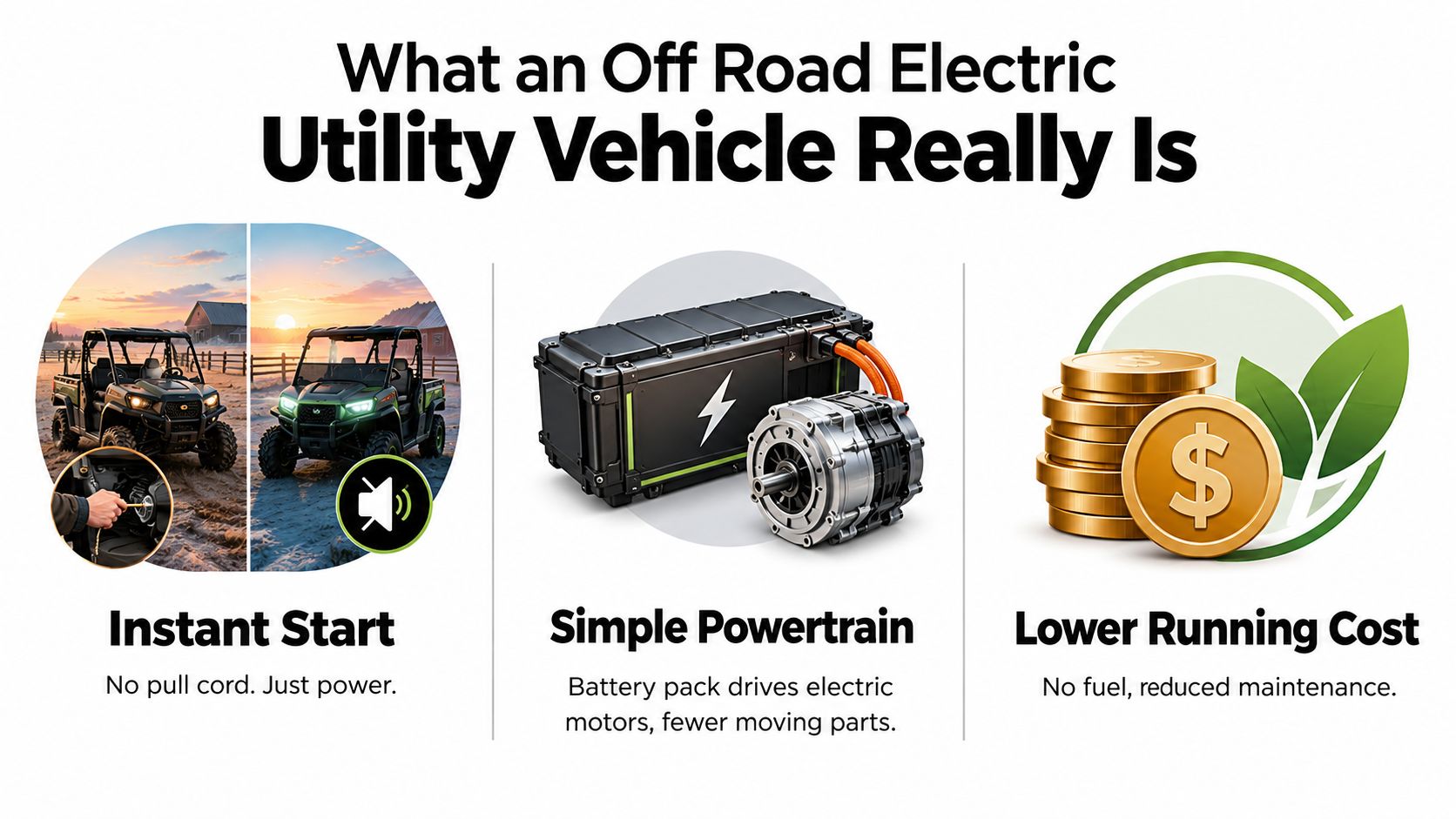
An off road electric utility vehicle is a battery-powered, four-wheeled work platform designed for terrain that would be unsuitable for a normal passenger vehicle. It combines an electric motor and battery pack with a utility bed, working clearance, suspension, and ratings for carrying people, tools, materials, or a trailer.
That makes it different from an ATV, which usually prioritizes a narrower footprint and single-rider trail access. It's also different from a golf cart, which may be quiet and electric but usually lacks the clearance, protection, load rating, and drivetrain needed for farm tracks or construction yards. An on-road electric vehicle has a different mission entirely. A utility UTV earns its place by hauling, towing, climbing, and returning to the same work area repeatedly.
The category is easier to understand through a morning job than a specification sheet. A ranch manager might use one vehicle for fence inspection, feed distribution, and moving tools between barns. A hunter might need quiet movement near a glassing ridge. A facility manager might use the same basic layout to carry maintenance equipment across uneven grounds. Their work differs, but each needs a stable platform that can carry a load without wasting energy on features that don't help the task.
Start with the duty cycle
The most useful definition is not “electric side-by-side.” It's a work vehicle sized around a repeated duty cycle. That cycle includes distance, terrain, payload, towing, stops, idle time, and charging access.
The broader off-highway electric vehicle market reached USD 15.41 billion in 2025 and is projected to reach USD 59.51 billion by 2034, with a projected CAGR of 16.25%, according to market data on commercial utility task vehicles. That growth matters because electric utility vehicles are moving beyond recreational experimentation into agriculture, logistics, construction, and property operations.
Before comparing models, write down what the vehicle must do on the hardest normal day. If the answer is “carry two people, climb wet slopes, tow a loaded trailer, and work far from the charger,” you need a different vehicle from someone making short warehouse loops on level ground. A useful side-by-side explanation can be found in this guide to what a side-by-side is, but the buying decision still comes down to the work.
How Electric Drivetrains Change the Drive
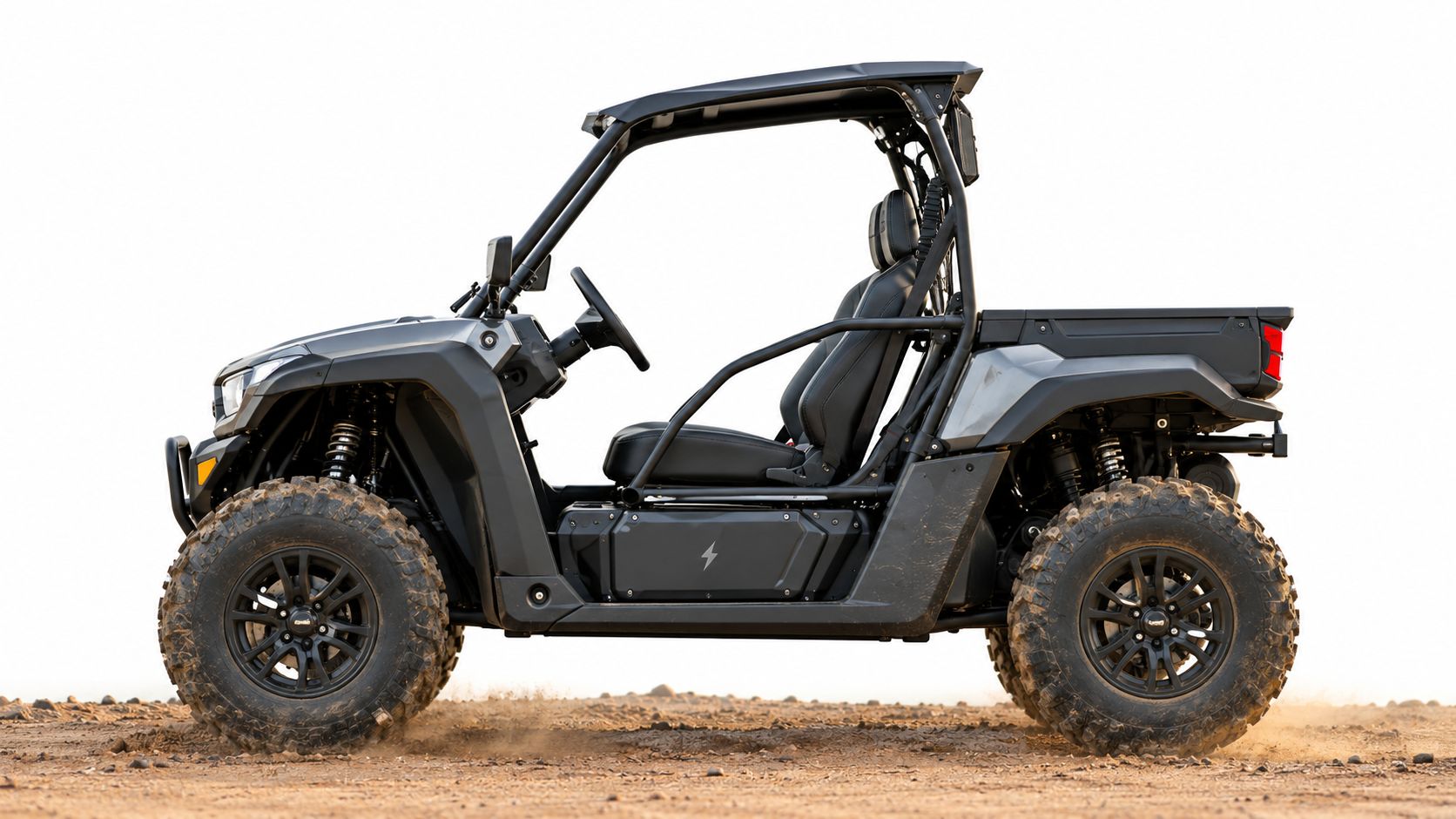
An electric drivetrain is straightforward. The battery sends power to one or more electric motors, and the motors turn the wheels through a simple reduction system. You don't wait for an engine to build revs, and you don't manage a clutch or shift through a conventional transmission.
That changes the first few metres of every job. Press the accelerator while pulling a loaded feed trailer up a wet slope, and the motor delivers strong turning force immediately. A gas engine may need revs and careful throttle control before it settles into the climb. Electric power feels more controlled because the vehicle responds as soon as you ask for movement.
Why low-speed torque matters
Utility buyers should care more about usable torque at low speed than a dramatic horsepower figure. A vehicle moving slowly with a full bed or trailer needs traction and controlled force, not a high top speed.
Consider a fence repair run after heavy rain. The UTV carries posts and tools, crosses a soft section, stops repeatedly, and then pulls away on an incline. Electric drive helps with repeated starts because there's no engine idle, no gear change, and no clutch engagement to manage. The operator can focus on choosing a line and maintaining traction.
The quiet operation also changes how people use the vehicle. Hunters can approach a location with less disturbance. Security teams can patrol without filling the area with engine noise. Farm workers can move near livestock without the same vibration and exhaust presence associated with a running gas engine.
Fewer service points, not no service
A battery and motor eliminate many engine-related service tasks. There's no oil change, spark plug, exhaust system, or fuel injector to maintain. That simplifies routine ownership, especially for a fleet that needs several vehicles ready each morning.
It doesn't remove wear. Tires, brakes, suspension components, steering joints, seals, and underbody protection still matter. Electric motors also won't overcome an overloaded bed, poor tire choice, or a route that exceeds the vehicle's traction capacity. The drivetrain is simpler, but the work remains demanding.
The Specs That Matter
A utility UTV earns its keep by finishing the shift, not by impressing visitors at a dealership. Judge it first by payload, towing, usable battery capacity, loaded range, and traction. Treat top speed and peak horsepower as secondary unless your work depends on them. A vehicle that carries the load, holds its line, and returns with energy in reserve is more useful than one built for speed.
Electric utility vehicles commonly use 60 to 72V architectures and lithium batteries in the 10 to 20 kWh class. Real-world range often falls around 70 to 150 km in normal use, according to this electric UTV buying guide. Use those figures as starting points, not promises. Rough terrain, heavy cargo, cold conditions, and repeated climbs all reduce the distance available.
Read the rating in working conditions
Payload includes occupants, tools, materials, and every other item carried in the vehicle. A generous-looking bed reaches its limit quickly when two workers and equipment share one trip. Check the rating against your normal crew and cargo, then allow room for seasonal loads.
Towing capacity matters most with a heavy trailer, soft ground, or a climbing route. Industry guidance places utility electric UTVs broadly around 1,000 to 1,640 lb of payload and 1,250 to 2,500 lb of towing, depending on model and configuration, as described in this electric ATV buyer guide.
Battery capacity shows stored energy. The better question is how much remains after the hardest section of the route. A larger pack can extend endurance, but it also adds weight and cost. Ask for a range test using your intended load and speed. Tire choice and condition determine how much traction reaches the ground, so review these UTV tire reviews for tread and compound guidance before choosing a setup.
| Duty Class | Typical Payload | Typical Towing | Real-World Range | Best Fit |
|---|---|---|---|---|
| Light duty | Around 1,000 lb | Around 1,250 lb | Lower end of the working range | Campus paths, property checks, warehouse loops |
| Medium duty | Around 1,200 to 1,400 lb | Around 1,500 to 2,000 lb | Mid-range working use | Farms, ranches, hunting access, facility maintenance |
| Heavy duty | Around 1,500 to 1,640 lb | Around 2,000 to 2,500 lb | Higher-capacity configurations | Construction support, demanding ranch work, frequent towing |
These ranges summarize utility-class figures from the linked buyer guidance. The table does not replace a model-specific rating. Ask whether payload includes passengers, whether towing assumes a particular hitch setup, and whether the range estimate came from flat ground.
Practical rule: Buy for the worst ordinary route, then keep enough energy in reserve for weather, detours, and a heavier load than expected.
A useful vehicle has enough continuous working ability to complete the route without forcing a choice between cargo and distance. If the dealer focuses on top speed, ask for a loaded range test, a grade test, and the battery capacity available after repeated acceleration. Those answers reveal whether the UTV fits your workday.
Electric Versus Gas Where the Work Happens
Electric and gas UTVs behave differently where buyers use them. The right comparison is simple, ask which one fits your property's workload, charging setup, and tolerance for noise, not which one looks better on a spec sheet.
| Factor | Electric UTV | Gas UTV |
|---|---|---|
| Noise | Very quiet during movement, useful near livestock, wildlife, and occupied facilities | Engine noise can disturb animals, hunters, staff, or nearby residents |
| Low-speed response | Immediate motor response supports controlled starts and towing | Requires engine revs and drivetrain management |
| Maintenance | No engine oil, spark plugs, exhaust, or fuel system service | Familiar engine maintenance and fuel-system servicing remain |
| Enclosed areas | No tailpipe emissions during operation | Exhaust requires ventilation and careful operating practices |
| Refueling | Depends on electrical access and charging time | Fuel can be transported and added quickly |
| Cold weather | Battery output and range can decline in low temperatures | Starting and fuel behavior can become difficult, but energy storage is simpler |
| Vibration | Low drivetrain vibration | Engine vibration is part of normal operation |
| Resale | Depends on battery condition, support, and buyer confidence | Established market may make used values easier to judge |
A hunter notices the difference on the approach to a stand. A rancher notices it while moving cattle or checking water. A facility manager notices it when a vehicle enters a barn, service tunnel, or enclosed yard. Quiet matters when noise changes the job.
The cold-weather tradeoff
Lithium iron phosphate batteries can lose roughly 20% to 40% of range below 0°C, and charging slows significantly in those conditions, according to independent battery guidance. A vehicle that works well in mild weather can fall short on a winter morning if the buyer has sized it too close to the advertised limit.
Gas has its own cold-weather problems, including starting difficulty and fuel handling. Electric shifts the challenge from the engine bay to the battery and charging plan. Store the vehicle where possible in a protected area, charge according to the manufacturer's instructions, and ask how the battery management system behaves when temperatures fall.
Refueling logistics can decide the purchase. A remote ranch may have fuel storage but limited electrical infrastructure. A warehouse or campus may have reliable power and predictable loops. Electric fits best where the vehicle returns to a known charging point. Gas still makes sense when the route changes without warning.
Resale depends on evidence. Buyers will want battery health information, service records, parts availability, and confidence that the manufacturer or dealer will support the vehicle. A quiet drivetrain does not make up for a battery that cannot be diagnosed or a dealer who cannot supply basic wear components.
Matching the Vehicle to Your Workday
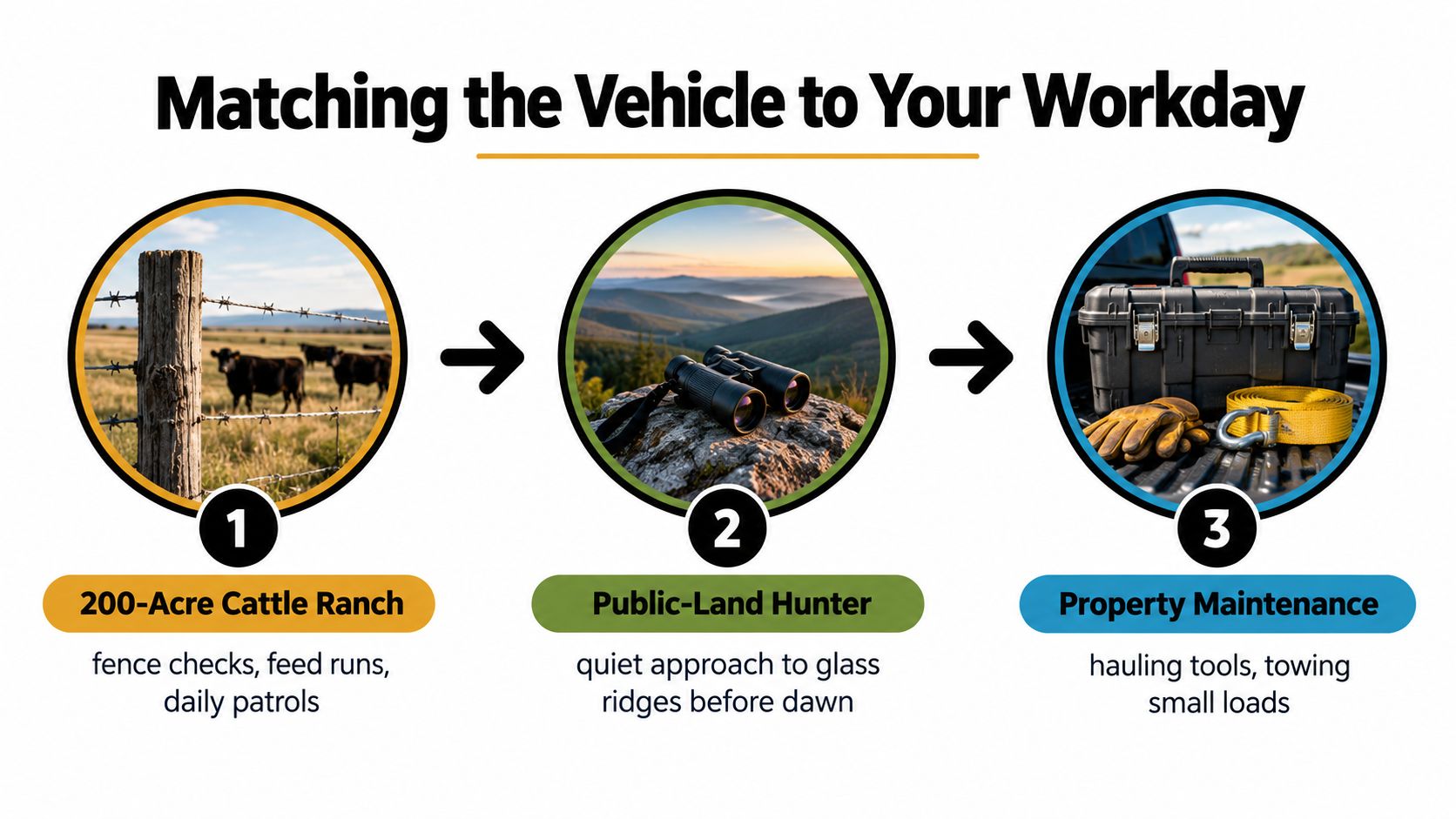
One electric UTV can suit several businesses, but the correct configuration changes with the route. A 200-acre cattle operation may use it for fence checks, feed runs, and daily patrols. The operator may travel moderate distances but spend much of the shift stopping, climbing, carrying tools, and crossing uneven ground. Four-wheel drive, a useful bed, strong low-speed control, and reserve battery capacity matter more than maximum speed.
A public-land hunter has a different requirement. The vehicle may move softly before dawn, carry gear and another person, then sit unused while the hunter observes a ridge. The route may be short, but mud, rock, steep access, and a long return trip make traction and realistic range important.
Same platform, different priorities
A university maintenance crew may run between buildings, carry hand tools, and make frequent stops. That duty cycle favors easy access, predictable charging, a compact turning radius, and a bed that can be loaded without slowing every task.
A warehouse yard may operate in tight loops. The vehicle could spend more time waiting than climbing, so operators should focus on charging location, visibility, braking, and load security. A large battery may be unnecessary if the vehicle reliably returns to the same charger.
Before choosing a configuration, record your own route rather than guessing. Measure:
- Distance: Map the longest normal shift, including the return to the charger.
- Terrain: Mark mud, slopes, loose rock, snow, standing water, and narrow gates.
- Load: Weigh typical cargo and include every passenger.
- Towing: Record trailer weight and how often the vehicle pulls it uphill.
- Stops: Note how often the vehicle rests and whether it can charge during those pauses.
- Access: Check whether the route requires four-wheel drive, extra clearance, or a narrow body.
Keep the work vehicle clean enough to inspect. Regular washing and detailing work trucks without shortcuts can help crews spot damage, packed mud, loose hardware, and corrosion before those issues become downtime.
The right platform is the one that matches the route you operate, not the route shown in a promotional video. A vehicle that spends every day on a flat campus doesn't need the same battery and traction package as one that climbs a remote ranch track with a loaded bed.
Charging, Maintenance, and Battery Care
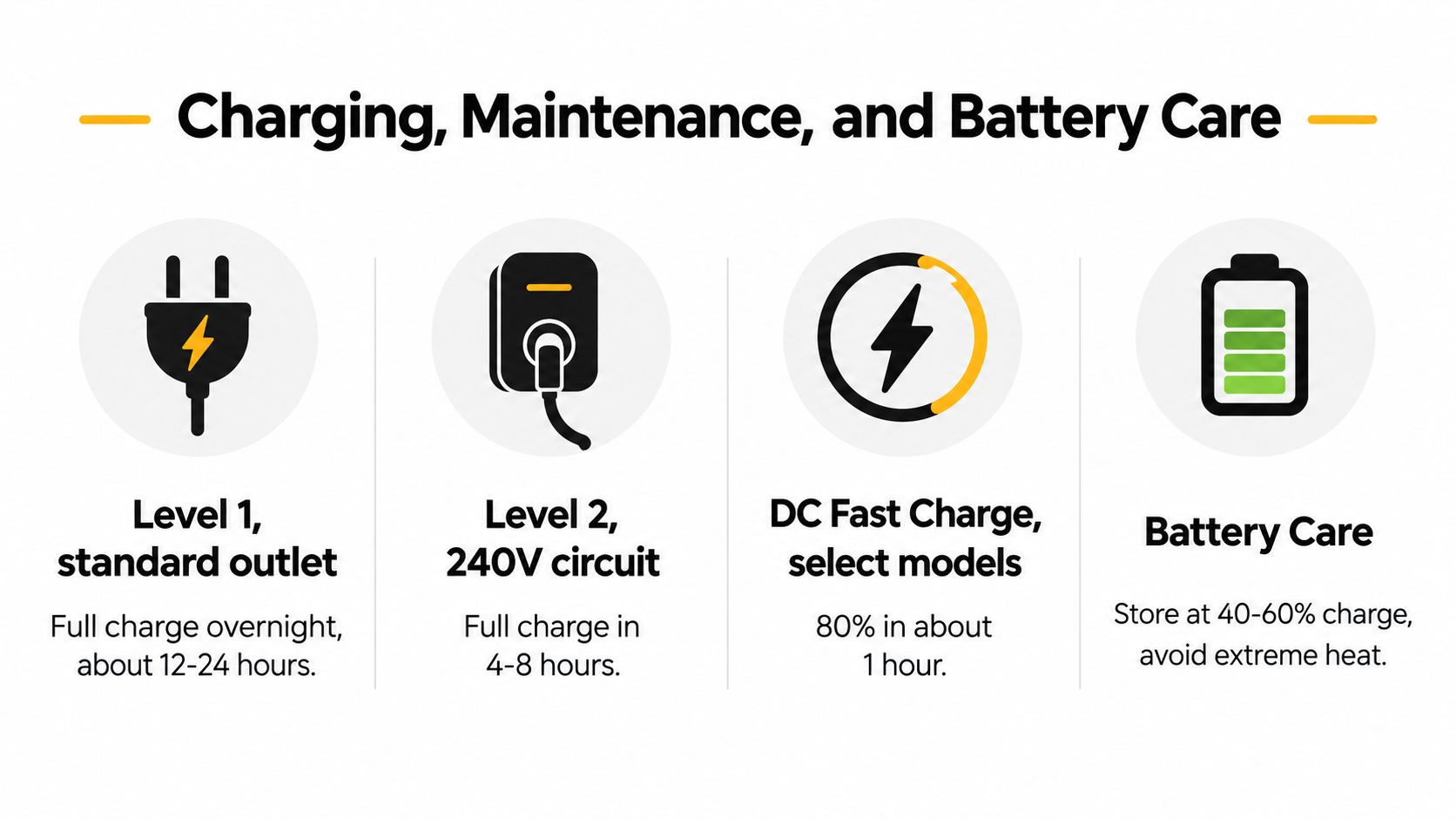
Charging only works when it fits the worksite. Level 1 uses a standard outlet and can suit an overnight routine. Level 2 uses a 240V circuit and is more practical when the vehicle must return to service sooner. DC fast charging exists on selected models, but you shouldn't assume compatibility. Confirm the connector, required electrical work, charging controls, and whether the local supply can support the installation.
A remote property needs a charging plan before it needs a second vehicle. Put the charger close to where the UTV ends its shift, protect the cable from traffic and weather, and decide who checks the connection each day. If solar power is part of the plan, review the electrical design carefully and use a practical guide to compare EV chargers for solar homes before selecting equipment.
What maintenance remains
Electric drive removes engine service, but it doesn't make the UTV maintenance-free. Inspect tires, wheel bearings, brakes, suspension joints, steering components, skid protection, bed hinges, charging connectors, and underbody wiring. Mud and water can still damage mechanical parts, and heavy towing can accelerate wear even when the motor itself needs little attention.
Cold storage deserves special attention. Ask the manufacturer how the battery should be stored, whether the vehicle limits charging at low temperatures, and whether the battery management system can warm the pack before charging. Don't leave a vehicle unattended for long periods with an unknown state of charge.
Fleet operators should standardize charging habits, inspection records, and fault reporting. A simple daily check can record tire condition, visible damage, charge status, and unusual warnings. Guidance on improving vehicle efficiency can support that process, but the most important improvement is operational discipline.
Battery care is not complicated. Follow the manufacturer's storage range, avoid extreme heat, use the approved charger, and don't treat the displayed range as a guarantee. A fleet with several electric UTVs also needs spare charging access, trained operators, and a plan for taking one vehicle offline without stopping the entire operation.
Rules, Terrain, and Insurance Reality
A vehicle can be mechanically capable and still be unusable on the route you need. Off-road UTV rules vary by jurisdiction, while street-legal low-speed and neighborhood electric vehicle classifications may impose different equipment, speed, registration, and road-access requirements. Trail access can also change by state, land manager, season, or vehicle classification.
Private land doesn't remove every restriction. An HOA may limit vehicle use, a lease may prohibit certain activities, and a right-of-way may not permit commercial traffic. Ask the landowner, local authority, trail manager, or property administrator before assuming that an off-road designation gives you unrestricted access.
Match the machine to the ground
Check the vehicle's ground clearance, water-fording guidance, approach and departure angles, tire design, and traction controls against the actual route. A muddy field, rocky service road, and snow-covered slope each demand different help from the tires and drivetrain. Don't use a claimed clearance figure as permission to enter water that may hide holes, debris, or electrical hazards.
Insurance deserves the same attention as the mechanical inspection. A farm policy may not automatically cover an electric UTV for theft, property damage, collision, or liability. Confirm coverage for the vehicle, passengers, employees, contractors, and the places where it operates. A broader overview of business auto insurance in Australia can help frame the questions, but your insurer must confirm your own policy.
Run this local verification checklist before signing:
- Ask the authority or land manager where the vehicle may operate.
- Confirm whether road registration or special equipment is required.
- Check HOA, lease, and right-of-way restrictions.
- Call the insurer and obtain written confirmation of coverage.
- Walk the route and identify water, mud, steep grades, gates, and soft shoulders.
- Confirm operator age, training, passenger, and helmet requirements.
- Ask the dealer which warranty and service rules apply in your location.
A Smart Buyer Checklist Before You Sign
Start with the workday, not the brochure. The best electric UTV is the one that carries the required people and cargo, reaches the farthest point, handles the terrain, and returns with enough energy to avoid a forced recovery.
Rank your decision in this order:
- Duty-cycle fit: Define distance, terrain, stops, passengers, cargo, and towing.
- Payload rating: Include occupants, tools, feed, materials, and accessories.
- Loaded range: Request a test under conditions that resemble your work, not an unloaded demonstration.
- Charging access: Confirm the outlet, circuit, charger compatibility, installation, and overnight routine.
- Traction: Choose two-wheel or four-wheel drive based on mud, slopes, snow, and towing.
- Clearance and protection: Check the underside, suspension travel, tire options, and water guidance.
- Battery support: Ask about warranty terms, diagnostics, replacement planning, and cold-weather operation.
- Dealer service: Confirm parts availability, technician training, and realistic repair turnaround.
- Fleet controls: For multiple vehicles, ask about usage records, fault reporting, and telematics.
- Fit and access: Make sure operators can enter, exit, see the bed, connect a trailer, and reach the controls while wearing work clothing.
Take the specific vehicle on a route that represents your property. Load it as you would on a normal shift. Include the trailer if towing is part of the job, and test a cold morning if that's when your work begins. Ask the dealer what happens when the vehicle needs a battery diagnostic, suspension repair, or replacement part.
Do not buy extra speed instead of usable range, traction, or payload. Do not accept a range figure without asking how it was measured. A working buyer should leave the dealer with written answers about battery capacity, warranty coverage, charging requirements, service support, and the vehicle's performance under load.
The right choice is quiet, predictable, and slightly boring. It completes the fence check, the maintenance route, the hunting approach, or the warehouse loop without drama.
Campus EV offers electric UTVs for hunting, ranching, property maintenance, and off-road utility work, with the Campus E1 lineup focused on practical side-by-side use. Review the available configurations and visit Campus EV to compare the vehicle's capabilities with your route, payload, terrain, and charging plan.