
You're standing beside a shiny side-by-side at the dealer, thinking about tomorrow's job instead of today's sales pitch. Maybe you need to reach a hunting blind before daylight without waking the whole property. Maybe you're carrying feed across a ranch, hauling fencing supplies, or clearing storm debris from a remote trail. The question behind your search for an electric 4×4 UTV for sale is simple: will it finish the work, or will you be walking back for a gas can?
An electric UTV can be an excellent property machine, but only if you judge it by usable range, real payload limits, terrain capability, charging access, and service support. Advertised range and motor power matter less than whether the unit can handle your longest workday with cargo in the bed, cold weather in the forecast, and enough energy left for the return trip.
Table of Contents
- The Moment Every Buyer Hits in the Dealer Lot
- What an Electric 4×4 UTV Actually Is
- Electric 4×4 UTV vs Gas Side-by-Side
- How to Read Range and Battery Claims
- Payload, Towing, and Slope Limits That Actually Matter
- Real-World Use Cases on the Property
- Charging, Service, and Financing the Right Unit
- Questions Buyers Ask Before They Sign
The Moment Every Buyer Hits in the Dealer Lot
A rancher I know once described the buying decision perfectly. He wasn't comparing motor types for entertainment. He was standing in a dealer lot with feed rounds to move, fence lines to inspect, and a property where a dead vehicle would be a serious inconvenience. He wanted the quiet operation and simpler daily routine of electric power, but he didn't want to discover halfway across the back acreage that the advertised range belonged to a flat, unloaded test route.
Hunters face the same decision from a different angle. A gas side-by-side may start reliably, but its noise and exhaust can work against a quiet pre-dawn approach. A property owner may care less about stealth and more about eliminating fuel storage, engine maintenance, and repeated short trips to a barn or jobsite.
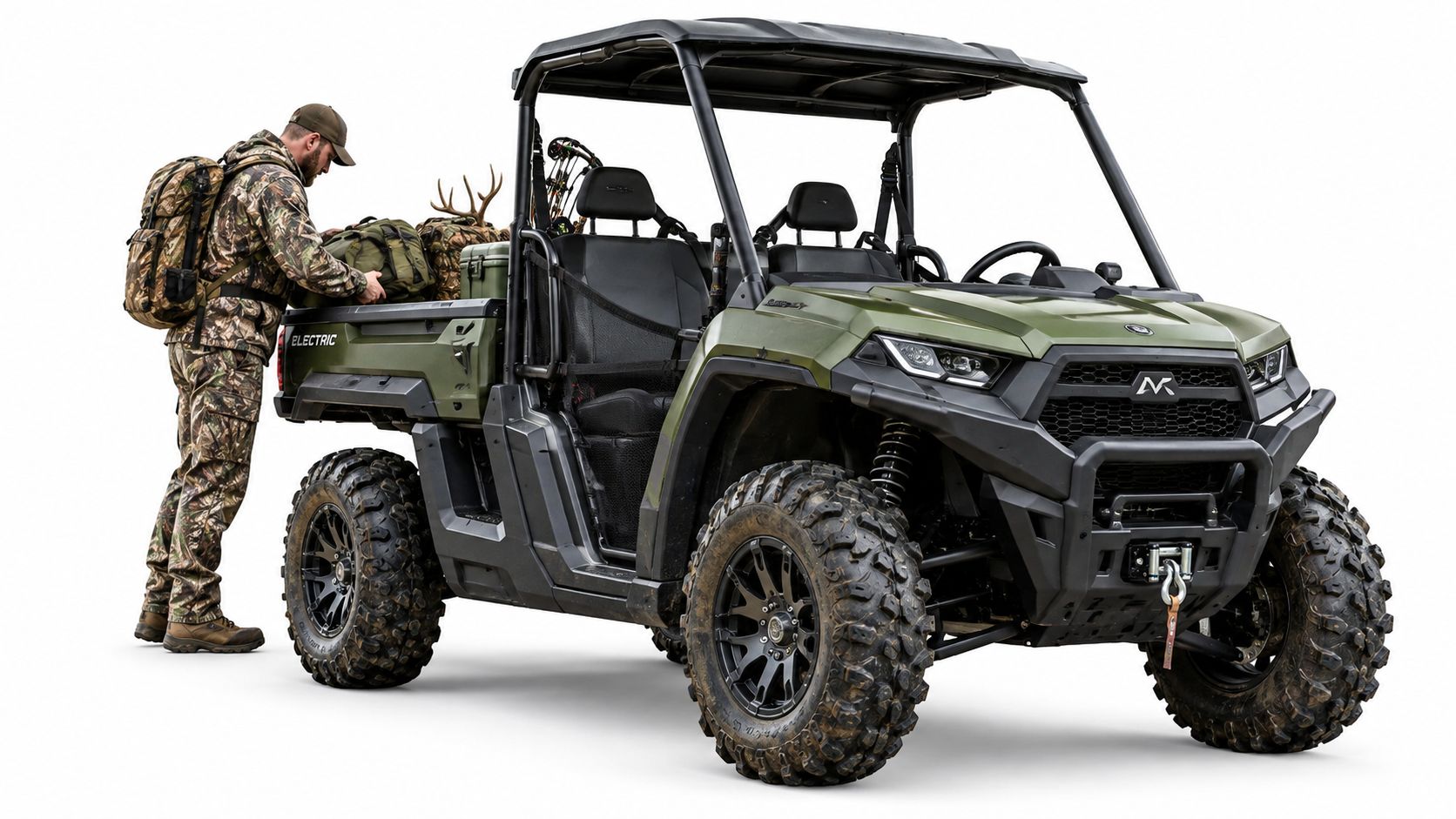
The right purchase starts with the work, not the brochure. Before you compare models, write down the longest route, the typical load, the roughest terrain, the coldest operating conditions, and where the vehicle will charge. Those answers expose a weak fit quickly.
The three checks I'd make beside the unit
- Usable range: How far will it travel with cargo, hills, mud, cold temperatures, lights, heating, and a reserve for getting home?
- Real load limits: What do passengers, tools, accessories, hitch weight, and bed cargo add up to, and how does that load affect stability?
- Ownership routine: Can you charge it where it lives, obtain parts when needed, and get battery warranty support from an authorized dealer?
Transportation is another practical issue buyers overlook when the right unit isn't sitting nearby. If you're comparing dealers in different regions, it helps to browse dealer shipping options before assuming a distant purchase will be simple.
An electric UTV makes sense when its operating envelope matches your property. Don't buy the quietest or most powerful-looking machine. Buy the one that can complete the hardest routine job without exceeding its battery, payload, traction, or slope limits.
What an Electric 4×4 UTV Actually Is
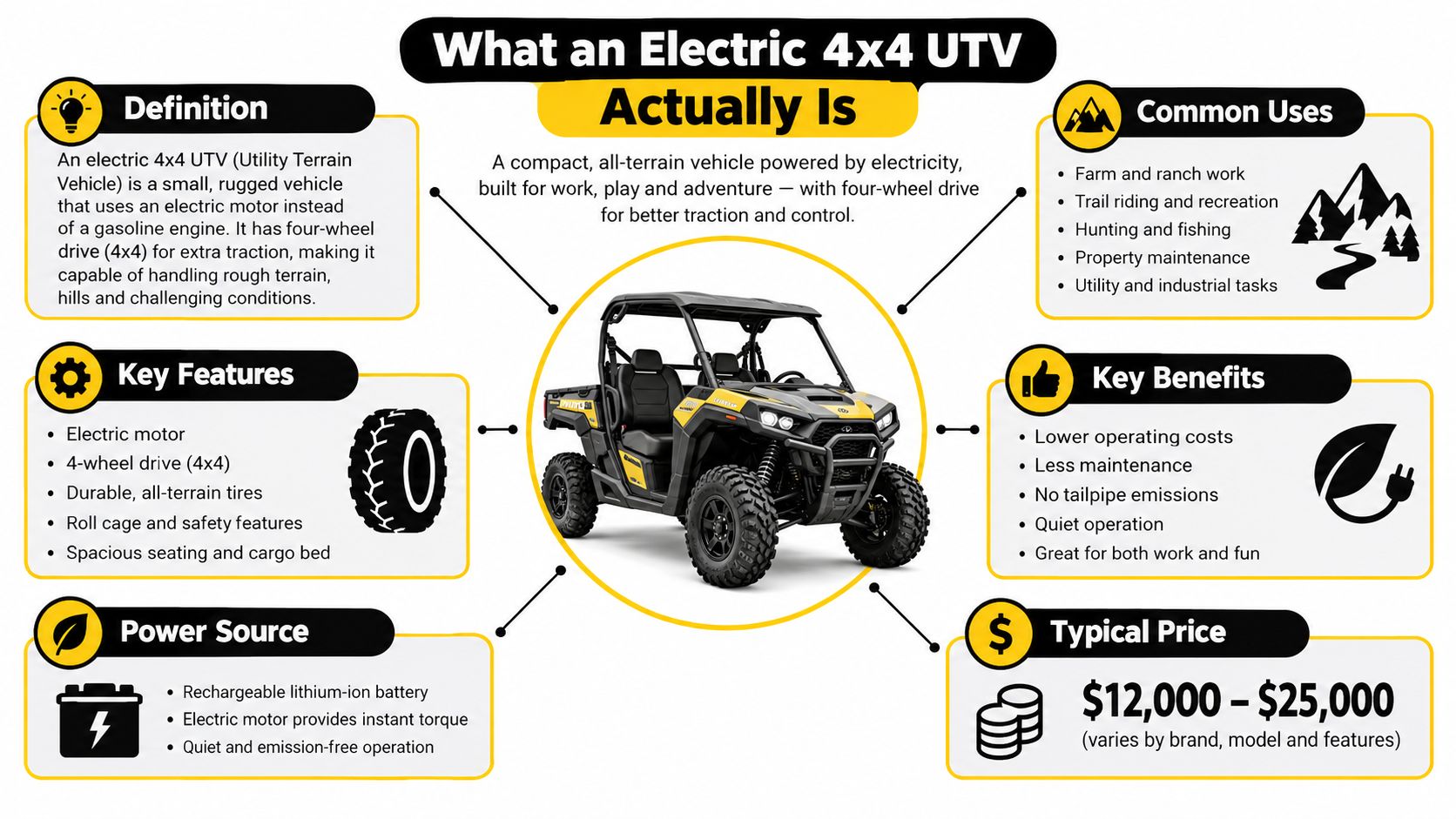
An electric 4×4 UTV is a utility side-by-side powered by an electric motor and battery instead of a gasoline engine. It still has four wheels, a protective rollover structure, passenger seating, cargo space, suspension, brakes, and selectable drive modes. The drivetrain changes, but the work remains familiar: hauling, towing, hunting, fencing, trail maintenance, farm chores, and jobsite transport.
The terminology on a listing can look more complicated than it is. Here's the plain-English translation:
- kW: Motor power. Think of it as the rate at which the motor can deliver work.
- kWh: Stored battery energy. This is the size of the fuel tank in electric terms, although the usable amount is lower than the nominal figure.
- 72 V: Electrical system voltage. Higher voltage can move power through the system with less current, but voltage alone doesn't tell you range.
- Ah: Battery capacity measured by electrical charge. It must be considered with voltage to estimate stored energy.
- PMSM: Permanent-magnet synchronous motor. It's an efficient electric motor design that delivers immediate torque without the engine, clutch, exhaust, and fuel system found in a gas machine.
- 2WD and 4WD: Two-wheel drive is generally suitable for firm, level surfaces. Four-wheel drive sends power to more wheels when terrain or load demands additional traction.
For example, the Campus E1 is listed with a 20 kW PMSM motor, a 72 V 150 Ah lithium battery, and selectable 2WD/4WD. The nominal battery calculation is approximately 10.8 kWh, found by multiplying 72 volts by 150 amp-hours and dividing by 1,000. That figure comes from the battery's rated capacity, not the amount you should expect to use at the wheels.
What the electric drivetrain changes
Electric power gives you immediate motor response, quiet operation, and no tailpipe emissions while the vehicle is running. It also removes routine engine oil service, spark-ignition components, exhaust hardware, and gasoline storage from the daily operating equation.
It doesn't remove the need for maintenance. Tires, brakes, suspension, steering, bearings, drivetrain components, battery systems, wiring, and charging equipment still need inspection. A battery-powered UTV also needs a charging plan and a warranty you can understand.
The vehicle remains an off-road machine, not a passenger car. You still need to manage speed, slope, cargo placement, traction, visibility, seat-belt use, and rollover protection. Four-wheel drive can help the tires find traction, but it doesn't cancel the limits of the chassis or the terrain.
Read every specification as a starting point. A motor rating describes available power, a battery rating describes nominal stored energy, and a range claim describes a particular test condition. None of those figures replaces a work-cycle calculation.
Electric 4×4 UTV vs Gas Side-by-Side
The electric-versus-gas decision comes down to the type of work you repeat. Electric usually fits properties with frequent short trips, indoor or enclosed-area operation, noise-sensitive hunting, and reliable access to overnight charging. Gas remains compelling where refueling must happen immediately, routes are long and remote, or the vehicle may work continuously without a charging window.
The environmental comparison needs the same honesty. The U.S. Department of Energy's 2024 life-cycle analysis found that a representative small electric SUV produces 52% fewer life-cycle greenhouse-gas emissions than a comparable gasoline vehicle. The calculation includes manufacturing, battery production, fuel or electricity production, operation, and end-of-life impacts. That's a vehicle-class benchmark, not a model-specific electric UTV result, and local electricity sources change the outcome.
Gasoline carries a large emissions burden during use because combustion happens at the vehicle. An electric UTV produces no tailpipe emissions while operating, although battery manufacturing, electricity generation, manufacturing, recycling, and disposal still matter.
The ownership differences you'll notice
| Buying factor | Electric 4×4 UTV | Gas side-by-side |
|---|---|---|
| Daily energy | Charge from an electrical supply | Store and transport gasoline |
| Noise | Quiet motor operation | Engine and exhaust noise |
| Routine powertrain work | No engine oil or spark-ignition service | Engine, fuel, exhaust, and transmission systems require service |
| Remote recovery | Depends on remaining battery energy | Refueling can be faster if fuel is available |
| Worksite emissions | No tailpipe emissions during operation | Exhaust emissions during operation |
| Charging or refueling | Requires a planned charging window | Requires fuel access and safe fuel storage |
Federal regulation already treats off-road engines as an established emissions-control category. The EPA's recreational-vehicle regulations include the 2002 rule for nonroad large spark-ignition engines and recreational engines, the 2004 Tier 4 rule for nonroad diesel engines and fuel, and the 2008 rule for nonroad spark-ignition engines and equipment. The framework includes exhaust and evaporative-emission requirements, including Parts 1051 and 1060 of Title 40.
That regulatory history doesn't make gas UTVs a bad purchase. It explains why they carry fuel-system, exhaust, and evaporative controls that an all-electric vehicle doesn't need during operation.
My dealer rule: If your workday naturally ends at the same property where the UTV is stored, electric deserves serious consideration. If you regularly travel beyond reliable charging access, gas still has the practical advantage.
How to Read Range and Battery Claims
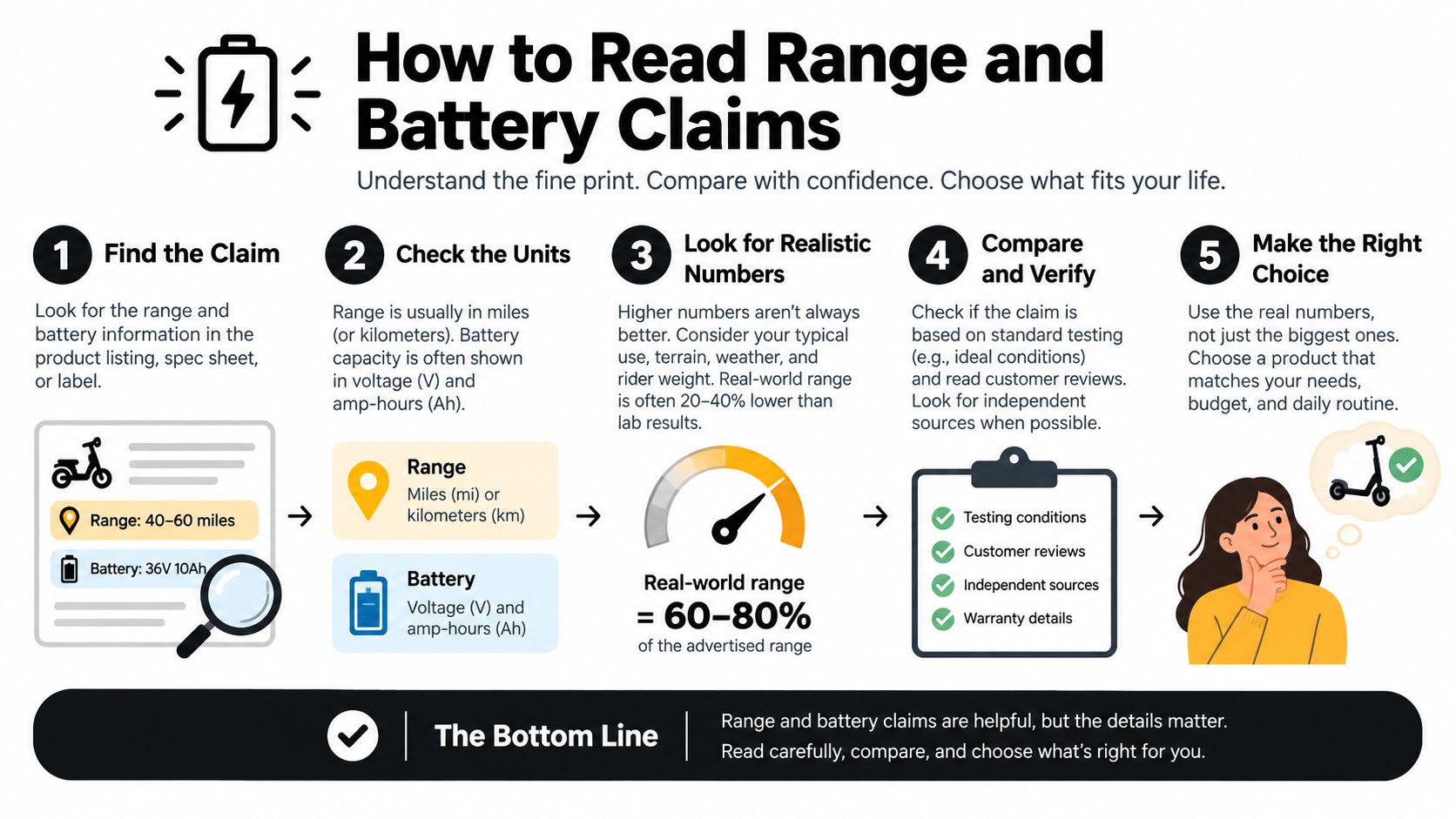
The range number on a listing is a baseline, not a promise. A light operator on firm ground may approach it. A hunter crossing muddy trails in cold weather with a loaded bed, lights, heater, and four-wheel drive engaged may not.
Start with the work cycle. Write down the distance to the farthest regular destination, the return distance, and the extra movement you make once you arrive. Then account for the conditions that increase consumption:
- Terrain: Hills, mud, deep grass, ruts, and soft ground demand more energy.
- Load: Occupants, tools, feed, fencing supplies, and accessories add rolling and climbing work.
- Tires: Incorrect pressure and aggressive tread can increase resistance.
- Driving style: High speed, repeated acceleration, and hard stops reduce efficiency.
- Accessories: Winching, lights, heating, and other electrical equipment draw from the system.
- Reserve: Keep a meaningful margin for detours, recovery, and the trip home.
Turn battery specs into a useful estimate
For a 72 V, 150 Ah battery, the nominal stored energy is approximately 10.8 kWh, before reserve capacity, inverter losses, drivetrain losses, and battery-management limits. The calculation is supported by the battery-efficiency research reference.
If a listing claims up to 60 miles, dividing 10.8 kWh by 60 miles produces a nominal figure of roughly 180 watt-hours per mile under the assumed test conditions. That is a math exercise, not a field guarantee. Sustained 4WD, mud, hills, cargo, and cold weather can push actual consumption higher.
Cold weather deserves its own line on your worksheet. The U.S. Department of Energy and Argonne National Laboratory cold-weather assessment found that conditions around 20°F reduced battery-electric vehicle range by 41%. Testing at 0°F produced an average reduction of about 50% and up to 59% in urban-style operation. Those results concern battery-electric vehicles generally, not a direct test of every UTV, but they show why winter range planning cannot rely on a summer headline.
Build the charging plan before buying
A practical charging setup needs a suitable outlet at the storage location, weather protection, a safe cable route, and enough time between work cycles. A standard 120V system may fit an operator who returns the UTV after each shift and can leave it charging overnight. A property running multiple shifts may need a dedicated circuit and a faster charging arrangement.
Use 2WD on firm, level ground when traction doesn't require four driven wheels. Engage 4WD for mud, slopes, loose surfaces, or heavy work that needs it. The goal isn't to avoid 4WD. It's to use it deliberately instead of paying an energy penalty on every easy section of the route.
Practical rule: Plan the range around the coldest loaded workday, not the easiest summer drive. If the calculation only works when the bed is empty, the weather is mild, and the route is flat, the unit is undersized for the job.
Payload, Towing, and Slope Limits That Actually Matter
A large motor won't protect an overloaded UTV. Buyers often ask about horsepower, bed size, and winch strength before asking how much the complete vehicle can safely carry on a side slope. That order needs to change.
Payload includes more than the material in the dump bed. Add the driver, passengers, tools, batteries or auxiliary equipment, mounted accessories, hitch load, and cargo. A sprayer tank, roof rack, enclosed cab, winch, or heavy toolbox can alter the center of gravity even when the total weight appears acceptable.
Run the payload calculation before you sign
Request the official figures in writing, then compare them with your actual work:
- List people first. Include every regular occupant, not just the lightest expected crew.
- Add permanent accessories. Count the winch, roof, cab, racks, spare equipment, and installed tanks.
- Add the routine load. Use the heaviest normal feed, tools, fencing, construction material, or hunting gear.
- Check bed and hitch limits separately. Bed capacity, towing capacity, and total payload are different specifications.
- Review load placement. Keep dense cargo low, centered, and secured rather than stacked high or pushed to one side.
The Campus E1 is listed with a 3,000 lb winch. That describes pulling capacity for the winch under its specified conditions. It does not increase the vehicle's payload rating, towing rating, slope capability, braking capacity, or safe cargo limit.
For a unit with a dump bed, the Campus E1 electric UTV with dump bed should be evaluated by its complete load documentation, not by the bed's convenience alone.
Treat slope limits as hard limits
The USDA Forest Service guidance on UTV safety identifies overloaded cargo beds, center-of-gravity changes, overfilled dump boxes, and operation beyond specified slopes or side slopes as rollover hazards. It recommends certified rollover protection structures, seat-belt use, approved modifications, and training for the terrain where the vehicle will operate.
The rollover protection structure and seat belts are a system. Use them every time. Don't assume a slow speed makes a dangerous side slope acceptable, and don't let four-wheel drive encourage you to climb terrain beyond the manufacturer's limits.
Before purchase, ask the dealer for:
- Official total payload and bed capacity
- Towing capacity and hitch-load limit
- Ground clearance and approach or departure information
- Maximum grade and side-slope guidance
- ROPS certification and seat-belt details
- Braking specifications for loaded operation
- Approved winch, sprayer, cab, and rack installations
A vehicle can have excellent traction and still roll over. The safe buyer matches the machine to the steepest trail and heaviest routine load, not to the occasional empty-bed test drive.
Real-World Use Cases on the Property
A winter hunter has a narrow margin for error. The route may be quiet and short, but the cold battery, heavy clothing, lights, gear, and muddy access road change the calculation. That buyer should map the full out-and-back trip, keep reserve energy for a recovery or detour, store the UTV where charging is practical, and ask how the battery should be stored and charged in freezing weather.
Quiet electric operation is useful here, but silence doesn't excuse careless driving. Plan the route before dawn, use the appropriate drive mode, and avoid carrying unnecessary equipment that steals range.
A rancher has a different priority. Feed, fencing supplies, water equipment, and tools make payload documentation more important than a headline range claim. A dump bed can reduce manual handling, while selectable 4WD helps when the load or ground conditions demand additional traction. The rancher should compare the unit against the heaviest normal chore, not a quick fence-line inspection with an empty bed. A focused resource for that decision is this guide to the best electric UTV for ranchers.
Three jobs, three buying priorities
- Hunting property: Quiet operation, cold-weather reserve, secure gear storage, and dependable charging near the cabin or barn.
- Farm or ranch: Payload, dump-bed operation, towing documentation, ground clearance, and service access.
- Warehouse or construction site: Short repeated routes, charging between shifts, low operating noise, and safe movement around people and structures.
The same chassis can suit all three jobs, but the purchase test changes. A warehouse operator may rarely need maximum range but may depend on predictable charging and low noise. A construction operator may care more about loaded braking, tire choice, and slope limits than entertainment features.
OSHA guidance for off-road utility vehicles identifies uneven terrain and slopes as rollover hazards and recommends avoiding travel across slopes, sharp turns, and excessive speed. Apply that guidance to every scenario, especially when a full bed changes how the vehicle handles.
Charging, Service, and Financing the Right Unit
The best specification sheet is useless if the vehicle can't charge where it lives. Inspect the storage location before buying. Confirm that the outlet is suitable, protected from weather, safely placed, and available for the full charging window. Operators with repeated shifts should plan for a dedicated electrical circuit rather than hoping a convenient outlet will keep up.
Public infrastructure may help in some regions, but property-based charging usually determines whether an electric UTV is convenient. If you're assessing broader charging equipment and infrastructure, this overview of EV charging stations available today can help frame the conversation.
Ask the dealer four direct questions
- Who performs warranty work on the battery and control systems?
- Which replacement parts are stocked or readily available?
- What does the battery warranty cover, and what conditions limit it?
- What maintenance schedule applies to the drivetrain, brakes, suspension, and charging system?
Review the practical ownership details in the Campus EV UTV maintenance cost guide before signing. Financing can also affect the decision. Campus EV offers 0% APR financing through authorized dealers, subject to the applicable program terms, which may make a higher-spec configuration easier to consider without treating the cheapest purchase price as the only measure of value.
My recommendation is straightforward: match the UTV to the longest workday, coldest likely conditions, heaviest routine load, and roughest regular route. Then buy from a dealer who can answer the battery, payload, charging, parts, and service questions without reaching for a vague brochure.
Questions Buyers Ask Before They Sign
Can I charge from a standard outlet? Often, overnight 120V charging can suit a single-shift operator. Ask the dealer to confirm charging time for the exact battery and plan a dedicated, weather-protected circuit if the UTV runs repeated shifts. Action: inspect the storage outlet before placing the order.
Is electric better than gas for off-road work? Electric fits quiet, short-to-medium property work with dependable charging. Gas still has the edge where refueling must be immediate or routes remain remote. Action: write down your longest unsupported route.
Will cold weather stop it from handling mud and hills? Cold reduces available range, and loaded 4WD work consumes more energy. Store and charge the vehicle properly, plan reserve, and pre-plan winter routes. Action: size the purchase for the cold loaded workday.
What service support should I demand? Confirm battery warranty, authorized technicians, parts access, and the process for diagnosing charging or drivetrain faults. Action: get those answers in writing before signing.
Campus EV offers electric UTVs for hunting, farming, ranching, property maintenance, and off-road utility work, including the E1 configuration discussed here. Visit Campus EV to review the available electric side-by-sides, then take your longest route, heaviest load, cold-weather plan, and charging location to an authorized dealer before you buy.