
A typical electric utility UTV delivers 15–80 miles per charge, but cold weather can cut usable range by 20–40%, so match the battery to your actual daily loop rather than the brochure maximum. That makes an electric UTV 4×4 a smart buy for some properties and a poor fit for others.
You're probably looking at an electric UTV 4×4 for sale after seeing the same promises everywhere: quiet operation, instant torque, low maintenance, and a range figure that looks comfortable on paper. Those advantages are real, but a working property doesn't operate on paper. Mud, hills, payload, repeated four-wheel drive, winter storage, and the distance back to the charger decide whether the machine earns its keep.
The right question isn't, “Which electric UTV has the biggest battery?” It's, “What does my daily route require, and can I reliably recharge before the next shift?” That distinction separates a useful work vehicle from an expensive machine that spends too much time plugged into a wall.
Table of Contents
- Why an Electric UTV 4×4 Makes Sense Right Now
- What an Electric UTV 4×4 Actually Is
- Critical Specs That Actually Matter
- Electric Versus Gas UTVs in Real Working Conditions
- Matching the UTV to Your Use Case
- Test Drive and Inspection Checklist
- Total Cost of Ownership Over Five Years
- Smart Pre-Purchase Steps and Quick Answers
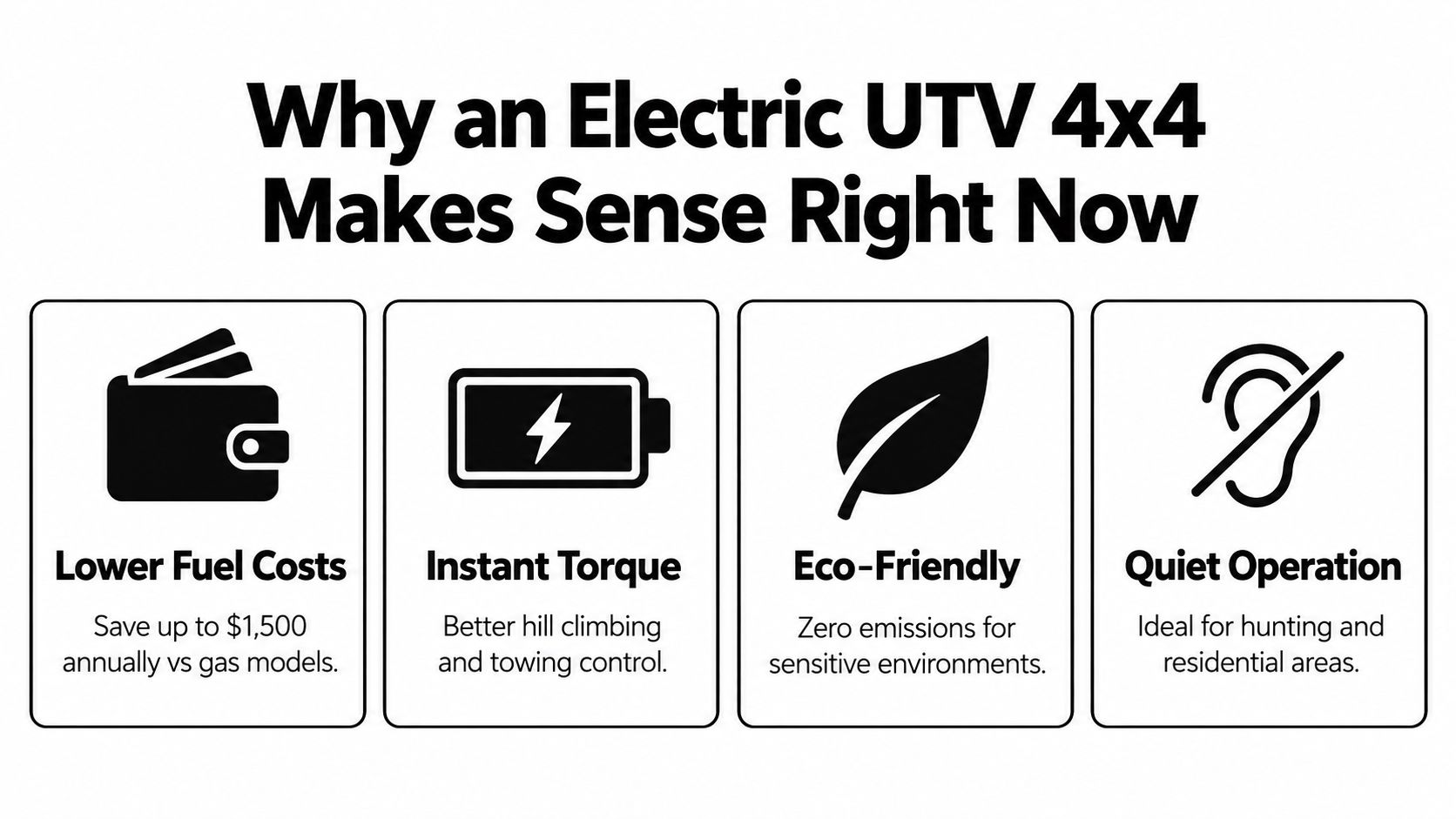
Why an Electric UTV 4×4 Makes Sense Right Now
Start with the weather, not the motor. Independent coverage places typical electric utility-vehicle range at roughly 15–80 miles, while cold-weather operation can reduce usable range by 20–40% (range and cold-weather coverage). A machine that works comfortably on a warm, flat test loop may need a much larger reserve on a winter ranch route with a loaded bed and constant 4WD.
That doesn't make electric a bad choice. It means you should size it around the workday. Measure the longest normal loop, add the return distance to the charger, identify the hills and soft ground, and then ask whether the UTV can finish with reserve. If the vehicle returns to the shed between tasks, overnight charging may be enough. If it leaves before dawn and works far from power all day, gas still has a practical advantage.
Who benefits most
Electric 4×4 UTVs fit properties where the vehicle makes frequent short trips and returns to a known charging point. Horse and dairy farms, hunting camps close to a base, warehouse yards, campuses, and residential properties can use the quiet drivetrain without dealing with exhaust around animals, buildings, or people.
Hunters also benefit when low noise matters more than long-distance refueling. A quiet approach can be useful around blinds, feeding areas, and private land, provided the route fits the available range.
Farmers and ranchers should focus on stop density. An electric vehicle can make repeated fence, gate, barn, and livestock checks without engine warm-up or frequent fuel runs. Construction and warehouse operators need a more careful match, especially if the UTV carries heavy loads continuously or has no dependable charging location.
Who should stay with gas
Buyers working deep backcountry routes, moving continuously away from electrical service, or operating in severe cold without sheltered storage should look closely at gas alternatives. The same applies to heavy commercial work where refueling speed matters more than quiet operation.
| Buyer profile | Electric 4×4 verdict | Key consideration |
|---|---|---|
| Hunting property near camp | Strong fit | Quiet operation and reliable overnight charging |
| Farm or ranch with daily shed access | Good fit | Measure loaded routes and hill work |
| Warehouse or campus fleet | Strong fit | Schedule charging between shifts |
| Remote backcountry operator | Possible poor fit | Recovery and refueling logistics matter |
| Severe-cold operation | Conditional | Heated storage and battery management are essential |
Practical rule: Buy the electric UTV that finishes your real route with reserve, not the one with the most impressive maximum-range number.
What an Electric UTV 4×4 Actually Is
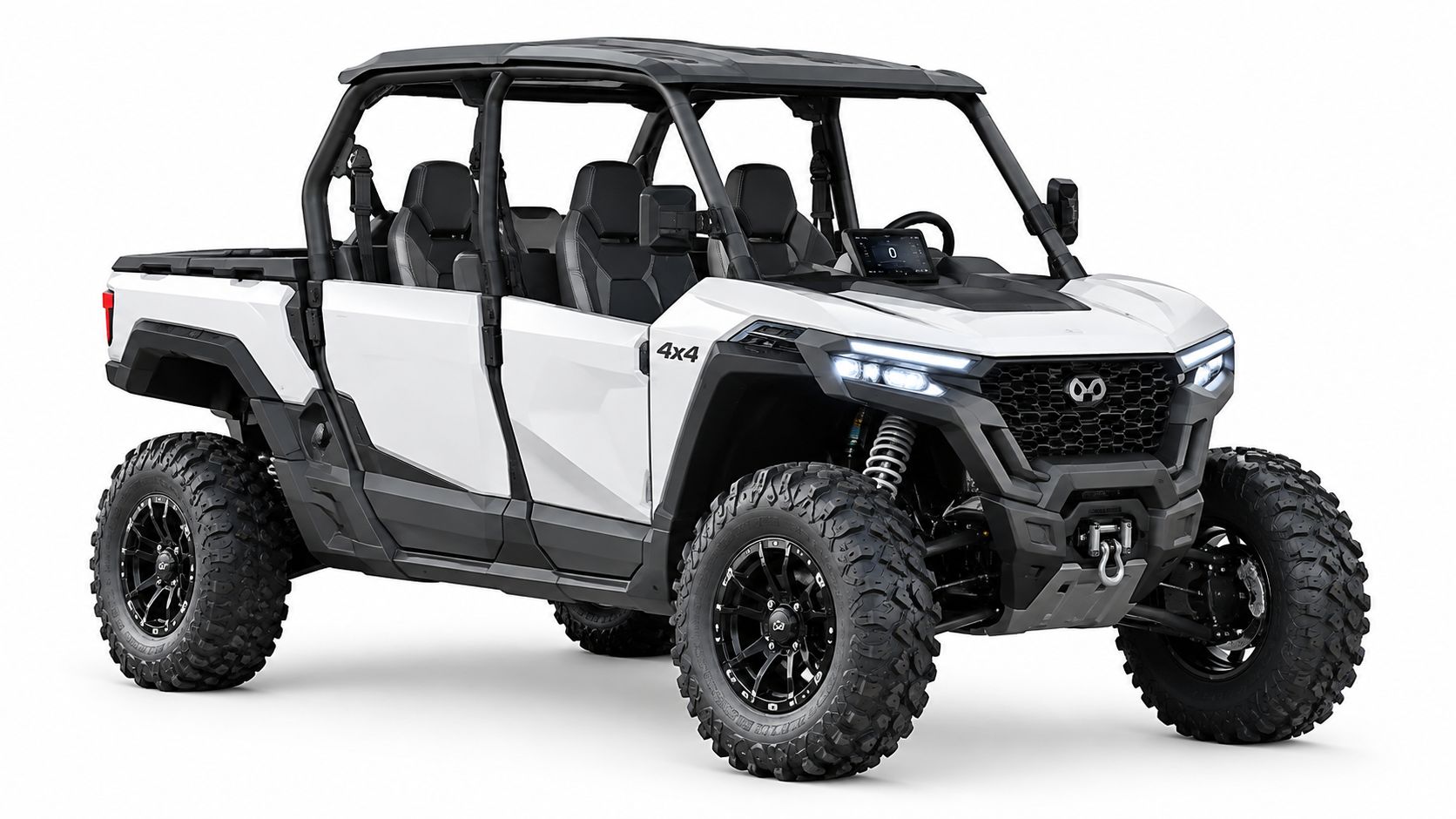
An electric UTV is a four-wheel-drive side-by-side powered by a battery and electric motor instead of a gasoline engine. Think of it as a battery-powered work truck with a dump body, two or more seats, off-road suspension, a protective frame, and a drivetrain designed for uneven ground.
It isn't an ATV, golf cart, e-bike, or electric dirt bike. A UTV is built around occupant protection, payload, steering-wheel control, seating beside the driver, and utility equipment. The four-wheel-drive system may operate in 2WD for firm ground and engage 4WD when traction becomes difficult.
A useful baseline is a 72V, 150Ah lithium battery, which represents approximately 10.8 kWh of nominal stored energy before reserve, conversion losses, and temperature effects. Pair that with a 20 kW PMSM motor, and you have a drivetrain capable of controlled low-speed work, hill climbing, and utility hauling. The actual result still depends on gearing, tires, payload, terrain, and software calibration.
The terms that matter
Kilowatt-hours, or kWh, describe stored energy. More usable energy generally supports longer work, but a larger pack adds weight and may require more charging infrastructure.
State of charge tells you how much energy remains. Treat the displayed percentage as an operating guide, not a promise of distance. A low state of charge under a heavy load can produce different behavior than the same percentage on flat ground.
The battery-management system, or BMS, monitors cell temperature, voltage, charging, and protection limits. Regenerative braking sends some energy back toward the battery during deceleration, but it doesn't turn downhill driving into free range.
Temperature deserves serious attention. Research reports that lowering battery temperature from 25°C to −15°C can reduce state of charge by approximately 23%, while charge-transfer resistance in LiFePO₄ cells at −20°C can reach roughly three times room-temperature resistance (lithium-ion temperature research). That's why cold-weather buyers need sheltered charging and a BMS that prevents charging when the cells are too cold.
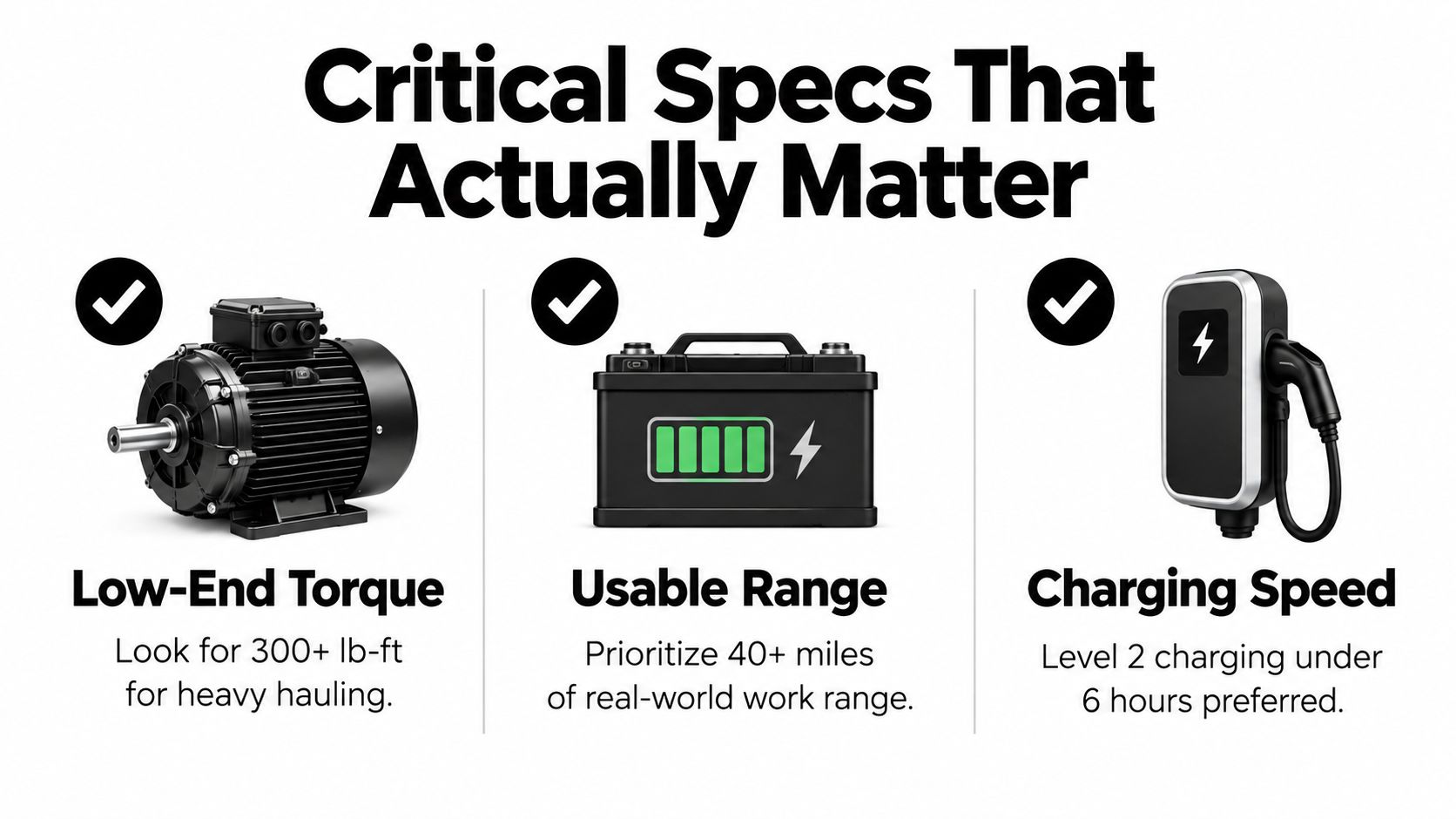
Critical Specs That Actually Matter
A spec sheet is useful only when each number answers a work question. Don't circle every figure. Circle the figures that protect your job.
Motor and drivetrain
Peak motor output matters, but low-speed torque control matters more when you're starting on a slope with a loaded bed or trailer. Ask how the UTV behaves at walking speed, whether the throttle is smooth, and whether 4WD engages without a harsh shock.
On-demand 2WD and 4WD is useful because hard ground doesn't need the same traction strategy as mud or loose rock. Locking differentials can help when a wheel loses grip, but they don't compensate for poor tires, excessive speed, or a badly distributed load.
Battery and range
Treat an advertised range, such as a 60-mile maximum, as a warm-weather benchmark. Request the test conditions: temperature, speed, payload, terrain, tire pressure, and drive mode. Then translate the result into your own route.
The important comparison is usable work range, not total brochure range. A loaded ranch route with repeated hills can consume energy much faster than unloaded travel on flat ground. Record your starting state of charge, ending state of charge, distance, terrain, weather, payload, and drive mode during a test.
Charging and cold operation
Charging below freezing is a technical issue, not a minor inconvenience. Experimental research found that charging at −10°C can take about twice as long, reduce usable capacity by approximately 23%, and increase aging rates by about 66% compared with charging at 23°C under conventional profiles (cold charging research).
A standard outlet may work for light use, but it can create unacceptable downtime for a busy property. Before delivery, confirm the charger's power requirement, circuit capacity, cable limits, and battery-heating strategy. If your shed needs new electrical work, arrange certified EV charger installs by Forward Electrical before the UTV arrives.
For practical efficiency habits, review this guide to improving electric vehicle efficiency. It's more useful to reduce unnecessary energy loss than to chase a larger battery blindly.
Payload, towing, and suspension
Check payload and towing separately. A vehicle may carry equipment well in its bed but behave differently when pulling a trailer, especially on wet slopes. Ask for the combined gross vehicle weight and understand how passengers, tools, cargo, and tongue weight consume the available margin.
Independent suspension generally improves comfort and wheel control across uneven ground. Ground clearance protects the underside, while tire construction determines whether the UTV floats over soft ground or digs in. A winch is valuable recovery equipment, but it isn't permission to exceed the machine's rated limits.
Electric Versus Gas UTVs in Real Working Conditions
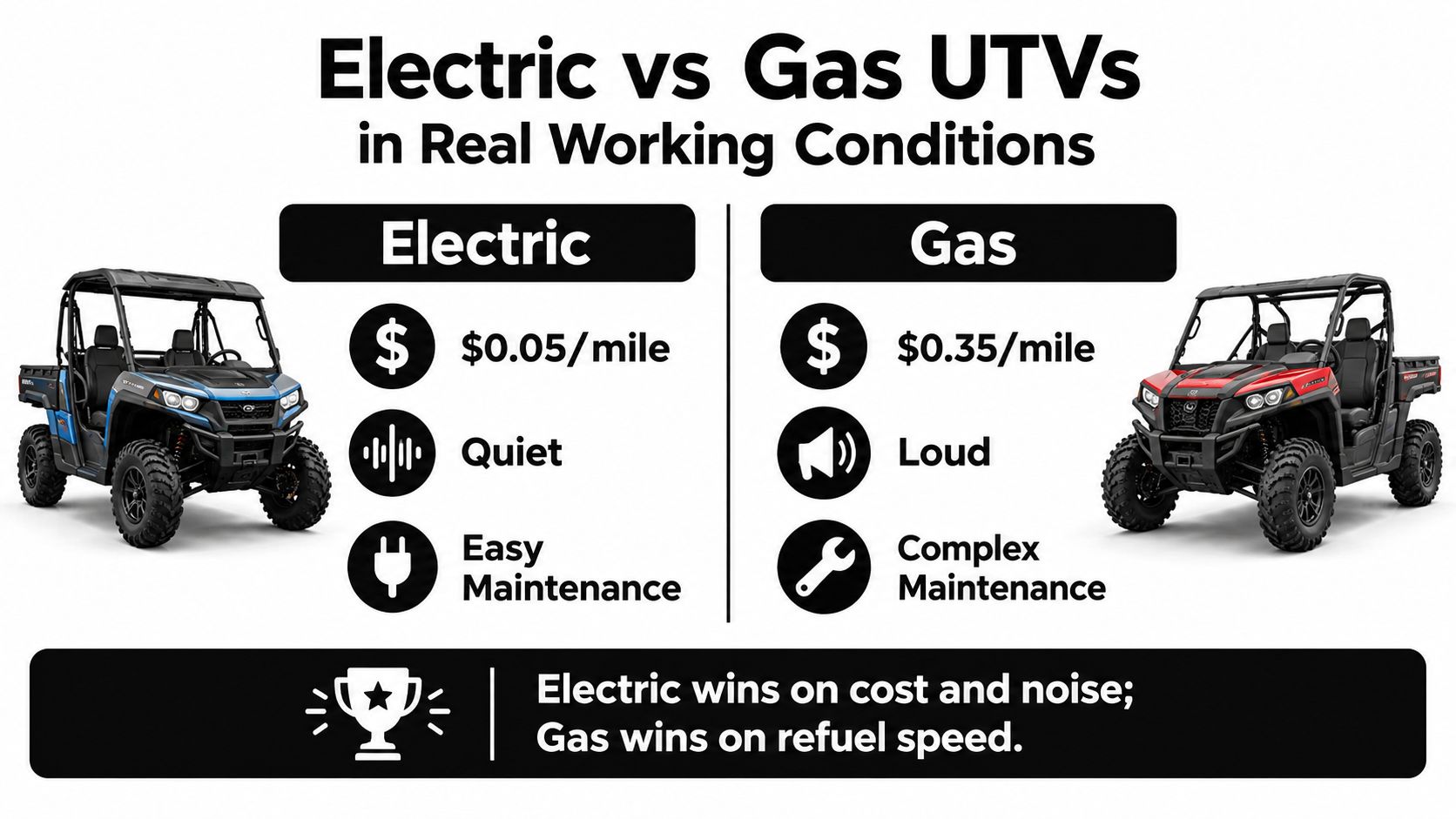
Electric wins when the work is local, repetitive, and quiet. Gas wins when the route is remote, the day is long, or refueling must happen in minutes. That's the honest split.
An electric drivetrain delivers immediate motor response and controlled low-speed movement without engine noise or exhaust at the vehicle. That helps around livestock, hunting areas, barns, warehouses, and residential properties. It also reduces routine engine service because there's no gasoline engine oil system to maintain.
Gas remains easier for long backcountry work. Carrying fuel is generally simpler than finding a reliable charging point, and a gas tank can be replenished quickly. Cold weather can still affect gas equipment, but electric buyers must manage battery temperature, charging limits, and winter storage more carefully.
The cost comparison depends on local electricity, fuel, duty cycle, and maintenance. Don't accept generic operating-cost claims without inserting your own energy prices and daily distance. Battery replacement is a risk that belongs in the ownership plan, even if the pack performs well during early use.
Safety doesn't change with the motor
A 4×4 system improves traction, not immunity from rollovers. The U.S. Consumer Product Safety Commission reported 2,258 deaths connected with off-highway vehicles from 2015 through 2017, and overturning accounted for approximately 38% of ATV fatalities (CPSC off-highway vehicle report).
Choose a vehicle with seat belts, a rollover-protective frame, suitable lighting, controlled speed, and tires matched to the terrain. Keep loads low and centered. Don't cross steep side hills aggressively, and never assume that electric torque makes an unstable slope safe.
The difference becomes clearer when the work is laid side by side:
| Working condition | Electric UTV | Gas UTV |
|---|---|---|
| Barn or warehouse use | Quiet and free of tailpipe emissions during operation | Exhaust and engine noise require more care |
| Short repeated routes | Efficient when charging is available | Easy to refuel but may run unnecessarily |
| Remote hunting route | Quiet, but range planning is critical | Fast refueling and longer field flexibility |
| Winter work | Requires temperature-aware charging | Usually simpler to refuel in the field |
| Routine service | Fewer engine-related consumables | More conventional service requirements |
Matching the UTV to Your Use Case
The right configuration depends on the job, not the badge on the hood. Start with the route, then choose the battery, drivetrain, body, and accessories that support it.
Hunting properties
Hunters should prioritize quiet movement, predictable return range, a secure gun or equipment solution, useful lighting, and a winch for recovery. A lower-noise vehicle is valuable only if the machine can reach the hunting area and return without exhausting its reserve.
Keep heavy equipment low in the bed. Test the vehicle with the same coolers, tools, and gear you carry. A large nominal range figure doesn't help if mud, hills, or winter temperatures dominate the route.
Farms and ranches
Farm and ranch buyers need a practical work platform. An electric dump bed helps with feed, fencing supplies, and property materials. On-demand 2WD and 4WD lets the driver avoid unnecessary drivetrain load on firm ground while retaining traction when conditions change.
Campus EV's Campus E1 provides a concrete example of this configuration: a 20 kW PMSM motor, 72V 150Ah lithium battery, on-demand 2WD and 4WD, electric dump bed, 3,000 lb winch, and CarPlay and Android Auto. Treat those features as a checklist to compare against competing machines, not as a substitute for a route test.
Campuses and warehouses
A campus or warehouse fleet usually has predictable routes and a central operating base. That makes charging easier to schedule, but the fleet manager should still track state of charge, operator load, tire condition, and charger availability.
For a three-seat machine or similar side-by-side, review the available electric side-by-side 4-seater options if passenger movement is part of the job. Choose seating and cargo capacity around the actual shift pattern, not occasional maximum occupancy.
Trail and property riding
Trail users should focus on ground clearance, suspension travel, tire sidewalls, steering feel, and passenger comfort. A vehicle that works well on a maintained property may feel heavy or awkward on tight technical trails.
Electric vehicles can avoid tailpipe emissions during operation, which is useful near enclosed work areas and sensitive sites. Total environmental performance still depends on the electricity source, battery production, vehicle use, and charging method. A 2024 Nature Communications study found lower greenhouse-gas intensity nationally for electric vehicles than for internal-combustion and hybrid vehicles across the categories and charging scenarios it examined (charging and lifecycle analysis).
Test Drive and Inspection Checklist
Treat the dealer's lot as a work simulation. A short drive tells you almost nothing if the machine stays unloaded on flat pavement.
Start with a walk-around. Check tire condition and pressure, bed operation, winch function, lights, horn, seat belts, ROPS integrity, charger-port condition, cable quality, and warning indicators. Ask whether the battery is cold, recently charged, or already warmed, because that affects what you're testing.
Drive it in both modes
Use 2WD first on firm ground, then engage 4WD where the dealer permits it. Pay attention to throttle smoothness, steering effort, brake feel, regenerative braking behavior, suspension noise, and drivetrain engagement. A good work UTV should feel predictable at low speed, not jumpy or vague.
If possible, carry a representative load and climb a mild grade. Watch the state-of-charge change over a known loop, rather than accepting a salesperson's range estimate. Record:
- Starting state of charge: Note the displayed percentage before driving.
- Distance: Use the same route for every model.
- Conditions: Record temperature, ground type, hills, payload, and drive mode.
- Ending state of charge: Compare the drop with the work you completed.
Check the charging plan
Reported charging times for large UTV batteries range from roughly 35–40 hours on a 110V outlet to about 6 hours on a 220V Level 2 charger, depending on pack size and charger capability (UTV charging coverage). Confirm the actual charger included with the vehicle, not an optional unit shown in a brochure.
Ask about error codes, software updates, battery warranty, motor warranty, dealer service access, and expected turnaround. If your operation also uses access equipment, understand the difference between a UTV and a scissor lift or boom lift before assigning the wrong vehicle to a raised-work task.
Total Cost of Ownership Over Five Years
A five-year ownership view starts with the purchase price, but it shouldn't end there. Build a worksheet with the vehicle price, financing cost, charging installation, electricity, tires, insurance, registration, scheduled service, accessories, and a battery replacement reserve.
Financing can materially change the result. Compare the total repayment under a conventional loan with any dealer-specific 0% APR offer, and read the eligibility conditions carefully. A lower monthly payment doesn't necessarily mean a lower total cost.
Electricity cost is straightforward to estimate once you know usable energy and local rates. Use actual charging energy where possible, because wall energy exceeds nominal battery capacity due to charger and battery losses. Compare that with the fuel consumed by a gas UTV doing the same route, then add the value of avoided engine service and the cost of any electrical work.
Protect battery value
Battery health depends heavily on operating and storage habits. Avoid prolonged full-charge storage, prevent deep discharge, and schedule charging after the pack has warmed from demanding work or cold conditions. Store the vehicle under cover and inspect it periodically during long inactivity.
Electric drivetrains can avoid tailpipe emissions during operation around barns, warehouses, hunting camps, and enclosed work areas. Total environmental performance still depends on the electricity mix and battery supply chain, so don't treat zero tailpipe emissions as the same thing as zero lifecycle impact.
Use this UTV maintenance cost guide to organize routine service questions before you sign. Then ask the dealer for written battery warranty terms, pack replacement procedures, and the expected service network.
Incentives deserve the same discipline. Check applicable federal clean-vehicle credits, state programs, agricultural support, and dealer rebates, but confirm eligibility before including them in your budget. I'd rather underwrite the purchase without an incentive and treat a verified credit as upside than depend on a program that doesn't apply to your vehicle or business.
Smart Pre-Purchase Steps and Quick Answers
Before you buy an electric UTV 4×4, complete three tasks.
- Measure the route. Record your longest daily loop, elevation changes, payload, soft ground, and winter conditions. Include the trip back to the charger.
- Audit the charging point. Identify the outlet, circuit, cable path, shed temperature, ventilation, and backup plan. Ask whether the included charger matches the time available between shifts.
- Book a structured test drive. Drive in 2WD and 4WD, carry a realistic load, climb a mild grade, and record state-of-charge change over a known route.
Confirm the dealer's chain of custody, authorized service coverage, battery and drivetrain warranty, parts availability, and financing terms. If you're unsure about ownership, compare a rental or short-term trial with buying an OEM-supported machine. Don't let a low entry price hide weak service support or an unclear battery warranty.
Quick answers
What does financing usually cover?
It may cover the vehicle and approved equipment, but charger installation, accessories, taxes, registration, and service plans can be treated separately. Request a written total rather than relying on the advertised monthly figure.
How does range degrade over time?
Battery capacity can decline with use, age, heat, deep discharge, and poor charging practices. Ask how the manufacturer measures battery health and what warranty threshold applies.
What maintenance does an electric UTV need?
You still need tire checks, brake inspections, suspension service, steering checks, winch care, charging-system inspection, and battery software or BMS diagnostics. Electric removes engine-related tasks, not all maintenance.
Can a 4WD UTV handle snow?
It can handle suitable snow conditions when equipped with appropriate tires, controlled speed, and a sensible load. Four-wheel drive improves traction, but it doesn't remove rollover risk, braking limits, cold-weather range loss, or the need for recovery planning.
The best electric UTV 4×4 for sale is the one that matches your route, charging window, terrain, and service access. Bring your measurements to the dealer, demand a loaded test drive, and reject any range claim that doesn't include temperature, payload, terrain, and drive mode.
Campus EV offers electric UTVs for hunting, farming, ranching, property work, and off-road utility use, including the Campus E1 configuration discussed above. Visit Campus EV to review the vehicle, find an authorized dealer, request a quote, and arrange a test drive around your actual workday.