
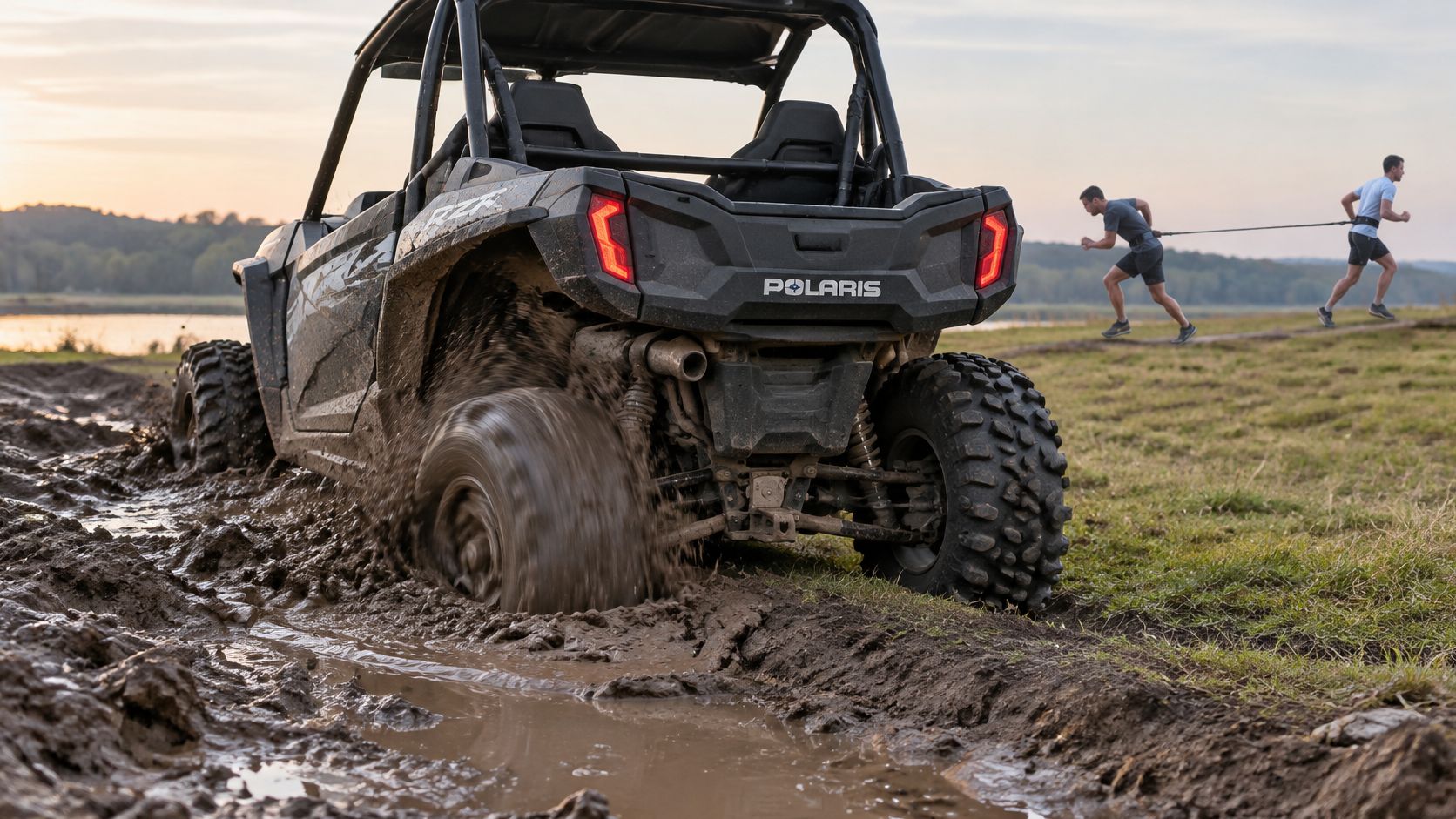
You're halfway across a wet paddock with a load on, one rear wheel drops into a soft patch, and it just spins. The other wheel sits on firm ground and does almost nothing. You press the accelerator harder, the spinning wheel digs deeper, and you're still going nowhere.
That's the exact moment the diff lock switch is built for. Used at the right time, at low speed, it can get you moving again. Used on the wrong surface or left on for a tight turn, it makes steering heavy and stresses the driveline. The skill isn't just knowing where the switch is. It's knowing what it changes, when to leave it alone, and how an electric motor changes your throttle habits.
Table of Contents
- What a Diff Lock Switch Does on a UTV
- Diff Lock Switch Settings Compared
- When to Lock the Diff and When to Leave It Open
- Why Electric UTVs Change Diff Lock Habits
- How to Engage the Diff Lock Safely
- Troubleshooting and Maintenance for Diff Locks
- Check Your Lock Setup Before You Buy
What a Diff Lock Switch Does on a UTV
Think of two runners tied to one rope, pulling the same load. If one runner hits ice, his feet slip fast while the other runner, standing on solid ground, can't pull effectively. An open differential works in a similar frustrating way.
A differential is the gear unit on an axle that normally lets the left and right wheels turn at different speeds, which you need in a turn. Each wheel connects to it through an axle shaft, the shaft that carries turning force to the wheel. That turning force is torque. When torque overwhelms grip, you get wheelspin, a tire rotating without moving the vehicle forward.
What Changes When You Lock It
With an open differential, power follows the path of least resistance. The slipping wheel takes the torque, and the grounded wheel gets almost none. A diff lock couples the two axle shafts together, so both wheels are forced to rotate at the same speed and the grounded wheel keeps pushing.
Toro's utility-vehicle operating guidance identifies heavy hauling, slippery areas, hills, and sandy surfaces as situations where differential lock can improve traction. It also warns that locking the rear wheels restricts sharp turning and can scuff the surface, so you should use it only when needed and at slower speeds.
Don't confuse the lock with 4WD. They do different jobs, and you can use them together.
- 4WD: Sends drive torque to both the front and rear axles.
- Diff lock: Stops one wheel on an axle from taking most of the usable power.
Practical rule: Treat the lock as a low-speed work and recovery tool for two wheels on one axle, not as a setting for continuous road driving.
Which positions your switch offers matter next, because not every control locks the same axle.
Diff Lock Switch Settings Compared
A diff lock switch isn't the same on every UTV, so read the labels on your own machine before you engage anything. Some switches are simple on and off. Others combine several drivetrain states in one control.
Toro's Workman UTX-D procedure documents a three-position switch that makes a useful reference. The down position disengages the lock, the middle position engages the rear differential lock, and the up position engages both front and rear differential locks. The same procedure sets the engagement limit at no faster than 8 km/h, or 5 mph, with the operator's foot off the accelerator pedal.
Diff Lock Switch Settings and What Each One Does
| Switch setting | Axle locked | Best used for | Trade-off |
|---|---|---|---|
| Down (disengaged) | None, open differential | Normal two-wheel-drive work on firm ground | Wheels can spin in mud with no extra grip |
| Middle (rear lock) | Rear axle | Hauling and rear-wheel slippage in mud or sand | Tighter turns scrub the rear tires |
| Up (front and rear lock) | Both axles | Steep, muddy or stuck situations | Hardest to steer; avoid on pavement |
| Combined 2WD/4WD selector | Front, rear or both, by model | Mixed terrain where drive mode and lock change together | Confirm axle and speed limit in the owner's manual |
The trade-off is straightforward. A rear-only lock adds traction while keeping steering easier, which suits everyday hauling when one rear tire starts slipping on a wet slope. Locking both axles gives you the most grip for a steep, rutted climb or a stuck vehicle, but steering resistance rises sharply.
Combined 2WD/4WD selectors need extra care. The same control may choose your drive mode and your lock together, so confirm two things in the owner's manual before first use. Which axle does it lock, and does the lock work in 2WD or only in 4WD? Those two answers, plus the engagement speed limit, are the first checks to run before you buy or before your first real job.
When to Lock the Diff and When to Leave It Open
Maximum traction isn't always the safest or most efficient setting. That's the point many new operators miss.
When an axle is locked, both wheels must turn at the same speed. In a turn, the outside wheel needs to travel farther than the inside wheel. A locked axle can't allow that difference, so tires scrub across the surface and steering gets heavy. On loose ground, the tire can slip a little and relieve that stress. On firm ground, it can't.
A utility-vehicle manual says the vehicle should be stopped and in neutral before engaging either axle lock, warns that steering response is noticeably reduced, and prohibits use on concrete, asphalt, or other high-traction surfaces because of possible turf or drivetrain damage. Your model may differ, which is why a generic habit of flipping the switch whenever you're stuck isn't enough.
When to Engage the Diff Lock by Terrain and Task
| Situation | Lock state | Reason |
|---|---|---|
| Mud or deep ruts at low speed | Engage before the obstacle | Keeps the grounded wheel pushing |
| Loaded trailer climbing a hill | Engage rear, or both if stuck | Prevents one wheel from spinning under load |
| Loose gravel or sand | Engage at low speed | Gives grip where tires dig in |
| Firm pasture or dry grass | Leave open | Lets the wheels turn freely in normal steering |
| Pavement or concrete | Disengaged | Locking causes scuffing and drivetrain stress |
| Tight turns in a yard | Disengaged | A locked axle resists turning |
| One wheel spinning and stuck | Stop, reduce throttle, then engage | Stops wasted wheelspin and restores drive |
Say you're on a deer trail after rain. Engage before the muddy dip, drive straight through, then release it for the bend. On a feed run up a slope, a rear lock helps a loaded trailer keep climbing. On the gravel lane back to the barn, leave it open for normal steering, and choose tires suited to the surface too, since picking mud tires for your UTV affects how much grip you have before you need the lock at all.
Engage for the obstacle, disengage for the turn.
Why Electric UTVs Change Diff Lock Habits
A gas engine builds torque gradually as revs climb. An electric motor delivers strong torque almost instantly from a stop. That difference changes how you should treat the diff lock switch.
This comparison shows how differently the two powertrains respond when you first press the accelerator.
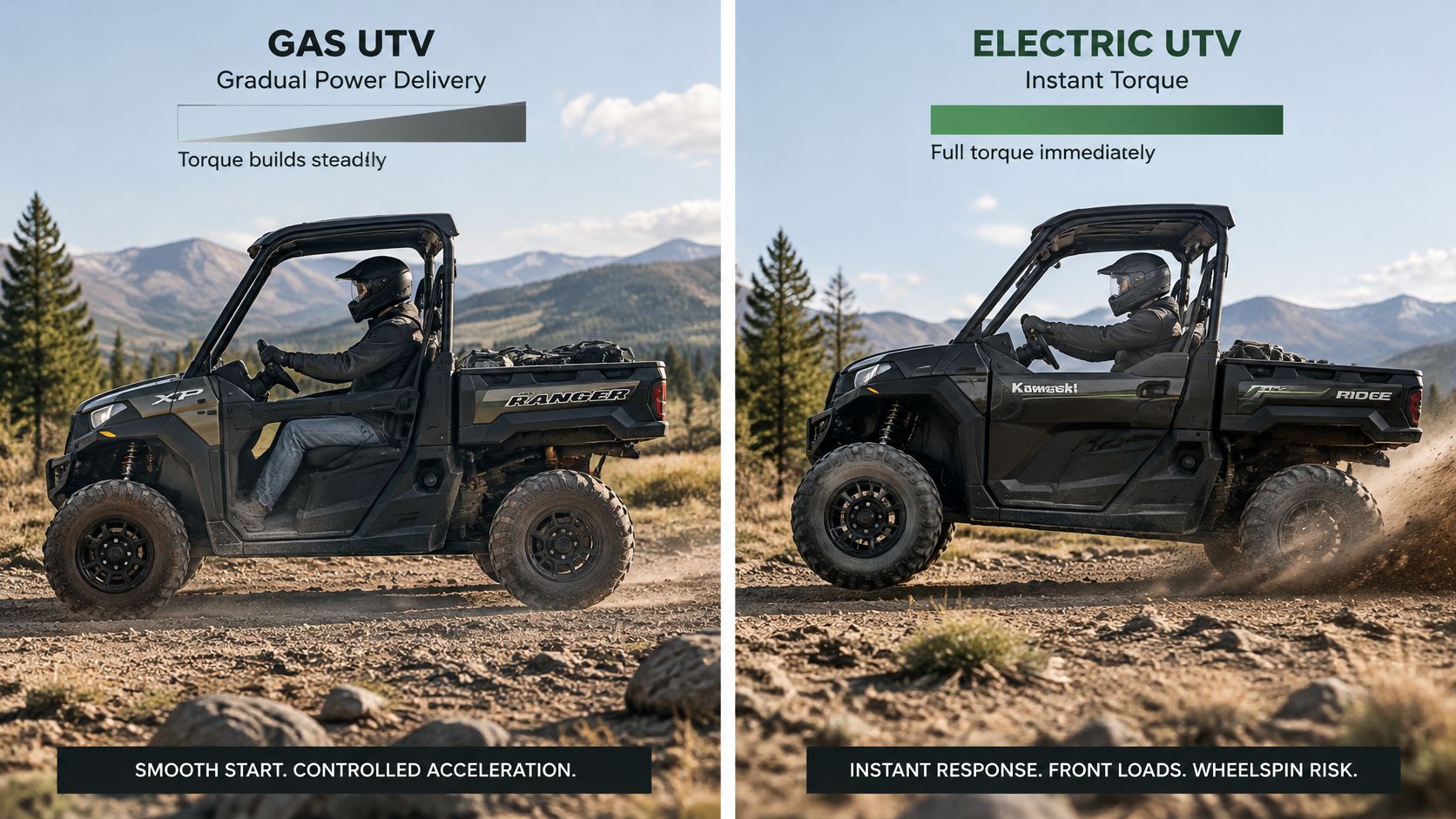
Instant torque makes wheelspin easier to trigger. It can also send a sharper shock through the driveline if a spinning wheel suddenly grips. So engage the lock while you're stopped or nearly stopped, then apply throttle smoothly and let the locked axle pull rather than punching it.
Other Electric Factors to Manage
- Tire pressure: Keep pressures even and correct, so both tires roll at a similar circumference.
- Load placement: Put heavy cargo low and over the driven axle where possible, so weight helps grip.
- Regenerative braking: It can slow you on a descent, changing how the vehicle settles before you stop to engage.
- Recovery choice: Sometimes a winch is the right tool instead of more throttle. Digging deeper with instant torque rarely helps.
Watch how an electric UTV responds at low speed in this demonstration.
Build the habit before you need it. Practice engaging and disengaging on a dry, firm, open area at walking pace, in a straight line, so you learn how the motor responds. Smooth throttle use also protects range, as explained in this guide to improving electric UTV efficiency. Use the numbered sequence that follows for the exact engagement order.
How to Engage the Diff Lock Safely
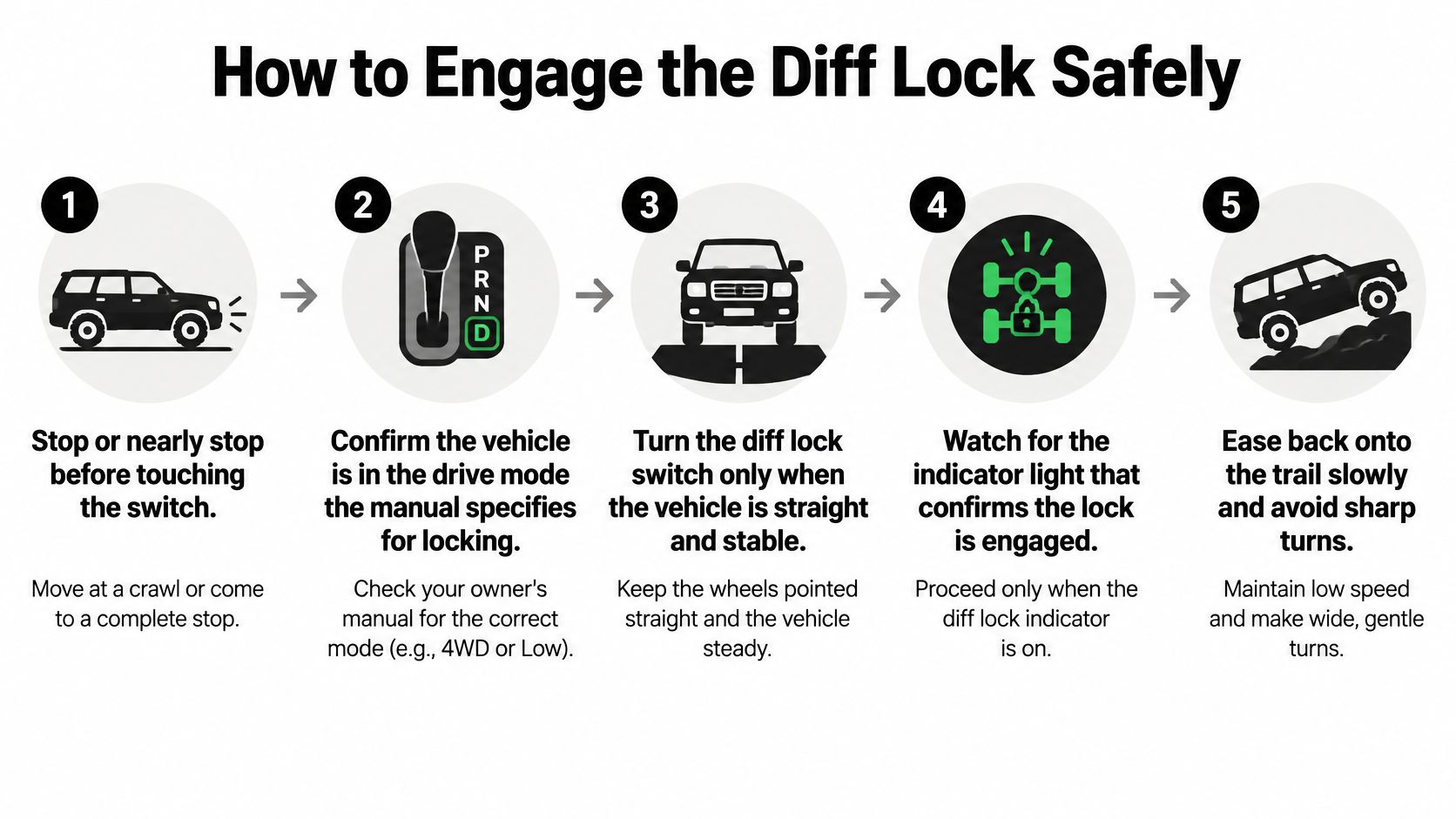
Use this sequence at the trailhead or before an obstacle, not after a wheel is already spinning fast. Polaris owner documentation warns that engaging a differential at high speed or while wheels are spinning can damage it, and notes that an indicator may flash until engagement completes, with gently moving the steering wheel back and forth helping it complete.
The Engagement Sequence
- Stop or nearly stop before touching the switch. This gives the locking parts a chance to align without a speed difference between wheels. Pressing the switch while moving fast is the most common slip.
- Confirm the drive mode your manual specifies for locking. Check whether it requires neutral, 2WD, or 4WD first. Guessing here can mean the lock never engages.
- Select the lock position for the obstacle. Rear lock suits most ruts and slippery climbs. Reserve a full front and rear lock, if fitted, for the hardest ground.
- Reduce throttle to zero or near zero. The wheels shouldn't be spinning when the lock engages. On an electric UTV, lift off fully, since torque arrives instantly when you press again.
- Watch the indicator and wait for confirmation. If it flashes, gently move the steering wheel back and forth and wait for it to stop flashing. Don't force the switch or drive off hard while it's unconfirmed, since some systems also limit speed until engagement completes.
- Drive slowly and steadily through the obstacle. Use constant, light throttle and keep the steering as straight as the ground allows. Jerky throttle inputs break traction again.
- Disengage as soon as traction returns. Turn off the lock before any tight turn and before you return to pavement. Leaving it on out of habit is where scrub and stress build up.
You'll know it's working when both wheels on the locked axle turn at matching speed and the vehicle moves forward steadily instead of sitting still with one tire spinning. If the indicator never confirms, treat that as information, not a challenge. Stop, reset, and retry calmly once.
Troubleshooting and Maintenance for Diff Locks
The most common problem is an indicator that keeps flashing and never confirms. Don't keep pressing the diff lock switch harder. Ease off the throttle, turn the steering wheel gently back and forth, and wait. The locking parts often need a small alignment change to drop in.
Eaton's locking differential guidance describes driver-selectable lockers as dash-switch-operated mechanisms that let the grounded wheel receive torque when the other wheel has no traction. It also explains that a locked axle can't accommodate normal left-right wheel-speed differences in a turn, increasing tire scrub, steering effort, driveline wind-up, and stress on gears or half-shafts. That's why several faults below trace back to using the lock on the wrong surface.
Diff Lock Symptoms, Likely Causes and Fixes
| Symptom | Likely cause | Fix |
|---|---|---|
| Indicator flashing and not confirming | Engagement not complete | Ease off throttle, gently turn the steering wheel back and forth, then wait |
| Lock will not engage | Speed or wheel spin above the limit | Stop or nearly stop, release throttle, then retry |
| Lock stays engaged in turns | Switch not returned to disengaged | Disengage before turning on firm ground |
| Clunking or binding in driveline | Lock used on high-traction surface | Disengage, inspect for stress, contact a dealer if it persists |
| Vehicle bound up or one wheel stuck | Drivetrain wound up under load | Stop, release throttle, recover by reversing or winching before engaging again; do not force the switch |
| Dead indicator, no lock response | Switch or wiring fault | Stop operating and contact a dealer |
The first three fixes take minutes in the field. Binding that persists, a wound-up drivetrain, and a dead indicator don't. Those need a dealer.
Habits That Prevent Repeat Problems
- Inspect after heavy mud: Check the driveline and axle boots for tears, packed mud, and leaks once you're home.
- Keep tire pressures correct: Even pressures keep rolling circumference matched, so the lock isn't fighting uneven tires.
- Avoid hard-surface engagement: Repeated locking on concrete or asphalt is preventable wear.
Stop-and-call rule: If the vehicle binds, makes a grinding noise, or the indicator stays dead after a restart, stop operating it and contact a dealer rather than forcing the switch.
Check Your Lock Setup Before You Buy
Before you buy, confirm five things. Each answer is easy to find if you know where to look.
- Which axle does the switch lock: Check the switch label and the spec sheet. Rear only, front only, and both axles suit different terrain.
- Does it work in 2WD or only 4WD: Confirm this in the owner's manual, not from the dashboard layout alone.
- What's the engagement speed limit: Find it in the manual. This decides how you'll use the lock in the field.
- Is the indicator clearly marked: Sit in the seat on a test ride and check you can see it in bright daylight.
- Can you reach the switch with work gloves on: Try it wearing your own gloves. A small, fiddly switch is a real problem on a cold morning.
The first two answers decide whether the lock suits your terrain. The third decides how you operate it. For reference, our Campus E1 has on-demand 2WD and 4WD and a locking rear differential, and it lets the driver easily switch between 2-wheel and 4-wheel drive. In 4WD with the differential locked, it climbed a steep grade without running out of power. You can compare that setup against other models in our range of electric 4×4 UTVs for sale.
Run a Short Ground Test
On a dry, firm, open area, engage the lock at a stop. Drive slowly in a straight line and confirm the indicator shows engagement. Then disengage, and only then turn. Any electric side-by-side should pass this calm test before its first real job, and the owner's manual overrides any general rule in this guide.
If you're replacing an old farm vehicle that's beyond repair rather than trading it in, services offering free towing for non-running farm utes can clear space in the shed before the new machine arrives. Match the lock setup to the terrain you work most, run the test, and confirm any open question with the dealer before the first muddy morning.
If you want an electric UTV with a locking rear differential and on-demand 2WD and 4WD for hunting, farm, and ranch work, take a closer look at the Campus E1 and test the lock for yourself on a test ride. Visit Campus EV to see the full specifications and find an authorized dealer near you.