
Most buying advice treats a cab as a comfort upgrade you bolt on after the "real" machine is chosen. That order is backwards. A roof and doors do not automatically make a side-by-side better. They change how long a person will stay on the job when the weather turns, and they change how an electric drivetrain spends its energy.
Comfort and usable range are not the same decision. If you hunt before daylight, check fence in sideways rain, or shuttle between barns, the useful question is how many protected hours you get on the routes you drive, after heat, hills, and payload take their cut.
Table of Contents
- Why an Enclosed Side by Side Is a Work Tool
- Soft Doors Hard Doors and a Full Cab
- Who Gains From Staying Inside the Cab
- Heat Cold Air and Power on an Electric Cab
- What a Protected Workday Does to Range
- Fitting Sealing and Seasonal Care
- Questions to Settle Before You Buy
Why an Enclosed Side by Side Is a Work Tool
An enclosed side by side is still a utility vehicle. A roof, a windshield, and doors or panels keep rain, snow, dust, and wind off the people doing the job. The machine still tows, still hauls, and still leaves the pavement. Adding a cab changes none of that hardware. What it changes is exposure.
A workshop with the bay door cracked open works the same way. You are not out of the weather. You stay at the bench longer because the worst of the wind is off your back. That is the honest case for panels and glass, and it puts this purchase on the work line of a budget rather than next to a recreational trail toy.
The demand for these machines sits in work, not Sunday riding. Grand View Research estimated the global electric utility vehicle market at USD 20.3 billion in 2024 and projected USD 29.0 billion by 2030, a 6.7% compound annual growth rate from 2025 through 2030, with agriculture named as a principal demand center for towing, hauling, and farm surveying.
Farm and ranch demand matters to the cab question because those jobs run on routes, not laps. Fence checks, feed runs, and pasture surveys happen on a schedule whether the morning is dry or not, and the vehicle either stays out or it does not.
Quiet work is the reason to enclose it
Farms, ranches, hunting properties, and maintenance sites already run these machines on loops a passenger car cannot make. A gas engine announces you on an access road and inside a livestock pen. An electric drivetrain stays quiet in both places. Panels around that quiet machine serve the chores, not the image of a mini truck.
The cab earns its cost on the routes you already drive, on the days you would otherwise park.
Weather protection matters most where the work is repetitive and scheduled. The heater, the lights, and a loaded bed still draw from the same pack that climbs the pasture hill. Anyone comparing an electric side-by-side with 4×4 should count protected working time and usable range on real routes before counting comfort features.
Soft Doors Hard Doors and a Full Cab
Enclosure level is a seal choice, not a quality ladder. Soft panels, hard doors, and a full cab each trade weather blocking against airflow, sightlines, and how fast you can get in with muddy boots. A tighter cab is not automatically the right one.
| Enclosure | Weather seal | Airflow and access | Best when |
|---|---|---|---|
| Soft doors and rear panels | Stops light rain and wind, leaks in a sustained storm | Easy to open, zip, or roll for air | You want shade and a quick exit more than a winter seal |
| Hard doors | Cuts wind, noise, and sideways rain better than fabric | Stiffer entry, roof and rear still separate decisions | Mixed seasons, and you still want the option to run partly open |
| Full cab | Windshield, roof, hard doors, and a sealed rear | Behaves like a small work truck, needs a defroster plan | The job continues in cold or wet weather and glass will fog |
Soft panels
A soft enclosure is fabric or vinyl doors and a rear panel over a roof and windshield. It goes on fast, and you can open it when the afternoon heats up. Brush, a hard rain, and winter wind find the zippers and the floor gap. Dust still rides in around your boots. Treat it as a windbreak you can live with, not as a sealed room.
Hard doors
Hard doors are rigid panels. They cut noise and weather better than vinyl, and they hold up to limbs on a two-track. The roof, the rear window, and the quality of the seal are still separate decisions. You can have stout doors and a cab that fogs because the rear is only a curtain. Check sightlines on a narrow trail before you commit. Gloves and a wide door swing fight each other in a tight shed.
A full cab
A full cab closes the windshield, roof, doors, and rear so the cabin acts more like a small work truck. That is useful, and it creates new jobs. Glass fogs. You need a defroster and a place for wipers. Entry with muddy boots gets slower. In July you may want panels that come off, because a sealed box with no airflow is a bad place to sit.
Floor gaps: Even a "full" cab lets dust in at the floor if the mats and sill seals are loose.
Hot months: Ask whether the doors or the whole cab can come off without a shop day.
Glass plan: If you cannot clear the windshield, the tighter seal is a liability, not a feature.
Who Gains From Staying Inside the Cab
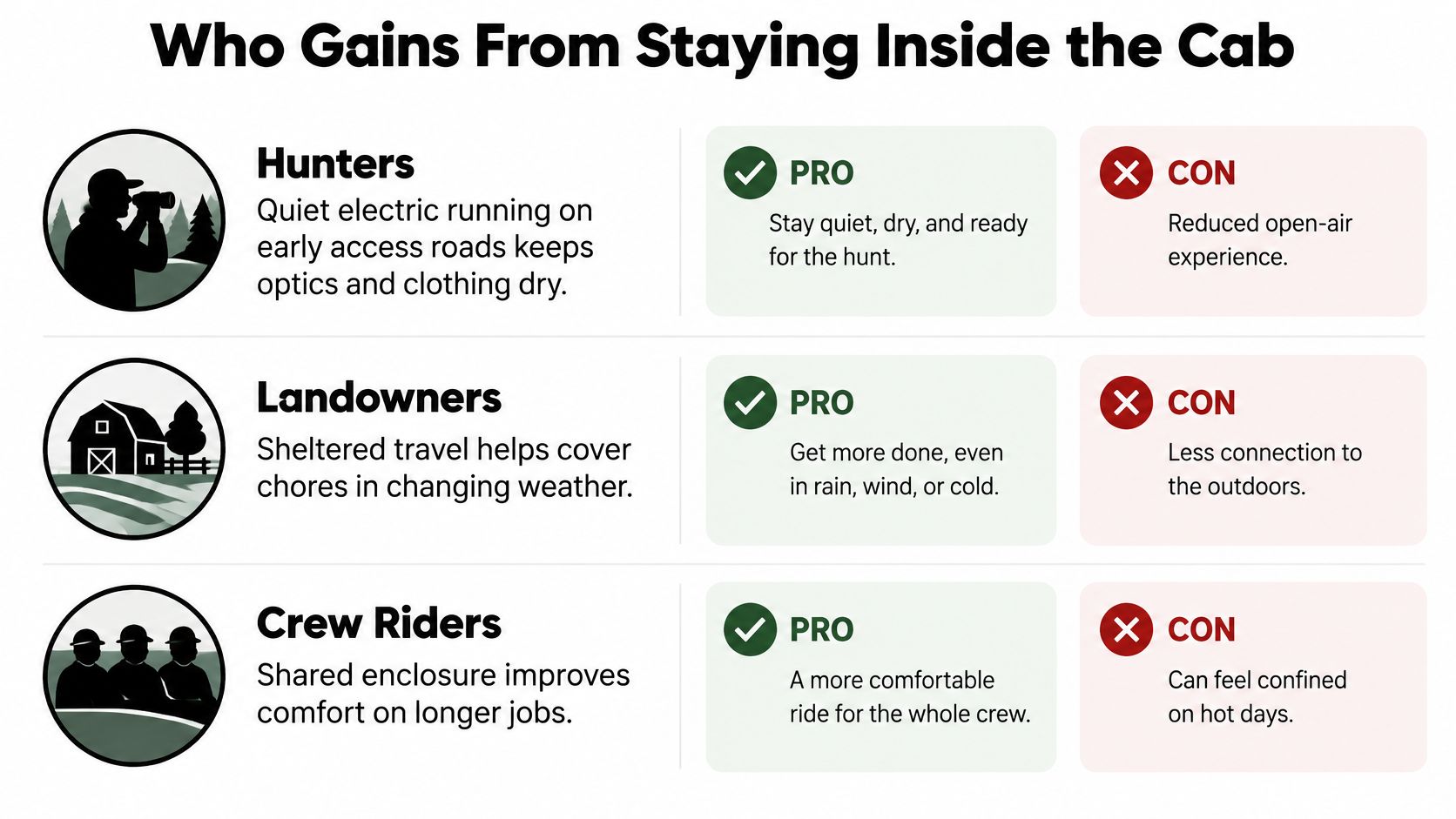
The same three levels land differently once a real job is attached. Match the seal to how often you stop, how wet the day gets, and whether a second person is riding.
Hunting access before shooting light
Hunters gain from quiet electric running on early access roads. Optics and outer layers stay dry, and you are not shaking water out of a scope at the first glassing spot. A full cab can feel tight when you step out often or need a wide view through brush. On a stop-and-stalk morning with short drives between sits, hard doors usually beat a fully sealed box. You still block the wind on the ride in. You are not fighting a door and a fogged side window every time you glass.
A soft setup is enough for a fair-weather scout when the main goal is a fast, quiet exit. It fails the week the rain starts at 4 a.m. and does not quit.
Farm and ranch loops
On a ranch, fence checks, livestock moves, spray support, and material hauls often end because of dust and sideways rain, not because the pack is empty. The operator is in and out all day with gloves on. Hard doors fit mixed seasons. You get a drier seat and you can still crack a panel when you are stacking posts.
A full cab earns its keep when the same loop continues through a cold rain and the alternative is quitting at noon. It is a poor fit if every gate means a full climb-out and the doors bang the chute panels.
Short moves between buildings
Property commuters and crews moving between barns, shops, or job sites run the same short trips over and over. Here a full cab usually reduces fatigue more than it complicates the route. Construction and warehouse-adjacent property work fits this pattern when the transfers are short, dusty, or wet. This is not on-road commuting. It is a shuttle that would otherwise soak a crew or fill their eyes with grit.
Soft panels for fair-weather flexibility, hard doors for mixed seasons, and a full cab when the job continues in cold or wet weather.
If your day is mostly one of those three, pick the enclosure for that day. Do not buy the tightest cab because a brochure called it premium.
Heat Cold Air and Power on an Electric Cab
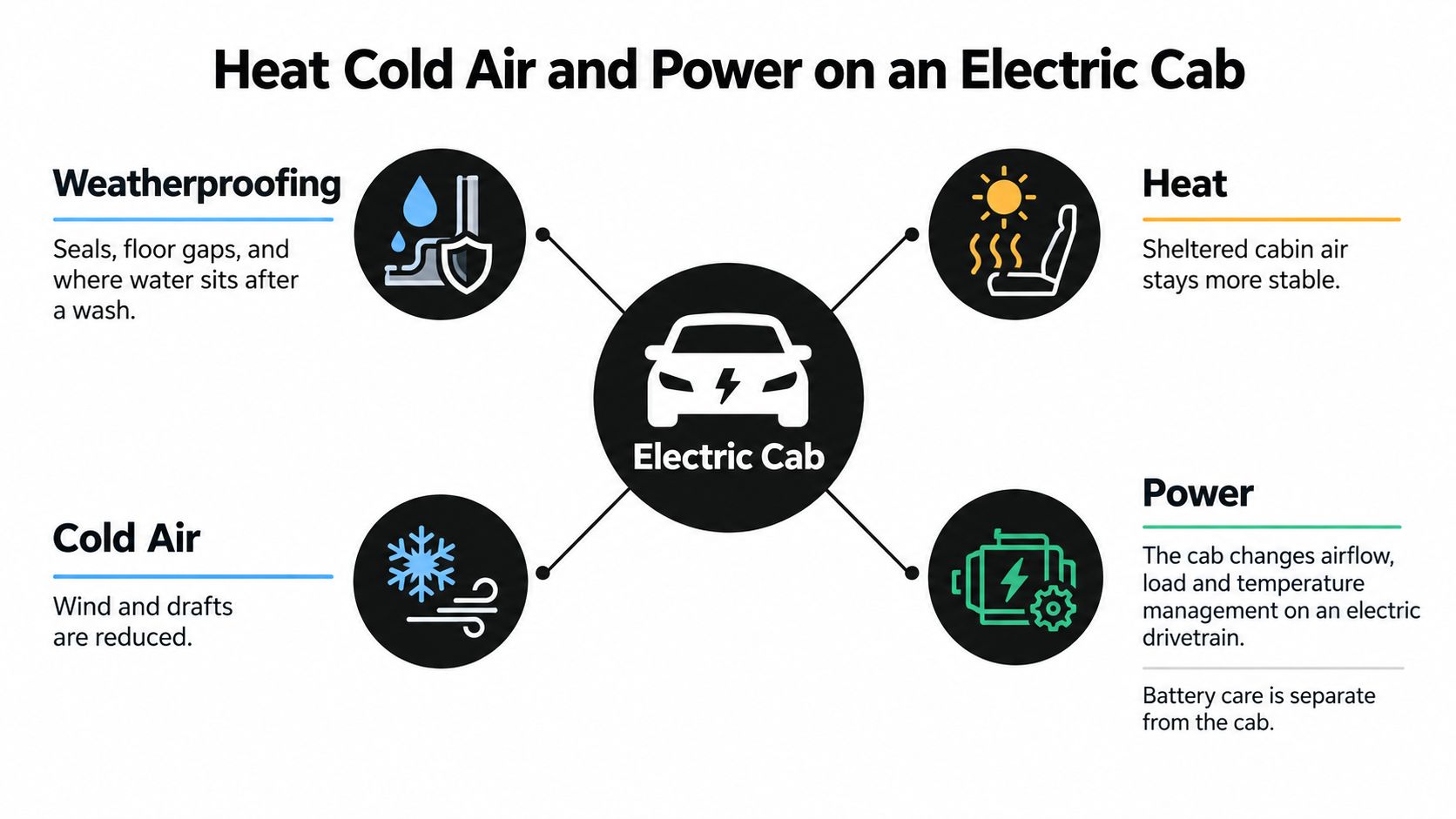
Weather sealing and battery care are different problems. Seals, floor gaps, and the low spots where wash water sits decide whether the cab stays dry. Pack temperature decides whether you still have range after the cab is closed. Mixing those up is how people blame the doors for a cold battery.
What cold does to the pack
Low temperatures raise internal resistance, cut available power, and spend energy warming the battery and the cabin. National Renewable Energy Laboratory testing found that vehicles stored outdoors in Fairbanks winter conditions lost up to 69% of range near -40°C (-40°F) and still ran. That is an extreme storage case, not a normal farm morning, and it shows the direction of the penalty. The same research found thermal preconditioning produced a 19% range increase in one cold-weather plug-in hybrid test versus no preconditioning.
Driving with a cold battery and charging one are not the same. You can roll out of a cold shed and work a short loop. Plugging in a very cold pack before the vehicle has warmed it is slower and harder on the cells.
Heat ages the pack while it speeds the charge
NREL fleet guidance in that assessment reported a charge of about 1.0 hour at 40°C (104°F) versus 1.5 hours at 5°C (41°F). The hotter case also aged the pack faster than operation near 25°C (77°F). Fast is not free. A metal roof in full sun can push cabin and pack heat together, which is why exterior finish and heat load matter in desert country. Owners in that climate often look to desert coating care for professional detailers so paint and plastics are not an afterthought next to the battery.
A practical fleet habit from that guidance is a routine window of about 20% to 80% state of charge. That avoids sitting full all week and avoids draining the pack to the floor on a workday.
Loads the cab adds
A sealed cab needs ventilation or the glass fogs and dust hangs in the air you breathe. A heater, a defroster, lights, and a winch are extra electrical loads on top of hills and payload. The cab did not create those loads. Closing the box makes you more likely to use them, because you will stay out in weather that would have sent an open machine home.
Shelter the charge: Park and plug in a moderate building when you can, not against a frozen wall.
Precondition on shore power: Warm the pack while it is plugged in, so cabin heat is not the only thing spending range.
Watch the accessories: If the winch and the heater run on the same morning, plan a shorter loop.
What a Protected Workday Does to Range
Published talk often starts at roughly 40 to 60 miles for many electric UTVs. Treat that as a moderate-weather sketch, not a winter promise. Powersports Business reporting in 2026 called cab and HVAC-equipped machines a fast-growing configuration while the overall UTV market was largely flat in the first half of 2026. Buyers are paying for time inside the weather, not for a longer trail score.
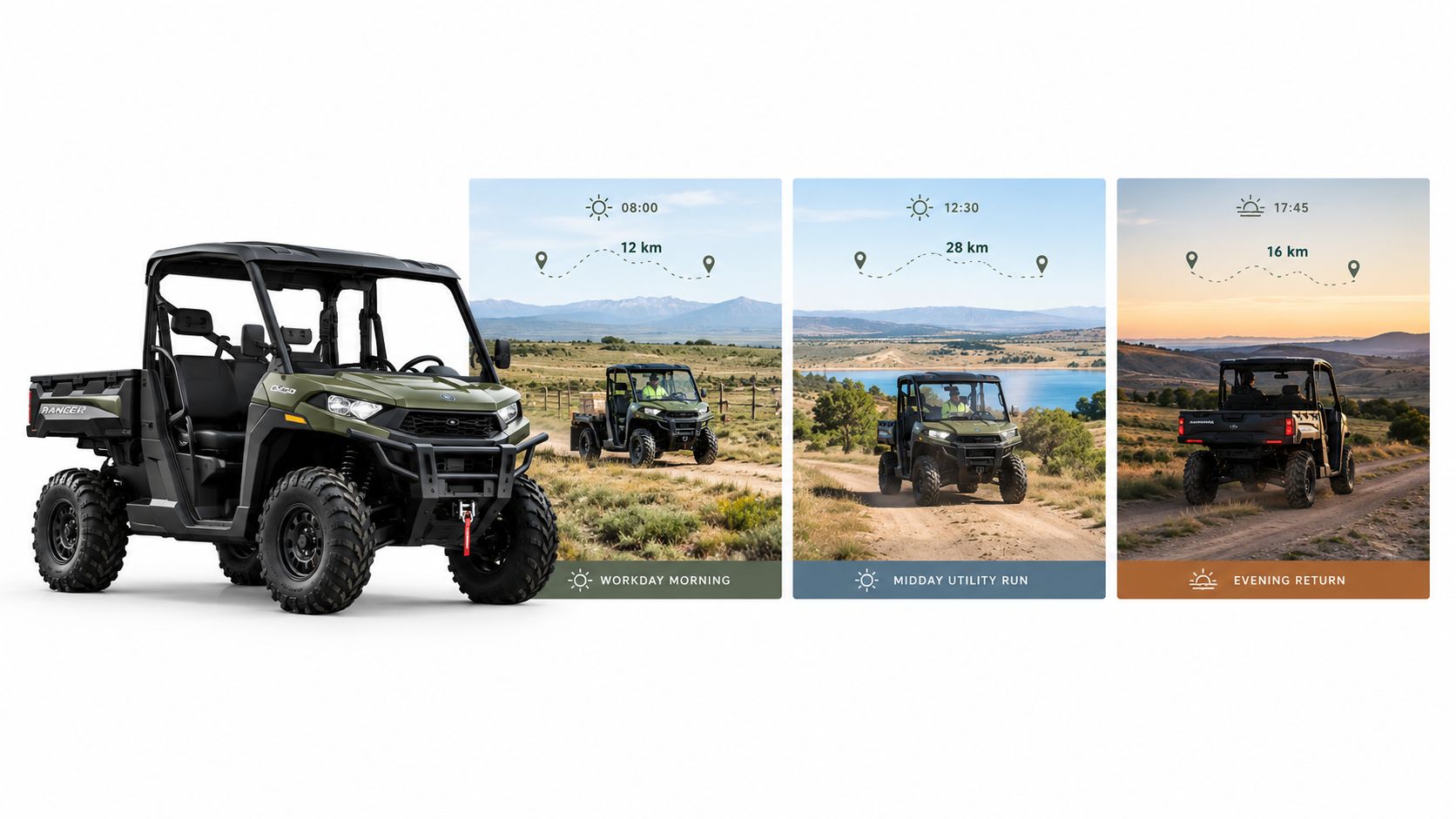
Three days, three different range calls
A cold scouting loop: Heater and defroster stay on. Stops are long, plugs are far apart, and the route is one continuous push away from the shed. Here, range loss is the main risk. If the moderate-weather figure is the only margin you have, do not plan that hunt on a full advertised distance. Cut the loop or stage a charge before you leave pavement.
A fence day with many short stops: The rancher is out of the seat at every brace post. A cabin keeps that person working through a drizzle that would have ended an open ride. A midday plug at the barn is realistic because the route already returns near power. Protected time can outweigh the miles the heater used.
Repeated yard trips: Even a cold-weather cut still leaves the route viable if the machine charges between tasks. Buyer guidance commonly warns that freezing temperatures can cut electric-UTV range about 20 to 30% and slow charging, and it advises indoor storage or letting the battery warm before charging, as covered by property-use electric UTV guidance. On a farm lane you drive six times, that cut is annoying. It is not a reason to reject the machine.
Long remote fence lines and far hunting tracks need a reserve. Short, repetitive property routes often do not, if someone plugs in during lunch.
How you drive those miles matters as much as the cab. Habits that stretch electric UTV efficiency on hills, payload, and speed keep more of the moderate-weather figure for the heater.
The useful comparison is hours you will stay out, not the biggest number on a spec sheet. A cab that shortens one hard day and lengthens ten ordinary ones is doing the job.
Fitting Sealing and Seasonal Care
Fit and care decide whether the cab you picked stays tight after the first muddy month. This is ownership habit, not a torque chart.
Confirm the enclosure belongs on that chassis
Start by matching the enclosure to the frame. Door swing, mirror clearance, and light clearance have to work in your shed and on your trails. A wiper or defroster needs a mount that does not block the accessory plan. If the kit fights the bed, the mirrors, or the way you open the door with a glove on, it is the wrong kit, even if the brand name matches.
Seal it before the storm
Close every panel on level ground. Look for daylight at the roof rail and along the floor. Then run a hose test on a dry day. Finding a leak in the yard is cheap. Finding it on a hunt, with optics in the footwell, is not.
Wash the tracks: Grit in a door channel turns a good seal into a slow leak.
Keep drains open: A cab that holds water is worse than no cab.
Inspect latches and zippers: A soft panel fails at the zipper long before the fabric wears out.
Store indoors when you can: NREL fleet guidance treats slower charging, reduced range, and lower power as the main cold-weather issues, especially in extended periods below -4°F (-20°C). The same guidance points owners toward sheltered, moderate-temperature charging plus connected preconditioning where the system supports it.
A simple charging habit
Charge in a sheltered spot that is not an icebox and not a hot metal box. Precondition on shore power when the vehicle allows it. Do not treat a very cold pack like a warm one. A dedicated, properly rated charging circuit near the equipment shed is what makes overnight charging normal, so you are not hunting an outlet at the start of work.
Those habits also hold down ownership cost. A cab full of grit and a pack left at outdoor extremes both show up later in UTV maintenance cost.
Questions to Settle Before You Buy
Bring a typical day, not a wish list, to the dealer. The enclosure is only right if it clears the chassis, the route, and the way you already work.
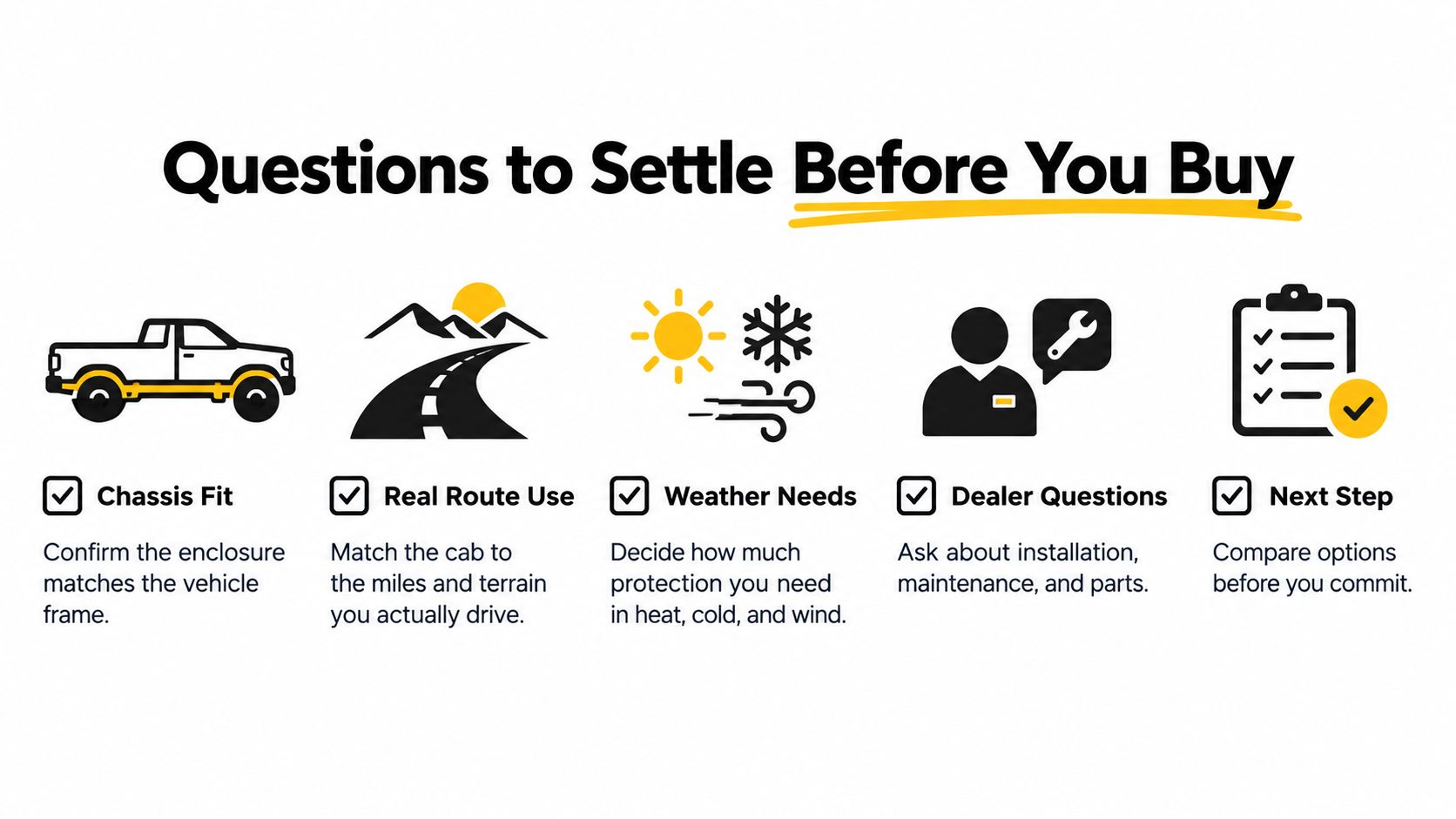
Walk the conversation in this order.
- Chassis fit. Does this enclosure match the frame, the door swing, and the lights you already need?
- Route versus a moderate-weather range claim. How long is the actual loop, and where can you plug in?
- Heater and defroster draw. Will those loads be on for the whole day or only the first miles?
- Storage and charging. Is there a sheltered spot and a proper circuit, or will the machine sit outside?
- Payload and winch on the same days as cabin heat. Stack those loads in your head before you stack them on the trail.
- Visibility and door access. Can you see the trail and get out with the gear you carry?
- Service through an authorized dealer. Who installs the cab, and who stands behind the electrical work?
One electric UTV aimed at hunting, farm, ranch, and property work is the Campus E1. It uses a 20 kW PMSM motor and a 72V 150Ah lithium battery, lists up to 60 miles of range, and offers on-demand 2WD/4WD, an electric dump bed, a 3,000 lb winch, and CarPlay or Android Auto. Authorized dealers sell it with 0% APR financing. Ask whether the enclosure you want clears that dump bed, that winch, and the mirrors, and ask how the dealer expects winter charging to happen on your property.
Do not order doors or a full cab from a comfort photo. Put the day's route and the storage plan on the table, then compare protected work time.
Campus EV builds electric side-by-sides for hunting, farm, ranch, and property work, where an enclosed cab only pays off if the day's range still covers the route. If you are weighing soft doors against a full cab, bring that route to a dealer and compare real working time, not a dry-seat demo. Start with the lineup and dealer path at Campus EV.