
You've opened several listings, and the machines look much alike: seats, a cargo bed, four-wheel drive, maybe a winch. But the right choice changes quickly when you explain what you plan to do with it. A hunter may need a quiet route to a stand and a reliable overnight charging plan. A rancher may need to haul supplies all day. A warehouse operator may care most about predictable trips and keeping a vehicle available through a shift.
A side by side utility vehicle for sale should be judged by its routes, loads, terrain, operating schedule, charging or refueling access, and the cost of downtime. Headline range and motor output matter, but they don't tell you whether a particular machine fits your work. Use your actual duty cycle to decide which specifications deserve attention, then verify those limits with the dealer before you buy.
Table of Contents
- Start With Your Real Workload
- Understand the Electric Utility UTV Market
- Evaluate the Features That Do the Work
- Compare Electric and Gas Side-by-sides
- Match the UTV to Hunting Farm and Ranch Work
- Check Dealer Support and Financing Before Buying
- Plan Charging Maintenance and Ownership Costs
- Choose With a Final Purchase Checklist
Start With Your Real Workload
Start with a normal day, not the sales listing. Where will you drive? What will the vehicle carry or tow? How many trips do you expect to make, and where can you recharge or refuel between them? A machine that works well for checking property may not suit a long, loaded route across rough fields.
Write down the work you expect the UTV to handle, then sort it into one of three duty cycles:
- Occasional hunting and property use: Access roads, wooded trails, fence checks, gear transport, and intermittent hauling. Quiet operation may be useful, but remote charging and cold-weather range need careful thought.
- Daily ranch work: Repeated trips, feed or tool transport, gates, mud, grades, and time-sensitive chores. Payload, drivetrain, uptime, and a practical charging routine matter more than a headline range figure.
- Warehouse or construction transport: Hard-surface routes, equipment or supply movement, work shifts, and predictable parking locations. These settings can suit electric operation when charging is dependable and the vehicle's written limits match the load.
Don't assume that electric is automatically the right answer, or that gas is the safe default. Electric can make sense for repeated, predictable routes where charging is available and quiet operation is valuable. Gas may be simpler when work takes you far from power, requires long uninterrupted runs, or leaves little time for charging.
Practical rule: If you can't describe your route, load, and charging plan, you're not ready to choose a powertrain.
Before you compare models, list your typical terrain, passengers, cargo, towing needs, operating hours, and parking conditions. Then ask a dealer to confirm the vehicle's payload, towing, and accessory limits in writing. That shifts the conversation from “Which one looks capable?” to “Which configuration can do my job without guesswork?”
Understand the Electric Utility UTV Market
An electric utility UTV is a side-by-side powered by an electric motor and battery, built to carry people, cargo, or equipment for work and property use. It sits within the broader UTV category, but market labels such as UCV, PUV, SSV, and RUV are classifications, not interchangeable feature descriptions. They don't tell you whether a specific model has the bed, payload, drivetrain, or range your work requires.
The North American market has a substantial utility base. Approximately 520,000 UTVs were retailed across North America in 2024, a decline of slightly more than 7% from the prior year. Utility-oriented UCVs represented 48% of the market, while consumer applications accounted for more than 85% of retail sales, according to this off-highway electric vehicle market overview. Those figures put utility machines in context, but they don't establish which powertrain is best for a particular buyer.
Electric off-highway vehicles are also becoming a more established equipment category. The U.S. off-highway electric-vehicle market was estimated at $543.35 million in 2023 and is projected to expand at a 12.4% compound annual growth rate from 2024 through 2030, according to this U.S. off-road vehicles market assessment. Market growth signals expanding availability, not guaranteed performance in your fields, woods, or work site.
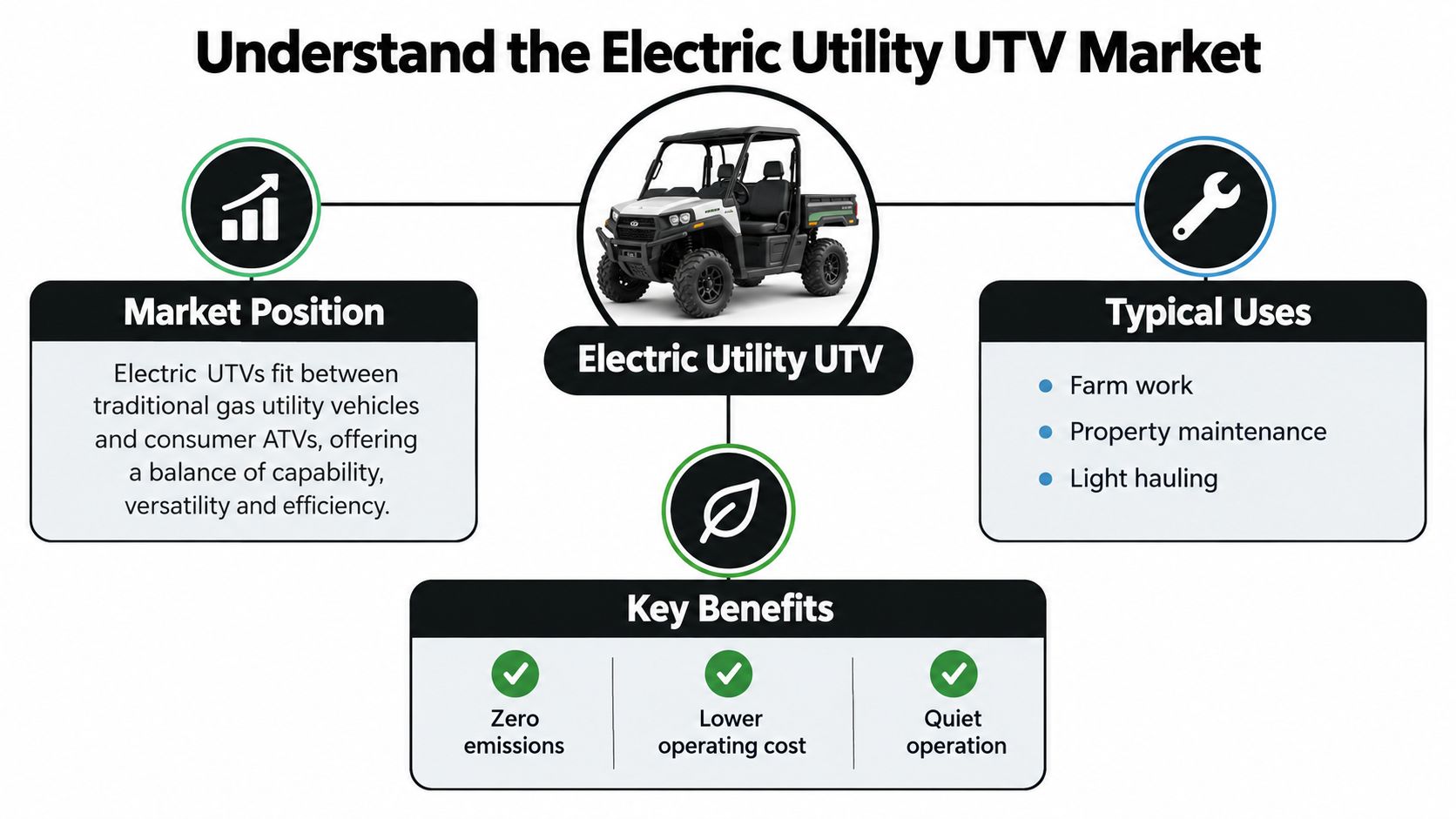
The useful takeaway is a buying lens: compare payload, towing, drivetrain, usable range, charging access, maintenance, and site suitability. A market category or a product label can't answer those questions for you. Ask for specifications that match the work you described, and treat advertised capabilities as starting points to verify rather than promises about every condition.
Evaluate the Features That Do the Work
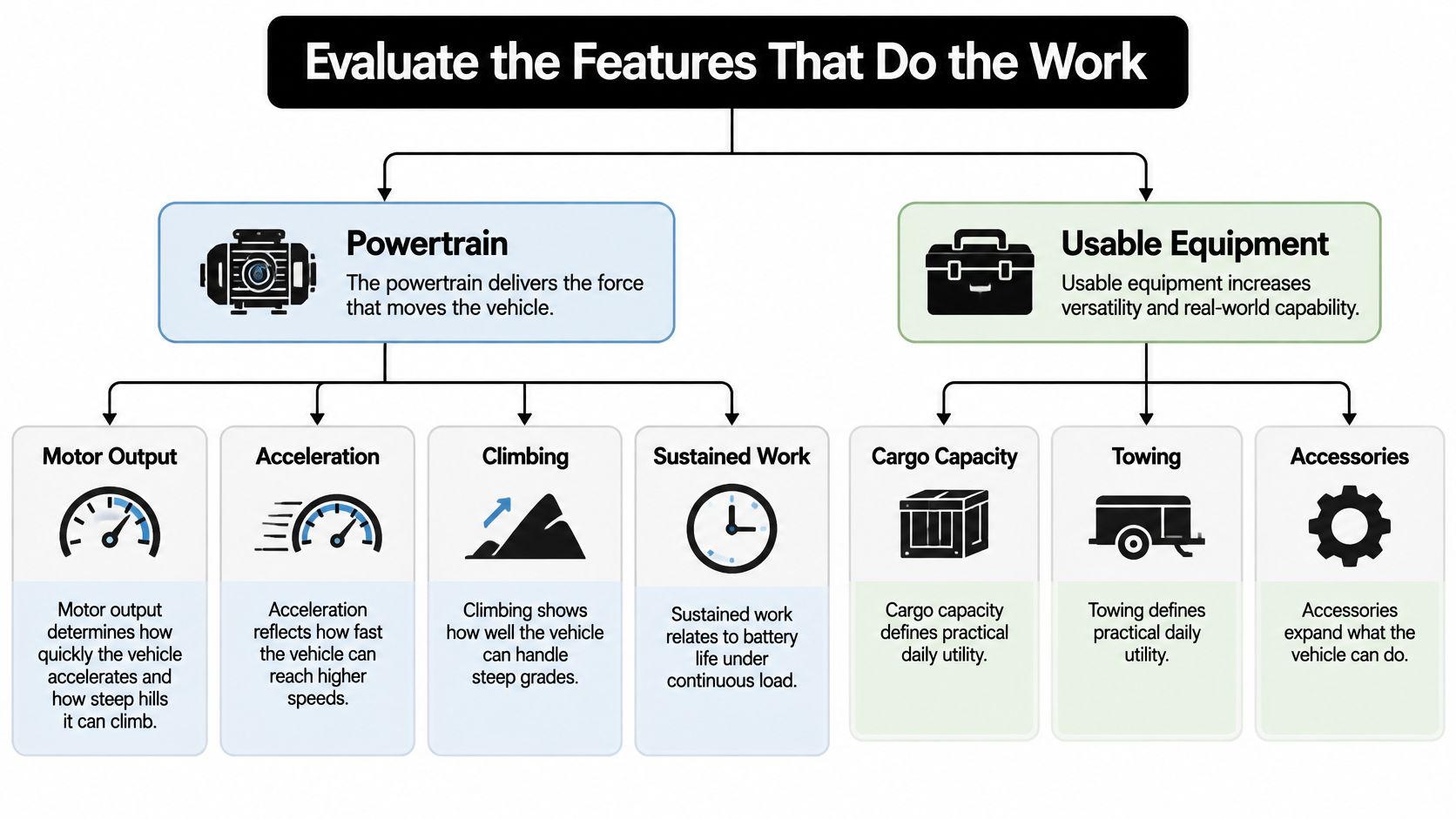
Start with the powertrain, but don't judge it by one specification. Motor output can help explain acceleration and climbing ability, while sustained work depends on the whole vehicle, including its battery, load, terrain, and operating conditions. A number on a spec sheet doesn't guarantee that the UTV will hold a particular speed or cover a particular route while carrying cargo.
A concrete example is the Campus E1, listed with a 20 kW PMSM motor, a 72V 150Ah lithium battery, and up to 60 miles of range. Those are stated specifications, not field guarantees. Ask how the manufacturer defines range, what conditions were used, and how payload, terrain, speed, temperature, and accessories may affect the result.
Match the drivetrain to the ground
Selectable 2WD and 4WD can help a driver adapt to changing traction needs, but confirm how the system operates and when the manufacturer recommends each setting. If your route includes mud, slopes, loose soil, or wooded ground, test the drivetrain on similar terrain where possible. For paved warehouse routes, traction requirements may look different, but the vehicle still needs to handle the actual surfaces and loads at your site.
A bed or electric dump bed can save repeated lifting, provided its capacity suits the cargo you plan to carry. The Campus E1 is listed with an electric dump bed and a 3,000-pound winch. Check the winch's rated capacity and intended use with the dealer, and verify the vehicle's payload and towing limits in writing. Don't infer those limits from the size of the bed or winch.
Inspect the equipment you'll rely on
Look beyond the motor and battery. Ask whether the cab or weather protection fits your climate and workday, whether the vehicle can carry the accessories you need, and how those accessories affect electrical demand or range. Phone connectivity may be convenient, but it shouldn't outrank cargo capacity, safe operation, or a verified charging plan.
Ask for the working limits, not a sales summary. Have the dealer identify the written payload, towing, bed, winch, and operating limits for the exact configuration you're considering.
Before you visit, list the heaviest load you expect, the steepest or roughest section of your route, and how often you'll use the vehicle continuously. Use that list to guide your questions, then take a test drive that reflects your conditions as closely as possible. The video below offers a visual introduction to utility UTVs, but your buying decision should rest on the specifications and limits documented for the model.
Compare Electric and Gas Side-by-sides
Choose between electric and gas based on operating conditions, not on a blanket claim about cost. A 2025 market analysis estimated that electric UTVs often carried an upfront premium over comparable internal-combustion models and identified rural charging availability as a barrier. The size of the purchase difference, financing cost, local energy prices, and maintenance expense all need to be confirmed for the vehicles and location you're comparing.
| Consideration | Electric side-by-side | Gas side-by-side | Best fit |
|---|---|---|---|
| Purchase and financing | May involve a higher initial cost; compare the full written offer and total repayment. | Compare the exact model price and financing terms rather than assuming it will cost less overall. | The option that fits your budget after fees, equipment, and financing are included. |
| Energy and downtime | Requires dependable charging access and enough time to recharge for the next work period. | Refueling is familiar and can be more convenient when power is unavailable. | Electric for predictable routes with reliable charging; gas for remote work without dependable power. |
| Routine service | Avoids engine-related items such as oil and spark-plug changes, but other components still need maintenance. | Requires engine-related service in addition to care for tires, brakes, suspension, and other parts. | Electric when reduced engine service suits the work pattern; compare actual service schedules. |
| Noise and site use | Quiet operation may suit hunting properties, enclosed work areas, and places where noise is a concern. | May be less convenient where low noise is an important operating requirement. | Electric when quiet operation adds practical value. |
| Range management | Plan around charging access, terrain, load, and weather, not the maximum advertised range alone. | Refueling can suit long or changing routes, but fuel availability and service still matter. | Electric for known routes and planned charging; gas for long, flexible routes. |
| Resale and support | Check local dealer capability, parts support, warranty terms, and likely buyer demand. | Check those same factors, including support for the exact model and configuration. | The option with dependable local support and a clear ownership plan. |
Get local electricity and fuel costs, service intervals, charger installation requirements, and downtime implications before you compare total ownership cost. Those variables can outweigh a general claim about savings. A vehicle that sits waiting for a charge during a critical shift may cost more in lost time than its energy use suggests.
My recommendation is conditional. Choose electric when your routes are predictable, charging is convenient, and the machine's verified working limits fit the job. Choose gas when remote operation, long runs, multiple shifts, or limited charging access would make electric ownership impractical. If you're uncertain, compare the two vehicles against the same route and workload, then put both operating plans on paper.
Match the UTV to Hunting Farm and Ranch Work
A maximum range figure is a starting point, not a promise about field distance. Load, terrain, driving pattern, temperature, and heating or climate-control use can reduce the distance available between charges. The National Renewable Energy Laboratory's cold-weather guidance indicates that extreme cold can reduce EV range by approximately 50%, while an Alaska-focused assessment found that outdoor-stored vehicles experienced reductions of up to 69% in severe conditions. Review the cold-weather range assessment before planning winter routes around a published maximum.
Occasional hunting and property use
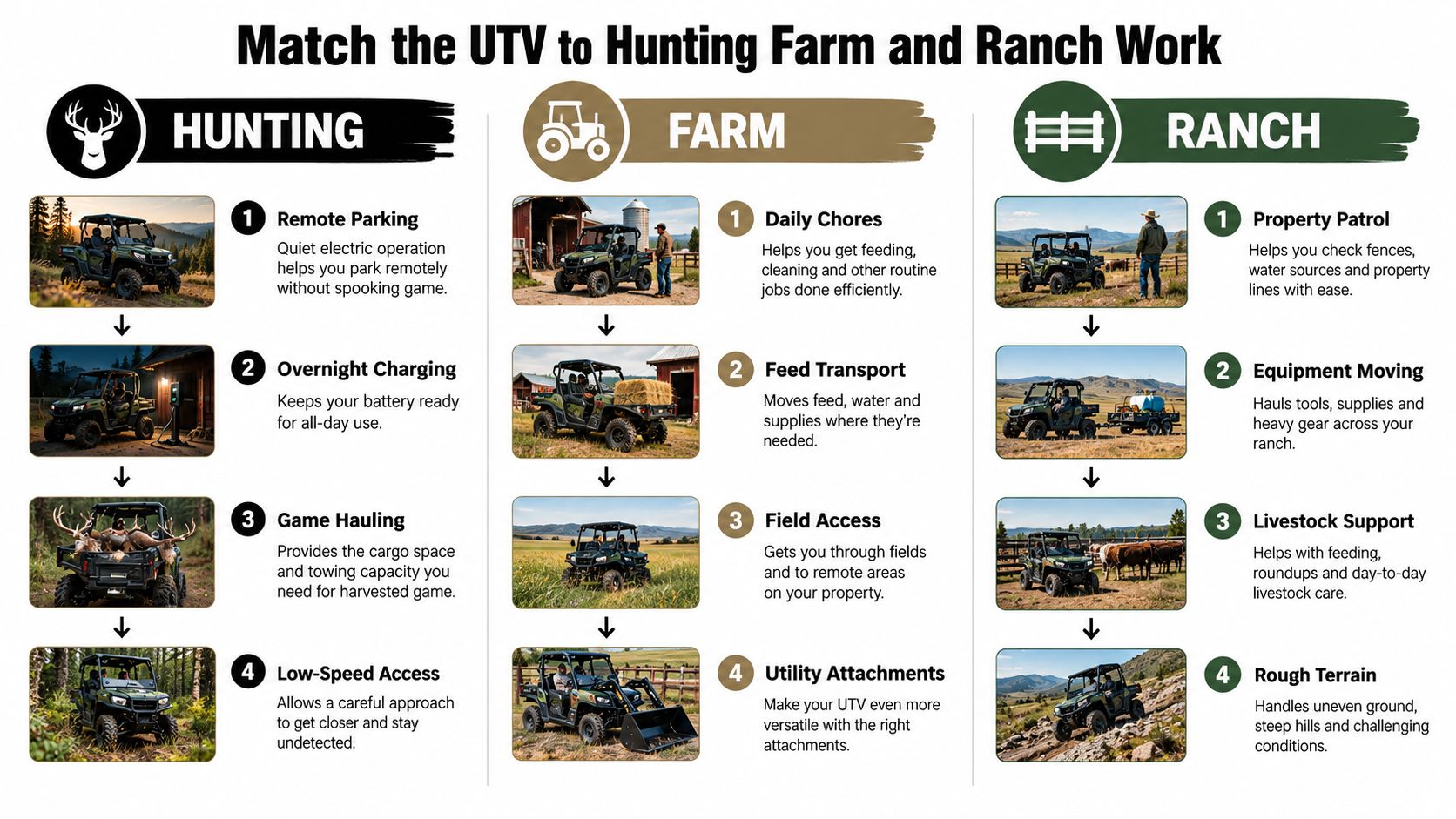
A hunter may value quiet operation on a property, but the route and charging plan matter just as much. Check where the UTV will be parked overnight, whether charging is available there, how much gear or game you expect to carry, and whether the vehicle can reach your access points without exhausting its practical range. In cold weather, leave a reserve rather than planning a trip that uses the full displayed range.
For farm work, consider a farm-focused electric utility vehicle in relation to your own routes and loads. Ask the dealer to document payload and towing limits for the configuration, then assess the bed, drivetrain, and accessories against your actual chores.
Daily ranch work
A ranch schedule can mean repeated stop-start travel, gates, uneven ground, mud, and frequent hauling. List the trips you make in a typical workday and identify when the vehicle can be parked and charged. If there's no reliable charging window, or a missed trip would interrupt essential work, gas may be the more convenient choice. If you can charge consistently and the route fits the machine's verified limits, electric may suit the routine.
Warehouse or construction transport
Hard surfaces and predictable routes can make electric operation easier to plan, but don't assume a short route means a light workload. Confirm what the vehicle will carry, whether it needs to tow, how long it must remain available, and where it can charge during or between shifts. Compare the expected duty cycle against the dealer's written payload and operating limits.
For all three profiles, ask about battery thermal management and covered storage if the vehicle will work in cold conditions. These details, plus cargo and route planning, tell you more than the headline range alone. If the dealer can't document how the advertised range relates to your expected work, treat that gap as a reason to ask more questions, not as a number to rely on.
Check Dealer Support and Financing Before Buying
An online listing is a useful starting point, not a complete purchase agreement. Ask the dealer to confirm the exact model year, motor and battery specifications, drivetrain, bed, winch, cab and accessories, availability, delivery terms, warranty coverage, and authorized service support. Make sure the paperwork describes the same configuration you inspected or test-drove.
Campus EV sells electric utility UTVs through authorized dealers. The company states that 0% APR financing is available, but don't assume the offer applies to every buyer, model, or time period. Request the rate, term, down payment, fees, approval conditions, and total repayment in writing before you compare monthly payments. A low payment alone doesn't establish that the offer has the best total cost.
If you're weighing ways to fund a vehicle for work, review these equipment financing options alongside the dealer's offer. Treat any financing resource as a comparison point, not a substitute for reading the lender's terms.
Use the dealer conversation to close the information gaps:
- Confirm the build: Match the advertised specifications to the serial-numbered or documented vehicle, including installed accessories.
- Read the warranty: Check what's covered, where service is available, and how the terms apply to battery and powertrain components.
- Verify operating limits: Get payload and towing ratings in writing for the exact configuration.
- Check delivery and setup: Confirm delivery charges, assembly, charging equipment, and any accessories needed before first use.
- Book a test drive: Ask to assess controls, visibility, access, turning, and ride quality in conditions relevant to your work.
To find an authorized seller, use the electric UTV dealer locator. Before signing, budget separately for insurance, registration, taxes, delivery, and required equipment. A clear written offer is more useful than an attractive listing with unanswered questions.
Plan Charging Maintenance and Ownership Costs
Build the ownership budget in separate categories. Include purchase price and financing, electricity or fuel, scheduled service, tires, storage, insurance, registration, charging equipment, repairs, accessories, and the cost of downtime. Ask for local prices and model-specific service requirements rather than relying on generic savings claims.
Electric drivetrains can eliminate engine-related service items such as oil changes, spark plugs, and exhaust-system maintenance. That doesn't make an electric UTV maintenance-free. Tires, brakes, suspension, controls, battery systems, and other components still need inspection and care, and parts may eventually need replacement. Ask the dealer for the maintenance schedule and warranty details for the model you're considering.
Charging access belongs in the budget, too. A buyer's guide cited full-charge planning ranges of 8–12 hours on 110V or 4–6 hours on 220V, but those aren't guaranteed times for every vehicle or setup. Confirm charging requirements, charge times, and compatible equipment with the manufacturer or dealer before buying. If you need to compare installation choices, these EV home charging station options can help you think through what to ask an installer.
A charger beside the vehicle's usual parking spot is more useful than a charging plan that depends on an inconvenient outlet or an uncertain work break.
Cold-weather preparation can affect practical range. NREL research found that cabin and battery climate-control loads can reduce EV range by as much as 35%. An Alaska technical assessment recommends preheating for roughly 15–30 minutes before departure while the vehicle remains connected to power; see the NREL cold-weather charging guidance. Covered or heated storage may also help with winter readiness and charging.
Ask whether the UTV supports preconditioning and how it should be stored and charged in your climate. Then estimate costs using your local electricity price, actual charging setup, work schedule, and expected service needs. For help thinking through the maintenance side, consult this guide to UTV maintenance costs, then confirm the applicable schedule with the dealer. Don't call an electric model cheaper to own until you've included charging, repairs, financing, and lost work time.
Choose With a Final Purchase Checklist
Choose by duty cycle first, then confirm the machine. An occasional hunting or property buyer should focus on route length, weather, overnight charging, quiet operation, and cargo needs. A daily ranch user should give priority to payload, terrain, drivetrain, charging windows, and uptime. A warehouse or construction operator should check surface conditions, shift coverage, load limits, and whether charging fits the work schedule.
Before signing, make sure you can answer these questions:
- Does the configuration match the job? Confirm drivetrain, bed, winch, cab protection, accessories, and written payload and towing limits.
- Can it complete the actual route? Account for load, terrain, weather, and a reserve, not just the advertised maximum range.
- Is energy access dependable? Confirm where and when you'll charge or refuel, including during busy work periods.
- Can you get service? Verify dealer support, warranty terms, parts access, and the maintenance schedule.
- Does the ownership plan add up? Include financing, energy, insurance, registration, delivery, accessories, repairs, and downtime.
The right side-by-side is the one whose verified configuration and support network fit your work. Test-drive it, get important limits and financing terms in writing, and compare the complete ownership plan before committing.
Campus EV offers electric side-by-sides for utility work, including hunting, farm, ranch, property, and job-site use. Compare the available configuration, request a quote, and arrange a test drive through Campus EV before deciding whether electric fits your duty cycle.