
You're at the barn before chores, bed loaded, charge showing high enough on paper, and the route still feels longer coming home than it did going out. That's rarely just the battery. How to maximize performance on an electric UTV comes down to six linked variables, and the best setup is the one you check before the first hill eats into your reserve.
Table of Contents
- Performance Targets to Check Before Every Shift
- How to Set Tire Pressure, Load and Drivetrain Mode
- Protect the Battery in Cold and Heat
- Plan Usable Range Around Your Actual Workday
- Charge on a Schedule That Fits Your Work
- Maintain Motor, Suspension and Weight
- Log Three Runs and Ask Dealers the Right Questions
Performance Targets to Check Before Every Shift
A dash can show 90 percent and still be lying about the workday. On a 12-mile ridge route, the shortfall usually starts before the wheels move: a cool pack, soft tires for the load, extra weight in the bed, and 4WD left on from the last muddy stretch. Each miss looks small alone, but they stack on the first climb and come back as lost reserve on the return leg.
Run this table as one pre-trip check, in under two minutes. Pressure, load and temperature belong in the same glance, because fixing only one still leaves the others taxing the pack.
| Variable | Typical target | Why it matters | How to check |
|---|---|---|---|
| Battery temperature | 25–35 °C (77–95 °F) | Efficiency drops and aging speeds up when the pack runs hot | Battery management display or infrared thermometer on the pack |
| Cell temperature spread | Within about 5 °C | Hotspots accelerate cell imbalance | Cell readings from the battery management system if available |
| Tire pressure | Manufacturer specification for the current load | Underinflation sharply raises energy use on every terrain | Gauge check while the tires are cold |
| Starting state of charge | High for any job longer than a normal loop | Available power falls as charge drops | Dash state-of-charge reading before leaving |
| Payload | Below rated capacity and spread evenly across the bed | Heavy loads on grades consume energy quickly | Known weights of tools, feed or game |
| Drivetrain mode | 2WD on firm, level ground | 4WD on easy surfaces spends energy without adding travel | Mode selector confirmed before departure |
That systems habit exists in other vehicle shops too, although the targets do not transfer: diesel performance tips for Sun City drivers is for a diesel pickup, while the E1 table stays electric-specific. Treat pressure, load and temperature as one routine rather than separate chores.
What to Fix Before You Roll
If two rows are outside target, fix them before departure. Low pressure with a heavy bed turns a moderate grade into a power drain; a warm pack makes the same route feel longer than the map distance. When the job needs traction, 4WD with the differential locked is the tool for a steep grade. On firm level ground it only spends reserve.
Practical rule: Don't trade a two-minute check for a walk back. Two misses at departure usually become a power problem away from the charger.
How to Set Tire Pressure, Load and Drivetrain Mode
Follow this order every time. It takes minutes, and it sets consumption for the whole shift.
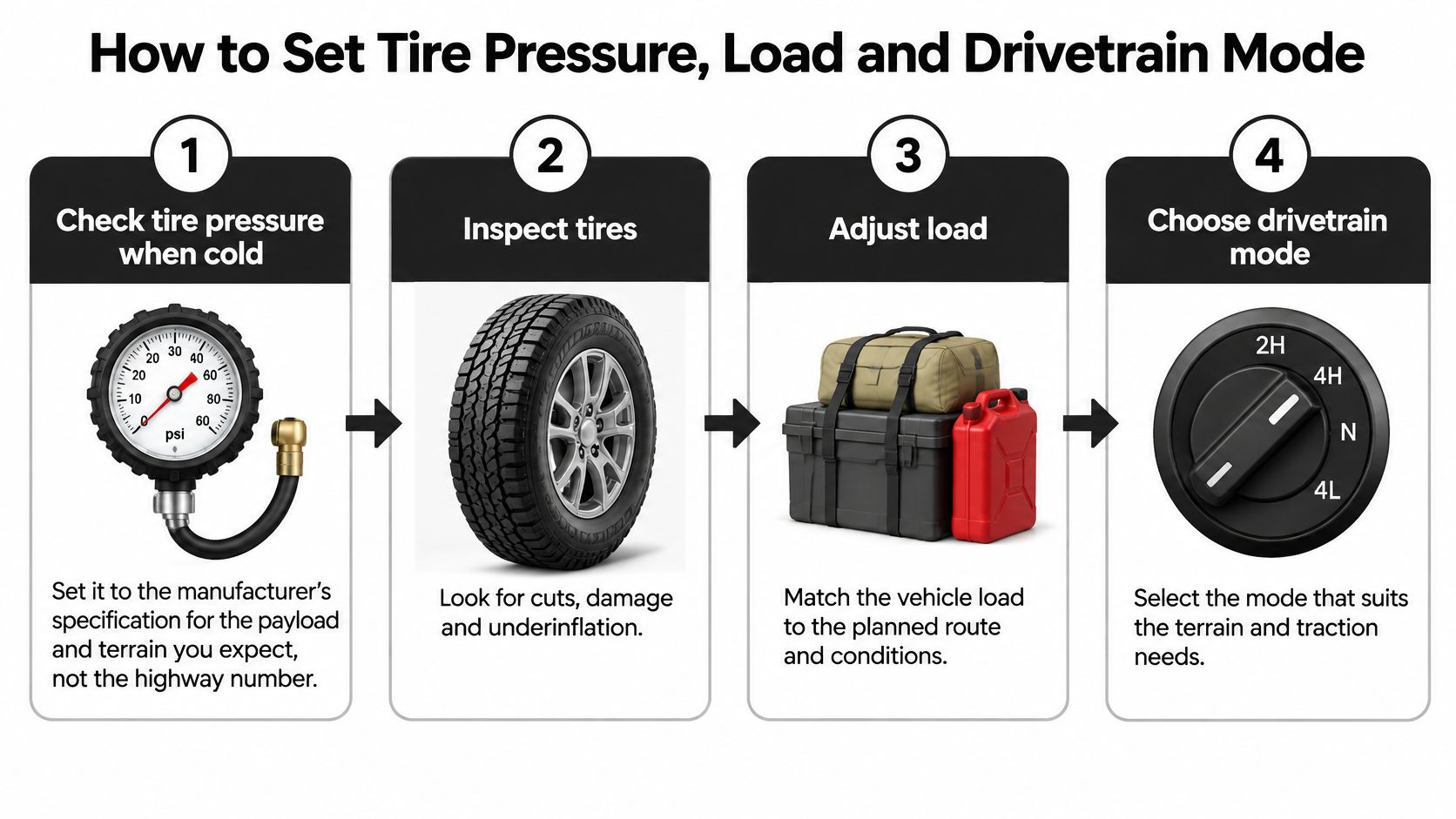
- Check pressure cold: Set each tire to the manufacturer's specification for today's payload and terrain, not last week's highway setting.
- Inspect the tires: Look for cuts, sidewall damage, embedded debris, and obvious underinflation before you load the bed.
- Trim the load: Remove cargo you don't need, then spread tools, feed, or firewood evenly so one corner doesn't carry the weight.
- Start in 2WD: Use it on hard-packed roads and firm lanes where traction isn't limited.
- Engage 4WD only when needed: Switch in for mud, snow, loose soil, or steep ground, then switch back once you're on firm surface.
- Drive soft ground smoothly: Slow down and use steady throttle. Repeated wheelspin turns battery energy into heat and torn-up ground without adding forward travel.
- Record your first runs: Note percentage used, payload, pressure, temperature, mode, terrain, and miles so later drift is visible.
The numbers explain why step one matters. A 2026 experimental study of a small utility electric vehicle measured baseline consumption from 1.13 kWh per 100 km downhill to 19.86 kWh per 100 km uphill, more than 17 times higher uphill. In that study, severe tire underinflation increased consumption by 26.0% on flat routes, 30.0% uphill, and 52.2% downhill.
Errors That Waste Range
- Road pressure off-road: A setting that works on pavement can be wrong for loaded work on soft or rocky ground.
- Near-maximum payload on grades: Weight matters most where the motor already works hardest.
- 4WD left engaged: Easy surfaces don't repay the extra drivetrain load.
- One unloaded test drive: It tells you almost nothing about a loaded workday.
If you're comparing tread or diameter before a change, use our side-by-side tire size comparison and repeat your baseline runs afterward. A well-set machine tracks straight at steady throttle, doesn't hunt for grip, and finishes close to its recorded consumption.
Protect the Battery in Cold and Heat
After a hill climb, a tow, or sustained 4WD in deep mud, the cab can feel cool while the pack is still hot. Judge the battery by its management reading, not by air temperature or by touching the case.
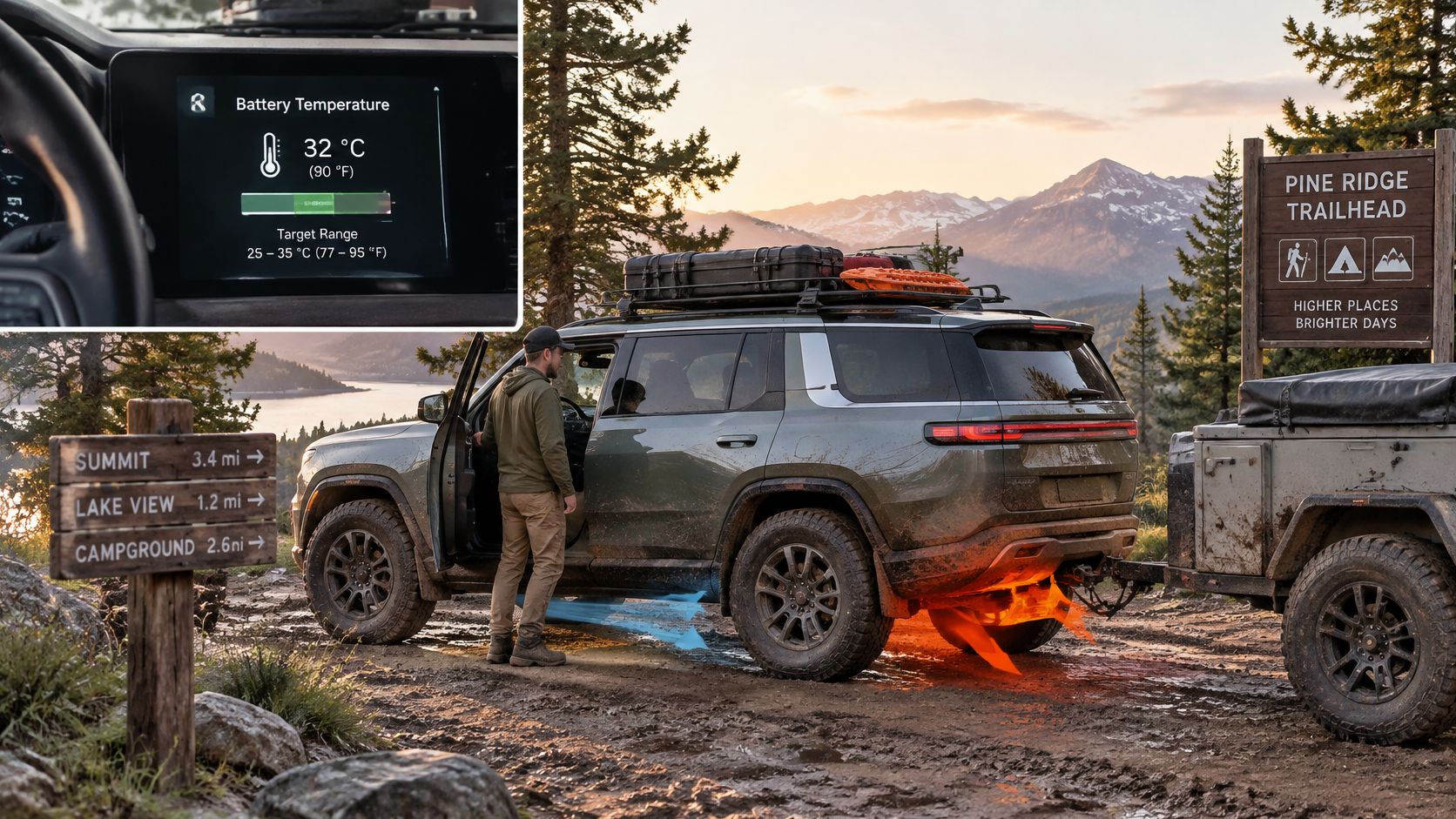
Hot Pack Protocol
Keep the pack near 25–35 °C (77–95 °F) when you can. A national laboratory lithium-ion safety review reports that each approximately 13 °C increase in operating temperature can roughly halve battery life, although the exact effect varies by cell chemistry and duty cycle.
Clear mud and cargo away from vents before departure. During the job, ease off prolonged full throttle when the pack is hot, then give it ventilation and cooldown time before plugging in. Charge only inside the manufacturer-approved temperature range, because internal cell temperature can exceed surface temperature.
For crews who want the emergency side of overheated lithium-ion packs in plain language, this guide to battery thermal runaway explained for emergency responders is worth bookmarking. In hot weather, park in shade and avoid stacking heavy midday hauls back to back.
Watch how temperature, load, and throttle interact on a working climb before you apply the cold-weather checks below.
Cold Pack Protocol
Cold cuts both range and peak power, and they're not the same problem. The University of Alaska Fairbanks cold weather EV report states that at −10 °C (14 °F), tested batteries retained about 77% of the energy capacity measured at 25 °C (77 °F). That same source indicates standard lithium-ion batteries generally should not be charged below about −20 °C (−4 °F) without suitable thermal controls.
Store the machine under cover or indoors, don't demand full-power towing or winching straight after cold soaking, and precondition before charging. If you run a heated cab in winter, budget that accessory load too, and check fitment options in our side-by-side cab heater guide before the season starts.
If the pack can't reach a proper cooldown or warm-up window before charging, shorten the next run instead of forcing the schedule.
Plan Usable Range Around Your Actual Workday
A headline range figure is a starting point, not a promise for your property. Independent vehicle testing reported in The Standard found an electric UTV's estimated range varied from 45 to 80 miles depending on configuration, with stated test conditions of 25 mph travel and 250 pounds of cargo.
Your day probably doesn't look like that test. Stop-start chores, uphill hauling, winter hunting, and winch pulls each pull energy differently.
| Workday Scenario | What Drains Energy | Planning Response |
|---|---|---|
| Stop-start ranch chores | Frequent acceleration, idling and short hauls | Group tasks into one loop and keep a fixed reserve for the return |
| Repeated uphill hauling | Steep grades multiply energy demand | Route around slopes and start with a high state of charge |
| Winter hunting | Cold reduces available capacity and peak power | Plan shorter loops and recheck the reserve before dark |
| Winch or tow work | Heavy loads and peak current pulls | Treat the job as a separate energy budget and keep a margin |
| Long return trip | Remaining charge shrinks while the load stays on | Set the reserve threshold before leaving the start point |
Build Your Own Number
Run three similar loops with a normally loaded bed. Divide percentage consumed by miles completed, then use that figure to set a reserve for each regular route. Never start the return leg below the energy that route needs plus a margin for a detour, a gate stop, or soft ground.
I would chase slower speeds, lighter payloads, and a smarter route before I chased a bigger battery. Write down your typical loop length, load, and terrain today, then set tomorrow's reserve from your own three runs.
Charge on a Schedule That Fits Your Work
Charging is the last variable in the system, and the one you set the night before. A peer-reviewed 2025 analysis of off-road electrification reported that many battery-powered off-road machines typically charge overnight and deliver approximately 6–8 hours of operating time.
That window only holds if the circuit matches the hours the machine sits. The same analysis summarizes City of Houston fleet research finding that Level 1 charging adds about 5 miles of range per hour, while Level 2 adds about 20 miles per hour.
| Charging Option | Range Added Per Hour | Overnight or Full Charge | Best Use |
|---|---|---|---|
| Level 1, standard 120 V outlet | About 5 miles | A full recharge takes many hours | Light use and short loops |
| Level 2, 240 V circuit | About 20 miles | About 160 miles in an 8-hour overnight window | Full working days with a set overnight window |
A Simple Duty Cycle
- Map tomorrow's jobs: Estimate miles, grades, and payload before you plug in, so the charge window covers the actual work.
- Charge during predictable idle time: Overnight suits most owners, while a long midday plug-in can cover one short extra loop.
- Put heavy work first: Start climbs and hauls at high charge, while power availability is strongest.
- Account for cold mornings: A cold pack delivers less, so a winter day needs a fuller battery at first light than a mild one.
If the barn sits far from the panel, ask an electrician about a dedicated 240 V circuit instead of running an extension across the yard. I'd pay for that circuit before I'd reshape a workday around a 120 V outlet. Pick the table row that fits your overnight window, then check it against tomorrow's route with the reserve included.
Maintain Motor, Suspension and Weight
Performance fades between shifts when small wear items stay unchecked. You won't see it on one short lane run. You'll see it as rising percentage per mile over a month.
Motor and Software Settings
Use the manufacturer's drive modes and charge profiles. Don't fit aftermarket current or power changes the manufacturer hasn't approved, because they can void warranty coverage and push the pack outside its temperature window. Smooth factory power delivery beats a hot, inconsistent tune for ranch work.
Suspension and Rolling Parts
Set sag and shock settings for your typical load. A sagging rear end changes tire contact, adds rolling resistance, and wears tread unevenly. Inspect wheel bearings, the drive belt or chain, and brake pads at the intervals in the owner's manual. Torque wheel lug nuts after the first few hours on new tires.
Weight You Carry Every Day
Remove racks, spare parts, and stored cargo when they aren't needed. Keep the heaviest items low and centered over the axle, not stacked behind it. Clean intake and cooling vents after mud or dust work, and check battery terminals and connectors for corrosion.
- Keep a service log: Date, miles, percentage used, and any new accessory or tire helps you spot wear early.
- Watch consumption drift: A steady rise on the same loop points to tires, bearings, brakes, or battery health.
- Schedule inspections: They're the main upkeep you control.
AAA stated in 2024 that EVs can cost 50% to 60% as much to maintain as gasoline vehicles because they have fewer mechanical parts. That passenger vehicle figure doesn't remove UTV inspections. It makes them the lever that protects your savings.
Log Three Runs and Ask Dealers the Right Questions
Your log beats a brochure. Record battery percentage, payload, tire pressure, temperature, drive mode, terrain, and miles for three similar runs.
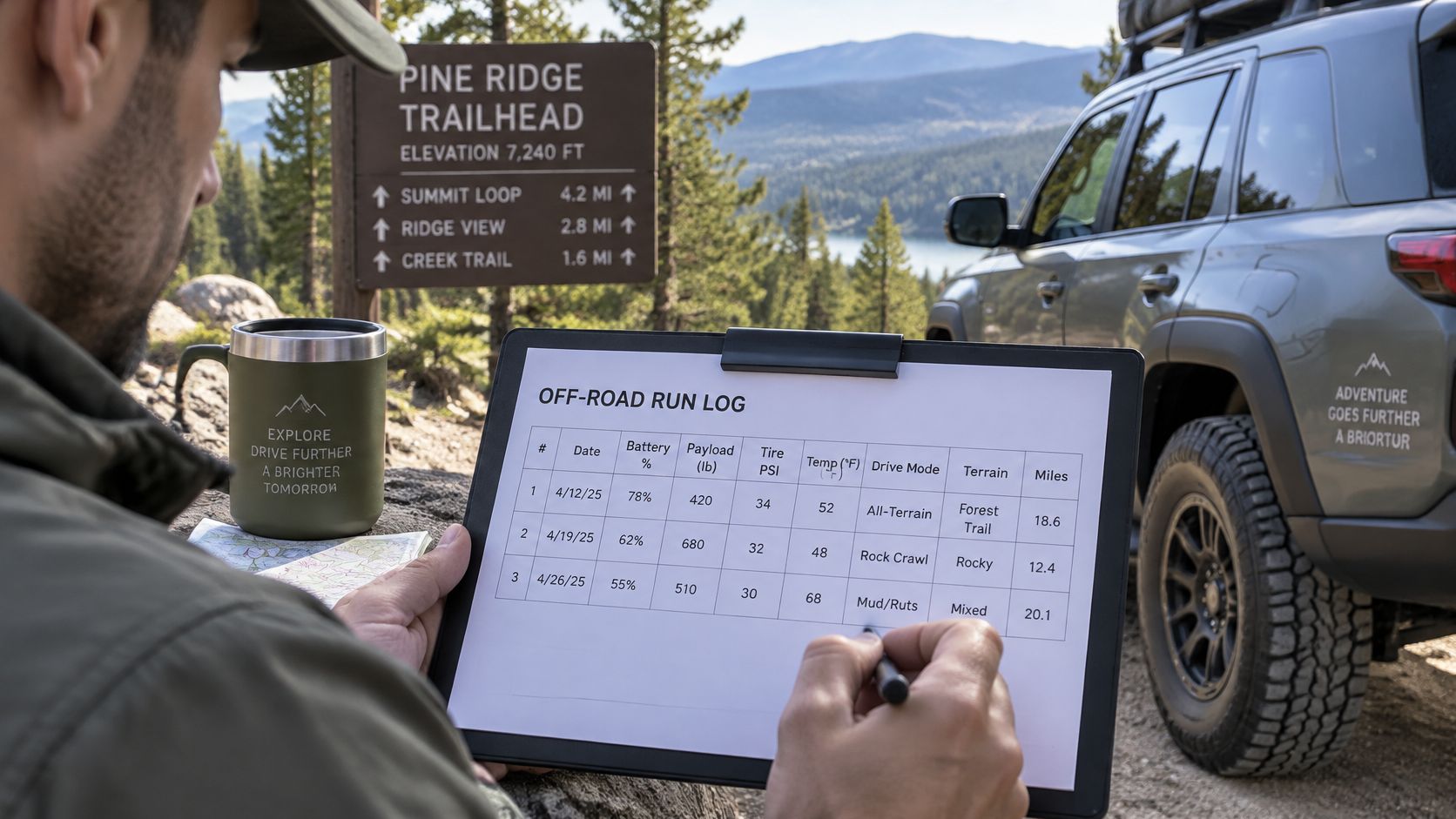
Those entries become your baseline. If consumption drifts above it on the same route, check pressure and load first, then look for bearing drag, brake drag, or a battery temperature problem. One Campus E1 owner, Brad, called the machine "a game changer" on our reviews page, but your terrain still decides whether it fits your work.
Four Questions Worth Asking
- Usable range on my ground: What do you measure with a loaded bed over terrain like mine, not just the headline figure?
- Temperature management: How does the pack handle heat during charging and after hill work?
- Power at low charge: How much winch and tow power remains, and how does it change as charge falls?
- Loaded demo: Can I see a steep-grade run with a loaded bed before I buy?
In 4WD with the differential locked, the Campus E1 climbed a steep grade without running out of power, so ask for that kind of demonstration on ground that resembles yours. Prepare with our electric UTV dealers near me locator, then run the pre-shift check on your next outing, log the numbers, and review them after three runs.
Before your next loaded loop, bring your three-run log and reserve numbers to Campus EV and compare them against the Campus E1 specifications and dealer support for hunting, farm, and ranch work. We'll help you match charging, tires, payload, and drivetrain setup to your actual routes, so the machine you choose performs on your ground, not just on a spec sheet.