
You're closed in for the second hour at low speed, checking fence or sitting over a field before daylight, and the windshield is fogging from the inside. Your hands still work, but barely. That's when most owners go shopping for a side by side cab heater and sort by heat output.
On an electric UTV, I'd sort by watts first. Every watt of heat comes out of the same pack that gets you home, and at hunting, ranch, or warehouse speeds you're not covering miles fast enough to hide that cost. Pick the heater like a battery load, then check whether it keeps you warm.
Table of Contents
- Cab Heater Types Compared for Electric UTVs
- Battery Budget for Cab Heater Output
- Safety Rules Before Any Heater Goes in the Cab
- How to Wire a Cab Heater on an Electric UTV
- Insulation and Zonal Heating That Cut Heater Load
- Maintenance and Cold-Weather Troubleshooting
- Confirm Your Heater Plan Before the First Cold Shift
Cab Heater Types Compared for Electric UTVs
| Heater type | Power source | Battery impact | Enclosed-cab fit |
|---|---|---|---|
| 12V DC fan-style heater via DC-DC converter | 72V pack through converter | Low; converter losses apply | Small cabs and short sessions |
| High-voltage PTC electric heater | 72V traction pack directly | High; full heater load drawn from the pack | Sealed cabs with wiring rated for the load |
| Factory HVAC electric heat | Traction pack via climate system | Managed by vehicle controls | Best when the vehicle includes it |
| Propane forced-air heater | Propane tank | None on battery | Only where the unit is approved for enclosed use |
| Diesel or gasoline-fired heater | Fuel tank | None on battery | Exhaust and CO risk; avoid unless designed for enclosed use |
| Engine coolant heat | Engine waste heat | None | Gas UTVs only; not available on electric |
Electric Options That Spend the Pack
A 12V DC fan-style heater is the cheapest way to move some warm air, and on a 72V machine it doesn't run off the pack directly. It runs through a DC-DC converter, so you pay conversion losses on top of the heater draw and you're limited by what that converter and its circuit can carry. That's fine for defrost help and short runs in a small cab. It isn't whole-cab heat for a long morning, and pushing a bigger unit through an accessory circuit just finds the fuse.
A high-voltage PTC heater draws straight from the traction pack. It's the strongest electric option for a sealed cab because it isn't choked by a 12V circuit, and PTC elements self-limit as they get hot. It's also the fastest way to spend range. If you're considering one, you're really deciding how much of your pack you're willing to trade per hour, and that trade needs wiring and protection rated for pack voltage, not accessory wiring.
Factory HVAC electric heat sits between the two. The vehicle manages the load, blends defrost and cab air, and protects its own circuits. When a machine offers it, I would take it over an add-on for a cab that works all winter, because the controls and ducting were designed together. You still pay in range, but you don't inherit a wiring project.
Fuel-Fired and Gas-Only Options
Propane forced-air and diesel or gasoline-fired heaters don't touch your battery, which is exactly why people look at them. The cost shows up elsewhere. They burn fuel, they make exhaust, and in an enclosed cab that exhaust question decides whether the unit belongs there at all. Only a unit specifically designed and approved for enclosed use is a candidate, with its own intake and exhaust routing. A portable camping-style unit set on the floor isn't that.
Engine coolant heat is simpler to rule out. Gas UTVs make waste heat and can pipe it through a heater core. An electric UTV has no engine coolant loop to tap, so that entire category, however good it is on a gas machine, doesn't transfer.
For price context, Side By Side Source's 2026 heater guide says complete UTV cab-heater systems typically cost $400 to $800 or more and heater fans generally draw 5 to 10 amps. In the same range, Side By Side Sports lists a 16,000-BTU UTV cab heater at $449.95, with an MSRP of $469.95.
Three-question filter: How big is the cab, how many hours will the heater run, and is anyone sitting in it at low speed for long stretches?
Answer those candidly and you'll usually land on one or two types. That's the goal here, not a shopping list.
Battery Budget for Cab Heater Output
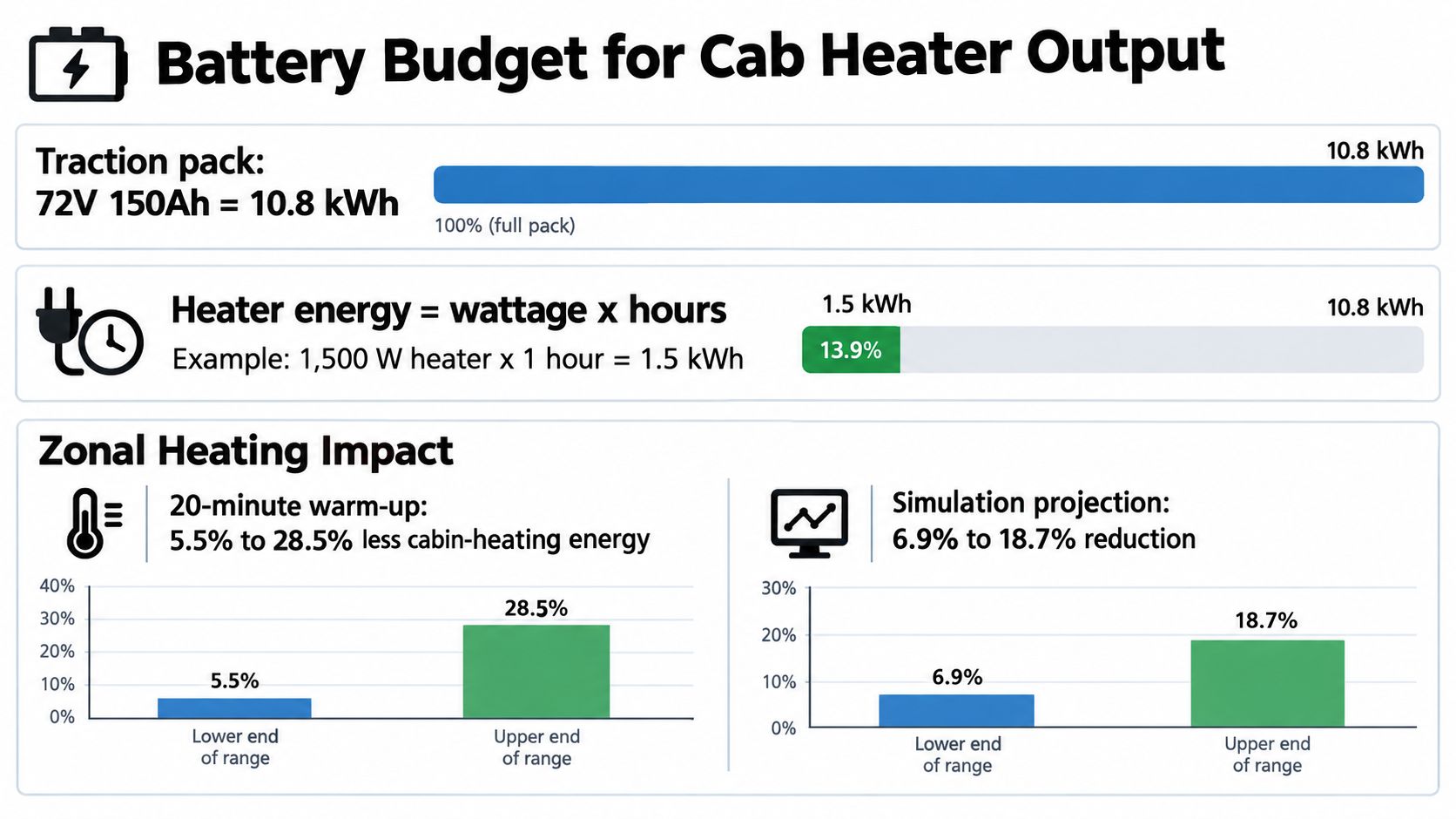
Start with one line of math and the rest follows. Heater energy equals wattage times hours. A 1,500 W heater running for one hour uses 1.5 kWh. On a 72V 150Ah pack, which holds 10.8 kWh, that single hour takes about 14% of everything you've got, before you've driven anywhere.
That same heater pulls about 20.8 A at 72V, which is why the wiring discussion matters as much as the warmth. Run it for four hours and you've spent 6 kWh just staying warm. Drop to 1,000 W for a four-hour shift and it's 4 kWh, roughly 37% of the pack, again before driving, lights, or a winch enter the picture.
| Heater output | Amps at 72V | Pack used per hour | Runtime on full pack |
|---|---|---|---|
| 300 W | about 4 A | 3% | about 36 hours |
| 500 W | about 7 A | 5% | about 22 hours |
| 1,000 W | about 14 A | 9% | about 11 hours |
| 1,500 W | about 21 A | 14% | about 7 hours |
| 2,000 W | about 28 A | 19% | about 5 hours |
What the Table Leaves Out
Every row is a best case. The runtime column assumes the heater is the only load, the pack gives up its full nameplate capacity, and you run it to empty, none of which happens in January. Converter losses take a cut on 12V units. A cold pack delivers less than its warm rating. And you should keep a reserve to get back to the barn or truck, so the usable slice for heat is smaller than the table suggests.
The cold itself compounds this. A vehicle thermal-management study from Chalmers found auxiliary energy consumption increased more than fivefold when ambient temperature fell from 10°C to −20°C, and below 0°C cabin heating became the vehicle's largest auxiliary load, followed by battery heating. That same work found combining cabin insulation, air recirculation, and battery-pack thermal protection increased range by up to 7% at −20°C, though the benefit varied with humidity and occupant count.
A heater that looks cheap at the purchase price can be the most expensive load on the vehicle by midwinter.
Use the budget before the shift, not after. Estimate your driving energy, subtract the heater's planned kWh, and check what's left against your reserve. That's the same discipline behind improving electric UTV efficiency more generally, and it's worth redoing whenever a job adds idle time or a headwind picks up across an open field. Slow work is where this bites hardest, because the heater meter runs by the hour while the odometer barely moves.
Safety Rules Before Any Heater Goes in the Cab
A heater that works isn't automatically a heater that's safe. That assumption gets people in trouble because heat output is easy to feel in ten minutes and carbon monoxide gives you nothing to feel until it's already a problem. In a small cab with the doors shut, the safety question has to be settled before output, price, or installation convenience.
The U.S. Consumer Product Safety Commission's carbon monoxide guidance warns that portable fuel-burning camping equipment must not be used inside a home, garage, vehicle, or tent unless it is specifically designed and approved for enclosed-space use, and it recommends carbon-monoxide alarms in recreational vehicles. NIOSH makes the companion point that gasoline-engine exhaust can accumulate rapidly in buildings or partially enclosed areas, and it recommends electric tools where practical.
Four Categories, Four Different Risks
Factory-integrated electric heat carries the least guesswork. The manufacturer sized the circuit, routed the air, and tested the whole cab as a system. A 12V fan heater on a fused circuit is next, provided the fuse, wire, and converter are all rated for continuous duty and not just a short accessory burst.
Portable propane is where I would stop most buyers. Unless the specific unit is approved for enclosed use, it doesn't belong in a closed cab, however warm it feels. Engine-driven or fuel-fired heat belongs in the same conversation, because any combustion source needs intake and exhaust paths that are completely independent of the air you're breathing.
An electric heater sidesteps exhaust entirely. It costs range, sometimes a lot of range, but it doesn't introduce combustion gases into a partially enclosed workspace. For a cab that sits closed in a hunting blind setup, a barn, or a warehouse aisle, that trade is usually the right one.
Pre-Purchase Checklist
- Sealed from cabin air: Confirm any fuel-fired unit keeps combustion completely separate from the air delivered to occupants.
- Independent intake and exhaust: Verify fresh-air intake and exhaust routing don't draw from or discharge into the cab.
- CO alarm fitted and tested: Mount it where an occupant breathes, not down by the floorboards, and test it before each season.
- Door and windshield gaps understood: Sealing changes ventilation, so a tighter cab raises the stakes on every item above.
- No household or improvised heaters: A unit built for a room or a tent isn't built for vibration, tilt, and a moving vehicle.
- No window-cracking workaround: Opening a window a crack is not a substitute for compliant equipment.
The same habit of inspecting before energizing applies beyond the cab, and the benefits of home electrical inspections make a useful parallel for anyone who charges and stores the vehicle in a shop or garage. Any heater that fails one checklist item stays off your shortlist. Don't negotiate with that rule to save money.
How to Wire a Cab Heater on an Electric UTV
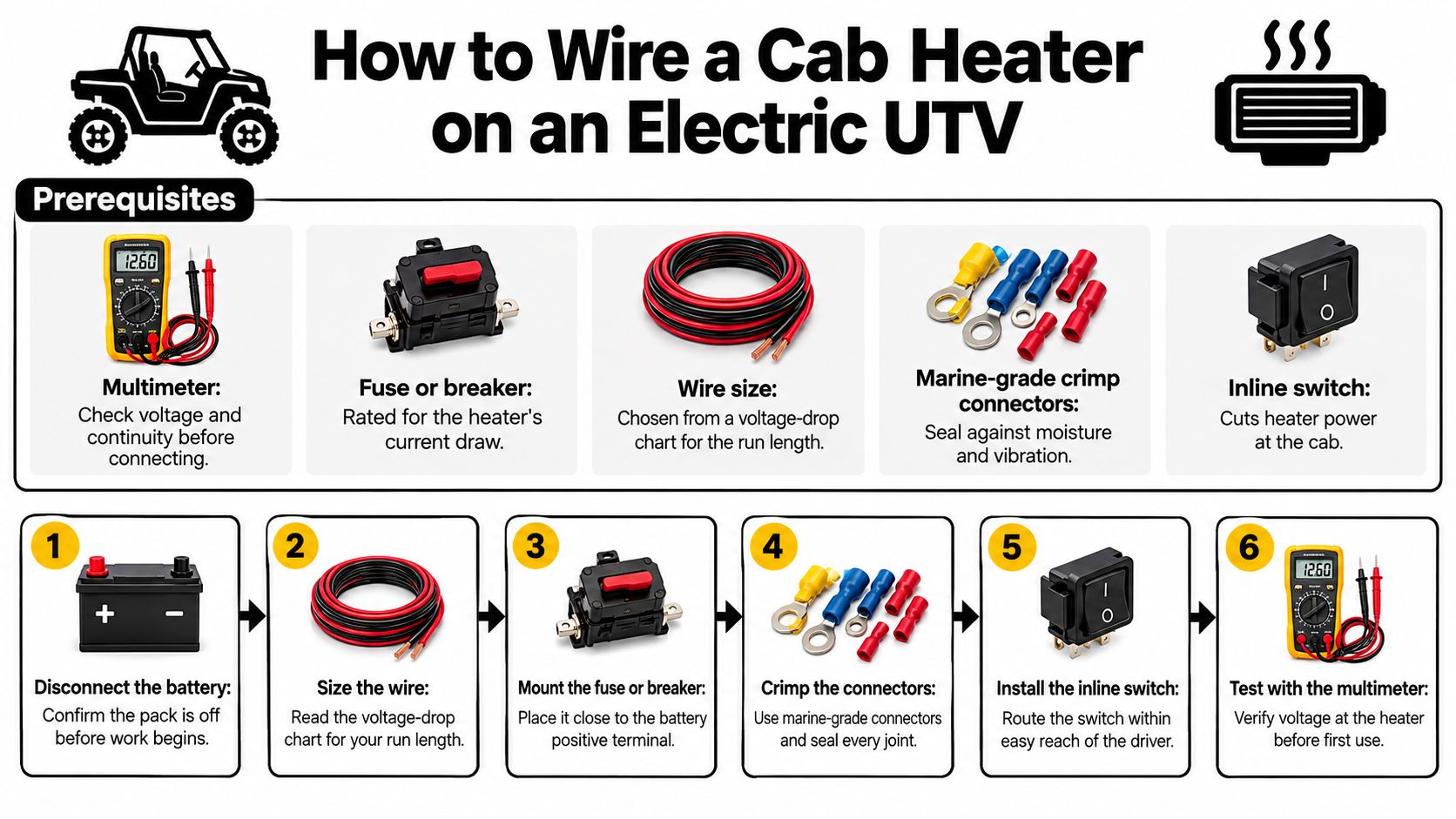
Good cab heat starts with a boring wiring job. You'll need a multimeter, a fuse or breaker rated for the heater, wire sized from a voltage-drop chart for your run length, marine-grade crimp connectors, and an inline switch you can reach without looking down. The path itself is simple. Battery positive goes to the fuse, the fuse to the switch, the switch to heater positive, and heater negative returns to a clean ground or dedicated negative.
Wiring Steps in Order
- Disconnect and verify zero volts. Follow the vehicle manufacturer's procedure for shutting down the battery system, then confirm with your meter that the circuit you're touching is dead. On a pack-voltage system, this step is not optional and it isn't a formality.
- Confirm which voltage you're wiring. A 12V fan heater needs a DC-DC converter between it and the pack, sized for continuous load. A high-voltage heater needs its own high-voltage circuit, and I'd have a qualified technician do that installation rather than treat it like an accessory.
- Mount the fuse close to the source. Rate it above the heater's continuous draw and below the wire's ampacity. A fuse protects the wire, not the heater, and placing it near the power source means a chafed run downstream can't draw unlimited current.
- Run the positive through the switch. Keep the loom clear of steering linkage, pedals, and anything that moves or gets hot. Leave enough slack for panels to come off later without straining a terminal.
- Ground to clean metal. Scrape paint at the ground point or use a dedicated negative return. A ground through paint and hope will show up later as weak heat and a warm connector.
- Secure, seal, and protect the run. Mount the heater so it can't shift, seal connectors against water, and pass wires through panel holes with grommets. Vibration will saw an unprotected wire against a raw edge all winter.
- Reconnect and test under load. Run the fan and measure voltage at the heater terminals while it's working. Voltage that looks fine with everything off can sag badly once the element and fan are drawing.
This walkthrough shows the physical side of mounting and routing before you commit to hole locations.
What a Correct Install Looks Like
You should see steady voltage at the heater under load, close to what you measured at the source. The fuse and its holder should stay cool after several minutes of running. The switch should cut power completely, with no fan creep or glowing indicator you didn't expect.
Field check: After ten minutes at full output, touch every connector in the run. Any one that's noticeably warm is telling you about resistance you need to fix now, not in February.
If any of those checks fail, find the cause before the cab goes back together. Heater circuits run at sustained load for hours, which is exactly the duty that exposes marginal crimps and undersized wire.
Insulation and Zonal Heating That Cut Heater Load
Heating the whole cab evenly is the most expensive way to feel warm. The National Laboratory of the Rockies zonal heating study found experimental testing of zonal heating strategies produced a 5.5% to 28.5% reduction in cabin-heating energy during a 20-minute warm-up, and vehicle simulations projected a 6.9% to 18.7% improvement in driving range versus conventional baseline heating. The simplest version, using existing HVAC vents while directing conditioned air toward the driver, already achieved a 5.5% heating-energy reduction on its own.
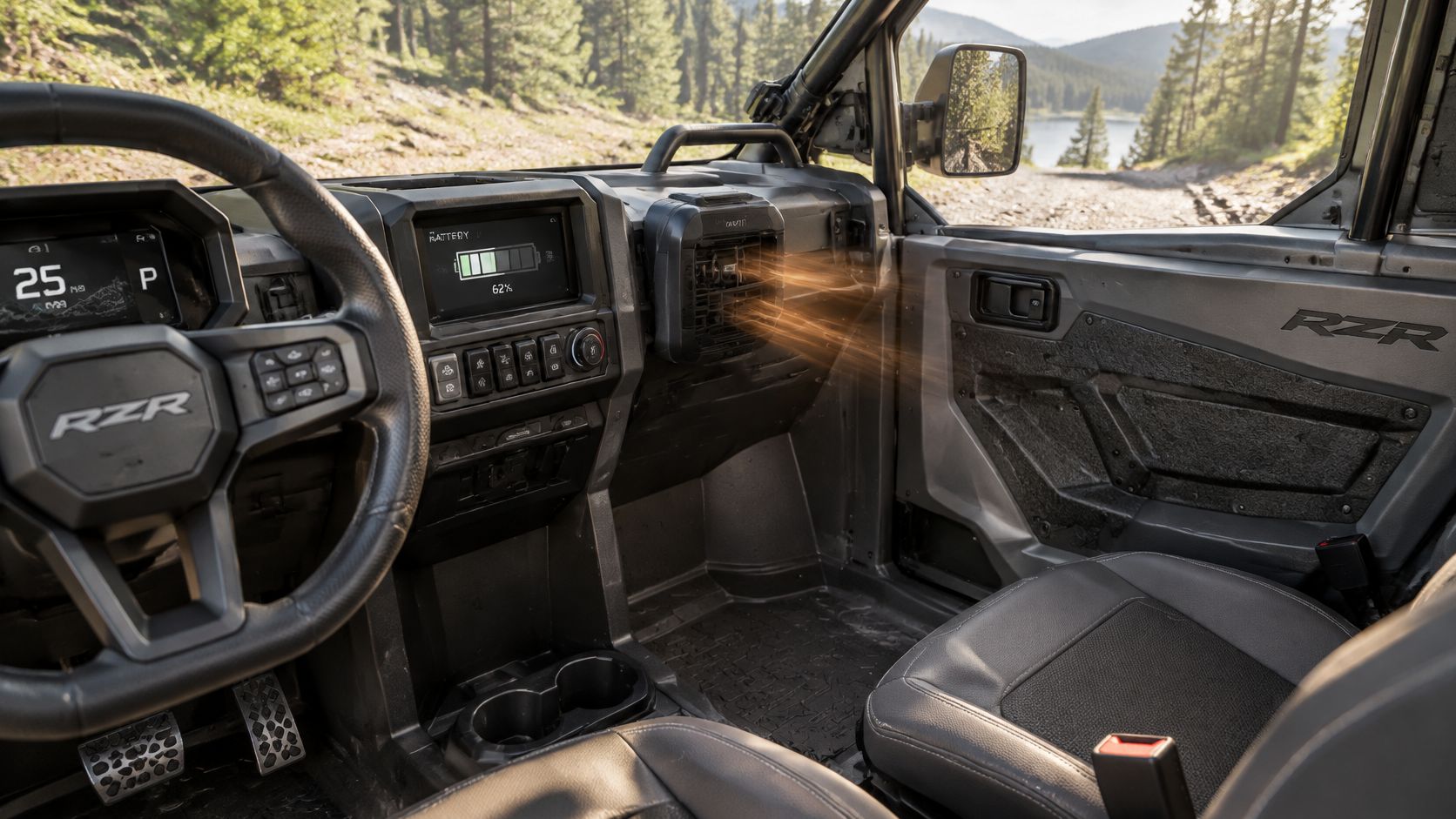
That last point matters for a side by side cab heater because you don't need new hardware to start. Aim the air you already paid for at the person and the glass, not at empty footwells and a cold roof panel.
Cheapest Fixes First
- Weatherstrip the door seams: Check windshield mounting for gaps too, since air leakage raises heater workload on every run.
- Aim vents at the driver: Put air on legs and hands and keep a defrost outlet on the glass instead of flooding the whole cab volume.
- Recirculate once warm: Reheating cab air costs less than heating fresh cold air, and this applies to electric heat only.
- Cover floor openings: Line the floor with insulation panels where pedals and drains let cold air pour in.
- Close cargo-area openings: A smaller heated volume warms faster and holds temperature with less wattage.
- Preheat while plugged in: Warm the cab and battery on shore power so the pack starts the shift already warm.
A well-sealed enclosed side by side makes every one of these steps work harder, because the heat you generate stays in the space you're sitting in. Sealing isn't a finishing touch. It's half the heating system.
Test each change instead of guessing. Run a timed warm-up from cold, note the minutes until the cab feels comfortable and the glass stays clear, then repeat after the next fix. The changes that cut minutes are the ones cutting kWh.
Maintenance and Cold-Weather Troubleshooting
Most heater complaints in January were visible in October. The common thread is that a side by side cab heater runs sustained current for hours, so small resistance, small gaps, and small storage mistakes all get amplified. Work through symptoms before you replace parts.
| Symptom | Likely cause | Fix |
|---|---|---|
| Heater blows its fuse | Draw above fuse rating or chafed wire shorting | Measure draw under load, match fuse to draw with margin, inspect the wire run |
| Weak output at low speed | Cold battery, low state of charge or undersized heater | Preheat while plugged in, check state of charge, compare wattage to the budget |
| Heater runs but cab stays cold | Door, windshield or floor gaps letting air out | Seal gaps, aim vents at the driver, check recirculation setting |
| Windshield fogs | Moisture with no defrost airflow | Run defrost, confirm the fan is moving air, dry the cab floor |
| Heater cuts out on hills | Low voltage under load or thermal cutoff | Check voltage under load, clear the intake, confirm connector tightness |
| Burning smell | Loose or overheated connector, dust on element | Power off, inspect and clean connectors, replace any discolored terminal |
| Sharp range drop after heater use | Heater load plus cold battery or outdoor storage | Recalculate the budget, preheat on the charger, store the vehicle indoors when possible |
Range Loss Is Not Always the Heater
That last row deserves a closer look, because owners often blame the heater for the whole winter drop. Cold-climate EV testing published through ScienceDirect found outdoor-stored vehicles experienced efficiency losses of up to 69% compared with heated storage, while indoor storage improved preconditioning and efficiency. The same body of work notes an engineering study reporting a 20% range reduction when an additional 5 kW was used for cabin heating, and broader reporting that EV range commonly falls 25% to 40% below 5°C.
Read those together and the picture changes. A cold-soaked battery, slow cold charging, snow resistance, low tire pressure, and repeated short trips can cost as much as the heater does. So plan scenarios instead of chasing one winter number. Starting battery temperature, outdoor temperature, heater wattage, enclosure quality, speed, payload, and indoor storage all move your real range, and planning around UTV maintenance cost should include the charging and storage habits that protect it.
Seasonal Routine Before the Cold Arrives
- Pull the fuse and inspect it. Look for corrosion or heat marks on the blades and holder.
- Check every connector. Discoloration means resistance, so clean, tighten, or replace the terminal.
- Clean the fan intake and filter. Dust and chaff cut airflow and overheat elements.
- Walk the wire run. Look for chafing at panel holes, grommets, and cable ties.
- Test voltage under load. Run the fan and element together and measure at the heater terminals.
A fuse that blows twice is reporting a fault. Fitting a larger fuse doesn't fix it, it just lets the wire become the fuse.
Confirm Your Heater Plan Before the First Cold Shift
Put the decision in writing before you buy anything. A short plan on paper beats a warm cab that leaves you short of the gate.
- Write down the basics. Note cab size, your weekly heater hours, and the battery reserve you refuse to spend.
- Match wattage to the reserve. For example, a 1,500 W heater uses 1.5 kWh an hour, and a four-hour shift at 1,000 W uses 4 kWh of a 10.8 kWh pack, so check that what's left still covers your driving.
- Check wiring and safety before purchase. Confirm fuse rating, wire size for the run, switch placement, and CO alarm location while returning the heater is still easy.
- Run a cold test and log it. Time the warm-up at the coldest temperature you realistically expect and record state of charge before and after.
- Recheck after any change. New doors, a different windshield, or moving the vehicle outdoors all change the math.
If the budget and safety checks pass, install it and test it. If they don't, shrink the heated space, drop the wattage, and preheat from the charger before each shift. You can find a dealer near you to book a test drive, reach us at +1 972-268-6160 or hello@campus-ev.com, and we sell genuine parts and accessories on our website when you're ready to fit out the cab.
If you're speccing an electric UTV for winter hunting, ranch, or property work and want heat that doesn't wreck your working range, visit Campus EV to look at the Campus E1 and talk through your cab setup. Bring your heater hours and reserve target, and we'll help you match accessories and charging habits to the way you work in the cold.