
Hang 2,500 lbs of trailer behind a UTV and every hill gets steeper. Many steep-ground accidents trace back to one cause: attempting terrain beyond the limits of the loaded vehicle or the operator's skill.
That reframes the search for the best UTV for steep terrain. The winning machine stays controlled under load on your actual slope, surface, and direction of travel, and the U.S. Forest Service trail guidance puts real numbers on that risk through its trail grade and cross-slope benchmarks.
Table of Contents
- Slope Numbers to Check Before You Compare
- Electric vs Gas on Steep Ground
- Traction, Drive Modes and Locking Differentials
- Stability Factors That Cause Rollovers
- Planning Range for Steep Routes and Cold Days
- Matching Priorities to Hunting, Farm and Trail Use
- Confirm the Slope Test Before You Buy
Slope Numbers to Check Before You Compare
Start with slope limits and rollover control, not speed. Forest Service trail guidance recommends keeping uphill and downhill trail grades below 10%, approximately 5.7 degrees, and generally recommends a maximum trail cross-slope of 15%, or about 8.5 degrees. Those are trail design benchmarks, not a promise that every loaded UTV is safe at those angles on every surface.
A 10% grade rises about 1 foot for every 10 feet of horizontal travel. That sounds mild until you add loose soil, a passenger, feed sacks, or a trailer pushing from behind. Side-hill travel is the harder problem. A 15% cross-slope creates a substantially greater lateral rollover concern than a straight climb, because weight shifts toward the downhill tires and a rut or rock on the uphill side can lift the machine further.
Convert Every Claim to the Same Units
Manufacturers mix percentages and degrees, which makes weak claims look strong. Convert before you compare, then ask what load and surface produced the number.
| Benchmark | Value | What it tells you |
|---|---|---|
| Forest Service trail grade limit | 10% (about 5.7 degrees) | Uphill and downhill grade benchmark for trails |
| Forest Service cross-slope maximum | 15% (about 8.5 degrees) | Side-hill rollover exposure, which is greater than straight climbing |
| SAE J1666 gradeability test | 25% grade (about 14 degrees) | Loaded at curb weight plus two 166-pound occupants |
| Steeper reference grades | 30% (about 16.7 degrees) and 40% (about 21.8 degrees) | Convert percentage claims before comparing |
| Penn State conservative design | 3 to 5 degrees | Recommended slope range where possible |
Penn State safety guidance adds a useful caution. Maximum uphill or downhill limits for many UTVs may be below 10 to 15 degrees, and conservative slope design sits around 3 to 5 degrees where possible. I'd treat any claim well above that range as a test result under specific conditions, not as a daily working limit.
A vehicle can manage a straight grade and still become unstable when turning, traversing uneven ground, or carrying a raised or poorly distributed load.
Put three questions to any seller before you talk price:
- What load was included: Was the machine empty, or carrying occupants, cargo, and tow weight?
- What tire specification was used: Which compound, tread, and pressure produced the result?
- Which drive mode was engaged: Was it in 2WD, 4WD, or 4WD with a locked differential?
If a seller can't answer those, the slope number is marketing. Four-wheel drive, controlled low-speed operation, a low center of gravity, adequate tire grip, seat belts, and rollover protection tell you more than top speed ever will.
Electric vs Gas on Steep Ground
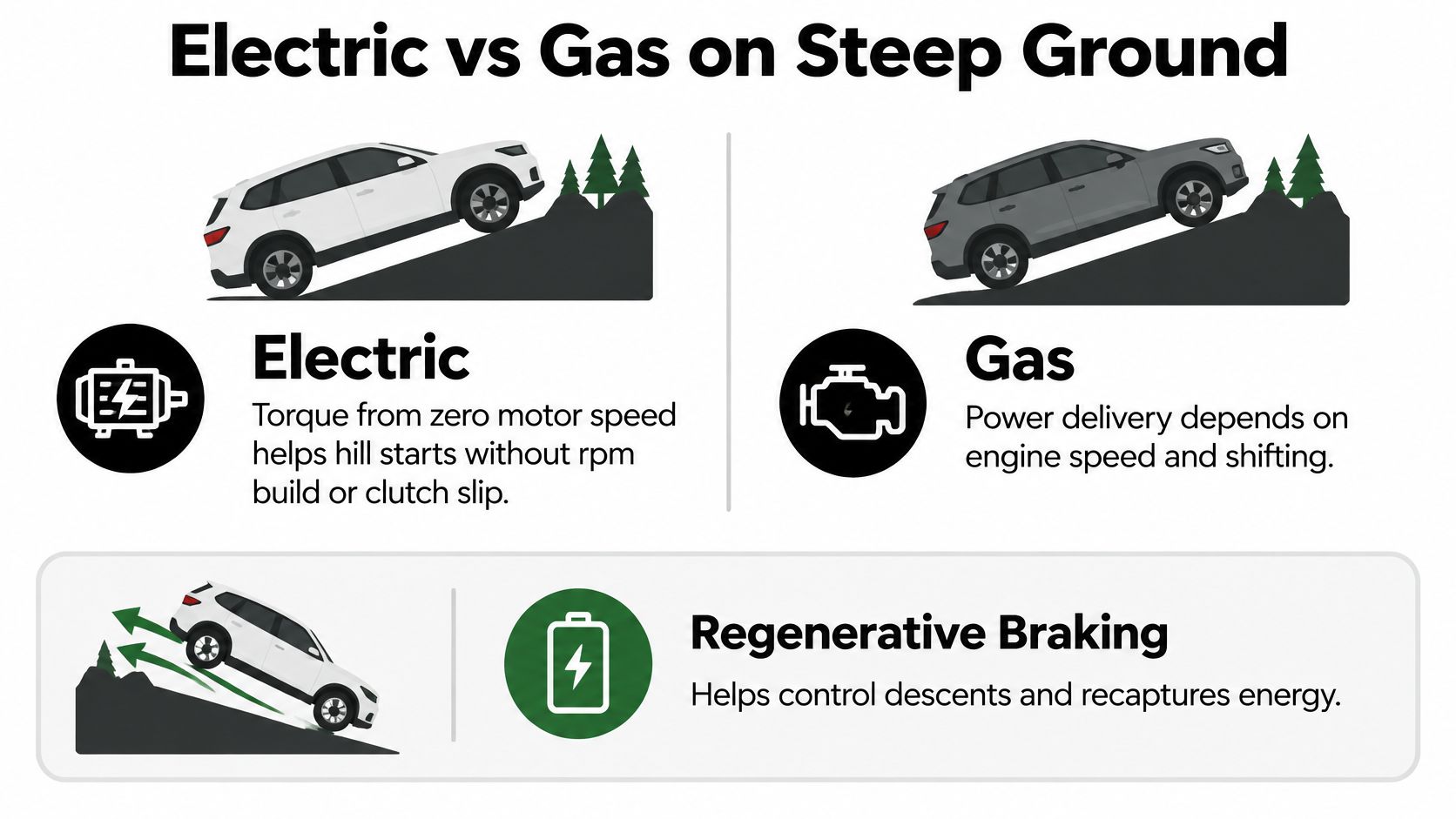
Electric motors deliver torque from zero motor speed. That's the difference that changes steep work most. A hill start doesn't need rpm to build or a clutch to slip, so you can feed power in smoothly instead of spinning a tire to get moving. As one account of electric off-roading and low-speed torque delivery explains, that immediate torque allows smoother low-speed propulsion on technical climbs, and regenerative braking can assist on descents.
Regenerative braking helps, but don't oversell it. Friction brakes remain necessary on steeper hills, and you should test how the two blend when you lift off the throttle on a descent. A machine that slows predictably without a sudden grab is easier to keep straight on wet grass or gravel.
| Factor | Electric UTV | Gas UTV |
|---|---|---|
| Torque at low speed | Available from zero motor speed | Builds with engine rpm and clutch engagement |
| Descent control | Regenerative braking assists, friction brakes still required on steep hills | Engine braking plus friction brakes |
| Power rating context | 20 kW is about 26.8 hp, but grade resistance depends on mass and traction | Peak horsepower also doesn't set traction or loaded gradeability |
| Energy supply for long steep routes | Battery, reduced by grade, payload and cold | Fuel tank, refuel in minutes |
| Noise on quiet approaches | Low motor noise | Engine noise |
Why Peak Power Doesn't Decide the Climb
A 20 kW motor is approximately 26.8 mechanical horsepower, but peak power doesn't by itself establish hill performance. Grade resistance rises with vehicle mass, payload, slope, surface condition, tire characteristics, and weight distribution. A lighter machine on the right tires will out-climb a stronger machine that's spinning.
Evaluate four linked specifications instead of motor power alone:
- Selectable 4WD: It maintains traction when one end of the machine unloads on a grade.
- Low-speed throttle calibration: Fine control matters when you're easing over a rock mid-climb.
- Regenerative braking behavior: Check what happens at lift-off, not just at full brake.
- Battery thermal and charge management: Repeated climbs draw sustained current, and heat changes output.
The Campus E1 fits this utility pattern. It's a 4×4 electric UTV with a 20 kW motor, a 72V 150Ah lithium battery at about 10.8 kWh nominal, on-demand 2WD/4WD, and an electric power dump bed. Campus didn't set out to make something flashy. It set out to build an electric UTV that tows 2,500 lbs up a hillside without flinching, charges overnight, and shows up ready every morning.
Gas still makes sense in clear cases. If you run long daily routes far from any charging point, or your fleet already runs on fuel infrastructure, refueling in minutes is a real advantage. I wouldn't trade that away for torque feel alone. Match the energy source to your duty cycle, then test the climb loaded.
Traction, Drive Modes and Locking Differentials
Traction is the first limit on most steep ground. A powerful motor can't pull a vehicle up a slope its tires can't grip, and once a tire spins on loose soil it digs a hole that makes the next attempt harder. Set the drivetrain before the grade, not on it.
The Approach Sequence
- Engage 4WD before the grade. Switching modes mid-slope interrupts drive exactly when you need it steady.
- Lock the differential on loose surfaces. Wet grass, mud, and ruts are where an open differential sends power to the wheel with least grip.
- Hold throttle steady. Smooth input keeps tires hooked up. Stabbing the throttle breaks traction.
- Avoid changing drive mode on the slope. If you lose momentum, stop straight, reassess, and back down straight if you have to.
The E1 has on-demand 2WD and 4WD and a locking rear differential, and the driver can switch between 2-wheel and 4-wheel drive easily from the seat. Use 2WD on firm, flat ground where it steers lightly and saves energy. Move to 4WD before a climb, a muddy gate, or any surface where one wheel might unload. If you're unsure how the control behaves, read how the differential lock switch works before your test drive, then practice engaging it on flat ground.
Practical rule: Engage the lock before you need it. A spinning wheel on a grade is a sign you engaged it one slope too late.
What the Lock Actually Buys You
With the rear differential locked, both rear wheels turn together, so one wheel on wet clay doesn't waste the drive while the other sits still on firmer ground. In 4WD with the differential locked, the E1 climbed a steep grade without running out of power. Treat that as evidence the drivetrain delivers under load, not as a guarantee for your hill. Your tire, load, and surface set your result.
The E1 also has 11 inches of ground clearance, which matters on the climb more than on the flat. Ruts deepen on grades, and the breakover point at the crest is where low machines hang up. Clearance keeps the belly off rocks and stumps so the tires stay loaded and driving.
Electric drive adds one quiet advantage here. The E1 has no delay when shifting between drive and reverse, which helps when you need controlled rocking to ease out of a stall without a gearbox pause. Use it gently. Rocking with big throttle inputs polishes the surface and digs you deeper.
Tires decide how much of this hardware you can use. Compound, tread pattern, and pressure set the grip ceiling. An aggressive tread on the wrong pressure still spins, and a worn tire on wet grass fails no matter what the differential does. When you read any gradeability result, separate wheel slip from motor limit. They call for different fixes, and only one of them is solved by more power.
Stability Factors That Cause Rollovers
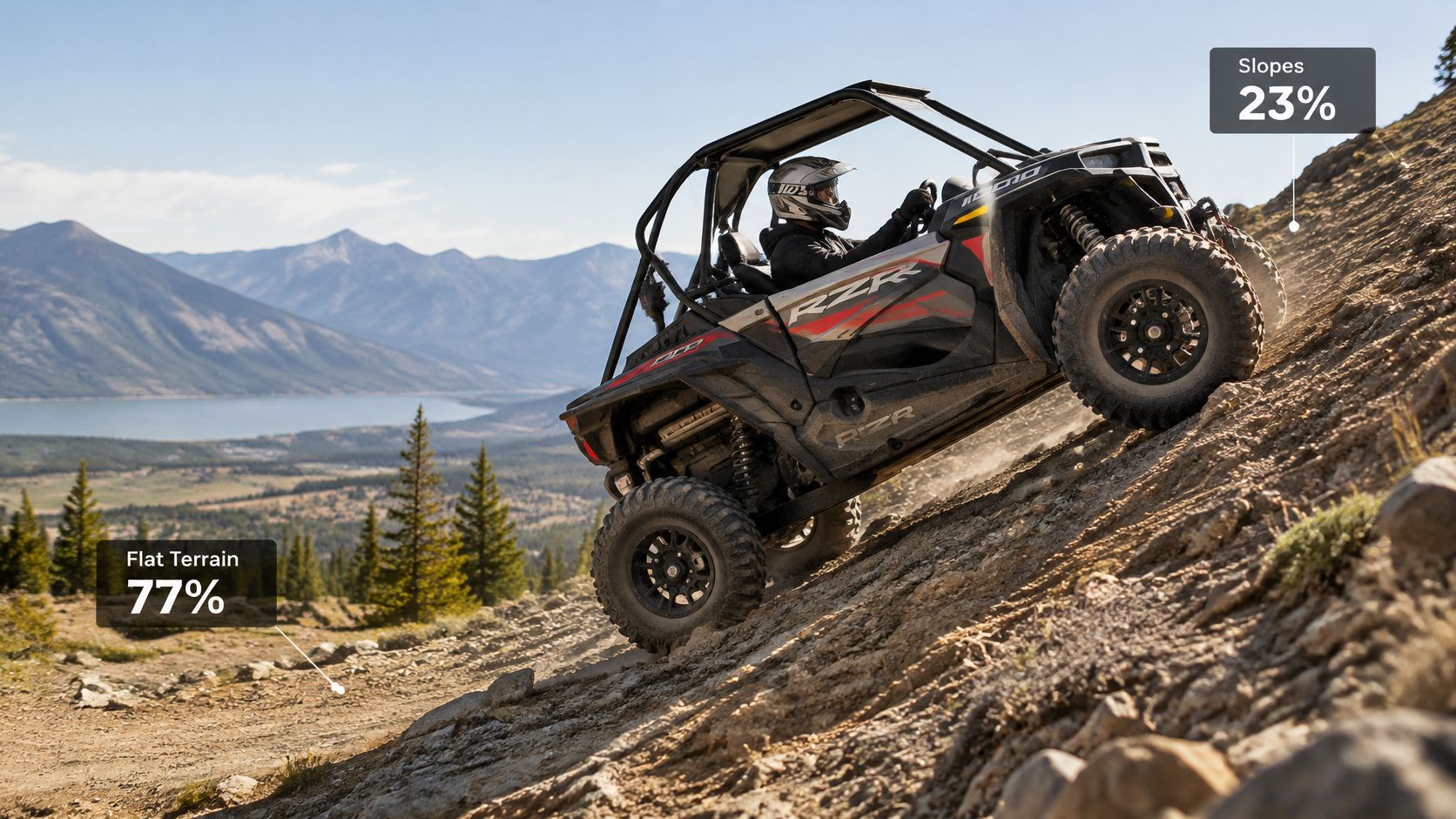
Steep slopes aren't where most injuries happen, which is exactly why buyers underestimate stability. The Consumer Product Safety Commission's 2024 OHV annual report found that 77% of injuries with known terrain responses occurred on flat terrain, while 23% occurred on gentle or steep slopes, with steep-slope cases at 8% of all known responses in the cited distribution. Flat ground doesn't mean safe ground. It means speed, sharp turns, and bad loading do most of the damage, and slopes amplify all three.
The same report notes that forward and backward overturns often occur while ascending or descending steep terrain. Earlier CPSC material identifies slanted or uneven terrain as a rollover factor and warns that sharp turns on flat ground can also trigger rollovers when speed, surface changes, or improper loading are involved.
The machine below is climbing straight, which is the right instinct on a grade.
Hardware You Can Compare on Paper
- Wheelbase and track width: A longer wheelbase resists pitching forward and backward on grades. Wider track resists side roll.
- Center of gravity: Lower and more central mass stays planted longer before a wheel lifts.
- Ground clearance: The E1's 11 inches clears obstacles, but raising a vehicle also raises its center of gravity, so judge both together.
- Suspension travel: Wheels that stay on the ground keep grip and keep the body level.
- Cargo bed height and load placement: Heavy cargo carried high or behind the rear axle changes stability fast on a grade.
- Rollover protection and seat belts: These don't prevent a rollover. They decide how it ends.
Judge the best UTV for steep terrain as a complete stability system. That includes 2WD and 4WD engagement, differential behavior, braking control, tire pattern, payload capacity, and rollover protection equipment, not incline capability alone.
Habits That Counter the Physics
USDA operator training guidance is blunt. UTVs can roll over when their maximum slope capability is exceeded, so climb and descend straight rather than traversing a slope. Ruts, rocks, dips, and an obstacle on the uphill side can tip a vehicle, because the uphill wheels ride up while the downhill wheels drop.
Keep heavy cargo low and centered, and secure it so it can't shift mid-grade. Keep passengers seated and belted, since a passenger leaning or bracing changes weight distribution. Avoid abrupt steering on slopes. If you must turn around, find flat ground rather than turning across the fall line.
Steep-terrain capability is safe, predictable control within specified limits, not the ability to climb the steepest possible hill.
Battery placement on an electric model may contribute to low and centralized mass, since the pack usually sits low in the chassis. That effect depends on the vehicle's engineering and its loaded condition. A low battery doesn't rescue a machine carrying a tall, loose load of fencing gear. Test or verify controlled performance on your intended surface, with your real load aboard, and wear approved protective equipment every time.
Planning Range for Steep Routes and Cold Days
Plan a steep route against the worst day you will have, not the brochure figure. The Campus E1 is rated at up to 60 miles on a single charge, and its real-world range depends on load, terrain, speed, and temperature. On hill country those four variables are the whole calculation. A loaded machine climbing all morning drains the pack far faster than an empty one rolling a flat fence line, and no advertised number survives that work unchanged.
| Condition | Expected effect on range | Planning note |
|---|---|---|
| Advertised Campus E1 range | Up to 60 miles on a single charge | Starting figure only |
| Sustained steep grades | Draw rises with elevation gain | Budget for the climb out, not the ride back |
| Heavy payload or towing | Faster depletion on every hill | Plan the route around the loaded state |
| Loose or soft ground | Rolling resistance adds up all day | Treat mud and sand like extra grade |
| Cold weather | Less usable capacity before you start | Winter mornings shrink every route |
Slope capability and range are separate questions. In 4WD with the differential locked, the E1 has climbed steep grades without running out of power. The motor will pull the hill. What the battery meter shows afterward is a planning problem, not a capability problem, and charging overnight only helps if the route ended with the machine home.
Build a Trip Model Instead of Guessing
Size every route against the worst routine day. Work through these inputs before you commit:
- Outbound elevation gain: Climbing out costs far more than rolling back.
- Return distance: Never plan to arrive home on the last of the charge.
- Payload and tow load: Feed, tools, passengers, and a trailer all raise draw on grades.
- Surface and tire pressure: Soft ground and low pressure increase rolling resistance all day.
- Temperature: Cold mornings cut usable capacity before you've turned a wheel.
- Accessory and idle use: Lights, heat, and waiting with systems on still draw power.
- Recovery reserve: Keep enough charge to winch, reroute, or climb out of a hollow.
Descending doesn't give the climb back. Regenerative braking recaptures some energy, but conversion losses, friction braking, and rolling resistance take their share. You'll always spend more going up than you recover coming down.
Some jobs consume more than steady travel. Winching, dump-bed work, repeated hill starts, stop-start chores on soft ground, and long stretches in 4WD all draw hard without adding miles. A ranch loop with six gates and two loaded climbs is not a 20-mile road trip, even if the odometer says so. Sound habits for improving electric UTV efficiency, like steady throttle and correct tire pressure, stretch what's in the pack, but they don't repeal gravity.
Remote cabins, large ranches, and winter farm chores carry the greatest exposure. Out there, a depleted vehicle isn't an inconvenience. It's a recovery problem, possibly on the slope you couldn't climb. Put the charger where the machine sleeps, and size the route so the worst day still ends with reserve.
Matching Priorities to Hunting, Farm and Trail Use
The same slope asks different things of different users. A hunter easing up a ridge at first light, a rancher hauling feed to a hillside pen, and a trail rider descending a washed-out track all need control, but they rank the hardware differently.
For hunters, the priorities are controlled low-speed climbs and descents, quiet operation on approaches, and hauling gear and game without loading the vehicle beyond its rating. If you're comparing machines for that work, the range of hunting utility vehicles shows how bed layout and drive modes differ across setups built for the field. For farmers and ranchers, payload and towing on slopes come first, then winch recovery and dump-bed work, then enough range for a full day of chores. Trail riders should put side-hill stability, tire grip, and brake feel on descents at the top.
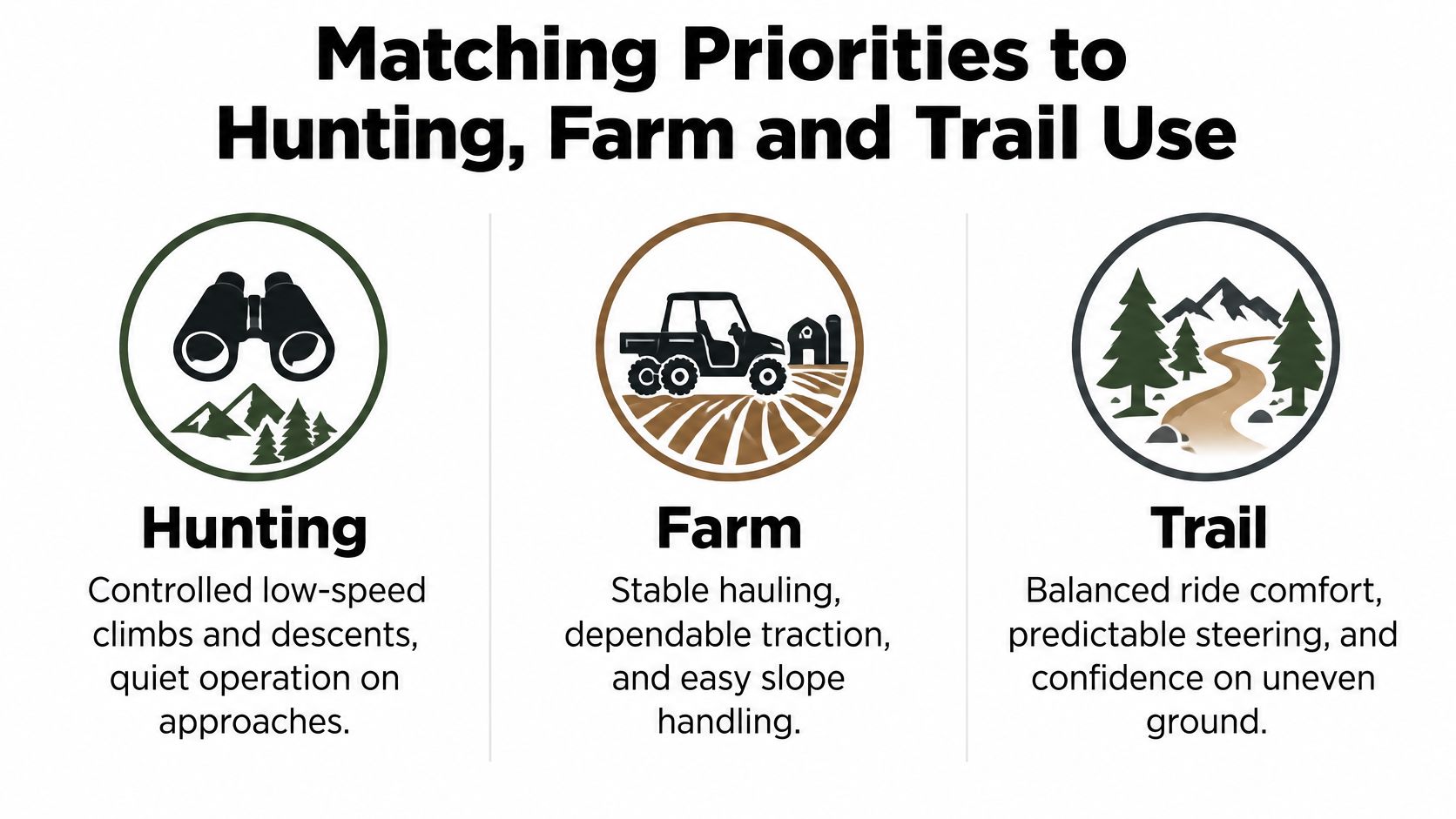
| Profile | Top priority | Second priority | Test on the slope |
|---|---|---|---|
| Hunter | Controlled low-speed climbs and descents | Ground clearance and 4WD engagement | Loaded hill start with gear aboard |
| Farmer or rancher | Towing and payload on slopes | Winch recovery and dump-bed work | Sustained climb with the real trailer or load |
| Trail rider | Side-hill stability and tire grip | Brake feel on descents | Straight ascent and descent first, avoiding full-load traverses |
Matching the E1 to Each Job
The E1 tows up to 2,500 lbs, which covers a loaded utility trailer, a feed wagon, or a small implement on farm grades. Its electric dump bed tilts electrically and includes stake pockets and four tie-downs, so a load of fencing supplies or firewood can be secured low and dumped without hand cranking on a slope. The 3,000 lbs winch capacity handles recovery work, dragging a stuck implement, or pulling game up to a track you can drive.
I'd weight those features differently by profile. Hunters get the most from quiet low-speed control and a bed that ties gear down tight. Ranchers get the most from the tow rating, the dump bed, and the winch working together on a chore loop. Trail riders should spend their test time on descent braking and steering feel rather than cargo features.
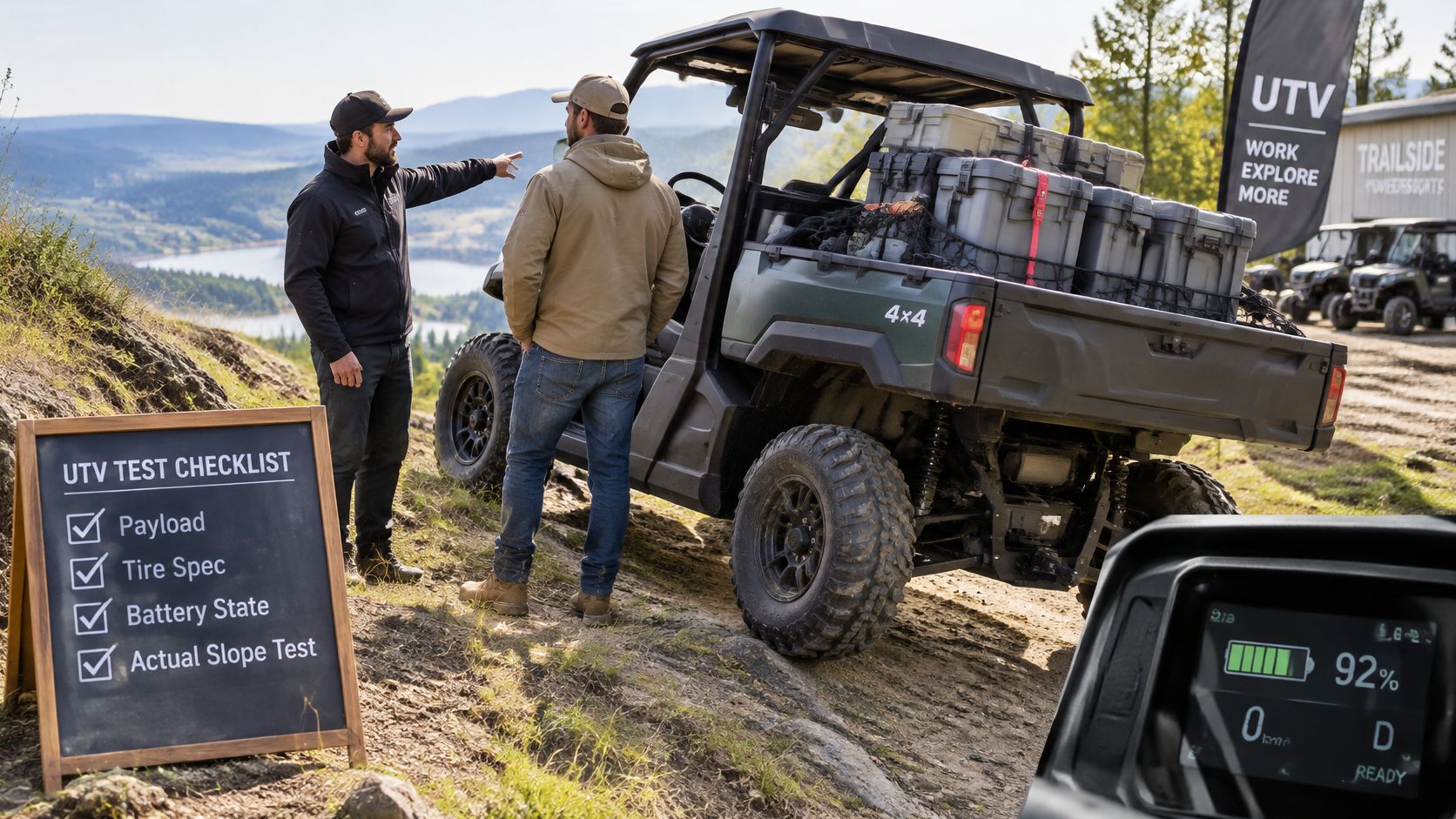
Run this checklist before you sign:
- Confirm payload with the loaded weight: Weigh what you'll carry, including passengers.
- Confirm tire specification: The test tire should be the tire you'll run at home.
- Confirm drive mode: Test in the 4WD and lock settings you'll use on your grades.
- Confirm route length: Match your longest routine loop against a conservative range plan.
Confirm the Slope Test Before You Buy
A spec sheet can't replace a test on the actual slope, load, and surface. Use standardized loaded gradeability, not an unloaded maximum-slope claim. The U.S. Department of Energy SAE J1666 implementation specifies testing at curb weight plus two 166-pound occupants and requires determining whether the vehicle can start and ascend a 25% grade, while noting whether wheel slip, not motor output, limits the result.
Watch the machine work a real hillside before you run your own sequence.
The Dealer Test Sequence
- Record the conditions. Note payload, tire specification, battery state of charge, and 4WD mode before the first run.
- Run a hill start. Stop on the steepest slope you'll really climb, then start from rest without a run-up.
- Run a sustained climb. Add cargo or a trailer and hold a steady pace to the top.
- Run a controlled descent. Note how regenerative braking and friction brakes share the work, and whether the machine tracks straight.
- Repeat the hill starts. Back-to-back starts show how the battery and motor behave when hot.
- Ask for manufacturer slope-test results. Get the stated conditions, then repeat a similar test on your own ground.
The value of a documented result is context. In a recovery test, the E1 pulled a zero-turn mower back up a wet clay bank of about 20 degrees. That tells you what it did on wet clay with that load. It doesn't guarantee your gravel track with a trailer, which is why your own test still matters.
This footage shows the kind of loaded, low-speed control to look for during your test.
Compare the results against your route plan, not against a rival's brochure. If the machine can't start on your grade with your load, or the descent feels vague, reject that configuration even if the price is right. On cost, we offer 0% APR for 36 months on the E1, and retail financing is available for qualified buyers through local dealers. Financing terms don't change physics, so settle the slope test first and the paperwork second.
If your land has grades that punish the wrong machine, come test the E1 the way this guide describes, loaded, in 4WD, on a real slope, and judge the hill start for yourself. We built it for hunters, farmers, and ranchers who need controlled electric torque, a locking differential, and overnight charging that has it ready every morning. Visit Campus EV to find a dealer, book a test drive on terrain like yours, and bring your checklist with you.