0% APR means no interest is charged on the financed balance for the stated term, so every scheduled payment reduces the amount owed, with the fees in the contract still to check.
You might be comparing electric UTVs for hauling feed, maintaining hunting property, or moving equipment around a jobsite when an interest-free offer catches your attention. The useful question isn't just whether you can qualify. It's whether the payment, purchase price, and ownership costs make sense for the work you need done.
Table of Contents
- What 0% APR Means in Plain Terms
- What 0% APR Costs Over 36, 48 and 60 Months
- How to Read a Financing Contract Step by Step
- Eligibility, Term Limits and Rebate Trade-Offs
- Whether 0% Financing Pays Off for Work Use
- Common Misunderstandings About Zero-Interest Loans
- Confirm the Offer Before You Choose Financing
What 0% APR Means in Plain Terms
Think of interest as rent you pay for using a lender's money. With an interest-bearing loan, you repay what you borrowed plus that rent. With genuine interest-free financing, you return the borrowed amount without the added interest.
The amount you borrow is called principal. Your down payment reduces what you need to borrow, but it isn't a financing discount. You're paying part of the purchase price upfront rather than through the loan.
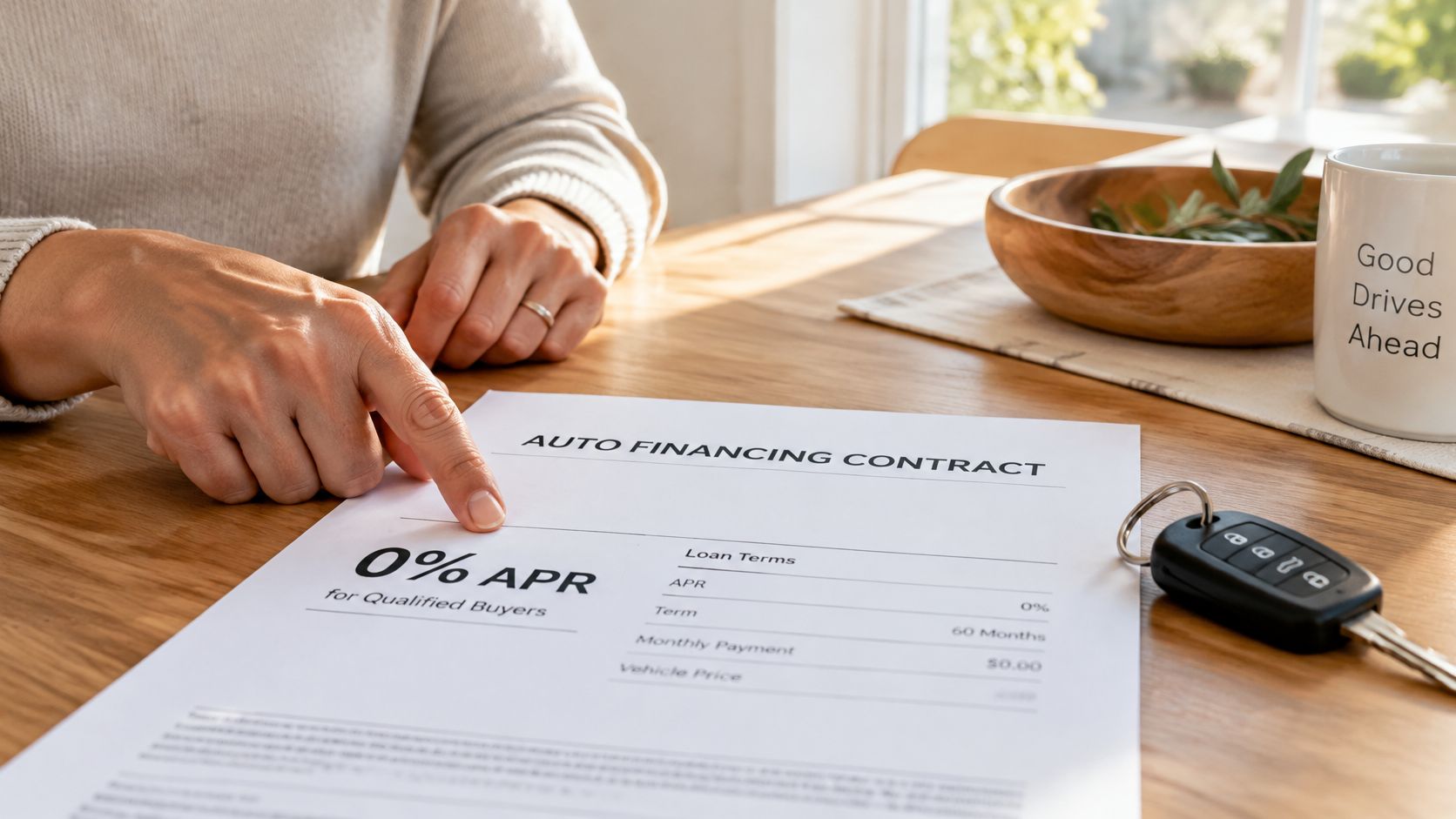
Interest-free doesn't mean cost-free
APR, short for annual percentage rate, describes the yearly cost of credit. It can account for loan-related fees as well as interest, so don't treat the advertised interest rate as a complete explanation of the transaction.
Separate the paperwork into these categories:
- Purchase costs: The UTV, selected accessories, delivery, taxes, and registration.
- Credit costs: Interest and any charges associated with obtaining the loan.
- Ownership costs: Insurance, charging equipment, maintenance, and other expenses after delivery.
Some purchase costs may be added to the loan. If that happens, your payment can rise even though the rate remains unchanged, because you're borrowing more.
Practical rule: Interest-free describes the borrowing arrangement, not a free vehicle or an all-inclusive ownership package.
For someone asking what does 0 APR financing mean, the most useful distinction is vehicle price versus borrowing cost. A good financing offer can reduce the latter without reducing the former. Confirm both in the written contract before committing.
What 0% APR Costs Over 36, 48 and 60 Months
For a hypothetical $20,000 amount financed over 48 months, the principal-only payment is approximately $416.67, compared with approximately $469.70 at 6% APR, using the credit-cost principles explained in the Federal Reserve's loan education guide.
The comparison below uses that same hypothetical balance with no fees added. Interest-bearing entries are approximate standard monthly amortization calculations, not dealer quotes.
Monthly payment and total cost for a $20,000 UTV at 0% and 6% APR
| Term | APR | Monthly payment | Total paid | Interest cost |
|---|---|---|---|---|
| 36 months | 0% | $555.56 | $20,000 | $0 |
| 36 months | 6% | $608.44 | $21,904 | $1,904 |
| 48 months | 0% | $416.67 | $20,000 | $0 |
| 48 months | 6% | $469.70 | $22,545 | $2,545 |
| 60 months | 0% | $333.33 | $20,000 | $0 |
| 60 months | 6% | $386.66 | $23,199 | $3,199 |
Rounding can require a small adjustment to the final payment. The table also shows possible calculations, not a promise that every repayment term is available.
Why the smallest payment can mislead
A longer term spreads principal across more payments. With an interest-bearing loan, it also leaves money outstanding longer, increasing total interest. With an interest-free loan, extending the term changes the payment schedule without adding scheduled interest.
Before comparing financing, establish the vehicle's purchase price. A side-by-side price comparison helps you separate the cost of the machine from the cost of borrowing to buy it.
Other zero-interest products can have different rules. If you're comparing promotional credit more broadly, Toya AI's guide to avoiding common balance transfer pitfalls offers context for reading promotional terms, but don't assume a credit-card promotion works like a fixed vehicle installment loan.
Compare total of payments and finance charge, not just the monthly payment.
Keep your down payment and separately paid expenses beside those figures. The total of loan payments isn't necessarily the total amount you'll spend to bring the UTV home.
How to Read a Financing Contract Step by Step
Read the completed contract, not just the payment estimate. Keep the buyer's order beside it so you can trace how the agreed purchase becomes the amount borrowed.
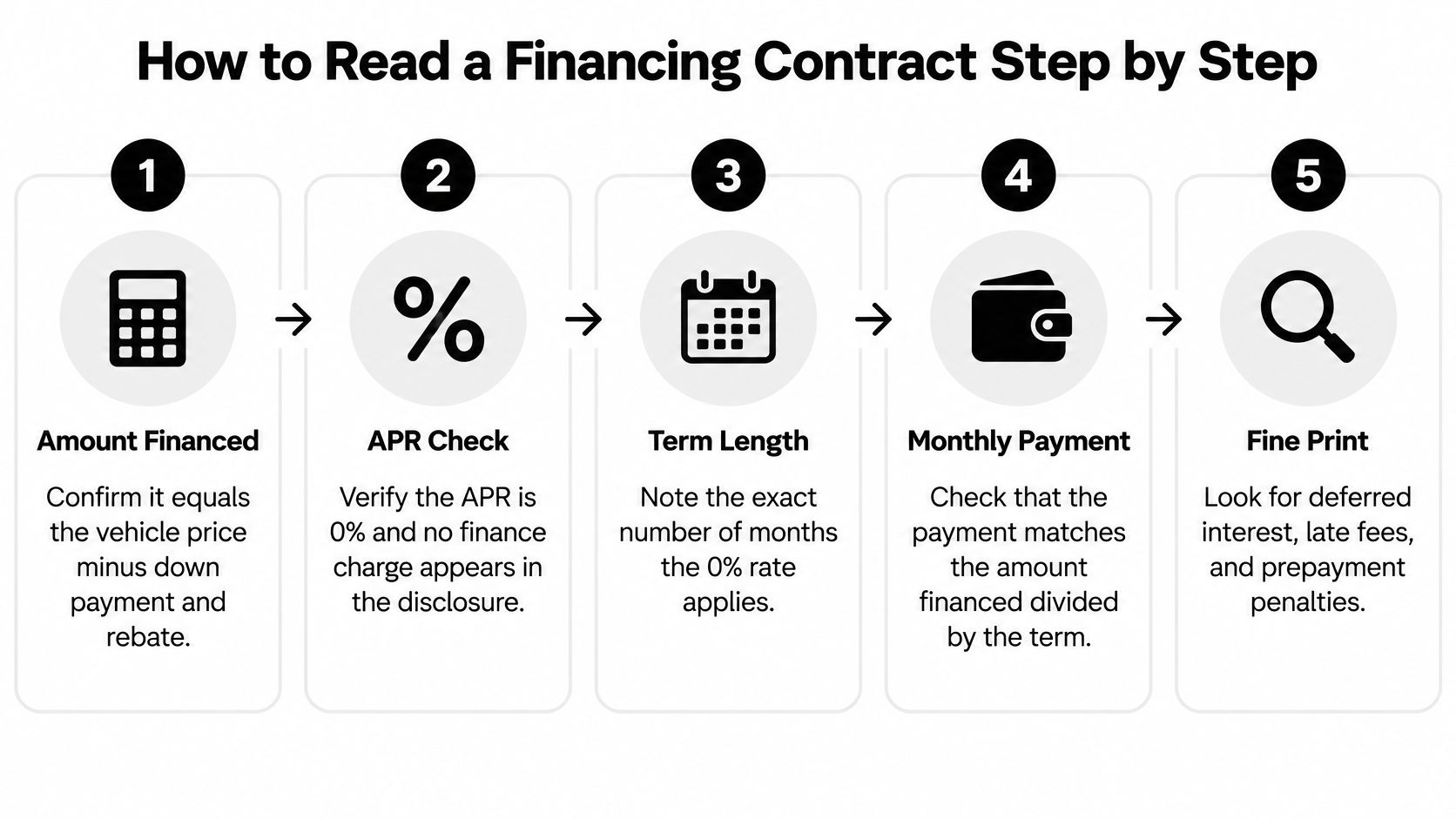
The following visual highlights the main disclosure fields.
Check the money before the conditions
Reconcile the amount financed. Start with the agreed vehicle price, subtract the down payment and applicable rebate, then add any costs you're financing. Ask for an itemized explanation if the resulting balance doesn't match the disclosure.
Find the APR and finance charge. Confirm that the disclosed rate matches the offer and investigate any finance charge. A fee associated with credit deserves an explanation even when the advertisement emphasizes no interest.
Read the full payment schedule. Identify the term, first due date, number of payments, and any different final payment. Check whether the advertised rate applies throughout the scheduled repayment period.
Check the arithmetic. Multiply the regular payment by the number of payments, allowing for a differently sized final payment. Reconcile that result with the stated total of payments rather than accepting an unexplained difference.
Read what happens outside the normal schedule
Itemize fees and optional purchases. Separate documentation, origination, delivery, taxes, accessories, and optional coverage. A down payment isn't a fee, but it belongs on your upfront-cash checklist.
Inspect late-payment and payoff provisions. Ask what happens after a missed payment, whether any rate changes, and whether early repayment carries a penalty. If the document mentions deferred interest, have the lender explain exactly when that interest could become payable.
Confirm how purchase payment is completed. Our policy requires payment at the time of purchase unless Campus EV approves alternative payment terms in writing. Make sure any approved financing arrangement and any amount you must pay directly are documented before delivery.
Don't sign an incomplete form or rely on a salesperson's verbal explanation to resolve contradictory language. Ask for a corrected document, then keep the signed contract, itemized purchase order, and payment instructions together.
A useful final check is to explain the agreement back in your own words: what you're borrowing, what you'll repay, when payments begin, and what happens if you pay late. If you can't explain a provision, get it clarified in writing.
Eligibility, Term Limits and Rebate Trade-Offs
A 0% offer can lower borrowing costs while still requiring a larger monthly payment than a longer loan. Approval and available terms depend on the lender and the offer. Campus EV offers 0% APR for 36 months on the Campus E1 for qualified buyers, with retail financing available through local Campus EV dealers.
The Federal Reserve's consumer-credit reporting framework uses APR to compare borrowing rates. For a purchase decision, consider APR alongside the repayment term and the total amount paid.
Compare the purchase paths
The hypothetical comparison below starts with the same $20,000 pre-rebate price. It assumes the listed rebate and financing terms, excludes taxes and fees, and uses standard monthly amortization.
0% APR offer compared with a rebate and a cash purchase
| Option | Amount financed | Estimated interest | Watch for |
|---|---|---|---|
| 0% APR, 36 months, no rebate | $20,000 | $0 | Qualification and the 36-month term |
| $1,500 rebate with 6% APR, 48 months | $18,500 | About $2,354 | Compare the total of payments |
| Cash purchase after $1,500 rebate | $0, with $18,500 paid in cash | $0 | Cash committed at purchase |
In this example, the rebate-plus-loan option costs more overall than the 0% loan. Paying cash after the rebate costs less in financing, but ties up $18,500 immediately. A different vehicle price, discount, or loan structure could change the comparison.
The choice of repayment length also affects the monthly commitment. A guide to choosing the right RV loan term discusses how term length shapes repayment. For an electric UTV, weigh the payment against the value of the rebate and the cash you need to keep available for work.
A rebate is valuable only after you account for the borrowing cost needed to use it.
Request written quotes for both options using the same equipment and fees. That keeps a discounted base vehicle from being compared with a financed vehicle that includes extra accessories.
Whether 0% Financing Pays Off for Work Use
A crew can love a zero-interest payment and still buy the wrong machine. A 0% APR offer, for qualified buyers, removes interest for a 36-month term. It lowers the cost of borrowing. It does not make an electric UTV free, and it does not make an idle one a sound work purchase. The vehicle has to earn its place through jobs you run, ownership costs you can name, and a payment that still fits in a slow month.
Set the ownership budget beside the financing quote. A loan figure without those costs works like a fuel receipt with the gallons left off: the number looks tidy, and the full spend is still missing. Compare that interest-free path with a cash rebate only after both quotes use the same equipment and fees. A rebate shrinks the price. Interest on the remaining balance, plus electricity, insurance, and upkeep, can erase that shrink.
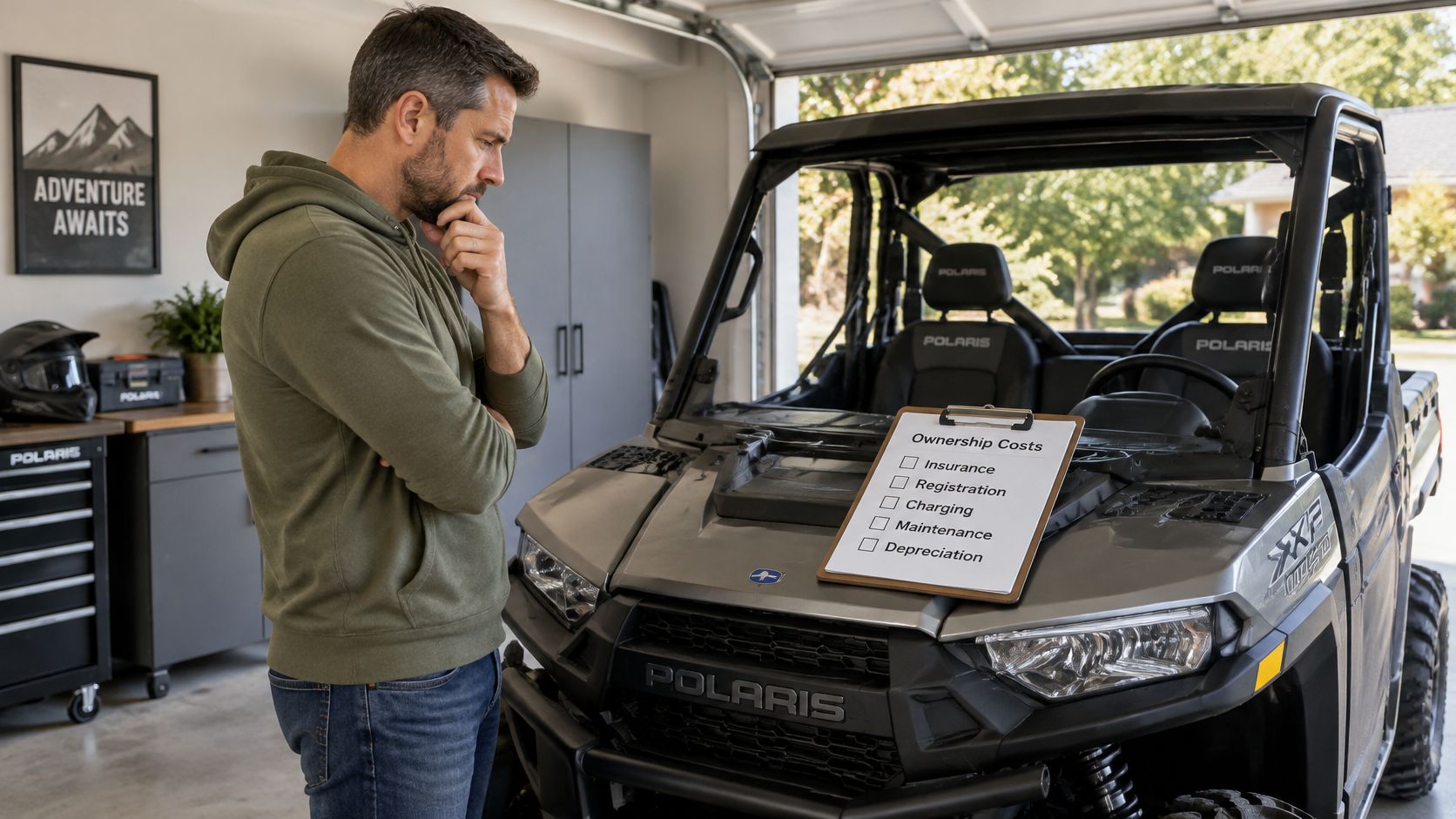
Depreciation matters even when you never receive a bill for it. If you sell before paying off the loan, you still have to settle the remaining balance. The Consumer Financial Protection Bureau's auto-loan glossary defines negative equity as owing more than the vehicle is worth. Hard daily use can pull resale value down faster than a short loan balance falls, so an early replacement can leave a gap between what you owe and what a buyer will pay.
Test the purchase against actual jobs
Build an ownership estimate for the period you expect to keep the UTV:
- Work demand: List recurring jobs, such as fence inspection, feed hauling, property patrols, or equipment transport. Separate regular use from occasional convenience.
- Operating expenses: Include electricity, insurance, maintenance, registration where applicable, accessories, and likely downtime.
- Battery and charging fit: Read the battery warranty, confirm charging access, and check expected range for your loads, terrain, and conditions.
- Replacement timing: Decide when you might sell or replace the machine, and whether a loan balance would still be open.
- Seasonal affordability: Test the payment against low-use or low-income months, not only your busiest season.
Count fuel and maintenance savings only against the machine you are replacing. Leave out savings from work you will keep doing with another vehicle. Quieter operation can help on a hunting property or around noise-sensitive work. Decide what that benefit is worth in dollars, or keep it out of the cost comparison.
Use the video with your written checklist. It does not stand in for the contract.
A budget-focused side-by-side buying guide can help you compare purchase alternatives. The stronger work purchase is the machine that meets the jobs at an ownership cost you can support.
Common Misunderstandings About Zero-Interest Loans
Misunderstanding: Interest-free means the vehicle is free.
You still owe the purchase balance. A seller may also offer a different price or cash incentive depending on the purchase method, so an attractive financing headline doesn't establish the best deal by itself.
The Consumer Financial Protection Bureau's explanation of advertised zero-interest financing notes that these offers generally target highly qualified borrowers and may require relatively rapid repayment.
Separate affordability from overall cost
Misunderstanding: The lowest payment identifies the cheapest offer.
A payment tells you how much cash leaves your account on each due date. It doesn't tell you how many payments you'll make, what you paid upfront, or whether optional purchases were included.
Ask for the complete purchase and repayment figures together. A comfortable payment can still accompany a more expensive transaction.
Misunderstanding: The promotional rate automatically lasts indefinitely.
The written agreement defines the period covered by the rate and what happens under other circumstances. A fixed interest-free installment loan and a deferred-interest promotion aren't interchangeable, so don't infer the structure from the headline.
- Start with the cash transaction: Establish the cash price and available rebate.
- Inspect the financed transaction: Confirm whether the vehicle price or included equipment changes.
- Finish with all-in cost: Combine upfront spending, scheduled repayment, and separately paid purchase expenses.
Don't assume a missed payment automatically triggers retroactive interest, either. Read the actual late-payment and promotional provisions. The goal is to understand your agreement, not import rules from a different credit product.
Confirm the Offer Before You Choose Financing
Choose interest-free financing when you qualify, the repayment schedule fits your budget, and the overall transaction compares favorably with the alternatives. A lower borrowing cost helps only if you can comfortably meet the obligations.
We offer 0% APR financing for 36 months on the Campus E1 for qualified buyers, with retail financing available through local Campus EV dealers. You can locate a local electric UTV dealer to confirm eligibility and obtain the written terms.
Leave with a complete comparison
Request the amount financed, payment schedule, total of payments, finance charge, down payment, and every fee. Ask whether the rate covers the full repayment term and whether any post-promotional rate applies. Request a separate cash-price and rebate quote for the same vehicle configuration.
Before choosing, confirm these points:
- Written agreement: The completed contract matches the offer you intend to accept.
- Itemized charges: You understand every mandatory and optional cost.
- Comparable prices: Cash and financed quotes include matching equipment.
- Ownership budget: Charging, insurance, maintenance, and replacement plans are accounted for.
- Affordable repayment: The payment still works during low-use months.
If the comparison is unclear, don't solve it by looking only at the monthly payment. Ask for an itemized quote that explains the difference, then choose the arrangement that supports both the purchase and your working budget.
Campus EV offers electric UTVs for farm, ranch, hunting-property, and off-road utility work, with financing available to qualified buyers through local dealers. Visit Campus EV to explore the Campus E1 and request a written financing comparison that includes the purchase price, repayment terms, and fees.