
You're probably looking at a dealer's lot with six machines that all claim to be the best farm UTV. One has the biggest engine, another has the highest towing figure, and a third is priced low enough to look irresistible. The decision that matters, though, isn't which badge looks strongest. It's which machine will perform the same jobs reliably over the next five to eight years without leaving your crew waiting for parts, charging, or repairs.
A farm UTV earns its keep through repeated short trips, awkward loads, rough ground, and weather that rarely cooperates. Buy around downtime risk and total cost of ownership, not horsepower alone. The right choice depends on whether you're checking livestock, working orchard rows, pulling fencing supplies, moving feed, or running a multi-shift fleet.
Table of Contents
- What a Farm UTV Is Really For
- The Specs That Matter on a Farm
- Comparing the Top Farm UTVs Side by Side
- Electric vs Gas for Real Farm Work
- Matching the Right UTV to Your Operation
- Total Cost of Ownership Over Five Years
- Buying Checklist and Maintenance Rhythm
What a Farm UTV Is Really For
A farm UTV earns its keep when it cuts trips, cuts wear on bigger equipment, and keeps work moving when a pickup would bog down or chew up a lane. Put it on chores that repeat every day, not on showroom numbers.
Use it for fence runs, livestock checks, feed delivery, tool hauling, and short towing jobs across wet ground or tight tracks. That is the job.
A farm machine needs a cargo bed, low-range gearing, useful ground clearance, selectable four-wheel drive, and rollover protection. Give me predictable torque and a stable load platform before I care about speed. A quick UTV that struggles on a slope or squats under weight costs more in missed work than a slower machine that stays planted.
The jobs that matter are plain enough:
- Livestock checks: Carry medication, feed, gates, and tools while moving around animals.
- Fence maintenance: Move posts, wire, a post driver, and hand tools to stretches far from the yard.
- Field support: Take seed, chemical, or repair parts to plots where a truck would damage soil or fail to fit.
- Short-haul towing: Pull a spray rig, calf cart, utility trailer, or small implement through mud and uneven lanes.
- Daily transport: Replace repeated pickup-truck trips that waste fuel, tires, and operator time.
The category traces back to the Kawasaki MULE 1000, introduced in 1988, a landmark often credited as the first modern UTV and a clear step from ATV-style machines to work-focused side-by-sides (UTV history and market context). That history matters because the machine changed from a niche utility tool into a standard farm asset. Treat it that way. Buy for uptime, parts access, and the jobs that keep your crew out of the shop.
Practical rule: Choose the UTV for its worst working day, not its best demo run.
Before you talk to a dealer, answer four questions. What is the duty cycle, occasional chores or daily high-hour use? What terrain will it cross, flat pasture, steep lanes, mud, terraces, or narrow rows? How many people and tools must it carry? Does electric, gas, or diesel create less downtime for your operation?
Insurance belongs in the same conversation. The guide from Farm & Country Insurance is a useful starting point for broader hobby-farm and umbrella-policy questions before you add a vehicle, passengers, or new equipment to the operation.
The Specs That Matter on a Farm
The spec sheet only matters if it solves a job. A high top-speed figure will not help you cross a muddy terrace, and a big horsepower number will not fix weak braking, poor low-range control, or a dealer who cannot get you a belt fast enough.
Start with load control
For a full-size utility UTV, a practical benchmark is approximately 2,500 pounds of towing capacity, about 1,000 pounds of cargo-bed capacity, and true low-range gearing. Independent farm-use guidance treats that mix as a solid middle ground for feed, fencing supplies, and implements without jumping straight into heavier, more expensive class-6 work vehicles (farm UTV specification guidance).
Payload needs to be judged at the axle and suspension, not just by the bed sticker. Ask whether the machine stays composed when loaded, whether the rear suspension bottoms out, and whether the brakes are sized for the UTV plus trailer. Towing capacity needs the same hard look. If you will pull often, check trailer-brake compatibility, hitch height, braking on descents, and whether low range can move the load smoothly from a dead stop.
Read the chassis, not the decoration
Ground clearance, approach angle, turning radius, and bed shape affect daily work more than paint, stereo output, or dashboard size. A tight turning radius matters in orchard headlands and livestock gates. Clearance and approach angle decide whether the front end climbs a ditch or hangs up on it.
A dump bed earns its keep when you load feed, stone, tools, or cut material by hand. Check the hinge location, lift mechanism, latch quality, and whether the bed can still rise with a practical load on it. A narrow, well-shaped bed can beat a larger bed that blocks visibility or makes hand loading awkward.
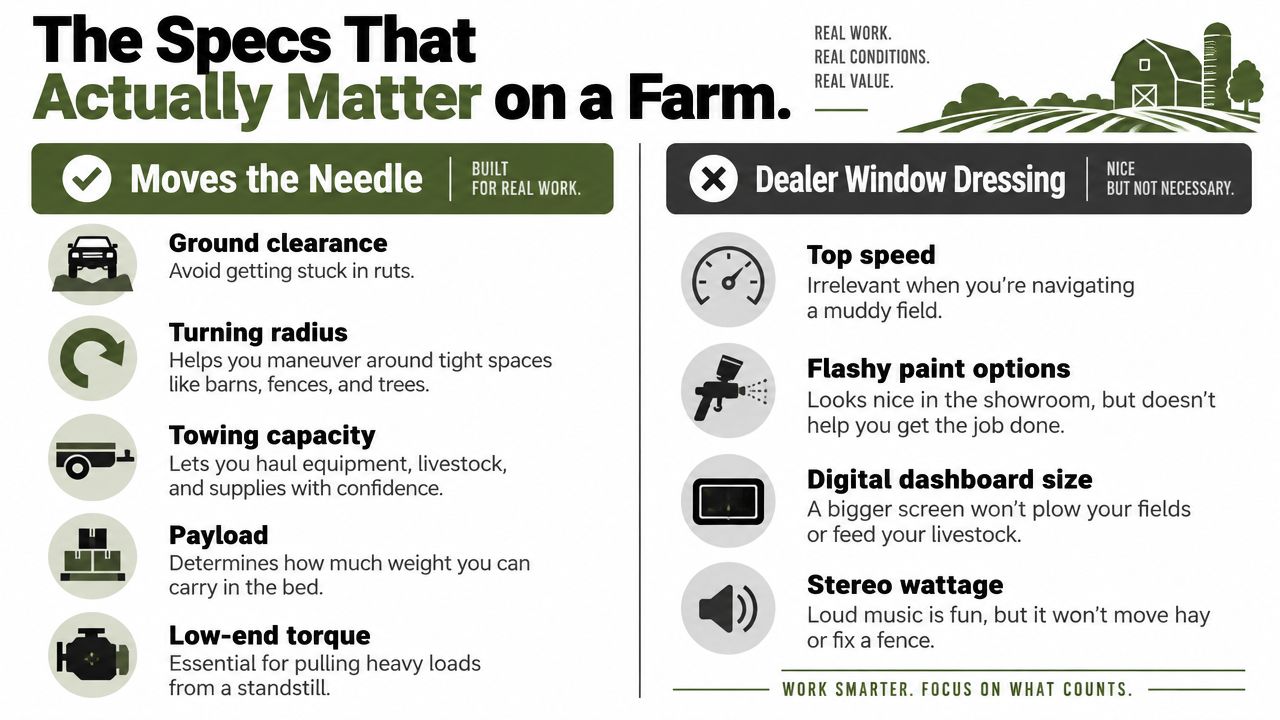
Selectable 2WD, 4WD, differential lock, and turf mode need to work without guesswork. Turf mode protects grass when traction is available, while differential lock helps when one wheel loses grip. Test every mode under load. Hard-to-reach or badly labeled switches turn into a problem the first time the machine bogs down.
Use acreage as a filter, not a shortcut:
- A 40-acre holding: Prioritize maneuverability, a manageable bed, quiet operation, and simple servicing. You probably do not need the largest engine.
- A 400-acre mixed operation: Choose the full-size utility tier with low range, strong towing, a stable bed, and a crew setup if workers ride along.
- A multi-section ranch: Put fuel range, cab protection, braking, service access, and dealer parts support ahead of cosmetic features.
Power output, payload, and towing need to be judged together. One farm guide identifies a 999cc, 82 hp class machine with 2,500 pounds of towing and 2,500 pounds of payload capability as a strong large-property setup, while some diesel utility models trade output for efficiency and lower towing, with roughly 24 hp and about 590 kg of towing (farm UTV comparison guidance).
For orchards, livestock work, fencing runs, and depot fleets that cycle all day, the right choice is the one that cuts downtime. Ask for service intervals, common replacement parts, diagnostic requirements, and local stock before you buy. A machine with impressive numbers but poor parts access is an expensive stationary object.
Comparing the Top Farm UTVs Side by Side
A farm UTV only earns its keep when it fits the job and stays out of the shop. Polaris Ranger and Can-Am Defender suit buyers who want strong output and broad trim choices. Kawasaki Mule is the safer pick for plain utility and low-drama ownership. John Deere Gator brings dealer familiarity in many farm regions. Kubota RTV fits operators who value work-first drivetrains and diesel availability. Yamaha Viking works for crews that carry people and tools together.
Treat the comparison below as a buying filter, not a promise that every trim matches the same figures. Payload, towing, clearance, bed size, and drivetrain shift by model year and configuration, so the exact unit matters more than the badge.
Top Farm UTV Specs Compared
| Model | Payload (lbs) | Towing (lbs) | Bed Capacity | Ground Clearance (in) | Drivetrain | Powertrain |
|---|---|---|---|---|---|---|
| Polaris Ranger 1000 | 1,000 | 2,500 | Dump bed | 12 | 2WD/4WD, trim-dependent | Gas |
| Can-Am Defender | Varies by trim, see dealer spec sheet | Varies by trim, see dealer spec sheet | Dump bed, trim-dependent | Varies by trim, see dealer spec sheet | 2WD/4WD, differential-lock options | Gas, selected diesel options |
| Kawasaki Mule | Varies by trim, see dealer spec sheet | Varies by trim, see dealer spec sheet | Utility bed, trim-dependent | Varies by trim, see dealer spec sheet | 2WD/4WD, model-dependent | Gas and diesel options |
| John Deere Gator | Varies by trim, see dealer spec sheet | Varies by trim, see dealer spec sheet | Cargo box, trim-dependent | Varies by trim, see dealer spec sheet | 2WD/4WD, model-dependent | Gas and diesel options |
| Kubota RTV | Varies by trim, see dealer spec sheet | Varies by trim, see dealer spec sheet | Hydraulic dump bed, trim-dependent | Varies by trim, see dealer spec sheet | 4WD, work-focused configurations | Diesel and gas options |
| Yamaha Viking | Varies by trim, see dealer spec sheet | Varies by trim, see dealer spec sheet | Dump bed, trim-dependent | Varies by trim, see dealer spec sheet | 2WD/4WD, model-dependent | Gas |
The numbers alone do not tell you the full cost. A bed rating means little if the rear end sags when loaded, steering gets sloppy, or braking fades under daily use. A stronger engine can still become the wrong buy if the transmission hunts under tow or the cooling system struggles during slow, heavy work.
Buy for downtime risk first. If you are fitting out orchards, favor a compact machine with easy access and low noise. For livestock checks, pick a unit that starts cleanly, creeps well, and does not punish you with constant clutch or throttle work. For fencing runs, choose a simple drivetrain and a bed that handles posts, wire, and tools without fuss. For multi-shift depot fleets, parts access and service speed matter more than a flashy spec sheet.
My ranking is blunt. Start with Polaris Ranger, Can-Am Defender, or Yamaha Viking if your local dealer can support them and the trim fits the job. Choose Kawasaki Mule or John Deere Gator if you want a conservative machine built for repeat chores and easy ownership. Go Kubota RTV when you want a work-focused diesel path and already run Kubota equipment, which helps keep servicing under one roof. If you are comparing lesser-known brands, this practical look at whether CFMOTO vehicles are any good is useful for judging support and ownership risk.
A full-size utility configuration with around 2,500 pounds of towing and 1,000 pounds of bed capacity remains the safer benchmark for hard farm use, as noted earlier. That is the point where a UTV starts earning its keep on real jobs instead of just looking capable on paper.
Electric vs Gas for Real Farm Work
A UTV that spends its day between nearby paddocks has different costs and failure risks from one hauling feed across a remote ranch. Electric suits repetitive, local work where noise, exhaust, and engine servicing create friction. Gas remains the better tool for long routes, continuous towing, remote work, and operations that cannot spare time for a charging window.
For livestock checks, electric earns its keep through quiet, controlled movement. Early-morning rounds create less disturbance in a quiet paddock, and the smooth low-speed torque makes gates, fences, barns, tools, and small loads easier to handle. Fewer engine-related service items can also reduce routine downtime, provided the farm has dependable charging and technical support.
Orchards and enclosed work areas strengthen the electric case. No tailpipe exhaust at the point of use helps around crews, stored materials, and buildings. Lower noise also lets workers communicate without shouting. Market reporting identifies noise, exhaust emissions, and routine maintenance as drivers of electric UTV adoption, and reports that LiFePO4 batteries rose from 34% of new installations in 2023 to about 58% in 2026 (electric UTV market and battery-chemistry reporting).
Charging is a duty-cycle decision
Measure the route before choosing the powertrain. A short-radius operation can often charge overnight from a standard household outlet, though charging speed depends on the vehicle and circuit. A faster workshop charger gives a fleet more flexibility, but installation adds cost and one shared charger can become a single point of failure. For a depot fleet, install charging capacity that matches the number of shifts, then keep a backup charging option for service interruptions.
Cold weather requires a real-world test. Battery range can fall in low temperatures, while cab heat and heavy loads consume more energy. If your operation works below 20°F, compare the vehicle's expected winter duty cycle with actual distances and loads. Do not plan the day from warm-weather brochure range.
Gas keeps remote, all-day work simpler. Fuel can be carried, refueling is quick, and the machine can continue without waiting for a charging window. Field repairs may also be more familiar when a sensor, belt, or electrical component fails far from a dealer. Modern gas UTVs still contain substantial electronics, so dealer support and parts access remain part of the downtime calculation.
| Factor | Electric UTV | Gas UTV |
|---|---|---|
| Noise | Strong fit for livestock, orchards, and early work | More noticeable during quiet operations |
| Exhaust | No tailpipe exhaust at the point of use | Requires ventilation awareness around buildings |
| Low-speed control | Immediate, smooth torque for gates and fencing | Strong performance, with engine and transmission behavior to manage |
| Refueling | Requires planned charging access | Fast refueling and easy fuel transport |
| Long continuous shifts | Best when routes are predictable and charging is available | Better fit for remote, extended fieldwork |
| Cold weather | Requires range and heating planning | Usually easier to keep in service through severe cold |
| Maintenance | Fewer engine-related service items, but battery and electronics matter | More routine engine, fuel, belt, and exhaust-system servicing |
| Downtime risk | Low when charging and technical support are controlled | Lower when fuel and mechanical support are readily available |
Market research reports faster growth for electric commercial UTVs than for internal-combustion models and increasing attention from fleet buyers that can charge at a depot (UTV powertrain and ownership analysis). Treat that as a fit signal, not proof of lower cost. Compare battery support, charger redundancy, maintenance access, route predictability, and the cost of a missed shift.
Choose electric for short-radius livestock checks, orchard work, indoor tasks, noise-sensitive sites, and predictable multi-shift routes with controlled charging. Choose gas for large acreage, frequent heavy towing, remote locations, and winter work where charging or range could stop the day. For a closer look at the category, review this guide to an electric side-by-side ATV, then test the vehicle with your actual load and route.
Matching the Right UTV to Your Operation
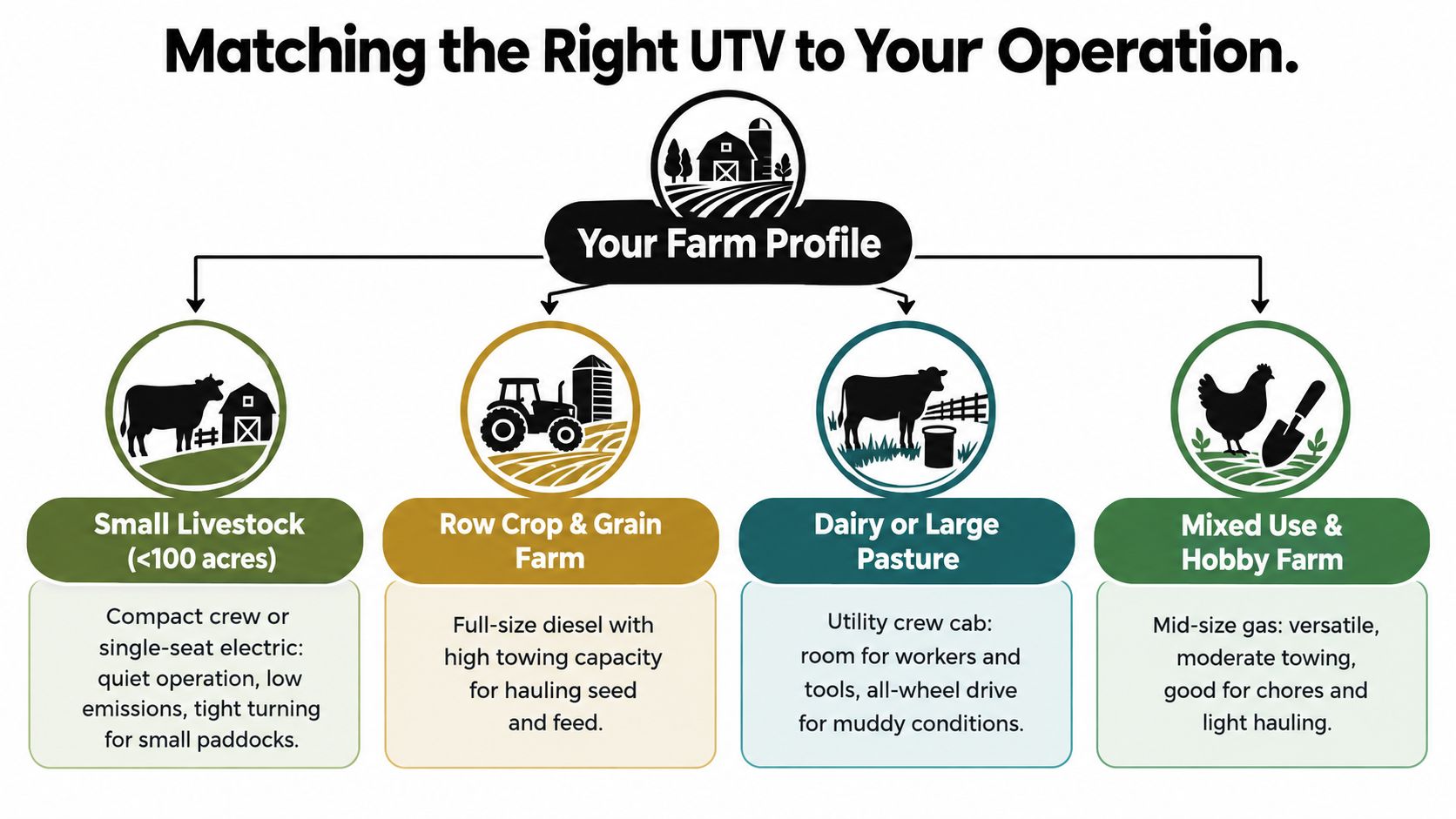
The right platform becomes clearer when you describe the farm by route length, load, and crew pattern. Acreage alone can mislead. A compact holding with intensive livestock work may put more hours on a UTV than a larger property with well-developed roads.
Small livestock operations
For a small livestock operation under 100 acres, choose a compact crew or single-seat electric UTV if most trips stay close to the barn. Quiet movement, a mid-size bed, tight turning, and low-speed control matter more than maximum towing. You'll spend less time disturbing animals and less effort maneuvering around paddocks, sheds, and gates.
My recommendation for the best UTV for a small cattle or sheep operation is a compact electric model when charging is available at the workshop. Choose a mid-size gas machine instead if the property has steep ground, limited electricity, or frequent trailer work.
Large cattle ranches
A large ranch with long distances between paddocks needs a gas crew model with practical fuel range, a protected cab, heating and cooling, and a dealer that can support high-hour use. Crew seating helps when two workers need to inspect fences, move feed, or transport equipment together.
The best UTV for a cattle ranch is the one that returns from a remote section without forcing a second trip for fuel, tools, or passengers. Favor reliable 4WD, low range, strong braking, and service access over a recreational suspension package.
Orchards, vineyards, and row crops
An UTV for orchard work must fit between rows, turn cleanly at headlands, and protect the crop. High clearance helps across uneven ground, but excessive width can make an otherwise capable vehicle unusable. Measure the narrowest working passage, then allow room for mirrors, tires, and loaded attachments.
Gas or diesel suits long field days and remote plots. Electric deserves serious consideration near harvest crews, buildings, and noise-sensitive areas because quiet operation and the absence of point-of-use exhaust can simplify the working environment. Confirm that its charging routine matches the shift.
Mixed-use and multi-shift fleets
A depot, contractor, or mixed farm fleet needs crew capacity, service intervals, parts access, and predictable uptime. Gas or diesel crew UTVs are usually the safer fleet direction when vehicles run high hours across changing jobs, especially if operators cannot pause for charging.
For an electric fleet, install charging where vehicles naturally return and assign vehicles to predictable routes. A platform such as the Campus E1 is one electric side-by-side option to evaluate for utility work, with on-demand 2WD/4WD, a 550-pound electric dump bed, and 1,500 pounds of towing capacity, based on the publisher's product information.
Equipment planning shouldn't stop at the vehicle. Farms that store water, fertilizer, or other materials may also benefit from reviewing these tanks every farm should consider, especially when the UTV will support recurring hauling and transfer work.
If you're comparing new and used utility options, review the current utility ATV and UTV listings as one part of your shortlist process, then verify specifications and support for the exact unit.
Total Cost of Ownership Over Five Years
A farm UTV that costs less at purchase can still be the expensive choice. Fuel use, tire wear, specialist diagnostics, parts delays, and lost work hours determine what the machine costs per working hour. Build the comparison around uptime, not horsepower.
Use these lines in a five-year model:
- Purchase price and financing or lease cost
- Fuel or electricity
- Scheduled maintenance and unscheduled repairs
- Tires, brakes, belts, fluids, and filters
- Insurance and registration
- Battery replacement risk for electric models
- Residual value
- Downtime hours multiplied by the operator's real hourly cost
Record battery replacement exposure even if the likely replacement falls outside the first five years. Market guidance places that risk around year six to eight. UTVs also cost more to service than ATVs, and automotive-style transmissions and differentials may require specialist support where dealer coverage is limited. Check local service capacity before choosing a powertrain, as outlined in this UTV service cost analysis.
Use the comparison chart as an illustrative example based on author assumptions, not a quotation. Model A, a gas mid-range UTV, shows a purchase price of $12,000, energy cost of $4,000, maintenance and repairs of $3,500, insurance and registration of $1,000, and resale value of $4,000, producing a $16,500 net cost (5-year TCO model methodology). Model B shows a $19,700 net cost, while Model C shows an $8,500 net cost, using the chart's stated assumptions.
Replace every figure with dealer quotes, expected energy use, the service schedule, a realistic resale estimate, and the cost of an idle operator. A premium electric can reduce energy and routine maintenance costs on orchard routes or predictable livestock work, provided charging and technical support keep the vehicle available. Gas usually suits remote ranches, fencing crews, and multi-shift depot fleets when quick refueling and familiar field service matter more than lower routine energy costs.
Apply the same calculation to hydraulic attachments. This guide to total cost ownership hydraulic systems reinforces the point: purchase cost, servicing, efficiency, and downtime belong in one operating-cost calculation.
Buying Checklist and Maintenance Rhythm
Take this checklist to the dealer and make the salesperson answer each point in writing. If they can't explain how the machine will be supported after delivery, the specification sheet isn't enough.
Before you buy
- Dealer proximity: Confirm who will diagnose and repair the vehicle when the farm needs it.
- Parts stock: Ask whether belts, filters, brake parts, and common electrical components are locally available.
- Warranty terms: Read exclusions, operating-hour limits, battery coverage, and required servicing.
- Implement compatibility: Verify hitch, PTO, sprayer, mower, dump-bed, and trailer requirements before choosing a trim.
- ROPS protection: Check the rollover-protection certification and passenger restraints.
- Diagnostics: Ask whether fault finding requires proprietary equipment and whether the dealer can provide it promptly.
- Working test: Drive on your own terrain, with a representative load, rather than accepting a smooth-lot demonstration.
Use hours and seasons, not road miles, to plan maintenance. Follow the manufacturer's schedule first, then build a working rhythm around actual conditions.
- At 25 hours: Complete the break-in service required for the machine.
- Every 50 hours: Check fluids, filters, fasteners, tire condition, and belt or drive-system condition.
- Every 100 hours: Inspect the driveline, differentials, steering, suspension, hitch, and brakes.
- Seasonally: Prepare diesel fuel systems for winter, inspect cooling and hydraulic loads for summer, and review battery thermal management on electric models.
Before every long workday, spend a minute on a walkaround. Check tire pressure, the bed latch, hitch pin, coolant or battery state of charge, visible leaks, loose hardware, and anything hanging below the chassis.
Shortlist two or three machines that match the duty cycle, then test-drive at least two on your ground. Log vibration, noise, steering effort, low-range control, braking, and operator comfort at working speed. Before signing, confirm the dealer can supply routine filters within 48 hours and can explain how urgent repairs are handled.
Campus EV offers electric UTV and powersports options for farms, ranches, construction sites, and other utility applications, including the Campus E1 electric side-by-side. Visit Campus EV to review the available utility platform and decide whether its charging profile, capacity, and drivetrain fit your farm's daily routes.