
The debate about whether electric power can handle real off-road work is settled. A California Air Resources Board technical assessment found that five categories of off-road equipment, including agricultural tractors, excavators, graders, rubber-tired loaders and tractor/loader/backhoes, could be fully electrified with motors and batteries already on the market when paired with a 50 kW charger. That same charger delivered enough energy to cover the recorded activity demands of four of those five equipment types.
A side-by-side with a dump bed works far below that duty cycle. The question isn't whether an electric utility vehicle with dump bed can do utility work. It's whether yours can do it with 500 lb of wet gravel in the bed, four-wheel drive engaged on a clay slope, and a January morning that started below freezing.
That gap between brochure range and work-cycle range is where buyers get hurt. I'd rather see your feed loop, your heaviest single load and your charger location on one sheet of paper than read another headline range figure.
Table of Contents
- Specs and Payload Numbers at a Glance
- Where Electric Dump-Bed UTVs Fit Your Work
- Range Under Real Work Conditions
- Cold Weather and Charging Routines That Work
- Dump Bed Safety on Slopes and Soft Ground
- Evaluating Models and Ownership Costs
- Financing and Dealer Considerations
- Test Your Shortlist Before You Buy
Specs and Payload Numbers at a Glance
Six numbers decide fit. Everything else on the spec sheet (paint, stereo, cupholders) is preference.
| Spec | Typical range | What to check |
|---|---|---|
| Dump bed payload | 450-600 lb on compact models | Confirm the rating against axle and tire limits |
| Towing capacity | 1,000-2,500 lb | Count the trailer plus its cargo, not just the trailer rating |
| Winch rating | 2,000-3,000 lb | Treat it as a recovery figure, not a daily hauling limit |
| Battery format | 48V-72V lithium, 100-150Ah | More amp-hours add energy and weight, cutting payload |
| Ground clearance | 9-12 in | Matters over ruts, rocks and stumps on rough ground |
| Drive system | 2WD/4WD with locking rear differential | Use 4WD on slopes, mud and loaded climbs |
Payload is the row buyers overestimate. That 450-600 lb covers everything you drop in the bed, gravel, feed sacks, firewood, a field-dressed deer, tools, and it's a structural and axle limit rather than a suggestion. The same number also has to absorb the winch, the bumper and any canopy you bolt on later. Batteries count here too: a bigger pack is heavier, so the model with the longest range in the lineup often has the thinnest payload margin.
Towing is a separate budget and doesn't stack on top of payload. A 1,000-2,500 lb rating has to cover the trailer and its cargo together, plus the tongue weight pressing down on the hitch. Loaded stopping on a grade is the part nobody tests at the dealer, so try it before you sign.
- Winch rating: 2,000-3,000 lb is a recovery tool for a stuck machine or a dragged log. It is not a towing substitute, and shock loads from snatching exceed the rating fast.
- Battery format: amp-hours buy energy and add mass. If two models share a chassis, the long-range version usually gives back some bed capacity.
- Ground clearance: 9-12 in clears stumps, frozen ruts and washouts. Check what hangs below the differential, not just the frame rail.
- Drive system: a locking rear differential turns a one-wheel-spin climb into a real one. It's the single most useful off-road option on a loaded machine.
The test that settles it: write down the heaviest load you move in a normal week, add your trailer weight, and check that total against the payload and towing rows. A model that fails those two numbers is out, no matter how good its range figure looks.
Where Electric Dump-Bed UTVs Fit Your Work
Start with the job, not the machine. A hunter topping up three feeders on a ridge, a rancher hauling hay to the barn, a crew shuttling gravel across a site and a warehouse team running parts between doors are four different duty cycles, and they don't reward the same vehicle.
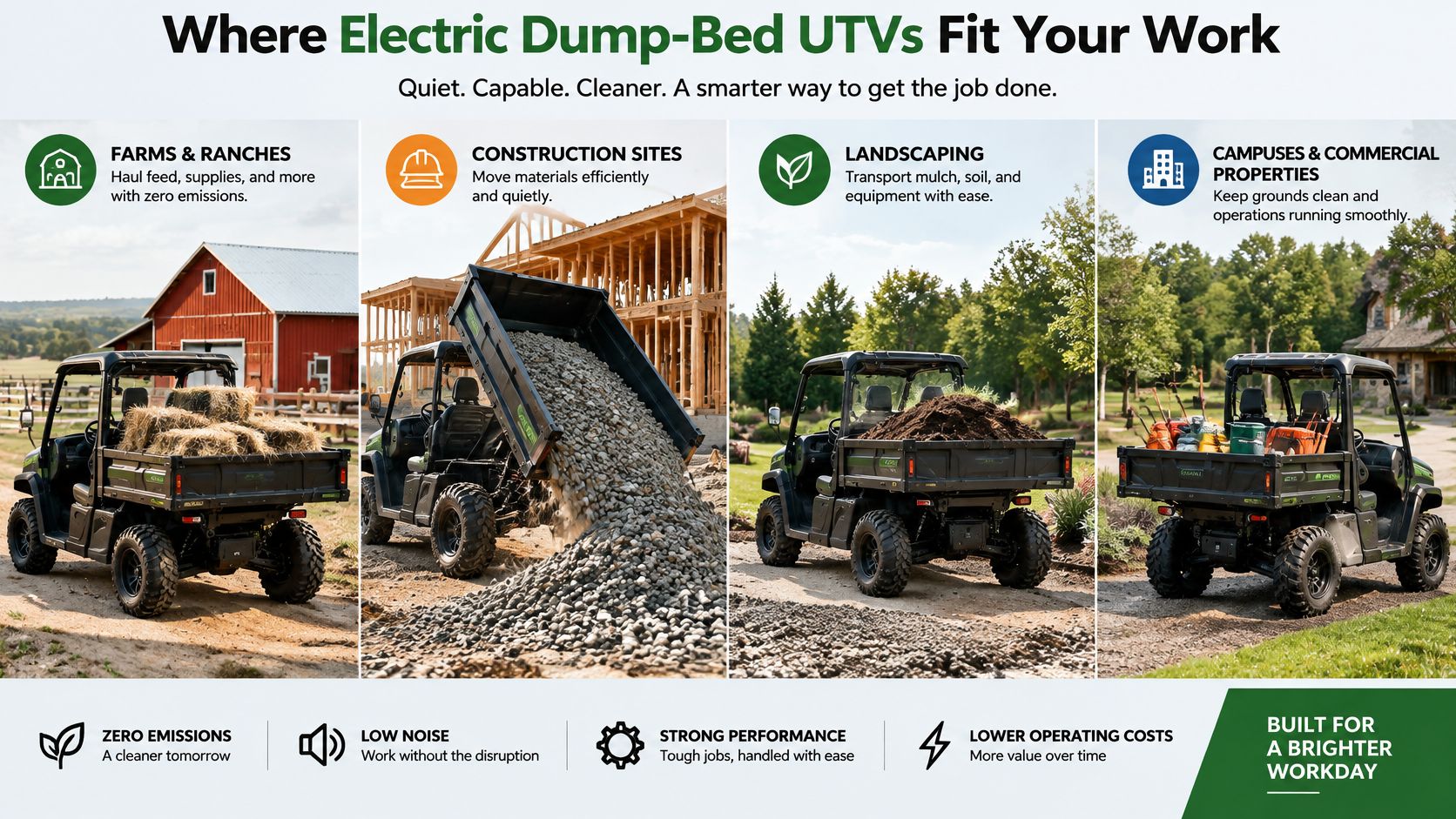
The work itself is mostly short and repetitive. Property maintenance, feed and bedding runs, fencing supplies, gravel and debris, quiet patrol loops at low speed. Electric drivetrains are good at exactly this pattern because there's no idling cost while you load, and torque arrives at zero rpm, which is what makes a loaded start on a grade feel controlled rather than strained.
Short loops versus remote routes
Sort your own use into one of two buckets before you shortlist anything. A 6-mile feed loop that starts and ends at a barn with a 220V outlet is close to ideal: the pack tops up nightly, the loads are known, and the route never changes. A 25-mile hunting route with three loaded legs and no power at the trailhead is a planning problem, and it needs either a split-charging plan (a small generator or a second charger at the cabin) or a much larger pack.
Construction and warehouse work usually lands in the first bucket. Repeated short hauls across a yard or site suit an electric machine, and a charger at the trailer or the shop door covers it. Ranching splits both ways: calving checks close to home are easy, while a full-day fence repair miles out is not.
Answer three questions, and the shortlist writes itself:
- How far do I drive on a working day, loaded?
- How much do I haul in a single trip, bed plus trailer?
- Where does the vehicle sit for the six hours it isn't moving?
Range Under Real Work Conditions
A published range figure is measured light: no payload, gentle throttle, warm pack, flat ground. Load the bed and every mile costs more energy, and on hills or in 4WD the draw climbs again. Heavy loads and steep terrain cut range, so the sticker number is a starting point for planning and nothing more.
| Condition | Effect on range | Planning rule |
|---|---|---|
| Empty bed, flat ground, 2WD | Baseline, closest to the advertised figure | Use as the planning baseline |
| Loaded bed, flat ground | Noticeably lower than baseline | Add a margin for every added load |
| Loaded bed, hills or 4WD | Lower again from higher current draw | Split the route into shorter legs |
| Stop-start hauling | Lower from repeated acceleration | Batch trips into fewer, longer runs |
| Winter cold | Usable energy shrinks below the mild-weather figure | Add margin for winter routes |
| Preconditioning while plugged in | Warms the pack before the first mile | Schedule before every departure |
| Charging on a 120V outlet | Much slower recovery than 220V | Plan for overnight charging |
| Charging on 220V | Much faster recovery than 120V | Fits a midday top-up |
Charging math that fits a workday
Standard charging on a 120V outlet takes much longer than on a 220V circuit, and that gap shapes your routine more than any range claim. The 120V cord is an overnight tool: plug in at the end of the shift and let it work. A 220V circuit is a lunch-break tool, so a machine that runs a morning route, sits for a few hours and runs an afternoon route gets a second working life out of the same pack.
Run a work-cycle test rather than guessing. Drive your real route with your typical load, note the battery percentage at the start and the finish, and convert that into a daily figure with a 20-30 percent safety margin. If a route burns 40 percent of the pack, budget half of it for the day and start every morning above that line. The Campus E1 is rated for up to 60 miles on a charge, which works out to about 30 miles of planned work on that budget.
A vehicle with a shorter advertised range that charges where the work happens will outwork a long-range model that comes home to a dead outlet.
Range is a habit as much as a spec. The guide to maximizing electric UTV performance covers the throttle discipline, tire pressure and load management that keep a pack healthy across seasons.
Cold Weather and Charging Routines That Work
Cold changes the pack before it changes the route. National Renewable Energy Laboratory analysis reports that usable energy at -10°C (14°F) can fall to approximately 75 percent of the energy available at 25°C (77°F), and that thermal preconditioning can raise driving range by as much as 19 percent compared with a cold start.
That makes winter range a work-cycle figure rather than a brochure figure. A loaded bed, mud, snow, grades and sustained 4WD all increase current demand while the cold pack has less usable energy to give. The advertised distance is only the starting point; the charge remaining when the machine returns is the number that matters.
The routine that holds up in winter is boring by design:
- Charge in shelter. A barn bay or shop keeps the pack warmer than an outdoor pad and helps it accept charge more readily.
- Precondition while plugged in. Initial heating draws energy from the outlet instead of the pack, leaving more charge for the route.
- Remove dead weight. Loose tools, excess ballast and material that is not needed that day all reduce the energy available for useful work.
- Treat difficult terrain as added load. Mud, snow, slopes and 4WD can turn a familiar route into a much higher-draw work cycle.
- Let the pack warm under light work. Give it a few minutes of gentle running before asking for winch power or a steep loaded climb.
- Record temperature, load and arrival charge. Several weeks of notes reveal the machine's actual cold-weather range more clearly than a single route or a maximum-range claim.
For a farm or small fleet, assign charging to the closing routine rather than leaving it to memory. The machine that leaves at 6 a.m. with material in the bed should already be parked, plugged in and ready before the crew leaves for the day.
If a dedicated 220V charging post is part of the plan, have a qualified electrician install it at the barn or shop before winter. This home charger mounting and install timeline outlines the general residential mounting and wiring sequence; the electrician should handle the circuit and charging-point installation for the UTV.
Dump Bed Safety on Slopes and Soft Ground
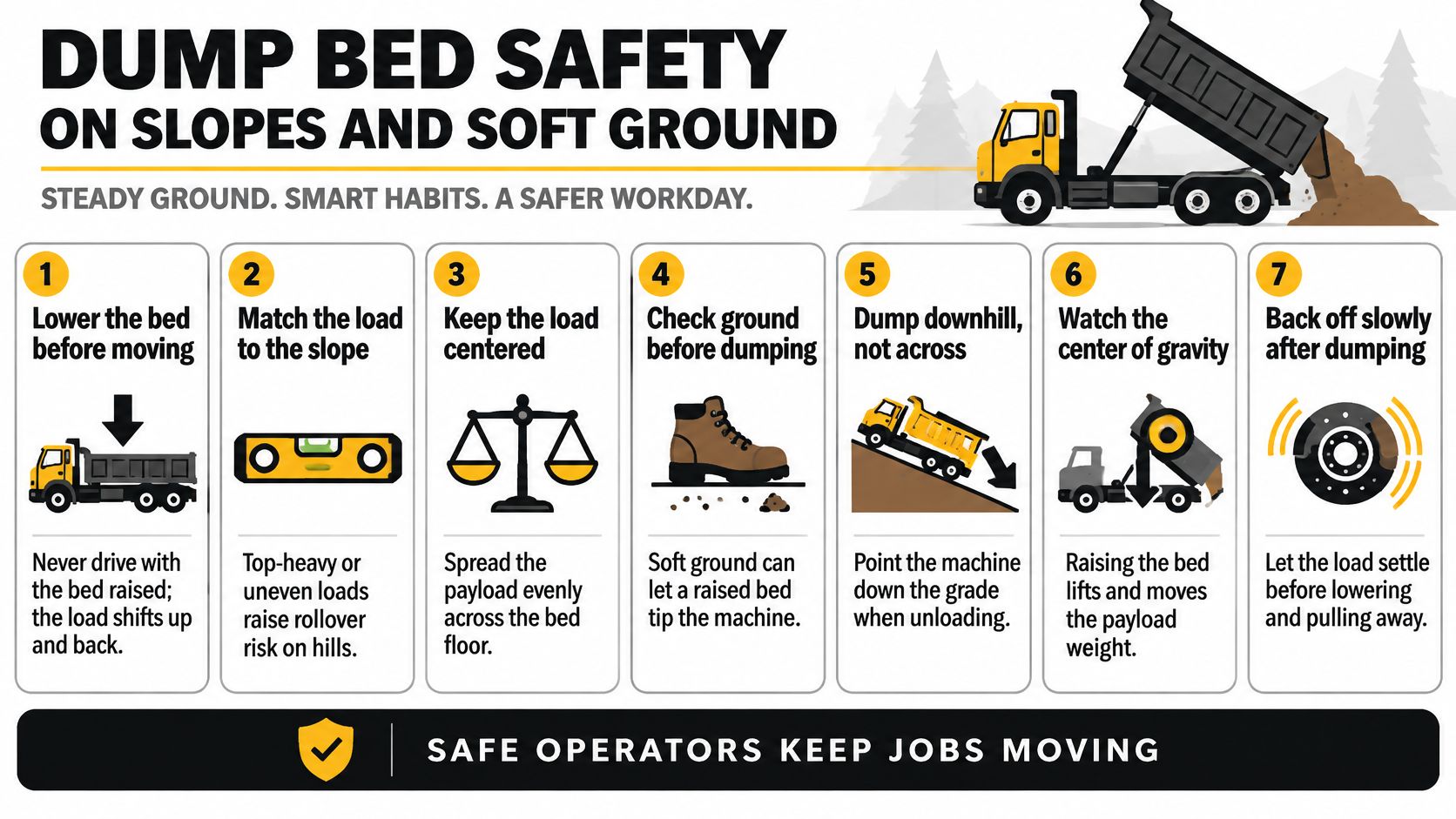
Raising the bed moves the payload's center of gravity up and back. That is a stability change, not just a convenience, and it is why a loaded dump-bed machine behaves differently in the last thirty seconds of a job than it did on the drive out. A bed that felt comfortably under its payload rating on flat ground can put the machine past its tipping point once the load lifts and the rear suspension unloads.
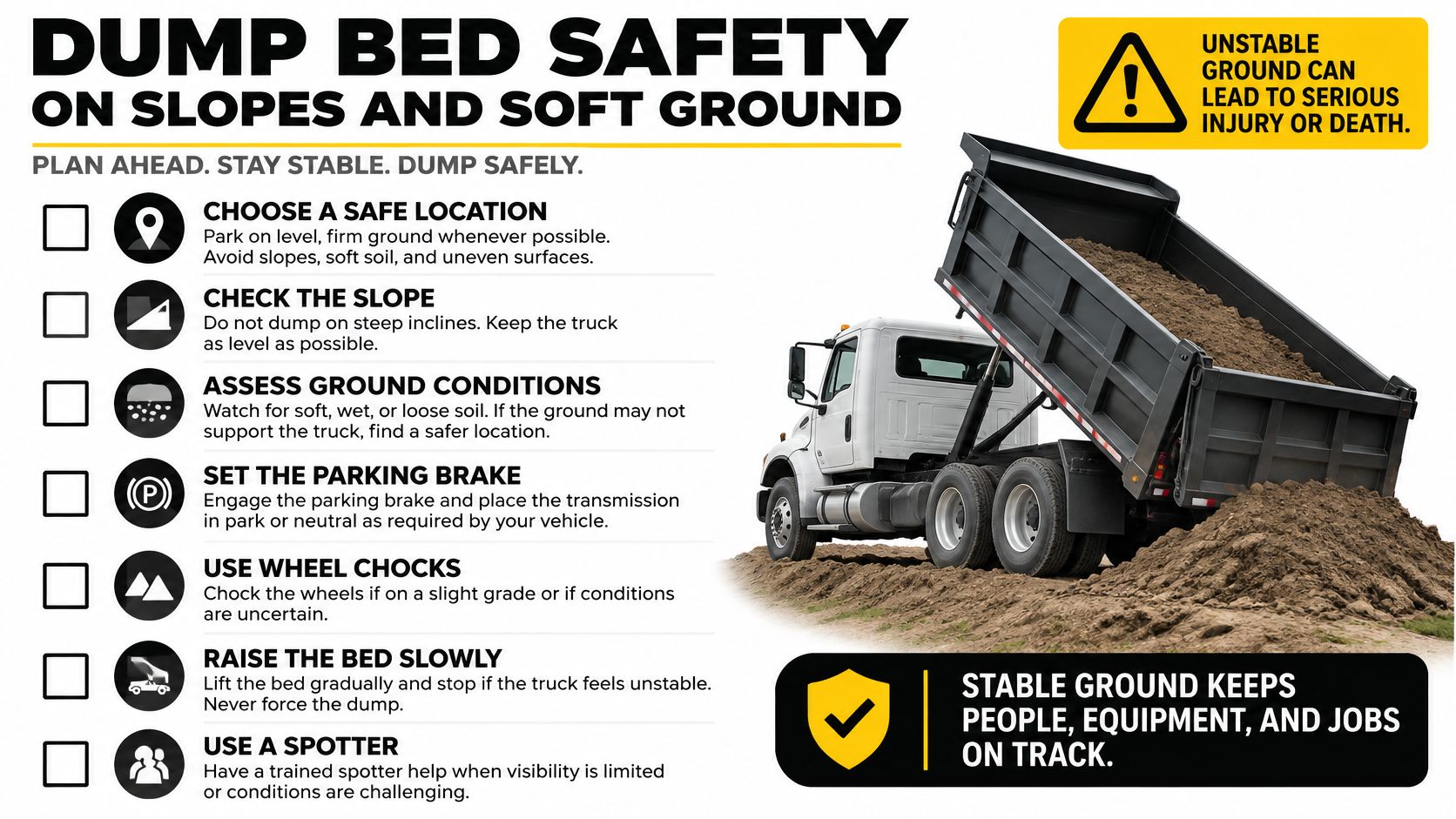
The Texas Department of Insurance safety guidance on dump trucks covers the practical rules, and they map directly onto a compact side-by-side with a short wheelbase and a narrow track, where payload placement matters more than the nominal bed capacity:
- Load dense material low and centered. Gravel, sand and wet feed belong on the bed floor over the axle, not heaped against the tailgate.
- Skip the tower. Excess material piled high in the upper part of the bed raises the center of gravity and gains you nothing but risk.
- Dump only on level, firm ground. The Texas guidance warns specifically against soft surfaces, where the ground or a shifted load can destabilize the machine.
- Secure loose items. Tools, feed bags and chains slide. Strap them or box them.
- Stay inside payload and axle limits. Wet material weighs far more than the same volume dry, so a "full" bed of saturated gravel can exceed the rating a dry load would sit under. A rear axle over its rating steers and brakes badly before it fails.
- Never turn or traverse a slope with the bed up. Straight in, straight out.
- Lower and secure the bed before driving. Every time, including the short hop to the next pile.
The highest-risk combination is loose gravel heaped at the rear of the bed, on a side slope, with the bed raised. The load shifts, the rear springs compress, and a compact machine on a narrow track tips before the operator has time to react. If your ground is steep enough that you are picking a route on the way in, pick it again on the way out with the bed down. This guide to choosing a UTV for steep terrain covers gearing, traction and descent control in more depth.
Maintenance carries a separate hazard. The same Texas guidance requires a raised dump body to be fully lowered, or positively supported and locked, before anyone works beneath it. A hydraulic cylinder that bleeds down does not announce itself, and the bed you lifted five minutes ago is still a suspended load.
The one habit that matters: before every move, look at the bed position and look at the load placement. Two seconds, every time.
Evaluating Models and Ownership Costs
Compare models on criteria, not brands. The questions that separate a good machine from an expensive lesson are payload against your real loads, pack capacity and warranty terms, drive system, bed build and lift mechanism, charging options and how close the service bench is.

Where the money actually goes
The battery is the cost center, and it's the part buyers ask about last. A peer-reviewed review of off-road electric vehicles reported that battery costs and replacement can represent approximately 52 percent of an electric tractor's total price, and it flagged limited battery life, long recharge times and thin rural charging infrastructure as the main barriers to adoption. That number reframes the whole purchase: you're buying a pack with a chassis attached, so the replacement terms matter more than the monthly payment.
Ask the dealer three things before you compare prices. How is the pack replaced, as modules or as a unit? What does that cost after the warranty ends? And does the warranty exclude deep discharge or leaving the machine stored at low charge in an unheated shed? Those exclusions are where owners get caught.
Running costs favor electric in a way that's easy to see on a spreadsheet: no oil changes, no filters, no fuel cans, no idling while you load. Tires, brakes and drive components still wear, so keep the maintenance calendar honest. Check tire pressure weekly (low pressure under load is both a range and a stability problem), inspect the lift mechanism and its hoses, and store and charge the pack exactly as the manufacturer specifies.
| Criterion | What to ask the dealer |
|---|---|
| Payload and towing | Does the rating cover my heaviest load, trailer included? |
| Battery and pack warranty | How is the pack replaced and what does it cost after warranty? |
| Drive system | Is there a locking rear differential for slopes and mud? |
| Bed and lift | Is the lift rated for loaded dumping and can the bed be fully secured? |
| Charging options | Does it charge on 120V and 220V, and is a mobile charger available? |
| Dealer service | Is service local and are parts stocked? |
Score each shortlisted model one to five on those six rows, weight the two you can't live without, and let the total pick the winner.
Ask this at the counter: what does a replacement pack cost today, and does that price include labour? A vague answer is your signal to keep shopping.
Financing and Dealer Considerations
The last 10 percent of the decision is paperwork and relationships, and it's where a good machine turns into a bad deal. Get the numbers in writing before you get attached to a color.
Start with five figures: cash price, APR, term length, down payment and the total paid over the life of the loan. A lower monthly payment stretched over a longer term usually costs more in interest, so compare totals rather than payments. Ask directly whether a rate is promotional, what it reverts to, and whether it depends on credit approval or a dealer program. Programs exist, including 0% APR for 36 months on the Campus E1, but confirm the current terms in writing rather than relying on a conversation.
Questions that belong in writing
- Pack warranty: length, what void it (deep discharge, cold storage at low charge), and the replacement price after it expires.
- Service distance: how far to the nearest bench, and whether the technicians are trained on the electric drive and battery system.
- Parts: availability for the dump lift, cylinders and seals, which are the components most exposed to weather and load.
- Downtime: whether a loaner or demo unit is offered while yours is in the shop.
- Delivery: a written checklist covering the charger, cord, included accessories and any setup the dealer performs.
Then confirm every advertised offer is current before you sign, and keep copies of the warranty and financing documents in the machine's folder. If you'd rather start with local support than a website, use the Campus EV dealer locator to find the closest dealer and see what's on the floor.
Test Your Shortlist Before You Buy
A demo lap around a flat lot tells you almost nothing about how a machine behaves with 500 lb of gravel behind the axle on a wet grade. Test drive with a loaded bed, on your slope, with your kind of load.
Bring three things to the dealer: your daily route length, your heaviest single load, and your charging location with a photo of the outlet. The goal is a work-cycle number, not a brochure figure. Record battery percentage at the start and finish of the loaded route, then confirm the charger can put back overnight what the day burned.
- Drive the loaded route and record the percentage used.
- Try a loaded start on the steepest grade you'll face, shifting into 4WD and locking the rear differential if the model has one.
- Run a full dump cycle with the bed loaded while parked on level, firm ground, and watch how the machine settles as the bed rises.
- Score every model on the six-row grid before you leave the lot.
Then act. Request a quote from Campus EV through the website, or find a dealer near you to book a test drive and see the machine with a load in it. Ask for written specs, pricing and availability, and check that every listed figure matches the exact unit you tested, because products and specifications can change without notice.
Keep a one-page sheet before you sign: route length, heaviest load, charger location, test-drive battery results and written terms. If a dealer can't fill a line, that's your answer on that model.
Campus EV builds the Campus E1 for exactly this kind of work, with an electric power dump bed rated to 550 lb, up to 2,500 lb of towing, on-demand 2WD/4WD and a locking rear differential for loaded climbs, plus up to 60 miles of range on a 72V 150Ah LiFePO4 pack backed by a 10-year warranty. If your daily loop is short and predictable and your charger sits where the work happens, that's the combination this guide keeps pointing to. Visit Campus EV to see the full spec sheet, request a quote or book a test drive with a load in the bed.