
You're halfway through a morning route when the gas UTV needs fuel, the grounds crew is waiting on supplies, and a security call pulls you across the property. The brochure for an electric side-by-side promises quiet operation and low running costs, but you still need to know whether it can finish your actual shift, carry the loads you assign, and recharge before the next one.
That's the right way to approach an electric UTV for property management. Don't start with advertised range or the longest accessory list. Start with the work: map the routes, record the loads and terrain, identify where the vehicle can charge, then compare the full ownership cost against the gas UTV it would replace.
Table of Contents
- A Day in the Life of an Electric UTV on a Managed Property
- How Electric UTVs Actually Work for Property Use
- Specs That Matter and Specs That Distract
- Planning Real Range With a Route-and-Duty-Cycle Worksheet
- Configurations and Accessories for Common Property Tasks
- Total Cost of Ownership and Realistic ROI
- Charging Strategy and Workplace Operating Procedures
- The Five Questions to Answer Before You Buy
A Day in the Life of an Electric UTV on a Managed Property
The day starts at the equipment shed. You collect a set of tools, drive past the barns to check a gate, drop off supplies near the grounds crew, and cross a field to inspect a fence. By mid-morning, the same vehicle may be hauling debris, towing a small trailer, or carrying a passenger on a security round.
A quiet electric side-by-side changes the feel of those short, repeated trips. There's no engine idling beside a barn or warehouse, and you aren't stopping to refuel during the shift. But quiet operation doesn't make a vehicle suitable by itself. The payload, surface, distance between stops, and chance of detours decide whether it's useful.
Property work also varies from one day to the next. A routine campus loop may be easy to plan, while a muddy field inspection with a loaded bed can use energy differently from paved travel. If your team handles seasonal landscaping, groundskeeping, or broader upkeep, it can help to review how Barefoot Organics property upkeep solutions organize recurring work across a managed site.
Before you compare models, trace a typical shift from dispatch to return. Mark every stop, note what the UTV carries, and identify the route that would be hardest to complete in poor weather. The useful question isn't which spec sheet looks strongest. It's whether the vehicle can complete your real work and return with enough charge to handle the unexpected.
How Electric UTVs Actually Work for Property Use
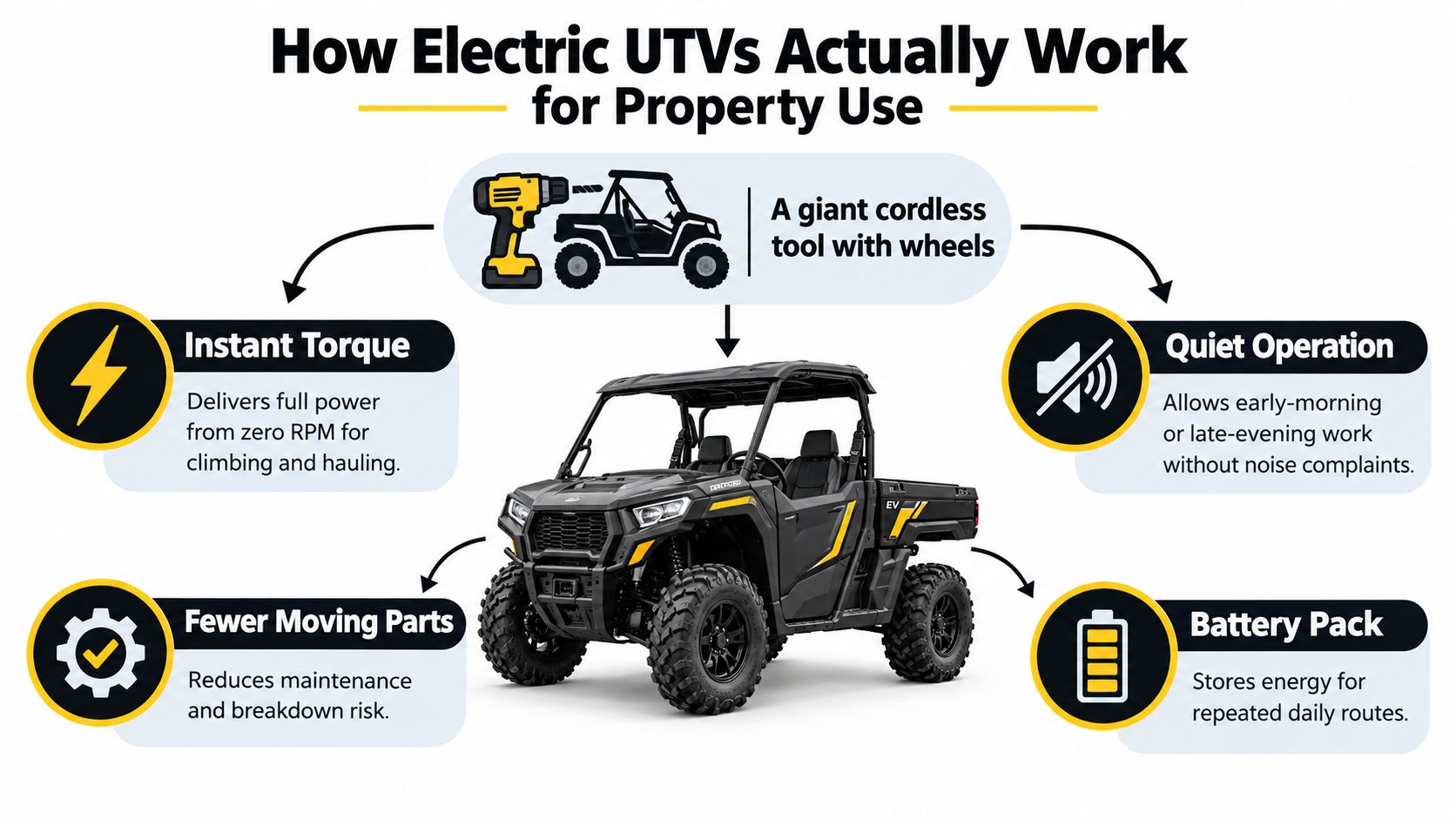
An electric side-by-side is a giant cordless tool with wheels. The battery stores energy, the motor turns that energy into motion, and charging replaces refuelling. The difference matters most in stop-start work: an electric motor can deliver torque promptly, without the engine, fuel system, and transmission arrangements found in a gasoline vehicle.
Battery, motor, and drivetrain
At fleet level, think of the battery as the energy tank and the motor as the part that puts that energy to work. Battery capacity is commonly expressed in kilowatt-hours, or kWh. It tells you how much nominal energy the pack can store, but it doesn't tell you exactly how far a vehicle will travel. Load, terrain, temperature, speed, and accessory use all affect how much energy a route consumes.
A permanent-magnet synchronous motor (PMSM) or AC induction motor converts electrical energy to motion without a conventional engine and its associated fuel and exhaust systems. The specific motor type is less important than whether the vehicle has enough usable power for your routes and loads. Check how it behaves on inclines and under load, not just how the manufacturer describes it.
Features that affect daily work
On-demand 2WD and 4WD let the operator choose traction for the surface and task. An electric dump bed can speed up unloading, while a winch can help with recovery or pulling equipment. These are practical tools only if their capacity and installation suit your work.
Battery-electric drivetrains produce no tailpipe emissions during operation and avoid engine-specific systems such as oil, spark-ignition, exhaust, and fuel-injection components, as described in this EPA life-cycle methodology document. That can matter in enclosed work areas, but it doesn't make the vehicle impact-free. Electricity generation, battery production, and end-of-life treatment also belong in an environmental comparison.
Specs That Matter and Specs That Distract
Read a UTV spec sheet as a route-planning document. Range, payload, towing, charging, and traction determine whether a vehicle can complete a job and be ready for the next one. Top speed, paint, and display size rarely solve the operational problem.
| Property task | Spec to rank first | What to verify before buying |
|---|---|---|
| Groundskeeping | Usable range under load | Can the vehicle finish the complete daily loop with a reserve? |
| Hauling materials | Payload rating | Does the bed rating cover the typical cargo, not just an occasional light load? |
| Security rounds | Range and charging access | Can the route finish without interrupting the patrol? |
| Towing a trailer | Towing capacity and terrain capability | Check the rating against the trailer, cargo, slopes, and surface. |
| Plowing a lane | 4WD capability and available energy | Confirm traction and whether the added work fits the shift's energy plan. |
The advertised-range trap
Range claims don't capture every property's operating conditions. A UTV carrying tools across firm paths has a different workload from one towing a trailer through mud or climbing hills. Cold weather and electrical accessories can also change the energy available for travel. Treat the published figure as a point of comparison, not a route guarantee.
The same caution applies to capacity numbers. Payload and towing are separate ratings, and neither tells you how the vehicle will handle a particular slope, surface, or repeated trip pattern. Ask the dealer to explain the operating limits, then compare them with your measured work rather than assuming a higher number automatically means a better fit.
Fleet rule: Buy for the most demanding regular task, not the most impressive brochure feature. If that job requires a capability the vehicle can't reliably deliver, a low purchase price won't fix the mismatch.
Planning Real Range With a Route-and-Duty-Cycle Worksheet
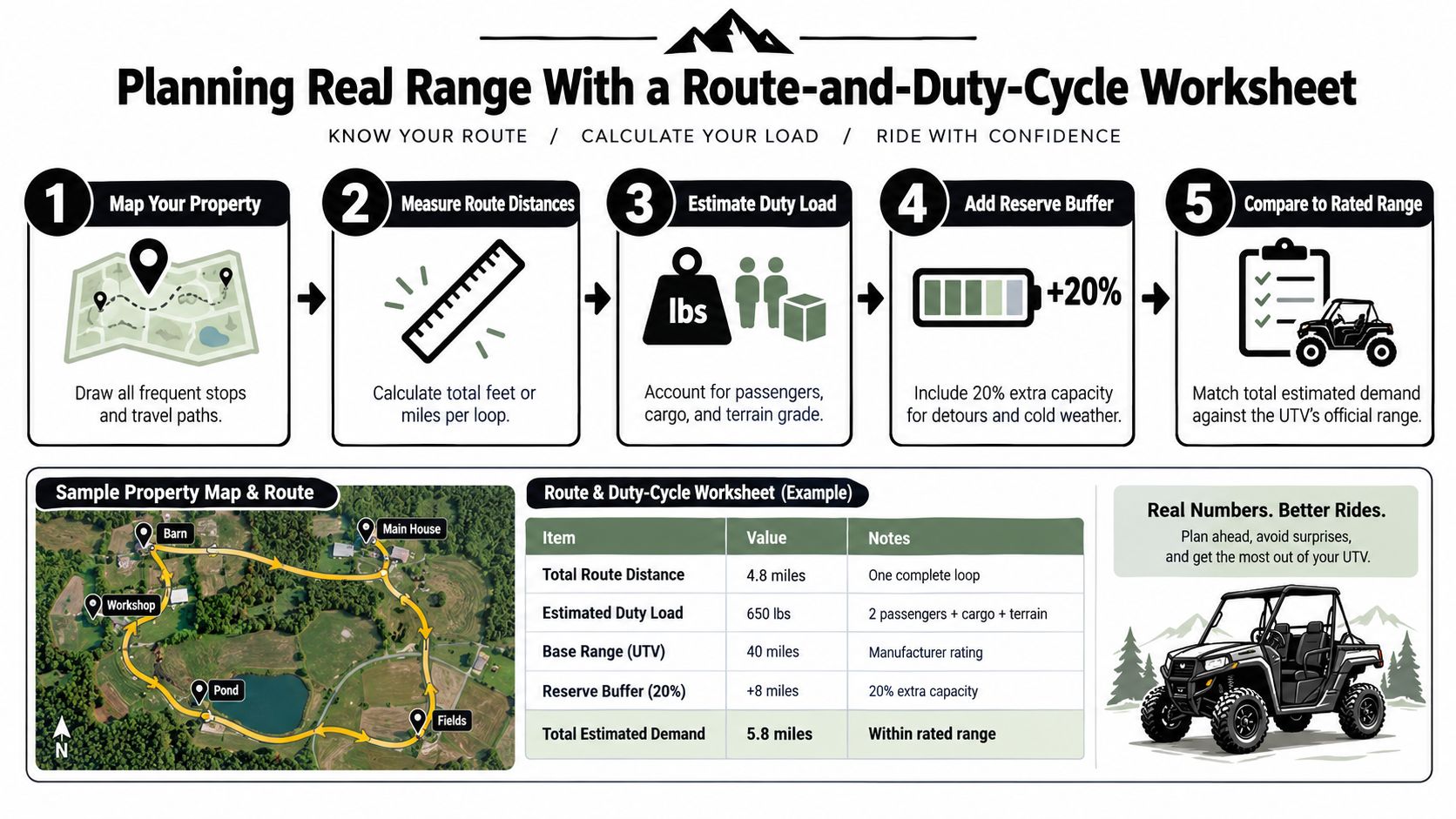
A defensible range plan begins with a map and a log, not a guess. Record the routes the UTV runs, then document what it carries and what conditions make those routes harder. For advice on reducing energy use once routes are set, see this guide to improving electric UTV efficiency.
Build the worksheet
- Map the stops. Mark barns, gates, storage buildings, work areas, patrol points, and the charging location. Draw the actual routes between them, including regular detours.
- Measure each loop. Use a property map, odometer, or route log to record distance. Note elevation changes and whether the route is paved, gravel, pasture, or mud.
- Record the duty load. Track passengers, cargo, trailer use, lights, winch use, cab equipment, and time spent stationary with accessories running.
- Account for difficult conditions. Flag cold-weather work, steep ground, soft surfaces, and route changes. Keep a reserve rather than planning for the battery to reach empty.
- Compare with the vehicle's documented range. Ask the manufacturer or dealer what conditions underlie its rating. Check whether your complete route fits with a practical reserve.
For example, a horse property might include repeated barn-to-gate checks, feed or equipment deliveries, and a separate hay run. Log routine rounds independently from the heavier weekly task. If the hay run changes the load, trailer use, or terrain, don't assume the same range estimate applies to both.
A campus may combine security loops, landscaping stops, and grounds-trailer work. Record each route and decide whether one vehicle can complete them in sequence or whether the assignments need separate dispatches. These are planning examples, not range guarantees; the result depends on the selected vehicle and actual operating conditions.
Decide how to charge between shifts
A second battery and a second vehicle solve different problems. A spare battery can help where the model supports a safe, practical battery swap; a second vehicle adds capacity for overlapping jobs or simultaneous routes. Confirm battery compatibility, replacement availability, and the manufacturer's approved changeover process before treating a spare pack as a solution.
Use 120-volt overnight charging only if the vehicle's charger and daily energy use allow a reliable return to service by the next shift. If the battery regularly needs more energy than that charging setup can replace during the available window, or if several vehicles must charge together, assess a 240-volt circuit with a qualified electrician. Choose the installation from measured usage and the vehicle's charging specifications, not from a generic rule.
Configurations and Accessories for Common Property Tasks
Choose equipment from the route and work, not from a catalogue. A property map shows where the UTV travels; a task list shows what it must carry, tow, or unload. Use both to specify a setup without paying for unused accessories.
Farms and ranches
For fence repairs, feed runs, and remote work areas, prioritize a cargo bed sized for regular loads, suitable towing capacity, and traction for the actual terrain. Add a winch when recovery or pulling is part of the job. A roof, windshield, and cab enclosure help with exposure to cold and rain. A heater makes sense only if the vehicle's power system can support it through the expected winter duty cycle.
A dump bed earns its place when crews repeatedly unload loose material. The Campus E1 is one example, with a 72 V, 150 Ah battery, about 10.8 kWh of nominal stored energy, an electric dump bed, a 3,000 lb winch, and on-demand 2WD/4WD, according to the Campus E1 specifications. Treat those features as a starting point, not a shopping list. Confirm which ones match the route and workload.
Campuses and resorts
For a grounds team combining supply runs, landscaping, and patrols, match accessories to the routes and staffing. A roof and windshield help with weather exposure; lighting supports work in low visibility. Choose passenger seating if patrols regularly carry two staff members. Brush protection can help around landscaping, but skip it if it blocks the driver's view or adds weight without serving a regular task.
Set the boundary between in-house work and contracted services before choosing the vehicle. Comparing the UTV's assigned duties with choosing a property maintenance provider can clarify which jobs the fleet must cover and which belong in a separate service arrangement.
Warehouses and large estates
On a large site, crews may move tools, collect debris, and transfer materials between buildings. Check that the vehicle fits travel lanes, storage areas, and loading points. An electric UTV with a dump bed suits repeated trips with loose debris or supplies, provided the bed's rated capacity covers the loads you expect to carry.
Before requesting a quote, mark each accessory as required, useful, or unnecessary for the routes you have logged. That simple filter keeps the configuration tied to daily work, rather than turning a utility vehicle into a collection of add-ons.
Total Cost of Ownership and Realistic ROI
A useful ROI case starts with the routes your UTV will run, not a spec-sheet estimate. Compare an electric UTV with the gas vehicle doing the same work, at the same expected use. Total cost of ownership (TCO) should include purchase and financing, electricity or fuel, scheduled maintenance, tires and brakes, charging installation, a battery replacement reserve, and resale value.
Public-fleet analyses can help identify costs to include, but their figures are not UTV forecasts. Maine's analysis considers vehicle cost, power output, electricity price, charging installation, incentives, energy use, and maintenance. Its modeled service life and savings estimates concern other vehicle classes, so don't use them to promise a side-by-side return. The practical takeaway is narrower: fuel and service savings may offset a higher purchase price, depending on local rates, workload, and equipment.
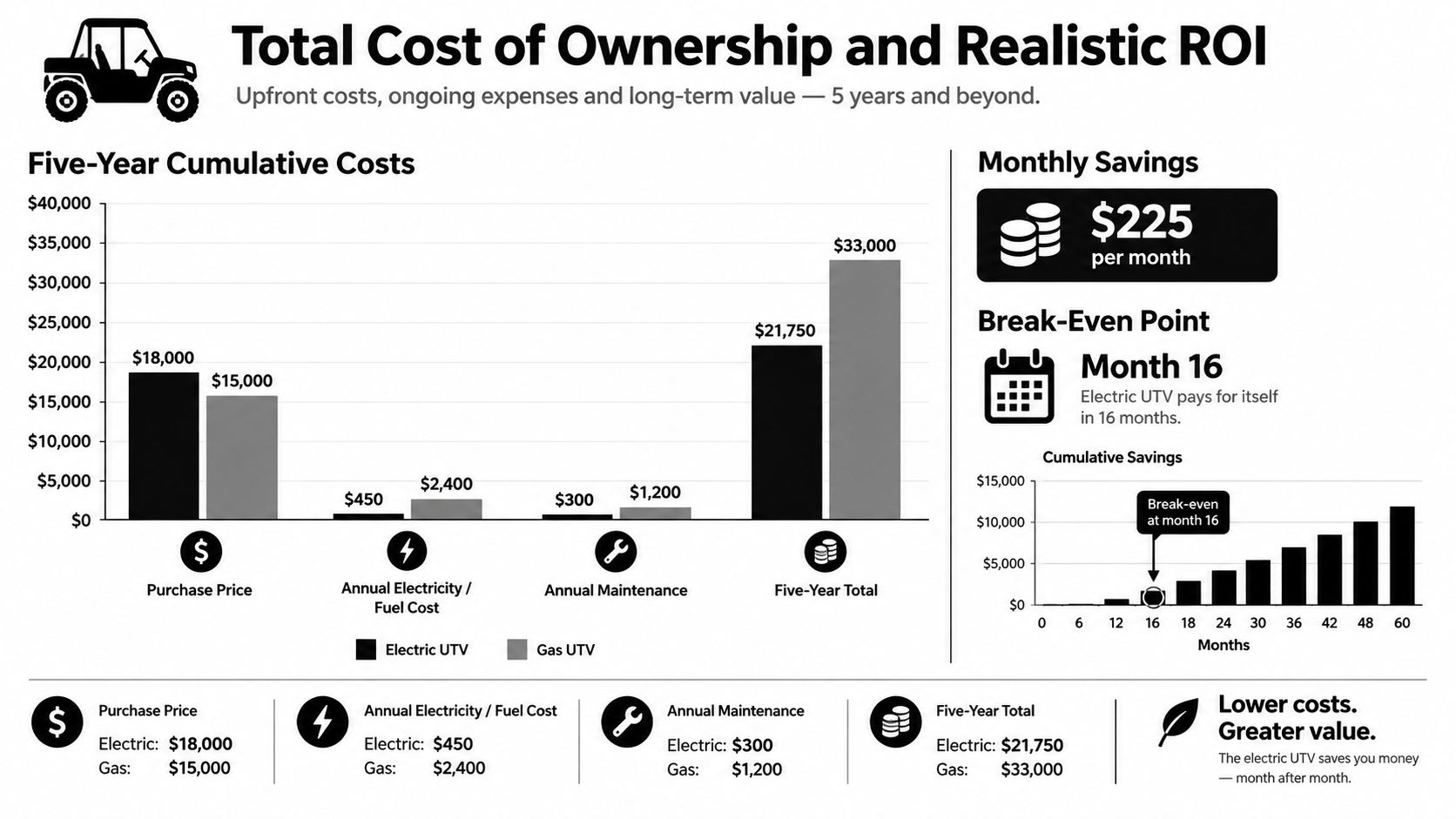
Build the comparison from your own invoices and route logs. Use logged distance and duty cycle to estimate energy use, then apply your actual electricity rate. Compare that result with the fuel used by the gas UTV on equivalent work. Include scheduled engine service, oil and filters, charging equipment, and a realistic battery reserve. Count tire wear, brake work, downtime, and financing too.
Washington State's public-fleet analysis modeled nearly 29,000 vehicles across 4.2 million scenarios and found $72 million in cumulative potential savings at a 5% threshold. The share of vehicles judged cost-effective changed by scenario, and transit buses contributed most of the savings. Treat the findings as evidence that vehicle class, duty cycle, and charging access shape the business case, not as a UTV payback estimate.
Financial test: Reject an ROI case that relies on optimistic range, understated maintenance, or unpriced charging equipment. Use your route records and local utility rate to check the assumptions, then review electric UTV maintenance costs when estimating service expenses.
Charging Strategy and Workplace Operating Procedures
A UTV that returns to a fixed parking spot should charge overnight by default. A Campus E1's 72 V, 150 Ah battery stores about 10.8 kWh nominally. With a typical 7.2 kW AC charging input, an ideal full charge would take about 1.5 hours. Allowing for charging and battery losses, plan on closer to 2 hours. Confirm the actual estimate using the charger rating and battery-management limits in the vehicle's owner manual.
Set up an appropriate dedicated circuit where vehicles park, then schedule charging after routes. Avoid routinely draining the battery. Set a return threshold of roughly 20–30% state of charge so crews are not planning shifts around an empty pack. If electricity rates vary by time, ask the utility or installer whether charging outside peak periods makes sense. For an overview of charging infrastructure and possible incentives, see QLD electric vehicle incentives explained.
Set site rules before dispatch
OSHA notes that no single federal standard specifically covers lithium-ion batteries. Existing rules and the General Duty Clause may still apply, so make charging and battery handling defined workplace duties. Assign trained staff, mark approved charging locations, and record who inspects the equipment.
Use a short daily checklist:
- Before dispatch: Check tires, brakes, lights, battery level, visible damage, and fault indicators.
- Before charging: Inspect the charger, plug, and cable. Record defects and remove damaged equipment from service.
- Before remote work: Confirm the route, expected load, communication method, and enough charge for a safe return.
- For every operator: Cover passengers, reversing, slopes, traction selection, and operation around pedestrians.
Stop using a vehicle if its pack is visibly damaged, unusually hot, or showing a charging fault. Keep people away and follow the manufacturer's and site's emergency procedures. Do not attempt an improvised repair. Record the incident, isolate the vehicle in the designated area, and contact qualified service support.
The Five Questions to Answer Before You Buy
Before signing a purchase order, answer these questions in plain terms:
- Does the duty cycle suit an electric UTV? Name the regular routes and tasks it must complete.
- Where will it charge? Identify the parking location, circuit, charging schedule, and responsible staff.
- What range and reserve do those routes require? Use measured distance, terrain, loads, and accessories rather than relying on the advertised figure.
- Which configuration fits the dominant work? Specify the bed, traction, towing, seating, weather protection, and accessories the crew will use.
- Does the TCO case hold up over the expected service life? Compare local energy, maintenance, infrastructure, financing, and replacement assumptions with an equivalent gas UTV.
Ask dealers who will provide service, whether the vehicle is supported by an authorized dealer, what the warranty covers, and how battery issues are handled. If financing matters, compare the actual terms available, including Campus EV's stated 0% APR financing option, rather than evaluating payment language without the full purchase and ownership costs.
Start with a one-week route log before calling a dealer. Bring the route, load, charging, and cost notes to the conversation, and ask the dealer to show how the proposed vehicle meets each requirement. That turns a brochure discussion into a fleet decision.
Campus EV sells electric side-by-sides for property, farm, and ranch work, including the Campus E1 with selectable 2WD/4WD and a dump bed. Review the available vehicle details and dealer options at Campus EV, then compare them against your route log before choosing a configuration.