
You're probably staring at an electric UTV for sale listing right now and seeing the same pitch over and over. Quiet. Clean. Easy to own. Then one big range number gets dropped on the page and you're expected to decide from that alone.
That's not how serious buyers should shop.
If you need a side-by-side for hunting access, fence checks, feed runs, grounds work, or hauling tools around property, the purchase comes down to three things. Real workload range. Cold-weather battery behavior. Dealer capability. Get those right and an electric UTV can be a smart machine. Get them wrong and you'll own an expensive unit that doesn't fit your day.
Table of Contents
- What an Electric UTV Really Is and Who's Buying One in 2026
- Specs That Matter for an Electric UTV
- Real-World Range and Charging for Electric UTV Work
- Matching the Right Electric UTV to Your Use Case
- Financing, Total Cost, and What Ownership Really Looks Like
- Maintenance, Warranty, and Battery Care Over Time
- Bringing It All Together for a Confident Purchase
What an Electric UTV Really Is and Who's Buying One in 2026
An electric UTV isn't a golf cart with knobby tires. It's a utility machine built for work, access, and hauling, just with an electric powertrain instead of a gas engine.
That difference matters because the right buyer doesn't choose electric for novelty. They choose it because the job favors quiet operation, simple daily use, indoor-friendly storage, and no on-site exhaust. If that's not your world, don't force it. Gas still makes more sense for some buyers.
Who actually benefits from electric
The strongest fit usually looks like one of these:
- Hunters who want quiet access: If you cross fields, move through timber edges, or reach a stand before daylight, less engine noise is a real advantage.
- Farmers and ranchers doing short repeated trips: Checking water, carrying tools, hauling feed, and moving between barns or gates is exactly the kind of stop-start work electric handles well.
- Property owners with daily chores: If you've got trails, gravel lanes, outbuildings, or a few acres that need regular attention, electric is easy to live with.
- Construction, grounds, and warehouse users: If the machine works near buildings, in covered spaces, or around people all day, electric cleans up the operating environment.
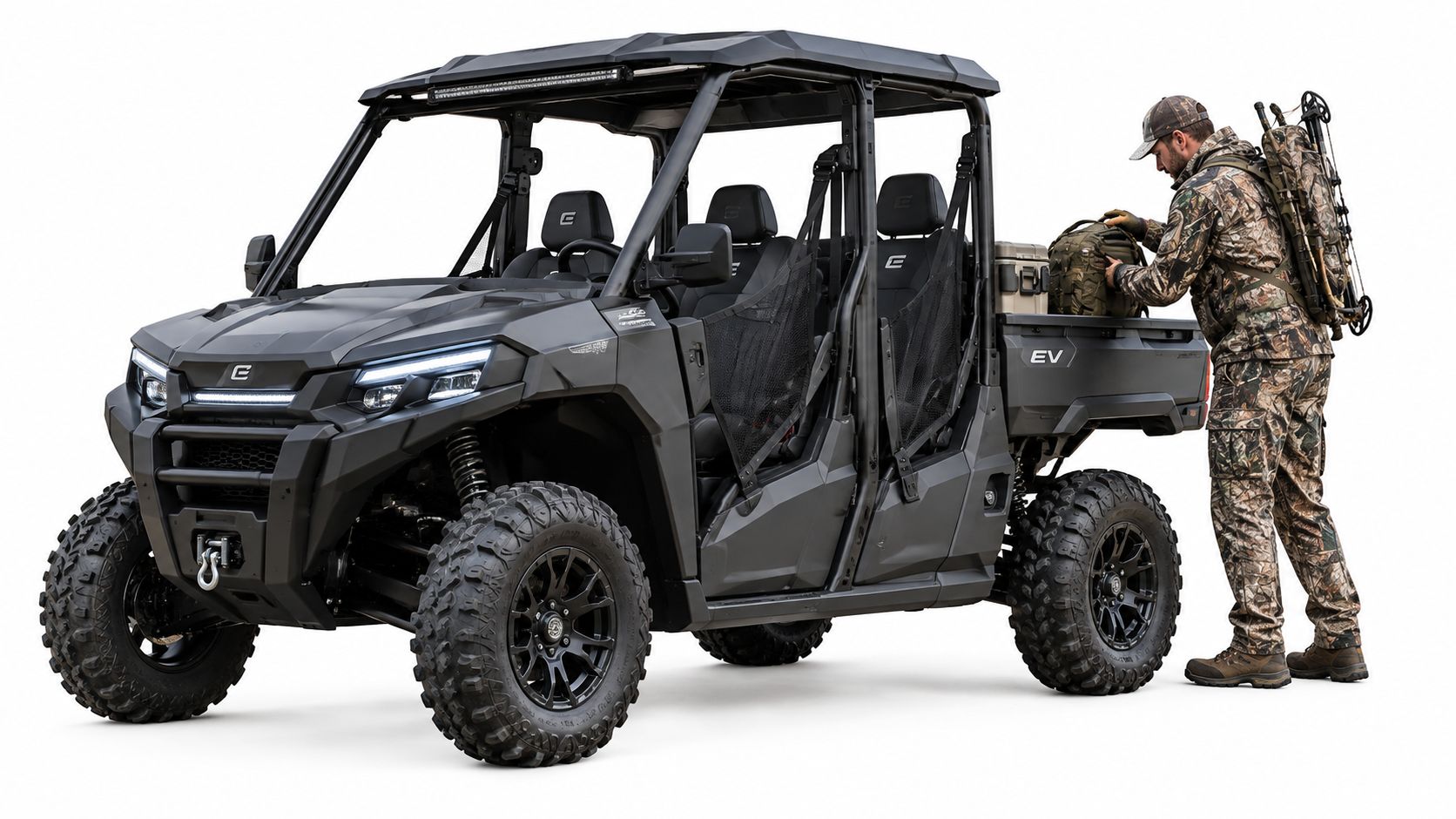
Some buyers shouldn't buy one yet. If your days involve long-distance remote use with no reliable charging plan, constant high-speed trail riding, or heavy towing far from your property base, you need to be brutally honest. Electric works best when the machine returns to a known place and a known charger.
Practical rule: Buy an electric UTV when your workday is repetitive enough to measure and your charging location is predictable.
What an electric UTV is not
It's not maintenance-free. It's not immune to weather. It's not automatically cheaper just because it uses electricity.
You still need to think about tires, suspension wear, brakes, charging routines, storage conditions, and battery behavior in winter. Serious buyers make the mistake of assuming electric removes planning. It doesn't. It changes what you have to plan around.
Where electric UTVs actually get sold
The shopping channel matters almost as much as the machine. I'd rank your buying options like this:
- Authorized brand dealers
- Regional powersports dealers that officially carry an electric line
- Dedicated EV-UTV showrooms
- Used listings, auctions, and independent resellers
That order isn't arbitrary. Warranty claims, software updates, recall handling, financing access, and trained service support usually get cleaner when the dealer is officially tied to the brand.
How to vet the seller before you care about the spec sheet
Run this checklist on every dealer conversation:
- Confirm authorization: Ask if they are an authorized dealer for that exact brand and model line.
- Ask about service in writing: Can they diagnose battery, charger, controller, and software issues, or do they outsource everything?
- Verify parts support: Ask what common wear items and electrical components they can get.
- Check technician training: A UTV mechanic who only knows gas engines isn't enough.
- Request a real demo: Not a parking lot crawl. Ask for a route that resembles your property or work pattern.
- Ask about recall handling: Who contacts you, who performs the work, and where?
- Review distance to service: If the closest competent shop is too far from where you use the machine, ownership gets annoying fast.
Dealer quality decides whether a small issue stays small.
A weak dealer can turn a good electric UTV into a headache. A strong dealer can make a modest spec sheet much easier to own.
Specs That Matter for an Electric UTV
A serious buyer should compare four spec families: motor output, battery capacity, drive configuration, and working hardware. Those categories reveal whether an electric UTV can handle the daily workload, rather than merely look capable on a listing page.
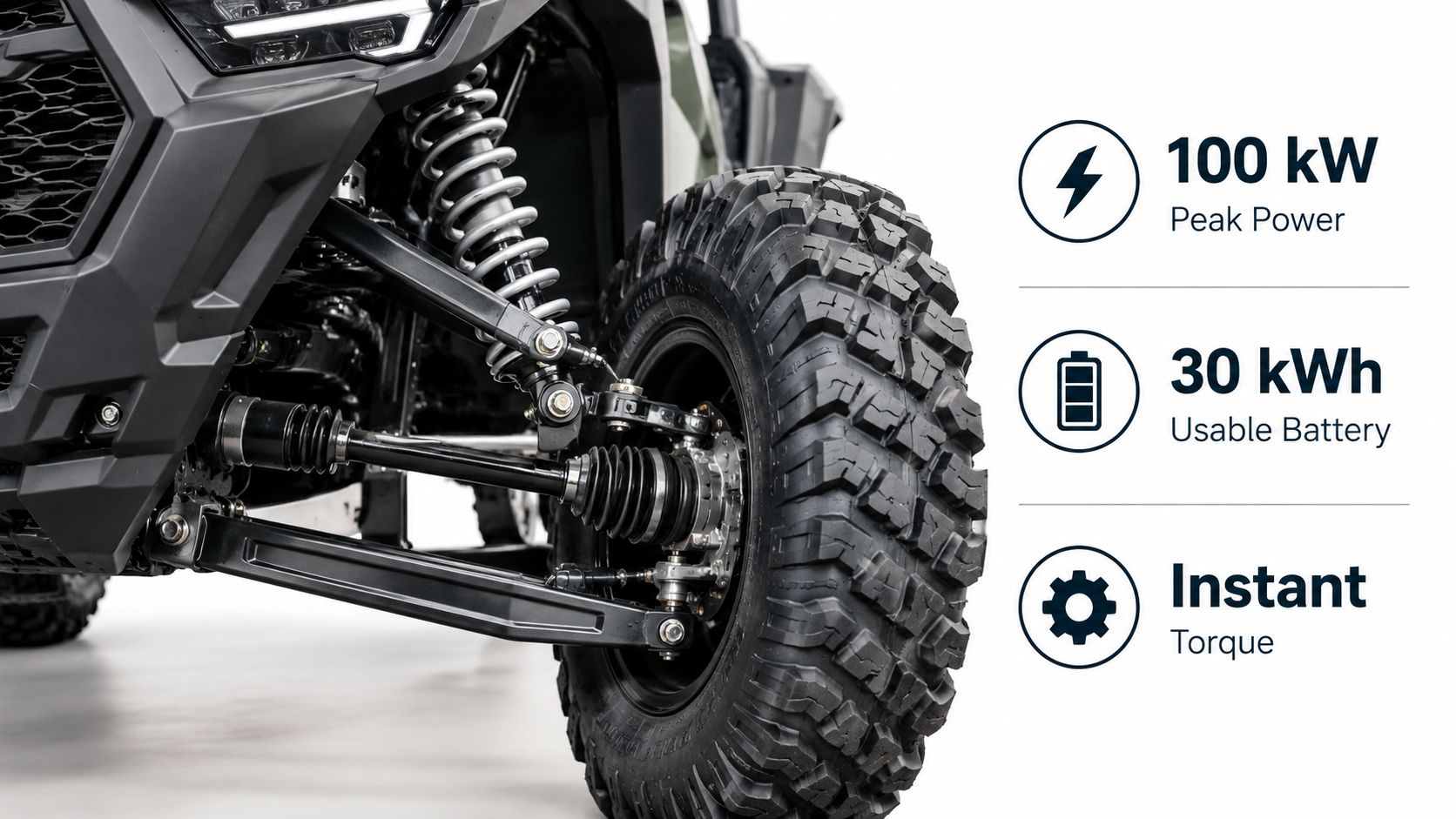
The Campus E1 provides a useful example. Its published equipment includes a 20 kW PMSM motor, a 72V 150Ah lithium pack, on-demand 2WD/4WD, a 3,000 lb winch, and an electric dump bed. Each item answers a practical ownership question: how it pulls, how much energy it carries, where it can travel, and what work it can complete.
Translate motor and battery figures
Motor output matters under load. It affects hill climbing, traction in soft ground, and repeated starts with a full bed. A stronger electric motor setup gives you more confidence leaving a gate, crossing a ditch, or climbing with tools and materials aboard. Match the output to the terrain and payload, not to the largest figure in a brochure.
Battery capacity needs the same treatment. A 72V 150Ah pack stores roughly 10.8 kWh of nominal energy, calculated by multiplying volts by amp-hours and dividing by 1,000. Compare that energy figure across machines, then account for usable state of charge, conversion losses, accessories, terrain, and temperature. Amp-hours alone can make two batteries look comparable when they are not.
Working hardware decides whether the UTV earns its keep
- On-demand 2WD and 4WD: Choose this setup if your routes include both firm property roads and muddy or slippery sections.
- Electric dump bed: It pays off when you regularly move feed, soil, tools, or debris. Repeated lifting is where this feature earns its place.
- 3,000 lb winch: Useful for self-recovery, moving material, or assisting another machine in mud.
- Three-seat layout: A sensible choice when a second worker, family member, or passenger often rides along.
If you want a closer look at how these features work together on a current electric side-by-side, this walkaround helps:
Ignore vague claims such as “premium off-road performance.” Ask whether the UTV climbs loaded without strain, recovers itself when traction disappears, and carries enough material to replace a trailer for small jobs. Those answers matter more than isolated motor or battery figures.
Real-World Range and Charging for Electric UTV Work
The brochure number is a controlled result, not a workday promise. Your terrain, speed, payload, tire pressure, weather, and drive mode determine what the machine delivers in the field. Build your own duty cycle before comparing listings, especially if the UTV must complete a route and return with reserve.
Stop shopping by one mileage number
Buying coverage reports many electric UTVs in a range of roughly 25 to 45 miles, while charging may take 4 to 12 hours, depending on the machine and charging setup, as discussed in this electric UTV range overview. That spread is enough reason to question any single headline mileage claim.
Write down the work the UTV must perform:
- Miles traveled: Count the complete out-and-back route, not only the distance to the farthest point.
- Hours of low-speed work: Checking stock, opening gates, and moving between buildings still consume energy.
- Payload carried: Feed sacks, tools, sprayers, fencing material, and game weight all affect range.
- Terrain: Mud, grass, hills, and loose surfaces reduce the distance available from a charge.
- Return requirement: If the vehicle must come home under its own power, reserve that energy before planning the route.
Treat advertised range as a lab number. Treat your route as the truth.
A practical range test should match your hardest recurring work pattern. Ask the dealer to let you drive the route with the load you will carry. Record the state of charge before and after, along with drive mode, temperature, and tire pressure. If the machine offers another traction setting, repeat the relevant section there. This gives you a useful comparison between listings and exposes whether the advertised range fits your routine.
If you want practical ways to extend operating time after purchase, Campus EV's guide to improving electric UTV efficiency connects driving and charging habits with everyday side-by-side use.
Charging is part of fit, not an afterthought
Some owners can complete their work with overnight charging from a standard outlet. Others need faster turnaround and should plan for a higher-voltage charging setup. Choose the charging arrangement around the next work cycle, not showroom convenience. A vehicle that cannot recharge before the next shift is poorly matched to the job, regardless of its advertised range.
Cold weather adds another planning requirement. A cold battery can affect charging procedure and available operating performance, while storage state of charge also matters. Ask the dealer exactly how the pack should be charged and stored in your climate. If the answer is vague, keep shopping for a dealer who understands electric work vehicles and can support ownership after delivery.
Matching the Right Electric UTV to Your Use Case
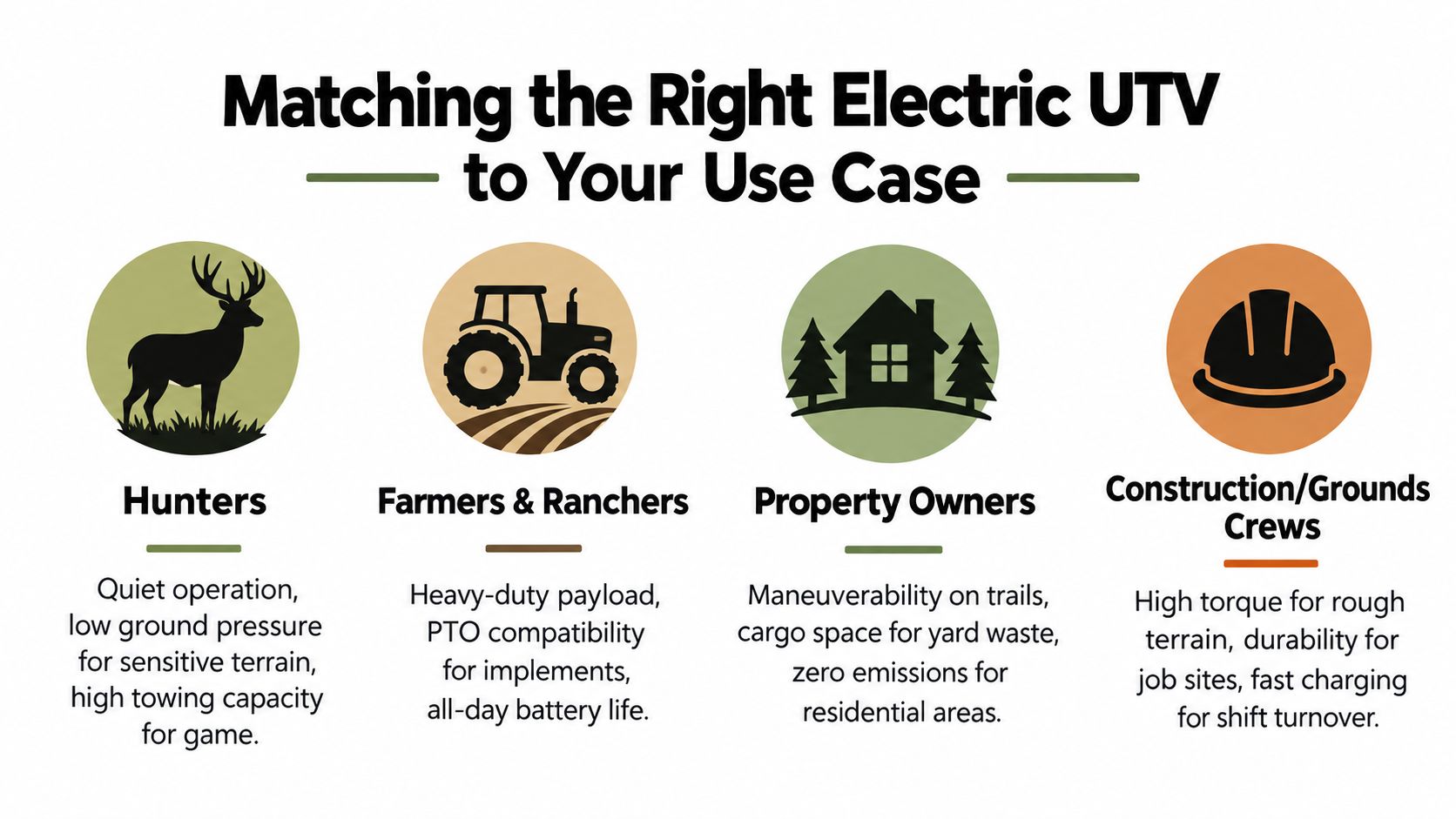
The right electric UTV for sale depends less on the badge and more on the day you expect it to finish. Buyers in different jobs should not shop the same way.
Hunters
Hunters should care about quiet approach, enough real range to get to and from remote access points, and a winch for recovery problems. You also need a realistic charging setup at camp, cabin, barn, or home base. If charging access is sloppy, the rest of the machine won't save you.
A hunting setup should also tolerate rough approach roads and occasional mud without forcing you into unnecessary 4WD use all day. That's where a selectable drive system earns its keep.
Farmers and ranchers
This group should shop for bed usefulness first, then traction, then charging discipline. Daily utility matters more than flashy trim.
Repeated stop-start chores are a good fit for electric. What isn't optional is cold-weather ownership planning. If you ranch in winter conditions, look hard at charge procedures, battery protections, and whether the dealer can explain how the machine behaves after sitting in the cold. If ranch work is your primary use, Campus EV also has a model-specific perspective on the best electric UTV considerations for ranchers.
A ranch UTV that charges poorly in winter is not a ranch UTV. It's a seasonal toy.
Property owners
Acreage owners need balance more than extremes. You want enough capability for trail work, debris hauling, fence repair, and general movement around the property without buying a machine that's oversized for your routine.
Look for easy ingress, useful cargo space, a bed you'll really use, and tires that suit mixed surfaces. The best ownership experiences in this group usually come from buyers with a stable storage location and a predictable charging routine.
Construction and grounds crews
Crews should be hard-nosed about payload behavior, dump-bed usefulness, and overnight charging turnaround. You're buying labor support, not a novelty unit.
A machine in this category should also be chosen with dealer support in mind. Commercial users can't tolerate long downtime for basic service questions.
| Use Case | What to prioritize first | What will cause regret |
|---|---|---|
| Hunting | Quiet operation, traction options, winch, return-range planning | Buying on brochure range alone |
| Farm and ranch | Bed utility, repeat-trip practicality, winter charging procedure | Ignoring cold-weather charging behavior |
| Property ownership | Versatility, simple charging, mixed-terrain comfort | Overspending on capability you won't use |
| Construction and grounds | Dump bed, workday readiness, service support | Weak dealer backing |
Financing, Total Cost, and What Ownership Really Looks Like
The sales conversation usually starts with monthly payment. That's fine, but it's incomplete. A serious buyer needs to look at cash flow, service pattern, battery planning, and insurance.
Financing for electric UTVs often runs through dealer-arranged programs, manufacturer-backed offers where available, and trade-in structures if you're replacing another machine. Leasing can work for some commercial users, but many rural and property buyers are better off purchasing if the unit stays in regular use for years.
One current example in the category is that Campus EV offers 0% APR financing through authorized dealers, and the Campus E1 includes CarPlay/Android Auto. Those are ownership factors, not just showroom talking points. Financing affects affordability now. Connectivity can matter later when resale buyers compare equipment.
The costs that belong in your spreadsheet
Use a simple framework. Put every ownership line in one place and stop pretending the sticker is the whole story.
| Cost Line | Electric UTV | Gas UTV (Comparable Class) |
|---|---|---|
| Energy or fuel | Electricity cost | Gasoline cost |
| Routine engine service | No oil changes or spark plugs | Oil, filters, engine-related service |
| Drivetrain wear items | Fewer engine-related components | More engine and fuel-system components |
| Tires | Still a real cost on rough ground | Still a real cost on rough ground |
| Insurance | Varies by use and carrier | Varies by use and carrier |
| Registration and local compliance | Depends on jurisdiction | Depends on jurisdiction |
| Long-horizon major cost | Battery replacement planning | Engine or fuel-system repair planning |
If you want a practical way to think about insurance inputs, this tractor insurance cost guide is useful because it shows the kind of coverage variables owners should ask about, even if your machine category differs. The point is to think in terms of use, storage, liability, and property risk, not just premium shopping.
For pricing context on current side-by-side models, Campus EV's side-by-side pricing page is a reasonable starting point when you want to compare financing discussions against actual machine configuration.
My blunt advice on cost
Don't buy electric because you assume it's automatically cheaper. Buy it because the operating pattern fits your property, your chores, and your charging setup. Then check whether the payment, insurance, wear items, and future battery planning still make sense.
Maintenance, Warranty, and Battery Care Over Time
Electric UTV maintenance is simpler than gas ownership, but simpler doesn't mean casual. You'll skip oil changes, spark plugs, and fuel-system service. What remains needs to be done consistently.
Tires, brakes, suspension bushings, wheel hardware, steering components, charge equipment, and software support still matter. Off-road machines live rough lives whether they burn fuel or not.
The battery temperature routine smart owners follow
Battery temperature should be treated like a real inspection item, not trivia. A practical ownership routine looks like this:
- Confirm allowed charge and discharge temperatures: Don't assume the machine can be charged normally in every weather condition.
- Verify battery management protections: Ask whether the pack has temperature monitoring and protective cutoffs.
- Test charging in your climate: A cold-soaked or heat-soaked machine should be part of the evaluation if that reflects your conditions.
- Document behavior changes: Watch for differences in power delivery, charging speed, and usable range under hot or cold conditions.
Lithium-ion research reports that low temperatures increase resistance, lower the discharge-voltage plateau, and can cause the battery to reach cutoff voltage sooner, while high temperatures accelerate electrode and electrolyte degradation. The same research also notes that one experimental study reported a lithium-ion module did not fully charge at 65 °C, whereas normal charging performance was achieved around 25–35 °C in this battery temperature study.
If a dealer can't explain cold-weather charging procedure clearly, keep shopping.
What the warranty should answer
Ask these questions plainly:
- Battery coverage: What exactly is covered, and under what conditions?
- Drivetrain coverage: Which motor, controller, and related components are included?
- Corrosion and environmental exposure: Off-road use brings moisture, dirt, and wash-down realities.
- Service location: Who performs warranty work?
- Voids: What owner behavior can jeopardize coverage?
The cold-weather ownership detail people skip
Require a written charging and storage procedure for winter use. Confirm that the charger cannot bypass battery protections. Avoid storing a fully depleted pack. Those are basic ownership disciplines, and they protect range, battery health, and resale value.
Bringing It All Together for a Confident Purchase
Anyone shopping an electric UTV for sale often asks the wrong first question. They ask how far it goes. The better question is whether it will finish your day and be ready for the next one.
That purchase decision gets much easier when you run three hard questions.
Question one is about the route
Will the machine cover your full recurring duty cycle with reserve, or are you secretly depending on luck? If your route includes loaded climbs, muddy pasture sections, repeated gate stops, or hunting access in rough country, test that exact pattern before you buy.
Question two is about the dealer
Is there an authorized dealer with real service capability within practical reach of where you'll use the vehicle? Not just a showroom. Not just a sales office. A place that can support the machine when ownership gets real.
Question three is about the full cost
Does the total cost picture fit the operation? That includes financing terms, routine wear items, insurance, storage reality, and long-term battery planning. If the machine only works on paper because you ignored one of those lines, it doesn't fit.
A benchmark worth using
If you want one model to use as a benchmark while comparing options, the Campus E1 gives you a practical checklist rather than a fantasy one. On-demand 2WD/4WD, an electric dump bed, a 3,000 lb winch, a lithium powertrain, and CarPlay/Android Auto map to real use cases like hauling feed, moving tools, hunting access, and property work. That doesn't mean it's automatically your answer. It means those are the kinds of features serious buyers should measure across the category.
Test the route, test the climate, test the dealer.
That's the action list. Not brochure range. Not a polished showroom speech. Run the route you'll drive. Check how the machine behaves in the temperatures you live with. Judge the dealer by service depth, not just friendliness.
Do that, and you'll know whether the electric UTV in front of you belongs on your property or belongs back on the lot.
Campus EV focuses on electric UTVs built for hunting, farm and ranch chores, property work, and other real utility use, with authorized dealer support and financing options that matter once ownership starts. If you want to compare a serious electric side-by-side against your actual workload instead of a brochure promise, visit Campus EV.