
A wider blade doesn't make an electric side-by-side better at plowing. It often makes it worse. Extra width adds front-end weight, steals steering feel, and forces the motor to push a heavier windrow on every pass. If the mount, axle, tires, and battery weren't sized for that load, you'll finish slower than you would with a narrower setup.
That's the core rule for any SxS snow plow on an electric UTV. You're not buying a blade. You're buying a complete work system that has to clear your route, protect the frame, and get back to the charger with reserve left. Start with route length, snow depth, and lift count. Blade width comes last.
Table of Contents
- Plow Types and Where Each One Fits
- Blade Size, Weight and Angle Trade-offs
- Winch Lift or Hydraulic Lift Compared
- Checking Fitment Before You Buy a Plow
- Cold-Weather Battery Planning for Electric UTVs
- Safe Operation and Routine Maintenance
- Matching the Setup to Farms, Campuses and Trails
- Confirm Your Setup and Common Questions
Plow Types and Where Each One Fits
| Plow type | Typical use | Main trade-off |
|---|---|---|
| Straight blade | Driveways, farm lanes, short private roads | Pushes snow to one side; simplest mount |
| V-plow | Wider areas where snow should go to both sides | Heaviest front-end load of the common types |
| Mid-duty winch-lift blade | Residential drives, rural access, property upkeep | Winch lift is slower; blade must be lowered for travel |
| Hydraulic-lift blade | Frequent height and angle changes on stop-and-start routes | Needs a power source and more hardware |
Rule out types in buyer order
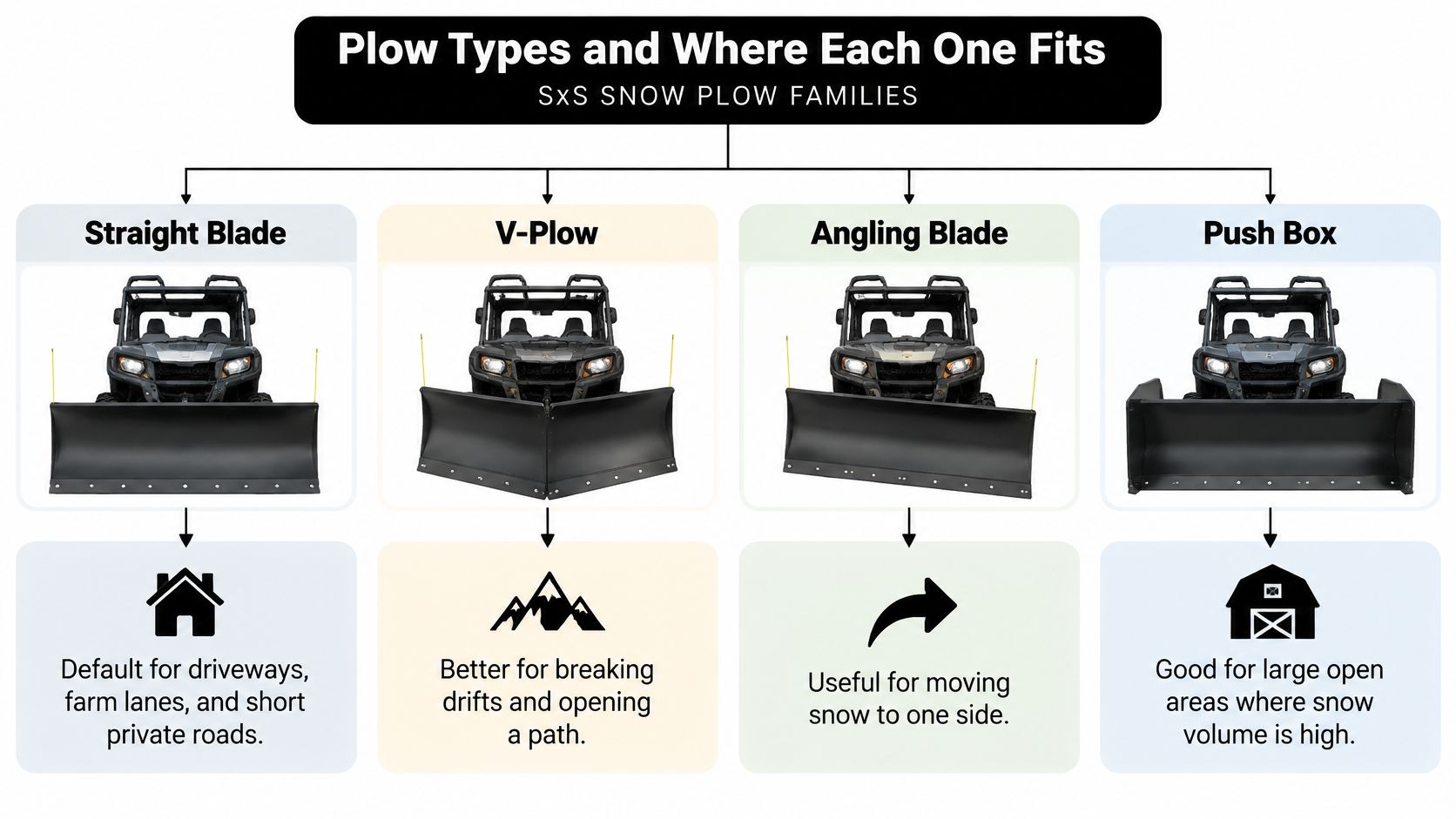
Start with a straight blade. It's the default for most owners because it's light, simple to mount, and easy to repair. Angle it, roll snow to one side, and work a driveway or farm lane in overlapping passes. For short private roads, that simplicity beats extra features you won't use.
Rule in a V-plow only when you regularly need to break a first path through drifts or throw snow to both sides of a wider lane. The center point helps you open a track, and the wings can carry snow in scoop position. You pay for that with the heaviest front-end load here, more hinge points, and a harder check on suspension and axle capacity.
A mid-duty winch-lift blade is where most residential and property setups land. You use the vehicle's winch to raise and lower the blade, keep the hardware count low, and accept a slower lift. A hydraulic-lift blade changes height and angle faster from the seat. That helps on stop-and-start work with curbs, aprons, and gate openings, but it adds a pump, lines, controls, and another electrical load to budget.
A plow is blade, push frame, mount, lift, and wiring working together. A strong blade on the wrong mount is still the wrong plow.
Answer three questions first
Before you compare brands, write down three answers. How long is the route from storage to the farthest point and back? How deep does snow usually get before you plow, not after a once-a-decade storm? How often will you use it, daily during snow season or only after storms?
Those answers rule out most bad matches. A short driveway plowed after each storm suits a straight, winch-lift blade. A long lane with drifting may justify a V-plow if the front end is rated for it. A property with constant angle changes may justify hydraulics. I'd start simple and only move up when your route proves you need it.
Blade Size, Weight and Angle Trade-offs
| Blade or system | Approximate weight | What the weight changes |
|---|---|---|
| Mid-duty system (before vehicle mount) | 170–195 lb | Front suspension compression and steering effort |
| 6-ft UTV straight blade | About 261 lb | Stopping distance and front-end payload |
| UTV V-plow | About 354 lb | Largest front-end load in this set; confirm axle rating |
| 6-ft blade fully angled | Clears about 5 ft in some setups | Narrower path than nominal width |
Weight decides whether the vehicle still steers and stops properly with the blade raised. The SnowEx mid-duty UTV plow range sits in a class where representative mid-duty systems weigh approximately 170–195 lb before the vehicle mount, while 6-foot UTV straight blades can weigh about 261 lb and V-plows about 354 lb. Don't read those numbers as shipping trivia. That mass hangs ahead of the front tires.
What front-end mass does to the vehicle
Added blade mass compresses the front suspension, increases steering effort, and lengthens stopping distance. The load gets worse when the blade is raised because its weight sits forward and high enough to change how the front end carries it. On soft or rutted ground, a nose-heavy UTV also loses the clean tire bite you need to keep a windrow moving.
A winch that can lift the blade doesn't settle the question. Lifting force only proves the cable can raise the load. It doesn't prove the front axle, suspension, chassis, or accessory limit allows you to carry and push with it for a full route. Check those ratings separately, with the mount included in the total.
Size for angled width, not the label
You'll plow angled most of the time, because a straight-ahead blade just builds a pile in front of you. Angling narrows the clearing path. A nominal 6-foot blade may clear only roughly 5 feet when fully angled in some configurations, so a blade that looks wide enough in the catalog can leave your tires running in uncleared snow.
Your tires then pack that leftover strip into ridges. You make extra cleanup passes, burn more battery, and leave ice lines where the tires ran. The angled clearing width must still exceed your tire track. That's the minimum, not a nice extra.
Angle has a second trade-off. More angle throws snow farther to the side, but each pass clears less ground. A steeper attack angle scrapes packed snow better, yet it adds cutting resistance and makes the motor work harder. In light powder you won't notice much. In wet snow you'll feel it in speed, traction, and current draw.
Selection rule: Pick a steel cutting edge with trip protection, so the edge or moldboard yields on a fixed obstacle instead of sending the full shock into the mount and frame.
Run the sizing routine
Measure your tire track outside to outside. Check the manual for front-axle, suspension, winch, and accessory limits. Add blade, mount, and push frame weight together. Then choose the widest blade whose angled width covers the track while the total load stays inside those limits. If a blade fails either test, it's the wrong size, no matter how good the price looks.
Winch Lift or Hydraulic Lift Compared
| Lift method | Best for | Watch for |
|---|---|---|
| Winch lift | Intermittent residential, farm-lane and property work | Slower raise; lower the blade for travel |
| Hydraulic lift | Frequent height and angle changes on stop-and-start routes | Needs a power source; more hardware and upkeep |
| Manual angle lock | Light, occasional snow on short drives | Stop, park and secure the vehicle before changing angle |
Lift choice isn't about which system sounds stronger. It's about how often you lift, how fast you need the blade to respond, and how much hardware you're willing to maintain through winter.
Where winch lift fits
Winch lift suits owners who raise the blade at the end of a pass, turn, drop it, and go again. The hardware is familiar, parts are easy to inspect, and there's no pump or hydraulic line to protect. Raise speed is slower, and cable wear matters. Check for frayed strands, crushed sections, and ice packed around the drum and fairlead before you start.
Synthetic rope handles repeated short lifts well if it's kept clean and spooled evenly. Wire cable tolerates abrasion but punishes you with broken strands once it starts to fail. Either way, a worn line under a raised blade is a bad place to save money.
Where hydraulic lift earns its cost
Hydraulic lift earns its keep when you're constantly feathering blade height over aprons, drainage lips, and uneven lot edges, or changing angle without leaving the seat. Response is quicker and control is finer. You also take on a pump, reservoir, hoses, fittings, and controls. On an electric UTV, that power draw belongs in your route budget, not as an afterthought.
Cold thickens hydraulic fluid and exposes weak seals. Inspect hoses for rub points where they cross the push frame, keep couplers capped and clean, and clear snow from hinge points before the first lift. A small leak at the start of a storm becomes a blade that won't hold height by the last pass.
Count lifts on a normal route. One lift per pass points to a winch. Many lifts and angle changes per route make hydraulics worth pricing.
Make the count decide
Walk your route on paper. Count every lift at road crossings, garage aprons, gates, and turnarounds, plus every angle change. Write that lifts-per-route number down. It decides the mechanism more reliably than any brochure claim about speed or power.
Checking Fitment Before You Buy a Plow
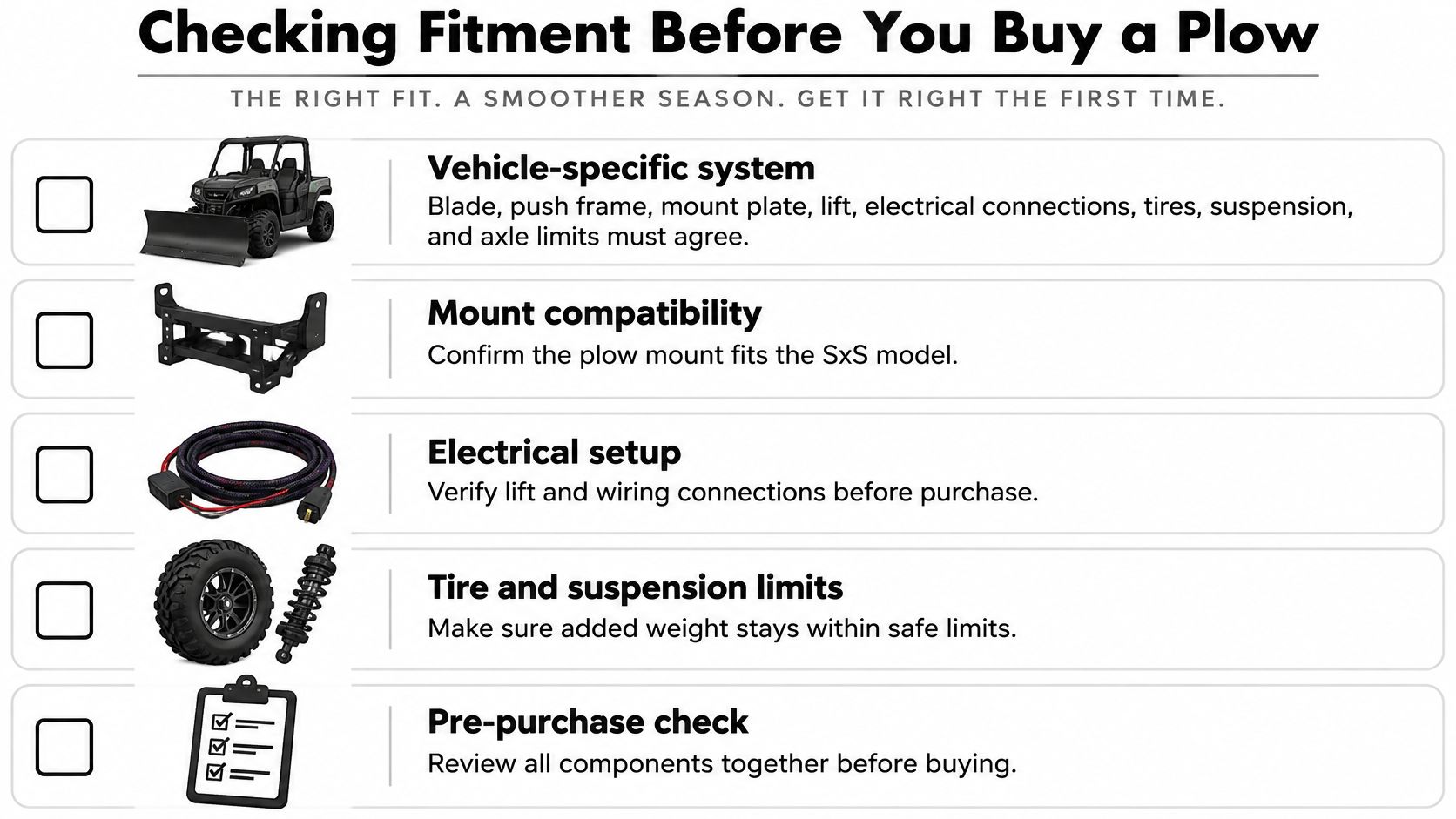
Fitment fails when owners treat a plow as a universal accessory. It isn't. Guidance collected by Snow & Ice America on ATV and UTV plows makes the point plainly, a plow system is a vehicle-specific combination of blade, mount, push frame, lift, electrical connections, tires, suspension, and axle limits, and the mount plate is model-specific, with different hardware needed even within the same brand family.
Run the fitment gate
- Exact model year and trim: Confirm the mount for your precise vehicle. A wrong answer is a plate that almost lines up and gets forced into place.
- Mount attachment points: Verify the frame points are designed for blade loads. A wrong answer is an aftermarket mount bolted to structure that was never meant to push snow.
- Blade width when angled: Compare angled width with tire track, not the nominal label. A wrong answer leaves tires packing snow on every pass.
- Lift amperage and winch rating: Confirm the lift can raise the complete blade and push frame repeatedly. A wrong answer is a winch that lifts once when warm and strains when iced.
- Front-axle and suspension capacity: Include blade, mount, driver, and cargo with the blade raised. A wrong answer is a front end sitting on its bump stops before you move.
- Traction and clearance: Check tire tread, pressure, and ground clearance with the attachment fitted. A wrong answer is a mount that drags on the first ramp or frozen rut.
- Warranty permission: Confirm plowing is allowed for the vehicle and attachment. A wrong answer is learning after a frame claim that plow use was excluded.
What a bad fit looks like in use
A poor mount doesn't always fail on day one. It shifts under load, wallows out bolt holes, and sends shock into places the frame wasn't braced for. Loose push-frame pins let the blade chatter. Chatter breaks traction and makes the blade edge skip over packed snow instead of scraping it.
Don't use the plow as a battering ram against hard snowbanks. Impact loads aren't the same as steady pushing loads, and no fitment check turns a compact UTV into a bank-breaking machine. Cut banks down in slices or leave them for heavier equipment.
Motor torque and headline range don't prove plow suitability. Plow loads are dynamic and concentrated at the front. Get written confirmation from the dealer or manufacturer for your exact model and year before you pay, and keep it with the warranty papers.
Cold-Weather Battery Planning for Electric UTVs
Cold turns an electric plow setup into an energy budget, not a traction spec. Instant torque helps start a windrow moving, while low temperature cuts the stored energy you can use. If you plan from a fair-weather range figure, the first real storm exposes it.
Plan the vehicle, blade, front-end load, and charger as one system before the first storm. A heavier blade and mount change how the machine carries weight, and deep snow keeps the motor working for longer stretches.
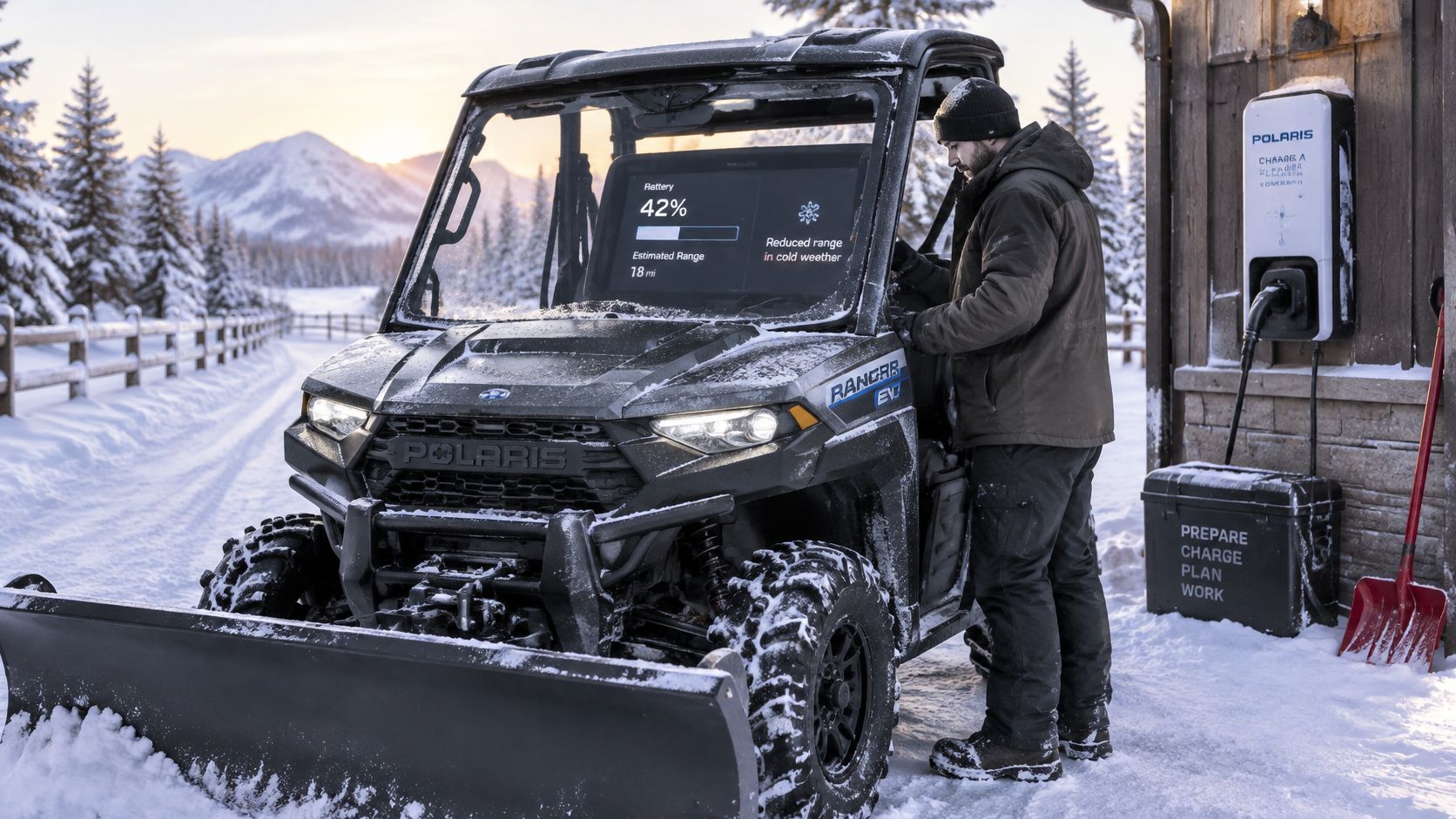
Cold reduces usable lithium-ion capacity and makes charging less forgiving. For a 72V 150Ah lithium pack such as the Campus E1's, judge the finish: can it complete your defined route after cold derating, front-end loading, and accessory loads? Overnight charging helps only when the route fits inside the energy you can use that morning.
Count every load on the route
The drive motor under snow load is only the start. Add headlights for early or late plowing, a cab heater if you run one, repeated winch or hydraulic lift cycles, and stop-start passes where you accelerate a loaded blade again and again. Wet snow raises all of it. So does spinning tires instead of backing off and taking a narrower bite.
Route habits protect range. Preheat the battery where the vehicle allows it, store the UTV under cover, and start at an appropriate state of charge rather than whatever was left after yesterday's chores. Cut unnecessary lift cycles by planning pass direction so snow ends up where you want it the first time. Our guidance on how to improve electric UTV efficiency covers the same discipline for everyday driving, and it matters more when a blade is fitted.
Work the route-energy worksheet
- Measure the route: Record total distance from storage, around every area you clear, and back.
- Count passes per storm: Include overlap passes and cleanup passes, not just first cuts.
- Estimate time per pass: Use a steady low plowing speed, not travel speed with the blade up.
- Add accessory load: Write down lights, heater use, and your lifts-per-route count for the full job.
- Apply cold derating: Reduce usable capacity for freezing conditions before you judge the result.
- Set your reserve: Decide in advance how much charge must remain when you park, and size it conservatively.
The video below is useful context for how quickly winter conditions change the work a compact electric machine has to do.
A worksheet that only works when every pass goes perfectly does not work. Shorten the route per charge, plow earlier before snow gets deep, or add a planned charge stop between areas. Electric UTVs suit short private drives, farms, camps, and property maintenance well when route length, snow depth, temperature, charging access, and recovery time line up. Long routes in deep snow need that charging plan settled before the first storm, not during it.
Safe Operation and Routine Maintenance
Deep, wet, or wind-packed snow pulls far more continuous motor and battery demand than light powder. The SuperATV Plow Pro listing reflects common commercial geometry, with selectable left/right angles up to 30 degrees and attack-angle adjustment around 52–65 degrees. More angle moves snow farther sideways, and a more aggressive attack angle scrapes packed snow harder while increasing cutting resistance.
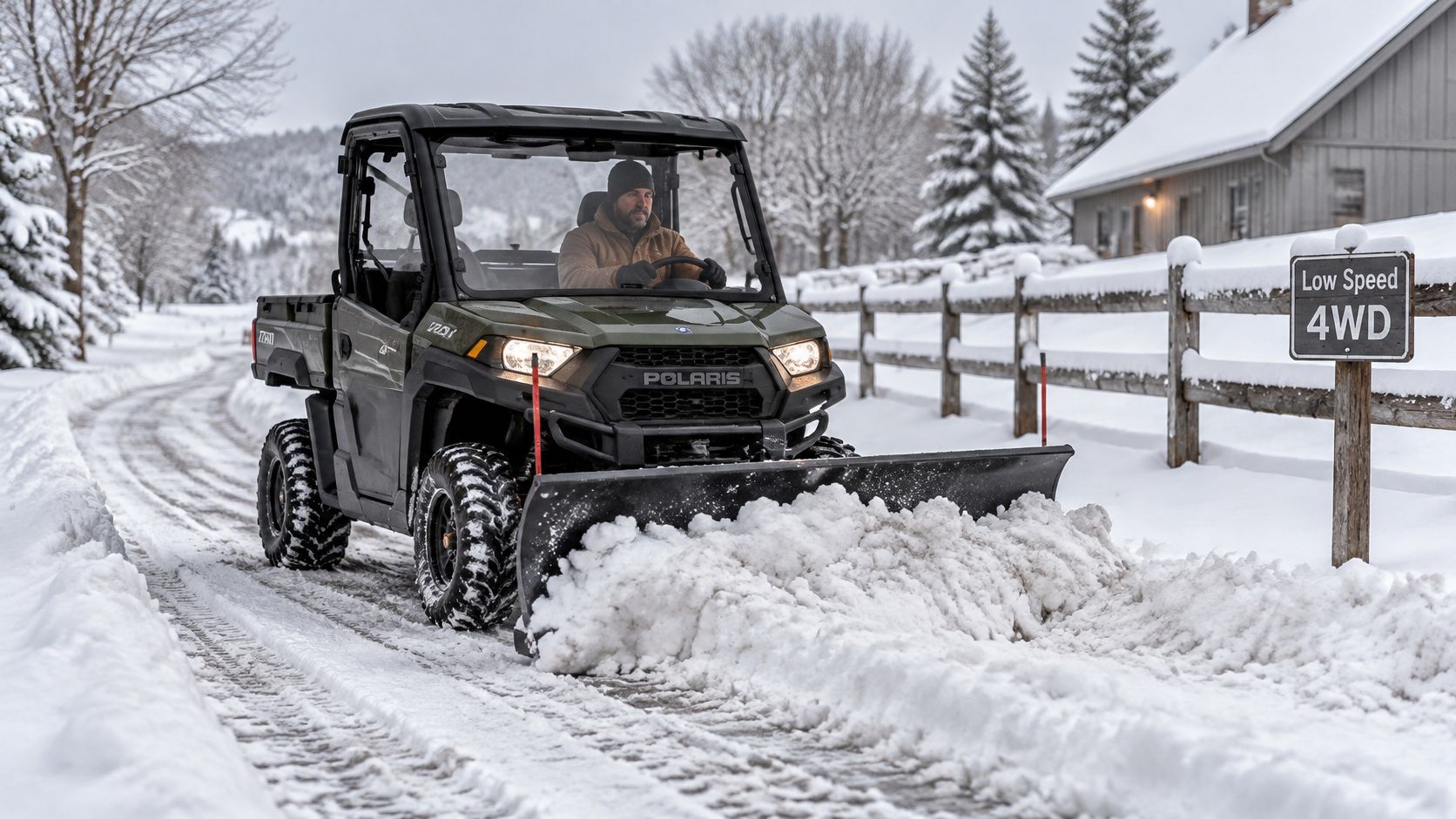
Use 4WD, hold a steady low speed, and take narrower passes when the blade starts rolling a heavy windrow. Repeated high-current impacts don't clear faster. They shock the mount, spin tires, and drain the pack. Back up, reduce the bite, and keep the blade moving.
Safety steps during the route
- Keep bystanders clear: Keep people well away from a moving blade, especially on the side you're angling snow toward, since the blade throws slush and debris outward.
- Stop before adjustments: Stop, park, and secure the vehicle before changing angle or disconnecting the plow.
- Clear the hardware: Keep lift cables, hitch connections, and hinge points free of packed snow and ice.
- Avoid bank impacts: Don't hit hard snowbanks at speed to break them loose.
- Respect the speed cap: Follow the travel and operating speed limits in your plow manufacturer's manual, including any limit that applies with the blade raised.
Lower the blade during travel where the manual requires it, and remember that ground clearance drops with the attachment installed. Check ramps, ruts, drainage crossings, and uneven transitions before you enter them. A mount that clears your driveway apron in summer trim may hang up with the push frame fitted. Carry that clearance loss in mind on every route, because the frame hangs lower than the blade edge suggests.
Post-storm routine
- Wipe the blade edge: Remove packed snow and grit before it freezes in place.
- Check bolts and trip parts: Confirm fasteners are tight and the trip mechanism moves and returns.
- Inspect mount and pins: Look for elongated holes, bent pins, and cracked paint around welds.
- Inspect lift parts: Check winch cable or hydraulic lines for frays, leaks, and rub points.
- Store it raised and covered: Keep the blade off wet ground and under cover where possible.
A trip edge that doesn't return cleanly leaves snow behind on the next pass, and the cause is usually ice packed in the hinge or a weak spring rather than a bent blade. Catching that after the storm costs minutes. Catching it mid-route costs the route. The same discipline behind essential preventive maintenance tasks for equipment applies to plows, because small catches after each storm prevent mid-storm failures. If you're tracking ownership costs across seasons, our breakdown of UTV maintenance cost helps you separate routine wear items from damage caused by overload.
Matching the Setup to Farms, Campuses and Trails
Farms and ranches
Route length decides the farm setup. Long lanes, feed roads, and gate approaches mean the vehicle may be far from its charger when the blade is working hardest. Check whether the battery covers the full lane and back in cold weather with your reserve intact. A winch-lift straight blade usually fits because you're making long, simple passes and lifting mainly at gates and turnarounds.
Gravel changes technique. Raise the blade slightly on skid shoes so you don't scrape stone into the yard, and accept a thin packed layer early in the season. That layer protects the lane surface once it freezes. For broader farm use cases, our page on an electric utility vehicle for farm work shows how plowing fits alongside hauling and towing duties. Farm owners reviewing risk around buildings, lanes, and equipment use can also compare farm property cover as part of the same winter planning.
Campuses and light commercial sites
Cycle count and charging access decide the campus setup. Walkways, small lots, and loading areas mean repeated short passes, frequent turns, and regular lifts at curbs and crossings. A mid-duty blade with a planned charge stop between areas works better than a heavy blade chosen for one wide lot. If operators change angle constantly to work around parked cars and building corners, that's when hydraulic control starts to justify itself.
Noise and early starts also matter on occupied sites. An electric UTV can clear before staff arrive without waking a residence block, but only if the charge plan covers the full round. Split the site into zones, plow the highest-traffic zone first, and charge during the natural break before secondary areas.
Trails and rough private roads
Ground clearance and traction decide the trail setup. Ruts, washouts, and uneven frozen ground punish wide blades and low mounts. Choose a narrower blade that stays inside the track when angled, keep tires at a pressure that lets the tread bite, and walk drainage crossings before the first storm so you know where the mount will dip.
Write down route length, passes per storm, typical snow depth, and nearest charging point. The first constraint that bites is the one to design around.
The same vehicle can take different setups on different properties. A farm lane rewards simplicity and range. A campus rewards cycle speed and charge access. A rough trail rewards clearance and restraint. Blade width doesn't settle any of those arguments by itself.
Confirm Your Setup and Common Questions
Use this sequence before the first storm, in this order. Skipping ahead to blade shopping is how owners end up with hardware the vehicle or route can't support.
- Confirm the route: Record route length, pass count per storm, and the battery reserve from your cold-weather worksheet.
- Choose plow type and angled width: Match the blade family to the property, then check angled width against tire track.
- Pick the lift method: Use your lifts-per-route count, not a preference for winch or hydraulic hardware.
- Verify fitment in writing: Get mount, axle, suspension, and warranty confirmation for the exact model year.
Check an electric UTV against the sequence
Run the Campus E1 through the same gate as any other machine. Its 3,000 lbs winch capacity sets the lift ceiling for a winch-lift blade, and its 72V 150Ah battery is the starting point for your reserve calculation. The vehicle also has front and rear 2-inch hitch receivers, with the hitch, ball and trailer wiring connection standard, which helps with related property work but doesn't rate the front end for plowing.
That's the distinction that matters. Winch capacity doesn't prove the chassis or front suspension is rated for the complete attachment. Ask the dealer or manufacturer to confirm front-axle and suspension capacity for the specific blade, mount, and push frame you plan to fit. If the answer isn't written and specific, you don't have confirmation yet.
Common questions
Is a plow practical on an electric UTV? Yes, when the route is short enough that your cold-weather worksheet still leaves reserve, the mount is model-specific, and the front end is rated for the complete system. It stops being practical when you need perfect conditions to finish.
What does a plow cost? As one budget anchor, a CFMOTO UForce snow-plow system listed by SideBySideSports was priced at USD 767.85 in 2026, against an MSRP of USD 806.24. Compare complete systems, blade, mount, push frame, and lift parts together, because a cheap blade with a separate mount can cost more than a bundled kit.
Does a strong winch mean the blade is fine? No. The winch only lifts. The frame, mount points, axle, and suspension carry and push. Rate each part separately.
Should you push into hard snowbanks to open a lane? No. Slice banks down gradually or use heavier equipment. Impact loading stresses the frame in ways steady plowing ratings don't cover.
When should you choose a V-plow over a straight blade? When drift-breaking and two-sided discharge are regular needs on your route, and the front end is confirmed for the extra weight. Occasional drifts don't justify carrying that load all winter.
Book the fitment check before you buy, not after the boxes arrive. Bring your route numbers, tire track measurement, and lifts-per-route count to that conversation. Keep the written confirmation with your warranty papers, and you'll know exactly what your setup is rated to do when the first storm hits.
If you're sizing an SxS snow plow for an electric UTV, Campus EV can help you check the Campus E1 against your route, blade weight, winch lift needs, and cold-weather reserve before you buy hardware. Bring your route length, pass count, and charging setup, and we'll help you confirm whether the vehicle and plow work as one system.