
You're at the gate with one partner, a bed full of mineral or gear, and a loop that has to finish before dark. The electric side-by-side's sheet says a long day on one charge. What you need to know is whether that pair, that load, and that route get home with power left.
A UTV 2 seater is built for that pair. Electric drive doesn't delete the energy problem. It moves it from a fuel can to a charger, a cord, or a generator at the far end of the property. Treat range and charging as a route mission, not a headline number.
Table of Contents
- Who Buys a Two-Seat UTV
- How Two-Seat Layouts Differ From Other Configurations
- Typical Specs to Expect in a Two-Seat UTV
- Passenger Safety Realities in Two-Seat Side-by-Sides
- How Real-World Range Compares to the Spec Sheet
- Charging a Two-Seat Electric UTV Away From the Barn
- Choose Your Two-Seat Electric UTV and Book a Test Drive
Who Buys a Two-Seat UTV
A two-seat UTV is a side-by-side that carries a driver and one passenger in adjacent seats, built for farm, hunting, and property work. It is not a single-rider ATV, and it is not a crew cab.
The people who get the most from it are specific.
- Farmers checking livestock, fences, and equipment, with one helper up front.
- Hunters reaching remote stands and hauling a harvest, which is why a dedicated look at hunting utility vehicles is worth the time before you buy.
- Ranchers and property owners covering large acreage in pairs.
- Workers on construction sites or warehouse grounds who need a second person in the cab, not a crowd.
The fit test is short. The layout suits one or two people who work the same routine loads together. It does not suit crews of three or more, families who need a rear bench, or operators who haul long loads every day. Those jobs belong on a three- or four-seat model.
Two-seat electric UTVs accounted for 31.6% of the global electric UTV market in 2025, with an estimated market value of $568.8 million, according to Market Intelo. That share is a buying pattern, not a reason to ignore seating. The rest of this guide walks the layout, the specs that matter, passenger safety, real range versus the sheet, charging away from the barn, and how to choose.
How Two-Seat Layouts Differ From Other Configurations
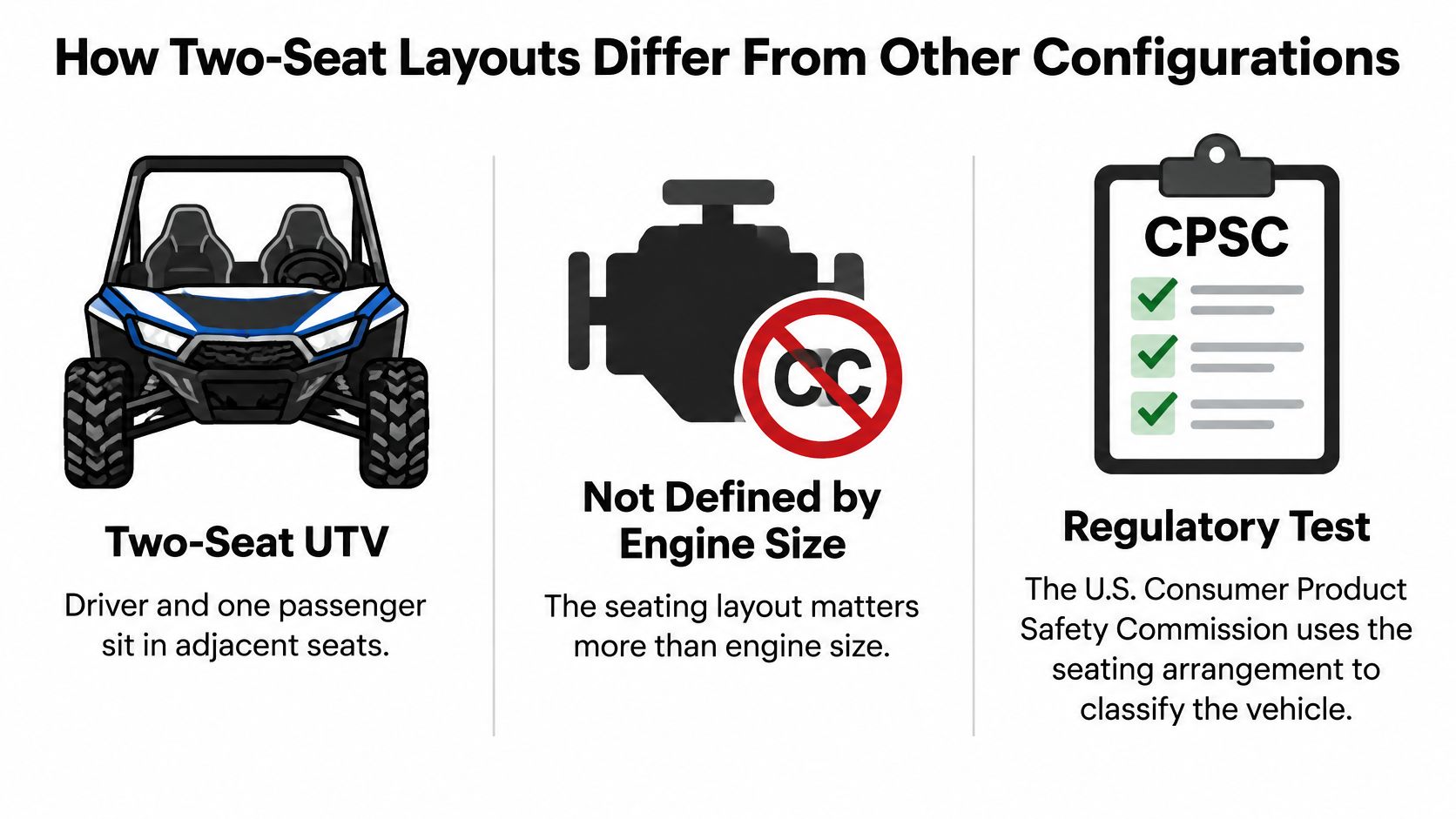
A two-seat UTV is defined by seating a driver and one passenger side by side, not by engine size or body style.
The U.S. Consumer Product Safety Commission classes these machines as off-highway vehicles with four or more pneumatic tires, automotive-style steering, throttle and braking controls, bench or bucket seats for two or more occupants, and a maximum speed of 25 mph or less. In its review of fatal incidents from 2016 through 2018, the commission identified 2,211 off-highway-vehicle-associated deaths from 2,156 incidents. Of the vehicles involved, 47 were classified as UTVs. At least 51 fatal incidents, about 2%, involved more than one death.
Seating layouts compared
| Layout | Occupants | Approximate wheelbase | Best fit |
|---|---|---|---|
| Two-seat side-by-side | 2 (driver and one passenger) | About 80 to 90 in | Hunting, solo farm work, property checks |
| Three-seat side-by-side | 3 | About 85 to 100 in | Crew of three with an occasional extra rider |
| Four-seat crew side-by-side | 4 | About 100 to 120 in | Crews, family trips, multi-person job sites |
Think of the two-seater as a pickup with a short bed and one cab row. It turns in a tight barn lane and stays easier to trailer. A crew model is closer to a longer car with a bigger trunk. It carries more people and longer cargo, and it needs more room to swing. If your week is mostly a full crew, start with a UTV 4 seater comparison before you lock the shorter chassis.
Day-to-day effect: Wheelbase changes turning radius in narrow lanes, how weight sits across the axles, and whether the bed still holds a useful load after both seats are filled.
Leave a passenger behind and the bed looks bigger than it is. Fill both seats and a long gate panel may not fit without a rack. That trade-off shows up on the first work morning, not on the showroom floor.
Typical Specs to Expect in a Two-Seat UTV
Spec sheets mix units across gas and electric models. Compare matching fields, not the biggest number on the page.
Typical two-seat UTV specifications
| Spec | Typical range | What it means in use |
|---|---|---|
| Engine or motor power | About 400 to 999 cc gas, or about 10 to 20 kW electric | Sets acceleration and hill climbing |
| Drive system | 2WD with on-demand or selectable 4WD, often with a locking rear differential | Engage 4WD for slopes, mud, and heavy loads |
| Towing capacity | About 1,000 to 2,500 lb | Check the hitch rating and trailer brake requirements |
| Payload (seats and bed) | About 800 to 1,500 lb | Add driver, passenger, and cargo together |
| Ground clearance | About 10 to 14 in | Determines how many ruts and rocks you clear |
| Battery (electric only) | Commonly 48V to 72V packs, often around 100 to 150 Ah | Sets usable energy, so voltage and amp-hours both matter |
| Occupant protection | 2-point or 3-point belts, roll cage, doors or nets | Required for safe passenger carrying |
Walk the sheet in that order. Power tells you whether a loaded machine climbs the grade you use, not whether it looks quick empty. On-demand 4WD and a locking rear differential matter most on slopes and in mud. A towing figure of about 1,000 to 2,500 lb is only useful after you read the hitch rating and whether the trailer needs its own brakes.
Payload is the spec buyers undercount. Driver, passenger, bed load, and tongue weight all sit on the same number. Ground clearance of about 10 to 14 inches decides which ruts you clear and which you straddle. On an electric model, voltage times amp-hours is the energy you can spend. A 72V pack and a 48V pack with the same amp-hour rating are not the same battery.
Gas models are compared on displacement and how far a tank goes between fills. Electric models are compared on kilowatts, battery capacity, and whether you can charge where the work happens. Belts, a roll cage, and doors or nets are part of the machine, not add-ons you sort out later. Ask those sheet questions once at the dealer, then use the selection checklist at the end to confirm them on a loaded run.
Passenger Safety Realities in Two-Seat Side-by-Sides
The passenger seat is the safety question on a two-seater, because that seat is occupied on purpose.
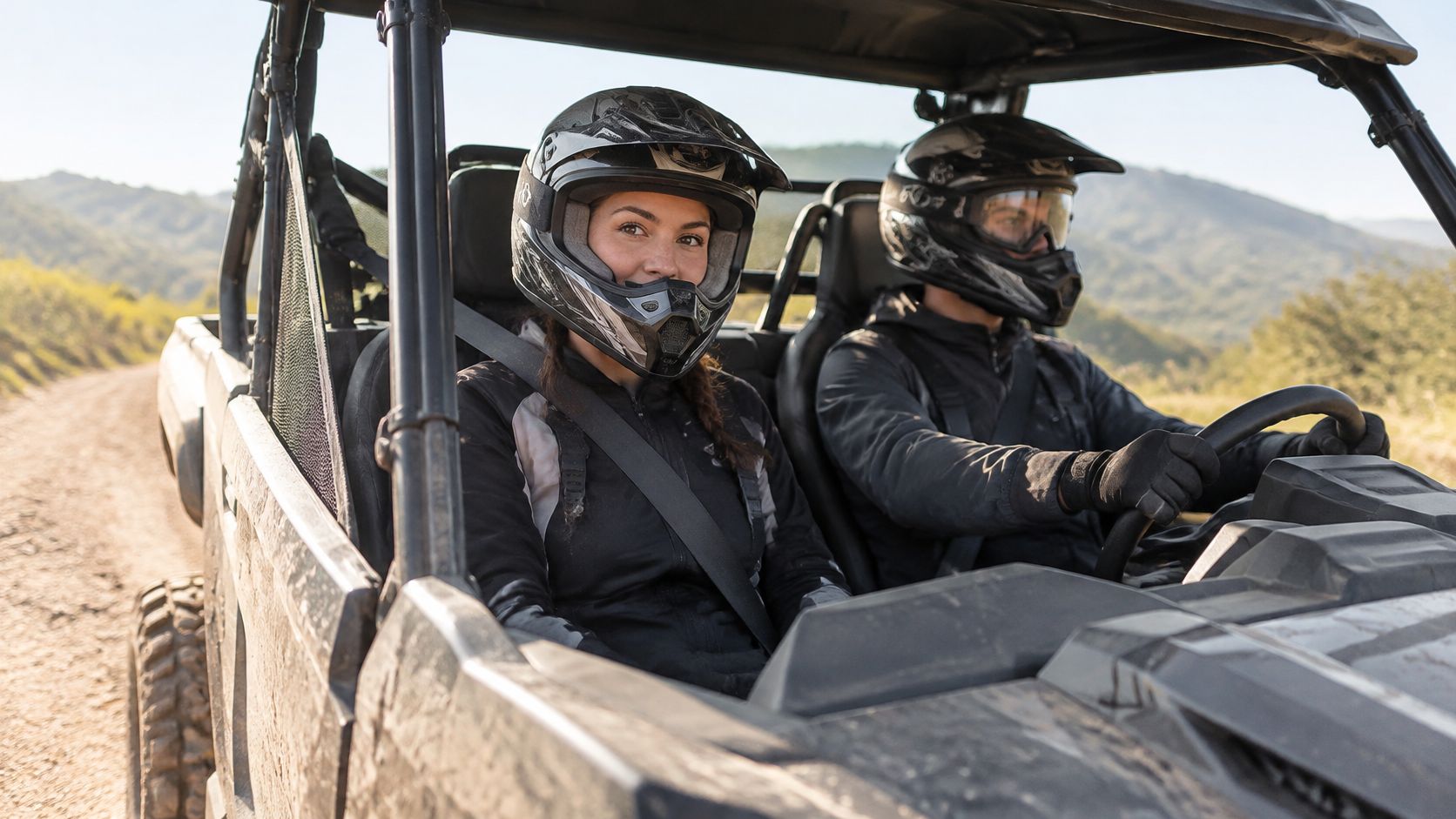
Researchers identified 458 injured people in 357 UTV crashes in Iowa between 2002 and 2019, and both crash and injury counts rose over that period, according to a large Iowa study. Among victims, 69% were male and about one-third were passengers. Only 32% of victims were wearing seatbelts, and 10% were wearing helmets.
Roughly two-thirds of victims were ejected, and one-quarter were struck or pinned by the vehicle. Non-collision events made up most injuries. Rollover protection and a belt that is buckled decide more outcomes than the powertrain. Sixty-one percent of crashes with known locations happened on public roads, and 6% of injured people died. That road share matters if you cross a county lane between parcels.
Ownership rules that are not accessories
- Buckle every belt before the wheels move. A lap belt or a three-point belt only works when it is fastened.
- Use the roll cage, and add a full harness if the cab is set up for one. Ejection is the common injury path.
- Keep speed down on slopes and in turns. A short wheelbase rotates quickly when the inside tire unloads.
- Brief every passenger before the first trip. Tell them where to hold, when to stay seated, and what "stop" means.
Seatbelts, rollover protection, controlled speed, and a passenger briefing are core ownership requirements, whatever is under the hood.
A short clip on how a side-by-side is meant to be ridden is worth watching with a new passenger before the first loop.
If the machine lives on a working farm, pair those habits with coverage that matches how you use it. A practical starting point is protecting farm utility vehicles from Farm & Country Insurance, so the policy tracks passenger use and road crossings rather than treating the UTV like unused equipment.
How Real-World Range Compares to the Spec Sheet
Advertised range is measured under test conditions that rarely match a farm loop or a hunting route, and brands rarely publish those conditions. Two machines claiming the same 60 miles can deliver very different workdays once load, grade, and temperature enter the picture.
The useful question is whether the return leg ends with charge to spare. Hills, cargo, headwind, cold, and towing each cut usable range, and the losses stack rather than average out. Treat the rated figure as a ceiling, then plan the route against realistic shares of it.
Planning range by working condition
| Condition | Expected share of advertised range | Planning example for a 60-mile claim |
|---|---|---|
| Flat ground, light load, mild temperature | Near the full rating | About 60 miles |
| Hills, cargo, and headwind | About 60 to 80% | About 36 to 48 miles |
| Cold weather below freezing | About 60 to 80% (20 to 40% loss) | About 36 to 48 miles |
| Near-maximum towing | About half | About 30 miles |
| Cold, hills, and towing combined | Often well under half | Test on your own route and set a generous reserve |
On a hilly loop with cargo, a 60-mile claim becomes roughly 36 to 48 miles of usable range. Less machine weight helps on flat ground, though mud, frequent payloads, and towing still dominate the watt-hours. A 72V/150Ah pack can look ample on paper and still miss a workday when every stop adds weight to the next leg.
Cold hits the same pack twice. You spend more energy heating the cab and rolling stiff tires, and the cells give up less of their rated capacity. Crews that already manage lithium packs in winter can borrow the habits in cold-weather battery care for field teams and apply them to a parked UTV the same way they would to a handheld radio.
A test you can repeat before you buy
- Load the machine the way you work. Both seats filled, typical bed weight, and the trailer if you tow.
- Run your real route. A dealer loop on pavement tells you little about a pasture grade.
- Record state of charge at each stop, including the turnaround.
- Set a reserve from that test, then buy only if the return leg still has it.
Driving style stretches or shrinks the same battery more than most option lists do. For the operating habits that get more miles out of a charge, start with how to improve efficiency, then retest your route and adjust the reserve.
Charging a Two-Seat Electric UTV Away From the Barn
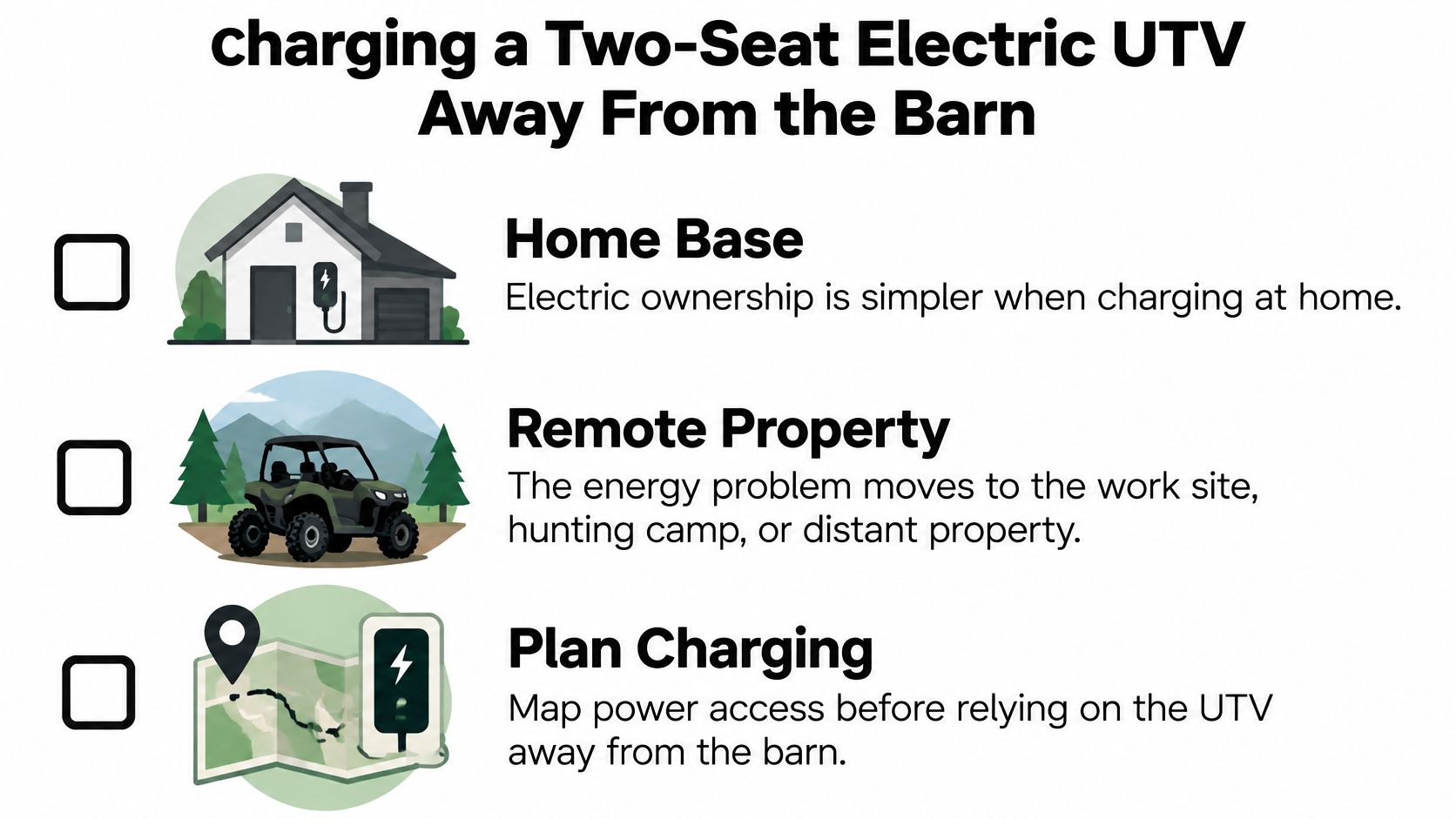
An electric UTV is simple at a home base with a dedicated outlet. On a remote property, a hunting camp, or a distant work zone, the energy problem moves. It doesn't disappear.
The U.S. Environmental Protection Agency's off-road vehicle assessment notes that this equipment is commonly operated in remote environments where charging infrastructure does not exist. Energy has to be delivered or generated where the machine works. Plugging into a household outlet is only the easy case.
A remote charging checklist
- Barn outlet. Confirm the circuit amperage matches the onboard charger, and don't share it with a welder on the same breaker.
- Extension cords. Long, thin cords add resistance and heat. Use a heavy gauge, keep the run short, and don't leave a coiled cord under load.
- Generator. Size it to the charger's draw plus a margin for lights or tools you run at the same time. A generator that sags under the charger will stretch an overnight top-up into a missed morning.
- Solar plus storage. It can cover a light overnight top-up if you size the array and the stationary battery against a daily energy budget, not against a sunny brochure day.
- Fixed overnight charge. This is the reliable pattern. The machine sleeps where the power is, and the work starts with a full pack.
If the home circuit is the plan, treat the install like any other high-draw charger. Lighthouse Energy Services' home EV guide from Lighthouse Energy Services walks through what a proper home install involves, which is the right standard even when the vehicle is a UTV rather than a car.
Occasional hunting trips need a recovery plan for a low state of charge on the way back. That can be a generator at camp or a tow to the barn. Repeated hauling needs a daily energy budget and one fixed charging point you don't negotiate every evening.
Write down the miles driven, the loads carried, and the hours of charging available each day. That log is the charging plan.
Choose Your Two-Seat Electric UTV and Book a Test Drive
Choose a two-seat electric UTV when you work alone or with one partner, the daily route fits the range from your own test, and the charging point is reliable. If the crew is usually three or four, or the route has no power at the far end, a crew model or a gas machine may serve you better.
Selection checklist
- Confirm the seating layout matches your typical crew. Buy for the people who ride most days, not for the one weekend you host extras.
- Match towing and payload to your heaviest real load, not the maximum rating on the brochure. Include tongue weight.
- Plan range from your own test route using the planning shares for hills, cold, and towing. Keep a reserve you measured, not one you hoped for.
- Map charging for every work zone. Barn, camp, and job site each need a named power source.
- Verify belts, roll protection, and the passenger briefing before anyone rides.
- Compare ground clearance and drive modes with the ruts, mud, and grades you already know.
What to do at the dealer
Visit an authorized dealer and ask for a demonstration on a slope plus a loaded run, not a parking-lot circle. Confirm financing terms before you sign. Our Campus E1 is sold through authorized dealers, seats three with a lap belt for the middle passenger, and carries 0% APR for 36 months for buyers who qualify. You can find a Campus EV dealer near you and book a test drive. Eligibility for that rate is confirmed at the dealer, not assumed from an ad.
Request an itemized quote for each model that includes the charger, hitch hardware, and the options you will use. Compare that total with a gas machine on the same basis: purchase price, how you refuel or recharge, and what the heaviest day costs in time. A quote that hides the charger makes the electric number look cheaper than the machine you will own.
Products, parts, and accessories can change with availability, so the quote in your hand is the one that counts. If the loaded demo can't finish a shortened version of your route with reserve left, don't talk yourself into the sheet. The right two-seat electric UTV is the one that returns both people and the load, on the power you planned.
Campus EV builds electric UTVs for hunting, farm, ranch, and property work, where a two-seat layout, a real route, and a charging plan matter more than a lab mileage claim. If a pair and a work loop match how you operate, compare the Campus E1 with your heaviest day in mind. Visit Campus EV to find a dealer and book a test drive before you commit.