
You rolled the side-by-side out at first light with the blind already strapped, and the only question in your head is whether you can get closer to the timber before legal light. That is where a lot of hunts go sideways, and it usually is not the camo.
A UTV hunting blind is an access job first and a concealment product second. Quiet electric drive does not rewrite a landowner's gate, a posted trail, or a refuge rule that ends the ride at the road. If the last legal stop is a long walk, the blind you bought for the hitch is the wrong tool for that morning.
I would write down three things before the straps come off: where the vehicle may legally stop, whether that blind can be towed or carried from that point, and whether the battery still has a return after a cold, loaded trip. Wind, panel noise, and how the box sits only matter after those three hold.
Table of Contents
- Verify Access Before You Load the Blind
- Blind Types and How a UTV Moves Each One
- Park Downwind and Set the Blind Facing the Wind
- Build and Secure a Blind That Stays Quiet and Stable
- Plan Range for a Cold, Loaded Hunt Day
- Match the UTV to the Blind You Can Legally Reach
Verify Access Before You Load the Blind
Permission is the first load limit. A quiet electric side-by-side still stops where the landowner, the state, or the refuge says a vehicle may sit. Low noise and no exhaust do not create a right to drive the last two-track to the timber.
Start with the private gate. A U.S. Forest Service study of private forest landowners in north-central Minnesota found that only approximately 3% of surveyed respondents currently allowed public off-highway-vehicle access, and among landowners with open-access policies, more than 65% still prohibited hunting, camping, and motorized recreation. Ask the owner or manager for the hunt and for the vehicle route in the same conversation. A quiet electric UTV is not a pass across a boundary you have not been given.
Public ground splits the same way, often by unit rather than by vehicle type. Wisconsin hunting regulations permit UTV use only in areas posted open to such vehicles. New York generally keeps motor vehicles on maintained roads unless that travel is specifically authorized or posted. One U.S. Fish and Wildlife Service refuge permit goes further: UTVs and ORVs are prohibited, hunters may park only on open roads or designated areas, and entry into gated hunt units is by foot or bicycle only. Some other federal refuges limit ATVs and UTVs to designated trails and also restrict hunting near roads and motorized routes. Read the unit sheet for the season you are hunting, not last year's map.
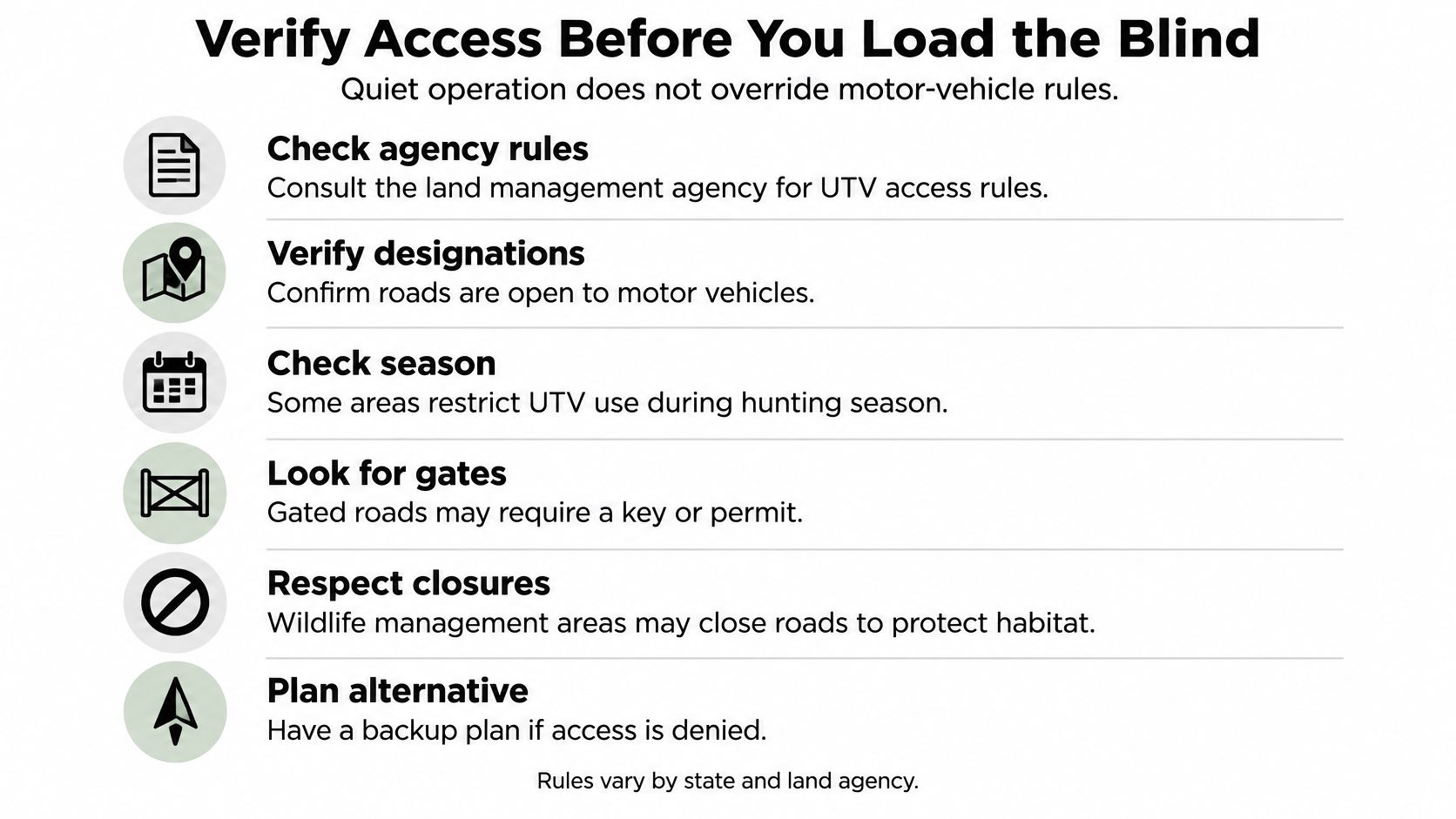
Five checks before the straps go on
- Name the land manager. Owner, state agency, or federal refuge. The person who controls the gate is the person whose rule you follow.
- Split road access from off-road access. A road open to trucks is not a two-track open to a side-by-side.
- Read seasonal closures and the permit. Some units shut motor routes for the firearm season even when the hunt itself is open.
- Decide if the UTV may stay. Some rules let you park beside the blind. Others require you to leave the machine at the road.
- Measure the walk. Pace from the legal parking point to the blind site, then pick a blind you can move that last stretch.
I would not strap a blind until the legal stop is named. A longer-range or quieter UTV adds little on public land when the final approach is foot-only.
Blind Types and How a UTV Moves Each One
An electric UTV can carry, tow, or haul most hunting blinds. Blind weight and footprint decide which of those three you use, and they also decide whether the last legal walk is realistic.
| Blind type | Size or weight | Reported price | How the UTV moves it | Best for |
|---|---|---|---|---|
| Towable fore-runner style blind | About 160 lb, up to 4 hunters | Not stated in 2024 coverage | Tow behind the 2-inch receiver | Quick moves to a cleared site with a small group |
| Modular box blind | Ships disassembled; fits a pickup bed or UTV cargo area | $2,999 starting (2024) | Carry parts in the cargo bed and assemble on site | A stand that stays in place for the season |
| Trailer-mounted blind | 96 in wide x 93 in long; 118 in with tongue | Not stated in 2025 coverage | Tow on the UTV hitch after checking trailer weight | Larger groups on open ground with turning room |
| Ground blind (fabric or pop-up) | Light enough for one hunter to shoulder | Shop the current fabric model; no fixed class price | Load in the cargo bed | Lightest option when the hunter carries the final distance |
What each row costs you in the field
A towable fore-runner style blind is the fast option on a cleared lane. Dirt Wheels reported in 2024 that the Redneck Blinds Fore Runner weighs 160 pounds, holds up to four hunters, and includes a 2-inch receiver for towing behind an ATV or UTV. Towing saves a second trip. It also needs a path wide enough for the shell and a hitch that is rated for that load plus whatever else is on the tongue.
A modular box blind is a season-long stand, not a dawn shuttle. Shooting Sports Retailer reported in 2024 that the Orion Modular Box Blind started at $2,999 and could ride in a full-size pickup or a UTV once it was taken apart. You pay in setup time at the site. Panels, hardware, and a level pad take longer than dropping a towable shell, and you do that work in the open, so scent and noise land before you ever hunt.
A trailer-mounted blind needs room more than muscle. RideApart reported in 2025 a towable hunting-blind trailer at 96 inches wide by 93 inches long, expanding to 118 inches with the tongue. That footprint will not pivot in a tight woods road. Stage it on flat ground, check the trailer's own weight against the UTV tow rating, and do not assume the hitch ball is the only limit.
A fabric or pop-up ground blind is the one that survives a foot-only finish. It loads in the cargo bed, comes off in one lift, and is the piece you can carry from the legal stop. It will not hide four people the way a box does, and wind will work the fabric if you skip the stakes.
Straps, receiver pins, and bed tie points belong with the blind, not as an afterthought. The short list of UTV hunting accessories is where those pieces live if the machine did not come with enough anchor points.
Add the blind, the people, the firearms, and the gear, then set that total against the UTV's rated tow and cargo limits before you buy. Pick the row that matches the trail you are allowed to use and the size of the party, not the row that looks biggest in a photo.
Park Downwind and Set the Blind Facing the Wind
Wind should pick both the parking spot and the route you walk. A blind can hide you from sight and still fail if your scent crosses the trail the deer are using.
Missouri Department of Conservation guidance says to set a stand so the prevailing wind carries human scent away from expected deer travel, and it notes that ridge tops often give steadier wind because fewer obstructions stir the air. Check at ground level anyway. Brush, a ditch, and the vehicle body itself can turn the flow even when the ridge feels clean. A light powder bottle or a scrap of tissue at knee height tells you more than a flag on the roof.
Park downwind of the corridor you expect animals to use, off the travel line, and use that same downwind edge to enter and to leave. While the UTV is moving, the blind cannot block the driver's view. Shut the machine down before animals are close. Electric drive cuts most drivetrain noise on the way in. Tire contact, braking, a door, and people shifting in the seats are still easy for deer to hear.
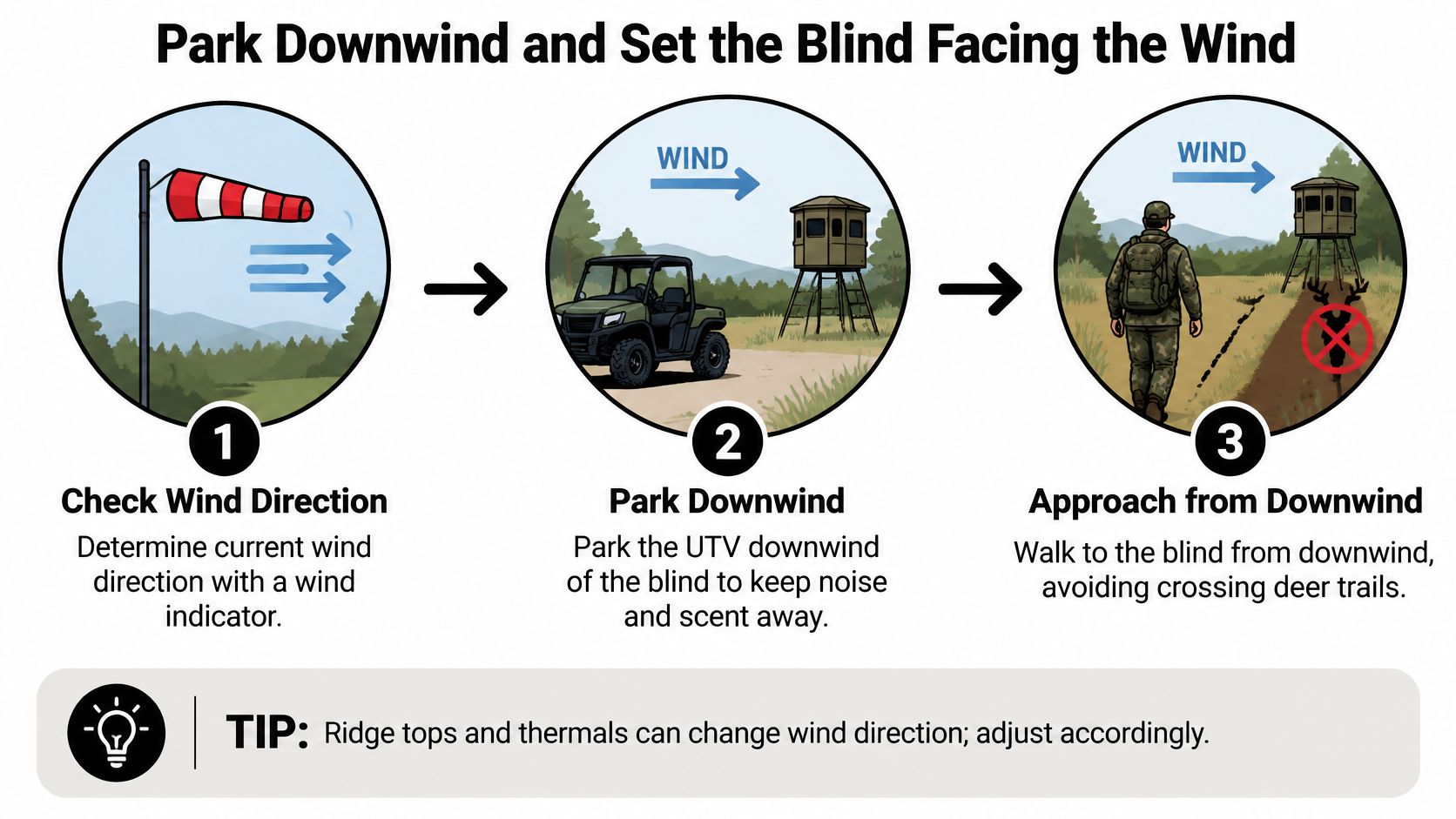
A short routine that keeps scent off the trail
- Test the wind at ground level. Powder or tissue, not a guess from the truck window.
- Mark the travel corridor the blind is meant to cover, including the trail you must not cross on the way in.
- Pick a parking point downwind of that corridor and off the animals' line.
- Set the shooting window toward the approach so you are not twisting the whole blind after you are inside.
- Shut the UTV down and walk the downwind edge. Do not idle the machine "just in case" beside the blind.
Ground blinds hide hunters well, and they also hide hunters from other hunters. Follow blaze-orange rules and the firearm-season requirements for that unit. If another party cannot see you, orange on the blind and on you is not optional decoration.
Build and Secure a Blind That Stays Quiet and Stable
A fabric panel that slaps once on a ridge can end the sit before an animal is in range. Build the blind so it stays tight, low, and inside the load the UTV is rated to carry. Quiet fabric helps. A shell that shifts on a side slope, or that pushes the machine past its payload, fails first: you never reach a legal parking point in a rig that is unstable or overloaded.
Wind is usually the loudest sound on the blind. Shape, sharp edges, wind direction, speed, and turbulent air all change how far that sound carries. Close openings so outside noise does not pour through the shell. On an electric side-by-side, round or shield outside edges, pull fabric panels tight so they cannot slap, fit quiet hinges, and keep shooting windows you can shut. Loose Velcro and a flapping skirt will give you away faster than the motor. Electric drive does not quiet a loose panel.
Why a tall shell is a handling problem
A raised enclosure lifts the vehicle's center of gravity and cuts rollover margin on a side slope. Keep added mass low and centered. Do not park a loaded UTV broadside on a hill while you set the blind. If the shell rides on the machine for the drive in, it should sit inside the bed footprint, not stacked above the roof line.
The blind, every occupant, the firearms, and the gear have to stay inside the manufacturer's payload rating and any roof-load limit. Cargo that can slide will slide on the first hard brake or the first rut. If the loaded machine cannot safely make the route you are allowed to drive, a larger blind is the wrong tool.
Load check before you leave the yard
- Add the weights. Blind, people, guns, and gear, then compare the sum with the payload rating on that UTV.
- Check the roof if anything rides up top. Roof limits are usually far lower than bed limits.
- Tie the load so a stop or a side hill cannot shift it into the cab or off the bed.
- Use tie-downs and straps for the highway. Secure the UTV with tie-downs and straps on a suitable trailer, and hold a removable blind to that same standard for the road leg.
A low, strapped blind is quieter. Rattling panels and a loose door are the sounds that carry after the motor is already off.
Plan Range for a Cold, Loaded Hunt Day
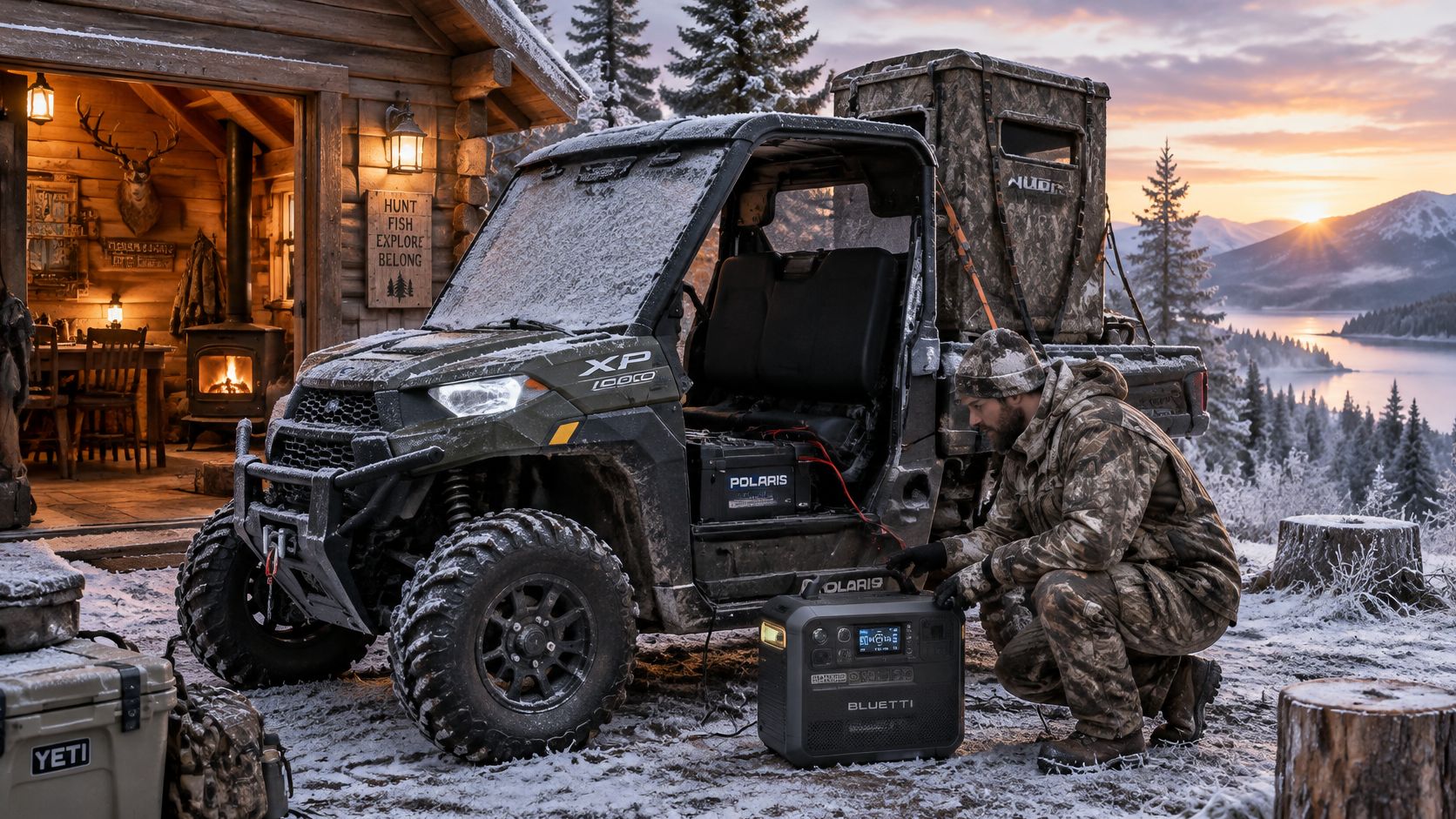
You roll out before first light with the blind in the bed, two people, guns, and a heater you will want the moment the wind hits. The gate you are allowed to use sits farther out than the stand you wish you could drive to. That legal stop, plus the drive home, is the distance that counts. A brochure mile figure comes from a flat loop. A cold, loaded hunt morning is not that loop.
Low-speed crawling, repeated starts in soft ground, hill climbs, a heater, a winch pull, passengers, gear, and a long sit at a remote blind all spend charge a sales figure never includes. Quiet running does not put those miles back. I budget the day as four subtractions from a full charge, and I do not let concealment talk me out of the return leg.
| Budget part | What to count | Planning rule |
|---|---|---|
| Outbound travel | Distance to the legal parking point with blind, people, and gear, including crawling and soft ground | Do not use the headline mile figure |
| Return travel | The same route back, including hills | Do not spend the whole charge on the way in |
| Terrain and temperature reserve | Outdoor cold that can cut usable range sharply, plus heater, winch, passengers, and waiting | Store the vehicle sheltered when possible and enlarge the reserve |
| Contingency | A detour, extraction, or walk-out | Arrive with charge left rather than a nearly empty battery |
Charge fully right before you leave. Keep the vehicle and the battery under shelter when you can, instead of on an open pad in a hard freeze. Outdoor storage in extreme cold is where usable range shrinks fastest. Enclosed or heated storage holds more of what you charged. Drop accessory loads you do not need on the drive, especially heat you can wait to use once you are set at the blind. Shutting down on a nearly empty pack turns a quiet approach into a walk out, or a winch job you may not have the charge to finish.
The habits that protect those miles are the same ones that maximize electric UTV performance on the route you are allowed to drive, not on a flat test loop.
A silent machine that cannot get back from the blind is not a working setup. Battery reserve and a recovery plan matter more than concealment. Watch one cold-morning load and the return before you trust any single mile number.
Match the UTV to the Blind You Can Legally Reach
Buy only after the access stop, the load math, and the cold-day budget are on one sheet. The machine should fit the route you have permission to drive, not the route you wish the regulations allowed.
- Mark the legal stop and the walk. If the UTV has to stay at the road, the blind has to survive that carry. If it may stay near the stand, towing becomes reasonable.
- Match the blind to that walk. A towable four-person shell needs a 2-inch receiver and a cleared lane. A modular box rides in parts and costs you setup time for a stand that stays all season. A trailer blind needs a flat place to turn. A fabric ground blind is the cargo-bed load when someone has to pack the last stretch.
- Use the printed ratings, not a headline capacity. Blind, people, and gear have to sit inside tow, payload, and roof-load numbers for that exact UTV.
- Run the cold budget again with shelter, heater, winch, and a return that is not an afterthought. Arrive with charge left.
- Take the sheet to an authorized Campus EV dealer and confirm how the Campus E1 hitch, bed, and cold-day behavior fit the route you are allowed to drive.
The Campus E1 has front and rear 2-inch hitch receivers, can tow up to 2,500 lbs, and can haul 550 lbs in its electric-powered dump bed. Winch capacity is 3,000 lbs, which is the recovery tool when a loaded morning meets soft ground, not a reason to ignore a closed gate. Hitch, ball, and trailer wiring come on the machine, so the tow decision is about the blind and the permission, not about buying a receiver later.
Side-by-sides built for this work are covered with the hunting utility vehicles we list. I would not sign for one until the parking point, the walk, and the return charge are written down. A quiet drivetrain does not fix a foot-only finish or an empty pack at the far end of the pasture.
Campus EV builds electric side-by-sides for the haul to a legal parking point, the tow or bed load a blind needs, and the cold-morning return that has to be planned before you leave. If you are matching a UTV hunting blind to a route you already have permission to drive, look at the Campus E1 with an authorized dealer and put your access sheet next to the hitch and bed ratings. Visit Campus EV to see the electric UTV and find a dealer.