
You're staring at a used electric UTV listing that looks clean, shows low hours, and promises quiet work on the farm or a better ride to the stand. That's the trap. A shiny side-by-side can hide a tired battery, and on an electric machine, the battery is the business end of the deal.
A used electric UTV is not bought the same way as a gas rig. Battery condition is the make-or-break variable, because age alone doesn't tell you how much range or usable capacity is left, and the U.S. Environmental Protection Agency has noted that lithium-ion systems were expected to last about 10 years in many cases, with real life depending on temperature, current, and discharge depth (EPA technical assessment). If you learn only one thing here, learn this, then price the machine like the pack might need work sooner than the seller wants to admit.
I'd treat every used electric UTV for sale as a battery purchase with a vehicle wrapped around it. That's the right mental model whether you're hunting, feeding livestock, patrolling acreage, or hauling tools around a jobsite. If you want the newer clean-slate route for comparison, the Campus EV off-road electric utility vehicle page gives you a sense of what a known-spec machine looks like before depreciation and mystery creep in.
Table of Contents
- Why Buying a Used Electric UTV Is a Different Decision
- Where Used Electric UTVs Actually Show Up in 2026
- Realistic Price Ranges and How to Judge a Fair Deal
- The Pre-Purchase Inspection Checklist That Actually Matters
- Test Drive and Diagnostics That Show the Machine's True Condition
- Used Electric vs New Electric vs Used Gas
- Legal, Registration, Insurance, and Total Cost of Ownership
Why Buying a Used Electric UTV Is a Different Decision
A used gas UTV often gives away neglect through a noisy engine, slipping belt, or fuel problem. An electric unit can look excellent, start silently, and still struggle when carrying feed, climbing a grade, or pulling a trailer. That difference changes how you inspect and price it.
The common mistake is trusting odometer miles, paint, and seat condition. Those clues describe use, not battery treatment. A pack exposed to summer heat, stored discharged, or subjected to repeated deep cycles can lose working range despite low mileage. A higher-mile machine with careful charging and storage may be the safer purchase.
Buy the battery story first
Ask for the battery's age, charging history, state-of-health report, and storage conditions. If the seller cannot provide them, price the UTV as though a replacement pack may be required. That does not prove the battery is bad. It does mean the seller has not earned full value for an unverified claim.
Use a simple worksheet before negotiating:
- Start with the asking price.
- Add the likely cost of battery replacement or pack repair.
- Add inspection, transport, and charger costs.
- Compare that total with a known-spec new off-road electric utility vehicle.
- Reduce your offer when battery evidence is missing.
Test the machine under the work you expect. Range on flat ground with no load tells you little about a hunting trip, livestock rounds, or a loaded bed. A pack that sags under demand can turn a cheap UTV into an expensive recovery problem.
Practical rule: if the seller discusses hours but avoids battery diagnostics, assume you are buying blind.
The smart purchase has three parts: documented battery condition, a price that survives a replacement-battery scenario, and a direct comparison with newer alternatives. That approach protects your budget better than a clean exterior ever will.
Where Used Electric UTVs Actually Show Up in 2026
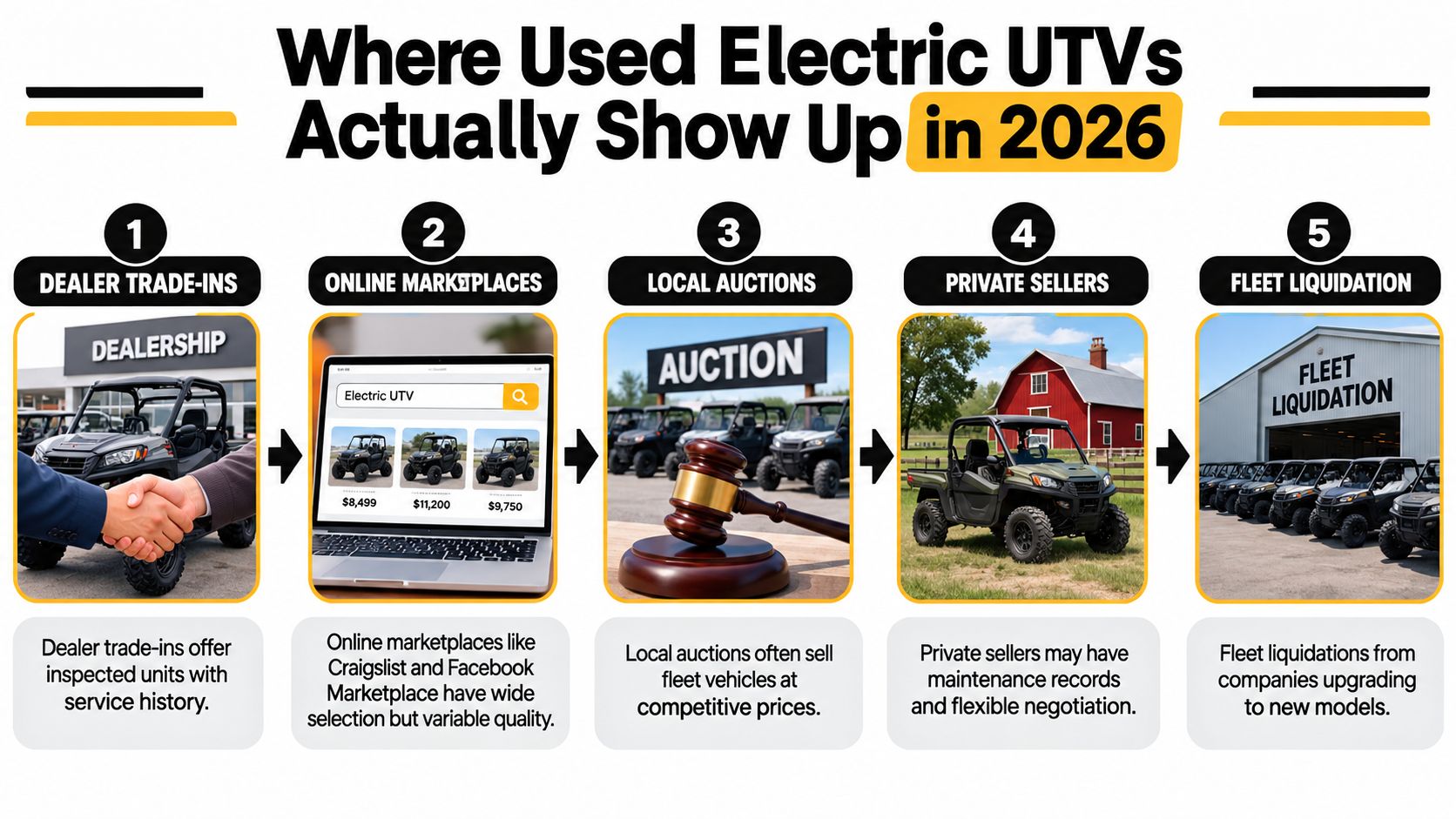
The cleanest listings usually come from dealer trade-ins and fleet liquidations. Dealers are more likely to have at least some service history, and fleet sellers often know exactly what the vehicle did all day. That doesn't guarantee battery health, but it does give you a trail to follow instead of a mystery.
Online marketplaces can still surface good units, especially when a private owner has records, charger info, and recent battery testing. The problem is that the best-looking listing and the best-maintained machine are not the same thing. If the seller can't explain charging habits, storage conditions, or why the pack was never tested, you should treat the ad as a starting point, not a verdict.
Channel by channel, here's how I'd read it
- Dealer trade-ins: Better for documentation, usually easier to inspect before money changes hands.
- Online marketplaces: Wider selection, but the battery story is often incomplete.
- Local auctions: Good for spotting fleet turnover, weak for pre-bid diagnostics.
- Private sellers: Sometimes honest and well-kept, sometimes just unclear.
- Fleet liquidation: Often the best place to find a machine with known duty cycles, especially if it came from a resort, ranch, or rental operation.
Specialty dealers pick up off-road inventory where the mainstream car sites don't bother to list it, and that's normal. UTVs live in a different market. If you're searching close to home, the electric UTV for sale near me page is a useful way to think about local sourcing and dealer proximity, but the main filter is still documentation.
Realistic Price Ranges and How to Judge a Fair Deal
A fair price starts with battery condition, not cosmetics. That's because a battery replacement can wipe out the savings you thought you were getting on the front end. Guidance commonly places lithium-ion UTV life around 1,000 to 2,000 cycles, with replacement estimates ranging from roughly $2,000 to $10,000 depending on pack size and design (used electric UTV guidance).
So don't ask, “What's it worth?” Ask, “What's it worth if the pack is healthy, and what's it worth if it isn't?” That simple shift keeps you from overpaying for a polished problem.
Used Electric UTV Price Bands by Configuration
| Configuration | Low Hours, under 200 | Mid Hours, 200 to 800 | High Hours or Unknown Battery Health |
|---|---|---|---|
| Basic utility trim | Higher end of fair if battery data is clean | Fair only with proof of range and charging history | Discount hard, assume replacement risk |
| Mid-spec with winch, bed, 4WD | Pay for records and a verified pack | Price should reflect visible wear and tested range | Treat as a battery project unless proven otherwise |
| Heavy-use fleet unit | Only buy with diagnostics and a load test | Buy if duty cycle was light and documented | Price it as if the pack needs work soon |
That table is intentionally blunt. A low-hour unit with no battery data is not automatically a bargain. Sometimes it's the most expensive machine on the lot because the next owner inherits the uncertainty.
For a broader market check before you visit a seller, the side-by-side prices page helps frame what dealers are asking elsewhere, but don't let sticker price distract you from the pack.
My rule: price the deal as if a replacement battery is coming, then ask whether you'd still want the machine at that number.
The Pre-Purchase Inspection Checklist That Actually Matters
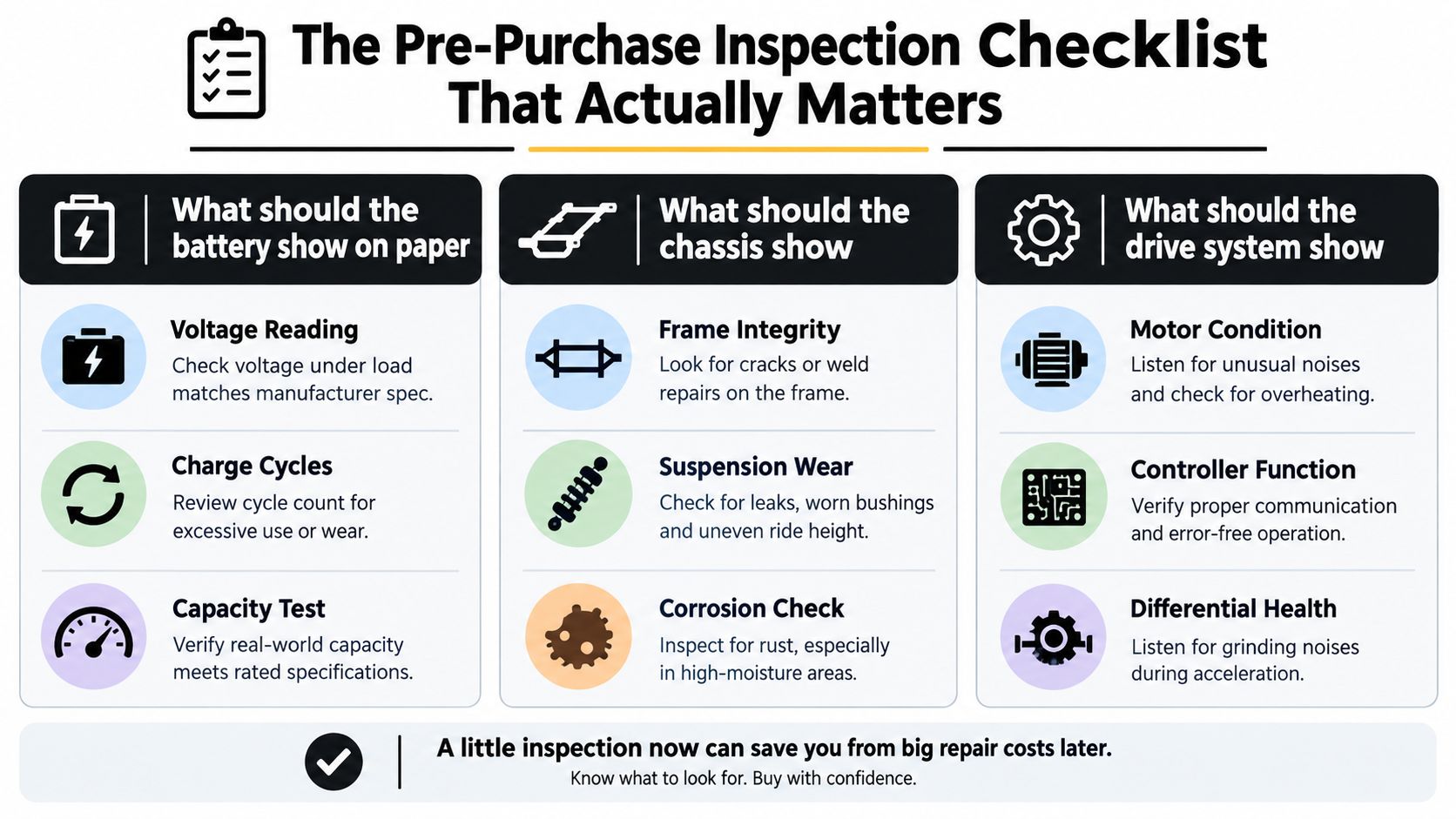
Start with what the machine is built to carry. Verify the manufacturer-rated payload, towing capacity, ground clearance, braking system, ROPS, occupant restraints, winch rating, and dump-bed mechanism. If the seller doesn't know those basics or waves them off, stop there. A UTV that's been overloaded or used like a tractor can hide damage underneath even if the body panels look tidy.
Battery checks that matter
You want the battery's manufacture date, service history, charger compatibility, and any BMS fault codes. Then inspect the enclosure, terminals, cables, and connectors for swelling, cracks, leaks, corrosion, heat damage, or loose wiring. State of health must be based on capacity and power data, because battery health is assessed using variables such as voltage, temperature, current, and internal resistance, not resting voltage alone (battery diagnostic guidance).
That matters because a resting voltage reading can look fine while the pack still collapses under load. I'd rather see a plain diagnostic screenshot than a seller's verbal promise that it “holds a charge.”
Chassis and drive line checks
Look for steering play, suspension wear, CV joint noise, differential engagement problems, and any sign of underbody impact damage. Test the regenerative braking feel, lighting, instrumentation, and the charger under supervision. For work use, inspect the cargo box, dump mechanism, and winch with the same seriousness you'd give the drivetrain.
If you need a simple outside-the-UTV reference for ownership items that get ignored until they fail, the car key replacement for EV owners article is a good reminder that even the “small” electric-vehicle parts can become annoying and costly when they're overlooked.
Pass or fail: if you see unexplained swelling, odor, leakage, overheating, or damaged charging gear, don't negotiate, walk.
Test Drive and Diagnostics That Show the Machine's True Condition
A test drive should force the UTV to prove it can handle your work. Bring cargo, find a hill if your property has one, and begin with a fully charged pack. If the seller refuses a loaded drive, walk away or price the machine as though major battery work is coming.
The UTV should accelerate predictably, stop cleanly, and remain composed on a steep grade. Listen for motor whine that changes sharply with throttle, driveline clunks, brake fade, or hesitation during regenerative braking. A clean exterior and low hour reading mean little if the machine loses power under load.
Range claims only matter under conditions close to your own. Hills, payload, mud, tire pressure, temperature, and 2WD or 4WD selection all change practical range. Record the battery's starting charge, the load, the route, and the ending charge. Use that result in your worksheet: price the UTV as if it needs a replacement pack, then subtract the value of the tested capacity and any remaining battery warranty. If the deal still works at that number, keep inspecting. If it does not, the low asking price is a trap.
A proper charging setup matters during ownership. The AdVoltage Electrical installation advice page reinforces the need to plan charging rather than rely on extension cords.
This walkthrough shows a loaded test drive on a used electric UTV, including the regen-braking checks described above.
After driving, inspect the charger, port, and cables again. Heat damage in the pack or charging hardware changes the purchase decision immediately. I would rather lose the sale than own a UTV that needs battery work during its first week.
Used Electric vs New Electric vs Used Gas
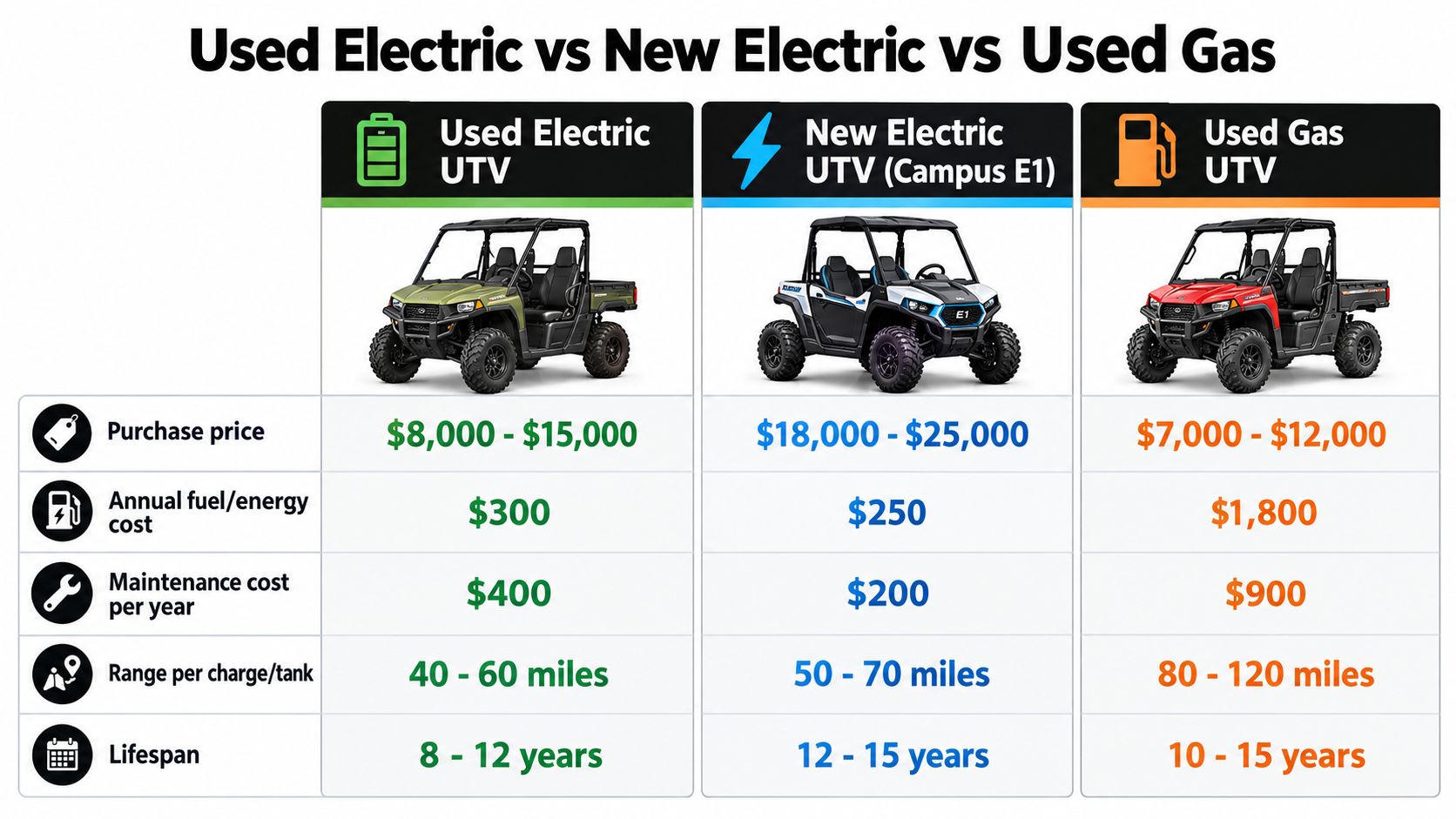
The decision comes down to real needs. A used electric UTV usually wins when you want lower entry cost, short repeatable routes, and overnight charging. A new electric unit wins when you want predictable battery life, warranty support, and a fresh start on wear items. A used gas UTV wins when your duty cycle is unpredictable and charging access is weak or nonexistent.
Published guidance estimates electricity use at about $0.09 per mile versus $0.15 for gas operation, but those numbers swing with local power rates, fuel prices, charger efficiency, terrain, payload, and temperature (electric UTV operating guidance). That's why the cheapest machine on paper is not always the cheapest machine to own.
How I'd sort the three
- Used electric: Best for buyers with known routes and a healthy battery report.
- New electric: Best for buyers who want a clean warranty path and fewer unknowns.
- Used gas: Best when work is spread out, the vehicle may run all day, and charging logistics are a headache.
If your property already has reliable power where the vehicle sleeps, electric makes more sense. If you need to drive far, load hard, and refuel fast, gas still has a place. And if you want a simple comparison against a fresh electric alternative, the numbers in the infographic show why some buyers skip the used market entirely.
Legal, Registration, Insurance, and Total Cost of Ownership
Registration and insurance are where buyers get lazy. They assume every off-road side-by-side fits the same paperwork box, then discover too late that the title status, local rules, and intended use change what they can do with it. If you plan to register for trail use, property movement, or a street-legal conversion, check the local requirements before you buy, not after.
Insurance deserves the same attention. Electric units can price differently from gas units because the insurer is looking at battery replacement exposure, repair complexity, and the cost of a major electrical fault. Private-party used purchases usually leave you with the most uncertainty, while dealer-certified used and new units give you a cleaner paper trail.
Price the machine like a working asset, not a toy
A true ownership number should include the purchase price, electricity or fuel, routine service, downtime, and a reserve for battery replacement. That reserve matters because the battery is the expensive unknown in the deal. If you can't comfortably set that money aside, the asking price is too high for the risk you're taking.
A used electric unit can absolutely be the smartest buy for hunting, ranch work, and property chores if the battery is documented and the range matches your day. If it isn't, the bargain vanishes fast. That's when a clean-slate unit starts to make sense, especially if you want a known-spec platform with a 20 kW PMSM motor, 72V 150Ah lithium battery, up to 60-mile range, on-demand 2WD/4WD, electric dump bed, 3,000 lb winch, and CarPlay/Android Auto. Those are the kinds of features that remove guesswork when the used market is full of unknowns.
The final rule is simple. Confirm the battery story on paper, verify it on the vehicle, price the deal as if the pack might need replacement, and only then decide. If you want help comparing a used unit against a new electric alternative built for hunting, farm, and ranch work, visit Campus EV and look at the current lineup before you sign anything.