
You're probably not searching for an electric UTV because you want another machine sitting beside the barn. You've got a fence line to inspect, feed to move, hunting gear to carry, materials to haul, or a worksite where a quiet utility vehicle would make the day easier. The search for an electric UTV for sale near me only becomes useful when the local listing fits the route, load, terrain, charging setup, and service support you'll use.
A nearby dealer can be more valuable than a lower advertised price several hours away, but only if the dealer has the right configuration and can support the battery, charger, drivetrain, and warranty after delivery. The practical comparison is between complete job cycles, not shiny photos or a single range number.
Table of Contents
- What Buyers Are Really Searching For
- Finding Electric UTV Listings and Dealers Nearby
- Electric UTV Specs That Matter on Real Work
- Matching Battery and Range to Your Daily Loop
- Inspecting and Test Driving a Nearby Electric UTV
- Price, Financing, Incentives, and Insurance
- First Weeks of Ownership and Charging Setup
What Buyers Are Really Searching For
Typing electric UTV for sale near me into a search engine sounds like a request for inventory. In practice, it's a request for a work vehicle that can start each morning, carry the expected load, reach the far side of the property, and return to a dependable charging point. Location matters because terrain, weather, electrical access, dealer capability, and parts availability vary from one area to the next.
That work focus is not unusual. The U.S. Centers for Disease Control and Prevention farm and ranch safety survey estimated that 1,580,000 all-terrain vehicles were in use on American farms and ranches, with 1,385,000, roughly 88%, used for work rather than recreation. Reported uses included general transportation, material movement, spraying, and livestock movement. A side-by-side bought for a ranch, farm, hunting lease, warehouse, or construction property should therefore be judged as a utility platform first.
Start with the job, not the listing
Write down the work loop before comparing brands. Include the route, the people or materials carried, the steepest ground, the surface conditions, and where the UTV will spend the night. A vehicle that fits light property checks may not suit repeated hauling, towing, or muddy access roads.
Use these questions during the first pass:
- Daily route: How far does the vehicle travel during a normal workday?
- Load: What must it carry in the bed, seats, or trailer?
- Ground: Will it cross slopes, loose soil, ruts, wet pasture, or packed gravel?
- Access: Can it reach a reliable outlet at the storage location?
- Support: Who handles diagnostics, battery concerns, warranty work, and parts?
The later buying decisions should answer those questions in order. First find legitimate local inventory, then compare useful specifications, test the vehicle on representative ground, calculate the complete purchase cost, and prepare the charging site before delivery. That process keeps a low sticker price from hiding a poor fit.
Finding Electric UTV Listings and Dealers Nearby
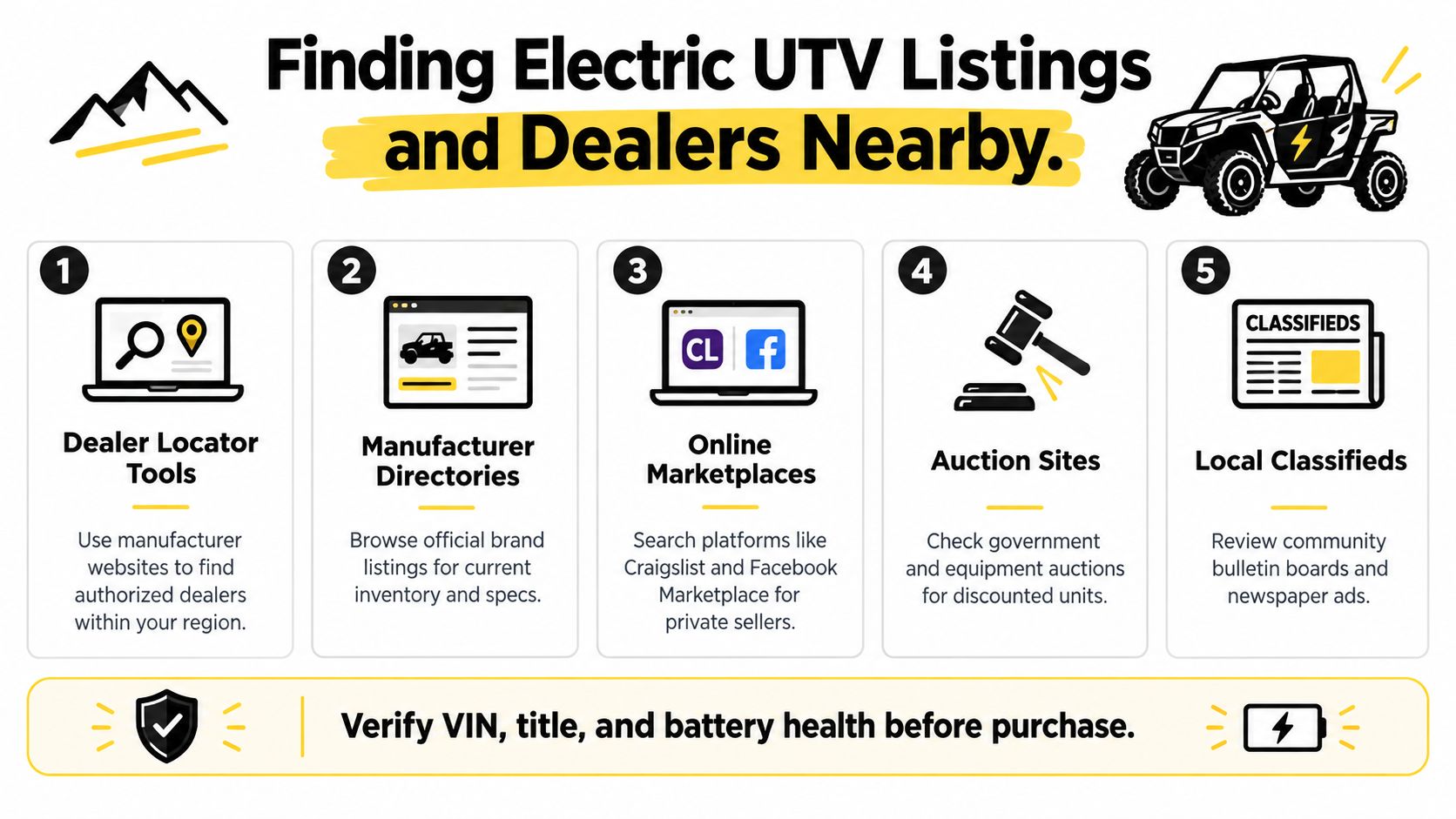
Local inventory is often less visible than the search results suggest. A dealer may show a model family without showing whether the exact battery, seating, drivetrain, bed, tires, or accessories are physically available. Start with manufacturer dealer-locator tools, then check authorized dealer pages and call before making the drive.
Use the online search as a filter, not as proof of availability. Search the nearest towns as well as your own location, and look for phrases such as “in stock,” “demo,” “available,” and “authorized dealer.” A manufacturer directory can help confirm that a seller belongs to the intended dealer network. Online marketplaces, auction sites, and local classifieds can reveal used equipment, but they require more careful verification.
Build a shortlist before you visit
Call each seller with a short script. Ask whether the unit is physically on the lot, inbound, sold, or only available by order. Request the exact model configuration, battery type, drivetrain, bed arrangement, tire package, charger, warranty terms, and estimated delivery timing in writing.
Ask about the service department rather than only the sales desk. You need to know whether technicians work on the specific electric UTV, what diagnostic equipment they use, whether replacement parts are stocked locally, and who handles battery or charger warranty claims. A dealer that sells a vehicle but sends every technical problem elsewhere may not be a practical local option.
| Source | What you'll find | What to confirm before visiting |
|---|---|---|
| Manufacturer dealer locator | Authorized dealers and regional coverage | Dealer status, location, test-drive availability, service capability |
| Manufacturer directories | Official models, specifications, and dealer listings | Exact configuration, current availability, warranty terms |
| Online marketplaces | Used units, private sellers, and local listings | VIN, title, battery condition, charger, service history |
| Auction sites | Government, business, and equipment-sale units | Buyer fees, inspection access, title status, battery and charger condition |
| Local classifieds | Community listings and older inventory | Ownership documents, maintenance records, accident history, seller identity |
For used equipment, inspect the VIN and title before discussing a deposit. Ask for a cold-start demonstration, charging proof, and a battery-health report if one is available. A clean-looking body can hide worn suspension, neglected terminals, damaged underbody components, or a charger that isn't included.
Practical rule: Don't drive to a listing until the seller confirms the exact unit, its paperwork, its charging equipment, and the person responsible for service.
Electric UTV Specs That Matter on Real Work
A specification sheet becomes useful when it answers a property question. Motor output affects how the vehicle responds under load and on grades. Battery voltage and capacity describe the energy system, but neither number alone tells you how far a loaded vehicle will travel. Drivetrain modes, payload, towing, clearance, bed design, and winch equipment often affect daily usefulness more directly than entertainment features.
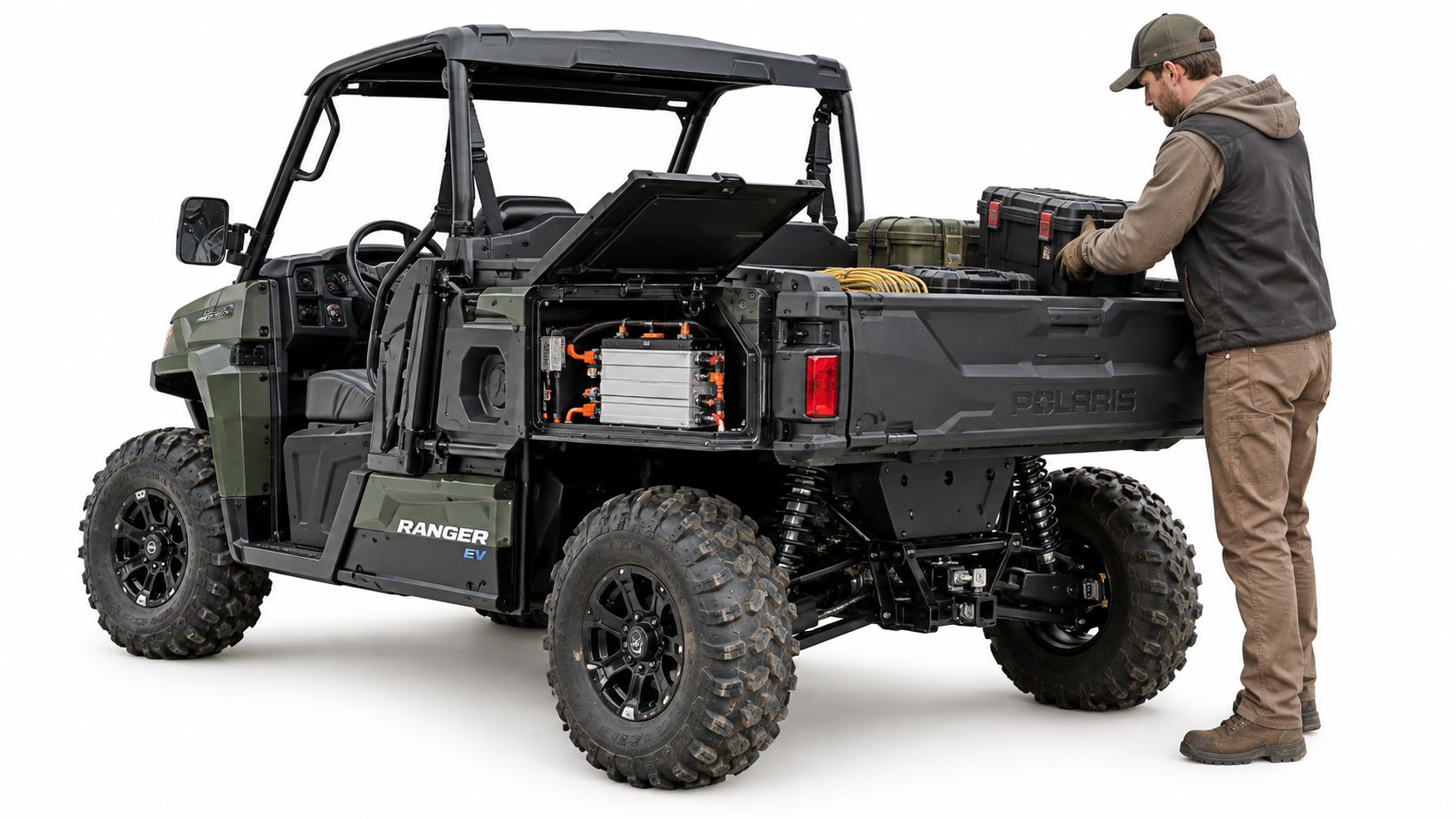
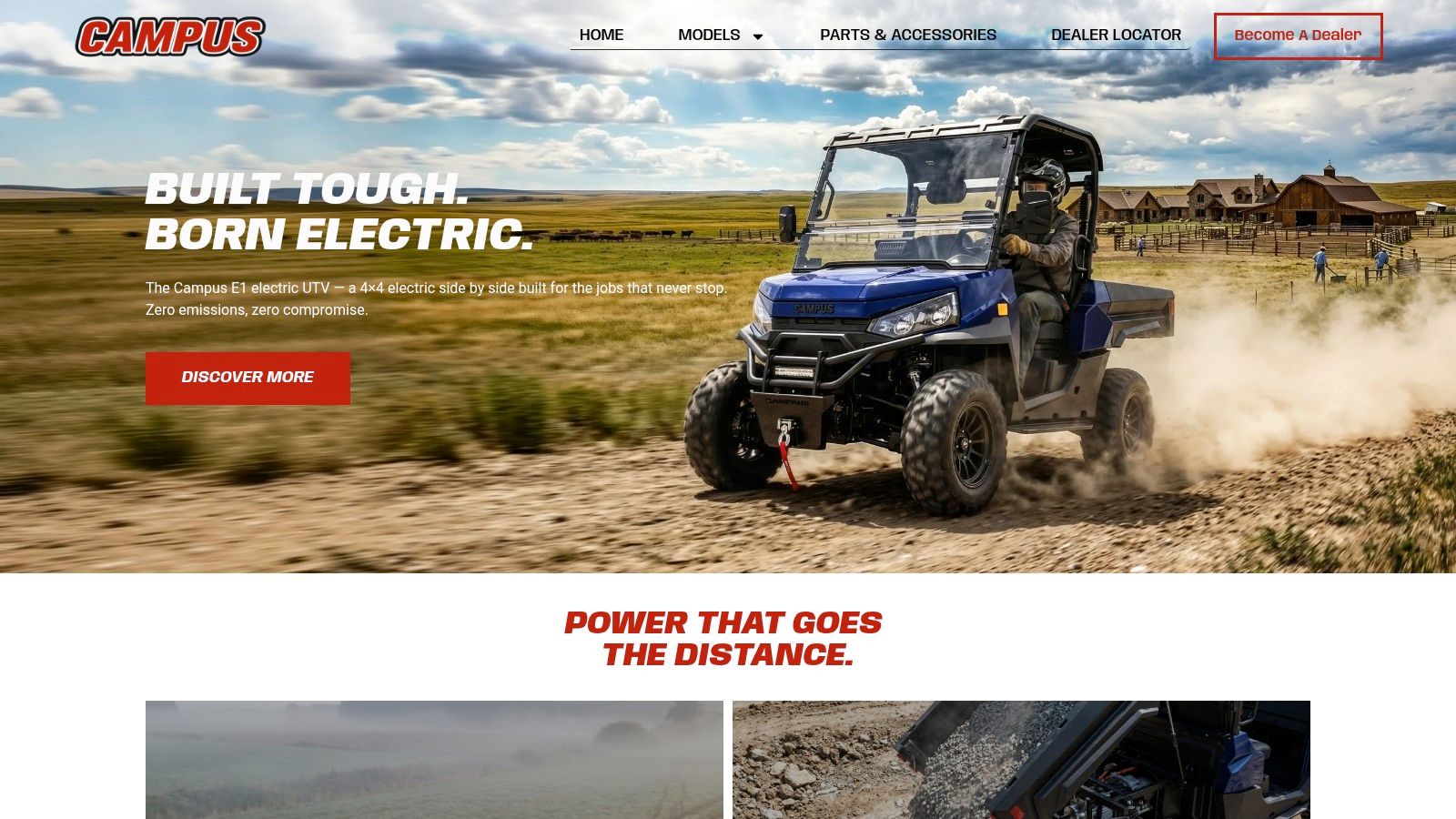
The Campus E1 provides a concrete example of how the numbers fit together. It uses a 20 kW PMSM motor, a 72V 150Ah lithium battery, on-demand 2WD and 4WD, an electric dump bed, and a 3,000 lb winch. Its published range is up to 60 miles under stated conditions. You can review the configuration on the Campus E1 electric off-road UTV with dump bed.
Translate each specification into a task
- Motor output: Ask how the vehicle behaves while climbing with people, tools, or cargo. Smooth control and usable low-speed torque matter on uneven ground.
- Battery system: Voltage describes the electrical system architecture. Amp-hours describe stored capacity at that voltage. Compare complete battery specifications and charging equipment, not one isolated figure.
- 2WD and 4WD: On-demand switching can conserve energy on firm surfaces while providing additional traction where the route demands it. Test the controls and confirm when each mode may be engaged.
- Payload and towing: Separate bed payload, passenger capacity, and towing capacity. A trailer load changes braking, acceleration, traction, and range.
- Ground clearance and tires: Clearance helps prevent underbody contact, while tire construction and tread determine grip, ride, and surface damage.
- Dump bed: An electric dump bed can save repeated manual lifting when moving feed, tools, soil, or supplies. Check its control location and operation under load.
- Winch: A rated winch is useful for recovery and pulling work, but confirm mounting, controls, cable condition, and safe operating limits.
- Cabin technology: CarPlay and Android Auto can be convenient, but they come after brakes, protection, traction, cargo capacity, and service support.
Available buying guidance says real-world electric UTV range can vary from roughly 25 miles to more than 60 miles, depending on temperature, terrain, payload, drivetrain use, and driving conditions. It also recommends extra capacity when daily travel exceeds 40 miles and advises buyers to verify the manufacturer's test conditions. Review the electric UTV buying guidance alongside the actual work route, not as a substitute for a test.
Matching Battery and Range to Your Daily Loop
A rated range figure is a starting point, not a promise about your property. A short unloaded drive on firm ground and a long day of fence inspection with tools, passengers, elevation, and cold weather place very different demands on the battery. The right comparison is usable range with a reserve, followed by a charging plan that works every night.
Create a job-cycle worksheet for each serious listing:
| Work factor | What to record |
|---|---|
| Route | Normal miles, detours, and the farthest point from the barn or shop |
| Terrain | Flat ground, slopes, mud, loose soil, ruts, and repeated starts |
| Load | Passengers, bed cargo, trailer weight, and winch work |
| Conditions | Cold weather, wet ground, heat, and wind exposure |
| Charging | Outlet location, cable distance, overnight access, and backup plan |
Compare two vehicles by asking how each would perform on the same route. A higher advertised range may be less useful if the vehicle has a weak service network, a difficult charging location, or a configuration that doesn't suit the work. A lower headline figure may be adequate if the daily loop is short, the storage site has dependable power, and the machine is rarely heavily loaded.
Choose charging speed around the work calendar
A 120V outlet may suit light daily use when the UTV returns home with plenty of time to recharge. A 240V circuit generally supports faster turnaround and makes more sense when the machine works hard, returns late, or must be ready again quickly. Confirm the charger's requirements before installation, because the vehicle, charger, outlet, breaker, and cable route must work as one system.
Cold conditions, elevation, payload, and frequent 4WD use can all reduce the margin between advertised and usable range. The guide to improving electric UTV efficiency can help you think through driving habits and energy use, but your own route remains the deciding test.
Range rule: Buy for the repeatable work loop, not the longest trip you can imagine completing under ideal conditions.
Inspecting and Test Driving a Nearby Electric UTV
A dealer-lot test drive should resemble the work you expect to do. A smooth loop across pavement tells you very little about traction, steering response, brake feel, suspension movement, or bed access on a property. Bring the person who will operate the vehicle most often, and bring a list of the tools or loads that define the job.
The safety case deserves attention. NIOSH identified 2,090 ATV injuries and 321 fatalities between 2003 and 2011, with three out of five occupational deaths occurring in agriculture, as summarized in NIOSH ATV safety material. Those historical figures reinforce the need to inspect rollover protection, seat belts, occupant capacity, brakes, lighting, tires, winch operation, slope limits, and operator training.
Use your hands, eyes, and ears
Walk around the vehicle before driving it. Look beneath the frame for impacts, inspect the battery compartment and charging port, check tire wear, operate every light, and examine the suspension and steering joints. Open and close the bed, test the dump function if fitted, and confirm that the winch operates smoothly without unusual noise or cable damage.
During the drive, use firm braking, controlled acceleration, tight turns, reverse, 2WD, and 4WD where the dealer permits. Drive over the kind of surface you'll encounter, then stop on a slope if the manufacturer's procedure allows it. Notice steering effort, pedal response, brake stability, body movement, visibility, seat-belt comfort, and whether the controls remain easy to use while wearing work clothing.
Afterward, ask the dealer to show the diagnostic process rather than only describing it. Use direct questions:
- Battery support: Who diagnoses battery faults, and where is that work performed?
- Warranty process: Who submits a claim, and what documentation does the manufacturer require?
- Service access: Which technician handles this model, and what parts are normally kept in stock?
- Ownership support: Can the dealer provide charger guidance, software updates, accessories, and scheduled inspections?
Walk away if the dealer won't identify the exact unit, avoids a proper demonstration, can't explain warranty responsibility, or pressures you to deposit money before you inspect the paperwork. A low price doesn't compensate for unclear title history, missing charging equipment, unexplained battery warnings, or no practical service path.
Price, Financing, Incentives, and Insurance
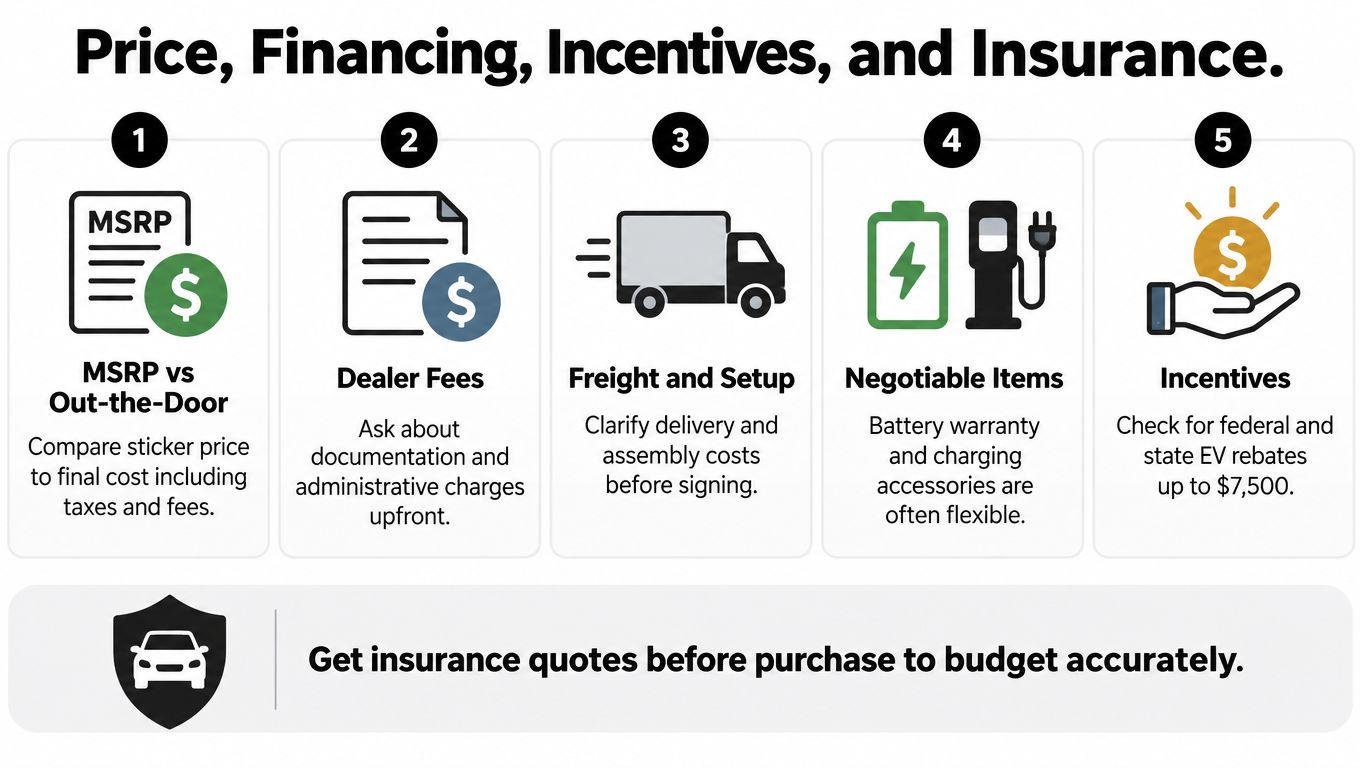
The sticker price is only one part of the buying decision. Ask for an itemized out-the-door quote showing the vehicle, freight, setup, documentation charges, accessories, taxes, registration, and any dealer-added products. Compare two quotes on the same basis, because one dealer may advertise a bare unit while another includes a charger, delivery preparation, or useful equipment.
Financing deserves the same scrutiny. Ask whether the offer applies to the exact configuration, whether it requires qualified credit, and whether the term changes the total amount paid. Agricultural, small-business, equipment, recreational, and personal lending may all be relevant depending on how the UTV will be owned and used. Get the written rate, payment schedule, fees, down-payment requirements, and early-payoff terms before treating an advertised promotion as part of the deal.
Check incentives before you sign
State, utility, local, or agricultural programs may change over time and may apply differently to off-road equipment than to street vehicles. Ask the program administrator whether the specific vehicle qualifies, whether the application must be submitted before purchase, and whether the benefit goes to the buyer, dealer, or utility account. Don't count a rebate until you've confirmed the eligibility rules in writing.
Insurance and registration also depend on how and where you operate. An off-road-only UTV may follow different requirements from a street-legal configuration, and private-property use doesn't automatically settle coverage questions. Ask your insurer about liability, theft, collision, trailer use, employee operation, and property boundaries. If you're comparing related recreational and small-vehicle policies, this resource on scooter insurance for riders in AL and can provide useful insurance context, but confirm that your actual UTV is covered.
For a broader market comparison, review side-by-side prices while keeping the same configuration and ownership costs in view. The cheapest quote may become expensive if it excludes required equipment, delivery, service, or adequate insurance.
First Weeks of Ownership and Charging Setup
Set up charging before the UTV arrives. Choose a dry, accessible location near the storage point, check where the charging port sits, and plan cable routing so equipment won't become a trip hazard or get crushed by a vehicle. A basic 120V arrangement may suit light use, while a 240V installation can support faster turnaround when the work cycle demands it.
Have a qualified electrician assess the circuit, outlet, breaker, grounding, and weather exposure. The EV requirements from Access Electrical offer useful preparation points, but the charger and UTV manufacturer instructions should govern the final installation. Don't use an improvised extension setup as a permanent solution, especially in a barn, shop, or damp outdoor location.
Establish a simple first-month routine
During the first weeks, record charging behavior, route conditions, loads, and any unusual warnings. Check tire pressure, inspect brakes, look over suspension hardware, and retorque accessible bed and winch fasteners according to the owner's manual. If the vehicle supports software or firmware updates, ask the dealer how updates are delivered and whether they affect diagnostics or warranty records.
Keep the dealer relationship active. Save the service contact, warranty procedure, charger details, and serial information in one place. Report small issues early, schedule the first inspection according to the manufacturer's guidance, and ask before adding heavy accessories that could affect payload, range, or warranty coverage.
A practical local purchase is one where the vehicle, job cycle, charging site, and service desk all fit together. Campus EV offers electric UTVs for hunting, farming, ranching, property maintenance, and off-road utility work through its dealer network. Visit Campus EV to review the available electric side-by-side configuration and locate a dealer for a test drive.